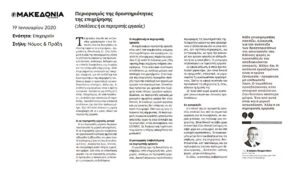
Tag: work

  • Employee suspension or Contract termination?

    Employee suspension or Contract termination?

    Employee suspension (: The other measure that is milder than terminating an employment contract)

    I. Preamble

    “Profit is the brother of loss” mentions a well-known Turkish saying.

    This saying is, unfortunately, proved right in the context of business. This is when the (healthy) attempt to make a profit turns out to be ineffective.

    What is crucial is how the businessman evaluates each case. Is the situation reversible or not? Is the cessation of business temporary or permanent? Does it affect the whole business or only part of it?

    In any case: the effort to reduce a business’s expenses turns out to be particularly significant. Wage cost reduction is the first thought.

    Layoffs? Is that the only solution?

    Are there milder measures? Rotational work or employee suspension?

    We have already referred to rotational work.

    In this article we will examine employee suspension.


    II. Suspension-in general

    1. In general

    Termination of an employment contract is a permanent (but also socially burdensome) measure. But what is basically crucial is the support of the business. Rescuing it will mean the (socially desirable) survival of jobs. Employee suspension is, as mentioned, the other milder measure (along with rotational work). Jobs are saved this way, even temporarily. The expectation of a definitive recovery of the business is kept alive. The prospect of a permanent rescue of (endangered) jobs survives.

    2. The legislative framework

    Suspension is regulated by Article 10 of Law 3198/1995, as in force (after its last amendment in 2010). This provision states:

    “Businesses and holdings, if their activity is restricted, may, instead of terminating the employment contract, suspend their employees in written, and the suspension shall not exceed a total of three (3) months per year, unless they have previously consulted the legal representatives of employees in accordance with the provisions of p.d. 240/2006 (Government Gazette 252 A) and Law 1767/1988 (Government Gazette 63 A).

    If there are no employee representatives in the company, all employees are informed and consulted. information may be provided by a one-time notice at a prominent and accessible place in the business. The consultation shall take place at the place and time specified by the employer. During suspension, the employee receives half the average of the last two months’ full-time wage of full-time employment. After the three months have expired, at least three (3) months must pass before the same employee can be suspended again. The employer must inform the relevant services of the Labor Inspection Body, IKA and OAED in any manner regarding the relevant statement of suspension, affecting part or all of their staff. “

    3. Purpose and basic principles

    3.1. Suspension has a dual purpose:

    (a) To contribute in the reorganization of the business with the restricted activity; and

    (b) To support the employees to look for a job during their suspension.

    3.2. The business that is called upon to deal with its restricted activity achieves, through suspension, a reduction in its redundant staff and employment costs.

    Most important: No layoffs.

    Suspension may extend to all of the employees (: complete suspension). But it may also extend to some of them (: partial suspension).

    In no case, however, can suspension be applied as a measure against a specific employee. Suspension is a collective measure (like that of rotational work).

    Thus, the company can suspend the employment relationship for its redundant staff.

    During suspension, the obligation to pay for salaries is limited: The employer pays (to the suspended employees) half (1/2) of the average full-time salary of the last two months.

    3.3. An employee who is suspended does not, of course, have to present themselves to the business and provide their work for the duration of the implementation of the measure.

    During this time, the employee has the opportunity to work for another employer. Alternatively: to engage in any other activity. They shall not in any event be deprived of their right to receive ½ of their salary. These salaries are not offset by what the employee receives from their (potential) employment under another employer to supplement their income.

    Additionally: the time period of suspension is considered as if the employee was actually working. This means that it is taken into account for the determination of the amount of compensation due in case of dismissal, for increasing the salary due to seniority, etc.


    III. Conditions for enforcing suspension

    1. It is clear from the wording of the law that the measure of suspension is, in some respects, identical to that of the unilaterally imposed rotational work. The same applies to what is accepted (and we have already analyzed) in the context of rotational work.

    The conditions laid down by law for the suspension of employees to be valid are, in particular, the following:

    (a) Restriction of the activity of the enterprise;

    (b) Prior information and consultation with employee representatives;

    (c) The written form,

    (d) The maximum length of suspension and

    (e) Notification to the competent departments of the Labor Inspection Body, EFKA. and OAED.

    2. In more detail:

    (a) Restricting the economic activity of the enterprise

    The first essential prerequisite is that the business’s “activity is reduced”. This requirement is also met with the unilateral imposition of rotational work. There we said: “The law does not further specify what “the reduction of business” really means. In any case, there is no need to jeopardize the viability of the business. However, any (minor) reduction of the operation of the enterprise, of the establishment or of a sector of the business and/or if the business is operating at a loss are not sufficiently meeting the relevant legal requirement. Nor is it sufficient for an employer to have financial or liquidity issues that result in their difficulty to pay employees for a certain period. It is required that the “volume of activity” should be such that “there will be a surplus of staff as a result of the reduction in available work” (Circular 35958/666/2017).”

    As suspension is imposed as an extreme measure, but also a measure milder than that of the termination of the employment contract, it is a reasonable premise that the reduction of the activity poses a real threat to jobs. In other words, it must be such a reduction that it could lead to dismissals for economic and technical reasons.

    (b) Prior information and consultation with employee representatives

    i. Prior to the employer’s decision on the suspension measure, the law requires prior information and consultation with employee representatives (in accordance with the provisions of Presidential Decree 240/2006 and Law 1767/1988). This is another (formal) requirement, which we met and analyzed in the case of a rotational system. Fortunately, even in the case of suspension, they do not need to end well.

    ii. The above (under i) obligation applies to all undertakings to which the employer intends to impose the measure. And this, regardless of the number of employees. (Irrespective of whether they employ fewer employees than those provided for their implementation, as set forth in Articles 3 of Presidential Decree 240/2006 and 1 of 1767/1988).

    iii. In addition, according to the abovementioned provision, “information may be provided by a one-time notice at a prominent and accessible place in the business. The consultation shall take place at the place and time specified by the employer.”

    iv. In any case: The information should contain the reasons why the employer needs to enforce the suspension measure. Indicatively: evidence of a significant restriction on the activity, its likely duration, and the proposed extent of suspension (eg, application to certain parts of the business or to the whole business).

    It is noted that in businesses with a small number of employees, this information may also be provided by an oral communication to employees.

    v. The invitation of the employer to consult the employees’ representatives, or in the absence of them, all employees, should, in addition, include the place and time of the consultation. The interval between the communication and the consultation should be sufficient for the employees to prepare. The (sufficient) time is a real issue and is judged on a case by case basis. This is because it depends on several factors. Indicatively: number of employees, number and complexity of issues to be consulted on etc.

    vi. Consultation under Article 4 of Law 3846/2010 is fairly broad. Of course, it is the exchange of views between the employer and employee representatives (or employees). It will focus on the measures and decisions that need to be taken to tackle the difficulties of the business with the significantly reduced activity. Specifically, the creation of a system of distributing the remaining work to all the staff of the enterprise (or to a specific part of it) in order to save jobs.

    vii. What is encouraging, however, is that, as stated above, the positive outcome of the consultation is not a requirement for the implementation of the suspension measure. There is no need for the employer and employees to reach an agreement.

    However, the imposition of the measure of suspension by the employer, without prior notice and consultation, is invalid.

     (c) The written form

    i. The written form (that is, the written statement of the employer’s decision to impose the measure of suspension) is required by the law itself. It is therefore an integral part of the validity of suspension, without which suspension is not possible. Consequence of this omission? The employee is entitled to full remuneration and not half of it, which they should be getting, if they had been lawfully suspended.

    ii. The requirement for the written form is not replaced by any general disclosure that is posted on display in the workplace. According to case law, the employer must send an individual written statement to each employee they are about to suspend (SC 499/1990). It is advised to keep two copies of this statement, one of which will be delivered to the employee. In his statement, the employer is not required to state in detail the incidents which have led them to take the above measure. However, it must be concluded that the application of this measure is a consequence of the restriction of the economic activity of his business. As already mentioned (under III.2.a.), it is only under this condition that the suspension of employees is allowed.

    iii. In the individual written statement, however, the employer must specify the commencement and duration of the measure. Notification of the employee’s forthcoming suspension must take place within a reasonable time prior to its commencement. Such an obligation is not required by law. It is, however, accepted by the courts as a manifestation of good faith (464/2013 First Instance Court of Xanthi). The purpose of timely notification is to allow the employee to seek other employment while suspended, so that they can supplement their income.

    (d) The maximum duration of suspension

    i. The law explicitly specifies the maximum length of time that the suspension measure can be implemented. In particular, its duration may not exceed three months in the same calendar year. The above quarter includes both business days, Sundays and holidays, with the term “year” being the period from 1 January to 31 December.

    ii. This maximum duration of suspension may be imposed either at once or in fractions. It is therefore possible for employees to be suspended once or more times during the year. Under no circumstances, however, can multiple suspensions turn into rotational work. Suspension requires continuous and total abstinence from work. Otherwise, the dual purpose of the imposed measure (the relief of the business and the employee’s opportunity to seek work elsewhere) is circumvented.

    iii. But there is one more time limit. It is about the time it takes to (re)suspend the employee. Therefore, if the abovementioned quarter is exhausted, three months of work are required in order for and employee to be suspended.

    (e) Notification to the competent departments of the Labor Inspection Body, EFKA and OAED.

    The last condition (of legality) of the suspension is that the employer notifies the relevant decision “by any means” to the relevant authorities of the Labor Inspection Body, EFKA (former IKA) and OAED.


    IV. In conclusion

    Alternation between profit and loss is not a theoretical possibility in a business. No matter how well organized it is.

    In the event of damages, it is the rescue of the business that must be dealt with first.

    It is up to the employer to choose the appropriate measures, where appropriate.

    The utilization by the employer of milder measures (compared to the termination of employment contracts) is, of course, preferable.

    Making use of the institution of suspension can be a step to the right direction…

    stavros-koumentakis

    Stavros Koumentakis
    Senior Partner

    P.S. A brief version of this article has been published in MAKEDONIA Newspaper (January 26th, 2020).
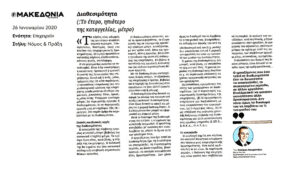

    διαθεσιμότητα εργαζομένου

  • Rotational Work or Dismissals?

    Rotational Work or Dismissals?

    Limitation of business activity (: Dismissals or Rotational Work?)

    I. Preamble

    When Demosthenes, in his work Olynthicus I, proclaimed that “it is harder to maintain wealth than to acquire it”, he probably did not realize the time value of this position of his (nor did he realize that I would be using it today).

    The value of this position is self-evident in matters relating to safeguarding personal wealth. The same goes in matters relating to ensuring the existence and health of every business.

    It is a fact that every entrepreneur (with no exception) sincerely strives for the development of their business activities.

    Sometimes their efforts are not successful. They then face a series of dilemmas: Should I shut my business down? Should I lay off some employees in order to still be able to offer jobs to the rest and keep my vision alive?

    Dismissing employees is the first (necessary -obviously not desirable) solution. It results, in any case, in the business saving the expenses it would otherwise occur.

    Terminating an employment contract is the most drastic, unilateral, way to intervene on it. When an employer decides to terminate an employment contract, the result is not only the termination but also the loss of the job. Without the employee’s approval.

    Safeguarding the interests of both the company and of the employees, is equally important. In order to avoid dismissals (and in the interests of both), the legislature has adopted, among other things, two more mild measures. These of rotational work and suspension. These measures may prove just as appropriate to protect the interests of the business (as well).

    In this article we will deal with the first of the two, rotational work.


    II. Rotational work -in general (and part-time work)

    1. In general

    Rotational work is part of the part-time employment institution. We have already referred to part-time employment in a previous article.

    2. The legislative framework

    2.1. Rotational work is regulated by the provision of article 38 par. a and b of Law 1818/1990-as applicable. This regulation states:

    “When drawing up or during the duration of an employment contract, the employer and the employee may, by a written individual agreement, agree to any form of rotational employment.

    Rotational employment is considered to be working fewer days per week or fewer weeks per month or fewer months per year, or a combination of these on a full-time daily basis.

    The protection provided by this Article shall also cover those employed in accordance with the agreements referred to in the preceding paragraph.”

    2.2. Also, par. 3 d’ states:

    “The employer may, provided their activities are reduced, instead of terminating the employment contract, impose a rotational employment system on their business, the duration of which may not exceed nine (9) months in the same calendar year, only after they have informed and consulted with the legal representatives of the employees, in accordance with the provisions of P.D. 240/2006 and Law 1767/1988. The agreements or decisions referred to in this paragraph shall be notified within eight (8) days of their drafting or receipt to the relevant Labor Inspectorate. “

    3.3. Rotational work is therefore different from part-time work. Rotational work refers to working fewer days per week or fewer weeks per month or fewer months per year or a combination of these. However, in any case, it exclusively refers to full-time employment.

    Working less than “full-time” is linked to part-time work.


    III. Rotational Work Schemes – Features and Requirements

    According to the above, two are the possible rotational work schemes.

    The former is the product of an employer-employee agreement.

    The second is that imposed by the unilateral decision of the employer.


    1. Rotational work as per a relevant agreement

    1.1. Conventional rotational work is what is agreed between the employer and the employee. This agreement can take place at two different times. When concluding an employment contract or, alternatively, during a (already existing) full-time contract. In the latter case, the agreement shall modify the original contract.

    1.2. In rotational work, employees’ working and non-working days alternate. There is, of course, a corresponding reduction in their remuneration. Despite this rotation, however, the operation of the business (or of the part of the business) continues. It goes without saying that the work is offered full-time. In no case is rotational work allowed when the work is offered part-time.

    As for the other provisions of the law:

    Switching between working and non-working days is not subject to any restrictions. This rotation can be freely agreed upon, without the need for the working and non-working periods to be the same or similar. For example, on a five-day work system it may be agreed to provide work for any number of one to four days a week, or to provide reduced weekly work only for certain weeks of the month and so on.

    1.3. In a bit more detail: There is no restriction on the duration of conventional rotational work (as opposed to the restrictions provided if the rotational work is unilaterally imposed -below under 2.4.iv). The content of the agreement is therefore left to the contractual freedom of the employer and the employee. The law does, however, lay down some clear conditions (below 1.4-1.6) for such agreements to be (legally) concluded.

    1.4. In accordance with the provision of §3 e’ Article 38 of Law 1892/1990, if the above agreement between the employer and the employee is not concluded in writing, the full employment of the employee shall be presumed!

    1.5. Also, according to the provision of Article 38 § 5 of Law 1892/1990, the written individual contract providing for the rotational work must include specific details. At least:

    (a) the identity of the parties;

    (b) the place of employment, the place of business or the address of the employer;

    (c) the time of employment, the method of allocation and the working hours;

    (d) the method of remuneration; and

    (e) any conditions for amending the contract.

    1.6. Lastly, according to the law the part-time contract must be registered within eight (8) days on the ERGANI information system (Article 38, § 3 e’ 1892/1990).

    It is important to stress that in the event of failure to register the agreement, a full-time employment relationship is presumed.


    2. The unilaterally imposed rotational work

    2.1. The employer may unilaterally impose on their business a rotational system. A prerequisite is the reduction of their activity. The daily working hours for workers must also be equivalent to full-time employment in this case as well. There is also no restriction in this case on the distribution of working days on a weekly and / or monthly basis.

    2.2. The unilaterally imposed rotational work relates to a collective arrangement. It cannot be applied, selectively, to individual employees. It should concern all the staff of the business or at least some part of it.

    It is obvious that the legislator’s objective is for the business (which now has a reduced activity) to evenly distribute the negative effects of its reduced turnover to all its staff. This is in order to avoid layoffs and save jobs.

    The collective nature of the arrangement also derives from the reference to the provision in question to a “rotational employment system”. It is also confirmed by the fact that, for the validity of its enforcement, the employer must inform and consult with the representatives of the employees (as discussed below under 2.4.c).

    2.3. The conditions laid down by law for (legally) imposing a rotational employment system are substantive and formal. Specifically:

    (a) Substantive requirements:

    • The reduction of the business activity of the employer,
    • The rotation of employees in the same or in different jobs at different times

    (b) Formal requirements:

    • Prior notification and consultation of the employee representatives,
    • The duration of the enforcement shall not exceed nine (9) months in the same calendar year; and
    • The decision of the employer to be registered within eight (8) days on the ERGANI Information System.

    2.4. In more detail:

    (a) The reduction of the employer’s activity

    The first essential prerequisite is that the business’s “activity is reduced”. The law does not further specify what “the reduction of business” really means. In any case, there is no need to jeopardize the viability of the business. However, any (minor) reduction of the operation of the enterprise, of the establishment or of a sector of the business and/or if the business is operating at a loss are not sufficiently meeting the relevant legal requirement. Nor is it sufficient for an employer to have financial or liquidity issues that result in their difficulty to pay employees for a certain period. It is required that the “volume of activity” should be such that “there will be a surplus of staff as a result of the reduction in available work” (Circular 35958/666/2017).

    Where rotational work is imposed as an extreme measure, but milder than that of the termination of employment contracts, it is a reasonable premise that activity reduction poses a real threat to jobs. In other words, it must be such a reduction of activity that it could lead to dismissals for logistic reasons (SC 771/2017).

    (b) The rotation of employees in the same or in different jobs at different times

    According to the case law of the Arios Pagos (Supreme Court of Cassation of Greece) (decisions no. 470/2018, 1279/2018, 771/2017 and 1252/2014), the rotational employment system requires that:

    • the rotation of employees in the same business, holding or part of a business or holding
    • in the same or in different jobs,
    • at different times but at regular intervals,

    at the same time while the operation of the business remains constant.

    This rotation can involve:

    • either groups of employees, one of whom will replace the other in succession in employment and in non-employment,
    • or one employee at a time, in the sense that one employee at a time will be placed on a compulsory leave, while the other employee will be employed full-time.

    Without this interchange of work, which will occupy all employees in the business or part of it that has a significantly reduced activity, the implementation of the system is, in principle, not acceptable.

    (c) Prior notification and consultation of employee representatives

    1. Prior to the unilateral decision of the employer to impose a rotational employment system, prior notification and consultation of employees’ representatives is required by law (in accordance with the provisions of Presidential Decree 240/2006 and Law 1767/1988). Fortunately, the successful outcome of such communications is not a requirement.
    2. The above (under i) obligation applies to all undertakings to which the employer intends to impose the measure. And this, regardless of the number of employees. (Irrespective of whether they employ fewer employees than those provided for their implementation, based on Articles 3 of PD 240/2006 and 1 of 1767/1988).

    iii. According to § 4 of article 38 of Law 1892/1990, as employees’ representatives:

    “Are defined in the following order of priority:

    (a) representatives of the most representative trade union organization of the undertaking or holding, which in its articles of association covers employees, irrespective of their category, position or specialty;

    (b) representatives of the existing trade unions of the business or holding;

    (c) the workers’ council

    (d) in the absence of trade unions and a workers’ council, all workers shall be informed and consulted.”

    1. In addition, according to the abovementioned provision, “information may be provided by a one-time notice at a prominent and accessible place in the business. The consultation shall take place at the place and time specified by the employer.”

    In any case: The briefing should include the reasons that make it necessary for the employer to impose a rotational system. Indicative: evidence of a significant reduction of activity, its possible duration, the proposed scope of rotation (its application, for example, to certain sectors of the business or to the business as a whole), the particular employment distribution system that the employer intends to implement (: SC 771/2017).

    It is noted that in businesses with a small number of employees, this information may also be orally communicated to the employees.

    1. The invitation of the employer to consult with the representatives of the employees, or in the absence of them, with all of the employees, should also include the place and time of the consultation. The time between the communication and the consultation should be sufficient for the employees to prepare. The (sufficient) time is a crucial requirement and whether or not that requirement is met is examined on a case by case basis. This is because it depends on several factors. Indicative: number of employees, number and complexity of issues to be discussed etc.
    2. The consultation under article 38 of Law 1892/1990 has a rather broad framework. Of course, it is the exchange of views between the employer and employee representatives (or employees). It will focus on the measures and decisions that need to be taken to tackle the company’s difficulties resulting from the reduction of its business. In particular, the creation of a system of allocating the remaining available work to all the staff of the enterprise (or of a specific sector of it) in order to save jobs.

    vii. What is encouraging, however, is that, as mentioned above, there is no legal requirement that the consultation on the implementation of rotational work has a successful outcome. There is no need for the employer and employees to reach an agreement.

    However, imposing a rotational employment system without prior notifications and consultation is illegal and is (considered to be) unilaterally adversely affecting the working conditions. In this case, the employee may regard the employer’s decision as a termination of the employment contract. The employee then has two alternatives: either (a) to leave and claim the legal compensation or (b) to continue to offer their services in accordance with the terms of the employment contract – rendering the employer at default for not accepting the services offered, which would result in the employer owing the employee all their wages.

    (d) Maximum duration of work rotation

    As already mentioned, in the case where the rotational work is agreed upon between the parties, there is no time limit. On the contrary, this is not the case when the employer imposes this system unilaterally. The duration of this unilaterally imposed measure shall not exceed nine (9) months within the same calendar year (§3 d’ Article 38, Law 1892/1990).

    (e) Registration of the employer decision in ERGANI

    The last formal requirement (for the validity) of the unilateral enforcement of a rotational employment system is to register the relevant decision within eight (8) days in the competent Labor Inspectorate. (Already, by virtue of Decision No. 40331 / 19.09.2019 of the Ministry of Labor and Social Affairs, it is mandatory to submit to the ERGANI information system the Labor Inspectorate Body’s appropriate forms, such as Form E9 on rotational work.)

    Therefore, the unilateral decision of the employer should be registered with ERGANI within eight days of its adoption.


    IV. In conclusion

    Imposing a rotational employment system is an important tool in the hands of the employer, in their effort to ensure, in times of distress, the survival of their business.

    It can happen by consensus.

    It can (fortunately) take place unilaterally.

    In this case, the employer needs to pay attention to some crucial legal requirements (evaluation of individual parameters, processing of specific data, planning of strategy, rotational employment system design & implementation, realization …)

    However, the employer is required to focus, above all, on the fulfillment (and proof of fulfillment) of the necessary legal requirements.

    And all of this is an important, if not necessary, step towards rescuing (troubled) businesses.

    Of course, and as a result, in rescuing (the always valuable) jobs as well…

    stavros-koumentakis

    Stavros Koumentakis
    Senior Partner

    P.S. A brief version of this article has been published in MAKEDONIA Newspaper (January 19th, 2020).

  • Wages due? (:The risks of the business)

    Wages due? (:The risks of the business)

    I. Preamble

    The “I am not paying” movement first appeared in 2008. Originally as a refusal to pay tolls. Following: refusal to pay for public transport, property tax and solidarity levy …

    Some claimed to be smarter than the rest of us, refusing to pay what was legally due. While the rest of us kept on paying …

    This Movement blew over when some of those who drove its actions came to power. Even more so: when it turned out that the law applies not only to those who respect it, but to the “smart” ones as well.

    What would the consequences be if a business decided to adopt the “I am not paying” logic with regard to the salaries of its employees? What are the consequences when a company chooses not to pay the salaries owed to one or more of its employees? Or when it truly is unable to pay them?


    II. The employer’s obligations under the employment contract – especially the obligation to pay wages.

    1. When an employer concludes an employment contract with an employee, they (the employer) undertake several obligations. Among them: protecting the life, health and personality of the employee.

    2. One obligation, however, stands out as the principal among the others. That of the payment of the established under the law or, where appropriate, the agreed upon salary (article 648 of the Civil Code). It is the employer’s consideration for the employee’s work.

    The employer’s obligation to pay the salary (whether it is the salary established under the law or the agreed upon salary) is complex. It includes the payment of the basic salary, as well as the payment of other, additional, wage benefits – e.g. of allowances.

    Salaries are not considerations freely agreed-upon. A salary is the means an employee supports their and their family’s livelihood. It is precisely this function that imposes certain thresholds. Those thresholds are set by law or a collective agreement.

    3. Specific legislative provisions aim at protecting wages and ensuring that they are paid. These include those relating to the claim by the employee of their (unpaid) salary – detailed below under III.

    However, the provision of article 48 of Law 4488/2017 added another weapon to the arsenal that the employee has at the expense of their employer. Possibly disproportionately powerful. In particular, the provision of Article 636A has been added to the Code of Civil Procedure. It specifically provides the employee with the option of issuing a payment order for wages due.


    III. The options of the employee in case their salary is not payed

    If the employer fails to pay the salary due, the employee shall be entitled:

    (a) To file a lawsuit. Requested: The wages due and even the relevant interest due, adding up from the date the salaries were due. Also: compensation for any damage suffered by the employee due to non-payment.

    (b) To apply for interim measures. Requested: Provisional award of the salaries demanded (728 Code of Civil Procedure) and / or any other appropriate measures.

    (c) To exercise the right stop providing their work. That is, to stop providing their work until the employer pays them the wages owed. By exercising this right, the employee renders the employer “defaulting” in accepting their work. This means, in practice, that as long as the employee refuses to provide his / her work (in the context of the above right), the employer continues to owe him / her his / her wages. As if the employee was working.

    (d) Apply for a payment order in respect of wages due. This procedure is initiated, as mentioned above (under II.3) under the (new) provision of section 636A of the Code of Civil Procedure.


    IV. Specifically: The issuance of a payment order for wages due to employees

    1. In general

    Of the above (under III) options given to employees, the most problematic and dangerous for the employer is the latter. In particular, the issuance of a payment order against them for wages owed. This is because through this process, the employee enjoys a number of important advantages. These advantages are related to the ease with which a payment order can be issued, as well as to the legal effects it brings. And these specific advantages are, at the same time, significant disadvantages for the employer …

    2. The provision of Article 636A of the Code of Civil Procedure

    According to Paragraph 1 of Article 636A of the Code of Civil Procedure: ‘… an order for payment of a remuneration may be requested, provided that the conclusion of the subordinate employment contract and the amount of the salary are proved by a public or private document or by an interim decision, which has been issued upon acknowledgment or acceptance of the application by the debtor, and if written notice has been served with a bailiff at least fifteen (15) days prior to the filing of the application. The work corresponding to the salary for which the order for payment is requested is presumed to have been provided. ”

    3. The facilitation of the Employee and the problems for the business

    The above (under 2) arrangement is beneficial for the employee and, at the same time, particularly problematic for the business. And this is because:

    (a) The employee (very easily) acquires an enforceable title against the business for their wages due, by having a payment order issued. This takes very little time and comes at a very low cost. At the same time, with this specific order (: payment order), the employee may seek enforcement (e.g. seizure) at the expense of their employer. The fact that an employee can acquire an enforceable title so fast is why the payment order has such a significant advantage compared to a lawsuit for wages due.

    (b) The employee has a lower burden of proof through this procedure. (This fact is also explicitly mentioned in the explanatory memorandum to Law 4488/2017-which introduced the provision of article 636A of the Code of Civil Procedure). The employee is required to prove in writing the conclusion of an employment contract and the amount of their salary. However, according to the explanatory memorandum to Law 4488/2017, the employee may use a wealth of evidence, such as “the printed extract from the employee’s personal account held in a governmental information system, such as the Labor Inspectorate, the Single Social Security Agency, the Independent Public Revenue Office or the offices of the Ministry of Finance, on the basis of information provided by the debtor employer or the public authority itself. ”

    If the employee uses any of these documents, he / she obtains an important (even if it is disputable) presumption. Specifically, that they actually provided the work corresponding to the salaries claimed.

    There is no doubt that in this way the employee’s burden of proof is facilitated in an absolute way. At the expense of the employer.

    (c) The employee shall be empowered to move rapidly and efficiently at the expense of their employer’s property. The employee (making use of the provision of Article 724 of the Code of Civil Procedure), may take advantage of another opportunity offered, one of major importance. They have the right, through the process the payment order, to register a charge or a preventive attachment on their employer’s real estate. Most importantly: they have the right to impose a conservative seizure on any of the employer’s other assets. However, what is most dangerous for the employer is the potential for the conservative seizure of their bank accounts and deposits.

    And all this, without requiring them to, at least, be served with the payment order. Such a “freeze” of the bank accounts of the business can only prove absolutely distressing and dangerous.


    V. The formal requirement of the (earlier) out-of-court declaration of the employee and the vigilance of the employer

    In order for the employee to obtain the payment order for wages due, the employee must notify the employer in writing. In particular, the employee must have served an out-of-court nuisance to his or her employer at least fifteen days prior to the filing of the request for the payment order. This formal requirement serves as a warning to the employer of the imminent issuance of the payment order, which may, within an extremely short time, bring about the extremely adverse consequences discussed above (IV).

    Once such an out-of-court declaration has been served, the employer must act immediately. In particular, the employer must either immediately overcome their inability to pay the wages due or prepare for the intended opposition (and suspension of execution?) against the payment order – and not only that. Their defense will be the proof that the salaries claimed are not due (Article 636A §3 Code of Civil Procedure). But even in this case, the consequences of (possibly) freezing their bank accounts will likely still be there (and still be extremely distressing). Working directly with their legal representative seems necessary …


    VI. In conclusion

    The employer’s potential inability (or refusal – even if it is justified) to pay their employees’ wages triggers indefinitely strong forces. The provision of Article 636A of the Code of Civil Procedure may prove extremely harmful to the employer.

    An employee who is or claims to be owed salaries is entitled to have a payment order issued. Then, without even giving it to their employer, the employee is entitled to make a conservative seizure of their employer’s bank accounts. It essentially blocks its operation completely. Either if the employer actually owes them money or the employee simply claims they owe it. Even if the employee is acting in bad faith.

    The ability of the employee to have a payment order issued is an (extremely dangerous and disproportionately powerful) weapon in their hands.

    The employer must be vigilant. Especially when they receive an out-of-court declaration from their employee for wages due. Even when they aren’t really due.

    Rationales of the “I am not paying” nature, even if “I do not have to pay” can prove to be problematic in this case as well. And dangerous. Even for the operation and the very existence of the employer’s business.

    stavros-koumentakis

    Stavros Koumentakis
    Senior Partner

    P.S. A brief version of this article has been published in MAKEDONIA Newspaper (January 5th, 2020).

    wages due in Makedonia newspaper

  • Accident at work (the, already unlimited, employer liability…)

    Accident at work (the, already unlimited, employer liability…)

    I. Preamble

    Most ancient Greek philosophers were concerned with destiny (and the inability of men to define it). This is why there are so many quotes referencing destiny. The most known of them, “destiny is impossible to escape” («το πεπρωμένον φυγείν αδύνατον») is attributed to Pindar. The relevant Socratic phrase is more or less the same: “no one can avoid destiny” («Την ειμαρμένην ουδ’ αν εκφύγοι»).

    Regardless of one’s position on destiny and fate, the law does not consider destiny at all.

    Even when we talk about accidents. Especially accidents at work.

    And then responsibilities are sought.

    And persons to be held responsible.


    II. Protection of workers

    Protecting the health and physical integrity of workers when they are working must be (and largely is) the responsibility of the State and the legislator. To a significant extent of the business as well. The humanitarian dimension is critical (as well as self-evident). But the financial aspect of accidents at work is also important: accidents at work and occupational diseases come at a cost. And not a negligible one: a cost burdening the victims, businesses, insurance companies, insurance organizations. Of course the community as well.


    III. Accident at work

    1. Legal definitions

    Article 1 of Law 551/1915 provides: “Accidental incident, deriving from a violent event, involving a worker or employee doing one of the works referred to in Article 2, while they are performing or on account of the work, the owner of the business shall provide a compensation to the persons entitled, in accordance with the provisions hereof, in the event that the absence from work caused by the accident is more than four days, except in the case where the worker or employee had intentionally caused the accident.

    Correspondingly, the provision of Article 8 law 1846/1951 (: “IKA (Social Security of employees) Institutional Law”) defines an accident as: “The violent incident or occupational disease occurring at work or because of work”.

    1. Therefore: The concept of an accident at work

    The concept of an accident at work covers any violent event that causes damage to the health of an employee. Requirement: it must have occurred while the employee was performing their job or because of their job. The concept of an accident at work also includes occupational diseases which are (directly or indirectly) related to the work of the victim. More precisely: if it is in a causal (direct or indirect) link with their work. Sometimes case law seems to, unfortunately, end up adopting extreme positions on what constitutes an occupational disease.

    1. Employer liability in the event of an accident at work

    The employer is obliged to compensate the victim (Article 2 of Law 551/1915). This is because (in accordance with Article 662 of the Civil Code): “the employer is responsible for the work and the place it is performed, as well as the residence, facilities and machinery or tools in order to protect the life and health of the employee.”

    Consequently, taking appropriate measures to prevent an accident at work is one of the basic obligations of the employer. It is noteworthy that in the event of an accident at work, the employer is burdened with the strict liability to provide the victims with compensation. In addition: to compensate their relatives (in case of death). It is also noteworthy that the liability of the employer is independent of the fault of the employer or of their agents.

    IKA (today EFKA) contributes (d. 1846/1951) to the compensation of the worker who suffered an accident at work. The employer’s liability for compensation of the employee extends, at least at first, beyond the contribution of EFKA.

    1. The coverage and contribution of EFKA

    When an accident causes the (insured) employee to be unable to work, they are entitled to receive (or, in the event of their death, the persons entitled) the insurance benefits provided by law (Act 1846/1951). Examples: medical care, sickness benefit, disability pension during his or her incapacity. In this case the employer is relieved of their responsibilities (from the Decree of the 24th of July 1920 “on the Codification of the Laws on the Liability of Compensation for Workers or Employees Involved in an Accident at Work”: liability for compensation, hospitalization and funeral). However, the employer (according to law) is not relieved from their duty to pay compensation for moral damage or for the psychological distress of their family (in the event of their death).

    When an employee, insured under EFKA, has an accident, they are entitled to the benefits provided, and the employer is exempted from any liability [under Law 551/1915 or under common law (Article 60 § 3, a). 1846/1951].

    The consequences of an accident at work are particularly (and on many levels) significant. It always activates provisions providing the affected employee with benefits. But it also activates the employer’s and business’s possible administrative, civil and legal responsibilities.

    It is important to note that the deadline for reporting the accident is extremely short (five days). It must be emphasizes, although unnecessarily, that the description of the accident should not be a ‘typical’ procedure. It should always take place with special care.


    IV. The responsibility (and waiver of responsibility) of EFKA

    1. The existing institutional framework

    1.1. The conditions for EFKA to claim from the employer everything it has paid.

    (a) The provision of Article 34 § 2 a. 1846/1951 states:

    «2. If, by judicial decision, it is ascertained that when the accident occurring in the performance or on account of the work is due to the misconduct of the employer or the person added thereto, the employer shall be liable to pay: (a) to IKA, every expense it made, for the benefits it provided due to the accident, (b) to the victim, or, in the event of their death, to the persons referred to in Article 28, the difference between the amount of the compensation due under the Civil Code and the total amount of the compensation benefits granted according to this  law… “.

    (b) Simply put: If a court ruling deems the employer or their agents fraudulent, the employer is obliged to pay to EFKA what the latter (EFKA) has paid to the employee (or, in the event of their death, to their relatives).

    1.2. The (previous) controversies regarding the employer’s misconduct

    The above provision (under 1.1.a) is particularly important. This is because, in the event a court finds a misconduct on the part of the employer, they are the one who bear the sole burden of compensating the employee (or, where appropriate, his or her relatives) in the event of an accident at work. In such a case, EFKA would be completely exempt.

    The payment by the employer of the social security contributions of their employees aims, inter alia, at mitigating their (strict) liability from possible accidents at work. When, however, is it considered that the employer should not be assisted by EFKA?

    It is true that there has been a lot of debate in the legal world about the exact content of (required by law) employer misconduct. Could we assume that an employer intends(!) to have an accident happen to an employee?

    In one hand, the employer’s misconduct (and their full liability) only existed if the misconduct also covers the outcome of an accident at work. That is, in cases where the employer wanted or accepted as probable the harm of the employee.

    According to others, the concept of fraud in the aforementioned provision also refers to the case where the accident at work is causally linked to fraudulent breach by the employer of the laws, decrees and regulations providing for the mandatory measures for the protection of safety and health at work.

    In order to clarify the specific legal considerations, the legislator undertook the authoritative interpretation of this provision. And the result was not in favor of the employer.

    1.3. The (rather unlimited) expansion of employer liability

    (a) Article 212 of Law 4512/2018 provides:

    ‘The true meaning of Article 34 (2) of Law 1846/1951 (A’ 179) is that the employer is obliged to pay the expense provided for under:

    (i) paragraph 2 and the difference between the amount, according to the Civil Code, of the compensation and the insurance benefits provided for in point,

    (ii) of paragraph 2, where, by judicial decision, it is found that the accident, in the performance of, or on the occasion of, the work, is due to the act of the employer or the added person from them, or as a result of the accident itself or in non-compliance with the provisions of laws, decrees or regulations which define the safety and health measures at work, if the accident is causally linked to violations of these provisions.”

    (b) Simply put: It is possible (and of course extremely common) for a court to associate an accident at work with a breach of an obligation to take (mandatory as per the existing institutional framework) measures relating to the health and safety of workers. 

    In this case:

    (i) the employer is considered to have acted fraudulently and

    (ii) the employer is also liable for what EFKA was obliged to pay to the employee who suffered the accident or, in the event of their death, to their relatives.


    V. Regarding the extent of the liability and risks of the business

    The primary responsible for compensating the victim is, at least at first – according to law 1846/1951- both the business and EFKA.

    In the event accidents at work occur, the liability of the employer and the business is already extremely wide (above under III.1.3.a).

    Failure to comply (or failure to least imperfectly comply) with safety standards in an enterprise constitutes the necessary grounds for the full relieving of the EFKA of its obligations to the affected employee. What EFKA paid for it is then sought by the company. The insurance contributions paid by the employer on behalf of the employee do not appear, in this case, to ‘be worth something’ …

    Experience has also shown that it is extremely easy for any accident, in any business, to be attributed (and is easily attributed) to incomplete compliance with safety standards. This fact establishes the employer’s misconduct (!!!). And, as a consequence, the sole responsibility of the employer and the full exemption of EFKA from any liability before the affected employee.


    VI. In conclusion

    It is only natural that the modern legislator does not deal with accidents at work as they were doing so in ancient Greece. Let alone dealing with them by invoking (the inevitable) destiny.

    But the company’s liability regarding accidents at work has already become very broad. Possibly: unjustifiably broad.

    Compliance to safety standards is not sufficient on the part of the business. It is also mandatory to invoke and prove such compliance. A slightly differentiated view of the auditors appointed to the specific accident at work can lead to significant (possibly even disastrous) consequences for the business and the entrepreneur.

    What should be done? It is imperative not only to comply with the safety standards but also to be able to prove (full) compliance.

    Even more:

    Extremely careful management of (in any case, completely undesirable) accidents at work is absolutely crucial. Regardless of whether one believes (or does not believe) in “destiny” and “fate” one thing is certain: The (possibly extremely) adverse consequences of an accident at work can certainly be mitigated.

    The same goes for the consequences affecting the business.

    stavros-koumentakis

    Stavros Koumentakis
    Senior Partner

    P.S. A brief version of this article has been published in MAKEDONIA Newspaper (December 22nd, 2019).

This site is registered on wpml.org as a development site. Switch to a production site key to remove this banner.