Tag: the proper legal advisor

  • The new law on SAs: Preferred shares

    The new law on SAs: Preferred shares

    Preferred shares (as a means of attracting investment funds)

    The notion of heroism is connected to our thinking, on a first level, with battlefields and national struggles – it is well known what Winston Churchill said to this respect for the heroes and the Greeks. But true heroes are also those of everyday life-those of the next door. Not only today but always. It has been written that “in the Odyssey, heroism is not that of battlefields but the endless struggle of the survival and success of post-war peaceful purposes such as development, trade …”.

    It is, therefore, a rule for companies to have the need (and, sometimes, a lust) to obtain liquidity. Other times the basic one and sometimes the necessary for investments. As the banking system does not tend to “prosper” to such demands, entrepreneurs (smaller or bigger heroes of everyday life) seek to create the necessary conditions and incentives to attract capital. Such incentives, taking advantage of the law’s options, can be given, as already stated in our previous articles, through warrantsand/or redeemable shares.

    The “privileges” of investors and the benefits for the business

    Why, however, preferred shares are seen as an instrument or form of financing and, moreover, more attractive than others (e.g. a bond loan or common stock)?

    The investor (whether a retail investor or not) is looking for alternatives other than to date to place his savings. Most of it and its participation in the share capital of the company-as owner of preferred shares.

    The privileges that can be given to the shares in question can be moved in a very broad context. In some cases, however, more interesting for the investor (and probably also for the business) would be: (a) the provision of a fixed dividend, (b) the drawing of interest and (c) the participation, in priority, to the company’s profits from particular business activity.

    The ability to liquidate them could also be a special “privilege”: As we can redeem preferred shares, the time and manner of liquidation of the investment will be predetermined. As well as the overall-final benefit of the investor.

    And in terms of business? It is important to stress that preferred shares broaden their capital base and improve its financial ratios and creditworthiness. Voting rights may not be a problem as preferred shares may be issued without voting rights.

    In conclusion

    The institution of the issue of preferred shares is, to a considerable extent, unknown in terms of its potential exploitation at the business level. However, the options and flexibility of the law and the possibility of combining it with similar institutions (e.g. redeemable shares) can make preferred shares an important tool in trying to attract investment funds. Finally, the potential claim of investors to place their funds in a company through the acquisition of shares with privileges focused on their desires, needs and requirements, and with a predetermined time and price for their disintegration, can make their respective investment more attractive and safer.

    stavros-koumentakis

    Stavros Koumentakis
    Senior Partner

    P.S. A brief version of this article has been published in MAKEDONIA Newspaper (April 7th, 2019).

  • The new law on SAs: Redeemable shares

    The new law on SAs: Redeemable shares

    Redeemable shares as a business financing tool

    It is clear that companies lacking the necessary liquidity are looking for sources of external financing. The banking system has always chosen to attract (and lend) companies that have little or no funding needed – especially in times of recession.

    Alternatively, a solution for companies is their capital enhancement either by the shareholders or by third parties – non-shareholders. In this case, however, it is reasonable for the candidates to participate in to consider: (a) the return on their investment; (b) to ensure their ability to withdraw from the investment; and (c) to ensure that the benefit which, at least initially, they were looking forward to, can be reaped.


    The basic function of redeemable shares

    Businesses that face liquidity or solvency problems or that simply seek to finance the business plans they have drawn up may have recourse to the issue of redeemable shares. These shares may be issued by the company either as common or as privileged with (or without) voting rights. The important thing, in this case, is that these shares are required to be redeemed by the issuing company either through a statement from the latter or from the shareholder to participate. Regardless of the obligation, the redemption is likely to be the (appropriate) strategic choice of the majority shareholder.


    The treatment of redeemable shares by the new law

    The new law on Sociétés Anonymes includes a set of arrangements for redeemable shares. The most important of them is the requirement of the takeover statement: when the relevant terms of the statutes are met and, at the same time, there are amounts available for the redemption available for distribution. This latter condition proves to be very important, since otherwise (lack of available funds) the relevant statement of the shareholder’s acquisition does NOT take effect. The provision of guarantees or other collateral to the holder of redeemable shares is worthless: Collateral, as an ancillary contract, can only work when funds are available for redemption. Otherwise, it proves to be irrelevant.

    Another important provision is that the General Meeting with an increased quorum and majority may decide to convert some of the existing shares into redeemable-always respecting the principle of equal treatment (pari passu) of the shareholders.


    In conclusion

    The capitalization of redeemable shares is also an arrow in the quotient of the company so as to make it attractive to increase its share capital in the effort to implement its business goals (with the point of note, of course, that the acquisition of redeemable shares presupposes the existence of corresponding available funds to the company).

    Further, leveraging the ability of the law to convert shares into redeemable may also be a means of return to the shareholders of a part of their share in the share capital.

    The potential (optimal and/or multilevel) utilization of the particular institution is (and must be) related to the data and needs of the business. But, like any other business decision, it is (and indeed even more) dependent on the strategy and interests of majority shareholders.

    The latter and their consultants are responsible for optimal planning and its effective implementation.

    stavros-koumentakis

    Stavros Koumentakis
    Senior Partner

    P.S. A brief version of this article has been published in MAKEDONIA Newspaper (March 31st, 2019).

    εξαγοράσιμες μετοχές, σταύρος κουμεντάκης

  • The insurance of the liability of the Members of the BoD and of the Executives of the S.A.

    The insurance of the liability of the Members of the BoD and of the Executives of the S.A.

    1.Introductory

    The liability insurance of the members of the board of directors of the Société Anonyme and of its executives is referred to in the international practice as “Directors’ and Officers’ liability insurance” or “D & Os liability insurance”. This insurance covers the damages of such persons:

    (a) arising from claims against them raised by third parties (lenders, employees, shareholders) or by the company itself for injurious and negligent acts or omissions in the performance of their duties,

    (b) for the risks incurred by the insurer.

    In Greek legal terminology, as well as in the context of private insurance law, it is commonly referred to as insurance of the civil liability of members of the board of directors of Société Anonyme. However, the scope of the relevant insurance contract goes beyond civil liability, since its coverage extends to both the criminal and the pecuniary costs incurred in administrative courts or authorities, as will be set out below. Moreover, the relevant insurance cover is not limited to the persons who form the board of directors of the Société Anonyme but also extends to the members of the executive committee, to the substitute members as well as to the executives who carry out management duties. In fact, it is often agreed also the insurance cover of the external directors, even of the spouses, heirs or administrators of inheritance, in respect of the claims against them concerning breaches of the duties of the insured persons.

    Consequently, legally more correct and more compatible with the content of the relevant insurance contract is to refer to liability insurance of the members of the management of the Sociétés Anonymes.


    2.The robust growth of this insurance product

    The cover of the liability of the members of the management of the Société Anonyme is a relatively new insurance product, which has strong growth in the international business community. This growth is, among other things, due to:

    (a) the judicial and legislative strengthening of the liability of the members of the management over the company itself but also vis-à-vis third parties,

    (b) the adoption of international corporate governance rules and the gradual imposition of a single corporate regulatory framework through Union law of the European Union,

    (c) the increase in corporate insolvency as caused by the international financial crisis of 2007-2008, which has grown into an international corporate financial crisis as well as,

    (d) the tendency of corporate creditors to turn against either the managers of the corporate entity or solely against them.


    3.The economic and business benefits of the relevant insurance

    Insuring the liability of management members of the Société Anonyme has a number of advantages that make it an attractive insurance product. It would not be an exaggeration if we described it as a necessary action and expense for individual legal entities. Indicatively, some of the reasons for confirming the need to conclude the relevant insurance contract are mentioned:

    (a) such insurance cover constitutes an alternative form of financing both of the company and of the third parties in respect of the damages they have suffered under the liability of those who manage the entity,

    (b) the terms and sizes of the relevant insurance contract make it easier for third parties and, in particular, for the shareholders of the recipient company to assess the risk profile of the latter,

    (c) the conclusion of this insurance contract ensures control and oversight (monitoring) of the company and contributes to prudent risk management,

    (d) offering this insurance cover is a fairly important reason to attract competent management executives, while

    (e) the conclusion of the specific insurance contract protects the company’s reputation and credibility.


    4.The nature of this insurance contract

    4.1. In the context of private insurance law, liability insurance for members of the Société Anonyme is part of third party liability insurance, although, as mentioned above, it has a broader scope. This insurance is in principle general in character and is not legally required. It is included in the non-life insurance and not in the insurance of persons, as the particular damage caused to the insured’s property is restored from the realization of the insured risk. In addition, it is classified as liability insurance, as it safeguards the risk of the creation or increase of liabilities in the assets of the insured.

    4.2. The liability insurance of the members of the management of the Société Anonyme usually takes the form of a genuine third-party contract, as three (3) different persons are involved:

    (a) the Société Anonyme in its capacity as recipient, which concludes the relevant contract as the policyholder of the insurer and, at the same time, on behalf of third parties (that is to say, members of its management),

    (b) an insurance company in its capacity as an insurer, which assumes the above-mentioned obligation to recover the damage to property not from the policyholder company but from third parties (ie members of its management) from the realization of the insured risk; and

    (c) the members of the company’s management in their capacity as insured persons as well as the beneficiaries of the insurance, as their right to expect the insurance indemnity is born directly and directly incurred .

    4.3. The aforementioned legal construction has the legal consequence that the Société Anonyme becomes liable for the fulfillment of the obligations arising from the relevant insurance contract due to its bearing capacity as a recipient of the insurance. In addition, the Société Anonyme is also the entity in which the rights to terminate and amend the insurance contract, as well as the right to withdraw or oppose it, are granted. On the contrary, the main obligation of the members of the management of the Société Anonyme is the non-infringement of the insurance obligations, i.e. compliance with the rules of conduct laid down by the law or the relevant insurance contract, in order to fulfill the insurer’s performance and, in particular, the payment of the insurance by the latter.


    5.The insurance cover

    5.1. In accordance with the aforementioned, the scope of the relevant insurance contract exceeds the civil liability of the members of the management of the Société Anonyme. However, as the basic scope of the relevant insurance cover refers to civil claims, its main basis is the damaging act which includes any actual or presumed breach of the duties of the members of the management over the company. Also, this insurance cover includes any unjust and injurious third party act or omission, error or negligence in the performance of the duties of the members of the management of the entity. That is, any individual responsibility of a director of a corporate body is enforced, whether he issued severally or jointly or independently. In this context, it is clear that the relevant insurance cover extends to the breach of substantive rules of private law which entail liability for the directors of the company. However, damages claims based on special agreements or conditions introduced by provisions of a subordinate law that exacerbate the liability of the legal entity beyond the legal provision are not covered.

    5.2. In any case, however, the cover of the relevant insurance contract does not extend to activities which are contrary to public policy, which is unfair and immoral and directly oppose prohibitive legislation. For this reason, criminal penalties, fines, and other financial penalties are also excluded from cover. The fines include those imposed by the competent supervisory authorities. Nevertheless, the legal costs of prosecuting the insured person are valid. In some insurance policies, it is agreed that the costs of the criminal proceedings should be covered only if the managing director is found innocent.

    5.3. Furthermore, apart from breaches of private law rules, the relevant insurance cover may extend to infringements of public law rules. Criterion for the relevant insurance cover is the nature of the compensation resulting from compensation under public law provisions. That is, if the indemnity is reparable, it falls within the liability of the members of the management of the Société Anonyme. On the other hand, if the nature of the compensation is valid, it is not covered by the relevant insurance contract. Consequently, subject to compliance with the relevant criterion, it is possible to cover pecuniary claims filed before administrative courts or administrative supervisors and the costs of the investigation by any competent authority.

    5.4. Finally, the exemptions introduced in the relevant insurance contracts fall into multiple categories, depending on the practice of the insurance companies and the criteria adopted by them. In order to avoid long and unnecessary developments in the present analysis, the following clarifications are considered appropriate:

    (a) the relevant insurance cover excludes claims covered by other policies, including but not limited to claims covered by professional liability insurance policies,

    (b) in addition, such acts are excluded from such cover, which involve a high risk for the insurer, which usually includes the liability of the members of the management of a Société Anonyme for defamation and personal injury, the claims related to the bankruptcy of the company and damages associated with transformations of companies,

    (c) furthermore, claims arising out of the liability insurance of members of the management of a Société Anonyme are excluded from claims arising in courts outside the European Union or from breach of legislation of States outside the European Union,

    (d) finally, the cases of fraudulent provocation of the insurance case are reasonably excluded from this insurance cover. In particular, the claims for third-party claims or the insurance of a Société Anonyme arising out of a fraudulent breach of the management duties or the provisions of the law by the management of the corporate entity are excluded.


    6.Insurance Clauses

    Apart from the above-mentioned exceptions, the relevant insurance contract applies special clauses, which refer only to the specific insurance contract or have been formulated on the basis of the development of the relevant insurance and which substantially restrict the liability of the insurer. In particular, the insurance policy may include:

    (a) the group clause, which allows for the uniform identification and treatment of the insurance risk and, moreover, charges the group with less expense by covering, with a group insurance policy, all the corporate entities of a group,

    (b) the own contribution clause of the insured, which entails the taking over by the insured member of the management of the Société Anonyme of a part of it and, in particular, of a certain amount or percentage of the indemnity in general or per insurance case,

    (c) the clause of the serial damage (otherwise chain damage) which limits more claims arising from the same unlawful act to the same amount of insurance and the same insurance period as they are treated as a single claim,

    (d) the dismissal clause of the particular member of the management of the Société Anonyme, which requires the entity to have previously denounced the relationship with that person as a necessary condition for the activation of the insurance cover,

    (e) the policyholder’s insured clause, which does not allow the claims of an insured member of the management of the entity to be covered by another insured person either directly or by way of redemption. This clause appears in a variant of the clause as a non-coverage clause, which limits or prevents the relevant insurance cover. This limitation takes place according to the degree and extent of the involvement of the insured persons involved in the management of the recipient’s insurance and includes claims by persons directly or indirectly linked to one of the insured persons. Because of its introduction, it is recommended not to create situations of conflict of interest, collusion and abusive behavior, but also to avoid enrichment.


    7.Epilogue

    7.1. The adoption of Law 4548/2018 on the reform of the law of Sociétés Anonymes has brought about a number of changes, sometimes sweeping, in the operation of corporate entities. Regarding the responsibility of the members of their management, a previous article from the blog of this web site has provided a detailed explanation of their intra-company and criminal liabilities, as they are now formed under the new legislative status (read the first part of the article for the liability of the Members of the Board). It is easy to see the intensification of the criminalization of entrepreneurship and it is equally easy to distinguish the discretion of the corporate managers in achieving the corporate purpose.

    7.2. Furthermore, in another article of the same blog, the administrative and criminal responsibilities of corporate managers vis-à-vis the State and the Insurance Organizations, as derived from the tax, insurance and customs legislation, as well as the liabilities attributed to them by specific provisions of the Civil, the Bankruptcy and Penal Code (read the second part of the article for the liability of the Members of the Board). It is clear that the exposure of the members of the Société Anonyme’s management to extremely serious risks.

    7.3. It is obvious, therefore, that the liability insurance of corporate managing directors is an effective means of defending and safeguarding them against the risks stemming from corporate governance and the tightening of the legislative environment. The conclusion of the relevant insurance contract, according to the above mentioned, is characterized by strong economic and business advantages: better corporate organization, higher status and corporate solvency, clearer business image and the ability to attract competent executives. Let us not close our eyes on international business practices and international corporate governance rules: the dissemination and establishment of these policies also into the Greek business community is the only appropriate choice.

    7.4.  Finally, the role of the legal counsel of the company proves to be decisive in the management of the issues related to the liability insurance of the members of the management of the Société Anonyme. In this context, the legal adviser is responsible for working closely with the insurance broker, with whom the corporate entity works, to evaluate the (more) insurance options and products offered and to assist in choosing the best solution. Additionally, the duty of the legal counsel is to ensure maximum insurance of the insurance of a Société Anonyme and the insured corporate managing directors by checking the legality of the conclusion and the valid content of the relevant insurance contract. Finally, in the event of the insured risk occurring, the legal counsel must make a substantiated claim for the fulfillment of the insurer’s obligations and, in particular, for the payment of the insurance.

    It should be perfectly clear:

    At any stage (out of the above mentioned) the appropriate legal advice is not received, it is highly probable that the potential cost of the business will prove to be infrequently high.

    Petros Tarnatoros
    Senior Associate

    P.S.: The article has been published in Greek in MAKEDONIA Newspaper (March 17, 2019).
  • Day meeting for the New Law on SAs to Foroepilysis

    Day meeting for the New Law on SAs to Foroepilysis

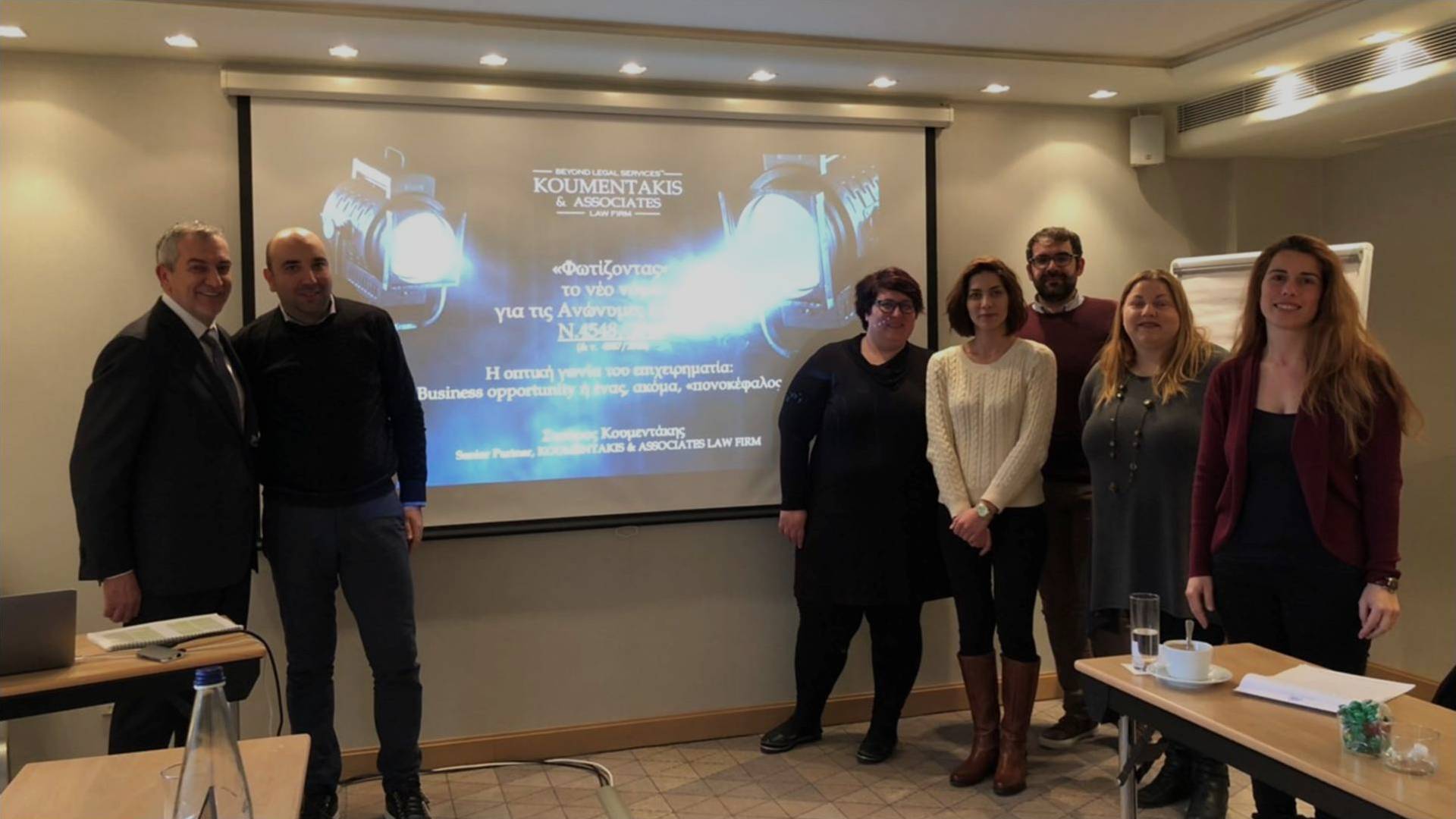
    [vc_row][vc_column][vc_column_text] One more presentation, within the framework of the day meetings which are organized by KOUMENTAKIS & ASSOCIATES on the New Law on on Sociétés Anonymes, was successfully held in Heraklion, Crete. Specifically, a presentation was recently held at Foroepilysis, a rapidly growing company of Mr. Vassilakis that provides accounting, financial and tax services.

    Stavros Koumentakis, Senior Partner, has highlighted the business opportunity that is emerged by the changes brought by the new Law on on Sociétés Anonymes. He presented the general framework of the New Law and made an extensive reference on individual regulations of the new law and the use of the law’s options for businesses on aspects, such as:

    • reducing their operating costs
    • attracting investors and investment funds
    • exploiting technology
    • attracting and retaining competent, senior-level, executives
    • protecting the clients of the Law Firm against their “internal and external enemies”.

    Mr. Stavros Koumentakis mentioned in particular that “the New Law on Sociétés Anonymes is an important opportunity for enterprises which cannot be missed. Law 4548/2018 extends the responsibility and report of the members of the Board of Directors in terms of civil, criminal and administrative sanctions. This may be a potentially serious problem if there are no corresponding provisions and insurance coverage”. He has also mentioned that “there is a immediate need for the necessary and beneficial regulations to be adapted in the SAs’ articles of association”.

    The presentation of Mr. Koumentakis at Foroepilysis, was attended by the top management, executives and employees and it was an opportunity for a broad exchange of views on the specific, extremely important (for enterprises, businessmen and board members) aspects.

    [/vc_column_text][/vc_column][/vc_row][vc_row][vc_column][vc_text_separator title=”Gallery” border_width=”3″][/vc_column][/vc_row][vc_row][vc_column][vc_images_carousel images=”36883,36885,36887,36889,36891,36893,36895″ img_size=”” speed=”6000″ slides_per_view=”6″ hide_pagination_control=”yes”][/vc_column][/vc_row]

  • Two-day conference on the new law on Sociétés Anonymes

    Two-day conference on the new law on Sociétés Anonymes

    [vc_row][vc_column][vc_column_text]

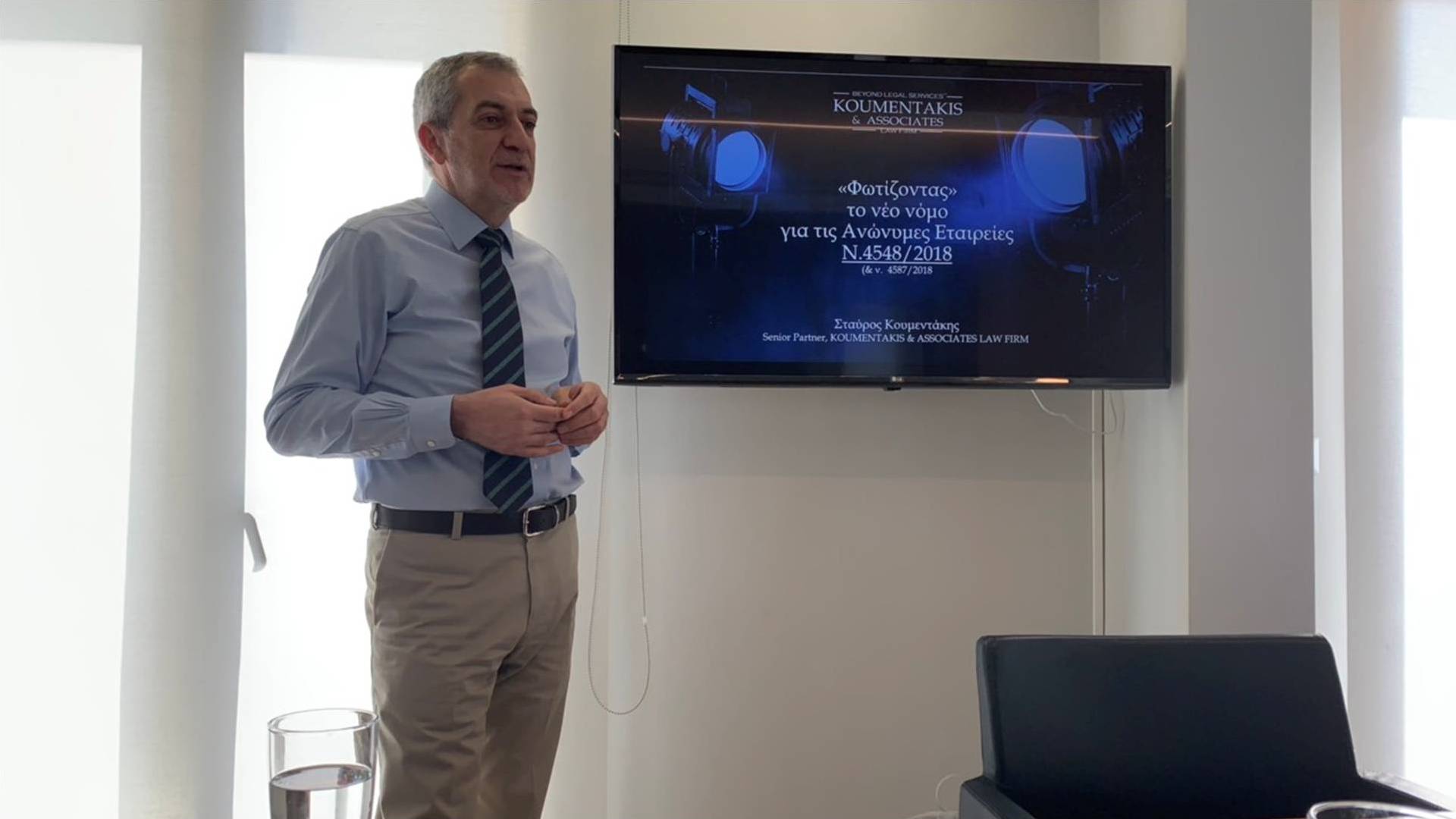
    On the occasion of the new Law on Sociétés Anonymes (in the final form of which the firm was actively involved), the Senior Partner of the Law Firm Mr. Stavros Koumentakis, held an internal informative seminar on “Enlightening the New Law on Sociétés Anonymes (L.4548 / 2018)”.


    Law 4548/2018

    At the two-day conference, of 12 hours duration, the Senior Partner of the Law Firm Mr. Stavros Koumentakis had the opportunity to make a detailed presentation of all the legislative text and not just of its basic regulations. Through the interactive and creative exchange of views between the partners and associates of the Law Firm, it was possible to enlighten individual aspects of the entire law. There was also highlighted the need for the immediate adaptation of the articles of association of the sociétés anonymes (in particular of the Law Firm’s clients) to the provisions of the new law as well as the “tailor made” exploitation, for each one, of the law’s particular options and regulations.

    Mr. Koumentakis’ suggestion’s objective was, among other topics:

    • reporting and, where appropriate, deepening into individual regulations of the new law
    • making use of the law’s options on behalf of the businesses on its own aspects, such as:
      • reducing their operating costs
      • attracting investors and investment funds
      • exploiting technology
      • attracting and retaining competent, senior-level, executives
    • protecting the clients of the Law Firm against their “internal and external enemies”.
    • the potential, necessary and beneficial regulations of the SAs’ articles of association, where applicable, the provisions of which must, individually and directly, be adapted
    • Significant “secrets” on issues such as the management and the power of the minority


    The Law 4548 presentations

    With this particular two-day conference, KOUMENTAKIS & ASSOCIATES Law Firm has launched a series of similar presentations, which is on track to take place in Businesses, Business Associations, Auditors Companies, significant Tax and Accounting Services Companies and so on.

    [/vc_column_text][/vc_column][/vc_row][vc_row][vc_column][vc_text_separator title=”Gallery” border_width=”3″][/vc_column][/vc_row][vc_row][vc_column][vc_images_carousel images=”36707,36709,36711″ img_size=”” speed=”6000″ slides_per_view=”6″ hide_pagination_control=”yes”][/vc_column][/vc_row]

  • The Proper Legal Advisor

    The Proper Legal Advisor

    [vc_row][vc_column][vc_column_text] Legal Advisor, Attorney, Counsel. How many times have we all been wondering about who is the appropriate? Is it a question of remuneration (: cheap / expensive), promoted by the media (: unknown / famous), studies and experience, age or gender? And me, I’m neither from the Boston Legals nor member of the team of Suits. No such luck nor experiences! I managed to write a simple decalogue, which does not even refer to the level of fees … Who is the appropriate legal advisor and lawyer? Is it yours?

    1. Trust, Integrity, Prestige

    A constituent element of the client – lawyer relationship is trust. If we do not trust the (potential) lawyer, legal advisor, or if he does not trust you, I shall be dogmatic: We DOT not start a cooperation. But in the case that we have started the cooperation and we already see that mutual trust has been lost, we stop it DIRECTLY! We seek for another lawyer. A lawyer we can trust.

    But in order to trust our lawyer, he must have inspired us and still, unfailingly and continuously, inspire us with his integrity, credibility, seriousness and prestige. If, hopefully, he did not succeed with us, how will he succeed in court, clients and colleagues while defending our interests?

    2. Strategy And Details

    It is usually easy for any lawyer to deal with our affairs. But is that all we need? We must not forget that our legal advisor must develop a strategy for handling each case (small or large). And it is certain he will do well if he can be two steps ahead of others – not just one. But this strategy should be dynamic. At all times, and depending on the developments, its correctness should be assessed and, when necessary, revised. Caution! We are not only interested in the “forest”, we are also interested in the “trees”. No single case was won by strategy alone. It is necessary to look into the details that our counterparts and contractors have not identified. Our Attorney is the right person to deal with them-better not you!

    3. Knowledge And Experience

    No one would like to (and should not) choose an “illiterate” lawyer or someone (who thinks he) “knows everything”. An appropriate legal advisor is not only he who has the appropriate scientific knowledge and expertise, but also, he who has the courage to accept the limits of his abilities. And for the rest to refer (or he himself to address) to the experts. And if, hopefully, our lawyer, focusing on our pocket or to impress us, makes us believe that “he knows everything and that he can do anything” you should introduce him to me. Because I still believe that there is NO such a lawyer.

    4. Consistency, Judgement And Perception

    What is more attractive than the spiritual consistency and the satisfactory, at least, judgment and perception? Does anyone imagine a lawyer who not only is he not able to perceive those that happen but is also unable to decode them and use them in his client’s benefit? Does anyone imagine a lawyer without analytical and, at the same time, synthetic thinking? And more over: Does anyone imagine a lawyer whose speech (spoken or written) is not understood or attractive? We must not forget that every lawyer has listeners, judges or co-contractors before him. And if he cannot bring the interest of the listener or reader to what he himself supports or, worse, be understood in the formulation of his thoughts, he probably should not be our legal advisor.

    5. Negotiating capacity, Persuasion And Passion

    And if I take for granted the judgment and perception of the lawyer we have chosen, I should also take for granted his negotiating capacity in the defense of our affairs and interests. It is precisely in this capacity that our legal advisor must be able to convince the people he is dealing with on our behalf.

    But it is a prerequisite that he himself has been convinced. And more over: to defend us and our interests with passion. For if he is not convinced himself, and is confined to the simple, lukewarm, quote or reading of our argument, we must also assume that even the people he has before him will not be convinced.

    6. Qualitative And Quantitative Performance. Speed Of Response And Availability

    We cannot expect from our lawyer anything less than the best. The best in quality, the most in quantity and at the right (fastest) time. And that because, think of a lawyer who does his job extremely good thus without respect (or commitment) to procedural deadlines or to the client’s business needs. A lawyer that has been just today able to start working on the job he was assigned with a month ago. And to complete it, “God will provide” …

    And just to meet our needs, experience has shown that it is not possible for a lawyer to invoke or use a timetable, to divide the days into working and unparalleled, or to systematic lack, for whatever reason, availability and inability to communicate. Availability is required when and wherever needed!

    7. Efficiency

    We have all met competent people who, however, are unable to focus on the outcome and often to succeed getting one. And it is true that each interested person, by nature, always wants to win (whether he says it or not). However, it is important that our attorney focuses on the best result and does not leave “incomplete” his or her relative effort either by indolence or by indifference or for any other reason. It is important that our lawyer does not leave the case file aside before completing whatever is necessary and possible.

    8. Calmness And Sobriety

    When someone reaches the point of seeking the advice or assistance of his lawyer, it means that a matter of importance is of concern to him. Sometimes these issues prove to be complex and highly complicated. And some others, are reaching the point of crushing, with their consequences, those concerned. And here is the need for an appropriate legal advisor: not to share (client’s) panic attack (but eventually), to decode the data and put them in their true dimension, to propose the appropriate strategy, but also to implement it, to select and oversee the individual solutions.

    Crisis management (whether it refers to smaller or larger or / and really big crises) is, beyond any doubt, an almost daily necessity to which our legal advisor must successfully respond.

    9. Self-Confidence And Ability to Collaborate.

    We all know what a lack of self-confidence means. And if we refer to children, we can reasonably look forward to strengthening it over time. But if we meet the lack of confidence in our doctor or lawyer, can we have hope? It may be the case if, in order to strengthen it, he will appeal to willing and better than its own colleagues. But if such are not available or are already tired of him? If he tries to “cling” to our own thought and opinion to choose or strengthen his own? He’s probably not the appropriate lawyer.

    It also does not seem for our legal counsel to be the right person if he lacks team spirit and of the ability to co-operate with the useful and necessary persons, to recognize their assistance and contribution and the fact that he relies (to any extent) on those. If our lawyer needs a confirmation of his skills by concealing the necessity of collaborations and of his associates, we should probably start to doubt both his abilities and him.

    And something more: Our legal advisor should have leadership skills, he must be able to set up a team and manage it for the best result but also to “take upon himself” our case. But, in particular: to be in a position to remove the burden that our case, personally, and fair, creates.

    10. Does He “Lay Down A Part Of His Life” For Your Cases?

    And if we identified the appropriate lawyer who has “everything in the world” -and more and even more, there is one last question: Do we feel that our lawyer deals with our affairs, simply as a good professional or that, in addition, he lays down a part of his life for them? If the second ALSO happens I think we should not leave him.

    He is the one who will do what is humanly possible for us and for our interests, the one who will “turn night into day” and who will “upset everything” for us. It is he who is honestly happy with our joy and who does not “give up” in our dead ends. He is the one who will continue to fight until victory or up to the end. He is the one who deserves to be OUR LAWYER!!!

    So, is your lawyer the proper lawyer, legal advisor and counsel? I guess you have, already, concluded…

    [/vc_column_text][/vc_column][/vc_row]

This site is registered on wpml.org as a development site. Switch to a production site key to remove this banner.