Tag: Stock exchange

  • ESG Criteria (Environment, Social, Governance), Business and Development

    ESG Criteria (Environment, Social, Governance), Business and Development

    There is a lot of discussion around the ESG criteria: for their value, the importance of their adoption by companies but also the way they are evaluated by investors, stock exchanges and the financial system. The global debate has reached our country for a long time now. The issue is no longer theoretical; it refers to attracting investment capital, to corporate creditworthiness and, ultimately, to growth. Let’s see why.

    What are the ESG criteria?

    ESG stands for Environmental, Social, and Governance. Specific the (: ESG) criteria are a set of standards for the operations of a company used by socially conscious investors to control potential investments. Environmental criteria examine a company’s performance as for the way they treat nature. Social criteria examine how the business manages its relationships with employees, suppliers, customers and the communities in which it operates. Governance deals with the leadership of a company, the remuneration of management and senior management, audits, internal audits and shareholder rights.

    However, investors and companies are not the only ones dealing with these criteria. They are already occupying the EU. In this context, one encounters a wealth of legislation related to the ESG criteria, which highlights the high interest of the latter.

    The (true) value of the ESG criteria

    In 2015, world leaders unanimously approved the 2030 Agenda for Sustainable Development. According to UN Secretary-General Antonio Guterres, “The Sustainable Development Goals are the path that leads us to a fairer, more peaceful and prosperous world, and to a healthier planet.”

    Consequently: the issue neither has just a legislative background nor is it just of legal value.

    It turns out that it has a special value for businesses as well.

    George Serafeim (Professor at Harvard Business School, Chairman of the Hellenic Corporate Governance Council and Member of the Board of Directors of the Athens Stock Exchange), when introducing The ESG Information Disclosure Guide for the Athens Stock Exchange stated: companies that improve their performance in environment, social and corporate governance (ESG)… improve their access to capital, employee engagement, customer satisfaction and their relationships with society and stakeholders”.

    In this Guide we read:

    “sustainability has become a pertinent and pressing topic across the world, mobilizing governments… Following the call to action of the UN Sustainable Development Goals (SDGs) an increasing number of companies are measuring, disclosing and managing sustainability risks and opportunities. Environmental, social and corporate governance … metrics have emerged as important factors that reflect companies’ ability to generate value and execute effective strategies…

    A growing body of research has confirmed a strong relationship between performance on ESG metrics and financial performance of companies, thus demonstrating that ESSG information is financially material and therefore relevant to investors. In the absence of ESG disclosure, investors can miss important information on a company’s operations, competitive positioning and investors can miss important information on a company’s operations, competitive positioning and long-term strategy.”

    The PRI

    The PRI [: PRI Initiative (Principles for Responsible Investment)] is an investment initiative developed in collaboration with the UNEP Finance Initiative and the UN Global Compact, an initiative that requires participants to meet the ESG criteria.

    The published data on the growing acceptance of the PRI Agreement looks impressive: This initiative already involves 170 investors managing 36 trillion (!) USD as well as 26 (!) Credit Rating Agencies (CRAs). Also: Four reports have been published as part of this initiative and more than twenty forums have been organized worldwide for industry professionals.

    The principles on which the specific investors and Organizations are committed are worth mentioning:

    Principle 1: We will incorporate ESG issues into investment analysis and decision-making processes.

    Principle 2: We will be active owners and incorporate ESG issues into our ownership policies and practices.

    Principle 3: We will seek appropriate disclosure on ESG issues by the entities in which we invest.

    Principle 4: We will promote acceptance and implementation of the Principles within the investment industry.

    Principle 5: We will work together to enhance our effectiveness in implementing the Principles.

    Principle 6: We will each report on our activities and progress towards implementing the Principles.

    ESG: Winning in the long run

    From the above, there is no doubt neither about the importance that investors attach to the adoption of the ESG criteria nor about the fact that companies should (also) focus on them.

    In the above context was the (relatively) recent event of the Athens Stock Exchange: ESG: Winning in the long run. The high participation in this event demonstrates the respectively high interest. There were also many interesting participations and presentations, which demonstrated the value of the adoption of the specific criteria by the companies.

    We will focus on only two points of those made:

    “Socially responsible companies are obviously becoming more attractive internationally and vice versa” (: Mr. Vas. Lazarakou, Chairman of the Hellenic Capital Market Commission)

    “According to estimates, in the next three or four years more than 50% of the mutual funds will be invested in strategies that will have ESG criteria. (The adoption of the ESG criteria) is not something, as we would say, nice to have but it is a must have “(: Mr. Theof. Mylonas, President of the Association of Institutional Investors)

    Base (also) on the specific data, the CEO of the Athens Stock Exchange, Mr. Socrates Lazaridis, announced the planning of the creation, by October, of an index that will include the sufficiently sensitized, ESG-conscious listed companies. As a natural consequence, the increase of investors’ interest in the shares of these (privileged) companies is expected.

    Companies that meet the ESG criteria and investment funds

    One would expect that the adoption of these criteria is only a burden (and a costly one, without any benefits) for businesses. But is that so?

    Morningstar is a world-renowned financial research and investment management services company. Highly prestigious, respectively, is its research. In a relatively recent (: 30.6.20) research (: “How Does European Sustainable Funds’ Performance Measure Up?“) We find extremely interesting facts. We also find a very interesting comparative overview of the returns of Sustainable Funds in relation to the Traditional Funds.

    Let us clarify at this point that Sustainable Funds are those that use environmental, social and corporate governance (ESG) criteria to evaluate their investment or social impact. In contrast, traditional ones (: Traditional Funds) do not focus on the existence (or not) of such criteria for evaluating either their investments and / or their potential investments.

    Yields and survival rate of Sustainable Funds in relation to Traditional Funds

    The aforementioned Morningstar survey provides a comparative overview of Sustainable and Traditional Funds in terms of their survival rate and, above all, their returns. The superiority of the former seems obvious on a global and European level in the course of a year, three years, five years and a decade. To clarify, in the present article we focus on those parts of the research that refer to investments at global and European level, but those parts do not demonstrate significant differences from the rest of the survey.

    Yields of Sustainable Funds worldwide

    Below we list the performance and returns of Sustainable Funds that invest, worldwide, in large-cap companies-Blend Equity, specifically:

    From the above data it appears that, in addition to the increased survival rate of Sustainable Funds, their average returns from the aforementioned investments range from 6.9% over a decade to 25.7% year-on-year. In contrast, the average returns of Traditional Funds are limited to 6.3% over a decade and reach 23.3% year-on-year.

    Yields of Sustainable Funds investing in Europe

    Below we list the performance and returns of Sustainable Funds investing in Europe-also in large-cap companies -Blend Equity˙ specifically:

    The survival rates of Sustainable Funds are, in this case, extremely high compared to Traditional Funds. The returns of Sustainable Funds, which invest in these European companies, are also increased: they range from 6.8% over a decade to 26.2% year-on-year. In contrast, the average returns of Traditional Funds are limited to 6.6% over a decade and reach up to 24.2% year-on-year.

    Yields of Sustainable Funds investing in the Eurozone

    Below we list the performance and returns of Sustainable Funds investing in the Eurozone in large cap companies -Blend Equity, specifically:

    The survival rates of Sustainable Funds are, in this case as well, extremely high compared to Traditional Funds. Respectively, the average returns of the Sustainable Funds that invest in the Eurozone in the specific companies range from 5.6% in a decade to 24.4% year-on-year. On the contrary, the average returns of Traditional Funds are limited to 5.5% over a decade and reach up to 23.7% year-on-year.

    Conclusion

    From the above, the conclusion is that those Funds (: Sustainable Funds) that focus on investments with ESG criteria have obviously better survival rates but also better returns than the others (: Traditional Funds). Companies, therefore, that meet these (: ESG) criteria are the ones that will receive the “lion’s share”, in terms of the interest of significant investors. The necessary funds for their growth and their development in the end seem to be, this way, easier to come across and it is safer to bet on receiving them.

    The interest of the global community, investment funds and stock exchanges (and most recently financial institutions), emerges as a clear manifestation of the adoption of the ESG criteria. Consequently, their adoption by large-cap companies, but also by those whose shares are listed on regulated markets, seems to be extremely important.

    The issue, however, should not concern the specific larger companies only. (It should) concern all businesses that are (or are likely to be) targeted by investors. Those whose creditworthiness is assessed. Those who either want to showcase their achievements in these areas or are simply evaluated by them.

    It is important to remember, however, that the younger generations of consumers are not only interested in the value for money of the product or service they buy.

    It is, therefore, obvious that the adoption of the ESG criteria by some companies, puts them in an (on many levels) advantageous position. (In this context we also find the “Equality Mark” awarded to companies provided by the bill for labor issues – see our article to follow).

    The relevant ESG “passport” is therefore necessary for the development and, in some cases, the survival of businesses.-



    Stavros Koumentakis
    Managing Partner


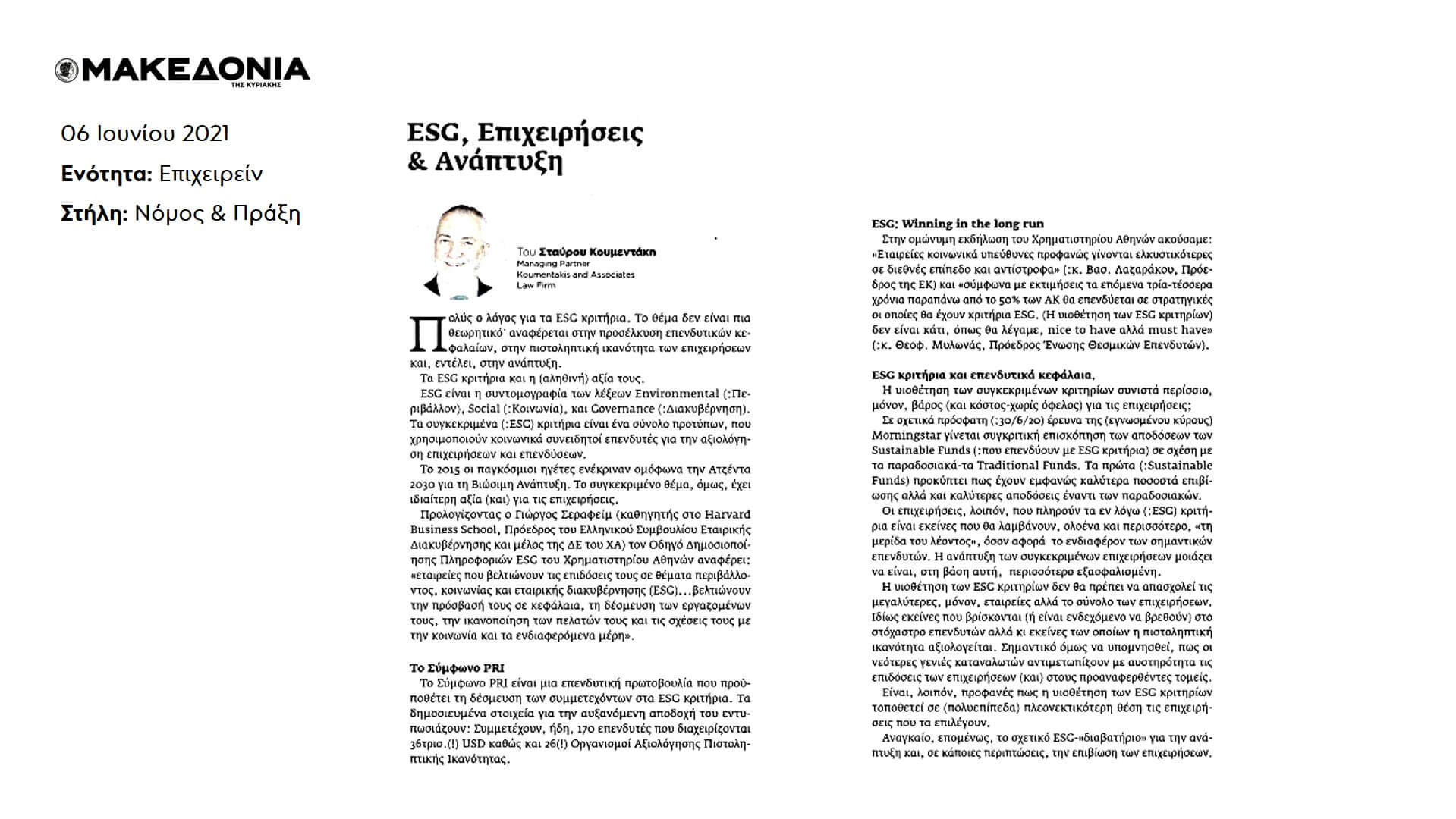
    P.S. A brief version of this article has been published in MAKEDONIA Newspaper (June 6, 2021).
    κριτήρια ESG

    Disclaimer: the information provided in this article is not (and is not intended to) constitute legal advice. Legal advice can only be offered by a competent attorney and after the latter takes into consideration all the relevant to your case data that you will provide them with. See here for more details.

  • Financing Small and Medium Enterprise and the Stock Exchange

    Financing Small and Medium Enterprise and the Stock Exchange

    It is common ground that Small and Medium Enterprises (: SMEs) need support for their survival and development – especially in the current circumstances. First and foremost, hey need funding. We have already seen that our European and national economies are, without a doubt, bank-centric. And this is something that needs to change, for many reasons. Banks neither can and nor do they want (nor is it appropriate) to bear the burden of financing the companies that need them. Both the economy and SMEs, in particular, have an (insurmountable) need to activate and leverage more, different, sources of funding. Undoubtedly, one of them is the capital markets – the stock exchange. EU data show that only 10% (!) of the external financing of European SMEs (ie from third-party sources) comes from the capital markets. The EU, albeit at a slow pace, is already working to assist SMEs in their first steps.

    Let’s take a look at the current processes taking place at European level to assist SMEs in their first steps in the magical (?) world of capital markets.


    EU assumptions about SMEs

    “There are 24 million SMEs in the EU-27. They represent the backbone of the economy. They generate more than half of the EU’s GDP while at the same time employing more than 100m. employees before the onset of the pandemic”. “On this basis, and in the light of the Covid crisis, we must take for granted the need to revise the SME Strategy” which was decided on 10.3.20 – just one day before the World Health Organization sounded the alarm on the pandemic of Covid-19 “(: Press release of 13.11.20 of the European Parliament).

    The specific assumptions, from the most official sources, cannot be disputed. In fact, the data they contain make it necessary for all of us to become alert. But above all the EU. Of course, our national government as well.


    The ” road to Calvary” of the stock exchanges

    The course of public offerings in the European Capital Markets

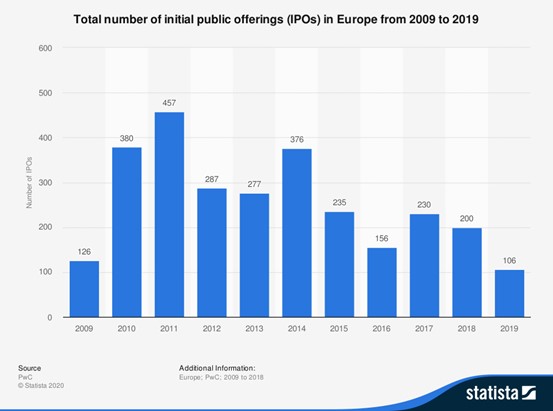
    Let’s take a look at the initial public offerings of the last decade (2009-2019) in Europe:


    It would not be possible to characterize their course (of the initial public offerings) during the last decade as blooming. However, this also reflects the interest of companies to list their shares in regulated markets. Respectively of investors for the capital markets.


    The course of the Greek stock exchange market during the last 20 years

    The boom (but also) frenzy of the Greek stock exchange market, which had the well-known (technically and logically expected) collapse of 1999, was followed by its contraction of the next twenty years.

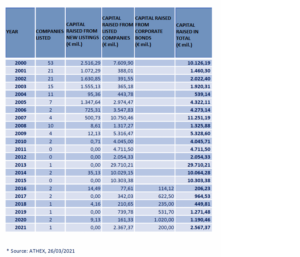
    Let’s also take a brief look at the extremely interesting data of the Athens Stock Exchange, from 1.1.2000-to 26.3.21 (which it kindly provided to us and with its permission we make public):

    The well-known efforts of the Athens Stock Exchange, as we all know, are proving to be bearing fruit in recent years in the corporate bond market. Of course, the largest companies are currently benefiting from it.

    And the stock exchange market?

    Let’s take a look at the (problematic) three years 2013-2015: €50 billion were raised. Also: in the first quarter of 2021 more than €2.3 billion was raised. Although the issue may seem multifactorial, it turns out that the stock exchange market can help raise funds. SMEs are, of course, entitled to their share. And, of course, to the relevant assistance.

    The EU is already moving in this direction…


    EU: The creation of a fund to assist SMEs during and after their listing

    The (basic-initial) assumptions about the necessity of creating such a fund

    One year ago (: 10.3.20) the European Commission published a Communication to the European Parliament and other EU institutions entitled “SME Strategy for a Sustainable and Digital Europe“.

    In the above (extremely interesting) Announcement, important assumptions are made. Among them:

    “SMEs in Europe find limited possibilities for growth financing, such as listing on capital markets through an Initial Public Offering (IPO). Capital markets are an important source of funding for SMEs growing int mid-caps and ultimately large companies. However, the number of SME IPOs declined sharply in the aftermath of the financial crisis and has not recovered since. In 2019, the value and number of European IPOs continued to fall by 40% and 47%, respectively, relative to 2018.”

    In order to address this problem, it is accepted by the European Commission that it would be particularly useful to set up a fund to facilitate the listing of SMEs during and after the registration process. In this way, more fast-growing and innovative SMEs would turn to the capital markets to raise the necessary funds for their development. More private investors would be attracted to the capital markets. The economy (European and, why not, national) would end up less “bank-centric”. Such a choice could only have positive results.

    In this context, the European Commission undertook, inter alia, to “support Initial Public Offerings (IPOs) of SMEs with investments channelled through a new private-public fund, to be developed under the InvestEU programme starting 2021 under the Capital Markets Union”.


    Motion for a resolution of the European Parliament

    Last September (: 16.9.20) a motion for a European Parliament resolution was tabled on further development of the Capital Markets Union (CMU): improving access to capital market finance, in particular by SMEs, and further enabling retail investor participation.

    This proposal records (recital 9) the “decline in Initial Public Offering (IPO) markets in the EU, reflecting their limited attractiveness for, in particular, smaller companies”. This phenomenon is due, among other things, to the fact that, according to the proposal, “SMEs face disproportionate administrative burdens and compliance costs associated with listing requirements”. It stressed “that the efficiency and stability of the financial markets should be improved and that the listing of companies should be facilitated”. Also, it noted that there is a need “to ensure an attractive environment pre-IPO and post-IPO environment for SMEs”. It encourages, in this context, “the creation and prioritization of a large, private pan-European fund, an IPO Fund, to support SME financing”.


    Opinion of the European Economic and Social Committee

    On 11.12.20 the European Economic and Social Committee (EESC) issued an Opinion on the above-mentioned Opinion from the Commission to the European Parliament. The EESC therefore (paragraph 5.4) “welcomes the development of a private-public fund focused on initial public offerings (IPOs) and fully supports the creation of additional equity, quazi-equity, venture-capital and risk-sharing financing instruments for SMEs”. In the same context it stated it “believes that promoting them and ensuring their accessibility is particularly important for innovative small and mid-caps”.


    The course / the (temporary?) quagmire for the creation of the fund

    It is known, however, that the EU does not always act extremely fast. We note, therefore, that there are other concerns about the rapid development of the whole issue: In the context of the parliamentary scrutiny, a relevant Parliamentary Question was submitted on 7.1.21 stressing the Commission’s lack of commitment to take substantive action in creating the aforementioned fund.


    References under the InvestEU program

    Regulation (EU) 2021/523 establishing the InvestEu program was adopted very recently (on 24.3.21).

    We read, inter alia (recital 21): “SMEs represent over 99% of companies in the Union and their economic value is significant and crucial. However, they face difficulties when accessing finance because of their perceived high risk and lack of sufficient collateral… SMEs have been particularly badly hit by the COVID-19 crisis… Moreover,, SMEs and social economy enterprises have access to a more limited set of financing sources than larger enterprises… The difficulty in accessing finance is even greater for SMEs whose activities focus on intangible assets. SMEs in the Union rely heavily on banks and on debt financing… Supporting SMEs that face the above challenges by making it easier for them to gain access to finance and by providing more diversified sources of funding is necessary to increase the ability of SMEs to finance their creation, growth, innovation and sustainable development, ensure their competitiveness and withstand economic shocks to make the economy and the financial system more resilient during economic downturns and to maintain SME’s ability to create jobs and social well-being. This Regulation … should also maximize the firepower of public / private fund vehicles, such as the SME IPO (Initial Public Offering) Fund, seeking to support SMEs through channelling more private and public equity” especially to companies of strategic importance.


    Is the stock exchange market the right means of raising capital for businesses?

    For some it proves valuable; for others less; for others it is completely unsuitable. In fact, in our next article we will try to approach some parameters of the relevant question. It should be noted, however, in quotation marks, that the world of the stock market has not proved to be magical for everyone: neither for investors nor for companies.

    However, those companies (especially SMEs) for which it would be evaluated as the, relevant, best tool available, it should be provided with the appropriate information and, of course, the appropriate assistance. In the context of the latter, in particular, the fund is expected to play an important role, which, as mentioned above, has been planned for a long time by the EU. Corresponding actions are being launched by the ATHEX and the Greek State (which we will also deal with in our next article).

    We hope they do not delay.

    For the good of businesses.

    For the good of the capital markets.

    For the good of our national economy (as well) …

    For the good, in the end, of all of us.


    Stavros Koumentakis
    Managing Partner


    P.S. A brief version of this article has been published in MAKEDONIA Newspaper (April 25, 2021).


    Disclaimer: the information provided in this article is not (and is not intended to) constitute legal advice. Legal advice can only be offered by a competent attorney and after the latter takes into consideration all the relevant to your case data that you will provide them with. See here for more details.
  • Business: Survival & Development. The (necessary?) turn to the capital markets?

    Business: Survival & Development. The (necessary?) turn to the capital markets?


    Businesses need capital (own or foreign) to survive and grow. In Europe, they turn to the banks, mainly, for their extraction. The European economy therefore is (and does not just look) bank-centered. The Greek market even more so. The comparison with the USA, the United Kingdom and Japan (: countries, that is, with developed capital markets) proves the statement to be true. It is not simply a matter of theoretical findings: the relative magnitudes leave no room for misinterpretation. Should we take it for granted that European companies’ fundraising will start to shift outside the banking system – to the capital markets, for example? And, if so, will this also apply to Greek companies? And if so, when?

    For the advantages (of course conditions and disadvantages) of financing outside the banking system (capital markets and beyond) we will be given the opportunity to deal with in our next article. Respectively with the conditions for increasing the creditworthiness of companies. Let us now try to give an answer to the questions mentioned in the introduction.


    Capital Market: US vs EU

    One indicator that is commonly used to assess the size of a capital market development is that derived from the market capitalization / GDP ratio.

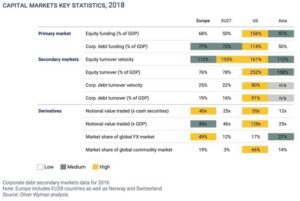
    A relatively recent report by FESE (Federation of European Stocks Exchanges) records an interesting statistic (based on the latest World Bank data published on 31 December 18). Specifically:


    Let us limit ourselves to the Index: Market Capitalization / GDP. We notice that it amounts to:

    At 156% for the US,

    At 50% for the EU27 and

    At 68% for Europe (EU27 + Great Britain + Switzerland + Norway).

    Therefore: for the European Union of 27 the relevant index is limited to 1/3 of that of the USA.

    A very obvious finding follows, that the European capital market lags behind that of the United States.

    There is also, as self-evident, the extremely limited use of European stock exchanges to raise capital by European companies.


    “The Greek economy is primarily bank-centric”

    The Governor of the Bank of Greece, Mr. Stournaras, participated, among others, in an online event of IOBE on 17.12.20 entitled “Financing, private debt and restart of the economy”. His speech, due to his position, was, of course, of particular importance.

    Referring to the Greek economy, Mr. Stournaras said: “The Greek economy is primarily bank-centric. What do I mean by that? Suppose one hundred units of funding are required. And let’s look at America, Europe and Greece. Of the 100 funding units in America, half, about 50%, comes from the capital markets; the other half from banks. In Europe, roughly 75% comes from banks and 25% from the capital markets. In Greece, 95% of the banks and 5% of the capital markets. So Greece is an exceptionally bank-centric country and banks play a very important role in financing and economic development.”

    However: As will be shown later on, the truth is (unfortunately) worse. Corporate finance from the European capital markets holds an even smaller percentage than what our central banker supports. (We can safely assume the same for Greek companies…).

    What if we look for the reason? We must, above all, attribute it to the structure and composition of the European economy. But even more so: in the general culture that prevails in the field of business finance in the old continent.


    The participation of the capital market in the financing of Greek companies

    Unfortunately, there does not seem to be (published-processed) data regarding the financing of Greek companies outside the banking system. But even if we accept as accurate the (rather optimistic) approach of Mr. Stournaras (: 5% share of the capital market as a whole), the conclusions still are absolutely disappointing.

    Listed companies, based on data from the Hellenic Capital Market Commission, are limited to: (a) one hundred and seventy-one (171) for the Main Market and (b) eleven (11) for the Alternative Market.

    Therefore: one hundred and eighty two (182) companies with listed shares in Greece (possibly those that were listed) share the 5% corresponding to the financing from the Greek capital market.

    For the rest (95%) that corresponds to the financing (basically) from the banking system, the 182 mentioned above are competing with the rest of the 821,540 (!) Greek companies. (Their total number is derived from the published data of the European Commission of 2019).


    EU data on SME access to capital markets

    The (dual-secondary) problem of the EU

    The finding of the central banker of our country (: “The Greek economy is primarily bank-centered”) identifies the problem. However, the magnitude of the dependence of the European economy and, consequently, of the Greek economy on the banking system seems more serious and worrying than he points out.

    Our (safe) source, the data and the position of the European Commission, expressed in: “Unleashing the full potential of European SMEs”. From what is mentioned there, it follows that:

    (a) Only 10% (!) of the external financing of European SMEs (ie from third-party sources) comes from the capital markets and

    (b) Only 11% of companies in Europe consider equity as a viable financial option. Most importantly: only 1% have used it.


    EU actions to manage it

    In order for the EU to manage the above (double & extremely serious) problem it decided to create:

    (a) A fund for the listing of SMEs on the stock exchange.

    This private / public fund was established under the InvestEU program. Through this, investments will be channeled to stimulate the financing of companies as well as funds run by women.

    (b) The ESCALAR initiative

    This initiative aims to create a mechanism to increase the size of venture capital and attract more private investment. Its purpose: to support companies with high growth potential.

    The success of both remains to be seen…


    The real (: main) problem of the EU and its management

    The real problem that the EU has to deal with does not seem to (only) be the creation of the conditions for better access of businesses to the capital markets.

    The real (and main) problem of the EU is to limit the further expansion of the financial system in the EU. And the consequent mitigation of the risks linked to this expansion.

    Most importantly: limiting the power of banks and bankers to the detriment of EU political power.

    The above-mentioned EU actions are, in principle, aiming in this direction.


    Do European SMEs have less money available than their US counterparts?

    The Association of Financial Markets in Europe (AFME) in collaboration with the Boston Consulting Group proceeded, together – six years ago (: 2/2015) to publish an interesting report: “Bridging the growth gap Investor views on European and US capital markets and how they drive investment and economic growth”.

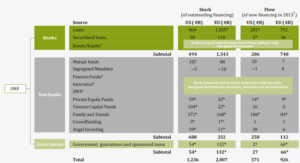
    We read in this report, among other things, that more money is available in European SMEs than in the US. According to the analysis estimates, SMEs (companies with a Turnover of less than € 50 million) in Europe have almost doubled the funding (compared to the US) from banks, non-banks and governments. The data emerge as particularly interesting. Specifically:


    We conclude from the above, indicatively, that in 2013 (taken into account as a reference year), 926 billion Euros of new financing, of all types, were given to European SMEs, compared to 571 billion Euros in the USA. The data, in both areas, exclude financing provided by personal financing (including funds made available to SMEs by their owners through their personal wealth and retained earnings).

    Based on the same analysis above: surveys and interviews show that European SMEs strongly prefer bank lending over personal or alternative sources of financing. This, moreover, is evidenced by the evolved character of the latter (such as venture capital and angel investing-available in smaller SMEs in Europe.

    In 2013, for example, €26 billion was invested by venture capital companies in SMEs in the US – compared to just €5 billion in their European counterparts. During the same period, €20 billion was invested by angel investors in US SMEs – compared to just €6 billion in Europe.

    Therefore: there is no shortage of money flowing into European companies. The problem is that companies are looking to recieve them (primarily) from banks. In this way, however, the banks become “dominant in the game”. Not only does this not solve the existing problems but, on the contrary, it multiplies them.


    Problem…

    It is a common finding that the rapid growth of the (global and European) banking system poses serious risks to the economy. It has already been proven that these risks are not theoretical. Both in the US and in Europe-recently and in the context of the (long-European) financial crisis. National economies have reached the brink of collapse due to the rapid growth and weak foundations of the banking system (see, for example, Cyprus and, secondarily, Greece).

    Also: the attitude of the banking system towards the SMEs in Europe and our country has been diagnosed as a serious problem. And so has it been again, in the context of the ongoing health / financial crisis.


    … vs business opportunity

    Should the specific problems mentioned above maybe push us in thinking “out of the box”? Do they force us to treat (and manage) them as an opportunity? An opportunity for gradual disengagement of the SMEs (but also of the national economy) from the entanglements and risks of the banking system?

    Is it time for SMEs in our country (as well) to turn to financing outside of it (the banking system)?

    To take advantage of the (given-alternative) funding opportunities out there? (Which will always increase ..)

    (And) of the Greek capital market?

    There is no doubt!

    The time has come (as will be shown in an article of ours to follow).


    Stavros Koumentakis
    Managing Partner


    P.S. A brief version of this article has been published in MAKEDONIA Newspaper (March 28, 2021).


    Disclaimer: the information provided in this article is not (and is not intended to) constitute legal advice. Legal advice can only be offered by a competent attorney and after the latter takes into consideration all the relevant to your case data that you will provide them with. See here for more details.

This site is registered on wpml.org as a development site. Switch to a production site key to remove this banner.