Tag: societes anonymes

  • General Assembly of the SA: The Highest Corporate Body

    General Assembly of the SA: The Highest Corporate Body

    The Board of Directors is in fact of fundamental importance for SAs (Read: The Board of Directors of the SA: Operation, Power, Members).

    Introducing the chapter on General Assembly of SAs, (GA), we will be focusing in the particular importance and value of the highest body of the SA and of course the limitations of its power.

    General Assembly of SAs: The scope of its decisions and powers

    The General Assembly is established by law (: art. 116 law 4548/2018-as previously in force) art. 33 of Codified Law. 2190/1920) as the highest body” of the SA (see Explanatory Report on art. 116, paragraph a, Law 4548/2018). The hierarchical organization of the SA is therefore demonstrated, at the highest level of which the General Assembly is located. It constitutes a collective body, the members of which are, exclusively, the shareholders of the company (in practice: owners of the SA and bearers of the financial risk of its activity).

    The characterization of the General Assembly as the highest body of the SA derives from and is consistent with the nature of the responsibilities granted to it and recognized by the law: The General Assembly “…is entitled to decide on every corporate matter” (: art. 116).

    The General Assembly of the SA has the power and authority, among other things, to elect (and freely recall) the Board of Directors (and the auditors) of the SA. To also exercise control and supervision over the activity of said bodies and persons – who are accountable for the actions of the respective management period. After the end of each corporate year, it approves (or not) their overall management. Therefore, the Board of Directors of the SA functions, in principle, as an executive body of the decisive will of the General Assembly (more precisely: of the majority of shareholders).

    It would not be an exaggeration to note that the General Assembly is responsible for taking the most important (in terms of importance and gravity) decisions regarding the existence, activity and course of the company. Even regarding its dissolution. In fact, regarding certain decisions, its responsibility is exclusive (especially art. 117 – for which our next article).

    Participants and decisions

    The decisions of the General Assembly are, of course, made by the shareholders. Directly linked to the shareholder status is the right to appear (in person or by proxy) and actively participate in its meetings. Shareholders have the opportunity to request information – on the occasion of an upcoming meeting or during the work of the General Assembly. During its conduct, in fact, they have the right to take the floor and ask questions – in the framework predetermined by law. The ultimate purpose of all individual rights of this nature is, in principle, the creation of the necessary conditions for the documented exercise of the right to vote for each of the items on the agenda. It is assumed, of course, that they hold the right to vote either as full owners of their shares or, for example, as usufructuary or pledged creditors. During voting, it is not possible for them to participate, automatically, when they are deprived of the right to vote (e.g., holders of non-voting preference shares).

    In order for the decisions of the General Assembly to produce legal results, the quorum and majority percentages must be met for the adoption of each decision, as provided for in the law and the articles of association. The voting of an individual shareholder (but not the sole or majority shareholder) has no consequences. It simply contributes to the formation of the corporate will, as expressed by the General Assembly. The decisions of the General Assembly, of course, are binding on all shareholders, regardless of whether they abstain, are absent or disagree (art. 116, sub. b).

    The action of the General Assembly (in contrast to the permanent nature of the Board of Directors) is periodic. The body meets – but also exists to take decisions according to the law and its articles of association – only when convened for this purpose. Its convening is sometimes mandatory (:ordinary General Assembly) and sometimes when it is deemed necessary by the circumstances (:extraordinary General Assembly). It is important to provide the shareholders with the opportunity to participate in decision-making without necessarily holding a meeting or even by simply signing the relevant minutes (see art. 135 and art. 136 respectively).

    Separation of Powers Board of Directors & General Assembly of SA

    The management of the SA belongs, first of all, to the Board of Directors. The General Assembly, however, has the ability/power to intervene in the relevant competence of the Board of Directors. However, different views have been developed regarding the extent of this intervention. According to the prevailing (and correct) view, the General Assembly has broad and general competence. Furthermore, (art. 116 and 86) margins for (positive or negative) intervention by the General Assembly in the work of the Board of Directors are recognized.

    It is important, however, to note that the GM’s power of intervention cannot lead to arbitrary usurpation of powers that have been assigned to other corporate bodies. In this context, the complete removal of the Board of Directors’ (legally derived) managerial power is excluded (after all, this would result in the Board of Directors being irresponsible ). But what is the point of such a choice by the GM? It would be simpler for it to choose (and elect) a new Board of Directors, which it would express and which would operate according to its directions (that and its substitute bodies)…

    It is possible to limit the scope of the power of the Board of Directors on the basis of a statutory (and, therefore, general) provision. However, the limitation of the obligations of the members of the Board of Directors, as well as the alteration of their liability regime, are not issues that are amenable to statutory regulation. Any limitation of the duties of the Board of Directors is, however, tolerated by a specific-relevant decision of the General Assembly. Such a decision, usually, will concern a specific act (or unit of competences) of the Board of Directors. Regardless, however, of any theoretical concerns, the influence of the decisions of the Board of Directors should be considered, as a rule, a given, as the majority shareholders are the ones who elect – and maintain in power – the members of the Board of Directors. They, in turn (the members of the Board of Directors), express and defend the interests of the majority shareholders, which, as a rule, they promote. Sometimes even before the corporate equivalents.

    It is possible that the articles of association require prior information and/or consent or (ex post) approval of the General Assembly for the performance of specific management actions by the Board of Directors or substitute bodies. Especially when decisions are to be taken that by their nature create risks for the company (such as the transfer/sale of significant assets). It is accepted, and rightly so, that the General Assembly is not only entitled but also obliged to intervene in defense of the interests of the shareholders (Greek Commercial Code 2263/2003).

    The decision-making by the General Assembly beyond the limits of its authority does not create any obligation of compliance or commitment towards the Board of Directors. Of course, given the fluidity of the relevant limits, the scope for shareholder intervention must be assessed on a case-by-case basis and always in accordance with the prevailing circumstances. Greater freedom of intervention by the General Assembly in matters of corporate organization is recognized, provided that it is an unlisted company. On the contrary, in listed companies, given the asymmetry of interests between the General Assembly and the Board of Directors, the involvement of the General Assembly is understood in decisions that (in terms of subject matter and importance) escape the current management of the Board of Directors.

    Binding Force of General Assembly Decisions – Conditions

    The decisions of the General Assembly produce, according to the aforementioned, binding results and develop legal consequences for all shareholders of the SA. And this, regardless of whether the shareholders participated or not in the crucial meeting (and/or vote). Regardless, in fact, of whether they voted for or against.

    Binding force, however, is produced by the legal decisions of the General Assembly. Legality is examined at two levels: (a) compliance with the legal decision-making process and (b) compliance of the content of the decision taken with the law and the statutes.

    In particular, the General Assembly takes valid decisions if it has been convened, constituted and decided in accordance with the legal forms and the (possibly existing more specific) statutory provisions. In the event that a relevant defect is found, the decision will be voidable. This practically means that it will produce, normally, legal effects, until it is voided by a final court decision (: art. 137).

    As for its content, in the event that the decision taken contradicts the law and/or the statutes, it will be invalid (art. 138 – however, the possibility of curing the invalidity is provided for under §4 of the same article).

    Shareholders – as already mentioned – have the possibility to make a decision without a meeting. Either remotely at the General Assembly using electronic means (art. 135) or through the countersigning of minutes without a meeting (art. 136). Similarly, the decisions of the previous paragraph are also binding on dissenting shareholders. However, in the case of countersigning of minutes, for the decision to be valid, it is required that it bear the signatures of all shareholders.

    Finally, in the event that more than one class of shares has been issued in the SA, for the legal adoption of certain decisions by the General Assembly (e.g. to increase or decrease the share capital), relevant approval is required from the special meeting of the class of shareholders affected by the specific decision. Similarly, a decision of the special meeting is required to be taken by the shareholders representing preferred shares upon a decision of the company to abolish or limit their privilege (art. 38 §7).

    There is no doubt that the General Assembly of a company is the highest body of the company. However, this does not mean that it can abolish or replace its other bodies. It also does not mean that it can operate without rules. Moreover, its operation and decisions are subject to judicial review for their legality. We must be particularly careful in this regard at all stages: convening, conducting, decisions. However, for its exclusive competence, decisions, in our next article.


    Stavros Koumentakis
    Managing Partner


    P.S. A brief version of this article has been published in MAKEDONIA Newspaper (January 14th, 2024).


    Disclaimer: the information provided in this article is not (and is not intended to) constitute legal advice. Legal advice can only be offered by a competent attorney and after the latter takes into consideration all the relevant to your case data that you will provide them with. See here for more details.

  • SA or Private Company: are they comparable?

    SA or Private Company: are they comparable?

    Ι. Preamble

    The German company Western & Co was the one to undertake, in 1891, the coverage of certain needs of the Swiss army, with a tool that would most likely be used in two ways. The Swiss soldiers would use this tool to disassemble and reassemble their gun (: screwdriver) or open a can to feed themselves (: can opener).

    This (multifunctional) tool was called Model 1890.

    The Swiss Karl Elsener had a company which was manufacturing surgical equipment.

    But because of his national pride, and, probably mainly, because of the business interest he had in this endeavor, he decided to give to the Swiss army more than just Model 1890. To do so, he made additions to the initial version of the tool. He added a corkscrew, a second, smaller blade and a pair of scissors. He established a company which he called Victorinox, using as a logo the Swiss cross in a red shield. This company, famous till this day, specializes -as we all know- in swiss army knives.

    The question is, which of the following would be more useful: a swiss army knife – multi-tool, a cheap knock-off or, just, a collapsible pocketknife?

    And, for our purposes:

    In our effort to compare Private Companies and Societe Anonymes, could we figure out which would be the best company type to go for? And, to take it a step further: which of the two would be the swiss army knife and which the collapsible pocketknife?

    Let’s attempt a brief comparison of the business aspects of the two company types. This way maybe we could give answers to specific questions.


    ΙΙ. The legal status of a Société Anonyme and a Private Company

    Both Private Companies and Societe Anonymes are capital companies (which essentially means that capital is very important in these company types).

    The first (Private Company) sometimes heavily resembles a partnership. The SA, on the other hand, is the clearest example of a capital company.

    Both company types are now well established in the Greek business reality.

    An SA is mostly chosen when the end goal is to create a business with a significant capital base and higher activity.

    The PC was created as a company type–step between an LLC and an SA. But, from the comparison of a PC and an LLCwe have already concluded that the existence of PCs have rendered LLCs irrelevant.

    On the other hand, we have already established that Société Anonyme offers significant business opportunities. We actually draw most of the arguments of the present from our previous article.

    Given all the clear prevalence of the two company types (PC and SA), a comparison of the two would be useful. The main objective would be to figure out which of the two company types is “better”.


    ΙΙΙ. Comparing SAs and LLCs

    It is important to draw (relatively) safe conclusions when it comes to studying the two company types. Analyzing the ten most important aspects of any organized business could be a way to do so. When assessing, from the business point of view, the SA, we pointed the aspects that set the SA apart from the other company types. Let us now assess a comparison of SA and PC.

    1. Establishment

    1.1. Regarding SA

    An SA can now be established in minimum time and with an close-to-zero expense. The articles of association are, of course, necessary.

    Since 2016 (article 9 act 4441/2016) the participation of a notary and a lawyer often proved redundant.

    The recent act adopts a provision previously in force, which, in some cases, allowed for an SA to be established with a private document (article 4 §2 act 4548/2019). A necessary requirement is to be using the official model articles of association and submit it to the relevant “one stop shop” of the Business Registry. An important prerequisite: to not diverge from the official model. Small (?) detail: the “one stop shops” still only have available models drafted according to the (abolished since 1.1.2019) act 2190/1920…

    In more complex cases (as well as in cases where the founders wish to divert from the provisions of the official model) the SA can only be established with a notarized document. A notarized document is also required when a legal provision specifically calls for it, or if contributions in kind are made to the company, contributions that in order to be transferred a notarized document is required (article 4 §2 act 4548/20190).

    But still in cases where the articles of association can only be valid if they come in a notarized document, there is a way to minimize costs. Choosing small (size-wise) articles of association – by avoiding unnecessary repetitions of the law, is the best practice. The cost (at least of the official copies) will be significantly smaller. And even more so: possible amendments of the law will not create a need to amend the articles of association accordingly.

    1.2. Regarding PC

    A PC is established and amended with a private document. The speed and low cost of establishing and amending it is one of the main reasons why it is, at least at a first glance, so appealing.

    But the “private document rule” does have some exceptions.

    A notarized document is mandatory for a PC in some specific cases. In case, for example, that such is required by a specific law or when specific assets are contributed to the company, whose transfer requires a notarized document (e.g. immovable property or rights in rem in immovable property). Additionally, a notarized document can be chosen by the company’s founders or founder (when talking about a single member PC) (article 49 act 4072.2012).

    A PC is established and amended with a private document as well.

    1.3. Conclusion

    Based on the aforementioned, we come to the conclusion that when it comes to the form of the document necessary for the establishment, the flexibility and the expenses relating to the establishment:

    • For the simplest of the cases it seams that no company type deserves a winning point. Both company types can be established with a private document and by adopting the formal articles of association provided.
    • But when considering those more complex cases, we must award the point to PC. Diversions from the formal articles of association provided for PCs can still be in the form of a private document. But when dealing with an SA, the smallest diversions from the formal articles of association and the document must be notarized.

    So: Societe Anonyme – Private Company: 0-1


    2. Attracting and keeping capable executives – minimizing salary expenses

    It is extremely important for all businesses to achieve, among others, a triple goal:

    • Attract capable executives,
    • Keep them for a long time,
    • Minimize their cost.

    When the (given) conflict of interests between management and ownership minimizes, at least by a little, everything becomes simpler. What are the relevant tools offered by an SA and what by a PC?

    2.1. Regarding SA

    The Act on SAs – 4548/2018 offers multiple opportunities to SAs, in order for them to successfully tackle the (given) conflict of interests between them and their executives. Some of them are Stock Options (article 113 act 4548/2018), Bonus Shares (article 114 act 4548/2018) and/or Ordinary Founders’ Shares (article 75 act 4548/2018).

    2.2. Regarding PC

    The provisions of the law are insufficient.

    The attraction of capable executives in a PC and the mitigation of the contradiction of their interest with the interest of the ownership are both covered by only one provision of the relevant act. To be more precise: the opportunity of an executive to become a partner in a PC by making non-capital contributions (meaning contributions that are not made in money or cannot be assessed in money). Such are the demands deriving from the undertaking to conduct works or provide services. Those contributions are made either at the stage of the establishment of the company and/or at a later time. Both the kind of the contributions and their value are determined freely by the partners (article 78 §§ 1 and 2 act 4072/2012).

    In other words: we offer to the executive the opportunity to become a partner of the PC, without them having to contribute capital. Instead of money, they undertake the obligation to simply offer their services.

    The convergence of the interests of the executives and the business is achieved in this particular way, which is provided by law.

    Is it possible for hybrid schemes to be created, schemes relevant to those offered in Société Anonyme (: stock options etc)? The answer is affirmative, but it would never be possible (with them being, by default, hybrids) for those schemes to provide sufficient security. Neither for the business, nor for the employee.

    2.3. Conclusion

    Based on the aforementioned, there is no doubt that the SA clearly prevails in this section. And, because the relevant tools available in an SA are plenty, a three-pointer must be awarded.

    The score now is:

    Societe Anonyme – Private Company: 3-1


    3. Cost savings for the company and the partners/shareholders

    The main goal of businesses and, of course, of partners/shareholders is to seek profit. This goal can be achieved through, among others, cost savings and reduction of expenses. Such are possible by, among others, minimizing salary expenses and utilizing technology. In detail, per company type:

    3.1. Regarding SA

    When an SA is established, it, of course, needs articles of association. The articles of association can be drafted at (almost) no expense, if the formal model articles of association are adopted. Meaning, the company can be established with a private document.

    But still in cases where the articles of association can only be valid if they come in a notarized document, choosing small (size-wise) articles is an effective way to minimize its cost. Such can be achieved by avoiding unnecessary repetitions of the law.

    When the company operates, minimizing expenses can be achieved by utilizing technology. The relevant provisions of the law are multiple and do suffice (below, under 7.1.). Minimizing expenses can also be achieved by utilizing tools for the reduction of salary expenses (above under 2.1.).

    Both when an SA is established and when it operates, its shareholders have options to save money. The partial, only, payment of the share capital (article 21 par. 1 act 4548/2018) is one of the tools available. By taking advantage of this option given, the shareholders must only pay part of the capital they undertake to pay. As for the rest, they undertake the obligation to pay for it sometime in the future.

    3.2. Regarding PC

    When the company is established, as mentioned above (under 1.3.) the cheapest company is PC.

    But when the PC operates, there are close to no tools to minimize salary expenses (above under 2.2.).

    The act on PCs offers enough provisions for the utilization of technology (below under 7). Expenses can be reducedthis way.

    When it comes to depositing the capital owed, there is no provision allowing its partial only payment to the PC. The capital must be deposited in its entirety when the company is established, or its capital is increased (article 77 par. 4 a’ act 4072/2012). However, PCs can have zero capital (article 43 par. 3 a΄ act 4072/2012). Additionally, it can be established only with non-capital contributions (article 78 act 4072/2012) or with contributions in the form of guarantees (article 79 act 4072/2012). In these cases, there is no need for the partners to freeze funds of theirs.

    3.3. Conclusion

    In this section PC seems to slightly prevail over SA when it comes to the stage of establishment. But at the stage of operations, the SA has more and more significant tools available.

    So at the end, SA seems to have a lead on PC. So, with a light heart, we can award the winning point:

    Societe Anonyme – Private Company: 4-1


    4. Attracting investment capital

    The financial crisis that our country has been experiencing for the past years has significantly restricted bank lending. This fact has driven/forced businesses to seek alternatives. Those alternatives are often a necessary prerequisite for their development and, sometimes, survival.

    4.1. Regarding SA

    The act on SAs offers a wide range of tools accommodating the attraction of investment capital.

    The tools offered are (among others):

    (a) Warrants (article 56 act 4548/2018), which offer the right to those who hold them to acquire, sometime in the future, shares of the company which issued them, in a pre-determined, low price.

    (b) Preference Shares (article 38 act 4548/2018), which can offer a wide range of privileges.

    (c) Redeemable Shares (article 39 act 4548/2018) offer the right to their owners to request to have them, sometime in the future, bought by the company which issued them, in a beforehand agreed upon price.

    (d) Bonds (article 59 et seq. act 4548/2018).

    (e) A combination of the above “tools”.

    4.2. Regarding PC

    A PC completely lacks relevant tools to the ones an SA has. It is, of course, possible to design hybrids (relevant to those of SAs), but safeguarding interested investors would not be easy or, to an extent, possible. And with limited guarantees, not many would be interested to invest in a PC.

    4.3. Conclusion

    The predominance of SAs is perfectly clear here as well. Since the tools available in an SA are multiple, a three-pointer must no doubt be awarded.

    The score now:

    Societe Anonyme – Private Company: 7-1


    5. Drawing liquidity from the company

    Most businesses in Greece are family-owned. The shareholders/partners often falsely confuse the company’s accounts with their own “pockets”. The consequences from the unnecessary drawing of liquidity from companies by the businessmen are often severe. This act is an (often felonious) embezzlement and could possibly also have administrative, tax and civil consequences. There are, though, lawful ways for the shareholder/partner to actually draw liquidity from their company without the aforementioned consequences.

    5.1. Regarding SA

    The most common tools are: (a) for the members of the Board to participate in the company’s profits, and (b) the conclusion of contracts between the SA and its major shareholders, BoD members and related parties.

    As significant (if sometimes not more significant) as the above tools are, among others, the following:

    • The distribution of dividend (final or interim),
    • The Deduction of the Capital (articles 29 et seq. act 4548/2018),
    • The Amortization of Capital (article 32 act 4548/2018),
    • The issuance of Ordinary Founders’ Shares (article 75 act 4548/2018) and
    • The issuance of Extraordinary Founders’ Shares (article 76 act 4548/2018).

     5.2. Regarding PC

    The PC does not have such a “toolbox”. The methods for drawing liquidity from a PC are clearly more limited.

    The partners participate in profit correspondingly to the percentage of the company share they hold (article 100 par. 4 act 4072/2012). However, PC partners cannot receive interim payments of the profits that are to be distributed (whereas SA shareholders can).

    Paying a fee to the PC’s manager for the services they offer is allowed, but only if there is a relevant statutory provision or a decision by the partners (article 64 par. 4 act 4072/2012).

    It is also possible to reduce the capital of the PC, as long as capital contributions were made and are still available. The reduction takes place with the cancellation of the shares that correspond to those contributions (article 91 par. 1 act 4072/2012).

    5.3. Conclusion

    The predominance of the SA is impressive. Again, in this case the tools available in an SA are numerous. Three points should be awarded here as well.

    The score now is:

    Societe Anonyme – Private Company: 10-1


    6. “Managing” small shareholders/partners

    The existence of persons holding minority shares is common in businesses. It is fair enough to protect those holding minority shares from possible abuse of the power held by the majority. But it is equally fair to protect the majority from possible extortionate or malevolent behavior of the minority. What are the tools offered by each company type?

    6.1. Regarding SA

    Act 4548/2018 offers a rather wide range of tools in that regard.

    The act strengthens, as it seems, the rights of the minority, especially through the right given to them for exceptional auditing.  Nonetheless, the existence and the implementation of the minority’s rights are not always enough to achieve the necessary balance in the relations between the minority and the company. Often, the exit of the minority shareholders from the company is in the best interest of both them and the company.

    The minority shareholders can reach the exit by taking five, among others, ways:

    (a) By the option given, under conditions, to the minority shareholders (holding ≤5% of the share capital) to request before a court:

    (aa) the redemption of their shares by the SA (Act 4548/2019, article 45) and

    (ab) to be bought-out by the majority shareholder (holding ≥ 95% of the share capital) -(Act 4548/2019, article 46)

    (b) By the option given, under conditions, to the majority shareholder (≥95%) to buy-out the minority shareholders(Act 4548/2019, article 47)

    (c) By the increase (ordinary or extraordinary) of the share capital, as well as

    (d) By a (combined) decrease and increase of the capital.

     6.2. Regarding PC

    The PC does not have such a toolbox.

    It is noteworthy that the acquisition of own shares is strictly prohibited in PCs (article 87 act 4072/2018). Nonetheless. In PCs, just like in SAs, there are provisions for the increase (article 90 act 4072/2012) and decrease (article 91 act 4072/2012) of the capital. The use of these (rather poor) tools offered, could possibly help achieve the intended goals. At least up to a point.

    6.3. Conclusion

    There is no question that the SA prevails by a lot. The tools offered by the SA are multiple.  A three-pointer in favor or the SA is what is appropriate in this case.

    The score now:

    Societe Anonyme – Private Company: 13-1


    7. Utilizing technology

    We are at the heart of an era characterized by fast and rapid technological changes. As a result, technology could not be neglected by the acts regulating the two company types.

    7.1. Regarding SA

    The Act on SAs facilitates, by providing plenty of relevant provisions, the utilization of technology. For example, technology can be used in an SA:

    (a) for issuing intangible shares and digitally keeping the Shareholder Book (Act 4548/2019, articles 34, 40 par. 2 & 5),

    (b) for the board of directors to conduct its business and take decisions (Act 4548/2019, articles 90 & 94),

    (c) for shareholders to exercise their rights through emails (Act 4548/2019, articles 122 & 123),

    (d) for General Assembly Meetings and forming of the relevant decisions (remotely and by electronic means – Act 4548/2019, articles 125 to 128, 131,135 and 136),

    (e) for shareholder unions (Act 4548/2019, article 144).

     7.2. Regarding PC

    In PCs, partners can hold meetings remotely and form decisions using electronic means (articles 125 through 128, 131, 135 and 136 act 4548/2019, 71 και 73 ν. 4072/2012).

    At the same time, PC is obligated to keep a company website, through which certain company information are made public (article 47 par. 2 act 4072/2012).

    7.3. Conclusion

    SA prevails here as well. Its prevalence, although not impressive, is still a fact. The point goes to SA. The score:

    Societe Anonyme – Private Company: 14-1


    8. Succession

    Both SA and PC are, as already mentioned, capital companies.

    PC, by default, resembles a partnership. And, exactly because the business reality in Greece is family-centric, Greek SAs too often have strong family/personal characteristics. It is common knowledge that succession is an issue that concerns all businesses with strong family/personal characteristic. Succession, i.e. the transfer of the business to the next generation, is an issue for which businessmen need to plan ahead. Succession-related issues are successfully tackled if the businessman approaches them with maturity and asks for the contribution of the right advisors. The company’s articles of association will play a definitive role in this regard.

    8.1. Regarding SA

    In SAs, a great help towards solving succession issues can be drafting “tailor made” articles of association. Those that will:

    (a) Set, in advance, reasonable rules for restricting the free transferability of shares.  Introduce a procedure that can take place through issuing restricted shares (Act 4548/2019, article 43). The restrictions apply on all transfers, including the ones owing to the death of a shareholder.

    (b) Regulate (in the most appropriate way and reasonably) the exercising of the rights of the minority. Also, the rights of minority shareholders concerning auditing.

    8.2. Regarding PC

    Similar provisions (to the ones mentioned under 8.1.) are found in the act on PCs as well. Provisions restricting the free transferability of company shares can be included in the latter’s articles of association (article 84 act 4072/2012). The articles of association can forbid or restrict the free (inter vivos) transferability of company shares. It can also provide pre-emption rights to the remaining partners, in case a partner transfers their shares. Additionally, it can provide the company with the right to suggest a specific partner or third party to buy the shares that are to be transferred.

    Similar rights can be provided for the surviving partners and for the company for transfers as a result of death (article 85 act 4072/2012).

    8.3. Conclusion

    In this section the SA does not strikingly prevail over the PC. But since the act regulating the first one is younger, its provisions are more up-to-date. The act on PCs for example does not entail provisions such as the Tag and Drag Along Right. Despite the fact that the SA does not strikingly prevail over PC, it still prevails. The point goes to SA here as well. The score:

    Societe Anonyme – Private Company: 15-1


    9. Protecting the investment

    It is not enough for businesses to be able to attract investment capital. It is necessary that they are able to keep it and protect it as well. An important role in this regard plays a carefully drafted, tailor made, statute. A statute that will be carefully defining the relationships between shareholders/partners, so as to avoid internal disputes.

    9.1. Regarding SA

    The rights of the minority shareholders and how they are exercised must, in this case as well, be carefully defined. Even more so when it comes to the rights of the minority shareholders concerning auditing.

    Another important issue for most SAs is securing the “next day” and the business venture, meaning securing the company’s and the existing shareholders’ interests. A possible transfer, i.e. of company shares to a competitor would, most likely, not be at the interest of the company. A provision for restricted shares appears to be necessary here as well.

    Establishing the reasonable (and probably necessary) restrictions that are the Tag Along Right and the Drag Along Right seems, in most cases, necessary.

    But necessary in all cases are:

    (a) The provisions in the articles of association regarding the protection from possible competitive and unfair actions taken by the BoD members, the executives and the shareholders.

    (b) The careful selection of the SA’s representatives.

    (c) The careful definition of boundaries of the responsibilities of each one of its representatives.

     9.2. Regarding PC

    Everything mentioned (above under 9.1) for SAs apply in PCs as well. Statutory provisions regarding the rights of the minority (the right of auditing included) can be included in a PC’s statute as well. In a PC, though, one cannot provide for Drag and Tag Along Rights. But it is possible to include statutory provisions (as already mentioned above, under 8.2) for restricting the free transferability of the company shares.

    9.3. Conclusion

    In this section we seem to not have a clear winner.

    Let’s leave the score as is.

    Societe Anonyme – Private Company: 15-1


    10. Protecting the natural persons involved:

    The representatives/managers of a business do carry major responsibilities.

    10.1. Regarding SA

    The range of the responsibilities of the members of the board of directors is very wide. Civil, criminal, administrative liabilities before the company, before third parties, etc. These liabilities can be put in two large categories:

    (a) The responsibilities of the members of the board of directors, according to the Act on SAs

    (b) The other responsibilities of the members of the board of directors

    The responsibilities of the members of the board of directors cannot be set to zero. But they can be limited. Solutions towards that direction (among others) are:

    (a) The reduction of number of the persons involved (i.e. through the provision of a Single-Member Administrative Body / Consultant-Manager)

    (b) The Insurance Of The Liability Of The Members Of The BoD And Of The Executives Of The S.A.

     10.2. Regarding PC

    PC’s managers do have responsibilities relevant to those of SA’s representatives (article 67 act 4072/2012). Much like in the case of SA, PC’s managers’ responsibilities are unavoidable. Limiting the number of persons-representatives involved with the PC and insuring them is possible in this case as well.

    10.3. Conclusion

    In this section, analyzing the last of the company aspects we will study in the present article, neither SA or Private Company prevails.

    The final score is overwhelmingly in favor of SA:

    Societe Anonyme – Private Company: 15-1


    IV. Businessmen’s choices

    SA and Private Company serve different purposes and have different advantages. Some aspects of theirs do resemble each other and some others do not.

    Despite the fact that SA and Private Company address different audiences, it is interesting to take a look at the Business Registry’s data for the years 2012 (when Private Company was established) until late-October 2019. And to be more precise:
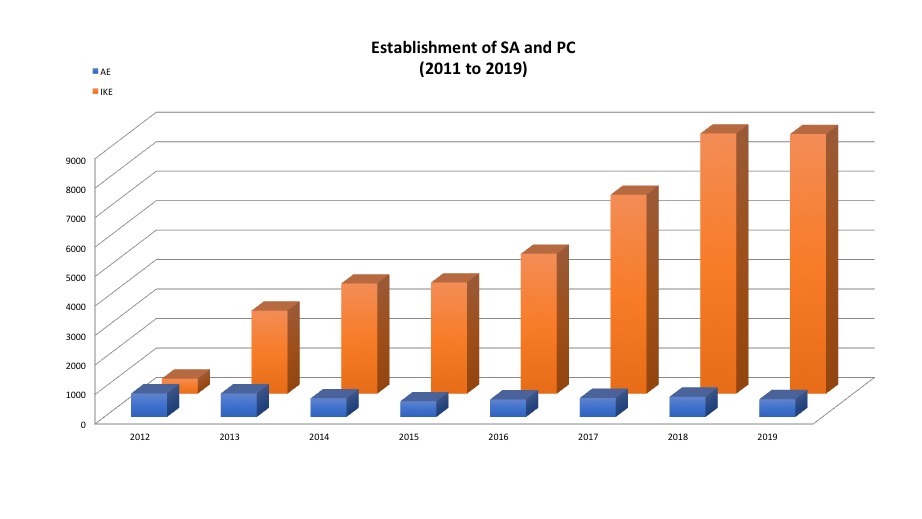
    Business Registry’s statistical data shows that the number of SAs established yearly is kept, notwithstanding some minor fluctuations, rather steady.

    On the contrary, the establishment of Private Company is steadily rising. Its flexibility and the fact that it is cheap and simple are, quite certainly, the reasons why it is preferred over SAs.


    V. In Conclusion

    SA and Private Company never competed against each other.

    Private Company prove to generally be cheaper than SAs. Of course, more flexible as well. And this is why they are generally preferred.

    But their “audience” is different. Bigger schemes, bigger investments and businesses wanting to take advantage of the tools the act on SAs provides, must, no doubt, choose the SA as the most fitting company type.

    The result of the comparison of these two company types, as mentioned above, is overwhelmingly in favor of Société Anonyme.

    And if we were to refer to SA as the “swiss army knife” by Victorinox (as the multitool that it is), we could not but consider Private Companyto be the “pocket knife”.

    Let’s say it is collapsible as well…

    stavros-koumentakis

    Stavros Koumentakis
    Senior Partner

    P.S. A brief version of this article has been published in MAKEDONIA Newspaper (November 10th, 2019).

  • Société Anonyme. The new act on SAs: “headache” or «business opportunity»?

    Société Anonyme. The new act on SAs: “headache” or «business opportunity»?

    New act on SA: a “headache” or a «business opportunity»?)

    Ι. Preamble

    Felix Hoffmann (1868–1946) was a famous German chemist.

    His name went down in history as the creator of, among others, a preparation intended to cope with headaches (the “aspirin”).

    The commercial success of the aspirin was, as we all know, huge. It was destined to be legendary -up to today. (As a result of its success, the aspirin is exhibited in the national Museum of American History of the Smithsonian Institute, in Washington.)

    The fact that the aspirin successfully cures headaches is, to this day, a given. The only headache it cannot cure is that which comes with businesses. And it is a big one…

    The new act on S.A.s has been in force, as it is well known, since 1.1.2019.

    But is it just one more “headache” or a (once in a lifetime) business opportunity?

    An act of a hundred and ninety (190) articles, a sixty-eight (68) page long act (pages in the Government Gazette) could not be analysed in just one article. This is not what we intend to do. But it is quite important to focus on the business aspect of it all. We will attempt to tackle the most important and most common practical issues that arise when dealing with an SA.

    The approach taken in this article will help realize how an act can turn into a business opportunity….

    (or not?)


    ΙΙ. A little backstory

    New act on SA – no. 4548/2018 (which replaced act 2190/1920) is very modern and up-to-date.

    But what was act 2190/1920? The second half of its name confirms that it was passed in 1920.

    Early 20th century, this act was indeed ground-breaking in the field of company law.  But with decades passing after it came into force, amendments were necessary in order for it to remain relevant. Some of them, major. And with the decades passing, the withdrawals, amendments, interventions and additions started piling on. Because going back to the provisions in place and “tweaking” them was not enough, we started adding new ones (e.g. articles 42, 42Α, 42Β, 42C, 42D, 42Ε). Those “adjustments” ended up being so many, that so few elements reminding of the initial act were left. Some provisions seemed to just be “thrown in there”, with no cohesion with the rest of the act. The act ended up being a true patchwork…

    Its replacement was a necessity.

    The hundred-year-old 2190/1920 already gave its place to the “young” 4548/2018. With the latter already in force for ten months now, we are in a place to come to some useful conclusions.


    ΙΙΙ. “Ignorance of the law” and “one size fits all” articles of association

    Since ignorance of the law is not forgiven, no one can claim they are above the law.

    What was happening until 31.12.2018? And what is happening now?

    Businessmen, with only a few exemptions, were completely ignorant when it came to their own company’s articles of association. Unfortunately, so did most of their advisors. Most articles of association were not “made” to serve the specific needs of each businessman. Minor amendments to the (statute) model-texts notaries had once drafted proved(?) enough. And the (new) SA was ready to go!

    But when a problem “knocked” on the SA’s door, the businessman would “knock” on a lawyer’s door. And the latter would turn, for the first time, to the articles of association.

    In most cases, that was TOO LATE…

    That is when the businessman would realize that they should carefully and properly amend their articles of association (and often this realization would come with a painful and unnecessary cost).


    IV. Business view of Societes Anonymes

    We have already seen in the introduction that such a long act (as is act 4548/2018) could not be analyzed (or even presented) in one article. But we sure can attempt to approach the most common and practical aspects of the act, at least from the business point of view. A decalogue would come in handy for businessmen and their advisors.

    Let’s take it one step at a time:


    1. A fast and, foremost, cheap start

    An SA can now be established in minimum time and with an close-to-zero expense.

    Since 2016 (article 9 act 4441/2016) the participation of a notary and a lawyer often proved redundant.

    The SA can now, in some cases, even be established with a private document (article 4 § 2 act 4548/2018). A necessary requirement is to be using the official model articles of association and submit it to the relevant “one stop shop” of the Business Registry. An important prerequisite: to not diverge from the official model. Small (?) detail: the “one stop shops” still only have available models drafted according to the (abolished since 1.1.2019) act 2190/1920…

    In more complex cases (as well as in cases where the founders wish to divert from the provisions of the official model) the SA can only be established with a notarized document. A notarized document is also required when a legal provision specifically calls for it, or if contributions in kind are made to the company, contributions that in order to be transferred a notarized document is required (article 4 §2 act 4548/20190).

    But still in cases where the articles of association can only be valid if they come in a notarized document, there is a way to minimize costs. Choosing small (size-wise) articles of association – by avoiding unnecessary repetitions of the law, is the best practice. The cost (at least of the official copies) will be significantly smaller. And even more so: possible amendments of the law will not create a need to amend the articles of association accordingly.


    1. Attracting and keeping capable executives

    It is extremely important for all businesses to achieve, among others, a triple goal:

    • Attract capable executives,
    • Keep them for a long time,
    • Minimize their cost.

    Businesses and their executives have, in most cases, contradicting interests -and both sides want to mainly serve their own.

    Executives want to receive, in most cases, bigger salaries and other benefits.

    Businesses want to give out lower salaries and minimize other relevant expenses. They also have medium- and long-term targets.

    When the conflict of interests between management and ownership minimizes, at least by a little, everything becomes simpler. But what is the way to do so in an SA?

    New Act on SA – 4548/2018 offers multiple opportunities to SAs, in order for them to successfully tackle the (given) conflict of interests between them and their executives. Some of them are the Stock Options (article 113 act 4548/2018), Bonus Shares (article 114 act 4548/2018) and/or Ordinary Founders’ Shares (article 75 act 4548/2018).

    In cases of Stock Options and Bonus Shares, the executive is offered a chance to become a shareholder (with or without monetary consideration). This new role (that of a shareholder) is offered either at the time the executives are hired or after they have already established a long-term relationship with the SA. This way the interests of the SA and an executive align.

    It is a bit different with Ordinary Founders’ Shares. Those shares are offered, among others, to executives at the time the SA is established.  The owner of an Ordinary Founders’ Share will be hoping for the improvement of the company’s economic outturn. This (improved) economic outturn is what it will bring for them the agreed upon profit. But the shareholders do not carry any risks regarding the shareholding balances: Ordinary Founders’ Shares do not carry rights equal to those typical company shares do (e.g. voting rights or participation in the management). At the same time, the dividend their owners can receive is maximum ¼ of the amount exceeding the minimum distributable dividend. In any case, Ordinary Founders’ Shares do manage to align the interests of executives and the business.


    1. Minimizing company expenses and shareholder disbursements

    Any business’s goal is, among others, the improvement of its cost-benefit ratio. This goal can (also) be achieved by minimizing costs. The shareholders aim to improve the company’s economic result. At the same time, to have to withdraw as less money as possible. The interests of a company and its shareholders are often perfectly aligned, sometimes identical.

    The recent act on Société Anonyme offers tools to achieve the abovementioned goals.

    We have already referred (above under 1) to the deduction of cost at the stage of a company’s establishment. Adopting the formal model articles of association and not involving a notary or a lawyer is a step to that direction. But what happens if a notarized document is required? Short articles of association with no repetitions of the law.

    But how can one minimize expenses when a company operates?

    We have already mentioned the tools the law provides for the minimization of salary expenses (above under 2).

    A relevant tool (for minimizing expenses) is the utilization of technology. The recent act offers significant opportunities for the utilization of technological tools. Opportunities not at all insignificant, that will not only boost effectiveness, but also minimize operating costs.

    And as far as shareholders are concerned, is it possible that they will have to suffer fewer financial burdens and make less withdrawals?

    The partial payment of the SA’s capital (article 21 § 1 act 4548/2018) is the tool to do exactly that. The partial payment of the capital can take place, under certain conditions, not only at the stage of an SA’s establishment, but also in cases of capital increases. By taking advantage of this opportunity, the shareholders can deposit in the company only a fraction of the capital they have taken on to cover. They can postpone the obligation to pay off the rest of it, thus facilitating the management of their finances.


    1. Attracting investment capital

    The expectations businesses once had, that banks would provide financial support, is well in the past.

    Attracting investment capital is now a pressing need.

    The act offers significant options and tools that will accommodate such needs.

    The tools offered are (among others):

    • Warrants (article 56 act 4548/2018), which offer the right to those who hold them to acquire, sometime in the future, shares of the company which issued them, in a pre-determined, low price.
    • Preference Shares (article 38 act 4548/2018) can offer a wide range of privileges. Receiving dividends before ordinary shares, receiving interest and having a priority when it comes to participating in a company’s profits that derive from a specific business activity are only some of them. Preference Shares can either incorporate or not voting rights.
    • Redeemable Shares (article 39 act 4548/2018) offer the right to their owners to request to have them, sometime in the future, bought by the company which issued them, in a beforehand agreed upon price.
    • Bonds (article 59 et seq. act 4548/2018).
    • A combination of the above “tools”.


    1. Drawing liquidity from the Société Anonyme

    Part of the (Greek) reality is the “utilization” of company cash, for covering needs of its shareholders. But a Company’s Cash and the Businessman’s “Pocket” are two different things. A possible blurring of the boundaries between the two will create multiple and extremely severe risks. For the business, as well as for the businessman. This is why “informally” obtaining liquidity from a company should be avoided. There are several tools, though, to help make it “formal”. A necessary prerequisite is the support of the majority of the shareholders and the ability of the company to respond.

    The most common tools are: (a) for the members of the Board to participate in the company’s profits, and (b) the conclusion of contracts between the SA and its major shareholders, BoD members and related parties (even more so since the previous provisions of the act have been abolished).

    As significant (if sometimes not more significant) as the above tools are, among others, the following:

    • The distribution of dividend (final or interim),
    • The Deduction of the Capital (articles 29 et seq. act 4548/2018),
    • The Amortization of Capital (article 32 act 4548/2018),
    • The issuance of Ordinary Founders’ Shares (article 75 act 4548/2018) and
    • The issuance of Extraordinary Founders’ Shares (article 76 act 4548/2018).


    1. Managingsmall shareholders

    New Act on SA – 4548/2018 strengthens, as it seems, the rights of the minority, especially through the right given to them for exceptional auditing.  Nonetheless, the existence and the implementation of the minority’s rights are not always enough to achieve the necessary balance in the relations between the minority and the company. Often, the exit of the minority shareholders from the company is in the best interest of both them and the company.

    The minority shareholders can reach the exit by taking five, among others, ways:

    (a) By the option given, under conditions, to the minority shareholders (holding ≤5% of the share capital) to request before a court:

    (aa) the redemption of their shares by the SA (Act 4548/2019, article 45) and

    (ab) to be bought-out by the majority shareholder (holding ≥ 95% of the share capital) -(Act 4548/2019, article 46)

    (b) By the option given, under conditions, to the majority shareholder (≥95%) to buy-out the minority shareholders (Act 4548/2019, article 47)

    (c) By the increase (ordinary or extraordinary) of the share capital, as well as

    (d) By a (combined) decrease and increase of the capital.


    1. Utilizing technology

    The Act on SAs facilitates, by providing plenty of relevant provisions, the utilization of technology. The use of technology, without it being obligatory, has proven beneficial on many levels. For example, technology can be used in an SA:

    (a) for issuing intangible shares and digitally keeping the Shareholder Book (Act 4548/2019, articles 34, 40 par. 2 & 5),

    (b) for the board of directors to conduct its business and take decisions (Act 4548/2019, articles 90 & 94),

    (c) for shareholders to exercise their rights through emails (Act 4548/2019, articles 122 & 123),

    (d) for General Assembly Meetings and forming of the relevant decisions (remotely and by electronic means – Act 4548/2019, articles 125 to 128, 131,135 and 136),

    (e) for shareholder unions (Act 4548/2019, article 144).


    1. Succession

    The SA is “the ultimate” capital company. In Greece, though, the majority of SAs are family businesses – heavily resembling partnerships, as per the way they are run.

    Almost every family business-SA at some point will have to deal with the issue of succession – the transition to the “next generation”. This issue is often “taboo”.

    Succession issues cannot be solved with “absolute truths”. But they can be solved if they are approached by mature businessmen and proper advisors.

    A great help towards solving succession issues can be drafting “tailor made” articles of association. Those that will:

    (a) Set, in advance, reasonable rules for restricting the free transferability of shares.  Introduce a procedure that can take place through issuing restricted shares (Act 4548/2019, article 43). The restrictions apply on all transfers, including the ones owing to the death of a shareholder.

    (b) Regulate (in the most appropriate way and reasonably) the exercising of the rights of the minority. Also, the rights of minority shareholders concerning auditing.


    1. Protecting the investment

    Attracting investment capital is not enough.

    The shareholders and administrators of an SA have the obligation to protect it.

    As already mentioned, carefully worded, “tailor made”, articles of association will play a significant part. Those articles must carefully set the proper boundaries in the relationships between shareholders, in order to avoid internal disputes.

    The rights of the minority shareholders and how they are exercised must, in this case as well, be carefully defined. Even more so when it comes to the rights of the minority shareholders concerning auditing.

    Another important issue for most SAs is securing the “next day” and the business venture, meaning securing the company’s and the existing shareholders’ interests. A possible transfer, i.e. of company shares to a competitor would, most likely, not be at the interest of the company. A provision for restricted shares appears to be necessary here as well.

    Establishing the reasonable (and probably necessary) restrictions that are the Tag Along Right and the Drag Along Right seems, in most cases, necessary.

    But necessary in all cases are:

    (a) The provisions in the articles of association regarding the protection from possible competitive and unfair actions taken by the BoD members, the executives and the shareholders.

    (b) The careful selection of the SA’s representatives.

    ) The careful definition of boundaries of the responsibilities of each one of its representatives.


    1. Protecting the owners, directors and executives

    The range of the responsibilities of the members of the board of directors is very wide. Civil, criminal, administrative liabilities before the company, before third parties, etc. These liabilities can be put in two large categories:

    (a) The responsibilities of the members of the board of directors, according to the Act on SAs

    (b) The other responsibilities of the members of the board of directors

    The responsibilities of the members of the board of directors cannot be set to zero. But they can be limited. Solutions towards that direction (among others) are:

    (a) The reduction of number of the persons involved (i.e. through the provision of a Single-Membere Administrative Body / Consultant-Manager)

    (b) The Insurance Of The Liability Of The Members Of The BoD And Of The Executives Of The S.A.


    V. The new act on SA as a “headache”

    The new Act on SA is, indeed, one more problem for businesses. And even more so, one more “headache” for businessmen. Businessmen have to (if they haven’t already):

    • Manage the (smaller or bigger) confusion created in their business.
    • Spend money on informing their
    • Spend money (i.e. on new articles of association) in order to align the operation of their company with the requirements of the new Act.
    • Get informed themselves (in general) and make sure that their advisors (legal, financial, tax) are also informed in detail and familiar with every aspect of the new Act.


    VI. The new act as a business opportunity

    On the other hand, the new act on SA is a significant business opportunity. With reference to the (necessary) alignment with its provisions, the businessman has the opportunity to reaproach important data. Among others, to search for the best solutions regarding:

    1. The drastic (and efficient) reduction of cost when attempting new business endeavours,
    2. The attraction and maintenance of capable executives, while simultaneously minimizing the cost of their salaries,
    3. The minimization of operational costs and of the shareholders’ withdrawals,
    4. The (always) wanted and necessary attraction of investment capital,
    5. The (best suited) solutions in obtaining liquidity from one’s business,
    6. The managing of small shareholders, something which, in some cases, proves crucial,
    7. The (multiple) utilization of technology, aiming to the business functioning more efficiently, as well as to saving money.
    8. The tackling of issues relating to succession.
    9. The protection of the business and the investment and, mainly,
    10. The protection of shareholders, BoD members and executives.


    VII. Utilizing the business opportunities

    There is no question that the new act on SA is a significant opportunity. An opportunity which, if approached in the right way, will create multiple business opportunities.

    But how should it be approached?

    It is necessary for the businessman to get informed on all the tools provided by law (it goes without saying, no great detail is needed).

    It is also necessary for them to confirm that their advisors and associates are in a place to support this endeavour. But the most important thing of all:

    It is imperative that they reaproach their SA’s articles of association and have them “tailor made” to their needs. The purpose and end goal should not be to just adjust it to the provisions of the recent act. The purpose should be to utilize the (very significant) opportunities it offers. Few of them mentioned above.


    VIII. In conclusion

    The recent (implemented since 1.1.2019) new act on SA has been the operative event for many headaches. Businessmen, accountants, lawyers, tax consultants, business advisors, we did not avoid them.  (at least not all of us…)

    No aspirin could treat, not even partially, a businessman’s “headaches”. The headaches created by the implementation of a new act included.

    If the “father” of aspirin (Felix Hoffmann) was alive, he would come to the same conclusion.

    With certainty.

    It is well-established that the “business opportunities” this act brought with it are more than significant. And multiple, compared to the “headaches”.

    All that is left is for us to utilize them.

    As soon as possible.

    stavros-koumentakis

    Stavros Koumentakis
    Senior Partner

    P.S. A brief version of this article has been published in MAKEDONIA Newspaper (November 3rd, 2019).

    νέος νόμος για τις ΑΕ απόκομμα

  • Board of Directors or a Consultant-Manager? 

    Board of Directors or a Consultant-Manager? 

    Board of Directors or a Consultant-Manager? 

    1. Preamble

    His unique personality and work are why the Austrian – American university professor, writer and advisor Peter Ferdinand Drucker, received, during his life of almost a hundred years (:1909-2005), the highest honors and titles. Some people gave him the title of the “Founder of modern management”. Although, since his time, his views have been challenged, his quotes still are of value. Among his others quotes: “The leader of a team must be able to say: “This has to be done. You will do it. In that way.” The survival of the team is depending on this unquestionable power. Without it, no one feels safe”.


    2. Facts change

    The multimembered/multi-shareholder and financially stronger business schemes are, in most cases, S.A.s. An essential part of an S.A.’s function: its Board of Directors. This collective body is the one that is, by law, exclusively given the power of the S.A.’s management.

    Until 31.12.2018.

    The management of an S.A., usually and essentially, is at the hands of the (capable or less capable) “leader of the team”, as Peter Drucker found, and that is such a person in every company.

    Facts have already changed (since 1.1.2019) for the Small and Very Small Businesses (as those are defined in Act 45488/2018) and for the unlisted companies.


    3. “Single-Member Administrative Body” or “a Consultant-Manager”

    According to Article 115 of Act 4548/2018, the Board of Directors of an S.A. can be replaced by one only manager – until now, that was the case only for Partnerships and other limited companies.

    This specific provision, since it constitutes a very important diversion from the pre-existing legal framework, seems to be the most “famous” among the one hundred and ninety (190) provisions in total of the new Act.

    The title meant to be given to this one person (which can now officially operate on its own, substituting the Board of Directors) is: “Single Administrative Body” or “Consultant-Manager” (from this point forward “Consultant-Manager”).

    Since 1.1.2019 (and as long as there is the relevant provision in the company’s statute) the Small and Very Small Businesses as well as the unlisted companies, can (now formally) trust their management to a single person.


    4. The legal framework around theConsultantManager

    The provision of article 115, par.2 of the new Act of S.A.s regulates the issues concerning the Consultant-Manager, by referring to the “rules in place for the Board of Directors, to the point they are compatible to the nature of the single-membered body”. A special (although indicative, par.5 of the same article) reference is made in this specific provision to the issues of appointment, conditions of electing, term of office, responsibilities, duties, powers of the Consultant-Manager, the appointment of its alternate, the Consultant-Manager’s civil and criminal liabilities, its payment and other relevant subjects to these, by referring to the relevant provisions in the Act set for the Board of Directors.


    5. The obligation of informing the “Consultant-Manager”, keeping Minutes and conclusion of agreements in which the “Consultant-Manager” has any interest.

    Among the obligations each member of the Board of Directors has, is the obligation to inform the other members of the Board (e.g. the obligation to reveal to them about any self-interests or conflicts of interest with the corresponding interests of the company – article 97 par.1). Given the lack of “other members”, the obligation of informing the rest of the BoD members is in this case an obligation to inform (article 115, par. 3) the company’s shareholders in a general assembly or each one individually.

    Furthermore: the decisions of the Consultant-Manager (the ones that are outside the sphere of the decisions taken regarding the “every day running of the business”) are recorded (article 115 par. 4) in the relevant book of Minutes (article 93), which can be kept digitally, as happens with the Board of Directors.

    Finally: for the conclusion of agreements between the Consultant-Manager and the S.A., the decisions (according to article 99) are taken and approved by the General Assembly (article 115 par.3) – instead of the, non-existing in this case, Board of Directors.


    6. Electing a Consultantmanager instead a Board of Directors can be useful

    The explanatory report of the new act of S.A.s mentions, among others, regarding this specific, new, article: “this is hoped to reduce the functional cost of the unlisted companies that wish to adopt this system, if they don’t have the size to justify a bigger number of people in administrative positions. Experience has shown that in many small S.A.s, there essentially is only one administrator, while the other members simply have a decorative function.”

    This specific assumption, although not expected in the context of an explanatory report, reflects the reality. And that is because it verifies, very vividly, the (true) observation that there is a “leader” in every team and also that in small (and not only) businesses in our country, the role of the Board of Directors is decorative.

    By selecting a Consultant-Manager instead of a Board of Directors, the management of the S.A., responds better to current conditions, because it is appointed to the only person that truly exercises this authority anyway. Additionally, it costs less and is more flexible. Afterall, the same explanatory report mentions: “Additionally, the ability to elect a “Consultant-Manager” simplifies the obligations in which the limited company has.”

    These reasons are not the only ones that point towards an S.A. electing a Consultant-Manager instead of the, until recently necessary, Board of Directors.

    We have already mentioned in previous articles (New Law on SAs: the Liability of the Member of the Board of the Directors and Other Liabilities of the Members of the Board of the Directors of a S.A.) the kinds and the extend of the liabilities of the members of the Board of Directors. Not rarely, the primary (usually one) businessman was in search, “using the lamp of Diogenes the Cynic”, of members to fill the empty seats of the (at least three-membered) Board of Directors. It is not uncommon either for people who accepted the, out of necessity (or out of wickedness, it doesn’t really matter) invitation from the businessman to «grace with their presence” this specific body and ended up being dragged to courts trying to prove their innocence or that “they don’t have blood in their hands”… In other words: when we limit the number of people involved, we automatically limit the range of people that could possibly be implicated in legal disputes or/and be exposed, in any way, to legal risks.


    7. Risks that come with this choice

    This choice (the election of a Consultant-Manager instead of a Board of Directors) is not without risks: The shareholders should consciously and in a formal manner accept the “ruling of one man” and everything good (and of course everything dangerous) that comes with it.

    What about the public image of the business? Will the potential future shareholders, investors or financiers accept the, at least in a first place, uncontrolled management of the Consultant-Manager?

    It does not seem very likely…

    Do the risks for the Consultant-Manager and/or the only (or primary) member of the shareholding scheme of the company increase?

    There is a long, ongoing, discussion regarding the issue of the requirements for “lifting the corporate veil” (of formally “seeing” in the legal world the owner of the company as the person behind it, and thus being able to claim from the owner what was initially due by the company). This can more easily be implemented where there are only a few shareholders or just one shareholder holding a company. In any case, one thing must be clear: Choosing a Consultant-Manager instead of a Board of Directors, is not by itself going to make the S.A.’s only representative liable for everything the company does. The lifting of the corporate veil, under the terms and requirements (mainly) set by precedents, cannot be referred in this case. The lifting of the corporate veil foremost refers to the cases where only one shareholder or partner take over (or tend to take over – directly or indirectly) the capital and the function of the legal person – hiding behind its legal form. But taking over the management of the S.A. by its Consultant/Manager who also happens to be the sole shareholder will, undoubtfully, push a court towards lifting the corporate veil.


    8. In Conclusion

    Thucydides, in his work “Stories”, outlines the personality of Pericles and while assessing its way of practicing politics mentions [2.65.10]: “It was in name a democratic state, but in fact a government of the principal man”. The distance between democracy and monarchy, in this case, is significantly smaller.

    The operation of an S.A. has, for the last one hundred years, gone hand in hand with its Board of Directors. This specific collegiate body functioned/functions, in most cases, only typically – as the explanatory report of the recent Act of S.A.s, bravely, admits. The BoD actual meetings have been replaced by the written BoD Minutes, that rarely need to be signed by the BoD members. In many cases those Minutes were/are only signed after they are published on the HELLENIC BUSINESS REGISTRY (in the past on the Government Gazzette) and after exact copies and excerpts of them have been issued by Drucker’s “leader” and Pericles’ “principal man”.

    This newly introduced provision of a Single-member Administrative body / Consultant-Manager is here to shift the legal frameworks and at the same time align it with everything reality and experience are demanding. It is here to make life and S.A.s’ function a lot easier. It is here to minimize the number of persons liable before the Government, Social Insurance Institutions and others that are possibly able to impose an indefinite number of administrative, criminal and civil liabilities on them.

    A careful application of this provision and a conservative use of it can, no doubt, make it successful.

    stavros-koumentakis

    Stavros Koumentakis
    Senior Partner

    P.S. A brief version of this article has been published in MAKEDONIA Newspaper (June, 16th, 2019).

    consultant-manager σύμβουλος-διαχειριστής

  • Calculating the value of a (minority) shareholding

    Calculating the value of a (minority) shareholding

    1. Preamble

    There is often the need to valuate a company, either as a whole or just a share of it (most likely a percentage of its shares / a specific shareholding). This need for valuation is associated either with a business deal (still at the stage of negotiations) (e.g. a merge or an acquisition) or with a legal dispute.

    The newly introduced law on S.A.s in more than one cases (e.g. articles 30, 45, 166 of Act 4548/2018) calls for a valuation of an S.A. or for a valuation of a specific share of it.

    In previously published articles {Minority Shareholders. Part A: The Claim of redemption of their shares by the S.A.,  Minority Shareholders. Part Β΄: Claim for a buy-out by the Majority Shareholder(s) and Minority Shareholders. Part C: The right of the majority to buy-out the minority} we have examined cases where the courts come in and, with the help of experts, valuate a company and a specific share of it. But what are the methods they follow in order to calculate how much a company is actually worth?

    Are there any laws?

    The answer is no.

    When it comes to public companies (listed either on regulated or unregulated markets), they all have something in common: the price of their shares is undisputable. The value of public companies (at least the value the stock market appoints to them) is easily calculated. “Blocks of shares” can of course reach prices that differ from the stock market value of the shares, but not by much.

    The question is: How are private companies valuated?

    A private company has no objective “market value”. No one can undisputedly assess its shares at any given point. Since such shares are not traded, the market has not been given the chance to show how much a private company is worth for it (the market).

    There are a few valuating methods that are generally (and globally) accepted.

    When it comes to assessing a specific share of a company, one must first valuate the company as a whole, according to specific financial information.


    2. Valuating a company

    According to experts, the most commonly used methods are based on:

    The company’s Balance Sheet (BS)

    Valuating a company according to its BS is, by far, the easiest and shortest way to go, since a BS is nothing but a snapshot of a company, taken the day the Balance Sheet is drawn. On the other hand, as a snapshot, the information a BS entails are static and thus could never represent the true value of a company. Although a BS could not, on its own, reliably evidence a company’s value, it is a good place to start an assessment and build on from that using other financial information.

    Profit and Loss Statement (PNL)

    When valuating a company according to its PNL, the focus is more on the company’s profits, dividend and sales. Such methods, when it comes to private companies, mainly take into consideration the return on capital. That seems to be the (only?) matter that interests an investor. When valuating a company using methods focusing on its PNL, when talking about profits we consider profits after tax.

    Goodwill

    A company’s goodwill is calculated mainly when negotiating a sale of said company. Goodwill is what is left when subtracting the company’s objective value from the sum a seller is willing to pay for it. Goodwill is the sum of a company’s intangible assets, such as its reputation, brand, place in the market, consumer and employee relations etc.

    Cash flow discounting

    This method valuates a company according to its cash flow discounting. The rationale behind it is that such a method will show a potential investor if a company is worth investing in the discounted cash flow finds the present cash value based on an expected cash flow -an x sum today is more valuable than the same x sum collected a year later. To elaborate, if one is holding 1€ today, with an annual interest rate of 5%, this 1€ will be worth 1,05€ in a year. Similarly, if 1€ payment is delayed for a year, today’s 1€ value is 0,95€.


    3. Valuating a company’s shares

    After figuring out how much a company is worth as a whole, its value is divided with the number of shares the company has issued. The result of this division is the value of each of the company’s shares (we have to stress that this is the most simplistic approach, as we, in this article, do not take into consideration the different kinds of shares a company can issue).

    This approach makes a lot of (mathematical) sense. But it makes no economic sense. How can a minority shareholding, for example 2% of the company’s shares, have a value proportional to that of the remaining 98% of the same company?

    When negotiating a sale of a minority shareholding, it is common that a discount is applied [discount from the value the shares come to have after the division: (company value/number of shares) x number of shares sold]. In practice we are shown that the discount applied has almost everything to do with the percentage of the company sold – that is with the powers over the company sold.

    The smaller the shareholding, the less powers come with it.

    Let’s talk with numbers

    The discount that is in practice applied is as follows:

    % of the company sold Discount applied
    < 10% 60% – 75%
    10% – 25% 45% – 55%
    26% – 49% 30% – 40%
    50% 15% – 25%
    >50% 5% – 10%


    A precedent set in the UK (case Lynall, Lynall v IRC (1971) 47 TC 375) is, at this point, worth mentioning, where the court ruled that, when calculating the value of a private company’s shares one has to, no matter the size of the shareholding sold, apply an additional discount of 25% to 50%.

    Nothing is fixed

    In order to apply any discount, all factors relating to the sale have to be taken into consideration. The aforementioned discounts are just a place to (or to not) start negotiations.

    For example, the sale price will be affected not only by the percentage sold, but also by the percentage held by the rest shareholders. There is a big difference, for example, if the shareholding sold is that of 11% when the rest shareholders are holding 5% comparing to when there is one shareholder holding a percentage of 40%. The sale price will also most likely be affected by to the rights following the shares regarding the receiving of dividends, the appointing of BoD members, legal issues regarding the right to vote in GAs, the person buying the shares (for the shareholder already holding 98% over a company, compared to an “outsider”, a 2% shareholding is far more valuable) and so on.

    Anti-embarrassment provision

    When a minority shareholding is sold to existing shareholders, it can be agreed in advance (in a private agreement) that, within a specific time period following the sale, if the buyer of the minority shareholding decides to sell their shares to a new buyer, the initial seller of the minority shareholding will benefit from a (possible) surplus value of the shares they sold in the first place.

    Forced sale

    No discount is applied when there is a case of a forced sale (e.g. a drag along).


    4. In Conclusion

    One has to always align with everything all national or international (e.g. EU Regulations) laws compel. But when it comes to everyday functions of the market, we come to realize that there are some “laws” set by the market itself. Those “laws” set and chosen by the market are often more powerful than the actual legislation that is in place. In any case (and despite all the exceptions), “laws” set by the market are the ones that, in the end, will prevail: the free market (no matter its rivals) will always know what is best, what should be required, how to valuate, to appreciate and, in the end, how to attribute the true value to things.

    Lida Koumentaki
    Junior Associate

    Υ.Γ. The article has been published in MAKEDONIA Newspaper (June 9, 2019).

    value of shareholding

  • Equity Instruments

    Equity Instruments

    Preamble

    “When there is something in written, no one can dare question it” -this is a Greek quote referring to the necessity of putting all agreements in writing. It also captures, in a neat and crystal-clear way, the relationship we elders have with “tangible pieces of paper” but also the insecurity that comes with their absence. This is how we were raised: with the need to hold “paper proof” engraved to our subconscious!

    Different times.

    Different times, but this “entry” in our subconscious is, more or less, still with us.

    Besides those “paper proofs”, in the general sense, there are some kind of “pieces of paper” that, as security instruments, have some special weight and value to them. One example would be the equity instruments. In the past, when discussing share transfers in a Stock Exchange Market, we were referring to nicely (and securely?) printed equities that “changed hands” through contracts made by the shouting pit brokers.

    Just before the dawn of this millennium (when we left behind the stockbrokers and were “introduced” to brokerage firms) we started talking about “the dematerialization of shares”. Printed shares of listed public limited liability companies would gradually be replaced by a simple entry in a ledger and transfers would no longer be done in the pit, but through the Automated Integrated Trading System of the Athens Stock Exchange.

    This is as far as the listed companies are concerned.

    Today, in the age of technology, the “paper” -the printed document- is gradually starting to lose its value. The certification of share ownership and some tangible piece of paper could no longer remain indissociable.


    The obligatory publishing of equity instruments (final, no longer temporary ones).  

    The share capital of a company is divided to shares (Article 34, sub. 1, Act 4548/2018). Shares can from now on only be registered (Article 40, par. 1, sub. A). When no regulation is providing otherwise, all companies have to (Article 40, par. 3) issue and deliver to their shareholders equity instruments, incorporating one or more shares (: single or multiple equity instruments). In most cases (of issuing equity instruments that incorporate multiple shares), the company has to replace existing equities with new ones, incorporating fewer shares.

    Pre-existing legislation (Article 8b, par. 3, Act 2190), provided for the right to issue temporary equity instruments. This provision no longer exists, thus the era when (in common practice) only temporary equity instruments where issued by limited liability companies, is well gone. From this point forward, we will only have permanent equity instruments.

    In any case, shareholders have the right to decide whether they will issue equity instruments or not (Article 40, par. 4 sub. A). A decision to not issue equity instruments will result in the need to define a way to certificate who is holding ownership over the company’s shares, in order for them to exercise the rights that come with said ownership. The shareholders are the ones to choose (and state in the company’s article of incorporation) the exact way the certification of ownership of said company’s shares will take place and thus be proven. In case they do not do so, the law defines (Article 40, par.4 sub. c) that the way to prove one is a shareholder is through the data entered into the company’s Shareholders Book. Since we have entered the “paperless era”, the law gives all S.A.s (listed or not, article 34, sub. a) the freedom to choose to either issue printed shares or intangible ones -shares not incorporated in some “piece of paper” and are nothing more than an entry in a ledger.


    The company’s Shareholders Book

    The certification of share ownership is mainly given through the company’s Shareholders Book, which all S.A.s must keep (Article 40, par. 2, sub. 5). The shareholders’ information (full name or company name, address or seat, occupation and nationality) are registered in the company’s Shareholders Book (Article 40, par. 2, sub. 2&3). But not only that. In this Book, the number and the class of shares (i.e. ordinary, preferred, redeemable etc.) that each shareholder owns is registered, along with the rights they have on them and the rights that derived from them (i.e. full or bare ownership, usufruct, voting, receiving dividends etc.).

    Experience has shown that the company’s Shareholders Boos is a rather “sour subject” for S.A.s: Sometimes it is kept, sometimes not. And the times it is kept, we are surprised (most of the times negatively) by the findings, because it is kept by people that do not know how to properly update it. The problems companies face because the Book is not properly updated are showing more and more during the past few years: the companies are now receiving more request for access to the Book’s data, by those who have the right to make such requests (e.g. banks, funds, interested investors, interested shareholders, courts etc.).

    When the company’s Shareholders Book is properly kept, things are simple: Not only the company’s shareholders information are shown in it, but also the number of shares they hold and all other necessary, and specified by law, information and rights. The (commonly) improper keeping of the Shareholders Book seems to be the reason (with the law accepting it) that the certification of the shareholder capacity cannot exclusively rely on the Book’s entries (article 40, par. 4, sub. c). In case of emergency (when there is simply no relevant entry in the Book, or there is an entry that is wrong or incomplete) the shareholders can provide any other document they hold, that is stating or proving their shareholder capacity and the relevant rights that come with it.


    Keeping the company’s Shareholder Book in an electronic format

    The very important for the company and the shareholders keeping of the Shareholders Book does not have to be done in paper. According to law (article 40, par. 2, sub. 4), the Book can be kept electronically by the company itself or by a third party. The keeping of the Book in an electronic format by the S.A. itself will, most likely, not solve the problems that have since this day been arising by the Book being held in a tangible paper format.

    Third parties that are allowed (by law) to electronically keep Shareholder Books on behalf of S.A.s are credit institutions, investment companies (that specifically have that right) as well as Central Securities Depositories. Under the current conditions of the Greek market, it does not seem safe for an S.A. to opt out to let the keeping of its Shareholder Book to a bank or an Investment Services Firm. The safest solution seems to be the digital keeping of the Shareholders Book by the Central Repository of the Athens Stock Exchange, which now offers this service not only to listed, but to not listed S.A.s as well. The relevant procedure is in progress.


    Keeping the S.A.’s shares in book entry form

    A company’s shares, as mentioned above, do not have to be issued -and even more so, do not have to be issued in paper form. The law (article 40, par. 5) provides that the S.A.s can keep them in a book entry form. For the procedures that lead to the dematerialization or immobilization of the shares, Regulation (EU) No 909/2014 of the European Parliament and of the Council of 23 July 2014 applies.  The company’s articles of incorporation should, in any case, predefine the specific method that will be used for the issuing and keeping of the shares in a Central Securities Depository.


    In Conclusion

    The day we will no longer be using actual and tangible pieces of paper is not far. The new law on S.A.s has chosen to give the freedom of either issuing or not shares and, in case someone opts out for issuing shares, the choice of either issuing them on tangible pieces of paper or as intangible entries in a log. Respectively, the company’s Shareholders Book, with the special place is holds to this day, can either be held as a tangible, thick and old actual book or as an electronic log that can easily be fed data and be easily held on a computer in an office, on a cloud etc.

    It seems that the value of the infamous quote “when there is something in written, no one can dare question it” seems more old fashioned by the day. All the more when it comes to S.A.s. The obsession with using tangible pieces of paper because it (supposedly) provide us with more security as well as with past practices and experiences will with not so much doubt be characterized by the younger amongst us with one, condescending word: inflexibility.

    If we do not manage to be amongst those who guide the rest to the future, at least we should try to be amongst the first who walk towards the future.


    stavros-koumentakis

    Stavros Koumentakis
    Senior Partner

    P.S. A brief version of this article has been published in MAKEDONIA Newspaper (June 2nd, 2019).

  • Minority Shareholders. Part Β΄: Claim for a buy-out by the Majority Shareholder(s)

    Minority Shareholders. Part Β΄: Claim for a buy-out by the Majority Shareholder(s)

    Minority shareholders.

    Part Β΄: Claim for a buy-out by the Majority Shareholder(s)

    1. Preamble

    It is redundant to say that in any country that respects its laws, the principle of freedom of contract stands strong. In Greece, this principle is introduced in our legal system in article 361 of the Greek Civil Code (: “For the establishment or modification of any legal obligation a contract is required, unless the law provides otherwise”). This principle is based on article 5 paragraph 1 of the Greek Constitution, which refers, amongst other things, to the [right to] economic freedom.

    Specific aspects of the principle of freedom of contract are the freedom to enter (or not) into an agreement, as well as the freedom to choose what said agreement (should one choose to enter into one) will provide.

    According to this, no one is obligated to enter into an agreement (even more so in a predefined one), unless a specific law “provides otherwise”.

    Respectively, when it comes to S.A.s,  no one is obligated to buy the shares of any minority shareholder -especially when the latter’s share is so small that it has no real value in terms of assisting to the formation of the so needed majority. In this case, it is highly likely that nobody will be interested (or nobody will let show they are interested) to purchase such kind of a minority shareholding.

    Amongst his other quotes, the actor and director Clint Eastwood has infamously said that “if you want a guarantee, buy a toaster”. If the minority shareholder decides that their investment is not profitable or even problematic, they cannot just simply return it for a refund: shares are not toasters. Shares are not covered by guarantees, as are toasters.

    A safe assumption could be that, at least at a first glance, no one can be obliged to acquire a minority share package, unless some specific requirements are met…

    There has already been a reference to the legal claim a minority shareholder may have against the company, for the latter to buy them out, as well as all the relevant requirements and procedures (read related article). In this article, we will mainly focus on a minority shareholder’s possible claim against the majority shareholder to buy them out.


    2. The right of the minority shareholders to request a buyout by the majority shareholder

    The requirement for the minority shareholding to be holding shares that do not exceed 5% of the total of the company’s shares

    In the case of a private S.A., (as far as public S.A.s are concerned, the rules of public offerings apply, supplemented by the Greek law of S.A.s) the main requirement is in regard of the percentage of the minority shareholding. The Greek law of S.A.s (article 45 paragraph 1 of law 4548/2018) is strictly limited to shareholders holding a maximum of 5% of a company’s shares. This percentage is calculated as a percentage of the nominal value of the shares the minority shareholders hold on the overall total of the total nominal value of all the shares of the company. It is irrelevant whether a shareholder is holding 5% or less of the ordinary or of the preferred shares of the company. Only the percentage of the company’s shares held matters.

    Furthermore: Minority shareholders holding a percentage higher than 5% of the company’s shares are not entitled to require a buy-out by any shareholder. Not even for a sum of shares equaling to less or up to 5%.

    This provision seems fair. Most of the minority rights recognized under Greek law are recognized to the minority shareholders that are holding more than 5% of a company’s shares. If a shareholder is not holding 5%, their protection seems, and is, extremely limited.

    The requirement for at least 95% of the company’s shares to be held by one (?) shareholder

    The majority shareholder -of 95% or more, a percentage gathered after the company was set up- has (originally) the obligation to buy-out the minority shareholder. In case the minority shareholder accepted at the stage of the very establishment of the company that they would have a percentage lower to 5%, the law assumes that they also consciously accepted that they would have limited protection under the law. Because of that assumption, Greek law has chosen not to “force” the majority shareholder to buy-out such a minority shareholder.

    It is noteworthy that in calculating the required 95% of the shares held by the majority shareholder, one must also count in the shares held by the parties related to them. The legal entities characterized as “related parties” to the majority shareholder and whose shares are considered as shares of the majority shareholder when calculating the percentage of shares the latter is holding, are identified as such by article 32 of law 4308/2014. The persons characterized as “related parties” to the majority shareholder and, again, whose shares are considered to be shares of the majority shareholder when calculating the percentage of shares the latter is holding, are identified as such by Appendix A of the aforementioned law. To be more precise:

    Regarding the related parties that are legal entities, article 32 of law 4308/2014 is extremely detailed. It is redundant, in the context of this article, to get into great detail. One general rule that would be useful to keep in mind is that related parties are generally considered to be the parent company and the subsidiaries of the majority shareholder or of a company that is related to the majority shareholder. It should also be noted that those legal entities that choose to or legally have to prepare consolidated financial statements with the majority shareholder or with related to the latter legal entities are also related parties to the majority shareholder.

    Annex A of law 4308/2014 instructs us in counting in shares held by natural persons- members of the majority shareholder’s close family- when calculating the latter’s share over the company. According to this law, such persons are the majority shareholder’s ascendants, descendants, spouses, and live-in partners.

    Time Limit

    The right given to the minority shareholder (holding a 5% or less of the company’s shares) to request a buy-out is subject to a five-year limitation period. This five-year period starts the moment the majority shareholder (along with their related parties) is holding at least 95% of the company’s shares. After the lapse of this five-year period, the aforementioned minority shareholder no more has the right to request a buy-out by the majority shareholder holding 95+% of the company’s shares.

    The shareholder obligated to buy

    Article 45 of law 4548/2019 refers to the obligation of the majority shareholder to buy-out the minority shareholder holding less or equal to 5% of the company’s shares. As already stated, in calculating the majority shareholder’s share over the company (in order to determine whether they are holding 95% or more) one must also account in the shares held by related parties of the shareholder (legal entities or members of their family). In case there actually are related to the majority shareholder parties holding company shares, one should take it as a given that the related parties will be obligated to acquire the shares sold by the minority shareholder analogically to the company shares they hold prior to the buy-out. It goes without saying, these related parties will have to pay for the shares they are acquiring, at the price determined by the competent court. This approach seems the only logical one since anything else would disturb existing balance amongst the remaining shareholders.

    The procedure leading to the buy-out

    The minority shareholder that wishes to be bought-out has to submit the relevant request to the competent court (article 46 par. 2 and article 46 par. 4 of law 4548/2018). The latter will rule whether the requirements set by the law are met. If the minority shareholder’s action is upheld, the court will rule on a just and equitable price per share, as well as on the specific terms the buy-out will be implemented. In order to determine the price per share, the court will take into consideration the value of the company. In this case it is more than fair (as well as allowed by law) for a report to be requested by an independent expert regarding the value of the shares sold; In most cases, the independent experts that will provide said report to the court will usually be either two chartered accountants or an audit firm. This independent expert report will evaluate the arguments made by the opposing parties.


    3. In conclusion

    The protection offered to the minority shareholder holding a percentage of less than 5% of the company’s shares is extremely limited by law. To counterbalance this extreme risk exposure (and in contrast to the right to economic freedom and the principle of freedom of contract, as they are both stated and protected by the Greek constitution) the above-mentioned minority shareholder has the right to request to be bought out from the company by the company’s majority shareholder of 95% or more.

    The law does not force S.A.’s shareholders to notify the moment the percentage either they or their related parties hold over the company’s shares reaches or exceeds that of 95%. As a result, the minority shareholder has to be alert as for when their rights kick in, otherwise said minority shareholder on the one hand risks to miss their opportunity to exercise their rights to be bought-out altogether, on the other to fail to achieve a good price for their shares.

    As for the majority shareholder, they have every reason to avoid holding 95% of the company’s shares. If they succeed in doing so, they will be able to enforce onerous terms on the minority shareholder while negotiating a possible buy-out of the latter. Such a negotiation could easily start by reminding the minority shareholder of the infamous abovementioned quote by Clint Eastwood…

    stavros-koumentakis

    Stavros Koumentakis
    Senior Partner

    P.S. A brief version of this article has been published in MAKEDONIA Newspaper (May 12th, 2019).

  • Minority Shareholders. Part A: The Claim of redemption of their shares by the S.A.

    Minority Shareholders. Part A: The Claim of redemption of their shares by the S.A.

    Minority Shareholders.

    Part A’: The Claim for Redemption Of Their Shares By The Société Anonyme.

    The existence and exercise of minority rights – as described in an earlier article – “Minority and its rights in the Société Anonyme” and “Minority rights in the SA: the exceptional auditing” – are not always enough to achieve of the necessary balance in its (the minority’s) relationships with the company. Nor, in the end, in the company itself.

    Sometimes “divorce” seems necessary …

    The majority of shareholders exercising their voting rights are entitled (and rightly) to make critical decisions about the future of the company. Critical, in a logical sequence, also for the future of minorities. Sometimes even potentially damaging to the latter.

    What are these potentially harmful decisions? And, if they are taken, the minority shareholders remain unprotected? And under what conditions would it be possible to implement a “divorce” between the company and the minority shareholders?

    According to English actor Carrie Grant: “Divorce is a game played by lawyers”. And from this particular “divorce” they could not miss …


    Causes For The Claim Of Shares Redemption

    It is a fact that within the framework of democracy (and of the law of the Société Anonyme) the majority shareholders are the decision makers. Sometimes, however, these same decisions could be assessed as making it “in an obvious manner, particularly unprofitable” to retain the minority shareholders in the company (Article 45 par.1, section an of the l. 4548/2019). The assessment, of course, belongs to the minority shareholders themselves. The latter will exercise their statutory rights if they adopt this position.

    The Law on the SAs (Article 45 par.2) recognizes as potentially harmful to minority shareholders decisions concerning: (a) the transfer of the registered office of the company to another State; (b) the introduction of restrictions on the transfer of shares; (c) the change of corporate purpose and finally (d) any other event which, according to the company’s articles of association, activates respective rights of the respective shareholders. In the latter case, however, it is necessary to provide for a time limit for their exercise.


    The “Way Out” Of Minority Shareholders And The Relevant Conditions For The Shares Redemption Claim  

    In the event that any of the above events occurs, the law provides (significant) protection to minority shareholders: they are entitled to address to the competent court asking for the redemption of their shares by the company (Article 45 par.1: “redemption by right”-internationally known under the Anglo-Saxon term as sell-out). It imposes, however, a double condition on the applicants (and claiming to be protected): Firstly, there having been represented in the General Meeting which took the disputed decisions and, on the other, their opposition. Possible absence from the relevant General Meeting, voting in favor of the relevant decision or abstaining from the vote, it removes the aforementioned right (i.e. to appeal to the Court asking for the redemption of their shares). However, if a statutory provision refers to an event not related to a decision of the General Meeting, this (double) condition does not stand.

    The term within which “the injured” minority shareholder must “take action” – i.e. bring the claim and exercise his / her right – is three months from the completion of the amendment of the articles of association. This time limit applies in cases of transfer of the company’s registered office to another state, of the introduction of restrictions on the transfer of shares and the change of the corporate purpose. In the other cases provided for by the Articles of Association, the deadlines indicated therein shall apply.


    The Case Of Introducing Restrictions On The Transfer Of Shares

    The company’s interest requires that the company’s continuity be safeguarded. And this is sometimes, to a considerable extent, dependent on its shareholder structure. The introduction of restrictions on the transfer of shares sometimes proves to be crucial (refer to the article on Restricted Shares). The relevant provisions in the Articles of Association at the time of the establishment of the company appear to be a “sine qua non” element to ensure the relations between the shareholders and the achievement of the corporate purpose.

    In the vast majority of cases, unfortunately, such statutory restrictions are not provided for when establishing the company. When the need is identified subsequently, the majority shareholders are in fact able to impose the necessary statutory change. However, the minority shareholders are then (reasonably) entitled to request the redemption of their shares and, ultimately, their exit from the company. It is for the court to decide on the reasonableness of the request of the minority shareholders and, in particular, “if their stay in the minority becomes manifestly unprofitable”. In other words: minor restrictions on the transfer of shares could not justify meeting the request of minority shareholders.

    However, for the cases where the necessary restrictions on the transfer of the shares have been provided since the company’s establishment, there is no reason for the corresponding minority shareholders’ rights.


    The Case Of Modifying The Company’s Purpose

    A similar assessment will, of course, be made by the Court even if the minority shareholder complains (and exercises his/her rights) due to a change in the corporate purpose. It would reasonably be considered to be particularly unprofitable for the applicant to convert, for example, a holding company into a CD production company. On the other hand, it would not be possible to (severely) support the minority shareholder requesting the redemption of his shares from a (painless) expansion of corporate activities.


    The Court’s Judgment On The Claim For Shares Redemption

    The minority shareholder’s claim for the redemption of its shares by the company is assessed by the competent court (Article 45 par.4). The latter is to determine whether the conditions laid down by the law and the substantive merits of the applicant’s arguments are fulfilled. If the claim is accepted, the Court shall determine the fair and reasonable consideration (in exchange for the redemption of the minority shares) and the terms of payment. In determining the price, the value of the company is taken into account. It is logically expected (and not only legally permissible) to request a relevant expert report, which is usually carried out by two auditors- chartered accountants or an auditing firm. This expert opinion is also the one to evaluate both sides’ arguments.

    The court decision is always binding on the company (Article 45 par.5). In the event of the fault being breached within the time limit set by the court order, it may be decided the company’s dissolution.

    However, the judgment is not binding on the requesting shareholder. If the price to be determined by the court decision is not evaluated by the applicant as satisfactory, it is entitled to refuse to complete the relevant procedure (transfer of its shares to the company). In that case, of course, he/she is charged with the costs of the relevant proceedings.


    In Conclusion

    Coexistence in life is not always easy – possibly once and unacceptable. Respectively in business – much more when particularly important (sometimes) economic interests are at stake. The law recognizes the minority shareholder’s right to ask for “dissolution” and for “compensation” by the company when certain important conditions are met. It is, however, particularly important to stress that the importance of the Articles of Association is once again as distinct. Its provisions should either take place in a timely manner (i.e. when the company is established) or in a way that does not affect minority shareholders (unless the aim is precise to affect their rights) …

    There is no doubt that the specific legislation is a means of protecting minority shareholders. But as this divorce, as already mentioned, “is a game played by lawyers”, it is likely to become a weapon, important in the hands of the majority.

    Particular attention, therefore, in both the articles of association and the lawyers …

    stavros-koumentakis

    Stavros Koumentakis
    Senior Partner

    P.S. A brief version of this article has been published in MAKEDONIA Newspaper (May 5th, 2019).

  • Workshop on the New Law on the SAs At the Money Show 2019

    Workshop on the New Law on the SAs At the Money Show 2019

    [vc_row][vc_column][vc_column_text] On Saturday, April 13th, at the Hyatt Hotel, within the framework of the 30th Money Show 2019, a workshop on “Family Businesses in the New Business Environment” was held. The event was co-organized by Capital Markets Experts, the Institute of the Association of Greek Financial Managers (SEODI) and the law firm of KOUMENTAKIS & ASSOCIATES.

    In a packed room, those interested had the opportunity to listen to speeches on three different axes. More specifically, the President of SEODI referred to the role of the Ecumenical Director as part of a family business, Mr. Vasilios Margaris, founder and chief executive of Capital Markets Experts, referred to the necessity of entering a family business on the Stock Exchange, while Mr. Stavros Koumentakis, Senior Partner of KOUMENTAKIS & ASSOCIATES Law Firm briefly presented the new Law on Sociétés Anonymes and referred to its application in family businesses.

    Stavros Koumentakis highlighted the multiple business opportunities that the changes brought by the new Law on Sociétés Anonymes are making and noted that Law 4548/2018, which has already begun to be implemented, offers many benefits that we need to focus on. In the relevant DECALOGUE, Mr. Koumentakis stressed that the new Law on Sociétés Anonymes offers options for:
    (1) Quick and economic start;
    (2) Attracting & retaining executives;
    (3) Cost reduction;
    (4) Attracting investment funds;
    (5) Various ways of raising liquidity;
    (6) For managing small shareholders;
    (7) Exploiting technology;
    (8) The preparation of succession
    (9) Protection of investment and
    (10) Protection of persons.

    As Mr. Koumentakis characteristically mentioned: “The new law is an important opportunity to get to know the operation of our Société Anonyme. With proper guidance and implementation of the new law, we can ensure better protection for founders, shareholders and the investment, redesign on the right bases and reduce operating costs. We can also attract new people and maintain the most capable executives, create the conditions for access to “cheap” funds and use modern technology, and finally, we can better prepare for the next day of our business”.

    In the relevant presentation and video briefing, the most important of the changes were briefly described and a special emphasis was placed on the need to inform entrepreneurs who need to understand the new law and ensure that this knowledge exists among executives and close associates. Lastly, the urgent need for immediate adaptation of the articles of association has been highlighted not only as compliance with the new law but, in particular, to meet the needs of each entrepreneur and each company to adequately meet present and future requirements – particularly those relating to their safe development course.

    [/vc_column_text][/vc_column][/vc_row][vc_row][vc_column][vc_text_separator title=”Gallery” border_width=”3″][/vc_column][/vc_row][vc_row][vc_column][vc_images_carousel images=”37166,37164,37162,37160″ img_size=”full” speed=”6000″ slides_per_view=”5″ hide_pagination_control=”yes”][/vc_column][/vc_row]

  • Minority rights in the Sosiete Anonyme. Part II. The Exceptional Auditing

    Minority rights in the Sosiete Anonyme. Part II. The Exceptional Auditing

    Minority Rights In The Société Anonyme: An Internal Enemy Or A Determinant Of Health? 

    Part B’- The Exceptional Auditing

    According to Solon the Athenian: “Best governance is where the people obey the rulers and the rulers obey the laws”. In the course of history, it has turned out that everyone who rules embraces (apparently, or even deeply) Louis Ludwig’s XIV saying “L ‘etat c’ est moi” (“the state is me” – for which we have already referred to in Part A of the present). In order to ensure legitimacy in the parliamentary democracy, the principle: “the government rules and the opposition controls” (rightly) applies.

    All of this, of course, does not concern politics alone, as it would be easy (and reasonably) able to make the visibility in life and business: Thus, obviously, brought birth to the need for control of the (small or large) majority of each minority. To safeguard the property of the latter but also the property of the enterprise. To ensure its prosperity and its growth.

    And finally: A company under the watchful eye of multiple controls and auditors pretends (and potential investors and/or creditors) for clear financial and “clean” representations …


    Regular And Exceptional Auditing In The Société Anonyme

    We have referred to minority rights (interests) in the Société Anonyme in a previous article. In the present, our reference is limited to the minority rights that are linked to the exercise of exceptional auditing.

    The regular auditing is distinguished for its periodicity as it relates to the approval of the annual financial statements by the General Meeting of the companies concerned (but not necessarily for those designated as small and very small entities). Therefore, exceptional auditing may be carried out in a company under regular auditing.

    In this context, it is not paradoxical to overlap (partial or total) specific auditing areas: for example, checking the fund is subject to regular auditing but it may also be the subject of exceptional auditing.

    In any case, the exceptional auditing may:

    (a)  also cover areas not covered by the regular auditing such as, for example, the feasibility of managing the company;

    (b) be always more targeted than the regular;

    (c) be carried out, in principle, by persons other than those carrying out the regular auditing and in different ways by the appointed ones;

    (d) result in a finding that is not primarily addressed to the same recipients.


    Types, Conditions and Exceptional Auditing Procedure

    In the event that the conduct of acts contrary to the law, the articles of association and/or resolutions of the General Meeting is assumed, shareholders representing more than 1/20 of the share capital of the Société Anonyme (or, for listed companies, by the Securities and Exchange Commission) are entitled to submit a request to the competent Court for the purpose of carrying out the relevant auditing (article 142, par. 1 & 2, l. 4548/2018). The relevant application shall be submitted within three years from the approval of the financial statements for the year in which the transactions in question appear to relate.

    However, if the circumstances show that the management of the company is not exercised in a proper or prudent manner, shareholders representing more than one fifth (1/5) of its share capital shall be entitled to apply to the competent court for the purpose of carrying out the audit ( Article 142 par.3, l. 4548/2018).

    The court decides whether or not to accept the verification request after checking whether or not the aforementioned conditions are met. It is likely that the requesting minority shareholders are represented in the Board of Directors (either because they have directly appointed members or because they have been elected members of the list of potential shareholders nominated by the shareholders). In this case, the court may also assess that there is no justification for the submission of such a request which, in such a case, will be rejected.


     The Auditors And the Conduct Of The (Exceptional) Auditing

    f the court accepts the request for auditing, it specifies the persons who will carry it out (Article 143). The persons entrusted with the auditing may be:

    (a) an audit firm or, at least, a statutory auditor;

    (b) Holders of an A class accountant’s license from the relevant Economic Chamber and, in addition (when it comes to the legitimacy or good governance)

    (c) persons with any specific knowledge, if required.

    The court, when accepting the request, also determines the amount of the remuneration of the appointed auditors, as well as the procedural issues regarding the time of payment, the possible advance payment and the person charged (if the applicants are liable for payment or the company under auditing).

    The auditors appointed will have to complete the auditing assigned to them in the shortest possible time. The relevant result is handed over to the applicant as well as to the Company. The Board of Directors is obliged to inform the shareholders of the company (no later than the next General Meeting) and the Hellenic Capital Market Commission – in the case of a listed company.

    However, it is important to underline that there is an independent obligation for auditors to submit their findings to the competent public prosecutor in case they find that criminal offenses have been committed.


     Exceptional Auditing: A Blessing or A Curse

    The exceptional auditing is usually conducted either when there is evidence or suspicion of mismanagement or when the demand for applicants is to exert pressure on the managers.

    Taking into account the potential scope and depth of the auditing being carried out, the exceptional auditing may work:

    (a) dissuasive or unlawful or unauthorized acts;

    (b) as a means of exerting pressure on their executives or (under certain conditions) of their extortion;

    (c) as (critical) evidence in the context of claims against the persons involved.

    It follows from the above that the right to conduct exceptional auditing is of particular importance in the operation and (conditionally) in the life of the société anonyme itself. This is even more perceptible when criminal offenses are identified, so the competent prosecutor must also be involved.

    In any case: The emergence of unauthorized or unlawful acts through an official (legally ordered) auditing procedure can only cause problems for the company itself – and not only to the case-by-case, insolvent or legally culpable persons.


     Minority rights in Conclusion

    The recognition of the (exceptional) auditing of the société anonyme by minority shareholders is of no doubt that it sometimes works positively (sometimes even beneficial) in the exercise of its management and in the achievement of the corporate purpose. There is also no doubt that it works in the direction of assisting the development of entrepreneurship as well as potential synergies.

    The mediation of the competent court to investigate the fulfillment of the conditions for carrying out the exceptional auditing adds value to the procedure, but also to the seriousness of its outcome. It is basically a result that can hardly be ignored by the members of the Board of Directors, the shareholders and the competent authorities. (And especially with regard to the latter let’s always keep in mind that no business is able to work absolutely thoroughly …).

    Accordingly, any abuse (sometimes simple exercise) of the right in question is harmful not only to the majority shareholder but also to the legal entity it concerns, itself. From this perspective, we all (majority and minority shareholders, legal representatives, courts dealing with such cases) work towards balancing potentially opposed interests and, ultimately, towards safeguarding the interests of the société anonyme.

    Only.-

    stavros-koumentakis

    Stavros Koumentakis
    Senior Partner

    P.S. A brief version of this article for minority rights has been published in MAKEDONIA Newspaper (April 27th, 2019).

    δικαιώματα μειοψηφίας

This site is registered on wpml.org as a development site. Switch to a production site key to remove this banner.