Tag: new law on societes anonymes

  • The new law on SAs: Redeemable shares

    The new law on SAs: Redeemable shares

    Redeemable shares as a business financing tool

    It is clear that companies lacking the necessary liquidity are looking for sources of external financing. The banking system has always chosen to attract (and lend) companies that have little or no funding needed – especially in times of recession.

    Alternatively, a solution for companies is their capital enhancement either by the shareholders or by third parties – non-shareholders. In this case, however, it is reasonable for the candidates to participate in to consider: (a) the return on their investment; (b) to ensure their ability to withdraw from the investment; and (c) to ensure that the benefit which, at least initially, they were looking forward to, can be reaped.


    The basic function of redeemable shares

    Businesses that face liquidity or solvency problems or that simply seek to finance the business plans they have drawn up may have recourse to the issue of redeemable shares. These shares may be issued by the company either as common or as privileged with (or without) voting rights. The important thing, in this case, is that these shares are required to be redeemed by the issuing company either through a statement from the latter or from the shareholder to participate. Regardless of the obligation, the redemption is likely to be the (appropriate) strategic choice of the majority shareholder.


    The treatment of redeemable shares by the new law

    The new law on Sociétés Anonymes includes a set of arrangements for redeemable shares. The most important of them is the requirement of the takeover statement: when the relevant terms of the statutes are met and, at the same time, there are amounts available for the redemption available for distribution. This latter condition proves to be very important, since otherwise (lack of available funds) the relevant statement of the shareholder’s acquisition does NOT take effect. The provision of guarantees or other collateral to the holder of redeemable shares is worthless: Collateral, as an ancillary contract, can only work when funds are available for redemption. Otherwise, it proves to be irrelevant.

    Another important provision is that the General Meeting with an increased quorum and majority may decide to convert some of the existing shares into redeemable-always respecting the principle of equal treatment (pari passu) of the shareholders.


    In conclusion

    The capitalization of redeemable shares is also an arrow in the quotient of the company so as to make it attractive to increase its share capital in the effort to implement its business goals (with the point of note, of course, that the acquisition of redeemable shares presupposes the existence of corresponding available funds to the company).

    Further, leveraging the ability of the law to convert shares into redeemable may also be a means of return to the shareholders of a part of their share in the share capital.

    The potential (optimal and/or multilevel) utilization of the particular institution is (and must be) related to the data and needs of the business. But, like any other business decision, it is (and indeed even more) dependent on the strategy and interests of majority shareholders.

    The latter and their consultants are responsible for optimal planning and its effective implementation.

    stavros-koumentakis

    Stavros Koumentakis
    Senior Partner

    P.S. A brief version of this article has been published in MAKEDONIA Newspaper (March 31st, 2019).

    εξαγοράσιμες μετοχές, σταύρος κουμεντάκης

  • Seminar At the Piraeus Chamber of Commerce and Industry On the New Law on the SAs

    Seminar At the Piraeus Chamber of Commerce and Industry On the New Law on the SAs

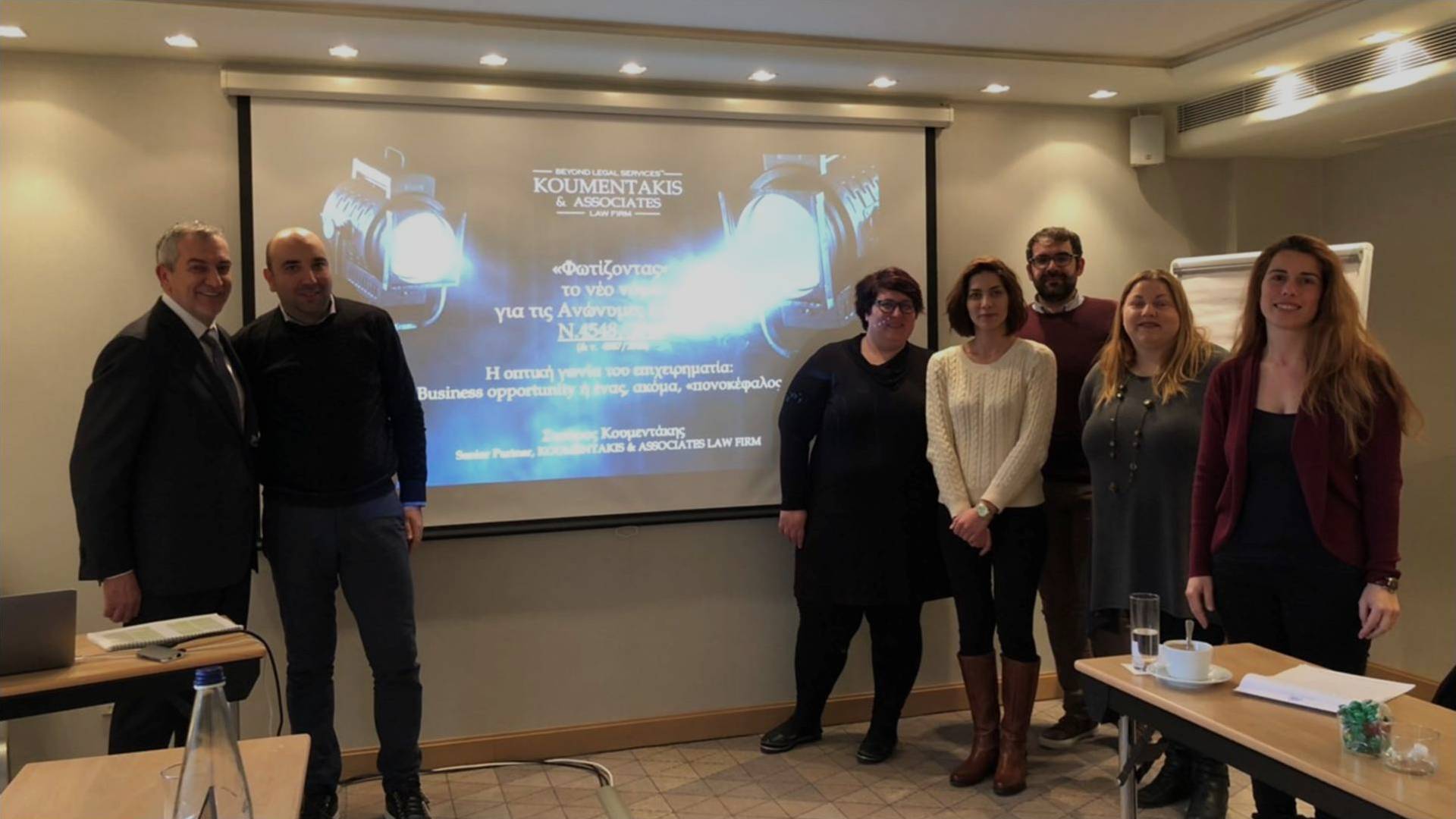
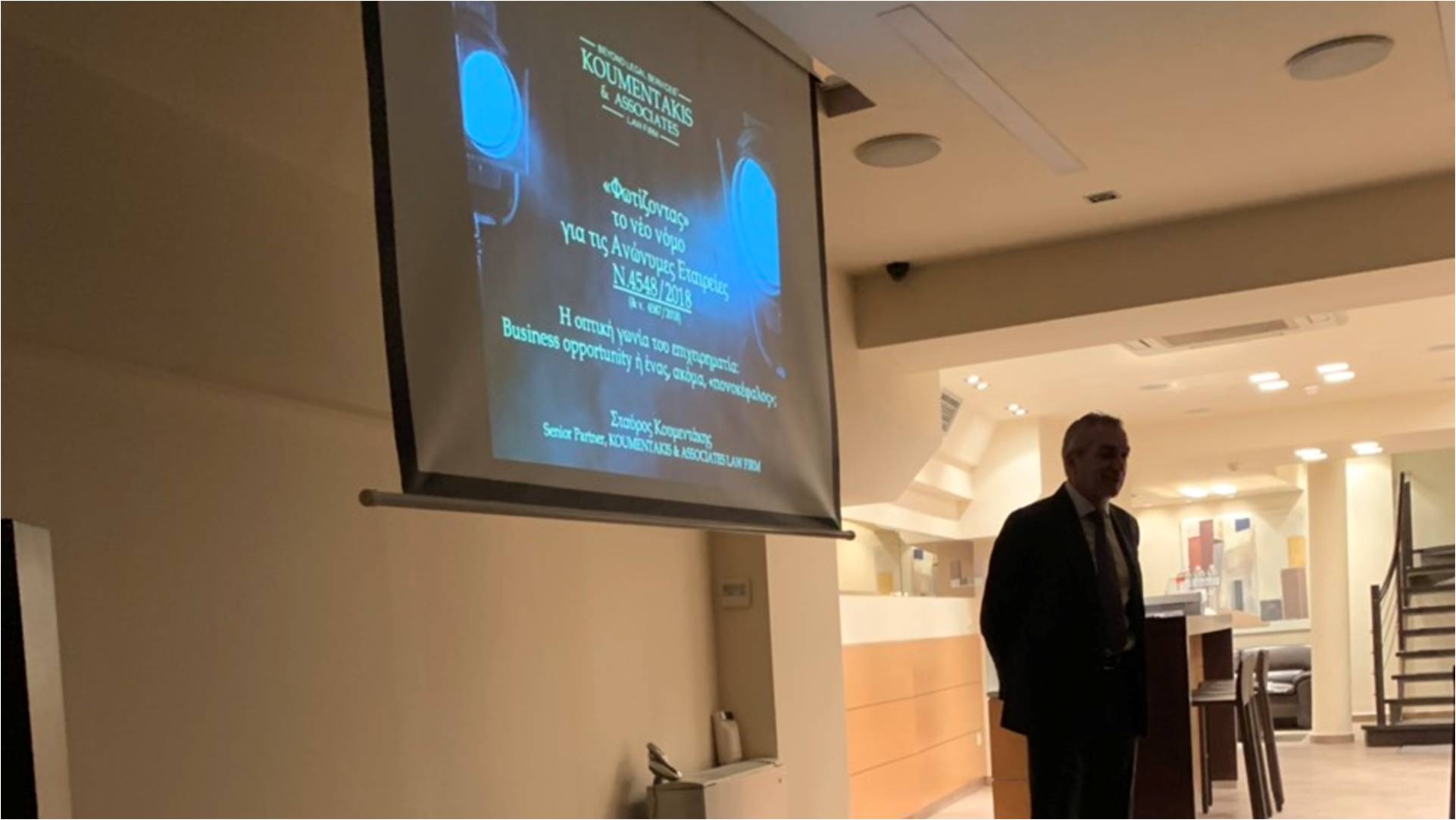
    [vc_row][vc_column][vc_column_text] Within the framework of the presentations and informative meetings organized by KOUMENTAKIS & ASSOCIATES LAW FIRM, a seminar was held at the Piraeus Chamber of Commerce & Industry on the needs as well as on the opportunities created for the entrepreneur regarding the regulations of the new Law on Sociétés Anonymes.

    With the participation of representatives from the PCCI and the co-organizers associations and federations (Association of Industries of Attica and Piraeus, Piraeus Trade Association, Pan-Hellenic Association of ship and exporter suppliers and Association of Piraeus Commercial Representatives and Distributors) Stavros Koumentakis, Senior Partner of the firm, enlightened the multiple business opportunities that constitute the changes brought by the new law on the SAs.

    As Mr. Koumentakis characteristically mentioned: “The new law is an important opportunity to become better aware of the operation of our Société Anonyme, to ensure the better protection for founders, shareholders and for the investment, to redesign on the right bases and to limit the operating costs, to attract new and to retain the most capable executives, to create the conditions for access to cheap capital, to make use of modern technology, and finally to prepare the next day of our business”.

    In the informative video presented as an introduction to the Seminar (you can see it below) the most important of the changes were briefly outlined, while the in the presentation that followed there were analyzed in depth the most important axes of Law 4548/2018. Particular emphasis was given on the need to inform entrepreneurs who need to understand the new law and ensure that this knowledge is available to their executives and to their close associates. Lastly, the urgent need for immediate adaptation of the articles of Association has been highlighted not only in compliance with the new law but, in particular, to meet the needs of each entrepreneur and each undertaking to adequately meet present and future requirements – particularly those relating to their safe growth course.

    At the event, besides Mr. Koumentakis, also participated with a presentation on the economic and tax issues of the new law, Mr. Panayiotis Papaspyrou, economist, Chairman of the Board of Directors. & Managing Director of “Financial Management Consultants S.A.”

    Mr. Koumentakis and the team of the Legal Advisors of KOUMENTAKIS & ASSOCIATES Law Firm continues to respond, as far as possible, to requests for relevant workshops and seminars throughout Greece. Next stop: The Money Show in Thessaloniki.

    [/vc_column_text][/vc_column][/vc_row][vc_row][vc_column][vc_text_separator title=”Gallery” border_width=”3″][/vc_column][/vc_row][vc_row][vc_column][vc_images_carousel images=”37018,37020,37022,37024″ img_size=”full” speed=”6000″ slides_per_view=”5″ hide_pagination_control=”yes”][/vc_column][/vc_row]

  • Other Liabilities of the Members of the Board of the Directors of a S.A.

    Other Liabilities of the Members of the Board of the Directors of a S.A.

    The Liability of the Member of the Board of the Directors of a Societe Anonyme

    Part 2: Other liabilities (others than those resulting from the law on the SAs)


    A. Preamble

    It is important, I appreciate, for both the members and the candidate members of boards of directors, to have a better understanding of the responsibilities they undertake. Equally important, of course, is not to “lose their sleep” to those who like to read articles like the present. However, in the event that I am the cause of such an event, I declare publicly that I am ready to take on the responsibilities and to bear the consequences (despite what Homer had already said in the Iliad (Rhapsody B ): “He who is in power, can not sleep quietly for a whole night”) ..


    B. General

    As already mentioned in the first part of this article, “the extent of the liability of those exercising authority over a Société Anonyme and the risks they face are not, in their entirety, recorded”. Any attempt to record can only be relevant in terms of its completeness. Most importantly, however, it is filled with awe in the range, depth (and weight) of the potential liabilities of the members of the Board of Directors.

    Here is an approach that is necessarily limited to the risks to which the members of the Board of Directors of the Société Anonyme are exposed – in addition to those resulting from the recent Law on Sociétés Anonymes (Part 1: The Responsibilities Arising From The New Law On Sociétés Anonymes). The plurality and the ingenuity of the individual (allegedly) injured, extend, in a great way, the extent and size of the potential risks faced by these individuals.

    However, it is important to recall, in this case, that “the status of a non-executive member of the Board of Directors does not automatically mean no liability”.


    C. Liability towards the State and Public Insurance Organizations

    1.General

    On the basis of the principle of the autonomy of legal entities (principle of separate personhood), the members of the Board of Directors are not liable for the debts of the Société Anonyme.

    One of the particularly important exceptions to this rule is when the Société Anonyme has debts to the State and, of course, to the Public Insurance Organizations. In this case, we are witnessing a breakthrough in the rule (the so-called “piercing the corporate vale”).

    Such are the cases that are dealt with later on…


    2.Liability arising from tax offenses

    2.1. Personal and joint accountability of the persons involved in the Management

    The Directors, Presidents, Managers, Managing Directors, and authorized to manage Legal Entities are personally and jointly and severally liable with the Company, both at the time of their operation and their merger and (together with the liquidators) at the time of their dissolution (Article 50 of Law 4174/2013- “Code of Tax Procedure”):

    (a) for the payment of taxes due, interest, fines and withholding taxes,

    (b) for non-retention of deductions and improper taxes and for non-reimbursement of VAT.

    (c) for the payment of ENFIA, in the event of interest and fines due to their own actions or omissions

    2.2. Criminal liability of those involved (and not) in Management

    General – Criminal liability

    In order to enforce the tax obligations of individual legal entities (of course also od Sociétés Anonymes) and to prevent tax and customs offenses, the criminal liability of those involved in the management of the legal entities is chosen in a series of legal acts.

    In this context (as well as in the case of domestic Sociétés Anonymes), as criminally liable persons, are identified (with almost identical formulas in the individual articles mentioned below) the chairpersons of the Boards of Directors, the directors, the authorized or co-directors, the managers or the general managers; directors and any person authorized either directly by law or by private will or by a court order to administer or manage them. Where all the above persons are absent, the penalties shall be imposed against the members of the boards of such companies if they are in fact temporarily or permanently engaged in one of the above-mentioned tasks.

    However, the fact of doing or not doing so is ultimately a matter of substance, which explains the (often unjustified) choice of the competent prosecutors to bring all the members of the boards of directors concerned to before the “procedure of the hearing”. (This is irrespective of the existence or not of executive and non-executive members of the boards of directors). The rationale “let them get their own back before a court” is, in this case, unjustifiably aggravating for the administration of justice. Most importantly, however, it creates extremely high costs at the financial, personal, social, family and professional levels of individuals who can not, in any way, be held accountable.

    Particularly:

    The crime of tax evasion

    The violation of provisions of the Code of Tax Procedure is rigorously dealt with by the provisions of articles 66 et seq. of this law (Law 4174/2013, as they apply after their re-approach by Article 8 of Law 4337/2015 – “Implementing Measures of the Memorandum”). The provision of article 66 of law 4174/2013 defines and deals with the offense of tax evasion with threatened imprisonment or, in the most important cases, with incarceration.

    As the perpetrators of an offense of tax evasion committed by a domestic Société Anonyme are also considered to be the persons in any way involved in the management of domestic Sociétés Anonymes and, in the aforementioned circumstances, all the members of their boards of directors (Article 67 of Law 4174 / 2013)

    The offense of non-payment of established debts to the State etc.

    The non-payment of established debts to the State, to legal entities governed by public law, corporations and public-sector bodies is also a criminal offense for those who are in any way involved in the management of Sociétés Anonymes and, under the aforementioned conditions, all members of their boards of directors (Article 25 Law 1882/1990 – “Tax Evasion, Taxation and Other Provisions)


    3.Liability arising from customs offenses

    On the basis of the Customs Code (Law 2960/2001), a customs debt is a liability of any natural person or legal entity against a Customs Authority for the payment of all duties, taxes, including value-added tax (VAT). ), and other governmental rights, which are commodity-related and charged in accordance with the relevant provisions. For the payment of the customs debt, the representatives of the legal entities as well as the liquidators of Sociétés Anonymes are also personally and jointly liable (Article 29 of Law 2960/2001)

    As regards, in particular, domestic companies, jointly and in the specific case (and with their personal property), are jointly liable those who are in any way involved in the management of Sociétés Anonymes and, in the above-mentioned circumstances, all the members of their boards of directors (Article 153 of Law 2960/2001):

    The above-mentioned persons are perpetrators or, as the case may be, collaborators of smuggling offenses and are consequently exposed to relevant (not minor) criminal sanctions (Article 153 of Law 2960/2001)


    4.Liability arising from the non-payment of Insurance Contributions

    In the provision of article 26 of law 1846/1951 (“Institutional law for IKA”) reference is made to the persons responsible for the social security contributions and the way of their payment. This obligation also covers the additional fees, surcharges and other charges payable to the Social Security Institutions – regardless of the time of their assertion.

    Both legal representatives, presidents, administrators, managing directors, administrators and liquidators of legal persons are jointly and severally liable to the employer (both during its operation and at the time of its dissolution or merger) (Article 31 v. 4321/2015).

    The obligation of these persons does not (automatically) take time after their removal or resignation.

    By the provision of article 1 of Law 86/1967, the persons liable for payment are criminalized both for the non-payment of employer’s contributions and for the deduction and non-reimbursement of employees’ contributions.


    D. Liability under the Civil Code

    Under the provision of Article 71 of the Civil Code: The legal entity (in this case the Société Anonyme) is liable (Article 71) for both acts and omissions of (the natural persons) who represent it, if liability for compensation is incurred and occurred at the time of the performance of their duties. The liability (if any) of the responsible representative, representative/member of the Board of Directors is joint and several.

    Under the provisions of Articles 71, 197 & 198 of the Civil Code: This liability refers to the damage caused to the other contracting party in the course of negotiations, regardless of whether or not the contract was concluded. This liability can also be imputed to the member of the Board who acted guiltily in the context of these negotiations.

    Under the provision, among others, of Article 914 of the Civil Code: The liability of the members of the Board of Directors may also be substantiated in the general provisions for compensation of the Civil Code. Two are the most interesting cases in this particular section:

    (a) The liability of the members of the Board of Directors vis-à-vis the shareholders when related to their actions and omissions and, as such, is affected by the “core of their shareholder rights as they go beyond the limits of normal management and as such should be taken (following an approval) or at least be made aware of the shareholders” (Athens Court of First Instance 12468/2012)

    (b) The liability of the members of the Board of Directors vis-à-vis third parties (generally more interesting in the case of an accident at work). Interestingly, based on existing case law (indicatively: Supreme Court 472/2018), the capacity of a member as a non-executive member is NOT sufficient to exempt him from any such liability. What is being investigated, in any case, is the existence of a fault in the face of a member, not his or her status as an executive or not.


    E. Liability under the provisions of the Bankruptcy Code

    The liability of the members of the Board of Directors arising from the provisions of the Bankruptcy Code is of both civil and criminal nature.

    (a) Their civil liability refers to the obligation to restore the damage to creditors (Article 98 of the Bankruptcy Code) in the event that either a bankruptcy petition is not filed in time, or the bankruptcy of the company has been caused by deception or gross negligence.

    (b) Their criminal liability (as well as the liability of managers, members of the management and directors of companies in general) is linked to actions that either cause the bankruptcy of the company or make it difficult for creditors to be satisfied or are linked to an omission of their legitimate obligations (Article 171 et seq. of the Bankruptcy Code)


    F. Liability under the provisions of the Penal Code – especially the offense of infidelity

    The provisions of the Penal Code in the legal form of which it is possible to include acts and omissions of the members of the Board of Directors of the Société Anonyme are scattered.

    One of the most commonly threatened is the offense of infidelity under Article 390 of the Penal Code. Based on this provision, the offense of infidelity is omitted by anyone who knowingly damages the property of another, which, by law or legal action, has custody or management. In the case of administrative offenses against the property of a legal person, those who are violating the rules of diligent management – and of course the members of the Board of Directors of the Société Anonyme – are also responsible (and exposed to the corresponding criminal sanctions).


    In conclusion

    The liability of the members of the Board of Directors (in particular executive directors) is in some cases objective and given. This, of course, automatically implies situations that create such liabilities. It is also assumed that in the context of entrepreneurship, especially in our country, the potential exposure of the legal entity (and the members of the Board of the Directors) to risks seems rather normal and reasonably expected.

    In the first part of this article, I concluded: “Not that every member of the Board of Directors is assumed to “get in trouble” yet, it is good to remember that the (exercise) of power is not a simple aphrodisiac”.

    But I wonder at the end: Would it be possible for the knowledge (or reminder) of the responsibilities of exercising power and the associated risks faced by those who exercise it, to repress the hormones involved?

    Or maybe not?

    stavros-koumentakis

    Stavros Koumentakis
    Senior Partner

    P.S. A brief version of this article has been published in MAKEDONIA Newspaper (March 10th, 2019).

    Σταύρος Κουμεντάκης

  • New Law on SAs: the Liability of the Member of the Board of the Directors

    New Law on SAs: the Liability of the Member of the Board of the Directors

    The Liability of the Member of the Board of the Directors of a Societe Anonyme

    Part 1: The Responsibilities arising from the new Law on Sociétés Anonymes


    Α. GENERAL 

    Preamble

    Power in Greece has always (with a special interest most people, if not everyone) attracted us. Whether to exercise it or to engage with those who have it. Hence, we seem to despise that power, at some point, is over. We also seem to forget (?) that its exercise poses risks. Sometimes serious ones.

    When Henry Kissinger concluded that “power is the supreme aphrodisiac”, we can be sure that he knew something more than we know. For the consequences of exercising power? Homer had already spoken: “He who is in power cannot sleep for a whole night”. And then, later, Charles Caleb Colton followed to clarify: “The sufferings of power are real, its joys fantastic”.


    The extent of the liability of the members of the Board of Directors

    The management of legal entities is related to the exercise of power. It is true, however, that if one goes back to the domestic (and of course, to the international) literature, it is unfortunately not possible to identify a study, a workbook, which will record all the risks involved in its exercise. Many individual risks, yes. An overall no. What does this mean at a practical level: that the extent of the liability of those exercising power and the risks they face are neither fully documented nor identifiable.

    In the operating environment of Sociétés Anonymes, as this is currently the case, the greatest concern of the directors is the extent of their liability: for acts or – more precisely – for their omissions.

    In this context (on the occasion of not only the new law on Sociétés Anonymes, but also of the timeless questions and concerns of interested parties involved), it is attempted to approach some basic areas of the liability of the members of the Board of Directors.


    Criminal liability – in general

    Criminalization of individual actions of entrepreneurship, business choices and management decisions of a Société Anonyme is a (not theoretical) possibility. The admission of public prosecutors to the day-to-day management of the business, as well as the attempt of (some of them) to be transformed into “Antonio Di Pietro” of the country’s economic and business life by adopting “Clean Hands” actions, sometimes works steadily and some other deterrent for beneficial business decisions.

    On the other hand, the involvement of the members of the Board of Directors (not necessarily the executive ones) in criminal (and not only) acts is quite common, due to omissions involving obligations towards the State (for example, non-payment of established debts, non-repayment of taxes levied-i.e. VAT, non-payment of insurance contributions). It is also not an uncommon thing, the involvement (not only criminal) of members of the Board of Directors in events related to (or attempted to relate to) entrepreneurship. We can also have in mind that a member of the Board of the Directors may be found “trapped”, whether responsible or not, for any matter.

    In what areas does the liability of the members of the Board of Directors of modern SAs extend? An initial record of the responsibilities/liability (civil and criminal) arising from the new Law on Sociétés Anonymes is being dealt with here.


    Intra-corporate liability under the new Law on Sociétés Anonymes

    The members of the Board of Directors of a Société Anonyme are liable for the remedy of any damage caused by their actions and omissions. All members can be liable either individually or jointly (and severally). The competent Court may share responsibilities between members according to the data and the attributes of each, individual.

    The limitation of the company’s claims against the members of the Board of Directors is three years, but it is suspended for as long as they have that status. For a maximum of ten years. What does this mean at a practical level? If, for example, the CEO of a Société Anonyme “misconducted” seven years ago – in the course of his duties and he transfers the company today (possibly under his capacity as a major shareholder and owner), the company (under its new ownership regime) is entitled to exercise its claims against him within ten years starting from the illegal act or omission.

    The approval of the financial statements, the management of the members of the Board of Directors and their possible discharge from “any liability” by the ordinary General Assembly of the Shareholders is considered to as a waiver. This will be “taken into consideration”, among other things, by the competent Court.

    The prerequisites for the exercise of the action as well as the exercise thereof are clearly and sufficiently documented and detailed in the new law. The exercise of the corporate action may be entrusted by the competent court (if it is not a choice of the Board of Directors) to a Special Representative.


    The criminal liability of the members of the Board of Directors on the basis of the new Law on Sociétés Anonymes

    The new law devotes (and logically) a separate section on the criminal liability/ responsibilities of the members of the Board of Directors. The threat of imprisonment for offenders is not the cause of concern as it is not expected that none of them will be taken to prison – for that reason alone. Interestingly, however, are the imminent financial penalties (from € 5.000 to € 100,000): We can be certain that no such sums are in sort for anyone. Exercising the duties of a member of the Board of Directors is not a story without (and) memorable criminal dangers. It would be extremely useful for those members who either have a “lose consciousness” or are being asked to make decisions and provide assurances on specific issues (in a false, e.g. certification of the payment of share capital or in the approval of financial statements that are not “absolutely accurate”) to think twice. It is also assumed that they should exercise the utmost care when performing their duties and faithfully adhere to (with the assistance of appropriate advisers) the law.


    In conclusion

    The acceptance of an “honorary” proposal for entering a Board of Directors of a Société Anonyme, the service of a good friend for the same reason (“to reach the minimum number of three members”), but also the participation in the corresponding body of a family business- is not a decision that has to be “lightly set” to take. Not that every member of the Board of Directors is assumed that “will not avoid interference”, but it is good to know that the (co) exercise of power is not a simple aphrodisiac.


    Α. SPECIFICALLY (and in detail)

    1. The intra-corporate liability of the members of the Board of Directors on the basis of the new law on SAs

    The extent and the conditions of the liability of the members of the Board of Directors

    The members of the Board of Directors of the Société Anonyme are responsible for the reparation of damages caused by their actions and omissions (Article 102 par. 1 of Law 4548/2018).

    There is no responsibility when the members are able to prove that they have shown “the care and diligence of a prudent businessman” (Article 102 par.2 of Law 4548/2018).

    Additionally, when we have to do with a joint act of the members of the Board of Directors (e.g. BoD decision), the joint and several liability of all its members applies. The competent court reserves the right to share the responsibility of each of the parties involved, but also to regulate the right of recourse (subrogation) between them (Article 102 par. 3 of Law 4548/2018).

    It is assumed that there is no liability of the members of the Board of Directors when they basically manage to prove that their actions or omissions: (a) are based on a previous legitimate GA decision or (b) concern a reasonable business decision taken in good faith, based on sufficient information and solely on the basis of the corporate interest, as well as (c) are based on a suggestion by an independent body or committee (Article 102 par.4 of Law 4548/2018).


    The limitation of the SA’s claims and its resignation from them

    The limitation of the claims of the Société Anonyme against the members of the Board of Directors is three years and is suspended for as long as the capacity of a member remains. In any case it occurs after a decade (article 102 par. 6 of Law 4548/2018)

    It is possible for a Société Anonyme to resign from its claims against the members of its Board of Directors after two years and with the mandatory consent of the General Assembly, provided that there is no opposition of the 10% of the share capital (article 102 par. 7 of Law 4548/2018)


    The conditions and the procedure for the exercise of the Company’s claims against the members of its Board of Directors. The involvement of the shareholders

    The Board of Directors is obliged to exercise the company’s claims at the expense of the members liable for compensation, “balancing the corporate interest”. In any case, the members of the Board of Directors are obliged to provide sufficient explanations to the shareholders when they fail to fulfill their specific obligation (Article 103 of Law 4548/2018).

    The shareholders of the company who have acquired more than 5% of the share capital during a six-month period are entitled to submit a request to the Board of Directors for the exercise of claims against its members (article 104 par. 1 of Law 4548/2018). They shall provide the necessary information and data to substantiate the damage and provide one month, at a minimum, for evaluation and for reaching the respective decision (Article 104 par.2 of Law 4548/2018).

    The Board of Directors shall take such a decision after a hearing of nominated members, but without the voting rights of the parties concerned. If the other members do not form a quorum, it is considered that no decision is taken (Article 104 par.3 of Law 4548/2018).

    When the request for the exercise of the corporate action is submitted by the majority of the shareholders, the exercise of same is obligatory for the Board of Directors (article 104 par. 4 of Law 4548/2018).

    The majority of the shareholders who have submitted a request to the Board of the Directors for a corporate action are entitled to appeal to the competent court when: (a) their request is rejected; (b) the period prescribed for assessment expires; (c) a period of four months following the decision for the corporate action expires; (d) the Board of Directors has not been able to reach a decision, or (e) a period of two months without bringing any action if the request is made by a majority of the shareholders has expired (Article 105 par.1 of Law 4548/2018).

    The competent court accepts the shareholder’s request when there is no overriding interest in not exercising the claim. In this case, it appoints a Special (and possibly also a Deputy) Representative for the exercise of corporate action (Article 105 par.2 of Law 4548/2018).


    The Special Representative for raising the corporate claim

    The Special Representative: (a) has the special and sole power to bring the action, but also to carry out the proceedings promptly and diligently, (b) has access to evidence, documents and information, (c) is bound by the historical the legal basis of the judgment. The Court may award him reasonable remuneration (Article 105 par.4 and 5 of Law 4548/2018).

    The Special Representative, after his appointment, may reach a negative decision with regard to the liability of the designated members of the Board of Directors. In this case, he informs the Board of Directors and the shareholders who have requested the relevant action. These shareholders may, however, be reinstated with a new application (Article 105 par.6 of Law 4548/2018).

    In the event that the application is dismissed at first instance, the Board of Directors may, on the recommendation of the Special Representative, waive the right of appeal (Article 105 par.7 of Law 4548/2018).


    The suspension of the limitations and the costs related to the respective trials

    The submission of a request by the shareholders to the Board of Directors for the enforcement of corporate claims suspends, in general, the limitations (article 106 par. 1 of Law 4548/2018).

    The costs of the trial for the appointment of the Special Representative, the trial against the members of the Board of Directors, as well as any remuneration are borne by the company (article 106 par. 3 Law 4548/2018).


    Direct damage of third parties from actions or omissions by members of the Board of Directors

    The provisions of Law 4548/2018 on the liability of the members of the Board of Directors do not affect or limit their liability in respect of claims arising out of direct damage to shareholders or third parties suffered as a result of their (of the members of the Board) actions or omissions. They also do not affect the liability of the members of the Board of Directors vis-à-vis corporate creditors under the provision of Article 98 of the Bankruptcy Code (: failure to file an application for bankruptcy of the société anonyme, as well as causing the suspension of payments by willfulness or gross negligence of the members of the Board of Directors) – (article 107 par. 3 of Law 4548/2018).


    The discharge of the members of the Board of Directors from the ordinary General Meeting

    It is possible for the General Assembly to approve the overall management by the members of the Board of Directors when approving its annual financial statements and exempting them from “any liability”. However, this approval – when and if provided – is NOT considered to as a waiver of claims by the company (for the proper waiver, Article 102 par.7 applies). Such an approval is estimated “accordingly” (whatever that means) by the Court that may be seised in the future against the members of the Board of Directors (article 108 par.1 of Law 4548/2018).

    The members of the Board of Directors take part in the vote for the approval of the overall management as well as employees of the Société Anonyme with their own shares, and with the shares they represent, provided that they have been given express and specific voting instructions (article 108 par. 2 of Law 4548/2018).


    2. The criminal liability of the members of the Board of Directors under the Law on Sociétés Anonymes

    False or misleading statements to the public (Article 176 of Law 4548/2018)

    There is a threat of imprisonment and a fine of € 10.000 to € 100.000 when a knowingly false or misleading statement is made to the joint founder, by a member of the Board of Directors or by the director of the company regarding (a) the cover or payment of the capital; (b) data of the company with substantial influence over corporate affairs – for the purpose of subscribing to securities issued by the company.


    Infringements made by the members of the Board of Directors (Article 177 of Law 4548/2018)

    There is a threat of imprisonment and a fine of € 10.000 to € 100.000 for a member of the Board of the Directors who:

    (a) Drafts or approves (knowingly) inaccurate or misleading financial statements or draws them up in violation of the law as to their content.

    (b) Distributes profits or other benefits to shareholders or third parties that do not arise from the Company’s financial statements or without the preparation of financial statements or based on (knowingly) inaccurate, misleading or financial statements drafted in breach of the law.

    (c) Acquires redemptive shares in breach of the relevant provision (Article 39).

    (d) Causes the acquisition by the company of its own shares (or its parent’s shares) or warrants (of its own or its parent’s company) in violation of the relevant provisions (Article 48, 49, 52 or 57).

    (e) Provides an advance, loan or guarantee (in violation of Article 51) either by charging the company with a view to a third party to acquire shares of the company or by charging its subsidiary with the purpose for a third party to acquire shares of its parent company.

    (f) Drafts (knowingly) an inaccurate or incomplete management report or other statutory annual reports.


    Infringements relating to the orderly operation of the company (Article 179 of Law 4548/2018)

    Threatened imprisonment of up to three years or a fine of 5.000 € to 50.000 €:

    (a) To whoever concludes a contract on behalf of the company without the prior authorization required under Article 100. (The offense shall be terminated if the necessary authorization is subsequently granted)

    (b) To the member of the Board of Directors who violates the obligation to certify the payment of capital within the time limit provided for in Article 20 or makes a false certification.

    (c) To the member of the Board of Directors who fails to draft or drafts after the expiry of the time limit: the company’s annual financial statements, the consolidated financial statements, the annual management report, the consolidated annual management report or the remuneration policy, the salary report or other annual report provided by law.

    (d) To the member of the Board of Directors who violates the obligation to re-adjust the share capital

    (e) To whoever hinders the auditing of the company by the statutory auditors or auditors designated to perform an extraordinary audit or does not provide the auditors with the information, he is required to provide.


    Infringements concerning the General Meeting of shareholders and bondholders (Article 180 of Law 4548/2018)

    A fine of 5.000 € to 15.000 € is threatened:

    (a) For any person who fails to convene the General Meeting of Shareholders or Bondholders or to include a specific item on the Agenda in contravention of the law or bond issuance program.

    (b) For any person knowingly taking part in or voting, without right, at a General Meeting of Shareholders or bondholders.

    (c) For the member of the Board of Directors who violates the obligation to provide information to shareholders.


    Penal and administrative penalties (Article 181 of Law 4548/2018)

    The imposition of penal penalties does NOT preclude, under this provision, the imposition of administrative sanctions. This simply means that, in the course of some criminal proceedings, it is possible to impose penalties on a member of the Board of Directors, but any administrative sanctions may follow …


    C. Epilogue

    The extent of the liability of the members of the Board of Directors is unfortunately not exhausted in the above sections and provisions (much more so in their “business view”). However, in subsequent articles, it will be sought to record the other sections of their liability and, of course, how to mitigate it. Above all, however, the way to remove the (potentially) adverse consequences and the relative risks that these members face.

    stavros-koumentakis

    Stavros Koumentakis
    Senior Partner

    P.S. A brief version of this article has been published in MAKEDONIA Newspaper (March 3rd, 2019).

     

    stavros-koumentakis-article-ευθύνη-μελών-δσ

  • Day meeting for the New Law on SAs to Foroepilysis

    Day meeting for the New Law on SAs to Foroepilysis

    [vc_row][vc_column][vc_column_text] One more presentation, within the framework of the day meetings which are organized by KOUMENTAKIS & ASSOCIATES on the New Law on on Sociétés Anonymes, was successfully held in Heraklion, Crete. Specifically, a presentation was recently held at Foroepilysis, a rapidly growing company of Mr. Vassilakis that provides accounting, financial and tax services.

    Stavros Koumentakis, Senior Partner, has highlighted the business opportunity that is emerged by the changes brought by the new Law on on Sociétés Anonymes. He presented the general framework of the New Law and made an extensive reference on individual regulations of the new law and the use of the law’s options for businesses on aspects, such as:

    • reducing their operating costs
    • attracting investors and investment funds
    • exploiting technology
    • attracting and retaining competent, senior-level, executives
    • protecting the clients of the Law Firm against their “internal and external enemies”.

    Mr. Stavros Koumentakis mentioned in particular that “the New Law on Sociétés Anonymes is an important opportunity for enterprises which cannot be missed. Law 4548/2018 extends the responsibility and report of the members of the Board of Directors in terms of civil, criminal and administrative sanctions. This may be a potentially serious problem if there are no corresponding provisions and insurance coverage”. He has also mentioned that “there is a immediate need for the necessary and beneficial regulations to be adapted in the SAs’ articles of association”.

    The presentation of Mr. Koumentakis at Foroepilysis, was attended by the top management, executives and employees and it was an opportunity for a broad exchange of views on the specific, extremely important (for enterprises, businessmen and board members) aspects.

    [/vc_column_text][/vc_column][/vc_row][vc_row][vc_column][vc_text_separator title=”Gallery” border_width=”3″][/vc_column][/vc_row][vc_row][vc_column][vc_images_carousel images=”36883,36885,36887,36889,36891,36893,36895″ img_size=”” speed=”6000″ slides_per_view=”6″ hide_pagination_control=”yes”][/vc_column][/vc_row]

  • (Common) Founders’ Shares

    (Common) Founders’ Shares

    An old story

    In the 1990s, a businessman with a very good financial standing was deciding on his next business venture. He had no doubt (and rightly as it turned out) about his success. The whole venture, apart from the robust business plan, was based on two pillars:

    (a) multi-share scheme (through the involvement of robust financially shareholders); and

    (b) participation in the shareholding scheme of certain, high-level executives, with 10% of the total share capital – but without payment of money on their part.

    The share capital of the new, then, société anonyme was extremely high and the agreement with the other shareholders was simple: 90% of their holding would be transferred to the company’s bank account (to form the share capital) with themselves as depositors. The remaining 10% would be re-routed to the corporate bank account but with (alleged) depositors the aforementioned executives. This would achieve the realization of the design and the participation of these executives in the company’s share capital. And even without these executives paying their own money.

    It should be noted here that in the 1990s one did not know that such a design could be auditable as a donation (from the shareholders to the benefiting executives). Today, in such a case, we would have all the consequences, potentially negative or very unpleasant, (civil, tax and criminal).

    This business venture was a major success.

    Yet, with a small side effect: People’s relationships never, as a rule, prove to be eternal. And as I am accustomed to saying, people are likely to argue, to get sick or crazy. Additionally, surely, they will eventually die.

    (And) in this case determinedly some of the specific events have occurred …

    Since then, based on these negative experiences, I have deterred customers and friends from proceeding with such plans. Sometimes my suggestions were accepted and sometimes not. (Unfortunately)

    The law, however, did not provide for the tools it provides for today.


    Conflicting interests and the available solutions

    It is clear that, at a first level, the interests of the company and its executives are not in line.

    The business, especially the newly established, needs executives who will do their best to achieve its goal without, at the same time, being burdened with the high salaries they will look for. We also need executives who will share their vision and (if they achieve their goals – why not) be rewarded accordingly.

    The executives, on the other hand, look forward, and reasonably, to material and moral rewards. The participation in the company’s profits is an additional consideration not at all worthwhile. And not on a material level only.

    Of course, there is always the stock options solution with both positive and negative aspects – see the article about Stock options

    A solution, which is clearly more attractive in certain cases, is that of issuing Common Founders’ Shares.


    The (Common) Founders’ Shares

    This type of instruments/ shares allows considerable flexibilities to the founders.

    Some of the founders (: shareholders) will be involved in the creation of the company and the accumulation of the initial share capital.

    In some other (other than the founders or third parties – i.e. executives) it is possible to recognize through the (Common) Founders’ Shares the right to withdraw part of the profits of the société anonyme. And this without they themselves being shareholders. In other words, without having participated in the concentration of the initial share capital.


    The institutional framework governing the (Common) Founders’ Shares

    On the basis of the provisions of the new Law on Sociétés Anonymes (Article 75 of Law 4548/2018), the Common Founders’ Shares are provided to some of the founders (and / or to all) as well as to third parties. The reasoning for this benefit is defined as “reward for specific actions at the company’s establishment”. In fact, they cannot exceed 10% of the total number of shares issued.


    What rights do the (Common) Founders’ Shares grant and what they do not

    The exclusive benefit (yet not least, Article 75 par.3 of Law 4548/2018) of the (Common) Founders’ Shares is the right to an amount equal to (maximum) 25% of the net profits after deduction of the amounts for the statutory reserve (Article 158 of Law 4548/2018) and the minimum dividend (Article 161 of Law 4548/2018). And, what does this mean at a practical level? That those (founders or third parties) who, at the stage of the establishment of the société anonyme, have received (Common) Founders’ Shares, are:

    (a) entitled to receive ¼ of the excess of the minimum dividend. And this without contributing, to a minimum, to the concentration of the share capital and

    (b) not entitled to receive anything if the minimum (Article 161 of Law 4548/2018) or not (Article 159 of Law 4548/2018) dividend be distributed (Article 75 par.5 of Law 4548/2018)

    However, the (Common) Founders’ Shares, which have no nominal value, do not confer any additional rights on their holders (such as participation in the management and administration of the company, voting at the General Meetings, participation in the proceeds of the liquidation – Article 75 par. 2 of Law 4548/2018).


    Redemption Right

    It seems logical not to keep in the forefront the rights resulting from the (Common) Founders’ Shares. Moreover, the basis for issuing and delivering them to the founders (or third parties) is the “reward for their specific actions when setting up the company”.

    Thus, the (Common) Founders’ Shares may be redeemed by the company for a period of 10 years after their issuance (Article 75 par.4 of Law 4548/2018). However, the redemption may take place earlier if there is a provision in the articles of association.

    The cost of their acquisition by the company will be what the articles of association lay down. In any case, however, it may not exceed ten times the average annual dividend received over the last five years.


    Issuance, registration and transfer of (Common) Founders’ Shares

    The law deals with the specific issues corresponding to those mentioned in the shares (Articles 75 par.6 and 40 to 42 of Law 4548/2018). In this context, securities may be issued (in paper or in book format). At the same time, their registration may take place in a particular book (equivalent to the Shareholders’ Registry), which can be kept electronically. Their transfer (acquisition or succession) is free.

    It is the company’s articles of association that determines how to prove the status of the holder. The delivery to the company of the document for their transfer or the utilization of other means provided by the articles of association is, in any case, sufficient for the “legalization” of their holder. In the event of the death of the holder, the rights are inherited and recognized in the person of the person (s) who will prove their status as heirs.


    In Conclusion:

    Making use of the institution of the (Common) Founders’ Shares looks (and is) an excellent tool for the sociétés anonymes under establishment. This is because (inter alia) this particular institution:

    (a) recognizes the services that certain persons (founders, employees or third parties) provide at the establishment stage of a société anonyme,

    (b) rewards their specific services and links their rewards to the profitable, only, course of the company – without being required to contribute money to its share capital,

    (c) associates their holders with the profitable and developmental path of the business and identifies, to a significant extent, the interests of both (holders of (common) Founders’ Shares and business)

    (d) does not upgrade their holders to shareholders (with the result that their holders do not have the rights of the latter and, in particular, the voting and minority rights, the right to elect the Board of Directors, the receipt of the proceeds of the liquidation and so on)

    (e) limits the presence and rights of their holders in the company and determines / limits the amount of their compensation at the time of the redemption of the securities they hold.

    In other words: This particular institution can remove the reservations of the most skeptical, as the signatories, regarding the participation of specific persons (i.e. executives or third parties) in the business process and in the financial result of a société anonyme.

    stavros-koumentakis

    Stavros Koumentakis
    Senior Partner

    P.S. A brief version of this article has been published in MAKEDONIA Newspaper (February 17th, 2019).

  • Presentation of the New Law on SAs to B. Karaoglou SA

    Presentation of the New Law on SAs to B. Karaoglou SA

    [vc_row][vc_column][vc_column_text] The series of presentations of KOUMENTAKIS and ASSOCIATES Law Firm on Law 4548/2018 are continued with great success. The presentations are addressed to Enterprises, Business Associations, Auditors Companies, significant Tax and Accounting Services Companies and so on.

    At a recent workshop held at B. Karaoglou SA – Accounting and Taxation Support, Mr. Stavros Koumentakis, Senior Partner, presented the general framework of the new Law on Societes Anonymes and extensively referred to its individual arrangements for protection of customers against “internal and external risks” as well as the utilization of the opportunities provided by Law 4548/2018 on behalf of businesses in aspects such as:

    • reduce their costs
    • attract and retain skilful executives
    • attract investors
    • exploit technology.

    As Mr. Koumentakis states, “the new Law on Societes Anonymes is an important opportunity for businesses that should not be lost. Law 4548/2018 extends the responsibility and report of the members of the Board of Directors in terms of civil, criminal and administrative sanctions, which can be a potentially serious problem if there are no corresponding provisions and insurance coverage”.  He also points out that “there is a direct need of regulations of the SAs’ articles of association”.

    The presentation of Mr. Stavros Koumentakis on the new Law to B. Karaoglou SA – – which was attended by senior management and executives – gave the opportunity for a broad exchange of views on the specific, extremely important (for businesses, entrepreneurs and members of the Board of Directors ) units.

    [/vc_column_text][/vc_column][/vc_row][vc_row][vc_column][vc_text_separator title=”Gallery” border_width=”3″][/vc_column][/vc_row][vc_row][vc_column][vc_images_carousel images=”36840,36842,36844″ img_size=”” speed=”6000″ slides_per_view=”6″ hide_pagination_control=”yes”][/vc_column][/vc_row]

  • Stock Option

    Stock Option

    Stock Option Plan for the distribution of shares to members of the Board of the Directors, employees and permanent associates


    A. Generally

    What are Stock Options?

    Stock Options are an institution for which there is no long experience in our country. At an international level, however, there is not only a long experience, but also a number of categories of same.

    Those that are most well known in Greece (and will be of interest to us here) are the ones that are intended to act as an incentive for senior and supreme executive staff. And in addition: the close-permanent associates of a business. Then, for reasons of brevity, all potential beneficiaries will be referred to as a whole as “executives”. The internationally accepted relevant terminology for stock options of this category is “Employee Stock Option” and abbreviated “ESO”.

    These Stock Options, in practical terms, are only the option that an executive (or a group of executives) of an enterprise acquires (at one or more subsequent times) the company’s shares in a predetermined, attractive, price. At a price that the executive himself/ herself is called to pay.

    Under the American model (:american options), this right is exercised at any time by the beneficiary, from the time of the issue of the Stock Option Plan up to its maturity. Under the European model (: european options or share options in the UK) this right is exercised by the beneficiary at the time of expiration and / or at predetermined, interim times.

    Any withdrawal /removal of an executive before the time at which the right may be exercised shall, as a rule, result in its loss.

    How do Stock Options work?

    First of all, let’s note that the Stock Options do not (and must not) concern all executives.

    But even with this constraint, we have to accept that the categories of executives to which they are addressed are two: To those which the company seeks to attract and those with whom it is already associated under some form of contractual relationship, more usually, labor.

    On the other hand, companies that decide to issue ESO can be of all kinds: Start-ups, businesses with a history (with liquidity problems or limited financial capabilities), businesses that are developing (and promising) or even developed companies (with significant financial capacity). A common feature of all: An attempt to motivate executives to either start or continue working with them.

    Both the core proposal of the company that decides to issue them and the specific parameters are known: “Come (or stay) with us and you will have serious expectations to derive significant benefits from the increase in the value of the business (in proportion to its part that corresponds to the stock option you receive)”.

    Internationally, it is adopted (at least in terms of listed companies) also one more alternative to (direct) ESO provision. The business undertakes instead of delivering the Stock Options to the executive to pay him money at predetermined times in the future. In particular, the difference in the present value of an agreed number of shares relative to the price they will have at those predetermined future dates.

    Stock Options on the side of the business and the executive

    With the adoption of Stock Options, the company creates significant incentives to attract an “expensive” executive, as it no longer faces him as a mere employee. The executive is upgraded from the level of the simple (and least important) employee to the potential tomorrow’s shareholder, a participant in the vision, development and, as a result, profitable course of the business.

    The enterprise (start-up, in difficulty, developing or developed) thus achieves a threefold goal: (a) to reduce the financial requirements of the executive in terms of his/her expected fixed earnings, (b) to increase his/her commitment to the firm (c) to raise (logically) his/her qualitative and quantitative performance.

    The executive, on the other hand, “attaches” stronger ties to the company’s chariot as is no longer a simple worker but upgraded to a potential (or tomorrow) shareholder. And even more: Looking forward to the profits he/she could make from his/her stay in the business, he/ she would hardly think of not paying off his/her full potential or leaving before the “full limit of the time”.

    By realizing the institution of Stock Options, the target of shareholders, management and executives becomes common: developing the value of the business and, consequently, the value of its stocks.

    Especially: The worries of the entrepreneur and the way they can be dispelled.

    However, there is also a serious (and quite reasonable) argument on the basis of which an entrepreneur (especially in companies with few shareholders) would not choose to make Stock Option available to his/her executives. Let’s note, among other things, the most common: What will happen if, once the relevant rights have been exercised, the executive (as a shareholder) leaves (resigns or be dismissed), bankrupts, dies or faces a mental health problem? Will then be as a partner an old friend and tomorrow’s enemy? Or will there be the widow and his orphans? Or maybe an insolvency administrator, someone irrelevant or even worse, the most important competitor of the business?

    In these critical questions can be given not only satisfactory answers but also absolutely adequate safeguards. The combination of individual legal options can safely succeed in achieving this.

    For example, the combination of stock options with the provisions on the issue of restricted stocks may create feelings of security for such concerns (For matters relating to the issue of restricted stocks, you may refer to our related article).


    B. The regulations of the new Law on Sociétés Anonymes

    On a procedural level, the issuance of Stock Options presupposes (Article 113 par.1) a General Assembly resolution on the beneficiaries of the plan (members of the Board of Directors, executives and / or persons providing their services on a stable basis) as well as on the details of such issuance. In this context, the decision of the General Assembly specifies (Article 113 par. 2) whether the Stock Options will be issued using the Company’s own shares or an increase in its share capital, the maximum number of shares to be issued, the subscription price or the method for its determination, the terms of sale of the shares, the duration and the beneficiaries of the plan, the manner in which the rights be exercised. However, especially with regard to the beneficiaries, the Board of Directors may be entrusted with the designation (by the Board of Directors) of either the beneficiaries, namely, or of the groups of beneficiaries

    The Stock Οptions issued may not exceed a maximum of 10% of the share capital (Article 113 par.2), although in practice it would hardly exceed even 1% or 2%.

    It is also noteworthy that the General Assembly may delegate (Article 113 par.4) for a period of five years its relevant power to the Board of Directors although such an assignment must be given sparingly as it could possibly lead to unpleasant reversals of sensitive balances between shareholders.

    In any event, the Board of the Directors is that body (Article 113 par.3) to:

    (a) issue the certificates of exercise of the relevant rights but also

    (b) (per calendar quarter) to either deliver the shares involved in the exercise of the Stock Options or to increase the share capital and amend the Articles of Association (by issuing and delivering the newly issued shares and certifying the relative increase).


    C. Epilogue

    Making use by an enterprise of a modern tool, such as Stock Options, can be beneficial at various levels. Although this approach is simplified, the potential risks to the entrepreneur can be reduced to a significant level (using safe legal tools) – if not eliminated. At the same time, the design of the relevant product can greatly safeguard the central focus of the business: whether it is to attract skilled executives or to maintain the most competent ones and / or to maximize what the benefiting executives are able to offer.

    stavros-koumentakis

    Stavros Koumentakis
    Senior Partner

    P.S. A brief version of this article has been published in MAKEDONIA Newspaper (February 3rd, 2019).

  • Warrants

    Warrants

    A. Introductory

    Warrants are a modern financial instrument, known to those who teach economics, but also to those involved with stock markets around the world. Warrants, little known to the general public, may be a means of attracting financing but also of supporting business development. Their operation is twofold: On the one hand, they align the expected future positive course of the company with the individual interests of third parties directly or indirectly involved. On the other hand, they broaden the framework of those who “struggle” for the success of the corporate venture – which is now becoming a common goal for more. Warrants may prove to be more attractive than issuing preference shares or convertible bonds.

    But let’s get to know them better.


    B. Getting acquainted with warrants, national and international experience

    What are the warrants

    Under the Law on Sociétés Anonymes (Article 56 par.1), warrants are the securities issued by a société anonyme and confer the right to the of the beneficiaries (: option) to acquire (more precisely: to buy) shares of its (of the issuer-in this case we are talking about corporate warrants).

    Reasonably, though, one could support that lawyers are not the most competent ones to talk about what warrants really are. This is because, in a wider (and correct) view, it is a stock derivative that creates the right (but not the obligation) to buy (or sell) a share at a specific price (: “exercise price”), before its expiration (an indicative definition can be found here: https://www.investopedia.com/terms/w/warrant.asp ). Thus, the institutional framework that governs the operation of warrants affects, on a multi-level basis, not only the operation of a société anonyme, but also the relationships formed around it. The relevant regulations could not therefore be missing from the new law on Sociétés Anonymes (Articles 56 to 58). It could also be impossible not to be of the concern of the legal community of the country. [The most complete, at present, work in our country is: “Warrants corporate and covered”, John Linaritis, Nomiki Bibliothiki, 2018)].

    The use of warrants in the context of the recapitalization of Greek banks (2012-2013)

    The experience of the recapitalization of Greek banks is the one that first brought us into contact with warrants (precisely with covered warrants – in contrast to the aforementioned corporate warrants). The relevant legislative framework was already in place in 2010 (from article 7a par. 1 and 2 of law 3864/2010, as it was in force with subsequent amendments of the years 2012-2013), before being replaced by Article 2 of law 4254/2014. It was further specified by the relevant Ministerial Council Acts No. 38/2012, 6/2013 and 43/2015.

    The attempts to attract private investors to recapitalize systemic banks have been achieved (even partly) through the use of warrants as “sweeteners” (as per the international terminology).

    Thus, those who decided to participate in the recapitalization of Greek banks during the period 2012-2013 were found to have warrants in their hands. Accordingly, on the basis of the MCA 38/2012, the holders of the warrants received from the Financial Stability Fund (FSF) free of charge, one Warrant for each common share of the Credit Institution they acquired. There was provision in this MCA for the readjustment of the number of shares attributable to each warrant “in the case of corporate actions”. The relative provision was further specified,by the MCA 43/2015.

    The beneficiaries of the warrants, thus, acquired the right to exercise them fifty-four (54) months from the date of issue of the securities – half – yearly. The exercise price of the warrants was set at the acquisition price of the respective shares by the FSF, plus an interest rate of 3% and a margin (proportional to time when the exercise of the relevant right) on the number of shares that the holder of the warrant was entitled to acquire while exercising the right.

    The valuation of warrants

    Since 1973, the “Black-Scholes” model has been adopted (with various supplementary interventions and adjustments) in the international literature on the valuation of warrants. This model takes into account: (a) three basic parameters for determining their value: the exercise price, the remaining time to the maturity date and the stock price of the share; and (b) at least three additional financial parameters: the expected dividend yield, the risk-free interest rate, and the expected volatility of the underlying share.

    In practice, however, for all of us non-economists: When the share price at the time of the exercise of the relevant right (i.e. that acquired by the warrant at the time of its acquisition) falls short of the amount to be paid (per share) for its exercise, it makes no sense to put any other parameter in the equation. This was done in the aforementioned case of bank recapitalization: The share price of systemic banks was downgraded, in contrast to the warrant exercise price, which was initially agreed on a constant basis over the individual periods of potential exercise.

    Thus, individuals who participated in the recapitalization of systemic banks received warrants, but they never exercised their right because the share price to which they were quoted was clearly lower than their warrants.

    This particular project was not to be successful.

    Exercising rights from warrants and related questions

    Regarding listed companies (as referred to above “systemic” banks), the aforementioned reasoning seems as self-evident and simplistic: Why exercise my warrant right when it is financially advantageous to buy the corresponding stock from the stock market with a smaller cost?

    But does the same also happens with non-listed companies? In those that their shares are not traded on a regulated market, so they are not freely available? And what happens when they can only be available in the context of a free transaction where the vendor’s and buyer’s “declarations of will” are identical?

    And, ultimately, the key question: Are warrants a failed and non-functional institution? Or can it be used multilevel in the context of boosting entrepreneurship? The answer to the specific, nodal questions is attempted below.

    The potential use and utilization of warrants

    The range of potential exploitation of warrants seems almost inexhaustible.

    Warrants can be an instrument (but most of all: a motivation) for business financing – it is not accidental that the term “sweetener” already mentioned and internationally used: I am currently participating in a share capital increase and I am excited that in the (near or far) future I will have, IF I choose, on favorable terms (in relation to the then data), an additional number of shares.

    This logic may prove attractive not only to attract equity start-ups but also to correspondingly growing and / or simply healthy businesses. On the other hand, it may prove to be appealing in the attempt to provide capital support to companies with liquidity & solvency problems and the inability or difficulty of drawing external financing or (joint) capital support. It is a strategy tool for venture capital, for individual investors, but also a tool for individual shareholders’ personal strategies.

    Moreover, it is not possible to disregard the potential use of warrants as a motivation for those who run the company, executives, associates, suppliers or creditors. And with regard to the latter (suppliers or creditors) – in addition as a means of partial or total repayment or favorable settlement of financial obligations.

    In all the above cases, warrants can have a dual function: (a) To align the (prospective) future positive course and prosperity of the company with the individual interests of third parties directly or indirectly involved (and not only shareholders) but also (b) To broaden the framework of those who (for tangible reasons of immediate interest) “struggle” for the success of the corporate venture that is now becoming a common goal.

    In all these cases, warrants may prove, multi-level, to be (and are) more attractive and preferable to the issue of preferred shares or convertible bonds.


    C. The approach (and regulation) of warrants by the law on the SAs

    Bearing in mind the above mentioned (under A) introduction, the choice of the relevant Legislative Committee (and of course of the Greek legislator) for integrating warrants into the regulatory field of the new Law on Sociétés Anonymes can be more clearly understood.

    Option to issue warrants

    By the provision of Article 56 par. 1 of the new law, the General Assembly shall be the competent body for the issue of the warrants, which shall decide with increased quorum and majority. A simple quorum and a majority of the General Assembly or a decision of the Board of Directors is sufficient if there is a relevant statutory provision (paragraph 2 applying mutatis mutandis the provisions for the extraordinary increase of the share capital – according to article 24).

    Individual decision parameters of the competent body

    The relevant competent body of Société Anonyme in its decision to issue warrants (which is subject to the publication of the law on the increase of the share capital) includes the following:

    (a) the time, the manner, the price for the issue of the warrants and the method of payment
    (b) the time limit and other conditions governing the exercise of the right which the warrants incorporate
    (c) the category and number of shares to be issued after any exercise
    (d) the value or method of calculating the value of shares to be paid when exercising the right
    (e) the number of shares to which each warrant is entitled to acquire
    (f) adjusting the terms of the warrants and of their rights in the case of corporate actions; and
    (g) any other relevant detail

     Other issues related to the issue of warrants

    Existing shareholders at the time of the issue of the warrants retain a relevant pre-emption right at the time of their issuance (Article 56 par.6) and reasonably as their future exercise would disrupt any equity balances. At the same time, it is possible to recognize (Article 56 par.7) the option of partial coverage of the warrants for which the issuance will be decided (in proportion to the application of Article 28 for the partial coverage of the share capital increase). Finally, it is stipulated (Article 56 par. 8) that the relevant warrants are nominal – reasonably also in this case as the shares of the Sociétés Anonymes can only be nominal.

    Acquisition of own warrants by the company (Article 57)

    The Société Anonyme cannot cover its warrants or take warrants of its own or its parent company.

    However, the Company may acquire warrants of its own (except in the case of a successor or a gratuitous cause) following a decision by the Board of Directors to: (a) justify the company’s interest; (b) record the purpose and (c) determine the maximum number of warrants to be acquired; (d) the duration of the approval (max 12 months); and (e) the minimum and maximum value of the acquisition.

    For the particular decision of the Board of Directors, a certified auditor’s report is required on the reasonable value of the acquisition. This specific value may not result in a reduction in the share capital to lower levels than those specified in the provision of Art. 159 §1.

    In the event that the issuer decides to acquire (and ultimately acquires) its own warrants in order to amortize them, it is obliged to immediately cancel it. Also, when the issuer acquires its own warrants either due to a succession or by a gratuitous cause, it is obliged to take a decision, within one month, either to cancel or to resell them. In any case, however, of an acquisition by the company of its own warrants (in contravention of the specific provisions) is obliged to transfer them not later than one year after their acquisition.

    Exercise of warrant rights (Article 58)

    The right resulting from warrants is, as already mentioned, a right of option. This means that the exercise of the right by the beneficiary is unilateral. The sole condition for its exercise is the payment to the company (in advance) of a given price.

    The nominal value of the shares to be issued may not, however, exceed the sum of the amount paid on the acquisition of the warrants and that paid in the exercise of the right in question.

    However, when the relevant right arising from the warrants be exercised, there is an increase in the share capital. In this increase, the old shareholders have no right of preference. The Board of the Directors is obliged to adjust, within two months, the share capital of the company.

    Finally, it is noted that the provision of a reserve to the issuing company is mandatory as long as the warrants remain valid. This reserve cannot be distributed and is at least equal to the value paid when the warrants were issued.


    D. Epilogue

    From the above, I do not think there is any doubt that the incorporation of warrants into national law provides an important (multi) tool for Sociétés Anonymes. An important tool for financing and for facilitating their financing, for creating incentives to help their productive, efficient and ultimately optimal operation and development. Above all, however, it is a tool that widens decisively the circle of natural persons and legal entities directly and indirectly (more or less) associated with it while, at the same time, with many interests in achieving the corporate objectives.

    It is up to businesses, entrepreneurs, financial (but especially our legal) advisors to optimize their use.

    stavros-koumentakis

    Stavros Koumentakis
    Senior Partner

    P.S. A brief version of this article has been published in MAKEDONIA Newspaper (January 27th, 2019).

  • Presentation of the New Law on SAs to ZIA Insurance

    Presentation of the New Law on SAs to ZIA Insurance

    [vc_row][vc_column][vc_column_text] Presentation of the New Law on SAs to ZIA Insurance – Business and Board members insurance coverage

    It is a fact that the new Law on Societes Anonymes is an important opportunity for enterprises that should not be lost.

    It is also a fact that the new law extends the responsibility and report of the members of the Board of Directors in terms of civil, criminal and administrative sanctions. This may be a potentially serious problem if there are no corresponding provisions and insurance coverage. The presentation of Mr. Stavros Koumentakis on the specific law to ZIA Insurance was an opportunity for a broad exchange of views on the specific, extremely important (for enterprises, businessmen and board members) aspects. An exchange of views also took place on the level of potential insurance coverage for individual complex products created on the basis of the new law.


    In his speech, Mr. Koumentakis presented the general framework of the new Law on Sociétés Anonymes, the differences that exist in relation to the older ones and was extensively mentioned:

    • deepening into individual regulations of the new law
    • making use of the law’s options on behalf of the businesses on its own aspects, such as:
      • reducing their operating costs
      • attracting investors and investment funds
      • exploiting technology
      • attracting and retaining competent, senior-level, executives
    • protecting the clients of the Law Firm against their “internal and external enemies”.
    • the potential, necessary and beneficial regulations of the SAs’ articles of association, where applicable, the provisions of which must, individually and directly, be adapted


    The presentation was attended by the senior management of ZIA Insurance. [/vc_column_text][/vc_column][/vc_row][vc_row][vc_column][vc_text_separator title=”Gallery” border_width=”3″][/vc_column][/vc_row][vc_row][vc_column][vc_images_carousel images=”36807,36805,36803,36801″ img_size=”” speed=”6000″ slides_per_view=”6″ hide_pagination_control=”yes”][/vc_column][/vc_row]

This site is registered on wpml.org as a development site. Switch to a production site key to remove this banner.