Tag: koumentakis and associates

  • Rotational Work or Dismissals?

    Rotational Work or Dismissals?

    Limitation of business activity (: Dismissals or Rotational Work?)

    I. Preamble

    When Demosthenes, in his work Olynthicus I, proclaimed that “it is harder to maintain wealth than to acquire it”, he probably did not realize the time value of this position of his (nor did he realize that I would be using it today).

    The value of this position is self-evident in matters relating to safeguarding personal wealth. The same goes in matters relating to ensuring the existence and health of every business.

    It is a fact that every entrepreneur (with no exception) sincerely strives for the development of their business activities.

    Sometimes their efforts are not successful. They then face a series of dilemmas: Should I shut my business down? Should I lay off some employees in order to still be able to offer jobs to the rest and keep my vision alive?

    Dismissing employees is the first (necessary -obviously not desirable) solution. It results, in any case, in the business saving the expenses it would otherwise occur.

    Terminating an employment contract is the most drastic, unilateral, way to intervene on it. When an employer decides to terminate an employment contract, the result is not only the termination but also the loss of the job. Without the employee’s approval.

    Safeguarding the interests of both the company and of the employees, is equally important. In order to avoid dismissals (and in the interests of both), the legislature has adopted, among other things, two more mild measures. These of rotational work and suspension. These measures may prove just as appropriate to protect the interests of the business (as well).

    In this article we will deal with the first of the two, rotational work.


    II. Rotational work -in general (and part-time work)

    1. In general

    Rotational work is part of the part-time employment institution. We have already referred to part-time employment in a previous article.

    2. The legislative framework

    2.1. Rotational work is regulated by the provision of article 38 par. a and b of Law 1818/1990-as applicable. This regulation states:

    “When drawing up or during the duration of an employment contract, the employer and the employee may, by a written individual agreement, agree to any form of rotational employment.

    Rotational employment is considered to be working fewer days per week or fewer weeks per month or fewer months per year, or a combination of these on a full-time daily basis.

    The protection provided by this Article shall also cover those employed in accordance with the agreements referred to in the preceding paragraph.”

    2.2. Also, par. 3 d’ states:

    “The employer may, provided their activities are reduced, instead of terminating the employment contract, impose a rotational employment system on their business, the duration of which may not exceed nine (9) months in the same calendar year, only after they have informed and consulted with the legal representatives of the employees, in accordance with the provisions of P.D. 240/2006 and Law 1767/1988. The agreements or decisions referred to in this paragraph shall be notified within eight (8) days of their drafting or receipt to the relevant Labor Inspectorate. “

    3.3. Rotational work is therefore different from part-time work. Rotational work refers to working fewer days per week or fewer weeks per month or fewer months per year or a combination of these. However, in any case, it exclusively refers to full-time employment.

    Working less than “full-time” is linked to part-time work.


    III. Rotational Work Schemes – Features and Requirements

    According to the above, two are the possible rotational work schemes.

    The former is the product of an employer-employee agreement.

    The second is that imposed by the unilateral decision of the employer.


    1. Rotational work as per a relevant agreement

    1.1. Conventional rotational work is what is agreed between the employer and the employee. This agreement can take place at two different times. When concluding an employment contract or, alternatively, during a (already existing) full-time contract. In the latter case, the agreement shall modify the original contract.

    1.2. In rotational work, employees’ working and non-working days alternate. There is, of course, a corresponding reduction in their remuneration. Despite this rotation, however, the operation of the business (or of the part of the business) continues. It goes without saying that the work is offered full-time. In no case is rotational work allowed when the work is offered part-time.

    As for the other provisions of the law:

    Switching between working and non-working days is not subject to any restrictions. This rotation can be freely agreed upon, without the need for the working and non-working periods to be the same or similar. For example, on a five-day work system it may be agreed to provide work for any number of one to four days a week, or to provide reduced weekly work only for certain weeks of the month and so on.

    1.3. In a bit more detail: There is no restriction on the duration of conventional rotational work (as opposed to the restrictions provided if the rotational work is unilaterally imposed -below under 2.4.iv). The content of the agreement is therefore left to the contractual freedom of the employer and the employee. The law does, however, lay down some clear conditions (below 1.4-1.6) for such agreements to be (legally) concluded.

    1.4. In accordance with the provision of §3 e’ Article 38 of Law 1892/1990, if the above agreement between the employer and the employee is not concluded in writing, the full employment of the employee shall be presumed!

    1.5. Also, according to the provision of Article 38 § 5 of Law 1892/1990, the written individual contract providing for the rotational work must include specific details. At least:

    (a) the identity of the parties;

    (b) the place of employment, the place of business or the address of the employer;

    (c) the time of employment, the method of allocation and the working hours;

    (d) the method of remuneration; and

    (e) any conditions for amending the contract.

    1.6. Lastly, according to the law the part-time contract must be registered within eight (8) days on the ERGANI information system (Article 38, § 3 e’ 1892/1990).

    It is important to stress that in the event of failure to register the agreement, a full-time employment relationship is presumed.


    2. The unilaterally imposed rotational work

    2.1. The employer may unilaterally impose on their business a rotational system. A prerequisite is the reduction of their activity. The daily working hours for workers must also be equivalent to full-time employment in this case as well. There is also no restriction in this case on the distribution of working days on a weekly and / or monthly basis.

    2.2. The unilaterally imposed rotational work relates to a collective arrangement. It cannot be applied, selectively, to individual employees. It should concern all the staff of the business or at least some part of it.

    It is obvious that the legislator’s objective is for the business (which now has a reduced activity) to evenly distribute the negative effects of its reduced turnover to all its staff. This is in order to avoid layoffs and save jobs.

    The collective nature of the arrangement also derives from the reference to the provision in question to a “rotational employment system”. It is also confirmed by the fact that, for the validity of its enforcement, the employer must inform and consult with the representatives of the employees (as discussed below under 2.4.c).

    2.3. The conditions laid down by law for (legally) imposing a rotational employment system are substantive and formal. Specifically:

    (a) Substantive requirements:

    • The reduction of the business activity of the employer,
    • The rotation of employees in the same or in different jobs at different times

    (b) Formal requirements:

    • Prior notification and consultation of the employee representatives,
    • The duration of the enforcement shall not exceed nine (9) months in the same calendar year; and
    • The decision of the employer to be registered within eight (8) days on the ERGANI Information System.

    2.4. In more detail:

    (a) The reduction of the employer’s activity

    The first essential prerequisite is that the business’s “activity is reduced”. The law does not further specify what “the reduction of business” really means. In any case, there is no need to jeopardize the viability of the business. However, any (minor) reduction of the operation of the enterprise, of the establishment or of a sector of the business and/or if the business is operating at a loss are not sufficiently meeting the relevant legal requirement. Nor is it sufficient for an employer to have financial or liquidity issues that result in their difficulty to pay employees for a certain period. It is required that the “volume of activity” should be such that “there will be a surplus of staff as a result of the reduction in available work” (Circular 35958/666/2017).

    Where rotational work is imposed as an extreme measure, but milder than that of the termination of employment contracts, it is a reasonable premise that activity reduction poses a real threat to jobs. In other words, it must be such a reduction of activity that it could lead to dismissals for logistic reasons (SC 771/2017).

    (b) The rotation of employees in the same or in different jobs at different times

    According to the case law of the Arios Pagos (Supreme Court of Cassation of Greece) (decisions no. 470/2018, 1279/2018, 771/2017 and 1252/2014), the rotational employment system requires that:

    • the rotation of employees in the same business, holding or part of a business or holding
    • in the same or in different jobs,
    • at different times but at regular intervals,

    at the same time while the operation of the business remains constant.

    This rotation can involve:

    • either groups of employees, one of whom will replace the other in succession in employment and in non-employment,
    • or one employee at a time, in the sense that one employee at a time will be placed on a compulsory leave, while the other employee will be employed full-time.

    Without this interchange of work, which will occupy all employees in the business or part of it that has a significantly reduced activity, the implementation of the system is, in principle, not acceptable.

    (c) Prior notification and consultation of employee representatives

    1. Prior to the unilateral decision of the employer to impose a rotational employment system, prior notification and consultation of employees’ representatives is required by law (in accordance with the provisions of Presidential Decree 240/2006 and Law 1767/1988). Fortunately, the successful outcome of such communications is not a requirement.
    2. The above (under i) obligation applies to all undertakings to which the employer intends to impose the measure. And this, regardless of the number of employees. (Irrespective of whether they employ fewer employees than those provided for their implementation, based on Articles 3 of PD 240/2006 and 1 of 1767/1988).

    iii. According to § 4 of article 38 of Law 1892/1990, as employees’ representatives:

    “Are defined in the following order of priority:

    (a) representatives of the most representative trade union organization of the undertaking or holding, which in its articles of association covers employees, irrespective of their category, position or specialty;

    (b) representatives of the existing trade unions of the business or holding;

    (c) the workers’ council

    (d) in the absence of trade unions and a workers’ council, all workers shall be informed and consulted.”

    1. In addition, according to the abovementioned provision, “information may be provided by a one-time notice at a prominent and accessible place in the business. The consultation shall take place at the place and time specified by the employer.”

    In any case: The briefing should include the reasons that make it necessary for the employer to impose a rotational system. Indicative: evidence of a significant reduction of activity, its possible duration, the proposed scope of rotation (its application, for example, to certain sectors of the business or to the business as a whole), the particular employment distribution system that the employer intends to implement (: SC 771/2017).

    It is noted that in businesses with a small number of employees, this information may also be orally communicated to the employees.

    1. The invitation of the employer to consult with the representatives of the employees, or in the absence of them, with all of the employees, should also include the place and time of the consultation. The time between the communication and the consultation should be sufficient for the employees to prepare. The (sufficient) time is a crucial requirement and whether or not that requirement is met is examined on a case by case basis. This is because it depends on several factors. Indicative: number of employees, number and complexity of issues to be discussed etc.
    2. The consultation under article 38 of Law 1892/1990 has a rather broad framework. Of course, it is the exchange of views between the employer and employee representatives (or employees). It will focus on the measures and decisions that need to be taken to tackle the company’s difficulties resulting from the reduction of its business. In particular, the creation of a system of allocating the remaining available work to all the staff of the enterprise (or of a specific sector of it) in order to save jobs.

    vii. What is encouraging, however, is that, as mentioned above, there is no legal requirement that the consultation on the implementation of rotational work has a successful outcome. There is no need for the employer and employees to reach an agreement.

    However, imposing a rotational employment system without prior notifications and consultation is illegal and is (considered to be) unilaterally adversely affecting the working conditions. In this case, the employee may regard the employer’s decision as a termination of the employment contract. The employee then has two alternatives: either (a) to leave and claim the legal compensation or (b) to continue to offer their services in accordance with the terms of the employment contract – rendering the employer at default for not accepting the services offered, which would result in the employer owing the employee all their wages.

    (d) Maximum duration of work rotation

    As already mentioned, in the case where the rotational work is agreed upon between the parties, there is no time limit. On the contrary, this is not the case when the employer imposes this system unilaterally. The duration of this unilaterally imposed measure shall not exceed nine (9) months within the same calendar year (§3 d’ Article 38, Law 1892/1990).

    (e) Registration of the employer decision in ERGANI

    The last formal requirement (for the validity) of the unilateral enforcement of a rotational employment system is to register the relevant decision within eight (8) days in the competent Labor Inspectorate. (Already, by virtue of Decision No. 40331 / 19.09.2019 of the Ministry of Labor and Social Affairs, it is mandatory to submit to the ERGANI information system the Labor Inspectorate Body’s appropriate forms, such as Form E9 on rotational work.)

    Therefore, the unilateral decision of the employer should be registered with ERGANI within eight days of its adoption.


    IV. In conclusion

    Imposing a rotational employment system is an important tool in the hands of the employer, in their effort to ensure, in times of distress, the survival of their business.

    It can happen by consensus.

    It can (fortunately) take place unilaterally.

    In this case, the employer needs to pay attention to some crucial legal requirements (evaluation of individual parameters, processing of specific data, planning of strategy, rotational employment system design & implementation, realization …)

    However, the employer is required to focus, above all, on the fulfillment (and proof of fulfillment) of the necessary legal requirements.

    And all of this is an important, if not necessary, step towards rescuing (troubled) businesses.

    Of course, and as a result, in rescuing (the always valuable) jobs as well…

    stavros-koumentakis

    Stavros Koumentakis
    Senior Partner

    P.S. A brief version of this article has been published in MAKEDONIA Newspaper (January 19th, 2020).

  • Blockchain & Businesses

    Blockchain & Businesses

    Ι. Preamble

    In 1956, American President Eisenhauer announced the US satellite program. Dr Richard Woolley, Astronomer Royal, rather hastily publicly characterized the discussions made at the time about space travel as “utter bilge!”. On 4.10.1957, the Soviet Union launched “Sputnik1”.

    Could blockchain be “utter bilge”?


    ΙΙ. 4IR, DLT & Blockchain

    We are at the age of the 4th Industrial Revolution (4IR). As analyzed in a previous article, 4IR emerged as the answer on how to boost production. The main idea behind it was to render factories “smart” and, as a result, more functional and effective. Soon enough, 4IR broke through those limits and started affecting most aspects of our lives.

    4IR has already blurred the boundaries between the natural, biological and digital world.

    We have already talked about the technologies constituting 4IR, among which is the Distributed Ledger Technology/DLT. As far as DLT is concerned, we came to the conclusion that it is “a database which, instead of being kept in a central location, it is distributed in a network of computers. The users of the computers with access to the network, depending on the licenses they hold, are able to access the information and/or add data.”

    We also saw that the most common DLR is the, widely known, blockchain. We understood that this “chain” “is protected in its entirety by complex mathematical algorithms, aiming to ensure the integrity and safety of the data. This chain is a complete recording of all the transactions recorded in the database. The most known application of blockchain is the creation and circulation of cryptocurrencies, as well as the accommodation of transactions entailing cryptocurrencies.” We also understood that blockchain has revolutionized the safety of transactions.

    And all that of course, even if they are hard to understand, seem (and are) extremely interesting. Especially for businesses. As long as the relevant questions are answered.

    Among those:

    What is the value of blockchain for businesses?

    How is blockchain steadily rendering itself necessary and those who ignore it irrelevant?

    Which are the opportunities to utilize it in order to achieve one’s business goals?


    ΙΙΙ. Utilizing blockchain

    Blockchain technology already applies in most sectors, private and public.

    Gradually, more and more businesses and organizations are considering the benefits and possible applications of blockchain in various aspects of their operations. Pilot projects are running. Some, innovators, are enjoying blockchain’s applications and advantages.

    The private sector is, at least for now, at the forefront when it comes to utilizing this technology.

    With banks leading the way (mostly). Internationally.

    Nevertheless, although hesitating at first, now steadily more and more states, public authorities, national and international organizations are coming to terms with the existence of blockchain and are starting to look forward to its benefits. With some of them already enjoying them.


    IV. Blockchain and businesses

    Businesses are set apart by their objects and way of operating. This is why a (possible) application of blockchain would differ, depending on the business applying it. It is a fact that businesses can utilize blockchain on many levels, thus rendering themselves innovators in their respective fields. The main goal always being turning this innovation into business profits. Blockchain can assist in this direction.

    Attaining business profits can be achieved (mainly) in two ways:

    • by incorporating blockchain in everyday operations of the business (in general or in specific aspects of its operations) -essentially by utilizing it as a business advantage.


    (and, as far as those who specialize in this technology are concerned)

    • by incorporating blockchain in the specialized services offered (e.g. offering advisory services to businesses for its utilization as a business advantage or offering tech support for incorporating it, as a tool, for the operation of the business).

    Given the number of possible applications of this technology, it would be impossible to try to mention all of them. We will confine ourselves to only mentioning the most important ones.


    V. Utilizing blockchain in business operations

    Blockchain works as a decentralized ledger. It offers disintermediation, safe and fast transactions. Those advantages have nothing to do with specific fields or objects. All businesses can benefit.

    Blockchain renders mediation and mediators unnecessary.  The relevant expenses are no longer applicable. Blockchain minimizes final costs and bureaucracy. It substantially speeds up the conclusion of transactions.

    Companies are now able to utilize blockchain for recording any data. Especially the data that they consider to add value to their product or service, as well as data verifying that said products or services originated from them. This application is available because any asset (financial, physical or virtual) can be digitalized and depicted in a blockchain ledger.

    In this regard, any business can blindly trust the data stored in a blockchain. Since data can be verified in no time, no one could really successfully claim something untrue in a blockchain world. The authenticity of a product, the country of its origin and the conditions under which it was manufactured could not be disputed in case a blockchain was used for keeping all the relevant information. The consumer, when they are confident about the criteria they used for making their choice, would much rather buy a product from a company with this “seal” than from a company without one.

    The authenticity of a certification of knowledge or of a degree is easily ascertained when the one issuing it has recorded it in a blockchain. This certification (or degree) is more prestigious and has an advantage compared to the ones not stored in a blockchain. In this regard, any employer will have no reason to doubt the authenticity of the titles submitted by a (prospective) employee, when those titles are stored in a blockchain and have a (unique and easily verifiable) “hash value”.


    VI. Cryptocurrencies and businesses

    Cryptocurrencies are digital currencies based on an open source software. The most popular cryptocurrency with the highest circulation is bitcoin.

    Cryptocurrencies allow for the transfer of value between transacting parties, eliminating the need for the mediation of a central authority (e.g. a Bank or a State). Being digital, those currencies do not take a physical form. All cryptocurrency transactions are confirmed by the users of the decentralized monetary system and are recorded in a blockchain. Cryptocurrencies resist inflation. And, with the technology that currently exists, it is impossible to forge them. The characteristics described render all transactions taking place with cryptocurrencies cheaper, faster and safer compared to transactions that take place using traditional currencies and payment networks.

    In general, most of us had a negative reaction when we first heard about the use of cryptocurrencies. The facts that those currencies are not issued by any government authority and they do not correspond to any other asset were enough. Additionally: they cannot be deposited in any bank, which would in turn verify their existence and ownership status. And besides, it was common knowledge that transactions conducted with cryptocurrencies where “shady”: either completely illegal or not so clearly legal.

    Cryptocurrencies are still treated with caution, maybe even fear. Ignorance is what will lead one down that path.

    Nonetheless, it is a fact that businesses can benefit on many levels from the use of cryptocurrencies. Some are already benefitting. In reality, there are many wallets holding a considerable number of cryptocurrencies. The ability of some businesses to transact with the owners of those wallets is already giving the first an advantage compared to their competition.

    The number of businesses accepting cryptocurrencies (mainly bitcoins) in our country is increasing rapidly. What is more interesting is the range of services and products offered. One, for example, could easily receive services offered at vehicle roadworthiness centres, web hosting services or services offered by a lawyer or a dentist and pay for them in cryptocurrencies. It is as easy for someone to buy toner, medical equipment and/or medicine from a drugstore and pay in bitcoin. Also, to pay off tuition fees to the University of Nicosia.

    A simple search at the world wide web gives the full picture.

    Regardless of a business’s day to day operations (sale of products, offer of services, profit-making) cryptocurrencies can be of a significant value when pursuing the corporate goals. Through, for example, a process of raising funds. And that, in some cases, may be more important.

    A business’s need for capital support can arise either at the stage of the establishment of a company or during the time it operates. It is well known that, on a national level, there are several platforms getting perspective investors and interested companies in touch.

    Cryptocurrencies offer companies the ability to raise funds (with incurring close to no expense and really fast) from international investment pools. Using blockchain and cryptocurrencies, crowdfunding no longer needs a third party to mediate investments.

    And even more so: businesses can raise funds that are useful for their operation, via issuing their own digital coins.


    VII. Smart contracts and businesses

    Smart contracts can most effectively operate in a blockchain environment. Smart contracts are concluded between two or more parties, but they are not reflected on pieces of paper. They are “written” and “signed” digitally by the contracting parties, in encrypted algorithm software codes.

    They are self-executed contracts and contain terms agreed upon by the contracting parties. It is obvious that businesses can replace most, if not all, contracts (i.e. employment contracts) with a smart contract.

    The usefulness of smart contracts has proven (and will be further proven in the future) to be extremely important in business transactions. For example, businesses that trade with geographically remote buyers and suppliers, are able, by using blockchain technology and the traceability it provides, to certify the origin, integrity and agreed upon quality of their intermediaries or final products. Respectively, they can verify the same characteristics for products they acquire from the global market.

    It is very important to stress that any violation in a smart contract is automatically identified. Such violation cannot be disputed. The consequences of both the execution of the contract (i.e. the payment of its price) and the violation of the obligations deriving from the contract (i.e. no execution of the contract) occur immediately.  These facts lead to the rapid decrease of the cost of transactions, the avoidance of conflicts and of the necessity of extensive involvement by humans. The decrease of the relating costs if self-evident. Lawyers lose business, which is good for businesses…


    VIII. Blockchain technology as a business activity

    Many people claim that blockchain is a technological revolution more significant than that of the internet. It is a revolutionary technology, which full potential is yet to be discovered. And while its use is steadily, day by day, established, this technology has existed only for a few years. And just like anything new, it has a lot of room for improvement and development. A great number of sectors are suggested as sectors to which this technology could contribute significantly.  Just to name a few of these sectors, blockchain could contribute to the economy, medical care, supply chains, education, creative industries and copyrights, transportation, maritime and energy (areas described in the European Parliament resolution of 3 October 2018 on distributed ledger technologies and blockchains: building trust with disintermediation (2017/2772(RSP)).

    So, it is certain that the businesses that will get involved in utilizing, improving and expanding this technology will be looking towards a more promising future.


    ΙΧ. The example set by Cyprus

    Blockchain technology cannot function on its own. It might cause lawyers to lose part of their business, but other occupational sectors will benefit significantly. Blockchain requires technical infrastructure and skilled personnel.

    Nonetheless, it is very important to understand that it is absolutely necessary for the proper legislative system to be in place and functional. Cyprus is already moving towards that direction.

    The Republic of Cyprus has already announced, in May 2019, the “Distributed Ledger Technologies (Blockchain) – A National Strategy for Cyprus”. Its purpose is the optimal utilization of the potential of Distributed Ledger Technologies, of course Blockchain included. One of the actions taken is the preparation of a legislative framework for new technologies.

    The Republic of Cyprus does not stop at planning the optimal utilization of blockchain in the public sector. It goes one step further by also considering the private sector and businesses. With that in mind, the National Strategy of Cyprus, brings legislative changes in the Companies’ Act, in income tax laws as well as in the Act regarding the prevention of the legalization of income deriving from illegal activities. It focuses on passing legal provisions regarding cryptocurrencies and smart contracts.

    The National Strategy of Cyprus was drafted based on documents already signed by Cyprus. Among them: “The European Blockchain Partnership –EBP”, signed on the 4th of June, 2018. Also, the “Southern Mediterranean Countries Ministerial Declaration on Distributed Ledger Technologies”, signed on the 4th of December, 2018.

    Despite Greece being among the countries that entered the Declaration, it hasn’t yet acted on them, contrary to Cyprus, in order to ease the application of blockchain and utilize it in the best possible way.


    Χ. In conclusion

    Poor Dr. Richard Woolley couldn’t imagine that one year after his infamous blunder regarding space travel (calling it “utter bilge!”-1956), such travels would have become a reality. Respectively, nobody would have possibly imagined (even in the early 1980’s), what a big part of everyday life internet would become.

    No one can mock blockchain today. It is a fact that it constitutes a “revolution” more important than that of the internet.

    The (fast) adaptation of businesses to the new era appears to be necessary. The first to adapt will benefit faster and enjoy more benefits. (The rest?)

    At the same time, the establishment of a regulatory framework regarding blockchain appears necessary. The example of Cyprus is both recent and sufficiently instructive.

    Further delays will only prove harmful.

    On a business and national level.

    stavros-koumentakis

    Stavros Koumentakis
    Senior Partner

    P.S. A brief version of this article has been published in MAKEDONIA Newspaper (November 17th, 2019).

  • SA or Private Company: are they comparable?

    SA or Private Company: are they comparable?

    Ι. Preamble

    The German company Western & Co was the one to undertake, in 1891, the coverage of certain needs of the Swiss army, with a tool that would most likely be used in two ways. The Swiss soldiers would use this tool to disassemble and reassemble their gun (: screwdriver) or open a can to feed themselves (: can opener).

    This (multifunctional) tool was called Model 1890.

    The Swiss Karl Elsener had a company which was manufacturing surgical equipment.

    But because of his national pride, and, probably mainly, because of the business interest he had in this endeavor, he decided to give to the Swiss army more than just Model 1890. To do so, he made additions to the initial version of the tool. He added a corkscrew, a second, smaller blade and a pair of scissors. He established a company which he called Victorinox, using as a logo the Swiss cross in a red shield. This company, famous till this day, specializes -as we all know- in swiss army knives.

    The question is, which of the following would be more useful: a swiss army knife – multi-tool, a cheap knock-off or, just, a collapsible pocketknife?

    And, for our purposes:

    In our effort to compare Private Companies and Societe Anonymes, could we figure out which would be the best company type to go for? And, to take it a step further: which of the two would be the swiss army knife and which the collapsible pocketknife?

    Let’s attempt a brief comparison of the business aspects of the two company types. This way maybe we could give answers to specific questions.


    ΙΙ. The legal status of a Société Anonyme and a Private Company

    Both Private Companies and Societe Anonymes are capital companies (which essentially means that capital is very important in these company types).

    The first (Private Company) sometimes heavily resembles a partnership. The SA, on the other hand, is the clearest example of a capital company.

    Both company types are now well established in the Greek business reality.

    An SA is mostly chosen when the end goal is to create a business with a significant capital base and higher activity.

    The PC was created as a company type–step between an LLC and an SA. But, from the comparison of a PC and an LLCwe have already concluded that the existence of PCs have rendered LLCs irrelevant.

    On the other hand, we have already established that Société Anonyme offers significant business opportunities. We actually draw most of the arguments of the present from our previous article.

    Given all the clear prevalence of the two company types (PC and SA), a comparison of the two would be useful. The main objective would be to figure out which of the two company types is “better”.


    ΙΙΙ. Comparing SAs and LLCs

    It is important to draw (relatively) safe conclusions when it comes to studying the two company types. Analyzing the ten most important aspects of any organized business could be a way to do so. When assessing, from the business point of view, the SA, we pointed the aspects that set the SA apart from the other company types. Let us now assess a comparison of SA and PC.

    1. Establishment

    1.1. Regarding SA

    An SA can now be established in minimum time and with an close-to-zero expense. The articles of association are, of course, necessary.

    Since 2016 (article 9 act 4441/2016) the participation of a notary and a lawyer often proved redundant.

    The recent act adopts a provision previously in force, which, in some cases, allowed for an SA to be established with a private document (article 4 §2 act 4548/2019). A necessary requirement is to be using the official model articles of association and submit it to the relevant “one stop shop” of the Business Registry. An important prerequisite: to not diverge from the official model. Small (?) detail: the “one stop shops” still only have available models drafted according to the (abolished since 1.1.2019) act 2190/1920…

    In more complex cases (as well as in cases where the founders wish to divert from the provisions of the official model) the SA can only be established with a notarized document. A notarized document is also required when a legal provision specifically calls for it, or if contributions in kind are made to the company, contributions that in order to be transferred a notarized document is required (article 4 §2 act 4548/20190).

    But still in cases where the articles of association can only be valid if they come in a notarized document, there is a way to minimize costs. Choosing small (size-wise) articles of association – by avoiding unnecessary repetitions of the law, is the best practice. The cost (at least of the official copies) will be significantly smaller. And even more so: possible amendments of the law will not create a need to amend the articles of association accordingly.

    1.2. Regarding PC

    A PC is established and amended with a private document. The speed and low cost of establishing and amending it is one of the main reasons why it is, at least at a first glance, so appealing.

    But the “private document rule” does have some exceptions.

    A notarized document is mandatory for a PC in some specific cases. In case, for example, that such is required by a specific law or when specific assets are contributed to the company, whose transfer requires a notarized document (e.g. immovable property or rights in rem in immovable property). Additionally, a notarized document can be chosen by the company’s founders or founder (when talking about a single member PC) (article 49 act 4072.2012).

    A PC is established and amended with a private document as well.

    1.3. Conclusion

    Based on the aforementioned, we come to the conclusion that when it comes to the form of the document necessary for the establishment, the flexibility and the expenses relating to the establishment:

    • For the simplest of the cases it seams that no company type deserves a winning point. Both company types can be established with a private document and by adopting the formal articles of association provided.
    • But when considering those more complex cases, we must award the point to PC. Diversions from the formal articles of association provided for PCs can still be in the form of a private document. But when dealing with an SA, the smallest diversions from the formal articles of association and the document must be notarized.

    So: Societe Anonyme – Private Company: 0-1


    2. Attracting and keeping capable executives – minimizing salary expenses

    It is extremely important for all businesses to achieve, among others, a triple goal:

    • Attract capable executives,
    • Keep them for a long time,
    • Minimize their cost.

    When the (given) conflict of interests between management and ownership minimizes, at least by a little, everything becomes simpler. What are the relevant tools offered by an SA and what by a PC?

    2.1. Regarding SA

    The Act on SAs – 4548/2018 offers multiple opportunities to SAs, in order for them to successfully tackle the (given) conflict of interests between them and their executives. Some of them are Stock Options (article 113 act 4548/2018), Bonus Shares (article 114 act 4548/2018) and/or Ordinary Founders’ Shares (article 75 act 4548/2018).

    2.2. Regarding PC

    The provisions of the law are insufficient.

    The attraction of capable executives in a PC and the mitigation of the contradiction of their interest with the interest of the ownership are both covered by only one provision of the relevant act. To be more precise: the opportunity of an executive to become a partner in a PC by making non-capital contributions (meaning contributions that are not made in money or cannot be assessed in money). Such are the demands deriving from the undertaking to conduct works or provide services. Those contributions are made either at the stage of the establishment of the company and/or at a later time. Both the kind of the contributions and their value are determined freely by the partners (article 78 §§ 1 and 2 act 4072/2012).

    In other words: we offer to the executive the opportunity to become a partner of the PC, without them having to contribute capital. Instead of money, they undertake the obligation to simply offer their services.

    The convergence of the interests of the executives and the business is achieved in this particular way, which is provided by law.

    Is it possible for hybrid schemes to be created, schemes relevant to those offered in Société Anonyme (: stock options etc)? The answer is affirmative, but it would never be possible (with them being, by default, hybrids) for those schemes to provide sufficient security. Neither for the business, nor for the employee.

    2.3. Conclusion

    Based on the aforementioned, there is no doubt that the SA clearly prevails in this section. And, because the relevant tools available in an SA are plenty, a three-pointer must be awarded.

    The score now is:

    Societe Anonyme – Private Company: 3-1


    3. Cost savings for the company and the partners/shareholders

    The main goal of businesses and, of course, of partners/shareholders is to seek profit. This goal can be achieved through, among others, cost savings and reduction of expenses. Such are possible by, among others, minimizing salary expenses and utilizing technology. In detail, per company type:

    3.1. Regarding SA

    When an SA is established, it, of course, needs articles of association. The articles of association can be drafted at (almost) no expense, if the formal model articles of association are adopted. Meaning, the company can be established with a private document.

    But still in cases where the articles of association can only be valid if they come in a notarized document, choosing small (size-wise) articles is an effective way to minimize its cost. Such can be achieved by avoiding unnecessary repetitions of the law.

    When the company operates, minimizing expenses can be achieved by utilizing technology. The relevant provisions of the law are multiple and do suffice (below, under 7.1.). Minimizing expenses can also be achieved by utilizing tools for the reduction of salary expenses (above under 2.1.).

    Both when an SA is established and when it operates, its shareholders have options to save money. The partial, only, payment of the share capital (article 21 par. 1 act 4548/2018) is one of the tools available. By taking advantage of this option given, the shareholders must only pay part of the capital they undertake to pay. As for the rest, they undertake the obligation to pay for it sometime in the future.

    3.2. Regarding PC

    When the company is established, as mentioned above (under 1.3.) the cheapest company is PC.

    But when the PC operates, there are close to no tools to minimize salary expenses (above under 2.2.).

    The act on PCs offers enough provisions for the utilization of technology (below under 7). Expenses can be reducedthis way.

    When it comes to depositing the capital owed, there is no provision allowing its partial only payment to the PC. The capital must be deposited in its entirety when the company is established, or its capital is increased (article 77 par. 4 a’ act 4072/2012). However, PCs can have zero capital (article 43 par. 3 a΄ act 4072/2012). Additionally, it can be established only with non-capital contributions (article 78 act 4072/2012) or with contributions in the form of guarantees (article 79 act 4072/2012). In these cases, there is no need for the partners to freeze funds of theirs.

    3.3. Conclusion

    In this section PC seems to slightly prevail over SA when it comes to the stage of establishment. But at the stage of operations, the SA has more and more significant tools available.

    So at the end, SA seems to have a lead on PC. So, with a light heart, we can award the winning point:

    Societe Anonyme – Private Company: 4-1


    4. Attracting investment capital

    The financial crisis that our country has been experiencing for the past years has significantly restricted bank lending. This fact has driven/forced businesses to seek alternatives. Those alternatives are often a necessary prerequisite for their development and, sometimes, survival.

    4.1. Regarding SA

    The act on SAs offers a wide range of tools accommodating the attraction of investment capital.

    The tools offered are (among others):

    (a) Warrants (article 56 act 4548/2018), which offer the right to those who hold them to acquire, sometime in the future, shares of the company which issued them, in a pre-determined, low price.

    (b) Preference Shares (article 38 act 4548/2018), which can offer a wide range of privileges.

    (c) Redeemable Shares (article 39 act 4548/2018) offer the right to their owners to request to have them, sometime in the future, bought by the company which issued them, in a beforehand agreed upon price.

    (d) Bonds (article 59 et seq. act 4548/2018).

    (e) A combination of the above “tools”.

    4.2. Regarding PC

    A PC completely lacks relevant tools to the ones an SA has. It is, of course, possible to design hybrids (relevant to those of SAs), but safeguarding interested investors would not be easy or, to an extent, possible. And with limited guarantees, not many would be interested to invest in a PC.

    4.3. Conclusion

    The predominance of SAs is perfectly clear here as well. Since the tools available in an SA are multiple, a three-pointer must no doubt be awarded.

    The score now:

    Societe Anonyme – Private Company: 7-1


    5. Drawing liquidity from the company

    Most businesses in Greece are family-owned. The shareholders/partners often falsely confuse the company’s accounts with their own “pockets”. The consequences from the unnecessary drawing of liquidity from companies by the businessmen are often severe. This act is an (often felonious) embezzlement and could possibly also have administrative, tax and civil consequences. There are, though, lawful ways for the shareholder/partner to actually draw liquidity from their company without the aforementioned consequences.

    5.1. Regarding SA

    The most common tools are: (a) for the members of the Board to participate in the company’s profits, and (b) the conclusion of contracts between the SA and its major shareholders, BoD members and related parties.

    As significant (if sometimes not more significant) as the above tools are, among others, the following:

    • The distribution of dividend (final or interim),
    • The Deduction of the Capital (articles 29 et seq. act 4548/2018),
    • The Amortization of Capital (article 32 act 4548/2018),
    • The issuance of Ordinary Founders’ Shares (article 75 act 4548/2018) and
    • The issuance of Extraordinary Founders’ Shares (article 76 act 4548/2018).

     5.2. Regarding PC

    The PC does not have such a “toolbox”. The methods for drawing liquidity from a PC are clearly more limited.

    The partners participate in profit correspondingly to the percentage of the company share they hold (article 100 par. 4 act 4072/2012). However, PC partners cannot receive interim payments of the profits that are to be distributed (whereas SA shareholders can).

    Paying a fee to the PC’s manager for the services they offer is allowed, but only if there is a relevant statutory provision or a decision by the partners (article 64 par. 4 act 4072/2012).

    It is also possible to reduce the capital of the PC, as long as capital contributions were made and are still available. The reduction takes place with the cancellation of the shares that correspond to those contributions (article 91 par. 1 act 4072/2012).

    5.3. Conclusion

    The predominance of the SA is impressive. Again, in this case the tools available in an SA are numerous. Three points should be awarded here as well.

    The score now is:

    Societe Anonyme – Private Company: 10-1


    6. “Managing” small shareholders/partners

    The existence of persons holding minority shares is common in businesses. It is fair enough to protect those holding minority shares from possible abuse of the power held by the majority. But it is equally fair to protect the majority from possible extortionate or malevolent behavior of the minority. What are the tools offered by each company type?

    6.1. Regarding SA

    Act 4548/2018 offers a rather wide range of tools in that regard.

    The act strengthens, as it seems, the rights of the minority, especially through the right given to them for exceptional auditing.  Nonetheless, the existence and the implementation of the minority’s rights are not always enough to achieve the necessary balance in the relations between the minority and the company. Often, the exit of the minority shareholders from the company is in the best interest of both them and the company.

    The minority shareholders can reach the exit by taking five, among others, ways:

    (a) By the option given, under conditions, to the minority shareholders (holding ≤5% of the share capital) to request before a court:

    (aa) the redemption of their shares by the SA (Act 4548/2019, article 45) and

    (ab) to be bought-out by the majority shareholder (holding ≥ 95% of the share capital) -(Act 4548/2019, article 46)

    (b) By the option given, under conditions, to the majority shareholder (≥95%) to buy-out the minority shareholders(Act 4548/2019, article 47)

    (c) By the increase (ordinary or extraordinary) of the share capital, as well as

    (d) By a (combined) decrease and increase of the capital.

     6.2. Regarding PC

    The PC does not have such a toolbox.

    It is noteworthy that the acquisition of own shares is strictly prohibited in PCs (article 87 act 4072/2018). Nonetheless. In PCs, just like in SAs, there are provisions for the increase (article 90 act 4072/2012) and decrease (article 91 act 4072/2012) of the capital. The use of these (rather poor) tools offered, could possibly help achieve the intended goals. At least up to a point.

    6.3. Conclusion

    There is no question that the SA prevails by a lot. The tools offered by the SA are multiple.  A three-pointer in favor or the SA is what is appropriate in this case.

    The score now:

    Societe Anonyme – Private Company: 13-1


    7. Utilizing technology

    We are at the heart of an era characterized by fast and rapid technological changes. As a result, technology could not be neglected by the acts regulating the two company types.

    7.1. Regarding SA

    The Act on SAs facilitates, by providing plenty of relevant provisions, the utilization of technology. For example, technology can be used in an SA:

    (a) for issuing intangible shares and digitally keeping the Shareholder Book (Act 4548/2019, articles 34, 40 par. 2 & 5),

    (b) for the board of directors to conduct its business and take decisions (Act 4548/2019, articles 90 & 94),

    (c) for shareholders to exercise their rights through emails (Act 4548/2019, articles 122 & 123),

    (d) for General Assembly Meetings and forming of the relevant decisions (remotely and by electronic means – Act 4548/2019, articles 125 to 128, 131,135 and 136),

    (e) for shareholder unions (Act 4548/2019, article 144).

     7.2. Regarding PC

    In PCs, partners can hold meetings remotely and form decisions using electronic means (articles 125 through 128, 131, 135 and 136 act 4548/2019, 71 και 73 ν. 4072/2012).

    At the same time, PC is obligated to keep a company website, through which certain company information are made public (article 47 par. 2 act 4072/2012).

    7.3. Conclusion

    SA prevails here as well. Its prevalence, although not impressive, is still a fact. The point goes to SA. The score:

    Societe Anonyme – Private Company: 14-1


    8. Succession

    Both SA and PC are, as already mentioned, capital companies.

    PC, by default, resembles a partnership. And, exactly because the business reality in Greece is family-centric, Greek SAs too often have strong family/personal characteristics. It is common knowledge that succession is an issue that concerns all businesses with strong family/personal characteristic. Succession, i.e. the transfer of the business to the next generation, is an issue for which businessmen need to plan ahead. Succession-related issues are successfully tackled if the businessman approaches them with maturity and asks for the contribution of the right advisors. The company’s articles of association will play a definitive role in this regard.

    8.1. Regarding SA

    In SAs, a great help towards solving succession issues can be drafting “tailor made” articles of association. Those that will:

    (a) Set, in advance, reasonable rules for restricting the free transferability of shares.  Introduce a procedure that can take place through issuing restricted shares (Act 4548/2019, article 43). The restrictions apply on all transfers, including the ones owing to the death of a shareholder.

    (b) Regulate (in the most appropriate way and reasonably) the exercising of the rights of the minority. Also, the rights of minority shareholders concerning auditing.

    8.2. Regarding PC

    Similar provisions (to the ones mentioned under 8.1.) are found in the act on PCs as well. Provisions restricting the free transferability of company shares can be included in the latter’s articles of association (article 84 act 4072/2012). The articles of association can forbid or restrict the free (inter vivos) transferability of company shares. It can also provide pre-emption rights to the remaining partners, in case a partner transfers their shares. Additionally, it can provide the company with the right to suggest a specific partner or third party to buy the shares that are to be transferred.

    Similar rights can be provided for the surviving partners and for the company for transfers as a result of death (article 85 act 4072/2012).

    8.3. Conclusion

    In this section the SA does not strikingly prevail over the PC. But since the act regulating the first one is younger, its provisions are more up-to-date. The act on PCs for example does not entail provisions such as the Tag and Drag Along Right. Despite the fact that the SA does not strikingly prevail over PC, it still prevails. The point goes to SA here as well. The score:

    Societe Anonyme – Private Company: 15-1


    9. Protecting the investment

    It is not enough for businesses to be able to attract investment capital. It is necessary that they are able to keep it and protect it as well. An important role in this regard plays a carefully drafted, tailor made, statute. A statute that will be carefully defining the relationships between shareholders/partners, so as to avoid internal disputes.

    9.1. Regarding SA

    The rights of the minority shareholders and how they are exercised must, in this case as well, be carefully defined. Even more so when it comes to the rights of the minority shareholders concerning auditing.

    Another important issue for most SAs is securing the “next day” and the business venture, meaning securing the company’s and the existing shareholders’ interests. A possible transfer, i.e. of company shares to a competitor would, most likely, not be at the interest of the company. A provision for restricted shares appears to be necessary here as well.

    Establishing the reasonable (and probably necessary) restrictions that are the Tag Along Right and the Drag Along Right seems, in most cases, necessary.

    But necessary in all cases are:

    (a) The provisions in the articles of association regarding the protection from possible competitive and unfair actions taken by the BoD members, the executives and the shareholders.

    (b) The careful selection of the SA’s representatives.

    (c) The careful definition of boundaries of the responsibilities of each one of its representatives.

     9.2. Regarding PC

    Everything mentioned (above under 9.1) for SAs apply in PCs as well. Statutory provisions regarding the rights of the minority (the right of auditing included) can be included in a PC’s statute as well. In a PC, though, one cannot provide for Drag and Tag Along Rights. But it is possible to include statutory provisions (as already mentioned above, under 8.2) for restricting the free transferability of the company shares.

    9.3. Conclusion

    In this section we seem to not have a clear winner.

    Let’s leave the score as is.

    Societe Anonyme – Private Company: 15-1


    10. Protecting the natural persons involved:

    The representatives/managers of a business do carry major responsibilities.

    10.1. Regarding SA

    The range of the responsibilities of the members of the board of directors is very wide. Civil, criminal, administrative liabilities before the company, before third parties, etc. These liabilities can be put in two large categories:

    (a) The responsibilities of the members of the board of directors, according to the Act on SAs

    (b) The other responsibilities of the members of the board of directors

    The responsibilities of the members of the board of directors cannot be set to zero. But they can be limited. Solutions towards that direction (among others) are:

    (a) The reduction of number of the persons involved (i.e. through the provision of a Single-Member Administrative Body / Consultant-Manager)

    (b) The Insurance Of The Liability Of The Members Of The BoD And Of The Executives Of The S.A.

     10.2. Regarding PC

    PC’s managers do have responsibilities relevant to those of SA’s representatives (article 67 act 4072/2012). Much like in the case of SA, PC’s managers’ responsibilities are unavoidable. Limiting the number of persons-representatives involved with the PC and insuring them is possible in this case as well.

    10.3. Conclusion

    In this section, analyzing the last of the company aspects we will study in the present article, neither SA or Private Company prevails.

    The final score is overwhelmingly in favor of SA:

    Societe Anonyme – Private Company: 15-1


    IV. Businessmen’s choices

    SA and Private Company serve different purposes and have different advantages. Some aspects of theirs do resemble each other and some others do not.

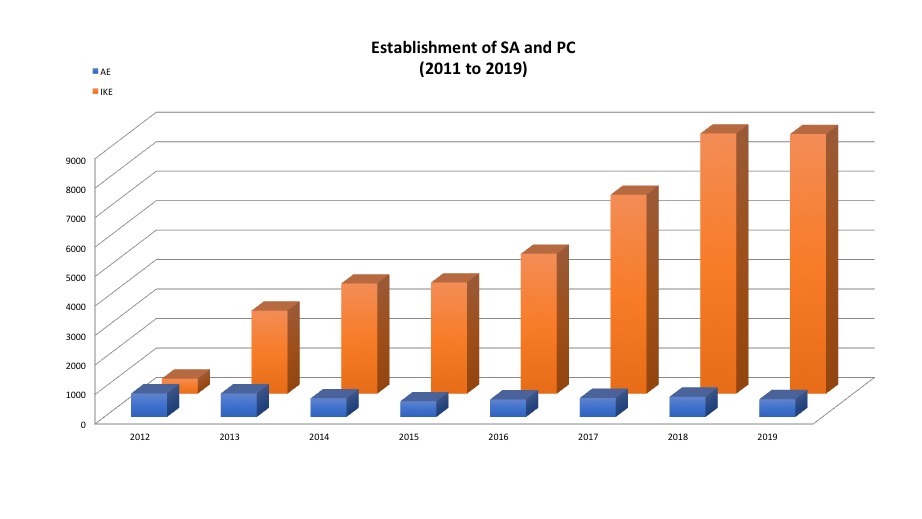
    Despite the fact that SA and Private Company address different audiences, it is interesting to take a look at the Business Registry’s data for the years 2012 (when Private Company was established) until late-October 2019. And to be more precise:

    Business Registry’s statistical data shows that the number of SAs established yearly is kept, notwithstanding some minor fluctuations, rather steady.

    On the contrary, the establishment of Private Company is steadily rising. Its flexibility and the fact that it is cheap and simple are, quite certainly, the reasons why it is preferred over SAs.


    V. In Conclusion

    SA and Private Company never competed against each other.

    Private Company prove to generally be cheaper than SAs. Of course, more flexible as well. And this is why they are generally preferred.

    But their “audience” is different. Bigger schemes, bigger investments and businesses wanting to take advantage of the tools the act on SAs provides, must, no doubt, choose the SA as the most fitting company type.

    The result of the comparison of these two company types, as mentioned above, is overwhelmingly in favor of Société Anonyme.

    And if we were to refer to SA as the “swiss army knife” by Victorinox (as the multitool that it is), we could not but consider Private Companyto be the “pocket knife”.

    Let’s say it is collapsible as well…

    stavros-koumentakis

    Stavros Koumentakis
    Senior Partner

    P.S. A brief version of this article has been published in MAKEDONIA Newspaper (November 10th, 2019).

  • Minority Shareholders. Part Β΄: Claim for a buy-out by the Majority Shareholder(s)

    Minority Shareholders. Part Β΄: Claim for a buy-out by the Majority Shareholder(s)

    Minority shareholders.

    Part Β΄: Claim for a buy-out by the Majority Shareholder(s)

    1. Preamble

    It is redundant to say that in any country that respects its laws, the principle of freedom of contract stands strong. In Greece, this principle is introduced in our legal system in article 361 of the Greek Civil Code (: “For the establishment or modification of any legal obligation a contract is required, unless the law provides otherwise”). This principle is based on article 5 paragraph 1 of the Greek Constitution, which refers, amongst other things, to the [right to] economic freedom.

    Specific aspects of the principle of freedom of contract are the freedom to enter (or not) into an agreement, as well as the freedom to choose what said agreement (should one choose to enter into one) will provide.

    According to this, no one is obligated to enter into an agreement (even more so in a predefined one), unless a specific law “provides otherwise”.

    Respectively, when it comes to S.A.s,  no one is obligated to buy the shares of any minority shareholder -especially when the latter’s share is so small that it has no real value in terms of assisting to the formation of the so needed majority. In this case, it is highly likely that nobody will be interested (or nobody will let show they are interested) to purchase such kind of a minority shareholding.

    Amongst his other quotes, the actor and director Clint Eastwood has infamously said that “if you want a guarantee, buy a toaster”. If the minority shareholder decides that their investment is not profitable or even problematic, they cannot just simply return it for a refund: shares are not toasters. Shares are not covered by guarantees, as are toasters.

    A safe assumption could be that, at least at a first glance, no one can be obliged to acquire a minority share package, unless some specific requirements are met…

    There has already been a reference to the legal claim a minority shareholder may have against the company, for the latter to buy them out, as well as all the relevant requirements and procedures (read related article). In this article, we will mainly focus on a minority shareholder’s possible claim against the majority shareholder to buy them out.


    2. The right of the minority shareholders to request a buyout by the majority shareholder

    The requirement for the minority shareholding to be holding shares that do not exceed 5% of the total of the company’s shares

    In the case of a private S.A., (as far as public S.A.s are concerned, the rules of public offerings apply, supplemented by the Greek law of S.A.s) the main requirement is in regard of the percentage of the minority shareholding. The Greek law of S.A.s (article 45 paragraph 1 of law 4548/2018) is strictly limited to shareholders holding a maximum of 5% of a company’s shares. This percentage is calculated as a percentage of the nominal value of the shares the minority shareholders hold on the overall total of the total nominal value of all the shares of the company. It is irrelevant whether a shareholder is holding 5% or less of the ordinary or of the preferred shares of the company. Only the percentage of the company’s shares held matters.

    Furthermore: Minority shareholders holding a percentage higher than 5% of the company’s shares are not entitled to require a buy-out by any shareholder. Not even for a sum of shares equaling to less or up to 5%.

    This provision seems fair. Most of the minority rights recognized under Greek law are recognized to the minority shareholders that are holding more than 5% of a company’s shares. If a shareholder is not holding 5%, their protection seems, and is, extremely limited.

    The requirement for at least 95% of the company’s shares to be held by one (?) shareholder

    The majority shareholder -of 95% or more, a percentage gathered after the company was set up- has (originally) the obligation to buy-out the minority shareholder. In case the minority shareholder accepted at the stage of the very establishment of the company that they would have a percentage lower to 5%, the law assumes that they also consciously accepted that they would have limited protection under the law. Because of that assumption, Greek law has chosen not to “force” the majority shareholder to buy-out such a minority shareholder.

    It is noteworthy that in calculating the required 95% of the shares held by the majority shareholder, one must also count in the shares held by the parties related to them. The legal entities characterized as “related parties” to the majority shareholder and whose shares are considered as shares of the majority shareholder when calculating the percentage of shares the latter is holding, are identified as such by article 32 of law 4308/2014. The persons characterized as “related parties” to the majority shareholder and, again, whose shares are considered to be shares of the majority shareholder when calculating the percentage of shares the latter is holding, are identified as such by Appendix A of the aforementioned law. To be more precise:

    Regarding the related parties that are legal entities, article 32 of law 4308/2014 is extremely detailed. It is redundant, in the context of this article, to get into great detail. One general rule that would be useful to keep in mind is that related parties are generally considered to be the parent company and the subsidiaries of the majority shareholder or of a company that is related to the majority shareholder. It should also be noted that those legal entities that choose to or legally have to prepare consolidated financial statements with the majority shareholder or with related to the latter legal entities are also related parties to the majority shareholder.

    Annex A of law 4308/2014 instructs us in counting in shares held by natural persons- members of the majority shareholder’s close family- when calculating the latter’s share over the company. According to this law, such persons are the majority shareholder’s ascendants, descendants, spouses, and live-in partners.

    Time Limit

    The right given to the minority shareholder (holding a 5% or less of the company’s shares) to request a buy-out is subject to a five-year limitation period. This five-year period starts the moment the majority shareholder (along with their related parties) is holding at least 95% of the company’s shares. After the lapse of this five-year period, the aforementioned minority shareholder no more has the right to request a buy-out by the majority shareholder holding 95+% of the company’s shares.

    The shareholder obligated to buy

    Article 45 of law 4548/2019 refers to the obligation of the majority shareholder to buy-out the minority shareholder holding less or equal to 5% of the company’s shares. As already stated, in calculating the majority shareholder’s share over the company (in order to determine whether they are holding 95% or more) one must also account in the shares held by related parties of the shareholder (legal entities or members of their family). In case there actually are related to the majority shareholder parties holding company shares, one should take it as a given that the related parties will be obligated to acquire the shares sold by the minority shareholder analogically to the company shares they hold prior to the buy-out. It goes without saying, these related parties will have to pay for the shares they are acquiring, at the price determined by the competent court. This approach seems the only logical one since anything else would disturb existing balance amongst the remaining shareholders.

    The procedure leading to the buy-out

    The minority shareholder that wishes to be bought-out has to submit the relevant request to the competent court (article 46 par. 2 and article 46 par. 4 of law 4548/2018). The latter will rule whether the requirements set by the law are met. If the minority shareholder’s action is upheld, the court will rule on a just and equitable price per share, as well as on the specific terms the buy-out will be implemented. In order to determine the price per share, the court will take into consideration the value of the company. In this case it is more than fair (as well as allowed by law) for a report to be requested by an independent expert regarding the value of the shares sold; In most cases, the independent experts that will provide said report to the court will usually be either two chartered accountants or an audit firm. This independent expert report will evaluate the arguments made by the opposing parties.


    3. In conclusion

    The protection offered to the minority shareholder holding a percentage of less than 5% of the company’s shares is extremely limited by law. To counterbalance this extreme risk exposure (and in contrast to the right to economic freedom and the principle of freedom of contract, as they are both stated and protected by the Greek constitution) the above-mentioned minority shareholder has the right to request to be bought out from the company by the company’s majority shareholder of 95% or more.

    The law does not force S.A.’s shareholders to notify the moment the percentage either they or their related parties hold over the company’s shares reaches or exceeds that of 95%. As a result, the minority shareholder has to be alert as for when their rights kick in, otherwise said minority shareholder on the one hand risks to miss their opportunity to exercise their rights to be bought-out altogether, on the other to fail to achieve a good price for their shares.

    As for the majority shareholder, they have every reason to avoid holding 95% of the company’s shares. If they succeed in doing so, they will be able to enforce onerous terms on the minority shareholder while negotiating a possible buy-out of the latter. Such a negotiation could easily start by reminding the minority shareholder of the infamous abovementioned quote by Clint Eastwood…

    stavros-koumentakis

    Stavros Koumentakis
    Senior Partner

    P.S. A brief version of this article has been published in MAKEDONIA Newspaper (May 12th, 2019).

  • Minority Shareholders. Part A: The Claim of redemption of their shares by the S.A.

    Minority Shareholders. Part A: The Claim of redemption of their shares by the S.A.

    Minority Shareholders.

    Part A’: The Claim for Redemption Of Their Shares By The Société Anonyme.

    The existence and exercise of minority rights – as described in an earlier article – “Minority and its rights in the Société Anonyme” and “Minority rights in the SA: the exceptional auditing” – are not always enough to achieve of the necessary balance in its (the minority’s) relationships with the company. Nor, in the end, in the company itself.

    Sometimes “divorce” seems necessary …

    The majority of shareholders exercising their voting rights are entitled (and rightly) to make critical decisions about the future of the company. Critical, in a logical sequence, also for the future of minorities. Sometimes even potentially damaging to the latter.

    What are these potentially harmful decisions? And, if they are taken, the minority shareholders remain unprotected? And under what conditions would it be possible to implement a “divorce” between the company and the minority shareholders?

    According to English actor Carrie Grant: “Divorce is a game played by lawyers”. And from this particular “divorce” they could not miss …


    Causes For The Claim Of Shares Redemption

    It is a fact that within the framework of democracy (and of the law of the Société Anonyme) the majority shareholders are the decision makers. Sometimes, however, these same decisions could be assessed as making it “in an obvious manner, particularly unprofitable” to retain the minority shareholders in the company (Article 45 par.1, section an of the l. 4548/2019). The assessment, of course, belongs to the minority shareholders themselves. The latter will exercise their statutory rights if they adopt this position.

    The Law on the SAs (Article 45 par.2) recognizes as potentially harmful to minority shareholders decisions concerning: (a) the transfer of the registered office of the company to another State; (b) the introduction of restrictions on the transfer of shares; (c) the change of corporate purpose and finally (d) any other event which, according to the company’s articles of association, activates respective rights of the respective shareholders. In the latter case, however, it is necessary to provide for a time limit for their exercise.


    The “Way Out” Of Minority Shareholders And The Relevant Conditions For The Shares Redemption Claim  

    In the event that any of the above events occurs, the law provides (significant) protection to minority shareholders: they are entitled to address to the competent court asking for the redemption of their shares by the company (Article 45 par.1: “redemption by right”-internationally known under the Anglo-Saxon term as sell-out). It imposes, however, a double condition on the applicants (and claiming to be protected): Firstly, there having been represented in the General Meeting which took the disputed decisions and, on the other, their opposition. Possible absence from the relevant General Meeting, voting in favor of the relevant decision or abstaining from the vote, it removes the aforementioned right (i.e. to appeal to the Court asking for the redemption of their shares). However, if a statutory provision refers to an event not related to a decision of the General Meeting, this (double) condition does not stand.

    The term within which “the injured” minority shareholder must “take action” – i.e. bring the claim and exercise his / her right – is three months from the completion of the amendment of the articles of association. This time limit applies in cases of transfer of the company’s registered office to another state, of the introduction of restrictions on the transfer of shares and the change of the corporate purpose. In the other cases provided for by the Articles of Association, the deadlines indicated therein shall apply.


    The Case Of Introducing Restrictions On The Transfer Of Shares

    The company’s interest requires that the company’s continuity be safeguarded. And this is sometimes, to a considerable extent, dependent on its shareholder structure. The introduction of restrictions on the transfer of shares sometimes proves to be crucial (refer to the article on Restricted Shares). The relevant provisions in the Articles of Association at the time of the establishment of the company appear to be a “sine qua non” element to ensure the relations between the shareholders and the achievement of the corporate purpose.

    In the vast majority of cases, unfortunately, such statutory restrictions are not provided for when establishing the company. When the need is identified subsequently, the majority shareholders are in fact able to impose the necessary statutory change. However, the minority shareholders are then (reasonably) entitled to request the redemption of their shares and, ultimately, their exit from the company. It is for the court to decide on the reasonableness of the request of the minority shareholders and, in particular, “if their stay in the minority becomes manifestly unprofitable”. In other words: minor restrictions on the transfer of shares could not justify meeting the request of minority shareholders.

    However, for the cases where the necessary restrictions on the transfer of the shares have been provided since the company’s establishment, there is no reason for the corresponding minority shareholders’ rights.


    The Case Of Modifying The Company’s Purpose

    A similar assessment will, of course, be made by the Court even if the minority shareholder complains (and exercises his/her rights) due to a change in the corporate purpose. It would reasonably be considered to be particularly unprofitable for the applicant to convert, for example, a holding company into a CD production company. On the other hand, it would not be possible to (severely) support the minority shareholder requesting the redemption of his shares from a (painless) expansion of corporate activities.


    The Court’s Judgment On The Claim For Shares Redemption

    The minority shareholder’s claim for the redemption of its shares by the company is assessed by the competent court (Article 45 par.4). The latter is to determine whether the conditions laid down by the law and the substantive merits of the applicant’s arguments are fulfilled. If the claim is accepted, the Court shall determine the fair and reasonable consideration (in exchange for the redemption of the minority shares) and the terms of payment. In determining the price, the value of the company is taken into account. It is logically expected (and not only legally permissible) to request a relevant expert report, which is usually carried out by two auditors- chartered accountants or an auditing firm. This expert opinion is also the one to evaluate both sides’ arguments.

    The court decision is always binding on the company (Article 45 par.5). In the event of the fault being breached within the time limit set by the court order, it may be decided the company’s dissolution.

    However, the judgment is not binding on the requesting shareholder. If the price to be determined by the court decision is not evaluated by the applicant as satisfactory, it is entitled to refuse to complete the relevant procedure (transfer of its shares to the company). In that case, of course, he/she is charged with the costs of the relevant proceedings.


    In Conclusion

    Coexistence in life is not always easy – possibly once and unacceptable. Respectively in business – much more when particularly important (sometimes) economic interests are at stake. The law recognizes the minority shareholder’s right to ask for “dissolution” and for “compensation” by the company when certain important conditions are met. It is, however, particularly important to stress that the importance of the Articles of Association is once again as distinct. Its provisions should either take place in a timely manner (i.e. when the company is established) or in a way that does not affect minority shareholders (unless the aim is precise to affect their rights) …

    There is no doubt that the specific legislation is a means of protecting minority shareholders. But as this divorce, as already mentioned, “is a game played by lawyers”, it is likely to become a weapon, important in the hands of the majority.

    Particular attention, therefore, in both the articles of association and the lawyers …

    stavros-koumentakis

    Stavros Koumentakis
    Senior Partner

    P.S. A brief version of this article has been published in MAKEDONIA Newspaper (May 5th, 2019).

  • Minority rights in the Sosiete Anonyme. Part II. The Exceptional Auditing

    Minority rights in the Sosiete Anonyme. Part II. The Exceptional Auditing

    Minority Rights In The Société Anonyme: An Internal Enemy Or A Determinant Of Health? 

    Part B’- The Exceptional Auditing

    According to Solon the Athenian: “Best governance is where the people obey the rulers and the rulers obey the laws”. In the course of history, it has turned out that everyone who rules embraces (apparently, or even deeply) Louis Ludwig’s XIV saying “L ‘etat c’ est moi” (“the state is me” – for which we have already referred to in Part A of the present). In order to ensure legitimacy in the parliamentary democracy, the principle: “the government rules and the opposition controls” (rightly) applies.

    All of this, of course, does not concern politics alone, as it would be easy (and reasonably) able to make the visibility in life and business: Thus, obviously, brought birth to the need for control of the (small or large) majority of each minority. To safeguard the property of the latter but also the property of the enterprise. To ensure its prosperity and its growth.

    And finally: A company under the watchful eye of multiple controls and auditors pretends (and potential investors and/or creditors) for clear financial and “clean” representations …


    Regular And Exceptional Auditing In The Société Anonyme

    We have referred to minority rights (interests) in the Société Anonyme in a previous article. In the present, our reference is limited to the minority rights that are linked to the exercise of exceptional auditing.

    The regular auditing is distinguished for its periodicity as it relates to the approval of the annual financial statements by the General Meeting of the companies concerned (but not necessarily for those designated as small and very small entities). Therefore, exceptional auditing may be carried out in a company under regular auditing.

    In this context, it is not paradoxical to overlap (partial or total) specific auditing areas: for example, checking the fund is subject to regular auditing but it may also be the subject of exceptional auditing.

    In any case, the exceptional auditing may:

    (a)  also cover areas not covered by the regular auditing such as, for example, the feasibility of managing the company;

    (b) be always more targeted than the regular;

    (c) be carried out, in principle, by persons other than those carrying out the regular auditing and in different ways by the appointed ones;

    (d) result in a finding that is not primarily addressed to the same recipients.


    Types, Conditions and Exceptional Auditing Procedure

    In the event that the conduct of acts contrary to the law, the articles of association and/or resolutions of the General Meeting is assumed, shareholders representing more than 1/20 of the share capital of the Société Anonyme (or, for listed companies, by the Securities and Exchange Commission) are entitled to submit a request to the competent Court for the purpose of carrying out the relevant auditing (article 142, par. 1 & 2, l. 4548/2018). The relevant application shall be submitted within three years from the approval of the financial statements for the year in which the transactions in question appear to relate.

    However, if the circumstances show that the management of the company is not exercised in a proper or prudent manner, shareholders representing more than one fifth (1/5) of its share capital shall be entitled to apply to the competent court for the purpose of carrying out the audit ( Article 142 par.3, l. 4548/2018).

    The court decides whether or not to accept the verification request after checking whether or not the aforementioned conditions are met. It is likely that the requesting minority shareholders are represented in the Board of Directors (either because they have directly appointed members or because they have been elected members of the list of potential shareholders nominated by the shareholders). In this case, the court may also assess that there is no justification for the submission of such a request which, in such a case, will be rejected.


     The Auditors And the Conduct Of The (Exceptional) Auditing

    f the court accepts the request for auditing, it specifies the persons who will carry it out (Article 143). The persons entrusted with the auditing may be:

    (a) an audit firm or, at least, a statutory auditor;

    (b) Holders of an A class accountant’s license from the relevant Economic Chamber and, in addition (when it comes to the legitimacy or good governance)

    (c) persons with any specific knowledge, if required.

    The court, when accepting the request, also determines the amount of the remuneration of the appointed auditors, as well as the procedural issues regarding the time of payment, the possible advance payment and the person charged (if the applicants are liable for payment or the company under auditing).

    The auditors appointed will have to complete the auditing assigned to them in the shortest possible time. The relevant result is handed over to the applicant as well as to the Company. The Board of Directors is obliged to inform the shareholders of the company (no later than the next General Meeting) and the Hellenic Capital Market Commission – in the case of a listed company.

    However, it is important to underline that there is an independent obligation for auditors to submit their findings to the competent public prosecutor in case they find that criminal offenses have been committed.


     Exceptional Auditing: A Blessing or A Curse

    The exceptional auditing is usually conducted either when there is evidence or suspicion of mismanagement or when the demand for applicants is to exert pressure on the managers.

    Taking into account the potential scope and depth of the auditing being carried out, the exceptional auditing may work:

    (a) dissuasive or unlawful or unauthorized acts;

    (b) as a means of exerting pressure on their executives or (under certain conditions) of their extortion;

    (c) as (critical) evidence in the context of claims against the persons involved.

    It follows from the above that the right to conduct exceptional auditing is of particular importance in the operation and (conditionally) in the life of the société anonyme itself. This is even more perceptible when criminal offenses are identified, so the competent prosecutor must also be involved.

    In any case: The emergence of unauthorized or unlawful acts through an official (legally ordered) auditing procedure can only cause problems for the company itself – and not only to the case-by-case, insolvent or legally culpable persons.


     Minority rights in Conclusion

    The recognition of the (exceptional) auditing of the société anonyme by minority shareholders is of no doubt that it sometimes works positively (sometimes even beneficial) in the exercise of its management and in the achievement of the corporate purpose. There is also no doubt that it works in the direction of assisting the development of entrepreneurship as well as potential synergies.

    The mediation of the competent court to investigate the fulfillment of the conditions for carrying out the exceptional auditing adds value to the procedure, but also to the seriousness of its outcome. It is basically a result that can hardly be ignored by the members of the Board of Directors, the shareholders and the competent authorities. (And especially with regard to the latter let’s always keep in mind that no business is able to work absolutely thoroughly …).

    Accordingly, any abuse (sometimes simple exercise) of the right in question is harmful not only to the majority shareholder but also to the legal entity it concerns, itself. From this perspective, we all (majority and minority shareholders, legal representatives, courts dealing with such cases) work towards balancing potentially opposed interests and, ultimately, towards safeguarding the interests of the société anonyme.

    Only.-

    stavros-koumentakis

    Stavros Koumentakis
    Senior Partner

    P.S. A brief version of this article for minority rights has been published in MAKEDONIA Newspaper (April 27th, 2019).

    δικαιώματα μειοψηφίας

  • Minority and its rights in the Société Anonyme

    Minority and its rights in the Société Anonyme

    Minority and its rights in the Société Anonyme: an internal enemy or a determinant of health? 

    Part A’

    «L’ etat c’ est moi» (: “The state is me”) is the most well-known saying, more known than him himself – of Louis IV, that refers to the omnipotence of the ruler and, consequently, to the inability of the existence of a different view. In France in the seventeenth and eighteenth centuries, every minority view was obviously judged to be repugnant: The Ruler knew!

    For the opposition, various views have been formulated over time (where and when) its existence has been accepted. One of the most characteristic views was that of Vladimir Ilic Lenin: “The best way to control the opposition is to guide them”. In this case, we have recognized the right of the (minority) opposition to existing with (yet acknowledged) rights of “guiding” it by the ruling (and majority) filiation.

    Needless to refer in both cases mentioned above, to the protection of minorities.

    Let us consider, accordingly, what the non-recognition of any right to minorities would mean in any business formation.

    So, is the (in substance) recognition and safeguarding of minority rights in corporate formations a safety factor not only for the minority but also for potential investors and creditors?


    1. Minority rights in the Société Anonyme

    In the light of the above considerations, the recognition of minority interests in the (corresponding) shareholders – and not only in the light of the constitutionally protected right of property – seems more obvious. It is also perfectly normal for the current legislator to (slightly) strengthen the rights of minority shareholders in the recent law on sociétés anonymes.

    It is true, of course, that we should always “weigh” the rights of the majority shareholders with the corresponding ones of the minority shareholders. The result, in any case, cannot be either the frustration of the proper functioning of the company or the rights of the latter (the minority). The right balance, at least as far as the legislator’s intentions are concerned, seems to be significantly reflected in the recent law.

    The recognition (on a formal level) and the existence of (in essence) minority rights, sometimes those that the law imposes on those who the investor (or the creditor) requires, is a prerequisite for seeking and finding investment (or loan) funds – as a rule critical for the smooth operation of the société anonyme.


    2. The extent and the nature of minority rights in the société anonyme

    The already in force Law on Societes Anonymes recognizes (like its predecessor) a series of rights to minority shareholders depending on the amount of share capital each one or more of them represents. Minority rights are mentioned on the one hand into the provision of article 141 of the new law and, on the other, are spread into its other provisions. Of particular interest, however, are the rights recognized by the law to minority shareholders (those representing 1/20 and 1/5 of the share capital) as regards the control of the company. However, because of their seriousness, we will deal with than in an article to follow.

    For the rest, an indicative escalation of the minority rights is attempted, divided into two sections: The one which concerns the (presumably) more important and the other, concerning the remaining, individual rights


    3. The most important issues

    3.1 Approval of the conclusion of (in principle) prohibited agreements

    Shareholders representing 1/20 of the share capital are entitled (Article 100 par. 3) to request the convening of a General Meeting for a final decision on the granting of an authorization to conclude an agreement for the cases in which the conclusion is prohibited without a special authorization granted by the Board of Directors (Article 99 et seq.). In the General Meeting that convenes to this respect (:Article 100 par. 4), the right of shareholders to oppose to the granting of an authorization to conclude the agreement is granted as follows: (a) for listed companies to the shareholders representing a percentage equal to or greater than 1/20 of the share capital and (b) for non-listed companies to the shareholders representing a percentage equal to or greater than 1/3 of the share capital (especially for the latter subject see related article<).

    3.2 The critical issues of GM’s competence

    Shareholders representing a percentage equal to or greater than 1/3 of the share capital are entitled (:Article 132 par.3) to oppose a decision-making on critical matters pertaining to the operation of the company (indicatively: change of the company’s nationality, its subject, the increase of shareholder obligations, the regular increase of the share capital, the change in the way the profits are distributed, the merger, the division, the transformation, the revival, the extension or the dissolution of the company, or renewing the power to the Board of the Directors for an increase in capital, etc.).

    3.3 The distribution of the minimum dividend

    A right is recognized (:Article 161 par.2) to shareholders representing a percentage equal to or greater than 1/3 of the share capital to be involved in the decision of the General Meeting to reduce the distribution of the minimum dividend to a percentage less than 35% of the net of profits (after deduction of the reservation for the statutory reserve and other credit lines of the statement of results that are not derived from realized profits). Shareholders representing a percentage equal to or greater than 1/5 of the share capital are entitled to oppose the decision of the General Meeting to not (in whole) distribute or reduce the distribution of the minimum dividend to less than 10% of the net profits.


    4. Individual rights of the shareholders

    4.1 Rights of individual shareholders

    In the law on sociétés anonymes a series of rights is recognized to the individual shareholders of the société anonyme. Indicatively:

    The right (: article 79 par.1), if provided for in the Articles of Association, for a shareholder to appoint directly members of the Board of Directors, the number of which should not exceed 2/5 of the total number of its members.

    The right (on a non-listed company – under Article 122 par.4) for the shareholder to require the company to send to him by email individual information for forthcoming general meetings at least ten (10) days prior to the date of the General Meeting.

    The right (: article 123 par.1) to require the company to make available to him the annual financial statements of the company and the relevant reports of the Board of Directors at least ten (10) days prior to the date of the Ordinary General Meeting.

    The right (: article 141 par.10) to require the company to make available, within 20 days, information on the amount of the company’s capital, the classes of shares issued and the number of shares in each class, especially preferred, (with the rights granted by each class) and the number of the restricted shares, with the restrictions, per case.

    The (conditional) right (: article 141 par.11) to require the company to make available to him the company’s shareholders holding a percentage of more than 1%.

    The right in case of dissolution of a company (: article 168 par.4) to require the competent court within three months of the dissolution of the company to determine the minimum selling price of the property, branches or divisions or of the enterprise under liquidation, as a whole.

    The right (: article 184 par.5) of any shareholder with bearer shares to request by 31.12.2019 from the competent court to oblige the company to register him/her in the shareholders’ registry, to issue and deliver new registered shares.

    4.2 Rights pertaining to a minority of 1/20 of the share capital

    The same law recognizes a series of rights to shareholders that accrue more than 1/20 of the share capital. Indicatively:

    The right (: article 102 par.7 case b) to consent to the resignation or reconciliation of the company with respect to its claims for compensation against members of the Board of Directors after the relevant action has been brought.

    The right (: article 104 par.1) of filling a claim for the company’s claims against members of the Board of Directors (as part of their intragroup liability).

    The right (: article 109 par.5 case b) to apply to the competent court to reduce the amount of remuneration or benefit paid or decided to be paid to a specific member of the Board of Directors (subject to the objection, in the relevant General Assembly) of shareholders representing 1/10 of the share capital).

    Right (: article 137 par.3 case b) to bring an action for annulment of a decision taken without the information demanded having been given to the claimants.

    The right to submit a request to the Company’s Board of Directors for the convening of a General Meeting (article 141 par. 1) for the inclusion of items on the Agenda of the General Meeting (article 141 par. 2), for the provision of information about paid-up amounts and payments to members of the Board of Directors and the Managing Directors (article 141 par. 6), to postpone the decision of the General Meeting (article 141 par. 5) and finally to make an explicit vote (article 141, par.9).

    The right (: article 142 par.1) to submit a request to the competent court for an extraordinary audit of the company in the case of acts that violate provisions of the law or the company’s articles of association or decisions of the General Meeting.

    The right (: article 169 par.2) in the event of rejection or non-approval of the acceleration and liquidation plan, submission to the competent court for approval of the above plan or other appropriate measures.

    4.3 Rights pertaining to a minority of 1/10 of the share capital

    For shareholders holding more than 1/10 of the share capital, a series of rights are recognized. Particularly:

    The right (: article 79 par.3 case (c)) to apply to the competent court for the revocation of a counselor appointed by a shareholder (in the context of exercising the relevant right provided by the articles of association- in accordance with paragraph 1 of same article), for a significant reason related to the person appointed.

    The right (: article 102 par. 7 cases (a)) to consent to the resignation or reconciliation of the company with respect to its claims for compensation against members of the Board of Directors, before the possible exercise of the relevant claim.

    The right to information on the course of corporate affairs and the assets of the company (Article 141 par.7).

    Finally, the right to request a court to interrupt or omit the liquidation stage and to immediately take the company out of GEMI – if the company’s assets are not expected to be sufficient to cover the costs of the liquidation (article 167 par.6).

    4.4 Rights pertaining to a minority of 1/5 of the share capital

    For non-listed companies the right is granted (: article 135 par.1 case d) to shareholders representing a percentage equal to or greater than 1/5 of the share capital to be involved in the decision-making by the General Meeting by a vote without a meeting.

    In addition, the minority of 1/5 of the share capital is granted with the right (: article 142 par.3) to seek extraordinary insolvency by the court if the management of corporate affairs is not exercised as required by sound and prudent management.


    5. Shareholder’s Unions

    The Shareholders’ Unions (: institution first emerging in the new Law on Sociétés Anonymes – Article 144) are entitled to exercise the rights granted to the individual shareholders but not those relating to each one of them individually.


    In conclusion

    The Law on Sociétés Anonymes recognizes (and correctly) a set of rights for shareholders with minority shareholding interests. Naturally, minority rights become more important as greater is the percentage of the share capital held by a shareholder. Of the most important are those of controlling the majority and its actions, which, however, because of their seriousness, will concern us in the next article.

    The existence and the ability to exercise minority rights are, in principle, beneficial for the company and the achievement of corporate goals – of course, for attracting investment funds as well. However, it is absolutely harmful to the company to abuse minority rights as well as to exercise it for the benefit of the existing shareholder rather than the company. However, given that what is (and is) the priority of the company rather than that of the individual shareholders, such situations need to be prevented, and, if necessary, decisive. It is important, however, not to forget, in any case, that what matters is the corporate interest.

    And that_ Only.-

    stavros-koumentakis

    Stavros Koumentakis
    Senior Partner

    P.S. A brief version of this article has been published in MAKEDONIA Newspaper (April 21st, 2019).

    dikaiomata-meiopsifias

  • Amortization of capital

    Amortization of capital

    The first reference to the issue of the amortization of capital dates, back, to 1920 – in the original text of the previous Law on Sociétés Anonymes (: Law 2190/1920). The Patriarch of the Law of Sociétés Anonymes I. Passias in the first volume of his monumental work (“The Law of the Société Anonyme”) referred to it giving its historical dimension.

    The legislative regulation of this issue, after more systematically dealing with it (in the second phase of its “life”), dates thirty-five years. Yet, despite its centuries-old life, this institution is, however, the least well-known and well-established institutions in the law of sociétés anonymes. And as little is known, so profitable it could prove to be for the shareholders. This is because in our country we “confuse” (often – without really needing) our pocket with the fund of our company, although there are other legitimate (and not just legitimate) ways of transferring liquidity from that fund (: of the société anonyme) in the pocket of his (the shareholders). In the broader known legal ways, one could include profit distribution and share capital amortization.


    So, what is the amortization of capital? Could it constitute a decrease?

    One of the legitimate ways of transferring liquidity from the company’s fund is also the amortization of the share capital. The legislator “felt” the need (albeit, as it is known, an insoluble one) to note, in one – separate paragraph of the relevant provision, that “amortization does not constitute a decrease of the capital”. But why did he need to make this specific clarification? Reasonable, as the question of “decrease?” was created in each of us when we first came into contact with this particular institution.

    Therefore, the amortization of the share capital does NOT constitute a decrease. The decrease of the share capital results in its reorganization – its dilution, i.e. by the amount decided by the General Meeting and its determination at a new, lower level.

    It is important to repeat that the amortization does NOT affect the share capital, which remains stable even after amortization.


    The conditions for the amortization

    The conditions for the amortization (partial or total of the share capital) are, just, two:

    (a) For the commencement of the relevant procedure: Decision of the General Meeting either with increased quorum and majority or (if there is a statutory provision) with a simple quorum and majority and

    (b) For the implementation of the relevant decision: Use of reserves or amounts of profits for the current year (see immediately below).


    The implementation of the amortization

    In accordance with the law, the amortization is implemented, by paying to the shareholders all or part of the nominal value of their shares. However, the specific payment is made (not with capital dilution but) by using special reserves that can be distributed. For the sake of completeness, this payment could of course also take place from the remaining profits of the year after the distribution of the first dividend, the formation of the statutory reserve and (of course) the payment of the due tax. Due to the fact that the money paid to the shareholder in the context of amortization is not taken from the share capital, its naming (“capital amortization”) is rather unfortunate. Rather right as it is the one that creates the above-mentioned reflection (: “i.e. decrease?”).


    Beneficiaries and the “price”

    Amortization does not (necessarily) benefit all shareholders. With amortization, it is possible to transfer liquidity from the company to either all or only certain shareholder / shareholders.

    It is said that “everything in life comes with a price”. Regardless of whether a person adopts this position in general, the “price” in this case is clear: Shareholders whose shares have been amortized retain their rights from the equity relationship but not those relating to their participation in the distribution of the first dividend and their right to reimbursement for their contribution if the company is liquidated.

    Therefore: The right to the first dividend is limited to those only from shares for which no amortization of their nominal value has taken place. The excess of the minimum dividend is allocated to all the shares, including those whose nominal value is written off. As regards the right to the distribution of the proceeds of the liquidation, the other shares (except for those for which the amortization) are preceded and then the excess is distributed in the totality of the shares (thus, the shares whose nominal value has been written off).


    The distinction of shares

    After the amortization of the nominal value of some shares, their share options are differentiated (better: diluted) in relation to the others. The protection of the rights of the remaining shares and of the bona fide third parties imposes (albeit not foreseen in the law) two alternative options: (a) the cancellation of the old (full rights) shares in combination with the issuance of new – with a respective note to their bodies or, more simply, (b) the note on the body of the specific shares of the amortization of their nominal value.

    In any case, the new shares (diluted by the aforementioned rights) are in practice and theoretically also called (incomprehensible to why so) “jouissance shares” – in addition to identifying them as common or privileged (i.e: “common jouissance shares” or where appropriate, “privileged jouissance shares”).


    The participation of “jouissance shares” in a possible decrease of the share capital

    The relevant question was put to the writer, in more than one case, by entrepreneurs who, with much interest, listened to the description of the particular institution. It is true that this particular issue does not seem to have been particularly dealt with in theory and by case law. On the occasion of the repetition of the relevant institution in the new Law on Sociétés Anonymes, as well as the discussions in the previous paragraph, diametrically opposed views were heard. I have no doubt that the better one is the one that recognizes the right of participation of jouissance shares in a consequential decrease of the share capital, which may take place with the return of part of the capital to shareholders. Argumentation in this direction has two very important axes:

    (a) The (non-disputable) wording of the law, which restrictively refers to the rights that the jouissance shares are deprived of (among which the right to participate in a decrease through the payment of a part of the capital to the shareholders, is not included) and

    (b) The fact that the return to the shareholders of the amortization product takes place either through the use of special reserves that are permitted to be distributed or by using profits for the current year after the first dividend and the formation of the statutory reserve – therefore the “share capital” account, which (in any case) remains unchanged after the amortization, is not used.


    The “restoration” of jouissance shares to the status before the amortization

    One more, extremely interesting, question the writer has accepted in one of the presentations of this particular institution is the possibility that jouissance shares returned to their pre-existing status. This question (due to the limited application of the institution) does not seem to have been dealt with by case law – nor in theory. But for the answer with (relative) ease, we could positively (that is, in favor of the validity) accept the assumption that such a possibility is not forbidden by law. However, reservations are made as regards the accounting management of the whole matter as the return (permanently) of distributed reserves does not appear to be an acceptable solution.


    In conclusion

    The institution of the amortization of the share capital is an old institution of the law of sociétés anonymes. However, since it has not become widely known, it has not received the adequate attention at the scientific and, most importantly, business level. As a result, it has not been sufficiently exploited. However, from the above, I do not think there is any doubt about its usefulness or the possibility of multi-level exploitation for the shareholders of the société anonyme.

    stavros-koumentakis

    Stavros Koumentakis
    Senior Partner

    P.S. A brief version of this article has been published in MAKEDONIA Newspaper (April 14th, 2019).

    aposbesh-kefalaiou

  • Seminar At the Piraeus Chamber of Commerce and Industry On the New Law on the SAs

    Seminar At the Piraeus Chamber of Commerce and Industry On the New Law on the SAs

    [vc_row][vc_column][vc_column_text] Within the framework of the presentations and informative meetings organized by KOUMENTAKIS & ASSOCIATES LAW FIRM, a seminar was held at the Piraeus Chamber of Commerce & Industry on the needs as well as on the opportunities created for the entrepreneur regarding the regulations of the new Law on Sociétés Anonymes.

    With the participation of representatives from the PCCI and the co-organizers associations and federations (Association of Industries of Attica and Piraeus, Piraeus Trade Association, Pan-Hellenic Association of ship and exporter suppliers and Association of Piraeus Commercial Representatives and Distributors) Stavros Koumentakis, Senior Partner of the firm, enlightened the multiple business opportunities that constitute the changes brought by the new law on the SAs.

    As Mr. Koumentakis characteristically mentioned: “The new law is an important opportunity to become better aware of the operation of our Société Anonyme, to ensure the better protection for founders, shareholders and for the investment, to redesign on the right bases and to limit the operating costs, to attract new and to retain the most capable executives, to create the conditions for access to cheap capital, to make use of modern technology, and finally to prepare the next day of our business”.

    In the informative video presented as an introduction to the Seminar (you can see it below) the most important of the changes were briefly outlined, while the in the presentation that followed there were analyzed in depth the most important axes of Law 4548/2018. Particular emphasis was given on the need to inform entrepreneurs who need to understand the new law and ensure that this knowledge is available to their executives and to their close associates. Lastly, the urgent need for immediate adaptation of the articles of Association has been highlighted not only in compliance with the new law but, in particular, to meet the needs of each entrepreneur and each undertaking to adequately meet present and future requirements – particularly those relating to their safe growth course.

    At the event, besides Mr. Koumentakis, also participated with a presentation on the economic and tax issues of the new law, Mr. Panayiotis Papaspyrou, economist, Chairman of the Board of Directors. & Managing Director of “Financial Management Consultants S.A.”

    Mr. Koumentakis and the team of the Legal Advisors of KOUMENTAKIS & ASSOCIATES Law Firm continues to respond, as far as possible, to requests for relevant workshops and seminars throughout Greece. Next stop: The Money Show in Thessaloniki.

    [/vc_column_text][/vc_column][/vc_row][vc_row][vc_column][vc_text_separator title=”Gallery” border_width=”3″][/vc_column][/vc_row][vc_row][vc_column][vc_images_carousel images=”37018,37020,37022,37024″ img_size=”full” speed=”6000″ slides_per_view=”5″ hide_pagination_control=”yes”][/vc_column][/vc_row]

  • Slitting of Vasilopita (Greek New Year’s cake with a coin)

    Slitting of Vasilopita (Greek New Year’s cake with a coin)

    [vc_row][vc_column][vc_column_text] The New Year was inaugurated at KOUMENTAKIS & ASSOCIATES Law Firm with the traditional ceremony of slitting Vasilopita (the Greek New Year’s cake with a coin).


    Despite the wish of Mr. Stavros Koumentakis (see the video below) that the coin – a Schweizer Goldfranken of twenty francs – be found in the slices of the younger associates, the lucky slice was that of the office. By joint decision, the equivalent of the coin was given to a soup kitchen.

    [/vc_column_text][vc_separator][/vc_column][/vc_row][vc_row][vc_column][vc_video link=”https://youtu.be/xma2sBg5BlM”][vc_separator][vc_column_text]

    The management and the associates of the firm exchanged heartfelt wishes for the new year, made the 2018 review and laid the foundations for an even brighter 2019.


    As Mr. Koumentakis said, 2019 starts dynamically with extroversion moves on many levels, starting with a series of informative presentations on the new Société Anonyme Law, for the reconfiguration and improvement of specific problematic provisions of which, the law firm has actively and dynamically participated. [/vc_column_text][/vc_column][/vc_row]

This site is registered on wpml.org as a development site. Switch to a production site key to remove this banner.