Tag: χρηματοδότηση

  • Founders’ Shares: Common & Extraordinary

    Founders’ Shares: Common & Extraordinary

    Shareholding status (the corporate, that is, participation in the SA) presupposes the possession of shares. However, it is possible for the SA to issue, in order to serve its interests (for its financing – e.g.) other securities besides shares. Among the other securities are also the founders’ (: common or extraordinary), which serve the SA, the shareholders and also their owners on many levels. About the common and extraordinary titles, but also their particularities, the present.


    Concept & Definitions

    The possibility of issuing ordinary and extraordinary founders’ shares on behalf of the SA is expressly regulated in Law 4548/2018 (art. 75 and 76 respectively). This is basically a regulation similar to that of art. 15 of the previous law 2190/1920.

    The issuance of these securities is intended to reward or attract the founders of the SA or third parties (e.g. employees, executives or members of its management), for specific actions beneficial to it, or, simply, synergies with it.

    The distinction between ordinary and extraordinary founders’ shares is based on: (a) the nature of the benefit for which they are issued and (b) the time of their issuance. Particularly:

    Common Founders’ Shares: These specific securities are issued by the SA at the time of its incorporation; their issuance at a later time is excluded (in the context, e.g., of any increase in its share capital). These titles are granted as an exchange/reward for services provided either by the founding shareholders or by third parties during the stage of the establishment of the SA (art. 75 §1). These services include actions that cannot be valued in money (e.g. providing work during the establishment of the company).

    Extraordinary Founders’ Shares: Unlike ordinary founders’ shares, extraordinary founders’ shares can be issued at any time – both during the formation of the SA and during its operation. In addition to their time of issue, extraordinary founders’ shares are also distinguished from ordinary founders’ shares in terms of the nature of the benefit against which they are granted. The extraordinary founders’ shares constitute a reward of the shareholder or the third party for benefits in kind to the SA- valuators, however in money (art. 76 §1). In this case, it is enough to simply grant the object to the SA – the transfer of ownership, i.e., is not required. An object in kind does not, therefore, mean the payment of money nor benefits not valued in money (e.g. the provision of work – given the reference of art. 76 §2 to art. 17 on contributions in kind).


    Rights

    Both common and extraordinary charters have no par value. Their monetary value does not, therefore, correspond to a part of the company’s share capital; they do not provide share rights to their beneficiaries. Their holder does not have the right to participate in the administration and management of the company, nor in the product of its liquidation (art. 75 §2 and art. 76 §1 sub. b).

    The only right they provide to their holders is the (limited) right to participate in the SA’s profits. The reward, in other words, of their owners presupposes a profitable, only, course of the SA – with which they are closely related.

    The right to withdrawals in the extraordinary founders’ shares is limited in amount, based on what the statutes of the SA and also the law (art. 76 §3 & 159) define for the distribution of amounts to the shareholders. With regard to the common founders’ shares, an additional, quantitative, limitation is set (art. 75 §3): the amounts distributed to them cannot exceed ¼ of the net profits of the SA, after deducting the amounts for the formation of the ordinary reserve (art. 158) as well as the amount for the distribution of the minimum dividend to the company’s shareholders (art. 161). Therefore, payments against the above are illegal.

    In order to ensure their right, which is exclusively of a property nature, the beneficiaries have, in addition, the right to attend the meetings of the General Assembly – without, however, the right to vote in them. They are also entitled to be informed about the property status of the SA, without, however, having a claim to see the corporate books.


    Common Founders’ Shares

    Conditions for Issuance

    The exclusive reason/purpose of issuing the common founders’ shares, as pointed out above, may be the reward of the founder-shareholders or third parties for services provided during the establishment of the company. However, a relevant statutory provision is required, which should be detailed in terms of their beneficiaries (founders of the SA or third parties) and the services that are rewarded. It should also make an explicit reference to the number of founders’ shares issued, which cannot exceed 1/10 of the number of shares – calculated of any type (e.g. common or preferred shares) – (art. 75 §1). Finally, their duration, which may be indefinite, should also be determined; i.e. it should be identified with the duration of the SA itself – subject to their redemption.

    The Redemption Right of the SA

    As the common founders’ shares aim to reward their owners for their actions at the time of formation of the SA, it is reasonable for their rights to exist for a limited time. In this context, the -issuer of the founders’ shares- SA itself is entitled to purchase them. The redemption takes place after ten years have passed since their issuance; however, it is possible for the SA to redeem them even earlier, as long as there is a relevant statutory provision (art. 75 §4). The relevant provision of the law confirmed the already formed position of the legal theory, which accepted the possibility of redemption in a shorter period of time (see in relation Explanatory Report of law 4548/2018 on article 75).

    The (statutory) right, and not obligation, to redeem the founders’ shares on behalf of the SA is formative right and is exercised unilaterally. In fact, the company’s right does not expire after the decade has passed, nor can it be limited or abolished.

    The taking of the decision to redeem the common founders’ shares can belong to the General Assembly (preferable – as it is related to the property rights of the shareholders); however, it is also possible to assign it to the Board of Directors.

    The purpose of the redemption is the cancellation of the founders’ shares against the payment of a consideration to their beneficiaries. The redemption consideration must be determined by the company’s articles of association and cannot exceed what the law stipulates (art. 159) for the distribution of amounts to shareholders. The exchange/price of the redemption may vary for each beneficiary. However, it is not allowed, under any circumstances, to exceed ten times the average annual dividend received in total by the beneficiaries of the founders’ shares during the last five years before the redemption (art. 75 §5).


    Extraordinary Founders’ Shares

    Competence of the General Assembly

    As pointed out above, the extraordinary founders’ shares can be issued by the SA during its operation. The relevant decision, which amends its statutes, is taken by the General Assembly, with an increased quorum and majority (76 §2).

    This decision of the General Assembly must be based (art. 76 §2) on a valuation report of the objects in kind that can be evaluated. Their valuation takes place with the corresponding application of what is provided for the valuation of contributions in kind (art. 17 and 18). In this way, the protection of the minority shareholders is achieved, as well as the control of any abuse of the relevant decision of the General Assembly. It should be clarified here, in any case, that the objects granted do not constitute contributions in kind and, consequently, do not form part of share capital of the SA.

    The Free Of Terms

    Contrary to what the law stipulates for common founders’ shares, the terms referring to extraordinary founders’ shares are freely determined (art. 76 §3). Depending on the time of issuance of the extraordinary founders’ shares (at the time of the formation of the SA or later), their terms will be determined either by its original articles of association or by a subsequent amendment thereof.

    A maximum on the amount that can be paid to the beneficiaries of the extraordinary founders’ shares is what the law prescribes (art. 159) for the distribution of amounts to the shareholders. It is therefore valid to determine the participation in the profits of the holders of the founders’ shares, preferentially, before the distribution of the minimum dividend to the shareholders.

    It should be noted here that the duration of the extraordinary founders’ shares is independent of the duration of the concession of the objects in kind. In fact, the right to redeem them from the SA is unlimited in time and can be exercised even while the aforementioned concession lasts.


    Issuance, Registration & Transfer of the Founders’ shares

    Matters related to the issuance, registration & transfer of common and extraordinary founders’ shares are treated analogically to those applicable to shares (art. 40-42, 75 § 6 and 76 § 4).

    The issuance of the founders’ shares, in paper or accounting form, is optional and declaratory-legitimizing. The founders’ shares, if issued, are exclusively nominal. This is dictated, among other things, by the need for control and secure identification of the beneficiaries of the founders’ shares. The latter, in fact, in order to facilitate their identification, are registered in the special book kept, even electronically, by the SA, according to the standards of the shareholders’ book (of art. 40 § 2).

    The transfer of the founders’ shares (in the context of special or universal succession) is free.


    The common and extraordinary founders’ shares are an extraordinary, literally, tool in the hands of the SA, its founding shareholders and its management. They provide a limited right to participate in its profits to the beneficiaries – but without making them shareholders or offering them shareholder rights (e.g. minority, participation in decision-making, in the election of management, etc.). On the other hand: the beneficiaries enjoy, correspondingly, one of the most important equity rights (that of participation in profits), which under other circumstances they would not be entitled to. Consequently, the founders’ shares can be an excellent tool for attracting executives, partners, co-investors, but also for reducing costs for the SA; in the end: maximizing the benefit for its shareholders.-

    Stavros Koumentakis
    Managing Partner


    P.S. A brief version of this article has been published in MAKEDONIA Newspaper (November 27th, 2022).


    Disclaimer: the information provided in this article is not (and is not intended to) constitute legal advice. Legal advice can only be offered by a competent attorney and after the latter takes into consideration all the relevant to your case data that you will provide them with. See here for more details.


  • Bonds: Convertible, Exchangeable and Profitable

    Bonds: Convertible, Exchangeable and Profitable

    We have already approached the concept and basic principles governing the Bond Loan as well as its issue. Bonds, also, both in their common form and their special (hybrid) categories (incl.: “Perpetual”, “Catastrophe”, “Reduced Coverage”). The possibility, lastly, of the Bond Lenders to capitalize, under conditions, their claims. However, there are some special categories of bonds with special interest: Convertible, Exchangeable and Profitable; this article is about them.


    Bond loan categories

    In the law on SAs (law 4548/2018) we find four categories of bond loans – corresponding to the bonds issued under each one. Specifically – those with: (a) common (art. 69), (b) exchangeable (art. 70), (c) convertible (art. 71) and (d) profitable bonds (art. 72). We looked into the common bond loan (with the common, i.e., bonds) in its basic form. It is, moreover, the one most commonly used. It represents a pure form of financing with foreign capital – as long as some hybrid element (referring to capital financing) does not intrude into its terms. The other categories of bond loans, however, constitute forms of intermediate financing. Let’s take that approach too.


    Exchangeable bonds

    Basic features

    It is possible (art. 70 §1 Law 4548/2018) to issue a bond loan with exchangeable bonds. The bondholders retain, in this case, the right (option) to request, with their own declaration, the (partial or total) repayment of their bonds, based on what is defined in the loan agreement. This repayment is not carried out in monetary terms but by transferring to them other bonds or shares or other securities of the issuer or third parties.

    A corresponding right of exchange may (also) be reserved in favor of the issuer.

    At the same time, it is possible for the bond loan to stipulate that the exchange becomes mandatory at a certain time or when a certain event occurs. It is also possible for it (the exchange) to depend on some suspensory condition.

    In the event that the issuer SA or a third party grants the right to exchange the (exchangeable) bonds, it is obliged to have and keep in its ownership free from any encumbrance (with the possible exception of ones existing in favor of the bondholders) the underlying bonds, (own) shares or other securities. This obligation extends, at the latest, until the time of payment/repayment of the loan (no pre-emptive right of existing shareholders is therefore established). The issuing SA, alternatively, is obliged to have drawn up a contract, which ensures the possibility of timely delivery, through a third party, of the bonds, shares or other securities in fulfillment of their relative obligation (art. 70 §2).

    The bond loan with exchangeable bonds acquires a hybrid form, in which case the bonds will be exchanged for shares. The bond lender, in this case, will become its shareholder.

    It should, however, be noted that the bond holder acquires shares that exist at the time of the exchange and are not then issued for the first time. On the other hand, the holder of convertible bonds (analyzed below) acquires SA shares that are issued for the first time when the bonds are converted (art. 71).

    The terms of the convertible bond form part of its contract. However, their configuration depends (also) on the securities with which the exchange is imminent. When, e.g., the bondholders are to receive securities that are registered (ind.: shares), then, correspondingly, the exchangeable bonds should also be issued, compulsorily, as registered (art. 59 §5 section a’). When the exchangeable bonds are to be listed on a regulated market, the securities with which they are to be exchanged (incl.: shares) should either already be listed or be listed at the same time as them (art. 6 §7 n. 3371/2005).

    The advantages

    The possibility provided to the bondholder to claim the repayment of their bonds from the SA or (instead) to be request the transfer to them of other, agreed upon securities (incl.: bonds, shares of the SA or of third parties) can function as a means of attracting investors and facilitating the financing of the SA. When, respectively, the specific possibility is provided to the SA, the background is created for the optimal choice on its part (either paying off bonds or exchanging them for the agreed securities).


    Convertible bonds

    Basic features

    It is possible, in accordance with what has already been mentioned, to issue a bond loan with convertible bonds (: convertible bonds- article 71 Law 4548/2018). They give the bond lenders the right to return their capital as well as interest. However, they provide, at the same time, the possibility of their (potential or mandatory) conversion into a predetermined number of shares. The bond lender of the issuing SA will then become its shareholder. This feature is also found, as mentioned above, in convertible bonds; however, in the case of the latter, the bond lender acquires existing (and not newly issued) shares of the issuer.

    By converting convertible bonds, new shares are created. The issuance, therefore, of the bond loan will end up as a capitalization of liabilities through an increase in share capital. The amount of the loan that will be converted into capital will also constitute the contribution necessary for the increase.

    Issuance

    The issuance of the convertible bond loan follows the procedure of either the ordinary (Article 71 §1 para. a) or the extraordinary increase (Article 71 §1 para. b) of share capital.

    In case of an ordinary issuance, the General Assembly takes the relevant decision with an increased quorum and majority. Such a decision constitutes an amendment to the statute (article 71). The Board of Directors of the SA is obliged until the end of the next month from the day of the exercise of the conversion right to ascertain the increase and to adjust the article of the statute referred to in the chapter, observing the formalities of publicity (art. 71 par. 4 sub. b).

    In the case of an emergency bond loan issue with convertible bonds, the competent body for making a decision to issue convertible bonds can be either the Board of Directors or the General Assembly – subject to the provisiona of the articles of association and the law.

    The decision on the issuance

    The decision to issue the convertible bond loan by the competent body of the SA must include (71 §2, section b) the time and method of exercising the conversion right, the price or the reason for conversion or their range. Also: the time or period of exercise of the conversion right as well as any denominations that need to be filled. It is also possible to determine the type of exercise of the relevant right or the competent person to whom the relevant exercise of the conversion right should be addressed.

    A potential content of the issuance decision can be “…the way to readjust the price or the conversion ratio, if events occur that may affect the value or marketability of the shares” (art. 71 §2 section b) Law 4548/2018). If there is no relevant provision, the relevant risk (e.g. on a bad business course of the SA) is borne by the respective bond holder.

    The Board of Directors is defined as the competent body for defining the final price or the final adjustment ratio before issuing the loan – even if the Board of Directors determines them precisely.

    Preemptive right

    The existing shareholders have a right of preference in the case of the issuance of bonds with the right to convert into shares (art. 26 §1). However, such a right is expressly excluded at the time of conversion of the bonds into shares (art. 71 §4 in fine). A corresponding right is not reserved, however, to the already existing bond lenders, whether an increase in the SA’s share capital or the issuance of convertible bonds takes place – at least not without a relevant statutory provision.

    The advantages

    The (potential) opportunity given to the bondholder to retain their loan claims or to become a shareholder of the SA, can make the bond loan a means of attracting investors and facilitating the financing of the SA. When, respectively, the specific possibility is provided to the SA, the choice of the optimal option, based on its financial data, is facilitated.


    Profitable bonds

    Key features & issuance

    The profitable bonds (participating bonds- article 72 law 4548/2018) have the effect of giving the bond lenders the right to receive either a percentage of the company’s profits (and, in fact, beyond the agreed interest) or another benefit linked to the company’s position.

    The receipt of a percentage of the profits can take place before (and not only after) the minimum dividend is distributed to the (common or preferred) shareholders.

    The competent body for the decision to issue profitable bonds is the General Assembly, which decides by simple quorum and majority. This seems normal, as through the exercise of the right to take a percentage of the profits from the bond lenders a significant influence is exerted on the profits of the shareholders. Thus, the shareholders are the ones who have to decide on a potential realization of such a reduction. Through an application by analogy of the extraordinary capital increase, it is possible to provide authorization to the Board of Directors, in order for the latter to proceed with an ” extraordinary ” issue of profitable bonds.

    The right to receive a percentage of profits is also the element that classifies profitable bonds in intermediate financing. Through them, the bond lenders have claims that directly dependent on the results of the SA. Profitable bonds, despite their differences, are similar to preferred shares (non-voting) which, at the same time, provide the right to receive interest.

    The advantages

    Profitable bonds become attractive to investors as they imply the reduction or elimination of currency risks or reduced return on capital, since in times of profitable corporate years bondholders enjoy an additional investment benefit. At the same time, however, they become attractive for the SA as a lower burden (low interest rate) is achieved due to the additional claims/expectations they provide to the bondholders (: participation in profits).


    Convertible, exchangeable and profitable bonds are not the most common in a bond loan. They are, accordingly, not common as a more specialized option for funding of the SA. However, as they offer attractive solutions both for (potential) investors and for the SA itself, they can be a means of attracting investment funds as well as an important alternative for the SA itself: an alternative capable of contributing not only to its survival but also to its development. –

    Stavros Koumentakis
    Managing Partner


    P.S. A brief version of this article has been published in MAKEDONIA Newspaper (October 30th, 2022).


    Disclaimer: the information provided in this article is not (and is not intended to) constitute legal advice. Legal advice can only be offered by a competent attorney and after the latter takes into consideration all the relevant to your case data that you will provide them with. See here for more details.

  • Bond loan

    Bond loan

    We already looked into the securities issued by an SA – as a means of its (external) financing. We also pointed out that the relevant list is, in principle, restrictive (“numerus clausus”). Among the issued securities are the Bonds, in the context of the Bond loan issued – for the exploration of which the present article.

    Bond Loan and Bonds

    The bond loan

    The bond loan (no. 59 to 74 n. 4548/2018) constitutes a basic form of long-term financing of the SA. According to the law (59 §1 ed. a), the loan issued by the SA and divided into bonds. Usually more bonds are issued – but it is possible to issue just one. The amount borrowed, through the bond loan, is divided into equal parts, each of which constitutes the nominal value of the bond in which it is incorporated. Bonds can be either nominal or anonymous (with the exception of those exchangeable into nominal securities or convertible into shares, which are always nominal – art. 59 §5).

    Bonds, in their usual form, offer bondholders an interest rate, which is agreed to be fixed (: straight bonds) or floating (: floating rate bonds).

    Debenture holders constitute a class of lenders of the SA.

    Tangible/ paper and intangible bonds

    The (tangible/ written) bond constitutes a security document (more precisely: debenture) and not just a document confirming or proving the claim of the b debenture holders. The latter (debenture holders) by paying the part of the loan that belongs to them, become, at the same time, the bearer of the corresponding bonds. Upon completion of the expiry time of each bond, the bearer is entitled to present it to the issuing company and the latter is obliged to pay them (:return) the amount stated in the bond.

    Bonds can, however, be intangible. They are mandatorily intangible if they are listed on a regulated market (art. 39 law 2396/1996 and art. 58 §2 law 2533/1997, as replaced by art. 16 law 2954/2001). They are optionally dematerialized or immobilized when such is provided for in the terms of the bond loan (art. 59 §§5 ed. a’ and 6 Law 4548/2018).

    Issuance and terms of the bond loan

    The competent body of the SA for the issuance of the bond loan and the formulation of its terms is the Board of Directors (art. 59 §2 ed.΄ b). It is possible, however, to assign this specific power to the General Assembly by the statute of the SA. Especially, however, with regard to convertible and profitable bonds, the authority to issue them and decide on them always belongs to the General Assembly (art. 71 and 72).

    The issuing SA, through its competent, each time, body, proceeds to freely shape the terms of the bond loan. The law, moreover, provides a wide, relevant leeway (article 69 §5). It is possible to subsequently modify them even with terms less favorable to the bondholders. However, in this case, a decision of the bondholders’ meeting is required, with a majority of two-thirds (2/3) of the nominal value of the bonds; in addition: the consent of the issuer.

    The terms of the bond loan constitute the bond program, which must be made known in advance to the bondholders, in order for them to be able to choose (or not) to enter into it.

    The “forgery” of the bond loan

    A common bond loan is classified, as a method of borrowing, in debt financing. However, a typical example of falsification of its specific categorization is, indicatively, the issuance of hybrid forms of bonds: the above-mentioned exchangeable, convertible and profitable – for which see our article to follow.

    The adulteration of the bond loan as a means of financing through the assumption of debt can, in addition, take place through terms (original or as amended) of the bond loan program.

    Initial terms of the bond loan

    The eternal bonds – perpetual bonds

    Οι αιώνιες ομολογίες-perpetual bonds

    It is possible for the SA to enter into a bond loan – without an express maturity. The SA issues, in this case, “eternal bonds” (perpetual bonds)- of an indefinite, i.e. duration. The SA reserves the right to never pay off the specific bonds or, alternatively, to pay them off at the time of its choice with the payment, in the meantime, of course, of the agreed interest (art. 60 §2 par. b’).

    Through the conclusion of a bond loan with the issue of perpetual bonds, the SA receives capital as financing, which is made available to it for an indefinite period of time: the bond lender cannot claim its return. They perpetual bonds (and therefore their hybrid nature) simulate, in this context, the with financing through equity capital (therefore and, under conditions, they are treated as equity capital in accounting): the long-term disposal of assets for the benefit of the company indicates capital; the inability to claim a refund of the payments made by the bondholders refers to the non-return of the contributions by the shareholders. Bondholders, however, do not become (nor can they be considered as) shareholders of the SA.

    Such a bond loan of indefinite duration cannot be terminated by ordinary termination (by meeting, i.e., a certain deadline and/or the existence of a specific reason): it is not consistent with its nature. However, the right of extraordinary termination (the condition of which, as a rule, is the existence of an important reason) cannot be excluded; moreover, it belongs to a contract of indefinite duration. However, a material reason is required. A reason, ie, the existence of which would render the continuation of the contract intolerable. As material reasons are understood to be those, the existence of which exceeds the ordinary investment risk and are expressly provided for, as a rule, in the bond program.

    Financing through perpetual bonds gathers, as an intermediate form of financing, advantages for the issuer similar to financing with the same means (: expansion of equity capital) as well as to financing with foreign means (: no change in the company’s equity balances and interest discount from its income).

    Correspondingly, however, this specific form of financing also holds advantages for investors. Due to the assumed (high) investment risk and the eternal commitment (and non-return) of their capital, the financial compensation collected by the bond lender (:interest) significantly exceeds, as a rule, the interest attributed to common bonds.

    Catastrophe Bonds

    Among the conditions that may be included in the bond loan is the possibility that the obligation to pay interest or return the capital to the bond lenders is conditional (60 §2 f. c΄). This refers to catastrophe bonds encountered in international practice. Their main content is the non-payment of interest or capital, in cases where a risk occurs (usually a natural disaster) for which there is no insurance coverage.

    Catastrophe bonds also present considerable usefulness. Through them, the issuer covers an (uninsurable) risk while, at the same time, the bondholders rightly expect, precisely for this reason, a higher return.

    Subordinated bonds

    Another interesting category of bonds are the subordinated bonds (art. 60 §2 f. d΄). With their issuance, it is agreed that in case of liquidation or bankruptcy of the issuer, the bond lenders will be satisfied after the remaining creditors of the issuer or after a certain category of creditors. This, in practice, means that their owners are subject to a less favorable satisfaction regime than other corporate lenders – they resemble, therefore, the equity capital. This is why they are referred to as quasi-capital social or quasi-fonds propres or substitute funds.

    The SA benefits from the issuance of subordinated bonds as it offers, through them, greater security to its privileged and common creditors. However, their holder – bond lender – also benefits as they rightfully expect a higher return.

    It should be noted here that the term “junior bonds” is not more accurate than the term “subordinated bonds”. As already mentioned, before their satisfaction, according to the law, either all or a certain category of creditors precede. It is therefore possible to issue subordinated bonds, which will not be satisfied along with the last class/series of creditors (as is the case with last series bonds).

    Conditions on modification of the bond loan

    The debt-equity swap

    The bond lenders may decide on the capitalization of the debt corresponding to their bond loan, if (art. 60 §8 f. d): (a) their meeting decides with a majority of two thirds (2/3) of the bonds and (b) the issuer gives its consent (art. 60 §8 f. d’ Law 4548/2018). The claims on both sides will be amortized; the bondholders will acquire shares of the SA: from creditors of the issuer they will turn into its shareholders.

    The shares that the bond lenders will acquire may be either from the issuer’s own (if any) shares or new ones – derived from an increase in its share capital.

    Debt capitalization and convertible bonds

    The case of dept-equity swap (: ex post agreement between the issuer and the meeting of bondholders to convert debt into capital) should not be confused with the case of convertible bonds (according to Art. 71). The amount initially paid to take over the convertible bonds also corresponds to the amount of the contribution during the conversion. On the contrary, in the case of subsequent capitalization (dept-equity swap), the assumption of the bonds at the time of the issuance of the bond loan does not take place in light of the eventual conversion. In the case of debt-equity swap, the claims of the issuer and the bond lenders are set off on both sides (according to art. 20 §4). In the most correct view, the valuation will be carried out in the way that it would take place, if it was a question of contribution of a claim against a third party (according to Art. 17).

    Other terms of mezzanine financing

    In addition to the agreement on the capitalization of the bond loan, there may be other elements (article 60 §8) on the basis of which one could classify the bond loan as mezzanine financing. Indicative: in cases where the interest rate is set to zero – then the loan also applies to contributions (article 60 §8-point a) as well as the subordinated collateral (article 60 §8-point c), which we already approached above. The freedom of transactions (article 60 §8-f. i’) can work in this specific direction.


    The bond loan is differentiated, significantly, in relation to a common loan. Its very flexible content can be adapted to the needs of the SA and also to offer significant benefits to the SA as a source of long-term external financing. However, it is possible to have significant benefits to the lender/holder of the bonds issued in its context. Due to its particularities and the increased, sometimes, assumed investment risk, the bond lender justifiably expects an increased return. Of particular interest, in the context of the bond loan, are the convertible, exchangeable and profitable bonds – for which, however, see our next article.

    Stavros Koumentakis
    Managing Partner


    P.S. A brief version of this article has been published in MAKEDONIA Newspaper (October 23rd, 2022).


    Disclaimer: the information provided in this article is not (and is not intended to) constitute legal advice. Legal advice can only be offered by a competent attorney and after the latter takes into consideration all the relevant to your case data that you will provide them with. See here for more details.

  • Provision of Credit by the SA for the Acquisition of Own Shares

    Provision of Credit by the SA for the Acquisition of Own Shares

    In our previous article, we referred to the issue of the acquisition of own shares by the SA. We established, there, the impossibility of the original acquisition and the cases, under conditions, that a derivation from this rule is permissible. In the present article we will explore an additional, but important, question: is it permitted for the SA to provide credit to third parties for the acquisition of own shares?


    Concept & Scope

    The prohibition (because this is what it is about) of the SA granting credit for the acquisition of own shares is regulated in the law (art. 51 law 4548/2018). This is a similar regulation to that of article 16a of the previous law 2190/1920.

    Objective of the scope

    The specific prohibition refers, explicitly, to the financing of third parties by the SA for the purchase of its shares through the granting of – indicatively: (a) advances, (b) loans and (c) the provision of guarantees. These cases, however, are not listed in the law exhaustively.

    The prohibited transactions, on the contrary, include, given the title and purpose of the relevant provision, any other form of credit. Among them, for example, is the conclusion of contracts for the provision of personal guarantees, the opening of credit accounts, etc. (2881/2004 Multimember Court of First Instance of Piraeus–Nomos Legal Database).

    The prohibition also covers financing for the acquisition of already existing shares as well as any newly issued shares, following an increase in the SA’s share capital. Therefore, financing for both the derivative and the original acquisition of SA shares is prohibited (31/2002 Multimember Court of First Instance of Piraeus, 2881/2004 Multimember Court of First Instance of Piraeus–Nomos Legal Database).

    Subjective of the scope

    First of all, it is, of course, forbidden for the SA to proceed with the financing in question to third parties. In addition, however, according to an express legislative provision (art. 51 § 2), it is not possible for subsidiary companies (within the meaning of art. 32 of Law 4308/2014) to make non-permissible advances, loans or guarantees for the acquisition of shares of their parent company by third parties. Neither are general or limited partnerships, in which the partner with unlimited liability is the SA.

    With reference to the concept of “third parties”, this includes, first of all, non-shareholders. Persons, i.e., who wish to acquire, for the first time, shareholder status through their financing. However, the existing shareholders of the SA also fall under this category. The latter, as recipients of the credit in order to increase their corporate participation.

    The members of the Board of Directors of the SA, or of its parent company, are also considered third parties (within the meaning of art. 32 of Law 4308/2014). Also, the surrogate persons who act in the name and on behalf of the aforementioned persons, to whom the financial aid is finally transferred. They are, however, expressly excluded and therefore do not fall under the concept of a third party, the staff of the SA or a company associated with it (art. 51 §4).

    Time of the Funding

    Financing, despite the wording of the law, does not necessarily precede the acquisition. On the contrary, it is equally prohibited, even if carried out after the shares have been acquired. After all, it is imposed by reasons to protect the company’s capital. However, proof of a causal link between the financing and the purchase is required in this case.


    Purpose

    The above prohibition clearly aims to protect the principle of the stability of the company’s share capital.

    The assumption, specifically, by the SA of potentially damaging obligations to third parties constitutes an infringement of the guaranty nature of the share capital vis-à-vis corporate creditors and existing shareholders. According to the jurisprudence, the consequence of any conclusion of the prohibited contracts is the disbursement of part of the corporate property; potentially, a prohibited return of capital to the shareholders.

    However, the eventual insolvency-inability of third parties to repay the financing results in a reduction of the SA’s assets. The shaking of the security and the trust of the company’s creditors is, however, a given collateral consequence (1435/2005 Supreme Court, 1046/2006 Court of Appeal of Piraeus, 2881/2004 Multimember Court of First Instance of Piraeus, 31/2002 Multimember Court of First Instance of Piraeus–Nomos Legal Database).

    At the same time, the prohibition of the aforementioned financing also prevents the increase – by unfair means – of the power of the members of the Board of Directors in the SA and, by extension, their majority position in the General Assembly (31/2002 Multimember Court of First Instance of Piraeus, 2881/2004 Multimember Court of First Instance of Piraeus–Nomos Legal Database).

    Despite the above risks, the provision of credits for the acquisition of own shares may serve reasonable corporate interests. Therefore, the necessity to observe a series of (legal) conditions to avoid arbitrariness arises.

    Reasons for the protection of creditors, but also of minority shareholders, require the observance of transparency when carrying out the, exceptionally, permissible financial transactions. The latter facilitate the attraction of new shareholders. In this way, the company’s need to find important investors is often met. Therefore, the shareholder composition is legitimately renewed and the business and financial goals of the company are served. After all, the relevant financed takeovers of companies are not unknown in the business world [: “leveraged buy out” (LBO)].


    The (Listed) Prohibited Transactions

    Payment in advance

    Financial transactions prohibited, in principle, include advance payments. The premature, i.e., satisfaction on the part of the SA of any of its non-expired obligations (art. 51 §1, section a’). Also, any advance payment of an amount that constitutes, in essence, a loan for the purpose of acquiring shares.

    However, the acquisition of company shares as a result of legal payments is deemed permissible, for example advance payment of dividends to a beneficial shareholder, by virtue of which they purchase shares as an investment.

    Loan

    The granting of a loan (806 Civil Code) to a third party, by the SA, for the purpose of acquiring its shares, is also a non-permissible transaction, subject to the penalty of invalidity (art. 51 §1, section a’). Any different characterization by the parties becomes irrelevant, when it bears the characteristics of the loan by law.

    Warranty

    The provision of a guarantee by the SA (to, usually, credit institutions) for the granting of loans to a third party, with the aim of the latter acquiring its shares, is also not permitted (art. 51 §1, section a’). The concept of guarantee (art. 847 Civil Code) must be interpreted broadly (1435/2005 Supreme Court – NOMOS Legal Database).

    Therefore, this concept also includes the cases of SA’s guarantee in securities, cumulative debt underwriting or real collateral on the company’s property.

    Dichotomy, however, prevails in theory and jurisprudence regarding the conclusion of guarantee contracts between the SA and third parties. Under the current law regime, it is supported by the theory that any contract of guarantee constitutes a case of refund of contribution. Therefore, articles 22§2 and 159 are directly applied. As far as jurisprudence is concerned, however, it is ruled to be absolutely invalid, i.e. falling within the meaning of the “guarantee” of art. 51 (31/2002 Multimember Court of First Instance of Piraeus, 2881/2004 Multimember Court of First Instance of Piraeus–Nomos Legal Database).


    Exemption Conditions

    The (cumulative) fulfillment of a series of conditions is necessary in order to allow an exception to the rule of prohibited financing (51§1). Specifically:

    Reasonable market conditions

    A prerequisite for the validity of the aforementioned financings is, first of all, that they take place under the responsibility of the Board of Directors, with reasonable (:usual in transactional practices in similar cases) purchase terms (art. 51§1, a’).

    Relevant indications are e.g. the level of the expected interest rate, the financial strength of the third parties, the overall security of the company, etc. In the opposite direction are e.g. the granting by the SA of interest-free loans or the provision of collateral without compensation.

    The ascertainment of the solvency of third parties falls within the responsibilities of the members of the Board of Directors, and thus in their duties of due diligence.

    Decision of the General Assembly

    In order for third-party financing to take place for the acquisition of SA shares, a previous decision of the General Assembly is required (art. 51 §1, para. b΄). The relevant decision is taken with an increased quorum and a majority – unless there is a statutory regulation that provides for higher percentages (art. 51 §1, para. b΄, 130 §2 and 132 §2).

    For the granting of a relevant license by the General Assembly, a corresponding notification by the Board of Directors is required. The Board of Directors, in particular, discloses the reasons and essential terms of each transaction and the interest it presents for the SA. Also, the related risks to its liquidity and solvency and the price at which the third party will acquire the shares.

    The obligation to inform the Board of Directors is fulfilled by submitting a written report to the General Assembly, which is submitted to the public (of art. 13). The report must specify, among other things, the manner in which corporate interests are served by the intended financing.

    It may be required to submit to the General Assembly another report of a certified chartered auditor-accountant. This is required when the financial support for the acquisition of SA shares refers to members of the Board of Directors of the SA or its parent company (within the meaning of art. 32 of Law 4308/2014), to its parent company itself or any surrogate persons thereof.

    The above obligation is dictated in order to avoid a conflict of interests. In the case of a co-submission of the said chartered auditor-accountant report, the application of art. 99 is excluded. A typical case, in which the fulfillment of the above-mentioned co-submission obligation is required, is the case of the acquisition of its shares by members of its management financed by the SA buy-out [: management buy-out, (ΜΒΟ)].

    Maintenance of net position

    The last condition for the validity of a transaction from those described above is the maintenance of the net position of the SA (art. 159§1).

    That is, it is required that the financial support of a third party by the SA takes place from its profits and free reserves (art. 51 §1, para. c΄). Otherwise, the relevant financial aid would be equivalent to a reduction of the company’s capital to an amount lower than its share capital and the other non-distributable elements of its net position. It would thus constitute a prohibited refund of contributions.

    In order to comply with this condition, all the financing up to that point is taken into account. In order to further secure, in fact, the corporate property and, of course, the corporate creditors, the provision in the liability part of the balance sheet of a non-distributable reserve equal to the amount of financing from the SA is additionally necessary.


    The Credit Institutions. The Staff of SA

    The provision of financing by credit and financial institutions (art. 51 §4) is excluded from the above prohibition. Under the condition, however, that they fall within their “current” transactions and provided that they are conducted according to common transactional conditions.

    Also excluded from these prohibitions is any transaction carried out for the purpose of acquiring shares by or for the staff of the SA or a company affiliated with it. The concept of staff includes any person who provides services to SA (or to a company affiliated with it); regardless of the type of contract between them (e.g. dependent work, services, project).


    Illegal Funding: Legal Consequences & Liability of Board Members

    The provision of financial assistance to third parties, in derogation of the provisions of art. 51, implies the absolute invalidity of the transaction in question (art. 51 §1, sec. a΄). The nullity is initial, final and irremediable. It occurs automatically, regardless of fault and knowledge or ignorance of the prohibition by the contracting parties. Possibility of curing of the flaw, in the sense of no. 183 CC, does not exist. This invalidity is examined ex officio by the court. Any waiver of its appeal does not produce legal effects (31/2002 Multimember Court of First Instance of Piraeus, 2881/2004 Multimember Court of First Instance of Piraeus–Nomos Legal Database).

    The provision is void even if the recipient of the provision and the one who eventually became a shareholder of the SA are different.

    Any financial benefit paid by the SA, by virtue of a void promissory note, is sought under the provisions on unjust enrichment (904 et seq. of the Civil Code).

    The members of the Board of Directors are responsible against the company for any prohibited financing to third parties for the purpose of purchasing SA shares. They are personally liable for any act or omission. Their responsibility is, specifically, both criminal (art. 177 §4) and civil, as long as damage was caused to the SA (art. 102 §1).


    The provision of credit to third parties by the SA for the acquisition of own shares is, in principle (and rightly so), prohibited. However, as such is possible, under certain conditions, to have beneficial consequences for the SA itself, it is envisaged (and reasonably) that a series of relevant conditions must be fulfilled for the acceptance of their validity. But what happens in cases where attempts are made to bypass the relevant prohibitions through third parties? About this see our next article.-

    Stavros Koumentakis
    Managing Partner


    P.S. A brief version of this article has been published in MAKEDONIA Newspaper (September 11th, 2022).


    Disclaimer: the information provided in this article is not (and is not intended to) constitute legal advice. Legal advice can only be offered by a competent attorney and after the latter takes into consideration all the relevant to your case data that you will provide them with. See here for more details.

  • The securities issued by the SA (also) as a means of financing it

    The securities issued by the SA (also) as a means of financing it

    An obvious, as well as necessary, condition for the achievement of the (corporate) objects of the SA is its financing. It may prove possible for the SA to finance itself-through its business activity and/or its reserves. And though often unfeasible, external financing is a safe alternative. Among the sources of the latter, in addition to the most obvious and common (:bank lending), is the issuance of securities. About them, as a foretaste, the present article. In more detail, for the individual securities and possibilities, see our articles to follow.


    Types of Securities Issued

    The SA is entitled to issue specific securities (: art. 33 §1 n. 4548/2018). The relevant list is in principle, and according to the Memorandum to the Law, restrictive (:“numerus clausus”). The types of securities, which can be issued by SA, are those listed below:

    Shares

    Their concept is important on so many levels!

    A share means, first of all, a part of the share capital. The latter (: share capital ) of the SA is divided into equal, such, shares. The sum of the nominal value of the individual shares/shares constitutes the share capital.

    A share also means the shareholder’s right, the shareholding, i.e., relationship.

    In addition, it also means the title -the security, i.e., in which the share right is incorporated, if the SA issues shares.

    Shares are regulated in articles 34 to 55 of Law 4548/2018.

    Bonds

    The bond loan issued by the SA is divided into bonds (art. 59 §1 a’ law 4548/2018). More specifically: the amount of the bond loan is divided into equal parts, each of which constitutes the nominal value of the bond, in which it is incorporated. Bonds can be nominal or anonymous. It is possible to issue a single bond for a bond loan.

    Bonds are regulated in articles 59 to 74 of Law 4548/2018.

    Warrants

    These are also securities issued by the SA. They provide the transferable right to their beneficiaries (: option) to acquire, with just a declaration on their part, shares of the issuer for a pre-agreed price. This statement must be addressed to the SA within a (pre)determined deadline.

    Warrants are regulated in articles 56 to 58 of Law 4548/2018.

    Founders’ Shares

    They are distinguished into ordinary (Article 75) and extraordinary (Article 76).

    The first (:ordinary) are granted to founders of the SA, as a reward for services rendered during its formation. These securities have no nominal value and do not grant the right to participate in the management of SA nor in the product of its liquidation. However, they provide the right to withdraw up to ¼ of the net profits, after deducting the amounts for the formation of the regular reserve and the distribution of the first dividend.

    The extraordinary founders’ shares, on the other hand, constitute consideration for the granting to the company, during its establishment or its operation, of specific objects (not money). These objects, however, do not constitute contributions in kind and their value does not represent part of the share capital.

    The founders’ shares are regulated in articles 75 and 76 of Law 4548/2018.

    Other(?) Securities

    The law (art. 33) provides the possibility for the SA to issue, in addition to the above, other securities – which may be provided by special provisions. However, other securities, different from the above – ones that are not provided for by special legislation – cannot be issued.

    It is argued, however, that the quoted principle of numerus clausus does not apply in an absolute manner: the SA can proceed to issue different securities or to issue their individual categories. The free transfer of property rights deriving from them is also possible.

    The individual classes of securities may lead to new forms (:hybrids), which combine characteristics of several, e.g., shares and bonds. Such examples are bonds convertible into shares as well as redeemable shares (art . 71 & 39 respectively).


    Possibility of Issuing More Classes of Securities

    The law (art. 33 §2) allows the SA to issue securities of individual categories – however, within the context of the decisions of its competent bodies and the law. In the case of shares, for example, such categories are preference and redeemable.

    At the same time, shares of the same “type”, e.g. the preference shares, may be distinguished in more categories – depending on the privilege they provide.

    Furthermore, the SA may issue securities of the same category in consecutive, chronological, series. This issue of them may result in the different nominal value of the shares of each series. Shares of different series, however, are not necessarily required to be issued at different points in time.


    Ability to Connect More Securities

    The law on SAs (art. 33 §3) introduces an innovative possibility: that of connecting several types or classes of securities (stapling). As pointed out in the Memorandum to the Law, on the specific provision, this is a practice known in the international markets.

    This practice can take place in case of simultaneous issuance of several types or classes of shares. If this condition is met, it is possible to stipulate in the conditions of issuance of these securities (e.g. in the articles of association for shares or in the bond issuance program for bonds) that: “…the acquisition of a security of a type or category is only permitted with the condition of simultaneous acquisition of a certain number of issued securities of another type or another category”.

    At the same time, in the terms of issue of the securities in question, it may also be provided that the linked securities may be transferred or encumbered only jointly. The obligation, in fact, of common disposition, can be provided for a certain time or until the fulfillment of a certain condition. However, it can also be provided for the entire duration of the SA. This obligation to share the securities may reduce their marketability and ultimately make their transfer more difficult. In particular, if it is set without a time limit or under the fulfillment of a condition.

    This particular practice “…allows for a relaxation of the closed number principle” (see Memorandum to the Law on Article 33). This does not mean, however, that the exercise of this practice creates a new kind of title. It creates, on the contrary, beneficiaries of different titles, in the person of whom different qualities co-exist vis-à-vis the SA.

    It is possible, for example, for someone to become a shareholder and a creditor of the SA at the same time. This will be the case when the link is for stocks and bonds. In this case, however, there may be conflicting interests in the specific beneficiary.

    Such conflicts of interest appear, above all, in times of financial difficulty. During these periods, shareholders are likely to resort to entering into high-risk investments. They may also decide on distributions or the payment of additional dividends in favor of themselves. This practice has the effect of reducing the amounts available for the SA itself and the bondholders. Therefore, the operator of linked securities will be asked, each time, to choose the interests that they will attempt to satisfy.

    The (Non?) Possibility of Separate Disposal of Securities Rights

    The law (art. 33, §§4 & 5) maintains the principle, in the first place, of the indivisible security. This means that the rights to the securities can only be disposed of in their entirety. A security, therefore, cannot be broken down into individual rights, subject to the provisions on partnership, pledge and usufruct.

    However, the above rule is not strictly followed. Exceptionally, the possibility of separate transfer of property rights deriving from the security is provided. Specifically: “…claims to withdraw profits, interest or debts, as well as other independent property rights arising from the securities are freely transferable”. This specific possibility, which also existed under the previous law, does not, however, cover the management rights of the SA (e.g. the right to vote).

    The Explanatory Report of Law 4587/2018 -which amended §5- lists among the other independent property rights, indicatively, the preference right , the right to the product of the capital reduction or amortization and the right to the liquidation product.

    However, the above exceptions can be excluded, resulting in a return to the rule of indivisibility. In particular, the law provides that the aforementioned exceptions are subject to the different provision of the articles of association or the terms of issuance of the relevant securities (article 33 §5 in fine).

    However, this prediction has been criticized. This criticism is based on the fact that the articles of association or the terms of issuance of the other securities may, in this way, interfere and set barriers in the decisions concerning the property of the holder of the security. Also, in the creation of an insecurity regime in transactions. And this is because it is possible for the holder of the security to transfer rights without even having the relevant right.


    SA may issue more classes of securities, utilizing the facilitations granted to it by law. Despite the fact that the law refers to their limited number, it is nevertheless possible to create and exploit their hybrids – securities with characteristics of more categories. In any case: the possibilities provided by the law for SAs are multiple and can be utilized in the direction of satisfying the corporate interest and its individual (financial and other) needs. It is up to them (the SAs) and their advisors to choose the best; also: to design them (in the optimal way).

    Regarding those topics, however, see our articles to follow.-

    Stavros Koumentakis
    Managing Partner


    P.S. A brief version of this article has been published in MAKEDONIA Newspaper (June 12th, 2022).


    Disclaimer: the information provided in this article is not (and is not intended to) constitute legal advice. Legal advice can only be offered by a competent attorney and after the latter takes into consideration all the relevant to your case data that you will provide them with. See here for more details.
  • Financing Small and Medium Enterprise and the Stock Exchange

    Financing Small and Medium Enterprise and the Stock Exchange

    It is common ground that Small and Medium Enterprises (: SMEs) need support for their survival and development – especially in the current circumstances. First and foremost, hey need funding. We have already seen that our European and national economies are, without a doubt, bank-centric. And this is something that needs to change, for many reasons. Banks neither can and nor do they want (nor is it appropriate) to bear the burden of financing the companies that need them. Both the economy and SMEs, in particular, have an (insurmountable) need to activate and leverage more, different, sources of funding. Undoubtedly, one of them is the capital markets – the stock exchange. EU data show that only 10% (!) of the external financing of European SMEs (ie from third-party sources) comes from the capital markets. The EU, albeit at a slow pace, is already working to assist SMEs in their first steps.

    Let’s take a look at the current processes taking place at European level to assist SMEs in their first steps in the magical (?) world of capital markets.


    EU assumptions about SMEs

    “There are 24 million SMEs in the EU-27. They represent the backbone of the economy. They generate more than half of the EU’s GDP while at the same time employing more than 100m. employees before the onset of the pandemic”. “On this basis, and in the light of the Covid crisis, we must take for granted the need to revise the SME Strategy” which was decided on 10.3.20 – just one day before the World Health Organization sounded the alarm on the pandemic of Covid-19 “(: Press release of 13.11.20 of the European Parliament).

    The specific assumptions, from the most official sources, cannot be disputed. In fact, the data they contain make it necessary for all of us to become alert. But above all the EU. Of course, our national government as well.


    The ” road to Calvary” of the stock exchanges

    The course of public offerings in the European Capital Markets

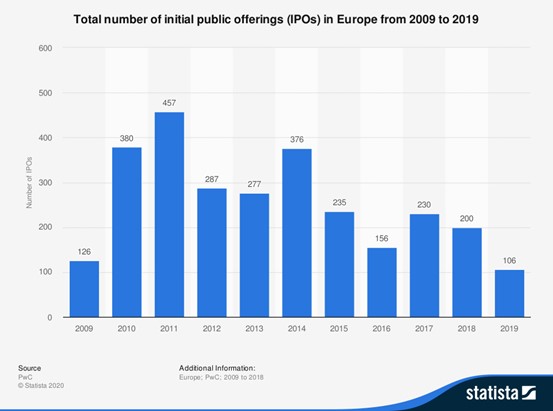
    Let’s take a look at the initial public offerings of the last decade (2009-2019) in Europe:


    It would not be possible to characterize their course (of the initial public offerings) during the last decade as blooming. However, this also reflects the interest of companies to list their shares in regulated markets. Respectively of investors for the capital markets.


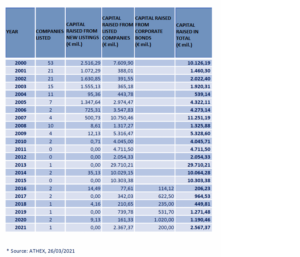
    The course of the Greek stock exchange market during the last 20 years

    The boom (but also) frenzy of the Greek stock exchange market, which had the well-known (technically and logically expected) collapse of 1999, was followed by its contraction of the next twenty years.

    Let’s also take a brief look at the extremely interesting data of the Athens Stock Exchange, from 1.1.2000-to 26.3.21 (which it kindly provided to us and with its permission we make public):

    The well-known efforts of the Athens Stock Exchange, as we all know, are proving to be bearing fruit in recent years in the corporate bond market. Of course, the largest companies are currently benefiting from it.

    And the stock exchange market?

    Let’s take a look at the (problematic) three years 2013-2015: €50 billion were raised. Also: in the first quarter of 2021 more than €2.3 billion was raised. Although the issue may seem multifactorial, it turns out that the stock exchange market can help raise funds. SMEs are, of course, entitled to their share. And, of course, to the relevant assistance.

    The EU is already moving in this direction…


    EU: The creation of a fund to assist SMEs during and after their listing

    The (basic-initial) assumptions about the necessity of creating such a fund

    One year ago (: 10.3.20) the European Commission published a Communication to the European Parliament and other EU institutions entitled “SME Strategy for a Sustainable and Digital Europe“.

    In the above (extremely interesting) Announcement, important assumptions are made. Among them:

    “SMEs in Europe find limited possibilities for growth financing, such as listing on capital markets through an Initial Public Offering (IPO). Capital markets are an important source of funding for SMEs growing int mid-caps and ultimately large companies. However, the number of SME IPOs declined sharply in the aftermath of the financial crisis and has not recovered since. In 2019, the value and number of European IPOs continued to fall by 40% and 47%, respectively, relative to 2018.”

    In order to address this problem, it is accepted by the European Commission that it would be particularly useful to set up a fund to facilitate the listing of SMEs during and after the registration process. In this way, more fast-growing and innovative SMEs would turn to the capital markets to raise the necessary funds for their development. More private investors would be attracted to the capital markets. The economy (European and, why not, national) would end up less “bank-centric”. Such a choice could only have positive results.

    In this context, the European Commission undertook, inter alia, to “support Initial Public Offerings (IPOs) of SMEs with investments channelled through a new private-public fund, to be developed under the InvestEU programme starting 2021 under the Capital Markets Union”.


    Motion for a resolution of the European Parliament

    Last September (: 16.9.20) a motion for a European Parliament resolution was tabled on further development of the Capital Markets Union (CMU): improving access to capital market finance, in particular by SMEs, and further enabling retail investor participation.

    This proposal records (recital 9) the “decline in Initial Public Offering (IPO) markets in the EU, reflecting their limited attractiveness for, in particular, smaller companies”. This phenomenon is due, among other things, to the fact that, according to the proposal, “SMEs face disproportionate administrative burdens and compliance costs associated with listing requirements”. It stressed “that the efficiency and stability of the financial markets should be improved and that the listing of companies should be facilitated”. Also, it noted that there is a need “to ensure an attractive environment pre-IPO and post-IPO environment for SMEs”. It encourages, in this context, “the creation and prioritization of a large, private pan-European fund, an IPO Fund, to support SME financing”.


    Opinion of the European Economic and Social Committee

    On 11.12.20 the European Economic and Social Committee (EESC) issued an Opinion on the above-mentioned Opinion from the Commission to the European Parliament. The EESC therefore (paragraph 5.4) “welcomes the development of a private-public fund focused on initial public offerings (IPOs) and fully supports the creation of additional equity, quazi-equity, venture-capital and risk-sharing financing instruments for SMEs”. In the same context it stated it “believes that promoting them and ensuring their accessibility is particularly important for innovative small and mid-caps”.


    The course / the (temporary?) quagmire for the creation of the fund

    It is known, however, that the EU does not always act extremely fast. We note, therefore, that there are other concerns about the rapid development of the whole issue: In the context of the parliamentary scrutiny, a relevant Parliamentary Question was submitted on 7.1.21 stressing the Commission’s lack of commitment to take substantive action in creating the aforementioned fund.


    References under the InvestEU program

    Regulation (EU) 2021/523 establishing the InvestEu program was adopted very recently (on 24.3.21).

    We read, inter alia (recital 21): “SMEs represent over 99% of companies in the Union and their economic value is significant and crucial. However, they face difficulties when accessing finance because of their perceived high risk and lack of sufficient collateral… SMEs have been particularly badly hit by the COVID-19 crisis… Moreover,, SMEs and social economy enterprises have access to a more limited set of financing sources than larger enterprises… The difficulty in accessing finance is even greater for SMEs whose activities focus on intangible assets. SMEs in the Union rely heavily on banks and on debt financing… Supporting SMEs that face the above challenges by making it easier for them to gain access to finance and by providing more diversified sources of funding is necessary to increase the ability of SMEs to finance their creation, growth, innovation and sustainable development, ensure their competitiveness and withstand economic shocks to make the economy and the financial system more resilient during economic downturns and to maintain SME’s ability to create jobs and social well-being. This Regulation … should also maximize the firepower of public / private fund vehicles, such as the SME IPO (Initial Public Offering) Fund, seeking to support SMEs through channelling more private and public equity” especially to companies of strategic importance.


    Is the stock exchange market the right means of raising capital for businesses?

    For some it proves valuable; for others less; for others it is completely unsuitable. In fact, in our next article we will try to approach some parameters of the relevant question. It should be noted, however, in quotation marks, that the world of the stock market has not proved to be magical for everyone: neither for investors nor for companies.

    However, those companies (especially SMEs) for which it would be evaluated as the, relevant, best tool available, it should be provided with the appropriate information and, of course, the appropriate assistance. In the context of the latter, in particular, the fund is expected to play an important role, which, as mentioned above, has been planned for a long time by the EU. Corresponding actions are being launched by the ATHEX and the Greek State (which we will also deal with in our next article).

    We hope they do not delay.

    For the good of businesses.

    For the good of the capital markets.

    For the good of our national economy (as well) …

    For the good, in the end, of all of us.


    Stavros Koumentakis
    Managing Partner


    P.S. A brief version of this article has been published in MAKEDONIA Newspaper (April 25, 2021).


    Disclaimer: the information provided in this article is not (and is not intended to) constitute legal advice. Legal advice can only be offered by a competent attorney and after the latter takes into consideration all the relevant to your case data that you will provide them with. See here for more details.
  • Business: Survival & Development. The (necessary?) turn to the capital markets?

    Business: Survival & Development. The (necessary?) turn to the capital markets?


    Businesses need capital (own or foreign) to survive and grow. In Europe, they turn to the banks, mainly, for their extraction. The European economy therefore is (and does not just look) bank-centered. The Greek market even more so. The comparison with the USA, the United Kingdom and Japan (: countries, that is, with developed capital markets) proves the statement to be true. It is not simply a matter of theoretical findings: the relative magnitudes leave no room for misinterpretation. Should we take it for granted that European companies’ fundraising will start to shift outside the banking system – to the capital markets, for example? And, if so, will this also apply to Greek companies? And if so, when?

    For the advantages (of course conditions and disadvantages) of financing outside the banking system (capital markets and beyond) we will be given the opportunity to deal with in our next article. Respectively with the conditions for increasing the creditworthiness of companies. Let us now try to give an answer to the questions mentioned in the introduction.


    Capital Market: US vs EU

    One indicator that is commonly used to assess the size of a capital market development is that derived from the market capitalization / GDP ratio.

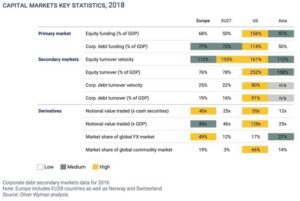
    A relatively recent report by FESE (Federation of European Stocks Exchanges) records an interesting statistic (based on the latest World Bank data published on 31 December 18). Specifically:


    Let us limit ourselves to the Index: Market Capitalization / GDP. We notice that it amounts to:

    At 156% for the US,

    At 50% for the EU27 and

    At 68% for Europe (EU27 + Great Britain + Switzerland + Norway).

    Therefore: for the European Union of 27 the relevant index is limited to 1/3 of that of the USA.

    A very obvious finding follows, that the European capital market lags behind that of the United States.

    There is also, as self-evident, the extremely limited use of European stock exchanges to raise capital by European companies.


    “The Greek economy is primarily bank-centric”

    The Governor of the Bank of Greece, Mr. Stournaras, participated, among others, in an online event of IOBE on 17.12.20 entitled “Financing, private debt and restart of the economy”. His speech, due to his position, was, of course, of particular importance.

    Referring to the Greek economy, Mr. Stournaras said: “The Greek economy is primarily bank-centric. What do I mean by that? Suppose one hundred units of funding are required. And let’s look at America, Europe and Greece. Of the 100 funding units in America, half, about 50%, comes from the capital markets; the other half from banks. In Europe, roughly 75% comes from banks and 25% from the capital markets. In Greece, 95% of the banks and 5% of the capital markets. So Greece is an exceptionally bank-centric country and banks play a very important role in financing and economic development.”

    However: As will be shown later on, the truth is (unfortunately) worse. Corporate finance from the European capital markets holds an even smaller percentage than what our central banker supports. (We can safely assume the same for Greek companies…).

    What if we look for the reason? We must, above all, attribute it to the structure and composition of the European economy. But even more so: in the general culture that prevails in the field of business finance in the old continent.


    The participation of the capital market in the financing of Greek companies

    Unfortunately, there does not seem to be (published-processed) data regarding the financing of Greek companies outside the banking system. But even if we accept as accurate the (rather optimistic) approach of Mr. Stournaras (: 5% share of the capital market as a whole), the conclusions still are absolutely disappointing.

    Listed companies, based on data from the Hellenic Capital Market Commission, are limited to: (a) one hundred and seventy-one (171) for the Main Market and (b) eleven (11) for the Alternative Market.

    Therefore: one hundred and eighty two (182) companies with listed shares in Greece (possibly those that were listed) share the 5% corresponding to the financing from the Greek capital market.

    For the rest (95%) that corresponds to the financing (basically) from the banking system, the 182 mentioned above are competing with the rest of the 821,540 (!) Greek companies. (Their total number is derived from the published data of the European Commission of 2019).


    EU data on SME access to capital markets

    The (dual-secondary) problem of the EU

    The finding of the central banker of our country (: “The Greek economy is primarily bank-centered”) identifies the problem. However, the magnitude of the dependence of the European economy and, consequently, of the Greek economy on the banking system seems more serious and worrying than he points out.

    Our (safe) source, the data and the position of the European Commission, expressed in: “Unleashing the full potential of European SMEs”. From what is mentioned there, it follows that:

    (a) Only 10% (!) of the external financing of European SMEs (ie from third-party sources) comes from the capital markets and

    (b) Only 11% of companies in Europe consider equity as a viable financial option. Most importantly: only 1% have used it.


    EU actions to manage it

    In order for the EU to manage the above (double & extremely serious) problem it decided to create:

    (a) A fund for the listing of SMEs on the stock exchange.

    This private / public fund was established under the InvestEU program. Through this, investments will be channeled to stimulate the financing of companies as well as funds run by women.

    (b) The ESCALAR initiative

    This initiative aims to create a mechanism to increase the size of venture capital and attract more private investment. Its purpose: to support companies with high growth potential.

    The success of both remains to be seen…


    The real (: main) problem of the EU and its management

    The real problem that the EU has to deal with does not seem to (only) be the creation of the conditions for better access of businesses to the capital markets.

    The real (and main) problem of the EU is to limit the further expansion of the financial system in the EU. And the consequent mitigation of the risks linked to this expansion.

    Most importantly: limiting the power of banks and bankers to the detriment of EU political power.

    The above-mentioned EU actions are, in principle, aiming in this direction.


    Do European SMEs have less money available than their US counterparts?

    The Association of Financial Markets in Europe (AFME) in collaboration with the Boston Consulting Group proceeded, together – six years ago (: 2/2015) to publish an interesting report: “Bridging the growth gap Investor views on European and US capital markets and how they drive investment and economic growth”.

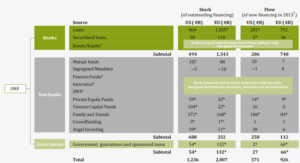
    We read in this report, among other things, that more money is available in European SMEs than in the US. According to the analysis estimates, SMEs (companies with a Turnover of less than € 50 million) in Europe have almost doubled the funding (compared to the US) from banks, non-banks and governments. The data emerge as particularly interesting. Specifically:


    We conclude from the above, indicatively, that in 2013 (taken into account as a reference year), 926 billion Euros of new financing, of all types, were given to European SMEs, compared to 571 billion Euros in the USA. The data, in both areas, exclude financing provided by personal financing (including funds made available to SMEs by their owners through their personal wealth and retained earnings).

    Based on the same analysis above: surveys and interviews show that European SMEs strongly prefer bank lending over personal or alternative sources of financing. This, moreover, is evidenced by the evolved character of the latter (such as venture capital and angel investing-available in smaller SMEs in Europe.

    In 2013, for example, €26 billion was invested by venture capital companies in SMEs in the US – compared to just €5 billion in their European counterparts. During the same period, €20 billion was invested by angel investors in US SMEs – compared to just €6 billion in Europe.

    Therefore: there is no shortage of money flowing into European companies. The problem is that companies are looking to recieve them (primarily) from banks. In this way, however, the banks become “dominant in the game”. Not only does this not solve the existing problems but, on the contrary, it multiplies them.


    Problem…

    It is a common finding that the rapid growth of the (global and European) banking system poses serious risks to the economy. It has already been proven that these risks are not theoretical. Both in the US and in Europe-recently and in the context of the (long-European) financial crisis. National economies have reached the brink of collapse due to the rapid growth and weak foundations of the banking system (see, for example, Cyprus and, secondarily, Greece).

    Also: the attitude of the banking system towards the SMEs in Europe and our country has been diagnosed as a serious problem. And so has it been again, in the context of the ongoing health / financial crisis.


    … vs business opportunity

    Should the specific problems mentioned above maybe push us in thinking “out of the box”? Do they force us to treat (and manage) them as an opportunity? An opportunity for gradual disengagement of the SMEs (but also of the national economy) from the entanglements and risks of the banking system?

    Is it time for SMEs in our country (as well) to turn to financing outside of it (the banking system)?

    To take advantage of the (given-alternative) funding opportunities out there? (Which will always increase ..)

    (And) of the Greek capital market?

    There is no doubt!

    The time has come (as will be shown in an article of ours to follow).


    Stavros Koumentakis
    Managing Partner


    P.S. A brief version of this article has been published in MAKEDONIA Newspaper (March 28, 2021).


    Disclaimer: the information provided in this article is not (and is not intended to) constitute legal advice. Legal advice can only be offered by a competent attorney and after the latter takes into consideration all the relevant to your case data that you will provide them with. See here for more details.

  • Companies Vs Investors / Banks: Balance Of Interests

    Companies Vs Investors / Banks: Balance Of Interests

    [vc_row][vc_column][vc_column_text] The financial data of the companies, the current circumstances each time, as well as the business plans often create the need to look for funds: more often in the form of a company’s capital strengthening and / or its financing.


    The Expectations of The Parties

    Business interest leads to the search for “cheap” funds (in the sense of the least possible financial burden). What is important is, on the one hand for no significant commitments and collateral to be, while on the other side for the repayment period (when it comes to lending) to be long.

    Investors (most commonly individuals, funds, venture capital, etc.) and, just recently banks, are always looking for

    a) the maximum possible return,

    b) the earliest possible return of the investment,

    c) the maximum possible collateral.


    Collateral

    Contractual undertakings and securities (guaranties, liens on mortgage, mortgage, pledges) have lost a significant part in the value scale of investors and banks. It is no longer the basic, and certainly not the only, security they are looking for. They often require (and, as a rule, achieve) important commitments from the company – contrary to their own interests and needs. The threatened sanction in the case of breach of these commitments is a kind of penalty (in the case of investors) or the recognition of a relative reason for terminating financing and claiming immediate return (in the case of banks).


    Restrictions, Commitments and Obligations

    The restrictions, commitments and obligations imposed are, generally, diverse. They may concern the company, its business activities, its management and its shareholders. Access to books and close monitoring of the company’s financial data is the minimum. It is quite indicative that one may (in the view of recent experiences) refer to the need for the investor’s or, as the case may be, the (bank) creditor’s assent in cases such as the following:

    (a) Approval of the business plan.

    (b) The composition of the Board of Directors (with the ultimate objective of the involvement of investors’ representatives in it).

    (c) The major decisions making (e.g. merger, demerger, division, interim dividend and dividend distribution, return of capital, purchase, sale, lease, rental and leasing assets, entering into significant commitments, provision of securities, and so.).

    (d) Third party financing either directly (e.g. loans) or indirectly (e.g. guarantees).

    (e) Amendment of core provisions of the Articles of Association.

    (f) Change in equity [transfers of shares either between shareholders or to third parties, including the provision of shares to executives as incentives, for example stock option (!)].

    (g) Insurance of the assets of the company and ban on the transfer of the insurance indemnity, and so on.


    The Multi-functional nature of Commitments

    The undertaking of obligations and commitments such as those mentioned above, operate on three levels:

    (a) The investor (or the Bank, as the case may be) feels the (really necessary for them) security in order to proceed with the useful, and sometimes critical, investment or financing of the company.

    (b) The company, its management and its shareholders should be ready to accept control, limitations and / or (worst case) veto rights in their significant business decisions.

    (c) The company on the one hand and the investor (or, as the case may be, the Bank), on the other hand, are linked with extremely strong ties throughout their co-operation, which cannot be broken without dramatic or even extreme adverse effects.


    The Enforcement of Commitments

    The commitments undertaken by the company are likely to prove problematic in a dual way – especially when the terms are imposed by a bank that finances:

    (a) The ability to take business decisions is transferred by the company, even partially, to (middle or senior) bankers, who are neither entrepreneurs nor have significant knowledge of the subject. Most important: they never hold a real risk for their choices, they never compromise their own personal property.

    (b) The freedom of the company, its management and its shareholders are limited regarding the implementation of its plans. The company binds to the creditor bank. No significant business decision can be taken without the consent of the latter. The bank even has the (normally uncontrolled) option to block or endorse any business move and any other funding. It also has the option to finance the company’s business itself – thus gaining a dominant position among its funding sources.


    The Balance of Interests

    In the context of a free economy like our country’s economy, nobody is obligated to conclude a contract and / or to accept specific unfavorable contractual provisions.

    In the case of searching for funds, the strong party is not, normally, the company: It will be often “drawn” into concluding contracts and to undertaking extremely problematic commitments.

    It often seems, logically, utopian to talk about “balance of interests”.

    There is only one thing for sure: The company shall not be “heard” when it attempts , in the near or distant future, either to discuss on the “small print” or to reproduce the assurance of its creditor (bank, fund or venture capital): “Come on, do not pay attention: these are typical – we are here for you” …

    stavros-koumentakis

    Stavros Koumentakis
    Senior Partner


    P.S. This article has been published in MAKEDONIA Newspaper and makthes.gr (October 14, 2018)


  • Startups: Financing, Risk and Sustainability

    Startups: Financing, Risk and Sustainability

    [vc_row][vc_column][vc_column_text] Startups: business ventures (emerging and usually promising) in the early stages of their operation. In Startups the subject of activity is almost always highly original, pioneering but also high risk-high reward.

    Startups Financing

    A business idea, as innovative, dynamic and promising as it may be, needs capital to be translated into a business venture and profit. Such capital, sometimes less and other times more important, may come from the savings of the “startupper” or from its close environment.

    Thus, the case of financing coming from the startupper’s close environment is not the most common one. Alternatively, financing comes from:

    (a) Business Angels. “Angel investors” are the ones who, first and above all will believe in the innovative idea and will agree to fund it. Angel investors will undertake high risk, acting individually or organized into an angel fund.

    (b) Venture Capitals. It is an organized fund of investors, with high-level professionals. In addition to capital, experience and knowledge in strategic, development, sales, administration, operation, marketing, and other issues, are also provided.

    (c) The Crowdfunding platforms. The “crowd” funding will come from the use of an on-line platform. The participants fund the idea with small amounts each. In Greece there is a relevant legislative provision thus with limited implementation to date.

    (d) Banks. This is not a common ase in our country, as banks typically look to finance existing businesses long established and with good-standing financial data.

    (e) The European Union. These funds are channeled directly or through programs managed at national level.

    (f) Business Incubators. Business Incubators usually provide support at a practical level (premises, furniture, equipment, administrative support, contacts) or/ and short – term support and financing.

    startups-funding

    Risk

    It is not reasonable for a young, optimistic and promising entrepreneur to expect the financing and support of an investor (or of a simple lender) without being ready to take the risk. And the specific risk concerns the provision of adequate collateral (personal or real – when available). It also refers, most commonly, to the commitment of an important part of the business and of his business freedom. This can be translated into a transfer to the investor of a part of the company’s share capital, into accepting drastic restrictions on making business decisions etc.


    Startups’ Sustainability

    The interests of the contributor / investor and the entrepreneur are partly identical and partly conflicting. The sustainability of the start-up is a common goal. The rapid and lucrative exploitation of the business idea as well. What will happen, however, if there are conflicts over the range of powers of each party? How to deal with the investor’s claim for collateral or with the pressure to restrict the business freedom of the startuper who is also the owner of the idea?

    In a country where 50% of startups fail within three years, the assistance of appropriate consultants is proving critical. Especially from a legal perspective.

    stavros-koumentakis

    Stavros Koumentakis
    Senior Partner


    P.S. This article has been published in Greek in MAKEDONIA Newspaper and portal makthes.gr  (September 30, 2018)

This site is registered on wpml.org as a development site. Switch to a production site key to remove this banner.