Tag: οικογενειακές επιχειρήσεις

  • Financing Small and Medium Enterprise and the Stock Exchange

    Financing Small and Medium Enterprise and the Stock Exchange

    It is common ground that Small and Medium Enterprises (: SMEs) need support for their survival and development – especially in the current circumstances. First and foremost, hey need funding. We have already seen that our European and national economies are, without a doubt, bank-centric. And this is something that needs to change, for many reasons. Banks neither can and nor do they want (nor is it appropriate) to bear the burden of financing the companies that need them. Both the economy and SMEs, in particular, have an (insurmountable) need to activate and leverage more, different, sources of funding. Undoubtedly, one of them is the capital markets – the stock exchange. EU data show that only 10% (!) of the external financing of European SMEs (ie from third-party sources) comes from the capital markets. The EU, albeit at a slow pace, is already working to assist SMEs in their first steps.

    Let’s take a look at the current processes taking place at European level to assist SMEs in their first steps in the magical (?) world of capital markets.


    EU assumptions about SMEs

    “There are 24 million SMEs in the EU-27. They represent the backbone of the economy. They generate more than half of the EU’s GDP while at the same time employing more than 100m. employees before the onset of the pandemic”. “On this basis, and in the light of the Covid crisis, we must take for granted the need to revise the SME Strategy” which was decided on 10.3.20 – just one day before the World Health Organization sounded the alarm on the pandemic of Covid-19 “(: Press release of 13.11.20 of the European Parliament).

    The specific assumptions, from the most official sources, cannot be disputed. In fact, the data they contain make it necessary for all of us to become alert. But above all the EU. Of course, our national government as well.


    The ” road to Calvary” of the stock exchanges

    The course of public offerings in the European Capital Markets

    Let’s take a look at the initial public offerings of the last decade (2009-2019) in Europe:
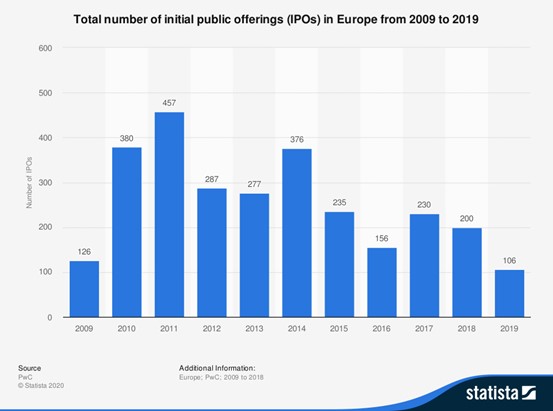


    It would not be possible to characterize their course (of the initial public offerings) during the last decade as blooming. However, this also reflects the interest of companies to list their shares in regulated markets. Respectively of investors for the capital markets.


    The course of the Greek stock exchange market during the last 20 years

    The boom (but also) frenzy of the Greek stock exchange market, which had the well-known (technically and logically expected) collapse of 1999, was followed by its contraction of the next twenty years.

    Let’s also take a brief look at the extremely interesting data of the Athens Stock Exchange, from 1.1.2000-to 26.3.21 (which it kindly provided to us and with its permission we make public):
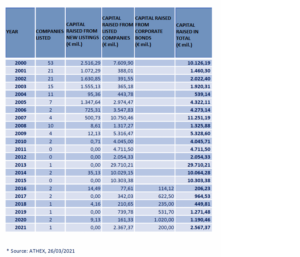
    The well-known efforts of the Athens Stock Exchange, as we all know, are proving to be bearing fruit in recent years in the corporate bond market. Of course, the largest companies are currently benefiting from it.

    And the stock exchange market?

    Let’s take a look at the (problematic) three years 2013-2015: €50 billion were raised. Also: in the first quarter of 2021 more than €2.3 billion was raised. Although the issue may seem multifactorial, it turns out that the stock exchange market can help raise funds. SMEs are, of course, entitled to their share. And, of course, to the relevant assistance.

    The EU is already moving in this direction…


    EU: The creation of a fund to assist SMEs during and after their listing

    The (basic-initial) assumptions about the necessity of creating such a fund

    One year ago (: 10.3.20) the European Commission published a Communication to the European Parliament and other EU institutions entitled “SME Strategy for a Sustainable and Digital Europe“.

    In the above (extremely interesting) Announcement, important assumptions are made. Among them:

    “SMEs in Europe find limited possibilities for growth financing, such as listing on capital markets through an Initial Public Offering (IPO). Capital markets are an important source of funding for SMEs growing int mid-caps and ultimately large companies. However, the number of SME IPOs declined sharply in the aftermath of the financial crisis and has not recovered since. In 2019, the value and number of European IPOs continued to fall by 40% and 47%, respectively, relative to 2018.”

    In order to address this problem, it is accepted by the European Commission that it would be particularly useful to set up a fund to facilitate the listing of SMEs during and after the registration process. In this way, more fast-growing and innovative SMEs would turn to the capital markets to raise the necessary funds for their development. More private investors would be attracted to the capital markets. The economy (European and, why not, national) would end up less “bank-centric”. Such a choice could only have positive results.

    In this context, the European Commission undertook, inter alia, to “support Initial Public Offerings (IPOs) of SMEs with investments channelled through a new private-public fund, to be developed under the InvestEU programme starting 2021 under the Capital Markets Union”.


    Motion for a resolution of the European Parliament

    Last September (: 16.9.20) a motion for a European Parliament resolution was tabled on further development of the Capital Markets Union (CMU): improving access to capital market finance, in particular by SMEs, and further enabling retail investor participation.

    This proposal records (recital 9) the “decline in Initial Public Offering (IPO) markets in the EU, reflecting their limited attractiveness for, in particular, smaller companies”. This phenomenon is due, among other things, to the fact that, according to the proposal, “SMEs face disproportionate administrative burdens and compliance costs associated with listing requirements”. It stressed “that the efficiency and stability of the financial markets should be improved and that the listing of companies should be facilitated”. Also, it noted that there is a need “to ensure an attractive environment pre-IPO and post-IPO environment for SMEs”. It encourages, in this context, “the creation and prioritization of a large, private pan-European fund, an IPO Fund, to support SME financing”.


    Opinion of the European Economic and Social Committee

    On 11.12.20 the European Economic and Social Committee (EESC) issued an Opinion on the above-mentioned Opinion from the Commission to the European Parliament. The EESC therefore (paragraph 5.4) “welcomes the development of a private-public fund focused on initial public offerings (IPOs) and fully supports the creation of additional equity, quazi-equity, venture-capital and risk-sharing financing instruments for SMEs”. In the same context it stated it “believes that promoting them and ensuring their accessibility is particularly important for innovative small and mid-caps”.


    The course / the (temporary?) quagmire for the creation of the fund

    It is known, however, that the EU does not always act extremely fast. We note, therefore, that there are other concerns about the rapid development of the whole issue: In the context of the parliamentary scrutiny, a relevant Parliamentary Question was submitted on 7.1.21 stressing the Commission’s lack of commitment to take substantive action in creating the aforementioned fund.


    References under the InvestEU program

    Regulation (EU) 2021/523 establishing the InvestEu program was adopted very recently (on 24.3.21).

    We read, inter alia (recital 21): “SMEs represent over 99% of companies in the Union and their economic value is significant and crucial. However, they face difficulties when accessing finance because of their perceived high risk and lack of sufficient collateral… SMEs have been particularly badly hit by the COVID-19 crisis… Moreover,, SMEs and social economy enterprises have access to a more limited set of financing sources than larger enterprises… The difficulty in accessing finance is even greater for SMEs whose activities focus on intangible assets. SMEs in the Union rely heavily on banks and on debt financing… Supporting SMEs that face the above challenges by making it easier for them to gain access to finance and by providing more diversified sources of funding is necessary to increase the ability of SMEs to finance their creation, growth, innovation and sustainable development, ensure their competitiveness and withstand economic shocks to make the economy and the financial system more resilient during economic downturns and to maintain SME’s ability to create jobs and social well-being. This Regulation … should also maximize the firepower of public / private fund vehicles, such as the SME IPO (Initial Public Offering) Fund, seeking to support SMEs through channelling more private and public equity” especially to companies of strategic importance.


    Is the stock exchange market the right means of raising capital for businesses?

    For some it proves valuable; for others less; for others it is completely unsuitable. In fact, in our next article we will try to approach some parameters of the relevant question. It should be noted, however, in quotation marks, that the world of the stock market has not proved to be magical for everyone: neither for investors nor for companies.

    However, those companies (especially SMEs) for which it would be evaluated as the, relevant, best tool available, it should be provided with the appropriate information and, of course, the appropriate assistance. In the context of the latter, in particular, the fund is expected to play an important role, which, as mentioned above, has been planned for a long time by the EU. Corresponding actions are being launched by the ATHEX and the Greek State (which we will also deal with in our next article).

    We hope they do not delay.

    For the good of businesses.

    For the good of the capital markets.

    For the good of our national economy (as well) …

    For the good, in the end, of all of us.



    Stavros Koumentakis
    Managing Partner


    P.S. A brief version of this article has been published in MAKEDONIA Newspaper (April 25, 2021).


    Disclaimer: the information provided in this article is not (and is not intended to) constitute legal advice. Legal advice can only be offered by a competent attorney and after the latter takes into consideration all the relevant to your case data that you will provide them with. See here for more details.


  • Societe Anonyme: Contracts with Members of the Board for the Provision of (Additional) Services

    Societe Anonyme: Contracts with Members of the Board for the Provision of (Additional) Services

    The Board of Directors of the Société Anonyme is its body, which is responsible for its management and representation. Its existence is provided and its operation is governed by law (basically: articles 77-115 law 4548/18). It acts, in principle, collectively. The principle of collective action, however, is not without its exceptions; it is therefore subject to divergence. The Board of Directors is, by its nature – as already mentioned, an instrument of the SA. Its members, as members of a collective body, are considered to be linked, respectively, with an organic relationship with the SA. The relationship of the Board member with the SA is twofold. It is distinguished (: “theory of separation”) into external-organic and internal-subjective. We will be concerned at this time with the provision of additional services to the SA by the member of the Board of Directors, regardless of their organic position and relationship: on the basis of a “special relationship”. By contracts, indicatively, of employment, works, independent services or mandate.


    The special relationship between board member and SA

    We often find, in practice, that the members of the Board of Directors provide additional services to the SA – especially in the context of the family SA. These are services that go beyond the narrow confines of its administration – as defined by law. They are, in other words, outside the framework of the narrowly defined duties of the members of the Board of Directors (as members, ie, of the specific body of the SA). These services are provided in the context of a “special relationship” (: article 109 par. 3 law 4548/2018). This specific relationship may include, for example, the type of contracts of employment, works, independent services or mandate. In any case, the correct legal characterization of this special relationship is (also) left, as we have already analyzed, to the judgement of the courts.

    With special reference to the specific (“special”) relationship, the legislator explicitly confirms the possibility of concluding such contracts, in order to remove any (possibly existing) relevant doubts. And even more: it demonstrates their difference (of these contracts and relationships) from the relationship that connects the members of the Board of Directors with the company due to their election or appointment. It confirms, in other words, that these are parallel relationships. Also: completely distinct relationships-based on their content.


    The content of the special relationship

    The content of the parallel (and special) contractual relationship that can be concluded by the member of the Board is, as already mentioned, the provision of (any) additional services. Its content is contrasted, in this way, with the content of the organic relationship that connects the SA with the member of its Board of Directors. The (organic) relationship that is determined by the law or the articles of association of the SA.

    The content of the specific, additional, services (and the related special relationship and contract) may be, inter alia, that of the legal, financial or technical consultant. The most common: the provision of services of an executive that usually results from a contract of employment concluded by the member of the Board of Directors with the SA.

    The difficulty of distinguishing the two relationships and qualities (member of the Board of Directors vs employee / provider of services in the SA) depends on their scope and content. This distinction turns out to be easier when the member simply participates in the Board of Directors, without being individually in charge of exercising (organic) power of administration, management and / or representation. On the contrary, when the member of the Board acts as a substitute body, that is, when the powers of the Board have been transferred in whole or in part, the distinction does not seem easy. In fact, in cases where the content of the special legal relationship concerns the management of the company and not just a field of action, the difficulties of discrimination are multiplied.

    The distinction, however, of the individual, aforementioned, relations seems absolutely necessary. This is because the regulations reserved by Law 4548/2018 on the conclusion and operation of the special relationship that connects the SA with the member of its Board of Directors, are different from those that govern their organic position (as a member of the Board).


    The special relationship as a transaction of the SA with a related party

    The members of the Board of Directors are included in those that the law identifies as parties related to the SA (:”parties”). The SA’s transactions with related parties are now regulated in articles 99-101 of law 4548/2018 (as they replaced the well-known article 23a of law 2190/1920). These are transactions with those parties who, due to their position, are likely to influence the content of these transactions based on their own interest. It was therefore deemed necessary to provide a regulatory framework aimed at protecting the SA. The above transactions reasonably include the conclusion of any special relationship (indicatively: employment, works, independent services or mandate contract) of the SA with a member of its Board.


    The conditions for concluding a special contract with related parties

    For the valid conclusion of a contract of the SA with related parties (and in this case, a special employment, works, independent services or mandate contract with members of the Board) the observance of a series of procedural rules and publicity rules is necessary (articles 100 and 101 of Law 4548/2018 ). These rules, in the light of the conclusion of a special contract of a member of the Board of Directors with a non-listed SA, are analyzed below:

    (a) The granting of a license

    In General

    According to paragraph 1 of article 100 of law 4548/2018: “the license to establish a transaction of the company with a related party or to provide collateral and guarantees to third parties in favor of the related party … is provided by a decision of the Board of Directors…”. The license granted is valid for a period of six months.

    The license must be special (article 99 of law 4548/2018). This means that the conclusion of the special contract should be included in the agenda of the meeting of the Board. In addition: its content (especially its financial object and its duration) must be submitted to the decision of the body responsible for granting the license (indicatively: 1990/2018 Court of Appeal of Thessaloniki).

    The Board of Directors is the competent body for issuing the license. In fact, the possibility of further assignment of the specific competence is explicitly excluded (article 100 par. 2 law 4548/2018). This provision of the legislator introduces an innovation in relation to the previous regime, which granted competence to the General Assembly (article 23a of law 2120/1920). In the justifications of the specific choice of the legislator, the fastest and simplest control procedure by the BoD is considered. In addition, the Board, due to its managerial powers, is considered the most appropriate body of the SA to recognize the benefit or not of the conclusion of contracts (as such: the contract of employment, works, independent services or mandate).

    The competence of the General Assembly at the request of shareholders

    In the event that the Board of Directors grants permission for the conclusion of a special relationship between the SA and a member of its BoD, it is obliged to announce its decision to the General Commercial Registry. Within ten (10) days from this announcement, shareholders of the SA representing 1/20 of the capital are entitled to request the convening of a General Assembly, in order for the latter to make a decision on the issue of granting a license. In fact, it is possible to (statutorily) reduce this percentage.

    Any transaction with an affiliated person, for which permission has been granted by the Board of Directors, is considered valid from the beginning, but it is subject to suspensory condition. In other words, either the aforementioned ten-day deadline must pass without any actions taken or the decisive responsibility is assumed by the General Assembly due to a request of 1/20 of the shareholders of the SA. In the latter case, the license for the transaction must ultimately be granted by the General Assembly. This license is not granted if shareholders representing 1/3 of the share capital object (article 100 §5 of law 4548/18-as in force, after modification of the initial wording of the provision, which provided for non-participation of related parties in the formation of a quorum and majority, after our own public intervention).

    The competence of the General Assembly in the absence of a quorum of the General Assembly

    As we have analyzed in our previous articles, the law deprives a member of the Board of Directors of the right to vote on issues in which a conflict of interests arises between them (or the related parties) and the SA. Such a case is the conclusion of a special relationship between the member of the Board of Directors and the SA. Therefore, the other members of the Board of Directors make the necessary relevant decision. However, the exclusion from the voting may concern so many members that the remaining ones do not form a quorum. In this case, the remaining members (regardless of their number) are responsible for convening the General Assembly (to make a decision on granting permission to enter into a special relationship).


    (b) Adherence to the publicity process

    In order to complete the process of granting a license for the conclusion of a special contract of the SA with a member of the Board of Directors, it is required to observe the publicity provided by law. In particular, according to article 101 of law 4548/2018: “The Board of Directors announces the issuance of a license for the preparation of a transaction either by itself or by the General Assembly, as well as the expiration of the deadline of paragraph 3 of Article 100 (ie the above mentioned ten-day deadline) …”. This announcement is submitted to publicity (: posting in the General Commercial Registry) before the completion of the transaction. At the same time, paragraph 2 of the same article sets out the minimum content that the above announcement must have.


    Exceptions to the obligation to issue a license

    The case of current transactions

    The obligation to grant a license is redundant in the event that the transaction (in this case the contract of the SA with the member of its Board of Directors) falls under the current transactions. Current transactions are defined, in article 99 §3 a’ of law 4548/2018, as “… those that are normal in relation to the operations and the object of the business activity of the company, in terms of their type and size and are concluded under market conditions”. In addition, according to the case law formulated under the pre-existing legal regime, a current transaction means “… that which, by its object, falls under the contracts drawn up in the context of the company’s day-to-day operations, ie whose terms are the usual terms of the contracts the company enters into with other traders. ” (1245/2018 Supreme Court).


    The case of the pre-existing contract

    A different case of exclusion from the licensing process is that in which a member of the Board of Directors is associated with the SA with a contract of employment, works, independent services or mandate, concluded before their election (or appointment) (1364/1990 Supreme Court, 21/2019 Single Member Court of First Instance of Volos). An issue, however, arises when the pre-existing contract is amended, after the election / appointment of the member of the Board of Directors (: eg. increase of the agreed fees). Depending on the content of the amended terms of these contracts (of employment, works, independent services or mandate), their prior approval by the competent body may be necessary.


    The remuneration of the members of the BoD on the basis of their special relationship / contract

    The members of the Board of Directors who have concluded an employment, works, independent services or mandate contract with the SA are, reasonably, entitled to receive remuneration – precisely on the basis of that contract. The specific remuneration is granted cumulatively with the (possible) remuneration received by the member of the BoD due to his / her organic position (ie, as a member of the BoD). These are fees which, although coming from the same SA and going to the same person, have different legal treatment. Thus, the fee from the special relationship / contract does not require prior regulation by law or the articles of association. It does not require its approval by the General Assembly (109 §1, Law 4548/2018) – in contrast to the remuneration that may be granted under the organic position. In fact, the law (article 109 §3, law 4548/2018) explicitly excludes the remuneration agreed on the basis of the special contract from the procedure and the conditions for granting remuneration to the members of the Board of directors of article 109 of law 4548/2018.


    Each member of the Board may, therefore, have a second capacity within the SA: the one that connects them with an additional relationship (employment, works, independent services or mandate) with the company. The two properties / legal relations (organic and special) are (and must remain) completely distinct. The first (organic) is governed, exclusively, by the mandatory provisions of the Law of Société Anonymes. On the contrary, the regulatory framework of the second (special) relationship is additionally governed by Civil (or Labor) Law regulations-depending on the contractual type which is chosen each time (mainly on the basis of tax and insurance advantages) and to which, in the end, it falls under.

    However, the separation of the qualities of the shareholder, the member of the Board of Directors and the employee / provider of services in the SA is important for a number of other reasons. Some of them have already occupied us in our articles (including: the need to separate the fees and finances of the entrepreneur / board member from the company’s fund, the use of the facilities provided by the law on SAs in terms of liquidity from businessmen / members of the Board).

    However, the separation of the above-mentioned qualities seems necessary on the basis of alignment with the (not typically necessary for non-listed companies, but substantially absolutely necessary) corporate governance rules.

    Rules necessary for the transition to the new era ˙ to the next day.-

    Stavros Koumentakis
    Managing Partner


    P.S. A brief version of this article has been published in MAKEDONIA Newspaper (March 14, 2021).


    Disclaimer: the information provided in this article is not (and is not intended to) constitute legal advice. Legal advice can only be offered by a competent attorney and after the latter takes into consideration all the relevant to your case data that you will provide them with. See here for more details.

  • Family businesses & succession… (protection of minority successors & the company)

    Family businesses & succession… (protection of minority successors & the company)

    Many aspects of family businesses have occupied us in the past -and still do. Among other things: as an important parameter of the national economy and as a “crossword puzzle for strong solvers” in the succession process. The issue of succession proves to be dominant in these companies. It occupies, among others, the one who is preparing to hand over, always with difficulty, the baton to their successors. The process, the time and the way of the owner being “cut off” from their share rights and the transfer of said rights to the successor were the subject of our previous article. Likewise the dangers of the “next day” (that is, the one that follows the succession) and the ways of managing them. At that time, we pointed out that a major issue is always who the successor is – who is the one to whom the reins of the business will be handed over. Not infrequently, however, minority percentages should be left to others besides the main successor. It is a given that for those (the successors of the minority), appropriate provisions should be taken. Provisions that, first of all, will concern the protection of their own rights. To limit, in other words, the “monarchy” of the majority.

    The road is one and only: the appropriate statutory regulations.

    Let’s approach the most basic of them-especially in the context of an SA.


    The statutory regulations for the benefit of the successors

    It is a given, as it was implied in the introduction, that the transferring shareholder will have to add one more concern to the not so few ones surrounding succession. In particular, they must re-approach the company’s statutory provisions on the basis of prevention, at a minimum, for: (a) safeguarding minority rights, (b) safeguarding shareholder percentages and preventing “malicious” increases of the capital (c) the equalization of the financial benefits of the shareholders through the (possible) issuance of preferrence shares.

    Particularly:

    (a) The rights of the minority

    The significance of the rights of the minority and the security they provide to the minority shareholders could only have occupied us in the past (see The Minority and Its Rights in the Societe Anonyme & The Minority Rights in the Societe Anonyme: The Exceptional Auditing).

    As we have already pointed out, the relatively recent law on SAs (Law 4548/2018) recognizes (like its predecessor, after all) a series of rights to minority shareholders. Rights that depend on the amount of share capital that each individually or several together represent. The rights of the minority are clearly recorded in individual provisions of the specific law (article 141-basically but are also found, scattered, in other provisions). Of particular interest, however, are the rights recognized by law (Article 142) to minority shareholders (to those representing 1/20 and 1/5 of the share capital) regarding the control of the company.

    The percentages of representation of the share capital, which are required for the exercise of the rights of the minority, are not high. It is possible, however, to reduce them even further. The provision of article 141§13 is the one that provides that: “the articles of association may reduce, but not by more than half, the percentages of the paid-up capital required for the exercise of the rights, according to this article”. The regulation of article 142 §3 regarding the rights corresponding to the shareholders representing 1/5 of the share capital is similar.

    The provisions, possibly also the expansion, of minority rights allow the transferring shareholder to implement a “protected” succession. A dual-purpose succession: one that provides a secure majority for the management of the SA and, at the same time, one that adequately secures minorities and their rights. Significantly limiting, by choice, the “one man principle” of the majority successor.


    (b) The special provisions regarding the decision to increase the share capital

    It is possible for the transferor to choose to offer the successor an increased majority. Sometimes, in fact, a majority greater than 2/3 of the share capital. It may be useful in this case to restrict the rights of the (new) majority shareholder. The reason? The prevention of the drastic restriction of the percentages and rights of the minority shareholders through, without their approval, the increase of the share capital of the company.

    On the other hand, it seems appropriate, in some cases, to transfer to one of the successors the shares that would result in an increased majority (greater than 2/3) of the share capital. Such a transfer would be appropriate, for example, in the event that the successor in question would be the only one wishing to take up the family business. Said successor should most likely be given the appropriate incentive to: (a) move unhindered in the benefit of the family business and at the same time (b) have the conditions for smooth decision-making by the General Assembly.

    Possibly, even in this case, it would be necessary to defend the percentages of the minority from any successive increases of the share capital with unilateral, in fact, decisions of the majority. Increases that, without being necessary, could lead to the nullification of the percentages of the minorities. Especially when the minority shareholders do not have (or do not want to provide) the capital to participate in them.

    Problems arise in all the above cases. Basically the only solution is the statutory increase of the majority, of more than 2/3, for the decision to increase the share capital (articles 23, 117, 130 par. 3 and 132 par. 3 of law 4548/2018).


    (c) The issuance of preference shares

    A “heretical” way (quasi) of equalizing the different percentages and share rights of the successors is the issuance of preference shares (article 38 of law 4548/2018-provided, of course, that relevant statutory provisions are in place).

    Preference shares can become a useful tool in the hands of the transferor, so that the latter maintains the balance between their successors. The (potential) minority shareholder will be able to look forward, for example, to receiving a fixed dividend, with no additional claim on the company’s profits and management. It is, in some cases, the appropriate solution: (a) for the minority shareholder who will thus secure a livelihood and (b) for the majority, who will have an incentive to increase the financial result of the family business, which will solely benefit them.


    The adoption of provisions of the law on Corporate Governance

    Proper management of the family business (and not only) is a prerequisite for its longevity. In a family business, however, decision-making is not always free of subjective elements, personal characteristics, and emotional charges.

    Solutions to this problem are provided by the recent law on Corporate Governance (: Law 4706/2020). Although its application is not mandatory for non-listed companies, it is nevertheless appropriate for each company to adopt its own regulations. At least a few, at least in fragments. Moreover, any corporate governance arrangement increases the creditworthiness of the business concerned and, ultimately, its value.

    One of the provisions of this law (as well) is the existence of independent non-executive members on the Board of Directors. According to the law (article 9 par. 1 law 4706/2020), a non-executive member of the Board of Directors is considered independent if, by definition and during their term in office, they do not directly or indirectly hold a percentage of voting rights greater than zero point five percent (0.5%) of the share capital of the Company and is free from financial, business, family or other dependent relationships, which may influence their decisions and independence and objective judgment.”.

    These members are responsible for overseeing the executives. A more impartial and clear decision-making decision is expected from these (independent, non-executive) members. The protection, in other words, of the company and minority shareholders.

    Changing our culture in the direction of good business practices is a necessity in every type of business. However, it is also considered extremely useful in the vast majority of the cases of succession in family businesses.


    Choosing the successor to whom the “keys” of the family business will be handed over is only one (and not the first) step in the long and arduous process of the succession. It is a given that this successor should be provided with the conditions for the smooth exercise of administration. The other (usually weaker) minority shareholders, however, should be provided with the tools that adequately secure their rights.

    Each case is, without a doubt, unique. With its own peculiarities.

    The right tools available are more than enough.

    They can easily be found in the provisions of the law on Corporate Governance. Also, in the of the law on SAs – when the family business is one. It is worthwhile to start with the minority rights and the company’s articles of association.

    It is worthwhile to focus, with much care, on all the parameters of succession. And on all its details.

    One thing is for sure: the result will not disappoint us…


    Stavros Koumentakis
    Managing Partner


    P.S. A brief version of this article has been published in MAKEDONIA Newspaper and makthes.gr (January 10, 2021).


    Disclaimer: the information provided in this article is not (and is not intended to) constitute legal advice. Legal advice can only be offered by a competent attorney and after the latter takes into consideration all the relevant to your case data that you will provide them with. See here for more details.

  • Family Businesses & Succession : the Risks for the Next Day

    Family Businesses & Succession : the Risks for the Next Day

    Family businesses are an important sector of our national economy (as well). Succession to them is always an extremely complex and potentially dangerous task. The process, the time and the way the previous owner is “cut off” from their share rights and the latter are transferred to the successor were discussed in our previous article. As we noted there, the owner can and should provide for the succession of their business. Their lack of action does not bode well for the future for the business. The same goes -in the end- in the case of the (“automatic”) regulation of the succession by life itself and the legislator).

    But in the event the owner does make the (preferable) decision to act, how could the next day’s risks be avoided (or even mitigated), in particular, in an SA? What would be the appropriate options for the current owner be? How could the continuity and family character of the business be ensured?


    Ensuring the continuity of the administration after the succession

    The transferring shareholder does not only have to worry about the above-mentioned elements (: procedure, time and manner of the “cutting off” from their shareholder rights). They must take care of a lot more. They must also ensure, as much as possible, the continuity of the business. Successful succession, moreover, also means ensuring the continuity of the management of the business. There is no doubt that such is achieved, among others, through the proper distribution of shares to successors. And not just their number. Possibly their kind as well.

    A business transferred to each subsequent generation can, in theory, be transferred to more than one successor. Among them may be some who show particular interest in entrepreneurship and others who dislike it. Some who would like to and could prove to be leaders. Some, possibly, who would like to but could not. And some who could but would not. And some third parties who could not and would not want to.

    It is not uncommon, on the contrary, for there to be difficulties in co-operation between successors. The transferring shareholder is responsible for the vital decision for the business to select the appropriate successor. This vital choice does not necessarily mean the exclusion of others. The transferor must rely on a fair, but also correct, judgment. In other words: The transferor must arrange for the distribution of shares among their (possibly more) successors. Considering even those who could not and would not want to get involved.


    Avoiding turning the business into a ” 50/50 SA”

    The problem of two equal participations in an SA was discussed in our previous article. As we pointed out there, this problem arises when the holders of 50% of the business’s voting rights (whether they are two shareholders or two solid groups of shareholders), do not agree on making critical corporate decisions, especially in the election of the Board of Directors. We usually describe this specific, multi-level problematic situation with the term “50/50 SA”.

    Succession in the family business – SA is one of the common causes for the creation of two equal participations (: 50/50). The impasse in this case proves to be a common phenomenon as well. Extra-corporate agreements aim to remove (and) such deadlocks. In some cases, they achieve, even temporarily, key agreements for the survival of the business. (As such and those concerning a coordinated vote in the General Assembly and in the Board of Directors). In some others, they fail miserably – possibly at a later time.

    The solution of this problem, based on the existing institutional framework, is given by the courts. According to the law, the “solution” is, unfortunately, the dissolution of the legal entity (exception: the possibility of the acquisition of the shares of the applicant for the dissolution by the other shareholders).

    From the above information only one, absolutely safe, conclusion can be drawn. Specifically: the transferring shareholder should not choose (as part of the succession process) the creation of two equal shareholdings. Either at the level of individuals or at the level of shareholder groups.

    Otherwise, sooner or later, the continuity and longevity of the business will be called into question.


    The concentration of the majority in a single successor

    As unfair as it may seem to a father to transfer his business to only one of his two children, it would be just as dangerous to equally split them amongst them. Because, no matter how excellent the relationships between the two children are, it is so easy for them to be broken by the interventions of third parties (spouses, partners and children, for example).

    And as dangerous as the choice of creating a business of two equal holdings proves to be, the more necessary the concentration of the majority of the share capital in one shareholder or group of shareholders. By at least one share. This option excludes the possibility of anarchy (: inability to elect a Board of Directors). It also excludes the possibility of a court decision to dissolve the business due to, precisely, the impossibility of electing a Board of Directors (among other reasons).

    This solution seems in some cases easier. When, for example, one of the many potential successors shows particular zeal, in relation to the others, for the continuation of the family business. And even better: when they have special, compared to the others, administrative skills. And when the others, except them, present different inclinations and interests.

    However, the concentration of the majority of shares in one successor should not be implemented, without the appropriate safeguards for the others. Compensatory provisions in the domination of the majority shareholder and in the (essentially) transformation of the family business into “one man authority” must be incorporated in the provisions of the articles of association. Especially those that regulate the issues (and provisions for protection) of the minority.


    Maintaining the family character of the business

    The choice of the successor, the time and the way for the succession, the distribution of the percentages on the share capital among the possibly more successors are, undoubtedly, particularly important elements in the process of the succession of the family business. However, in order to ensure its continuation, additional safeguards are necessary in some cases. Those, for example, concerning restrictions on the transfer of shares to third parties – outside the family. At least not without the approval of the majority.

    The statutory provisions prove, in this case as well, to be decisive. The issuance of restricted shares (article 43 of law 4548/2018) is moving in this direction. (In short: those shares that have restrictions / commitments regarding their transfer are characterized as restricted).

    Such commitments may, inter alia, be the obligation to initially offer the shares to be transferred to the other shareholders or to some of them (article 43 par. 2 par. A). Also: the suggestion by the business of a single shareholder to whom the shares in question will be transferred, if the latter so wishes (article 43 par. 2 par. B).

    The specific data and provisions do not mean at all that the family business should avoid attracting third parties as shareholders and / or investors. In some cases it may be an appropriate – even a central, in fact, targeting. However, any such action must be coordinated. Also be accepted (and not tolerated) by the majority shareholder / shareholders.


    The process of succession often proves to be long, labyrinthine and painful. It is not, of course, exhausted in its careful planning. Nor in the selection of, only, the appropriate advisors. It does not even end with the installation of the successor in the “chair” of the head of the family business.

    It is necessary to create schemes that will not only prevent phenomena of inability to make decisions and anarchy but will also provide stability to the administration. Schemes that will provide adequate security for the future of the business. And, why not, schemes that will ensure its character as “family” – unless the majority shareholder decides otherwise…

    The process of succession is known to be complex – “a crossword puzzle for strong solvers”.

    The process of succession can, from another point of view, be the opportunity to settle issues that remained unsolved for years, even decades.

    To help the development of the business and the economy!

    A guide to a better day!

    Let us manage it with prudence and optimism…

    Stavros Koumentakis
    Managing Partner


    P.S. A brief version of this article has been published in MAKEDONIA Newspaper and makthes.gr (December 27, 2020).


    Disclaimer: the information provided in this article is not (and is not intended to) constitute legal advice. Legal advice can only be offered by a competent attorney and after the latter takes into consideration all the relevant to your case data that you will provide them with. See here for more details.

  • Family businesses …… the challenge of succession and transfer

    Family businesses …… the challenge of succession and transfer

    Family businesses make up the vast majority of businesses, globally, on a European and, of course, on a national level. In our country they constitute 80% of the total number of businesses and 44.3% of the listed companies. As a result, they prove to be extremely important for the economy of our country (and not only). They produce economic and social wealth, create and maintain jobs. They often offer innovation. Despite their multilevel contributions, however, they are not a stabilizing factor for individual economies. Their introversion, low productivity and, in particular, the challenge (and usually impossibility) of succession, make their future uncertain and their environment, therefore, insecure.


    The difficult (as proven) task of succession

    The task of succession in family businesses proves to be extremely difficult. Its difficulty is confirmed by the findings of the paper “Study on the Succession and Transfer of MM Commercial Enterprises”, prepared under the auspices of the Ministry of Labor and Social Security and the National Confederation of Greek Commerce. Among those findings: “… according to Ward 14 statistics, 30% of family businesses are estimated to pass successfully into the hands of the second generation, and about 15% have successfully passed to the third generation, while longer-lasting companies end up being only 3 out of 100”.


    The management of succession in family businesses

    In order for the succession by the next generations to be successful, considerable effort and preparation is required. It is not enough, of course, to choose the (in the opinion of the founder or major shareholder) best successor. It requires, before anything else, a sincere commitment from the same (: founder or major shareholder). It also requires the parallel involvement of consultants in various capacities and close cooperation with them. Significant, and coordinated, effort is required.

    The traditional approach to succession in family businesses seems very simple. It focuses exclusively on the delivery of the company’s reins to the successor. A tradition that has, basically, two stages (the order is random): One concerns the legal transfer of the ownership from the founder (or main owner) to the successor. The other is the transfer of management and the establishment of the successor in the position of the transferor.

    The modern approach (inter: “The process of succession in family businesses” – A. Kefala, C. Georgiou) treats succession as a long-term process that is analyzed in individual phases. In more detail:

    Phase A’: Diagnosis of the health (and possible pathogens) of the family.

    Phase B’: Diagnosis of the health (and possible pathogens) of the business.

    Phase C’: Adopting the model of the Modern Business and Strategically Aligning it with the Vision of the Founder.

    Phase D: Implementation of the Alignment Strategy.

    However, regardless of the methodology one would choose (also look at the aforementioned study as well as at practices and methods adopted by various counselors), one thing is certain: the process of succession in family businesses is not and should not be treated as a simple process.


    The transfer of the family business

    The (potential) legal actions and procedural steps of the succession vary, depending on the corporate type of the family business. Since it is impossible to record in one article what happens in all types of companies, we will limit ourselves in this case to the most important of them: the SA. Also, to the most common, at a legal level, possible options.


    “Inter vivos” ormortis causa“?

    The time, the results and the terms of the transfer of the family business can be chosen (or not) by its owner. In the latter case (: when the owner does not choose) the owner lets “luck”, “old father time”, the provisions of the law and, possibly, the “battle” of any of their descendants choose for them.

    In other words: The transfer of the family business can take place, on the terms that the owner will choose during their lifetime (: transfer “inter vivos”). Otherwise, the transfer will happen when, inevitably, the owner’s lifespan comes to an end (at a when unknown to all of us) (: transfer “mortis causa”). In the latter case, the terms and effects of the transfer will be those provided for by inheritance law in general. Possibly by a will of the owner. Especially in SAs, the relevant provision will also apply (: article 42 of law 4548/2018).

    It is true, however, that the specific provisions of the law do not regulate the smooth succession and transition to the next generation. But neither do they guarantee it; and how could they…


    The subcategories of the “inter vivos” transfer option

    In a family SA, the subcategories of the “inter vivos” transfer of the shares of the main (or sole) shareholder in the succession are (basically) three: the sale, the parental benefit and the endowment. The path that will be chosen presupposes the identification of the best, tax-wise, solution. And, therefore, the optimal tax (and of course legal) planning.

    Also: the shares to be transferred in the succession can be transferred in full or only in partial ownership – ie by transferring the bare ownership and withholding the usufruct.

    Let’s look at the individual options in more detail.


    The transfer of full ownership of the shares

    In SAs, the principle of free transfer of shares applies (article 41 §1, law 4548/18). The shares can be issued pledged, only as an exception (article 43, law 4548/18). Also: it is possible to issue (or not) physical shares. In the event that physical shares have been issued, in addition to the transfer of ownership of the share, the title itself must also be transferred. That is, the physical delivery of the share titles must take place, in addition to the agreement for the transfer of the ownership of shares from the shareholder to the successor.

    The transfer of the shares must be registered in the shareholders’ book (article 41 par. 2 of law 4548/2018).

    It should be noted that in the light of succession, when full ownership of the shares are transferred, this signals something perhaps even more important. Specifically, the final, complete, and irreversible departure of the transferor from the capital (and not only) of the family business. And finally, their complete replacement by the successor.

    Needless to say, the choice of the right successor has, especially in this case, an even greater value.


    The transfer of only the bare ownership of the shares

    The shares of the SA may be subject to usufruct (article 54 par. 1 law 4548/2018). The usufruct can be established by agreement (articles 1143 of the Civil Code) between the transferring shareholder-usufructuary and the owner of the bare ownership-successor. Also: for a definite or indefinite period of time. In any case, and for as long as the aforementioned right lasts, the usufructuary has the power of use and benefit from the shares (1142 Civil Code). This, in practice, means that (although there may be different agreements in place) the usufructuary of the shares has the right to receive the distributed dividends; also to vote at the General Assemblies of the company (article 1177 Civil Code & 54 §2, law 4548/2018).

    More specifically, in the event that the transferor transfers only the bare ownership of their shares, retaining the usufruct for themselves, they:

    (a) Ensure their livelihood for the time after the transfer.

    In more detail:

    It is possible for the transferor to look forward to dividends corresponding to the transferred shares for their livelihood. Or, more broadly, they may look forward to managing said dividends themselves. In some cases, the (sufficient) protection of the transferor becomes more or less imperative. After all, there are many examples of (subsequent) ingratitude on the part of the successor. The retention of usufruct by the transferor is a sufficient compensation for the theoretical (and / or practical, sometimes visible) risks.

    It should be noted, however, that, despite the retention of usufruct by the transferor, it is possible to agree on the transfer of the dividend to a third party, other than the usufructuary (Article 33 §5 of Law 4548/18).

    (b) Ensure the maintenance of their position and power in the supreme body of the SA.

    In more detail:

    It is also possible that the transferor wishes (for some time and to some extent) to maintain their involvement in the management and operation of the SA. Retaining for themselves the usufruct, they retain, at the same time, the right to participate in the General Assembly. Also (and most importantly) the right to vote – in the name and on their behalf. In other words, they do not operate as a proxy of the owner of the bare ownership and successor shareholder (articles 1177 of the Civil Code and 54 § 2, law 4548/2018).

    It is possible, however, to agree between the transferring shareholder-usufructuary and the acquiring shareholder of the bare ownership – successor that the latter will exercise the voting rights deriving from the shares. This agreement, in order to be valid before the company, must be registered in the shareholders’ book. However, this agreement may take place at any time after the usufruct has been established.

    In the event that the shareholder holding the usufruct assigns the right to vote deriving from the transferred shares, they demonstrate the maximum possible trust in their successors. The succession will have, at least in this case, occurred. The successor will be the one who will formally be entitled to make the most important decisions for the management and operation of the family business. On a practical level: The right to elect the Board of Directors and, in general, the management of the family business.


    The choice (?) of the transfer “mortis causa”

    The “headaches” of the “inter vivos” transfer can be completely avoided by the main (or sole) shareholder of the SA. In what way? By them avoiding, during their lifetime, to make any choice or preparation. This choice (more precisely: denial of choice) certainly seems convenient. It is a given, however, that they will not ensure in this way, not in the slightest, the succession of their business. Moreover, the major (or sole) shareholder may assess that the issue of succession is not sufficiently important or, at least, a major priority for them.

    However, the options they have, relating to the transfer of the shares of their company “mortis causa” are two. The first is to leave things in the “hands of the law” by adopting the option of unallocated succession: just whatever the law provides for their heirs. The second is to adopt the best solutions for them by drafting the appropriate, according to them, will, in order to transfer their shares and company to specific persons, in the way and in a manner that they will choose.


    Successful succession in family businesses is a complex process. It requires the commitment of all persons involved. It requires effort, patience, perseverance and, of course, time.


    But the latter (: time) is not always ” kind old father time” nor does it “cure all”.

    Therefore: Careful planning of the succession and its completion during the lifespan of the main or sole owner is desirable.

    Most importantly: the willingness and commitment to devote the necessary time and as much energy as each individual case requires.

    Under the specific conditions: the result is going to reward us.-

    Stavros Koumentakis
    Managing Partner


    P.S. A brief version of this article has been published in MAKEDONIA Newspaper (November 15, 2020).


    Disclaimer: the information provided in this article is not (and is not intended to) constitute legal advice. Legal advice can only be offered by a competent attorney and after the latter takes into consideration all the relevant to your case data that you will provide them with. See here for more details.

  • Family business, divorce and claim for award of the share in assets acquired during the marriage

    Family business, divorce and claim for award of the share in assets acquired during the marriage

    Family businesses in our country are (as we have already seen in our previous article) the vast majority of all businesses. It is estimated that family owned businesses constitute 80% of all businesses (data from 2016) and 44.3% of all listed companies (data from 2020). These include companies with partners / shareholders that are spouses. Also, some others where the main (or sole) shareholder is one of the spouses. Things fact makes things a little complicated when there is a deviation from the evangelical: “Those who God has joined together, man should not separate” (Matthew 19: 6 & Mark 10: 9). From a theological, social, sociological (and not only) point of view. Of course also from the legal point of view. What is the luck of the assets acquired during a marriage that is now dissolved? And what, in particular, happens with participations in equity?


    The claim for award of a share in the assets acquired during the marriage

    In general

    The claim for award of a share in the assets acquired during the marriage (: 1400 Civil Code) was introduced in 1983 in our legal system. The relevant law (: Law 1329/1983) aimed at “the application of the constitutional principle of equality of men and women in the Civil Code…”. And also: “… the partial modernization of the provisions of the Civil Code concerning Family Law”.

    The claim for award of a share in the assets acquired during the marriage presupposes the application of the system of separate ownership of the spouses (1397 Civil Code). It does not apply when assets are jointly owned by them (articles 1403 et seq. of the Civil Code).


    The claim for award of a share in the assets acquired during the marriage: the legislation.

    It is not uncommon for the property of a single spouse to increase during a marriage. And this happens despite the other spouse’s contributions to this increase. This contribution often translates into the satisfaction of secondary (?) family needs. Indicative: housework, meeting the needs of the children of the family, etc. But sometimes it translates into a substantial contribution to the business activity of the other spouse (eg providing work in their business without pay, providing ideas for business development (1298 / 2016 Multimember Court of First Instance of Thessaloniki).

    The legislator “took action” to redress this injustice. The provision of article 1400 par. 1 of the Civil Code stipulates that: “If the marriage is dissolved or annulled and the property of one spouse has, after the marriage has taken place, increased, the other spouse, if they have contributed in any way to this increase, has the right to demand the return of the part of the increase which comes from their contribution. It is presumed that this contribution amounts to one third of the increase, unless it turns out to be greater or lesser or to be no contribution at all.”

    Simply put: After the dissolution (or annulment) of the marriage the (non-benefitted) spouse is entitled to claim from the other, whose assets increased during the marriage, their share (based on their own contribution) in augmentation. This contribution, however, must (in order to be compensated) go beyond the “expected”. That is, the (given) obligation between the spouses for contribution to the family needs according to their strengths (: 1389 Civil Code). Only then is the contribution taken into account in determining the amount of the claim on the assets acquired.


    The system of separate ownership (or separation of assets)

    The aforementioned claim for award of a share in the assets acquired during the marriage presupposes the application (otherwise not deviation from the system) of separate ownership (or separation of assets) of the spouses. This system is provided in the provision of article 1397 of the Civil Code. The specific provision states that: “… marriage does not change the separate ownership of assets by the spouses”. The assets of the two spouses are distinct.

    Whether, therefore, it is movable or immovable property; whether it was acquired before or after the marriage, the property of each spouse constitutes their individual (separate from the other spouse’s) property. As a result, each spouse has the right to manage his or her personal property as he or she deems fit. And, of course, to manage it freely.

    Acquisition of joint assets by both spouses (together) is common. Their relationship with respect to specific, common, assets is not affected from whether or not they are married. The specific relationship is governed, in this case as well, by the provisions of co-ownership and joint proprietorship (articles 785 et seq. And 1113 et seq. of the Civil Code).


    The impossibility of claiming award of a share in the assets acquired during the marriage: The system of joint ownership

    It is possible for the spouses to addopt (in deviation from the system of the aforementioned separate ownership of the spouses) the system of joint ownership (article 1403 et seq. of the Civil Code). The specific system refers to the case where the spouses choose, conventionally, the establishment of “… co-ownership in equal parts of their assets, without the right of each of them to dispose of their share”.

    The application of a co-ownership system can take place either before or during the marriage. However, when it is selected, a claim for award of a share in the assets acquired during the marriage cannot be made a posteriori. The purpose for which this claim is to be made is covered by joint ownership.


    The conditions of the generation of the claim for award of a share in the assets acquired during the marriage

    We have already addressed the negative condition that must be met in order for the claim for award of a share in the assets acquired during the marriage to be born. Specifically: to not have applied the system of joint ownership.

    However, in order for the relevant claim to be raised, three more, cumulative, conditions must be met. Specifically:

    (a) The marriage must have been dissolved or annulled (or, by analogy, the seperation of the spouses for at least three years must have been completed – article 1400 par. 2 of the Civil Code).

    The dissolution of the marriage occurs either with the death of one of the spouses or with the issuance of a divorce. In the latter case (: issuance of divorce) as well as the annulment of the marriage, the claim for award of a share in the assets acquired during the marriage is born after the irrevocability of the relevant court decision (1438 par. 2, 1381 CC). Possible fault of one or the other spouse is indifferent.

    (b) The property of one (or of both) of the spouses has been increased during the marriage.

    The increase of the property must have taken place during the marriage. The increase is calculated by comparing the property of each spouse at the beginning and end of the marriage.

    As property at the beginning of the marriage the net property of each spouse is taken into account. The sum, in other words, that arise after deducting liabilities from assets.

    The property at the end of the marriage is the net property at the time. The time point of calculation of the “final” property in case of termination of the marriage with a divorce or with an annulment, as well as in case of a three-year separation is a controversial issue. Various opinions have been expressed.

    A first opinion accepts, as the time of calculation of the “final” property, the time of the irrevocability of the separation of divorce or annulment of the marriage or of the completion of the three-year separation.

    A second opinion (more correct, more efficient and fairer in the view of the signatory) wants the time of calculation of the “final” property to be at the time of filing for divorce or for an annulment of marriage, or of the commencement of the three-year separation. In this way, the possibility of the liable spouse trying to “reduce their wealth” is avoided.

    A third, interim, opinion is that after the time of filing for divorce or annulment of the marriage or the commencement of the three-year separation, the presumption of contribution by 1/3 ceases to be valid in favor of the beneficiary spouse. The beneficiary spouse, therefore, is then required to prove any percentage of their contribution.

    (c) The other spouse has contributed to the aforementioned property increase.

    The contribution of one spouse to the increase of the other’s property is taken into account regardless of the way in which it takes place. That is to say, as contribution is considered any activity of the beneficiary spouse, which is in relation of cause and effect with the property increase of the property of the liable spouse.


    The legal nature of the claim for award of a share in the assets acquired during the marriage

    The claim for award of a share in the assets acquired during the marriage constitutes a liability property claim. The fact that it stems from the bond of marriage makes it personal. That is, only the beneficiary spouse has that right, which is extinguished upon said spouse’s death, as it cannot constitute a claim of an heir. Additionally: it cannot be assigned to a third party by the beneficiary spouse. Exception to the above exists if the claim has been contractually recognized or the beneficiary spouse has filed a relevant lawsuit.

    On the basis of its obligatory and property character, the controversial issue of its fulfillment with monetary (compulsory) or actual return of the assets acquired is raised.

    One view is that the claim for award of a share in the assets acquired during the marriage is necessarily monetary. In this context, exercising their claim, the beneficiary spouse may not receive the same assets that belong to the other spouse and are part of the increase of their property. On the contrary, the increase of their property is calculated only in accounting and is returned to the beneficiary spouse in cash.

    Another, more correct, view is that the provision of the increase, in its actual form, is possible. Many times, in fact, it is what is desired by the parties. According to this view, the beneficiary spouse is entitled to claim and the liable to request to pay the corresponding part of the assets acquired as such. In such cases the court may order, on the basis of similar requests, the return of either a percentage of co-ownership of the assets acquired or of a certain or certain things of equal value with the percentage of the beneficiary’s participation in the increase of the other’s property (Plenary session of the Supreme Court 28/1996).


    The assets included in the assets acquired and the claim on shares

    The concept of assets acquired during the marriage does not include all, without exception, the assets acquired by the liable spouse, after the beginning of the marriage. What was acquired through donation, inheritance or bequest or by disposing of the assets acquired during the marriage are excluded.

    The assets acquired during the marriage may include rights in rem, as well as prefecture and possession rights in movable or immovable property, money and cash deposits, credit securities, copyrights, bonds and future receivables (eg rents, dividends). Also any shares of an SA. Likewise the shares in LTDs, Private Companies or partnerships and cooperatives.

    However, the assets of the legal entity must be distinguished from the assets of the shareholder / partner-spouse. The latter owns shares, stocks or other types of corporate holdings. The property of the company belongs to the legal entity (in which the spouse participates). Even in the case of a single-member company, owned by the liable spouse.


    Securing the claim for award of a share in the assets acquired during the marriage – The case of claiming shares

    The recognition of the claim for award of a share in the assets acquired during the marriage aims at the restoration of justice between the spouses. Restoration which, however, may be rendered impossible. The cause of the rendering of restoration impossible is the awareness by the spouses of the impending dissolution of the marriage.

    Reasonably, once the relationship between the spouses is disrupted, the spouse whose fortune has increased may seek to reduce his or her wealth. Fictitious dispositions of their assets, fictitious commitments and liquidations, transactions without receiving a consideration (gifts) and unjustified spending, are common ways of minimizing the property of the liable spouse. During this period, the beneficiary spouse simply has an expectation of a right. They do not, legally, have the possibility to file the lawsuit of the article 1400 of the Civil Code (Supreme Court 87/1998).

    Thus, effective temporary protection of the claim until its final satisfaction is sometimes highlighted as vital. This is because, according to what has already been mentioned, the initiation of proceedings for the final satisfaction of this claim should follow the dissolution or annulment of the marriage by an irrevocable court decision. Alternatively, the completion of a three-year separation.


    The provision of a legal mortgage title

    The legislator chose to include the beneficiary spouse of article 1400 of the Civil Code in the persons to whom a mortgage registration title can be granted by law (1262 no. 4 of the Civil Code). This proves that the legislator treats the latter as a creditor to whom they provide special protection.

    It is noteworthy that the provision of a legal mortgage registration title (1262 no. 4 of the Civil Code) does not presuppose the filing of a divorce or a lawsuit for a claim for a share in the assets acquired during the marriage. The mortgage can be registered at any time during the marriage – even before its dissolution or cancellation or the completion of a three-year separation.


    The temporary protection of article 1402 of the Civil Code

    An explicit and independent claim for the provision of security to the beneficiary spouse is also provided under article 1402 of the Civil Code which, in particular, states that: “Without prejudice to the provision of article 1262 no. 4, each of the spouses has the right, in the event that a divorce or marriage annulment action has been brought or that they have brought a claim under Article 1400, to request insurances from the other spouse or their heirs, if it can be deducted by their behavior that there is a reasonable fear that the beneficiary’s claim is in jeopardy.”

    The conditions for the provision of such insurances, which must be met cumulatively, are: (a) on the one hand the previous exercise (by either spouse) of a divorce or marriage annulment action or of an action for participation in the assets acquired during the marriage (especially by the spouse seeking insurances), (b) on the other hand the existence of a reasonable fear that the request provided under article 1400 of the Civil Code is in jeopardy, due to the behavior of the other spouse or of their heirs.


    The possibility of applying for interim measures

    The possibility of applying for interim measures, in parallel with the aforementioned measures of articles 1262 no. 4 and 1402 of the Civil Code were explicitly challenged by and have divided legal theory. Until recently.

    After the amendment of the provision of article 682 of the Code of Civil Procedure (with law 4335/2015), the claim for award of a share in the assets acquired during the marriage may, before it is even born, become the subject of temporary judicial protection in the form of interim measures. That is, even before the irrevocable dissolution or annulment of the marriage and / or the completion of three (3) years from the separation of the spouses. And this is because it constitutes a future requirement, which is subject to article 682 of the Code of Civil Procedure (1298/2016 Multimember Court of First Instance of Thessaloniki).

    There is a prerequisite for an emergency or for an imminent danger to exist, in order to qualify for interim measures.


    The (possible) interim measures

    The beneficiary spouse may intend to acquire shares of the SA (or of a corporate holding in another type of company) in the development of which they contributed, or they may aim to their financial compensation through it. In this case, they are entitled to request from the competent Court, in order to secure their right, the issuance of interim measures. Specifically: precautionary seizure (707p. Code of Civil Procedure) or escrow (725et seq. Code of Civil Procedure).

    The specific measures seek to impose a legal burden on the shares. Particularly:

    The interim measure of precautionary seizure binds temporary assets of the debtor in order to ensure the satisfaction of the monetary or convertible to monetary claim.

    The interim measure of the court guarantee is ordered to secure non-monetary claims. In particular, in disputes concerning the ownership, the occupancy or the possession of a thing,  or any other dispute concerning the thing (of course also of shares).

    In any case, the Court rules and orders any appropriate and necessary interim measure to protect any future claim for award of a share in the assets acquired during the marriage.


    A possible dissolution of a marriage raises a lot of problems. Among them is the splitting of joint assets but also the claim for award of a share in the assets acquired during the marriage by one of the two spouses. In commonly owned by the spouses assets it is not uncommon to come across a company in which the spouses will participate 50/50 (in this case see our previous article).

    Problematic (also) seems the case where the sole (principal or ordinary) shareholder, partner or owner of a legal entity is one of the spouses. The other has, basically, a claim for a share in the shares (or in any other type of corporate equity) of the owner spouse.

    Of course, the settlement of the entire dispute outside the courtrooms is desirable.

    In any other case, the business will certainly not benefit.

    And, to a significant extent, neither will the spouses.-

    Stavros Koumentakis
    Managing Partner


    P.S. A brief version of this article has been published in MAKEDONIA Newspaper (October 25, 2020).


    Disclaimer: the information provided in this article is not (and is not intended to) constitute legal advice. Legal advice can only be offered by a competent attorney and after the latter takes into consideration all the relevant to your case data that you will provide them with. See here for more details.

  • Small Business and Small Business Act

    Small Business and Small Business Act

    If someone, swept up by the characterization (: Small and Medium Enterprises), considers that their importance in the European economy is “equal”, they are mistaken. The figures of the European Union (March 2020) seem revealing. Small and Medium Enterprises in the European Union are around 25 million. They cover two out of three jobs. They generate 50% of its (total) GDP. And, in addition, 50% of them undertake innovation activities. The European Union since 2008 has demonstrated its interest (through the Small Business Act and related tools).

    The data for our country seem shocking: The Greek Small and Medium Enterprises amount (: 2019) to 821,209 (against the total of 821,540-only 331 are characterized as Large). They represent 63.5% of the total value added. They cover an employment share of 87.9%.

    So they deserve our attention.

    But mainly the attention of the State.


    Small and Medium Enterprises may be family businesses. Or maybe not. We mentioned in our previous article the importance of family businesses in the Greek (and not only) economy.

    Let us focus in this article on Small and Medium Enterprises.


    Small and Medium Enterprises and the… rest

    The distinction of companies based on their size

    In order to talk about small and medium-sized enterprises, it is necessary to determine which ones we are referring to. A noticeable difference and feature of each category is the size of the business. Size is a very important feature of any business. It also affects its organizational structure and its management.

    The size of a company usually takes into account the number of employees, turnover, invested capital and capacity.

    The (relevant) Recommendation of the European Commission

    Distinction of companies according to their size is provided in the relevant Recommendation of the European Commission 361EC / 06.05.2003. Based on this Recommendation, companies are divided into:

    (a) Very Small Enterprises: These are enterprises with less than 10 employees and a turnover of less than € 2,000,000.

    (b) Small Enterprises: Enterprises that employ less than 50 employees and their turnover does not exceed € 10,000,000.

    (c) Medium Enterprises: Enterprises with less than 250 employees and a turnover of less than € 50,000,000.

    (d) Large Enterprises: Enterprises that employ 250 or more employees and their turnover is over € 50,000,000.


    The distinction of enterprises at national level

    We find a similar distinction of enterprises (entities) at national level in law 4308/2014 (article 2), to which the law of SAs also refers (law 4548/2018, article 2 case k). According to Law 4308/2014, entities are divided into:

    (a) Very Small Entities: “Very small entities are entities that at the closing date of their balance sheet do not exceed the limits of at least two of the following three criteria: a) Total assets: 350,000 euros. b) Net turnover: 700,000 euros. c) Average number of employees during the period: 10 people”.

    (b) Small Entities. “Small entities are entities that are not very small entities and at the closing date of their balance sheet do not exceed the limits of at least two of the following three criteria: a) Total assets: 4,000,000 euros. B) Net turnover: 8,000 .000 euros. c) Average number of employees during the period: 50 people”.

    (c) Medium entities: “Medium entities are entities that are not very small or small entities and which at the closing date of their balance sheet do not exceed the limits of at least two of the following three criteria: a) Total assets: 20,000,000 euros. b) Net turnover: 40,000,000 euros. c) Average number of employees during the period: 250 people”.

    (d) Large Entities. “Large entities are entities that at the closing date of their balance sheet exceed the limits of at least two of the following three criteria: a) Total assets: 20,000,000 euros. B) Net turnover: 40,000,000 euros. C) Average number of employees during the period: 250 people “.

    Following the above, Law 4548/2018 (for SAs) provides (article 2 par. k): “For newly established companies and until the preparation of the first balance sheet, “very small”, “small” and “medium” companies means those whose capital does not exceed the amounts of 100,000, 500,000 and 1,000,000 euros, respectively, while “large” means those whose capital exceeds the amount of 1,000,000 euros “.


    The «Small Business Act» (SBA) for Europe (2008)

    The importance of Small and Medium Enterprises (hereinafter referred to as SMEs) for Europe is, according to what has been said (especially in the introductory part), indisputable. The Commission of the European Communities has recognized in good time the need to take initiatives to better adapt the single market to the needs of SMEs. In the light of the above initiatives, the Commission presented the “Small Business Act” (hereinafter: SBA) for Europe (2008). This is the Communication from the Commission of the European Communities to the European Parliament, the Council, the European Economic and Social Committee and the Committee of the Regions of 25.06.2008 in Brussels.

    According to this Communication, SMEs are a key factor in the well-being of the European Union, local and regional populations. In this context, the Commission’s goal was to transform the EU into an international environment for SMEs. In an environment capable of contributing to the sustainable development and competitiveness of SMEs.


    The goal of the «Small Business Act»

    The goal of the initiative was identified as:

    (a) improving the overall approach to entrepreneurship policy;

    (b) the definitive introduction of the “Think Small First” principle in policy-making, ranging from legislation to public services; and

    (c) promoting the development of SMEs and addressing the problems that continue to hamper this development.


    The 10 principles of the «Small Business Act»

    The Commission has adopted ten principles in order to implement the announcements and provisions for SMEs. Principles aimed at planning and implementing policies at EU and Member State level to improve SME development conditions. The Commission’s list is structured as follows:

    1. Creating an environment in which entrepreneurs and family businesses can thrive and in which entrepreneurship is rewarded.
    2. Ensuring that honest businessmen are quickly given a second chance in the event of bankruptcy.
    3. Setting rules in accordance with the “Think Small First” principle.
    4. Greater response of public administrations to the needs of SMEs.
    5. Adapting policy instruments to the needs of SMEs: facilitating the participation of SMEs in public procurement and making better use of the opportunities offered by state aid for SMEs.
    6. Facilitate SMEs’ access to finance and create a legal and business environment conducive to timely payments in commercial transactions.
    7. Support SMEs to take full advantage of the opportunities offered by the single market.
    8. Promoting the upgrading of skills in SMEs as well as all forms of innovation.
    9. Enabling SMEs to turn environmental challenges into opportunities.
    10. Encourage and support SMEs to benefit from market development.


    The implementation of the ten principles

    The Commission has submitted measures-recommendations for the implementation of the SME development project. Some of them concern the Commission itself. Others, concern Member States. Many of these are legislative proposals. In particular, tax legislation and law on insolvency. Also, possible bilateral agreements between states, with the aim of opening the EU markets to third markets.

    Of the measures proposed, some focus on citizens and their information. To those citizens who are already (or not) doing business. The aim is to cultivate a business culture, to inform about state aid and public procurement, to strengthen the “green markets”.


    Small and Medium Enterprises in Greece (2019)…

    The Member States are committed to implementing the above ten principles developed by the Commission. Their efforts are reflected in annual reports, separate for each Member State.

    Regarding Greece, this report captures the importance of the SMEs for the domestic economy and entrepreneurship. Specifically, according to the “Small Business Act” for Greece (2019), the Greek SMEs:

    (a) amount to 821,209 companies (almost 100% of the total of 821,540 Greek companies);

    (b) represent 63.5% of the total value added, while the corresponding figure in the EU is 56.4%; and

    (c) contribute the most in the field of employment with their (relative) share reaching 87.9%, while the corresponding share in the EU is 66.6%.


    …and the performance of our country in the ten principles of the Small Business Act.

    Despite the fact that the SMEs are of this crucial importance for the Greek economy, the performance of our country in terms of the principles of the Small Business Act for 2019, almost overall, is disappointing. (: Comparison with other Member States).

    Specifically, Greece’s performance is below the EU average in 8 out of 10 Small Business Act policy principles. Our country’s effort has a positive sign only in the field of state aid and public procurement. It is compatible with the EU average in terms of the principle of promoting upgrading skills in SMEs as well as all forms of innovation.

    Greece, unfortunately, has one of the lowest scores in the EU in terms of implementing the principles of: (a) second chance, (b) access to finance, (c) turning environmental challenges into opportunities, and (d) internationalization.

    Specifically:

    (a) Entrepreneurs who have declared bankruptcy, unwittingly, and want a second chance at doing business, are almost unable to turn to it. In addition: the fear of (relative) failure in our country is high. Reasons for the above, of course, the law on insolvency in our country, the cost and the time of the bankruptcy process. It is a regulated sector that undoubtedly needs further legislative intervention and reform. Some improvements, however, are expected to take place with the imminent introduction of the law on insolvency.

    (b) Access to financing is one of the most important factors in the development of entrepreneurship and the economy. Our country, however, has an extremely low performance in the possibilities it provides to companies to find financing. The extremely reduced possibilities concern both external lending (banks) and internal (own lending).

    (c) Greece presents extremely low performance in terms of the existence of a business “green” culture. The size of SMEs benefiting from public support measures for their green production is one of the lowest in the EU. At the same time, SMEs still do not receive any assistance in improving their energy efficiency and the use of renewable energy sources.

    (d) Finally, in terms of internationalization, our country has implemented most of the Commission’s recommendations. However, progress in the development of imports and exports is particularly slow. The cause of this problem is located in the (non) information of the SMEs.


    The European Union has recognized in time the importance of Small and Medium Enterprises in the European economy. It has set out the principles within which both it and the Member States must act.

    The relevant actions of our country still seem inefficient. They clearly lag behind the other Member States and their progress. The most characteristic are the areas related to: (a) the “second chance” that could be taken advantage of by the “honest” among the bankrupt, (b) access to finance, (c) the promotion of “green culture” and related development and (d) the internationalization of Small and Medium Enterprises.

    It is up to the State to do the right thing.

    To the SMEs to remain vigilant.

    And exert due pressure.

    Stavros Koumentakis
    Managing Partner


    P.S. A brief version of this article has been published in MAKEDONIA Newspaper (September 27, 2020).


    Disclaimer: the information provided in this article is not (and is not intended to) constitute legal advice. Legal advice can only be offered by a competent attorney and after the latter takes into consideration all the relevant to your case data that you will provide them with. See here for more details.

  • Family businesses and the Economy

    Family businesses and the Economy

    Family businesses are the first form of business in the history of mankind. They are also the vast majority of companies in Greece, Europe and the world. This assumption is an indisputable fact. The quantitative data document it in an emphatic way. Family businesses are often associated with small and medium-sized businesses. Well-known, global, business giants are family businesses. It is for these reasons that the value of family businesses is considered (and is) absolutely crucial to the global economy. Of course to the domestic economy as well. The (special) issues they are called upon to manage are many and complex. Their problems respectively. They do not, however, receive due attention or special care at the legislative level.

    Are there solutions?


    But what is a family business?

    The opinion (2016 / C 013/03) (: Own-initiative Opinion) of the European Economic and Social Committee on “Family businesses in Europe as a source of renewed growth and better jobs “ was published on 15.1.2016 in the Official Journal of the European Union. In it, a recommendation is made for the adoption of a definition of family businesses.

    Therefore, a family business (according to this report) should be defined as one where the majority (direct or indirect) of the decision-making rights belongs to the natural person (or persons) who founded the business or is the owner of its share capital or to their spouse, parents, children or direct heirs of their children and, at the same time, a representative of the family or relatives formally participates in the management or administration of the business.

    What about listed companies?

    Listed companies should be (based on the same report) characterized as family businesses, if the person who established or acquired the company or their family or descendants hold 25% (and more) of the decision-making rights.

    However, it was assessed by the same Opinion that this definition is too broad. It was even added that “it should be limited in a way that emphasizes the family character of the business, and especially the multigenerational purposes of its objectives”. It did not, however, come up with a (limited in scope) definition of it.

    If one studies the global family business literature, they will find that definitions of the nature of “they cannot be limited” have been proposed. It is therefore a given that we have not agreed on a commonly accepted definition.

    Family businesses, however, are a reality.

    An indisputable reality.

    And, in fact, globally.


    The Importance of Family Business in the US Economy

    In the US, according to research published in Family Business Magazine:

    (a) 60% of businesses are controlled by families

    (b) family businesses generate 64% of US GDP and employ 62% of the workforce there; and,

    (c) 37% of the top Fortune-500 companies are family controlled.


    The importance of family businesses in the European economy

    The importance of family businesses in the European economy also seems shocking. The above-mentioned Opinion refers, inter alia, to the elements of the final report (11/2009) of the Expert Group “Overview of Family – Business – Relevant Issues: research, networks, policy measures and existing studies”. The latter shows that family businesses at European Union level – for all countries where data are available:

    (a) account for more than 60% to 90% of all European companies;

    (b) employ from 40% to 50% of all employees.

    (c) contribute about to 2/3 of the GDP

    The European Union (seems to) pays special attention to family businesses. In the framework of its interest, it founded, in 1997, the European Family Businesses which is one of its organizations. Its aim is to “promote the development and continuity of family businesses in Europe, through a European program based on freedom, common values, the rule of law, prosperity and social justice”. Based on data from this Organization, the most recent data (: 2009) by European country (family businesses as a whole) are as follows:

    The importance of family businesses in the Greek economy

    Three years ago, an extremely interesting report was published, entitled “An Overview of the Environment for Family Businesses in Greece”. Coordinator: the Athens Chamber of Commerce and Industry (ACCI). This report was implemented in the framework of the FABUSS (Family Business Successful Succession) program – (: project in the framework of the ERASMUS program, which sought to help young people connected with family businesses, to become competent and effective “successors”).

    Based on the data of this report, 80% of business owners in Greece describe their business as family run. In other words: 80% of Greek companies are characterized as family businesses by their own owners. The percentage is impressive.


    Family businesses and the Greek stock market

    The Athens Stock Exchange is well aware of the value and importance of family businesses. In the context of the relevant understanding and care, it kindly provided us with part of the data it collects from the notifications of significant changes in voting rights, according to Law 3556/2007. Let’s take a look at one of the relevant tables:

    In family businesses, the management is exercised, basically, by the holders of significant percentages of their share capital. This is a safe rule for spotting the family nature of a business. [above mentioned, No. 2016 / C 013/03 Opinion (: Own-initiative Opinion) of the European Economic and Social Committee].

    From this table (and the detailed data that accompany it) extremely interesting conclusions are drawn for the companies listed on the Main Market of the Athens Stock Exchange. One of them, which is a quite safe conclusion to draw in fact, is that among them, family companies exceed the rest listed companies by 44%.

    From the other conclusions we choose to mention the ones that are most interesting in the context of the present. Among them:

    (a) In 44.3% of the listed companies on the ATHEX Main Market, the executives hold more than 20% of their share capital (: most likely members of one or more families). Respectively: in 35.2% of the same companies, the executives hold more than 1/3 of their share capital and

    (b) 13.6% of the market value of those listed on the ATHEX Main Market are from listed companies in which the executives hold more than 20% of their share capital. Also: 8.1% of the market value of the same companies are listed companies, in which the executives hold more than 1/3 of their share capital.

    Based on the data that, by law, the companies listed on the Main Market of the Athens Stock Exchange must provide, we can safely spot the family companies. It turns out that their participation in the stock market, their business and financial development is not negligible at all.

    In other words: Family businesses also have a significant role in the Greek Stock Exchange.


    The issues that concern a family business – especially the issue of succession

    We could safely conclude, based on the above, that family businesses are the musculoskeletal system of the Greek economy. They do not, however, enjoy any particular privilege. They do not enjoy (nor have they ever enjoyed) special attention from the executive authority. Most interestingly: Not even from the researchers. Other categories of business (which include, unquestionably, family businesses) seem (?) more interesting…

    Extremely important data emerge from the above-mentioned ACCI report. Among them: the problems faced by family businesses. The most important of these (seems to be): the issue of succession.

    Seven out of ten family business owners plan to pass on the family business to the next generation. But this is not, of course, an automatic or, at least, simple process.

    According to the same report, the most important problems regarding the succession concern the high transfer taxes, the need to adapt the business’s staff to the new ownership and management regime, the insufficiently developed administrative capacities of the successors and their low level of training.

    The most important factor for successful succession (seemingly) is the change of mentality of the founder / director. Such a change concerns a multitude of modules. From seemingly simple issues (moving away from everyday business and making strategic decisions) to more complex ones (assisting the successor in managing and handling the next day).

    The development of a succession management plan is undoubtedly absolutely necessary. And so is the assistance of appropriate counselors.

    Our country is not characterized by a lack of consultants (business, tax, legal).

    We all know a plethora of such.

    The (self)projected as experts on succession issues, infinitely many.

    The really capable, however, are very few.


    The advantages of family businesses

    The most important advantages of family businesses (also as per the the above-mentioned Opinion) could, as a rule/indicatively, include the following:

    (a) The long-term perspective of the activities of the family businesses and the specific values ​​that govern them.

    (b) Building inter-business relationships on the basis of trust. [As the family business is characterized by the intention to pass it on to the next generation, it treats (basically) its employees with care and responsibility. They are, after all, the ones who will support the next generation (as well). This element further strengthens the relationship of trust].

    (c) The high quality of the products or services offered. Creating long-term bonds with employees, customers, suppliers and local communities.

    (d) The investment of sufficient capital and (reinvestment) of a significant part of the profits. The effort is focused on building a stable, independent and innovative business. A key concern is to reduce business risks and pass on a healthy business to future generations.

    (d) The development of family businesses in a more balanced way, in order to achieve their long-term (multi-generational) goals.

    (e) The development and operation of family businesses on the basis of a system of values,

    (f) The sense of personal responsibility, devotion and, possibly, self-sacrifice of those family members who either manage it and / or work within it

    (g) The effort to preserve the image of the business.

    (h) The (self-evident) respect for those who set up the business and take over its management.

    (i) The ability to better manage crisis situations as well as periods of recession and stagnation.

    (j) The sense of personal responsibility of those who exercise management and the effort to ensure the longevity of the business.

    Therefore: Family businesses are characterized by a multitude of advantages over the other types of businesses.

    It is worth realizing their value, nurture and further utilize them.


    The recommendations of the European Economic and Social Committee

    The European Economic and Social Committee in the above-mentioned Opinion:

    (a) Recognizes the unique value of family businesses (according to the Small Business Act which states that “the EU and Member States should create an environment within which entrepreneurs and family businesses can thrive and entrepreneurship is rewarded”)

    (b) Calls on the European Commission, on the one hand, to adopt an active strategy promoting best practice for family businesses in the Member States and, on the other, to take action to establish a legal framework and regulations for family businesses.

    (c) Calls, inter alia, on the European Commission:

    • To include a family business category in European statistics (Eurostat) to effectively collect family business data from national statistical offices.
    • To improve the legislation on the transfer of family businesses from one generation to the next, especially from a tax point of view, in order to reduce the exposure of these businesses to liquidity problems.
    • To promote the climate of family organization, which is based primarily on long-term employment.
    • To assist in promoting innovation among family businesses.
    • To assist in the development of education and the promotion of research in the field of family entrepreneurship.
    • To support family holdings and the redevelopment of cooperative entrepreneurship, especially the type that attracts family businesses.
    • Introduce tax reliefs for reinvested earnings.


    The European Economic and Social Committee is an advisory body. The European Commission consults it, but it is up to the latter to decide whether or not to adopt its proposals. Unfortunately, no further legislative action has been taken on the measures proposed by the EESC.

    The importance of family businesses in the international, European and national economy is undeniable. Commonly accepted (by all).

    The European Union has shown its practical interest in family businesses. It has not, however, taken the next, absolutely necessary, institutional steps (eg issuing Instructions, Regulations, etc.) to assist them.

    Do we have to wait for that (European Union) initiative before we act?

    Obviously not.

    The State must take the necessary measures in order to support 80% of all Greek businesses. Among those measures must be the introduction of tax reliefs (for the transfer of said businesses from one generation to another) and, respectively, for the (reinvestment) of profits.

    Respectively, however: Entrepreneurs who (sooner or later) will be called upon to hand over the reins of their business should not hesitate and take their time, looking for excuses (for themselves). The initiation of the appropriate procedure, with the assistance of the competent persons, should not be delayed at all. Thoughts of the type: “It does not concern me.-“, “I have / we have time…”, “no one will do better!” look only natural. But not justified.

    Therefore: The State must do the right thing.

    Entrepreneurs must do so, respectively.

    Immediately.-

    Σταύρος Κουμεντάκης

    Stavros Koumentakis
    Managing Partner


    P.S. A brief version of this article has been published in MAKEDONIA Newspaper (September 20, 2020).


    Disclaimer: the information provided in this article is not (and is not intended to) constitute legal advice. Legal advice can only be offered by a competent attorney and after the latter takes into consideration all the relevant to your case data that you will provide them with. See here for more details.

  • Workshop on the New Law on the SAs At the Money Show 2019

    Workshop on the New Law on the SAs At the Money Show 2019

    [vc_row][vc_column][vc_column_text] On Saturday, April 13th, at the Hyatt Hotel, within the framework of the 30th Money Show 2019, a workshop on “Family Businesses in the New Business Environment” was held. The event was co-organized by Capital Markets Experts, the Institute of the Association of Greek Financial Managers (SEODI) and the law firm of KOUMENTAKIS & ASSOCIATES.

    In a packed room, those interested had the opportunity to listen to speeches on three different axes. More specifically, the President of SEODI referred to the role of the Ecumenical Director as part of a family business, Mr. Vasilios Margaris, founder and chief executive of Capital Markets Experts, referred to the necessity of entering a family business on the Stock Exchange, while Mr. Stavros Koumentakis, Senior Partner of KOUMENTAKIS & ASSOCIATES Law Firm briefly presented the new Law on Sociétés Anonymes and referred to its application in family businesses.

    Stavros Koumentakis highlighted the multiple business opportunities that the changes brought by the new Law on Sociétés Anonymes are making and noted that Law 4548/2018, which has already begun to be implemented, offers many benefits that we need to focus on. In the relevant DECALOGUE, Mr. Koumentakis stressed that the new Law on Sociétés Anonymes offers options for:
    (1) Quick and economic start;
    (2) Attracting & retaining executives;
    (3) Cost reduction;
    (4) Attracting investment funds;
    (5) Various ways of raising liquidity;
    (6) For managing small shareholders;
    (7) Exploiting technology;
    (8) The preparation of succession
    (9) Protection of investment and
    (10) Protection of persons.

    As Mr. Koumentakis characteristically mentioned: “The new law is an important opportunity to get to know the operation of our Société Anonyme. With proper guidance and implementation of the new law, we can ensure better protection for founders, shareholders and the investment, redesign on the right bases and reduce operating costs. We can also attract new people and maintain the most capable executives, create the conditions for access to “cheap” funds and use modern technology, and finally, we can better prepare for the next day of our business”.

    In the relevant presentation and video briefing, the most important of the changes were briefly described and a special emphasis was placed on the need to inform entrepreneurs who need to understand the new law and ensure that this knowledge exists among executives and close associates. Lastly, the urgent need for immediate adaptation of the articles of association has been highlighted not only as compliance with the new law but, in particular, to meet the needs of each entrepreneur and each company to adequately meet present and future requirements – particularly those relating to their safe development course.

    [/vc_column_text][/vc_column][/vc_row][vc_row][vc_column][vc_text_separator title=”Gallery” border_width=”3″][/vc_column][/vc_row][vc_row][vc_column][vc_images_carousel images=”37166,37164,37162,37160″ img_size=”full” speed=”6000″ slides_per_view=”5″ hide_pagination_control=”yes”][/vc_column][/vc_row]

This site is registered on wpml.org as a development site. Switch to a production site key to remove this banner.