Tag: κεφαλαιαγορά

  • Supplementary insurance: a step forward?

    Supplementary insurance: a step forward?

    The consultation on the draft law “Insurance Reform for the Young Generation: introduction of a capitalization system of predetermined contributions to the Supplementary insurance, establishment, organization and operation of the Supplementary Capital Insurance Fund” was recently completed. While we were waiting for it submission in July, we see that it was postponed to September. Its delay, we hope, is in the direction of its improvement. However, some are already turning against it. Rightfully so? Regardless of the position one takes, we all agree that several points need improvement. Some of them have already been duly pointed out – also by the author. But it is time, now that the dust has settled down, for a brief and calm review and evaluation.

    Distribution vs capitalization system

    A key innovation, introduced by the above bill, is the significant strengthening of the capital nature of Supplementary insurance.

    The characteristics of the social security system in our country classify it as distributive (despite any individual and, sometimes, optional elements of capital nature). What does this mean; The social security contributions of today’s employees finance the pensions of (current) retirees. Any social security deficits in this system are fully covered by the state budget. This system works, in fact, effectively when there are many employees and few retirees. What happens when this is not the case, like today in our country? Deficits are accumulating at the expense of the state budget and, ultimately, at the expense of us all.

    In the capital system, the contributions of each insured person constitute their own, personal, “savings” which are used to finance their own, only, pension. Not the pention of others. The observance of the contributions is carried out in “individual insurance portions”. The total amount accumulated in the individual insurance shares is managed by specialized managers, who invest them properly-where they are allowed (including: real estate, shares, bonds, etc.). The positive return on investment has a positive effect on the savings of each insured and increases their capital. And, finally, the basis for calculating their pension.

    The positives

    According to the competent Ministry

    The main advantages of the relevant legislative intervention, according to the competent Ministry, are that:

    (a) It is expected to lead, based on relevant European experience, to higher supplementary pensions for young insured persons.

    (b) It introduces the logic of the “individual piggy bank”, giving the young insured persons more options and more control over the final amount of their pension.

    (c) It helps restore young people’s confidence in the insurance system.

    (d) It creates a new culture of saving, with significant benefits for the national economy.

    (e) It enhances the viability of the insurance system by disconnecting ancillary insurance from adverse demographic developments.

    Remarkably

    Among the really positive elements of this bill we should, without a doubt (in particular), note:

    (a) The Conversion of the supplementary insurance fund from a distributive to a capitalized system (: art. 1)

    (b) The Procedure for the Selection of Board Members of the Supplementary Capital Insurance Fund -of the administrator, ie, of the amounts that will be accumulated in total in the individual insurance shares (: art. 12)

    (c) The establishment of a (sufficient) Corporate Governance System (: art. 31 ff.) – in particular of the relevant regulations concerning the Risk Management Unit and the Internal Audit Unit.

    (d) The possibility of choosing (and / or changing) an investment program by the insured (: art. 62)

    (e) The choice to accompany the specific legislation with the three studies (Actuarial for the cost of the transition to the new system and the maturation rate -drafted by the National Actuarial Authority, the Macroeconomic study – drafted by the Foundation for Economic & Industrial Research and the Analysis of its viability Public Debt – drafted by the Public Debt Management Agency), which confirm, in a solemn way, the correctness of the core of the specific legislation.

    The strengthening of the domestic capital market

    Among the, indeed, many advantages of this bill, one more should be added: The strengthening, through the specific legislation, of the domestic capital market and the Greek stock exchange. Through its support, entrepreneurship, growth and, ultimately, the National Economy are expected to be strengthened. It is true that this argument has not been stressed enough by the competent ministry. We easily understand why. The lack of the relevant communication, however, does not diminish its importance and value at all.

    Concerns & Suggestions

    In addition to the, without a doubt, positive aspects of this legislation, we must also record the following [General -below under (a) and Specific, on the individual provisions -under (b)] concerns and corresponding proposals. Specifically:

    (a) General

    e-EFKA is called upon to undertake investment activity in the domestic and international capital markets.

    The examples and memories of the investment activity, of previous years, of the Insurance Funds (at which time they bought products with reduced collateral – let’s remember the Structured Bonds) were not positive. On the contrary: This investment action created huge deficits in the Insurance Funds and led to their financial ruin. Much more: it was one of the reasons for the long economic crisis (2009) and the consequences, known to all of us, at national, and not only, level.

    Past experience therefore requires us to be more careful in order to avoid the recurrence of such phenomena.

    (b) The individual provisions

    i. Article 28: (Investment Committee)

    In this specific provision, the Managing Director, the Head of the Investment Unit and an Employee of the said Unit are appointed as members of the Investment Committee. It is additionally stated: “By decision of the Board of Directors it is possible to add as members two experts from the Public or Private Sector, depending on the needs of the Fund”.

    However, in the author’s view, it is necessary for this Investment Committee to be supported by experts of recognized prestige and international experience. Such a reinforcement: (a) will give increased prestige and decisive importance to its suggestions (b) will weaken any ill-intentioned comments made against logic that (should) prevail in the Investment Committee but also against its decisions.

    ii. Article 33 & 34: (Risk Management and Internal Monitoring Units)

    It is desirable to assist the work of the specific, of special importance and value (in accordance with the remarks made in the introduction) Units by External Consultants of prestige that will be selected according to objective criteria. The active involvement of such External Consultants will work in the direction of transparency and security of the whole system and project.

    Let us not forget that, even today, there is not too many capable executives in the market. Even the listed companies, as a result, face serious problems in the staffing of such units – necessary within the Corporate Governance System (mandatory – from 17.7.21).

    iii. Article 44 (Overdue Contributions):

    (a) According to §3: “the criminal prosecution of the debtors is suspended only with full payment of these contributions”.

    In case a debtor does not have the possibility for immediate repayment, their criminal conviction will be inevitable. But what is the case today? The criminal proceedings are suspended as long as there are arrangements in places. The judicial system is burdened in this way, but payments do take place and the sums outstanding are reduced.

    In the opinion of the writer, the content of this provision should be re-evaluated: If there is a final conviction of a debtor, they will no longer have any interest in repaying the lenders, in case they lack (explicit) assets.

    (b) According to §4: “the payment by the employer… of all overdue contributions…. constitutes a condition for the valid termination… of the employee’s employment contract”.

    In case an employer does not have the possibility for immediate payment of all the overdue contributions, they will not be able to terminate the employment contract to which they relate. It is a given that such an arrangement will intensify the pressure for the repayment of the debts.

    But what if the employer really lacks the necessary financial means? The employment contract will not be possible to terminate, the arrears of wages will most likely continue to accumulate, and the employee will be forced to resign, depriving themselves of the (always significant) severance pay.

    It is possible, therefore, that this provision will work to the detriment of the employee and, therefore, its re-evaluation should take place.

    iv. Article 47 (Investment Strategy)

    (a) According to §2: “The Fund ensures the adequate diversification of portfolios and the selection of quality investments… In this context, excessive reliance on a specific item or issuer or group of companies is avoided, as well as excessive accumulation of risks in the portfolio as a whole”

    It would be desirable to specify in the law (or in a CMO to be issued) the mixture of investments that will be selected (eg listed shares, real estate, deposits, Greece / abroad, etc.) respective to the regulations concerning the operation of the Mutual Funds.

    The provision, as it is, creates flexibility, but dramatically increases the risk of reliance on the evaluation of specific individuals in terms of its specialization. It is, in the writer’s view, obvious that the (imposed) dispersion of investment risk should be subject to specific, explicitly defined rules.

    (b) According to §3: “Assets are primarily invested in regulated markets”

    Investments in shares that are not listed on regulated markets are proving to be catastrophic (based on existing experience as well).

    At least the clarification of this provision is desirable.

    (c) According to §4: “Investments in derivatives… only if they contribute to the reduction of investment risks or facilitate effective investment management”

    Investments in derivatives should, in the author’s view, take place exclusively for hedging.

    It is therefore proposed to delete: “or facilitate effective investment management” as the risks that will be created will be inconceivably high.

    (d) According to §5: “The fund reserve of benefits is invested in products with low investment risk, as they are determined by a decision of the Board of Directors. After consulting the Investment Committee and the Risk Management Unit… »

    It would be preferable to add: “… as well as from the opinion of the external investment manager of article 49 hereof”, a fact that will give security, decisive importanceand prestige to the opinion of the Investment Committee.

    v. Article 49: Investment Manager

    “… The Fund may enter into contracts for the management of part of its assets with external investment managers.”

    In the opinion of the signatory, a wording with the following content is desirable:

    “… The Fund is obliged to conclude, for a limited time (not less than one year and not more than three) management contracts for up to 1/5, as the case may be, of its assets with external investment managers, whose work at regular intervals will be evaluated based on the parameters to be set by a CMO to be issued … »

    The bill on supplementary insurance is undoubtedly moving in the right direction. The choice of the capitalization system alone over the multi-problematic (due to demographic data) distributive one, would in itself be enough for the positive evaluation of the bill.

    However, as there are imperfections that can be further improved, let us not stick to any of the positive provisions of the bill.

    And, further, let us not choose, only, its further improvement for the good of future generations and, ultimately, of our national economy.

    It is worth using this bill as a basic model for the general reform of the insurance system.

    The benefits will be astonishing.

    For all of us.-

    Stavros Koumentakis
    Managing Partner


    P.S. A brief version of this article has been published in MAKEDONIA Newspaper (August 15th, 2021).


    Disclaimer: the information provided in this article is not (and is not intended to) constitute legal advice. Legal advice can only be offered by a competent attorney and after the latter takes into consideration all the relevant to your case data that you will provide them with. See here for more details.

  • Joint Investment Accounts

    Joint Investment Accounts

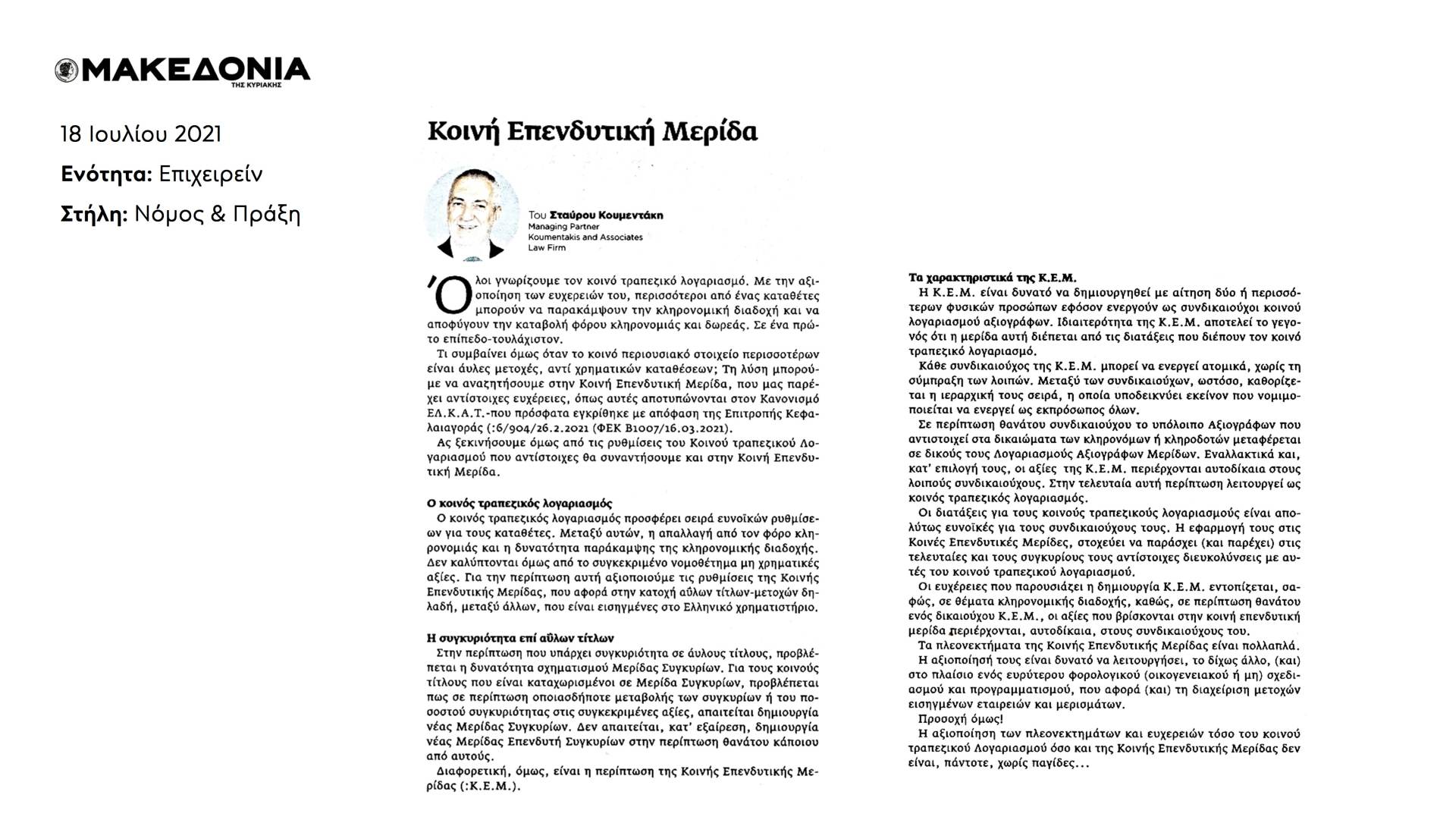
    We all know the Joint Banking Account. By utilizing its capabilities, more than one depositor can bypass the inheritance procedure and avoid paying inheritance and donation tax. At first -at least. But what if the common asset of more than one person is intangibles, rather than cash deposits? We can look for the solution in the Joint Investment Accounts, which provide us with corresponding facilities, as they are reflected in the Regulation of the Hellenic Capital Market – which was recently approved by a decision of the Hellenic Capital Market Commission [: 6/904 / 26.2.2021 (Government Gazette B1007 /16.03.2021)]. But let’s start with the regulations of the Joint Bank Account that we will encounter in the Joint Investment Accounts.

    The Joint Bank Account

    The Joint Bank Account is under the provisions of the law (Law 5638/1932 “on deposit in a joint account”). The inflow of capital from abroad and, in particular, the inflow of capital of Greeks living abroad was the purpose of its introduction into the Greek reality. This goal, moreover, is explicitly stated in the Explanatory Memorandum of the relevant legislation.

    The Greek legislator aimed, in particular, to make Greek banks competitive with their counterparts abroad. It sought to achieve this by introducing a deposit instrument, which would offer a number of favorable arrangements for depositors. Among them, the exemption from inheritance tax and the possibility of bypassing the inheritance.

    As regards, in particular, the case of succession, the possibility of an agreement is provided for, according to which “… upon the death of any of the beneficiaries, the deposit and the account thereof automatically pass to the survivors, until the last one”. This term, in fact, is accompanied by a highly advantageous arrangement for the survivors. It is provided, in particular, that in the event of the death of one of the beneficiaries “… the deposit is owned by them (: the other survivors) free of any inheritance tax or other fee. On the contrary, this exemption does not extend to the heirs of the last remaining beneficiary “(article 2 of law 5638/1932).

    The wording of the law provides, as we also mentioned in the introductory remarks, that the object of the joint account can be, exclusively, money (article 1 of law 5638/1932).

    It is obvious that, based on the above data, non-monetary assets ​​are not covered by this legislation. Securities and debt instruments-e.g. In some cases, however, the legislature opted for the proportionate application of the favorable provisions of the law on the joint account. Indicative: the securities of the State in accounting form. In the case of the Joint Investment Account as well. The latter concerns the possession of intangible securities-shares, ie, among others, that are listed on the Greek stock exchange.

    The co-ownership of intangible securities

    The possession of intangible securities and the development of investment activity in the Greek Capital Market through the opening of a Securities Account, presupposes for each investor to be legalized-to have a Share, ie in their name. The latter contains their identification data and receives from ATHEXCSD, when it opens, a Registry Serial Code Number (RSCN) which is unique to DSS and does not change (: Section III, Part 4, 4.1 and 4.3. Regulation of the Hellenic Central Securities Depository SA-ATHEXCSD, the content of which was approved by a recent decision of the Hellenic Capital Market Commission: 6/904 / 26.2 .2021 (Government Gazette B1007 / 16.03.2021), based on the provision of article 4 of law 4569/2018 and Regulation (EU) 909/2014 (CSDR)

    It is possible that sometimes two or more investors are co-owners of some shares. In this case, it is presupposed, according to those that apply to the listed shares, the participation of all, without exception, the co-owners for each related transaction.

    In case there is co-ownership in intangible securities, the possibility of forming a Co-ownership Share is provided. It is assumed that each of the co-owners has an independent Customer Share. The Share of Conjunctures is determined on the one hand by the co-owners and on the other hand by their percentage of co-ownership in the securities ​​(Section III, Part 5, 5.2.2. Regulation of ATHEXCSD).

    For the common securities that are registered in a Co-ownership Share, it is provided that in case of any change of the co-owners or the percentage of co-ownership in the specific values, the creation of a new Co-ownership Share is required. This new Share is also determined by the new data of the current times and the new percentages of ownership.

    An exception is that it is not required to create a new Co-ownership Investment Share in the event of the death of one of the co-owners. In this case, ATHEXCSD changes the names of the co-beneficiaries by registering in the position of the co-owner who passed, their heirs. Obviously, it also changes, respectively, the percentages of co-ownership (: Section III, Part 5, 52.7. Regulation of ATHEXCSD).

    What is mentioned immediately above does not apply, however, in the event that the possibility of registration in a Joint Investment Account is opted for.

    The Joint Investment Accounts- In General

    The Joint Investment Accounts (: JIA) can be created at the request of two or more natural persons if they act as co-beneficiaries of a joint securities account according to the provisions of par. 6 of article 13 of law 4569/2018. A legal entity, therefore, cannot participate in the creation of a JIA (: Section III, Part 5, 5.1.1. Regulation of ATHEXCSD).

    The JIA is clearly identified by the co-beneficiaries, who -as provided- are joint owners of the values ​​registered in it (: 5.2. Regulation of ATHEXCSD).

    As we have already pointed out above, the peculiarity of JIA is the fact that this Share is governed by the provisions governing the Joint Bank Account (: Law 5638/1932).

    The characteristics of the JIA

    In General

    The contract of the JIA contains the individual terms for its operation. The creation of a JIA, however, is distinguished for its specific characteristics.

    Each Participant in a Joint Investment Account implements under their own responsibility any transaction related to the operation of the relevant Securities Account at DSS, acting (also) on behalf of the co-beneficiaries. Each co-beneficiary, therefore, can act individually, without the complicity of the others (: 5.1.6. Regulation of ATHEXCSD). Among the co-beneficiaries, however, their hierarchical order is determined, which indicates the one who is legitimized to act as a representative of all (: 5.1.5.b. Regulation of ATHEXCSD).

    The case of death of one of the co-beneficiaries

    The change of the co-beneficiaries of a JIA she is not possible. Specifically, in case of death of a co-beneficiary (and if the application of the condition of sub-paragraph a of article 2 of law 5638/1932 has not been implemented), the balance of Securities corresponding to the rights of the heirs or bequests is transferred to their own Securities Accounts (5.1.8. Regulation of ATHEXCSD).

    However, the case in which the provision of article 2 of law 5638/1932 is applied is different. In the latter case, the securities ​​are automatically transferred to the other co-beneficiaries. Specifically, ATHEXCSD modifies the details of the JIA, as it eliminates the deceased from the co-beneeficiaries. However, the hierarchical order of the co-beneficiaries, recorded from the beginning, is maintained (: 5.1.9. Regulation of ATHEXCSD).

    It is possible, of course, as a logical consequence, after the death of the other co-beneficiaries, that only one survivor remains. In this case, the registered in JIA assets ​​are owned by the beneficiary remaining. The latter is obliged, in this case, to proceed with the unification of the JIA with their unique Share (: 5.1.9. Regulation of ATHEXCSD).

    The provisions for the Joint Bank Accounts (: Law 5638/1932) are favorable for the co-beneficiaries. Their application in the Joint Investment Accounts aims to provide (and it provides) to the latter and their co-beneficiaries corresponding facilities with those of the Joint Bank Account.

    The possibilities presented by the creation of a JIA are clearly identified in matters of inheritance, as, in case of death of a beneficiary of a JIA, the assets ​​that are in the Joint Investment Account automatically belong to their co-beneficiaries.

    The advantages of the Joint Investment Account are multiple.

    They can be enjoyed, without a doubt, (also) in the context of a wider tax (within a family or not) planning and scheduling, which (also) concerns the management of shares of listed companies and dividends.

    But beware!

    Utilizing the benefits and facilities of both the Joint Bank Account and the Joint Investment Account is not always without pitfalls…

    Stavros Koumentakis
    Managing Partner


    P.S. A brief version of this article has been published in MAKEDONIA Newspaper (July 18, 2021).

    Disclaimer: the information provided in this article is not (and is not intended to) constitute legal advice. Legal advice can only be offered by a competent attorney and after the latter takes into consideration all the relevant to your case data that you will provide them with. See here for more details.

  • Financing Small and Medium Enterprise and the Stock Exchange

    Financing Small and Medium Enterprise and the Stock Exchange

    It is common ground that Small and Medium Enterprises (: SMEs) need support for their survival and development – especially in the current circumstances. First and foremost, hey need funding. We have already seen that our European and national economies are, without a doubt, bank-centric. And this is something that needs to change, for many reasons. Banks neither can and nor do they want (nor is it appropriate) to bear the burden of financing the companies that need them. Both the economy and SMEs, in particular, have an (insurmountable) need to activate and leverage more, different, sources of funding. Undoubtedly, one of them is the capital markets – the stock exchange. EU data show that only 10% (!) of the external financing of European SMEs (ie from third-party sources) comes from the capital markets. The EU, albeit at a slow pace, is already working to assist SMEs in their first steps.

    Let’s take a look at the current processes taking place at European level to assist SMEs in their first steps in the magical (?) world of capital markets.


    EU assumptions about SMEs

    “There are 24 million SMEs in the EU-27. They represent the backbone of the economy. They generate more than half of the EU’s GDP while at the same time employing more than 100m. employees before the onset of the pandemic”. “On this basis, and in the light of the Covid crisis, we must take for granted the need to revise the SME Strategy” which was decided on 10.3.20 – just one day before the World Health Organization sounded the alarm on the pandemic of Covid-19 “(: Press release of 13.11.20 of the European Parliament).

    The specific assumptions, from the most official sources, cannot be disputed. In fact, the data they contain make it necessary for all of us to become alert. But above all the EU. Of course, our national government as well.


    The ” road to Calvary” of the stock exchanges

    The course of public offerings in the European Capital Markets

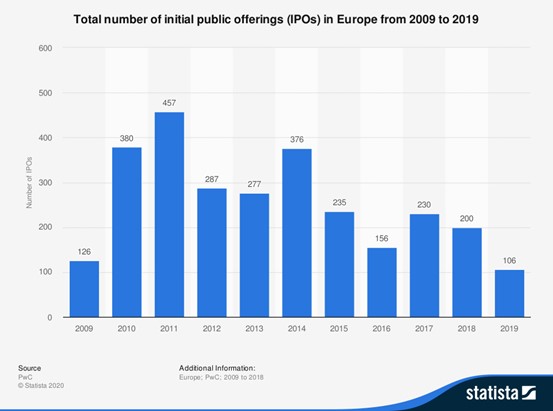
    Let’s take a look at the initial public offerings of the last decade (2009-2019) in Europe:


    It would not be possible to characterize their course (of the initial public offerings) during the last decade as blooming. However, this also reflects the interest of companies to list their shares in regulated markets. Respectively of investors for the capital markets.


    The course of the Greek stock exchange market during the last 20 years

    The boom (but also) frenzy of the Greek stock exchange market, which had the well-known (technically and logically expected) collapse of 1999, was followed by its contraction of the next twenty years.

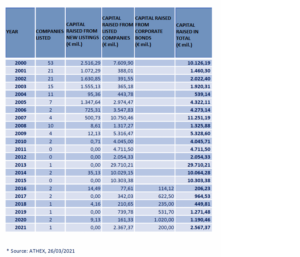
    Let’s also take a brief look at the extremely interesting data of the Athens Stock Exchange, from 1.1.2000-to 26.3.21 (which it kindly provided to us and with its permission we make public):

    The well-known efforts of the Athens Stock Exchange, as we all know, are proving to be bearing fruit in recent years in the corporate bond market. Of course, the largest companies are currently benefiting from it.

    And the stock exchange market?

    Let’s take a look at the (problematic) three years 2013-2015: €50 billion were raised. Also: in the first quarter of 2021 more than €2.3 billion was raised. Although the issue may seem multifactorial, it turns out that the stock exchange market can help raise funds. SMEs are, of course, entitled to their share. And, of course, to the relevant assistance.

    The EU is already moving in this direction…


    EU: The creation of a fund to assist SMEs during and after their listing

    The (basic-initial) assumptions about the necessity of creating such a fund

    One year ago (: 10.3.20) the European Commission published a Communication to the European Parliament and other EU institutions entitled “SME Strategy for a Sustainable and Digital Europe“.

    In the above (extremely interesting) Announcement, important assumptions are made. Among them:

    “SMEs in Europe find limited possibilities for growth financing, such as listing on capital markets through an Initial Public Offering (IPO). Capital markets are an important source of funding for SMEs growing int mid-caps and ultimately large companies. However, the number of SME IPOs declined sharply in the aftermath of the financial crisis and has not recovered since. In 2019, the value and number of European IPOs continued to fall by 40% and 47%, respectively, relative to 2018.”

    In order to address this problem, it is accepted by the European Commission that it would be particularly useful to set up a fund to facilitate the listing of SMEs during and after the registration process. In this way, more fast-growing and innovative SMEs would turn to the capital markets to raise the necessary funds for their development. More private investors would be attracted to the capital markets. The economy (European and, why not, national) would end up less “bank-centric”. Such a choice could only have positive results.

    In this context, the European Commission undertook, inter alia, to “support Initial Public Offerings (IPOs) of SMEs with investments channelled through a new private-public fund, to be developed under the InvestEU programme starting 2021 under the Capital Markets Union”.


    Motion for a resolution of the European Parliament

    Last September (: 16.9.20) a motion for a European Parliament resolution was tabled on further development of the Capital Markets Union (CMU): improving access to capital market finance, in particular by SMEs, and further enabling retail investor participation.

    This proposal records (recital 9) the “decline in Initial Public Offering (IPO) markets in the EU, reflecting their limited attractiveness for, in particular, smaller companies”. This phenomenon is due, among other things, to the fact that, according to the proposal, “SMEs face disproportionate administrative burdens and compliance costs associated with listing requirements”. It stressed “that the efficiency and stability of the financial markets should be improved and that the listing of companies should be facilitated”. Also, it noted that there is a need “to ensure an attractive environment pre-IPO and post-IPO environment for SMEs”. It encourages, in this context, “the creation and prioritization of a large, private pan-European fund, an IPO Fund, to support SME financing”.


    Opinion of the European Economic and Social Committee

    On 11.12.20 the European Economic and Social Committee (EESC) issued an Opinion on the above-mentioned Opinion from the Commission to the European Parliament. The EESC therefore (paragraph 5.4) “welcomes the development of a private-public fund focused on initial public offerings (IPOs) and fully supports the creation of additional equity, quazi-equity, venture-capital and risk-sharing financing instruments for SMEs”. In the same context it stated it “believes that promoting them and ensuring their accessibility is particularly important for innovative small and mid-caps”.


    The course / the (temporary?) quagmire for the creation of the fund

    It is known, however, that the EU does not always act extremely fast. We note, therefore, that there are other concerns about the rapid development of the whole issue: In the context of the parliamentary scrutiny, a relevant Parliamentary Question was submitted on 7.1.21 stressing the Commission’s lack of commitment to take substantive action in creating the aforementioned fund.


    References under the InvestEU program

    Regulation (EU) 2021/523 establishing the InvestEu program was adopted very recently (on 24.3.21).

    We read, inter alia (recital 21): “SMEs represent over 99% of companies in the Union and their economic value is significant and crucial. However, they face difficulties when accessing finance because of their perceived high risk and lack of sufficient collateral… SMEs have been particularly badly hit by the COVID-19 crisis… Moreover,, SMEs and social economy enterprises have access to a more limited set of financing sources than larger enterprises… The difficulty in accessing finance is even greater for SMEs whose activities focus on intangible assets. SMEs in the Union rely heavily on banks and on debt financing… Supporting SMEs that face the above challenges by making it easier for them to gain access to finance and by providing more diversified sources of funding is necessary to increase the ability of SMEs to finance their creation, growth, innovation and sustainable development, ensure their competitiveness and withstand economic shocks to make the economy and the financial system more resilient during economic downturns and to maintain SME’s ability to create jobs and social well-being. This Regulation … should also maximize the firepower of public / private fund vehicles, such as the SME IPO (Initial Public Offering) Fund, seeking to support SMEs through channelling more private and public equity” especially to companies of strategic importance.


    Is the stock exchange market the right means of raising capital for businesses?

    For some it proves valuable; for others less; for others it is completely unsuitable. In fact, in our next article we will try to approach some parameters of the relevant question. It should be noted, however, in quotation marks, that the world of the stock market has not proved to be magical for everyone: neither for investors nor for companies.

    However, those companies (especially SMEs) for which it would be evaluated as the, relevant, best tool available, it should be provided with the appropriate information and, of course, the appropriate assistance. In the context of the latter, in particular, the fund is expected to play an important role, which, as mentioned above, has been planned for a long time by the EU. Corresponding actions are being launched by the ATHEX and the Greek State (which we will also deal with in our next article).

    We hope they do not delay.

    For the good of businesses.

    For the good of the capital markets.

    For the good of our national economy (as well) …

    For the good, in the end, of all of us.


    Stavros Koumentakis
    Managing Partner


    P.S. A brief version of this article has been published in MAKEDONIA Newspaper (April 25, 2021).


    Disclaimer: the information provided in this article is not (and is not intended to) constitute legal advice. Legal advice can only be offered by a competent attorney and after the latter takes into consideration all the relevant to your case data that you will provide them with. See here for more details.

  • Business: Survival & Development. The (necessary?) turn to the capital markets?

    Business: Survival & Development. The (necessary?) turn to the capital markets?


    Businesses need capital (own or foreign) to survive and grow. In Europe, they turn to the banks, mainly, for their extraction. The European economy therefore is (and does not just look) bank-centered. The Greek market even more so. The comparison with the USA, the United Kingdom and Japan (: countries, that is, with developed capital markets) proves the statement to be true. It is not simply a matter of theoretical findings: the relative magnitudes leave no room for misinterpretation. Should we take it for granted that European companies’ fundraising will start to shift outside the banking system – to the capital markets, for example? And, if so, will this also apply to Greek companies? And if so, when?

    For the advantages (of course conditions and disadvantages) of financing outside the banking system (capital markets and beyond) we will be given the opportunity to deal with in our next article. Respectively with the conditions for increasing the creditworthiness of companies. Let us now try to give an answer to the questions mentioned in the introduction.


    Capital Market: US vs EU

    One indicator that is commonly used to assess the size of a capital market development is that derived from the market capitalization / GDP ratio.

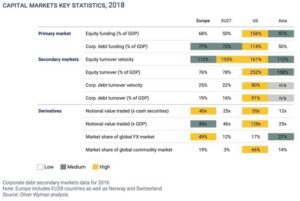
    A relatively recent report by FESE (Federation of European Stocks Exchanges) records an interesting statistic (based on the latest World Bank data published on 31 December 18). Specifically:


    Let us limit ourselves to the Index: Market Capitalization / GDP. We notice that it amounts to:

    At 156% for the US,

    At 50% for the EU27 and

    At 68% for Europe (EU27 + Great Britain + Switzerland + Norway).

    Therefore: for the European Union of 27 the relevant index is limited to 1/3 of that of the USA.

    A very obvious finding follows, that the European capital market lags behind that of the United States.

    There is also, as self-evident, the extremely limited use of European stock exchanges to raise capital by European companies.


    “The Greek economy is primarily bank-centric”

    The Governor of the Bank of Greece, Mr. Stournaras, participated, among others, in an online event of IOBE on 17.12.20 entitled “Financing, private debt and restart of the economy”. His speech, due to his position, was, of course, of particular importance.

    Referring to the Greek economy, Mr. Stournaras said: “The Greek economy is primarily bank-centric. What do I mean by that? Suppose one hundred units of funding are required. And let’s look at America, Europe and Greece. Of the 100 funding units in America, half, about 50%, comes from the capital markets; the other half from banks. In Europe, roughly 75% comes from banks and 25% from the capital markets. In Greece, 95% of the banks and 5% of the capital markets. So Greece is an exceptionally bank-centric country and banks play a very important role in financing and economic development.”

    However: As will be shown later on, the truth is (unfortunately) worse. Corporate finance from the European capital markets holds an even smaller percentage than what our central banker supports. (We can safely assume the same for Greek companies…).

    What if we look for the reason? We must, above all, attribute it to the structure and composition of the European economy. But even more so: in the general culture that prevails in the field of business finance in the old continent.


    The participation of the capital market in the financing of Greek companies

    Unfortunately, there does not seem to be (published-processed) data regarding the financing of Greek companies outside the banking system. But even if we accept as accurate the (rather optimistic) approach of Mr. Stournaras (: 5% share of the capital market as a whole), the conclusions still are absolutely disappointing.

    Listed companies, based on data from the Hellenic Capital Market Commission, are limited to: (a) one hundred and seventy-one (171) for the Main Market and (b) eleven (11) for the Alternative Market.

    Therefore: one hundred and eighty two (182) companies with listed shares in Greece (possibly those that were listed) share the 5% corresponding to the financing from the Greek capital market.

    For the rest (95%) that corresponds to the financing (basically) from the banking system, the 182 mentioned above are competing with the rest of the 821,540 (!) Greek companies. (Their total number is derived from the published data of the European Commission of 2019).


    EU data on SME access to capital markets

    The (dual-secondary) problem of the EU

    The finding of the central banker of our country (: “The Greek economy is primarily bank-centered”) identifies the problem. However, the magnitude of the dependence of the European economy and, consequently, of the Greek economy on the banking system seems more serious and worrying than he points out.

    Our (safe) source, the data and the position of the European Commission, expressed in: “Unleashing the full potential of European SMEs”. From what is mentioned there, it follows that:

    (a) Only 10% (!) of the external financing of European SMEs (ie from third-party sources) comes from the capital markets and

    (b) Only 11% of companies in Europe consider equity as a viable financial option. Most importantly: only 1% have used it.


    EU actions to manage it

    In order for the EU to manage the above (double & extremely serious) problem it decided to create:

    (a) A fund for the listing of SMEs on the stock exchange.

    This private / public fund was established under the InvestEU program. Through this, investments will be channeled to stimulate the financing of companies as well as funds run by women.

    (b) The ESCALAR initiative

    This initiative aims to create a mechanism to increase the size of venture capital and attract more private investment. Its purpose: to support companies with high growth potential.

    The success of both remains to be seen…


    The real (: main) problem of the EU and its management

    The real problem that the EU has to deal with does not seem to (only) be the creation of the conditions for better access of businesses to the capital markets.

    The real (and main) problem of the EU is to limit the further expansion of the financial system in the EU. And the consequent mitigation of the risks linked to this expansion.

    Most importantly: limiting the power of banks and bankers to the detriment of EU political power.

    The above-mentioned EU actions are, in principle, aiming in this direction.


    Do European SMEs have less money available than their US counterparts?

    The Association of Financial Markets in Europe (AFME) in collaboration with the Boston Consulting Group proceeded, together – six years ago (: 2/2015) to publish an interesting report: “Bridging the growth gap Investor views on European and US capital markets and how they drive investment and economic growth”.

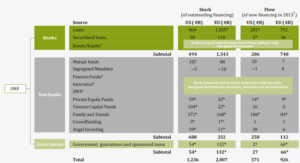
    We read in this report, among other things, that more money is available in European SMEs than in the US. According to the analysis estimates, SMEs (companies with a Turnover of less than € 50 million) in Europe have almost doubled the funding (compared to the US) from banks, non-banks and governments. The data emerge as particularly interesting. Specifically:


    We conclude from the above, indicatively, that in 2013 (taken into account as a reference year), 926 billion Euros of new financing, of all types, were given to European SMEs, compared to 571 billion Euros in the USA. The data, in both areas, exclude financing provided by personal financing (including funds made available to SMEs by their owners through their personal wealth and retained earnings).

    Based on the same analysis above: surveys and interviews show that European SMEs strongly prefer bank lending over personal or alternative sources of financing. This, moreover, is evidenced by the evolved character of the latter (such as venture capital and angel investing-available in smaller SMEs in Europe.

    In 2013, for example, €26 billion was invested by venture capital companies in SMEs in the US – compared to just €5 billion in their European counterparts. During the same period, €20 billion was invested by angel investors in US SMEs – compared to just €6 billion in Europe.

    Therefore: there is no shortage of money flowing into European companies. The problem is that companies are looking to recieve them (primarily) from banks. In this way, however, the banks become “dominant in the game”. Not only does this not solve the existing problems but, on the contrary, it multiplies them.


    Problem…

    It is a common finding that the rapid growth of the (global and European) banking system poses serious risks to the economy. It has already been proven that these risks are not theoretical. Both in the US and in Europe-recently and in the context of the (long-European) financial crisis. National economies have reached the brink of collapse due to the rapid growth and weak foundations of the banking system (see, for example, Cyprus and, secondarily, Greece).

    Also: the attitude of the banking system towards the SMEs in Europe and our country has been diagnosed as a serious problem. And so has it been again, in the context of the ongoing health / financial crisis.


    … vs business opportunity

    Should the specific problems mentioned above maybe push us in thinking “out of the box”? Do they force us to treat (and manage) them as an opportunity? An opportunity for gradual disengagement of the SMEs (but also of the national economy) from the entanglements and risks of the banking system?

    Is it time for SMEs in our country (as well) to turn to financing outside of it (the banking system)?

    To take advantage of the (given-alternative) funding opportunities out there? (Which will always increase ..)

    (And) of the Greek capital market?

    There is no doubt!

    The time has come (as will be shown in an article of ours to follow).


    Stavros Koumentakis
    Managing Partner


    P.S. A brief version of this article has been published in MAKEDONIA Newspaper (March 28, 2021).


    Disclaimer: the information provided in this article is not (and is not intended to) constitute legal advice. Legal advice can only be offered by a competent attorney and after the latter takes into consideration all the relevant to your case data that you will provide them with. See here for more details.
This site is registered on wpml.org as a development site. Switch to a production site key to remove this banner.