Tag: δικαίωμα μειοψηφούντων

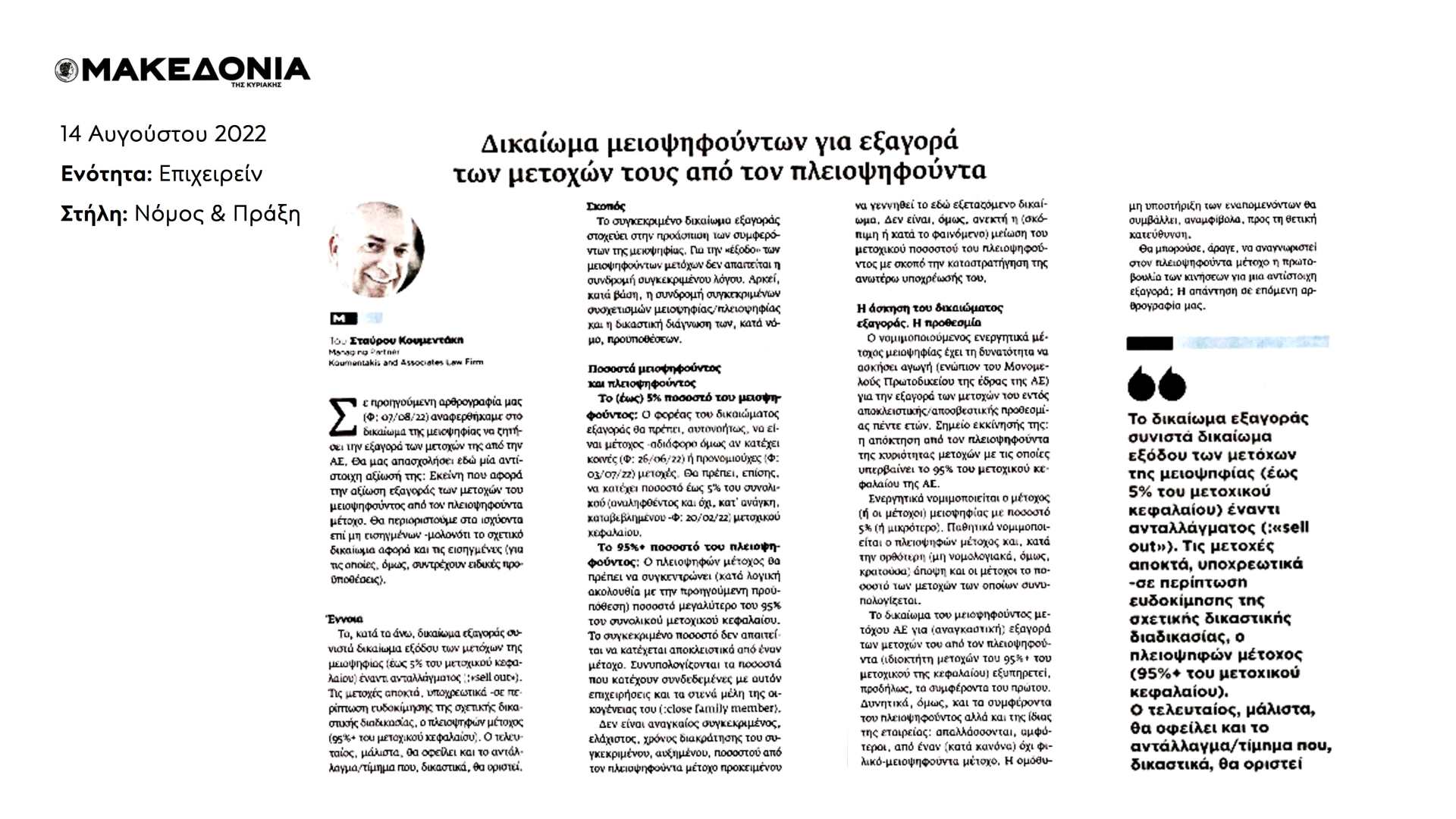
  • Right of Minorities to Redeem Their Shares from the SA

    Right of Minorities to Redeem Their Shares from the SA

    In a previous article we referred to the rights and obligations arising from the shareholding relationship. Among the latter is the right of the minority to request the redemption of its shares by the SA. This right is regulated in Article 45 of Law 4548/2018, in a similar manner to the previous Article 49a of Law 2190/1920. We will be concerned with this right in the present article.


    Meaning

    The redemption right mentioned above constitutes an exit right (usually) of the minority shareholders in return for monetary compensation; however, a court decision is required. This specific right, as analyzed below, occurs in exceptional cases and under specific conditions. It cannot, however, be applied to companies whose shares are listed on a regulated market or on a stock exchange (art. 45 §7) .

    However, it is important to note that the bearers of this right can claim with a lawsuit from the court the redemption of their shares by the SA in one case only: If, for reasons stated in the law, their stay in the SA becomes, in an obvious manner, particularly burdersome.


    Purpose (:obvious and less obvious…)

    The specific redemption right is an obvious compensation for the right of the majority shareholders to take binding, decisive decisions: for the SA itself and/or the minority shareholders. The recognition of a specific («sell out») right manifestly promotes the interests of the shareholder worthy of protection; the one who wishes to withdraw from an SA that no longer serves their interests and does not satisfy their expectations; the one who wants to be released from the SA, in which they have suffered fundamental changes, which did not occur at the time of their entry.

    However, it should not be ignore that only the rights of the (affected) shareholder are served. Correspondingly, the reasonable/justified interests of the SA are also served: through the departure of the complaining /afflicted shareholder, it is freed from their (obviously, in this case, annoying) presence; from the (smaller or bigger) problems that they are causing or would be possible to cause the company; from a (potentially) “disturbing” minority shareholder.


    Reasons for Exercising the Redemption Right

    The enumeration of the reasons for which the shareholder can claim the redemption of their shares by the SA is restrictive (art. 45 §2).

    This primarily regards the taking of particularly important decisions of the General Assembly; decisions that are recognized by law for shareholders as “particularly burdensome in the case of the preservation of their shares”. Specifically:

    (a) The decision of the General Assembly to transfer the headquarters of the company to another state ( art . 45 §2 para. a) : The specific, exceptionally serious, decision creates, among other things, a financial burden on the shareholders; it also makes it difficult to exercise their shareholder rights.

    (b) The introduction of restrictions on the transfer of shares (art. 45 §2 para. b) : Such a decision binds, often excessively, the freedom of the minority shareholder to transfer their shares; also their justified expectation of liquidation of their participation and of their immediate exit. With this specific provision, in the end, the legislator attempts to protect the shareholder from the adverse consequences of corporate decisions that, even if legal, are against the principle of the free transfer of shares (401/2019 Court of Appeal of Athens, 2038/2016 Multimember Court of First Instance of Athens, NOMOS legal database).

    (c) The change of the company’s objectives (art . 45 §2 para. B.) A decision of this nature negates (or could be argued to negate) the minority shareholder’s expectations of maintaining a profitable (in their view) corporate activity. The statutory purpose of the SA is often one of the main criteria for participation in it. Therefore, the amendment, extension or abolition of the statutory purpose justifies the activation of the right of redemption (2760/2014 Court of Appeal of Athens, 3635/2012 Multimember Court of First Instance of Athens, 5723/2010 Multimember Court of First Instance of Athens, NOMOS legal database).

    (d) Any other case which, according to the articles of association, activates the relative right of the shareholders to redeem their shares from the SA (art. 45 §2 para. c): The statutory, relevant reasons should correspond, in terms of importance and severity, to those provided for by law. It is therefore required that the statutory provisions consist of decisions that substantially change the corporate reality and, in addition, make it particularly burdensome for the minority shareholders to maintain their shares. It is necessary, for reasons of rapid clearing of corporate relations, to provide for a deadline for exercising the right of redemption (817/2018 Supreme Court, 1832/2019 Court of Appeal of Thessaloniki , 107/2014 Multimember Court of First Instance of Katerini, NOMOS legal database) .


    The “Extremely Burdensome” Effect Of Maintaining The Shareholder Relationship

    A condition for the exercise of the redemption right is also its “particularly burdensome” effect it has on the shareholder’s stay in the SA. And, in fact, in an obvious way. The legislator is not content, therefore, simply with the unpleasantness or non-beneficial of their stay.

    The concept of “burdensome” stay is a vague legal concept. The concretization, evaluation and application of it (or not), in each case, is done by the court based on the objective judgment of the average, prudent, person. Also taken into account are the facts that pushed the minority shareholder to the buyout mechanism (817/2018 Supreme Court, 401/2019 Court of Appeal of Athens, 2760/2014 Court of Appeal of Athens, 5723/2010 Multimember Court of First Instance of Athens, NOMOS legal database).

    The burden of staying is found on two levels: moral and material. Regarding the first (:moral), “burdensome” is determined by personal reasons (ind.: the tarnishing of the shareholder’s reputation). On the material level, on the contrary, it is determined by the financial disadvantage of the shareholder staying in the SA.

    Therefore, based on the reason the shareholder invokes, the law mandates the externalization/invocation, but of course also proof of the unfavorable situation in which they find themselves. Probability is not enough; full proof is required.


    Participation & Objection to the Decision of the General Assembly

    A necessary formal condition for the exercise of the redemption right is the express opposition (and not only the participation) of the shareholder in the General Assembly that took any of the restrictive decisions referred to in the law or the articles of association. Therefore, it is necessary to vote against the relevant decision in an explicit and solemn manner and also to record it (also for evidentiary reasons) in the minutes of the relevant meeting of the General Assembly.

    The specific condition is not claimed to be met, if the summons of the (damaged) shareholder did not take place legally. Furthermore, it is not required to occur when the reason for redemption is provided as such by the articles of association and is not related to a decision of the General Assembly (art. 45 §1 in fine , §2 c. c) .


    Exercise Deadline

    The action by which the shareholder claims the redemption of their shares is subject to a three-month exclusive amortization period (art. 45 §3 paragraph a’).

    The specific deadline typically starts from the completion of the amendment of the articles of association (observance, i.e., of the publicity formalities). The shareholder, however, as long as they are aware of the relevant decision of the General Assembly, can exercise their right even before the completion of the publicity formalities. However, after the expiry of the above three-month period, the specific right expires; in fact, it is not presented even by way of objection (3635/2012 Multimember Court of First Instance of Athens, NOMOS legal database).

    As pointed out above, the law provides that the reason for redemption may be defined in the articles of association; therefore, it should not be linked to a decision of the General Assembly. In this case, the action is brought within the period provided for there. It is argued, however, that when the reason for the acquisition concerns an amendment to the articles of association, the above-mentioned three-month deadline must be observed.


    The Exercise of the Redemption Right

    The aforementioned right of redemption (art. 45) is exercised by a lawsuit before the Single Member Court of First Instance of the seat of the SA, which hears according to the regular procedure. The relevant action of the shareholder is diagnostic regarding the existence of the redemption right and the calculation of the value of the shares. It is opposed in terms of its request for the condemnation of the company to buy back its shares at a specific price.

    The court is, of course, competent to judge with regard to the presence (or not) of the necessary, by law, conditions. Also, to determine a fair and reasonable consideration for the shares, if the lawsuit is accepted (3635/2012 Multimember Court of First Instance of Athens, NOMOS legal database).

    The price the shareholder leaving will receive is determined based on the company’s assets and valuation. The court, in order to determine them, can order an expert opinion from certified auditors-accountants (art. 45 §4, sec. b’ 2038/2016 Multimember Court of First Instance of Athens, NOMOS legal database).

    There is always the possibility that the redemption will not be completed within the specified period, due to the fault (or choice) of the debtor. In order to prevent this uncertainty, the court reserves the right to decide (for this case) the dissolution of the company – then its liquidation will follow (art. 45 §5, 107/2014 Multimember Court of First Instance of Katerini, 3635/2012 Multimember Court of First Instance of Athens, 5723/2010 Multimember Court of First Instance of Athens, NOMOS legal database) .

    Given the acquisition by the SA of its (own) shares, the relevant provisions apply (art. 45 §6, 49 §§4-7 and 50) and regulations that will concern us, however, see our article to follow.


    Minority shareholders retain, in specific, serious, cases (and under specific, but strict, conditions), the right to impose on the SA the redemption of their shares. They are thus freed from their stay in an SA that (they consider) no longer satisfies their interests and expectations. And as for the SA: in this way, it is unhooked from potentially annoying shareholders; it is freed from potential (present or future) problems; it focuses on the development and achievement of its business goals. Although, therefore, the specific regulations are included in the category of minority shareholder protection, beneficial for the SA, nevertheless, it could be considered that they end. Possibly, therefore, from the latter it would be advisable to choose their activation; and not unfairly – as experience has shown (and proved).

    The majority shareholder’s right to redeem the minority’s shares is of particular as is, respectively, the claim of the latter to redeem their shares from the majority. About them, however, see our article to follow.-

    Stavros Koumentakis
    Managing Partner


    P.S. A brief version of this article has been published in MAKEDONIA Newspaper (August 14th, 2022).
    Disclaimer: the information provided in this article is not (and is not intended to) constitute legal advice. Legal advice can only be offered by a competent attorney and after the latter takes into consideration all the relevant to your case data that you will provide them with. See here for more details.


  • Right of minority shareholders to sell their shares to the majority

    Right of minority shareholders to sell their shares to the majority

    In a previous article we referred to the right of the minority to request the redemption of its shares by the SA (art. 45 of Law 4548/2018). We will be concerned here with a corresponding claim: The one concerning the claim of redemption of the minority’s shares (this time not by the SA but) by the majority shareholder. This right of redemption is regulated in article 46 of Law 4548/2018, in a similar way to the previous article 49b of Law. 2190/1920.


    Meaning

    The redemption right that we are trying to approach here, constitutes an exit right of the minority shareholders (up to 5% of the share capital) against consideration (: “sell out”). The shares are mandatorily acquired by the majority shareholder (95%+ of the share capital) in case of success of the relevant court proceedings; the latter, in fact, will also owe the consideration/price that will be determined by the court.


    Purpose

    The specific redemption right is yet another arrow in the minority’s quiver to defend its interests. The “exit” of the minority shareholders does not require the presence of a specific reason or a finding that their stay in the SA is “particularly burdensome” (as, respectively, is required for the application of Article 45 – for the acquisition, i.e., of minority shares from the SA). The reason is completely irrelevant in this case. Specific minority/majority correlations and the judicial finding of the statutory conditions are sufficient.

    The release of the minority from the SA takes place with a simultaneous-direct strengthening of the shareholding position of the majority shareholder. The minority shareholder is released from a share scheme in which the power balances have significantly changed, in relation to those that applied when the SA was established or when they joined it. At the same time, the majority shareholder is likely to be the sole shareholder of the SA. That is, to get rid of (even small percentages – often, however, annoying) minorities. The potentially formed, with the exercise of the specific redemption right, “one man principle” is likely to be problematic on a substantive and, in particular, legal level; however, it may also be, under conditions, beneficial. In any case: the sole or majority shareholder of the SA has the right to choose. However, they retain, in any case, the right to allow the entry of new shareholders they choose.


    Public Offer(?)

    The case of acquisition of minority shares by the SA cannot occur in the case of listed companies (art. 45 §7). This, however, is not the case here.

    The redemption right explored here (for the purchase of the minority’s shares by the majority shareholder) also applies to listed companies. Subject, however (art. 46 §1, section a), to the provisions and procedure regarding the submission of a public offering for the purchase of securities (art. 28 Law 3461/2006). The latter, as more specialized, should be considered to have priority of application. Moreover, their parallel application is excluded as they require the fulfillment of different conditions. In the present, however, we will exclusively limit ourselves to the conditions of article 46 – to non-listed, that is, SAs.


    Minority & Majority Percentages

    The (up to) 5% percentage of the minority

    The entity for the right of redemption should, of course, be a shareholder. It does not matter, however, the type or category of shares they own (e.g. if they are common or preferred).

    The minority shareholder must own up to 5% of the total (submitted and not necessarily paid up) share capital. This means that the specific right can be born to more than one minority shareholder. It is then up to each of them to claim (or not) the redemption of their shares by the majority (with 95%+ percentage of the total share capital).

    The 95%+ percentage of the majority

    The configuration of the 95%+ rate

    The majority shareholder should gather (in logical sequence with the previous condition) a percentage greater than 95% of the total (even if only taken up) share capital. The collection of said percentage should have taken place at a time subsequent to the establishment of the SA. The legislator’s specific choice seems reasonable: the rights of the minority are deemed worthy of protection precisely because of the change in the shareholding balances of the SA. On the contrary, during its establishment, the minority shareholder consciously chooses to participate – on the basis of any shareholding scheme. The right to regret is not recognized in this case.

    It is accepted, however, that this right is also exercised in the event that the majority shareholder held a percentage greater than 95% at the time of establishment, then decreased below this by transferring their shares, and exceeded it again.

    The calculation of 95%+

    This percentage (in excess of 95%) is not required to be held exclusively by one shareholder. The percentages held by the following persons are also calculated (ar. 46§1 b’):

    (a) businesses connected to it (within the meaning of article 32 of Law 4308/2014) and

    (b) their close family members (: close family member – Par. A of Law 4308/2014). A close family member of a person is defined as that member of their family, who can be expected to influence or be influenced by that person during their dealings with the entity (meaning, in this case, with the SA). Close members are expressly defined as: “…The spouse or partner with whom the person lives together (meaning, in this case, the majority shareholder). …Dependents, including ascendant or descendent relatives, of the person or his/her spouse or partner, with whom the person cohabits.”. Necessary, however, is the narrowing of the interpretation of the specific provision when the majority shareholder does not exert influence on the specific persons and they do not, as a result, act as a group.

    Getting & Keeping 95%

    It is not necessary (according to article 46) for a specific, minimum, holding time of the specific, increased, percentage by the majority shareholder in order to birth the right under consideration here. However, it is not reasonable, on the other hand, to tolerate the (intentional or accidental) reduction of the majority’s shareholding in order to circumvent the above obligation. It is accepted, in this context, that if the majority shareholder (or persons connected or closely related to them) transfer the shares after the initiation of a relevant trial, the minority shareholder does not lose their claim. Nor does the trial become moot. Instead, the decision issued will bind the universal, quasi -universal or special successors of the aforementioned shareholders.


    Exercise Deadline

    The legitimized minority shareholder has the possibility to bring an action for the redemption of their shares within an exclusive/depreciation period of five years (art. 46 §1, section a’). The specific period starts with the acquisition by the majority shareholder of the ownership of shares with which it exceeds 95% of the SA’s share capital. With the lapse of the five-year period, the minority shareholder definitively loses the possibility to pursue, judicially, the acquisition of their shares by the majority.


    The Exercise of the Redemption Right

    The right of redemption (art. 46) is exercised by a lawsuit before the Single-Member Court of First Instance of the seat of the SA, which hears according to the regular procedure. The one who can submit such a lawsuit, as already mentioned, it the minority shareholder (or shareholders) with a percentage of 5% (or less).

    The lawsuit can, of course, only be filed against the majority shareholder. However, in the event that percentages are combined, there is no agreement between theory and jurisprudence regarding the issue of who the lawsuit is against. It is argued in theory that, in this case, all the shareholders whose percentage of shares is included are passively legitimized. The jurisprudence, however, has judged that only the majority shareholder is passively legitimized in this case (1716/2016 Court of Appeal of Athens, QUALEX legal database). This position is evaluated as incorrect. On the one hand, because, after the acquisition, the percentages of participation of those shareholders included will change. On the other hand, because the majority shareholder may not be one (in the case of, e.g., spouses with 46% each).

    The action that will be brought is declaratory in its part concerning the existence of the right of redemption and the calculation of the value of the shares; counter-voting, in its part and request for the conviction of the majority shareholder in the redemption of the minority’s shares at a specific price.

    If the lawsuit is successful, the court order will determine the fair and reasonable consideration that the minority shareholder will receive. To determine the compensation, the court may order an expert opinion from two certified auditors or an auditing company.


    The right of the minority shareholder SA for (forced) redemption of their shares by the majority (owner of shares of 95%+ of its share capital) is evidently serving the interests of the former. From another perspective, however, both the interests of the majority and the company itself are served and promoted: they are both relieved of a (usually) unfriendly minority shareholder. The like-minded support of the Remainers will undoubtedly contribute in a positive direction.

    Would it be possible for the majority shareholder to recognize the initiative of the movements for a corresponding acquisition? The answer is found in our next article.-

    Stavros Koumentakis
    Managing Partner


    P.S. A brief version of this article has been published in MAKEDONIA Newspaper (August 7th, 2022).


    Disclaimer: the information provided in this article is not (and is not intended to) constitute legal advice. Legal advice can only be offered by a competent attorney and after the latter takes into consideration all the relevant to your case data that you will provide them with. See here for more details.

  • Family businesses & succession… (protection of minority successors & the company)

    Family businesses & succession… (protection of minority successors & the company)

    Many aspects of family businesses have occupied us in the past -and still do. Among other things: as an important parameter of the national economy and as a “crossword puzzle for strong solvers” in the succession process. The issue of succession proves to be dominant in these companies. It occupies, among others, the one who is preparing to hand over, always with difficulty, the baton to their successors. The process, the time and the way of the owner being “cut off” from their share rights and the transfer of said rights to the successor were the subject of our previous article. Likewise the dangers of the “next day” (that is, the one that follows the succession) and the ways of managing them. At that time, we pointed out that a major issue is always who the successor is – who is the one to whom the reins of the business will be handed over. Not infrequently, however, minority percentages should be left to others besides the main successor. It is a given that for those (the successors of the minority), appropriate provisions should be taken. Provisions that, first of all, will concern the protection of their own rights. To limit, in other words, the “monarchy” of the majority.

    The road is one and only: the appropriate statutory regulations.

    Let’s approach the most basic of them-especially in the context of an SA.


    The statutory regulations for the benefit of the successors

    It is a given, as it was implied in the introduction, that the transferring shareholder will have to add one more concern to the not so few ones surrounding succession. In particular, they must re-approach the company’s statutory provisions on the basis of prevention, at a minimum, for: (a) safeguarding minority rights, (b) safeguarding shareholder percentages and preventing “malicious” increases of the capital (c) the equalization of the financial benefits of the shareholders through the (possible) issuance of preferrence shares.

    Particularly:

    (a) The rights of the minority

    The significance of the rights of the minority and the security they provide to the minority shareholders could only have occupied us in the past (see The Minority and Its Rights in the Societe Anonyme & The Minority Rights in the Societe Anonyme: The Exceptional Auditing).

    As we have already pointed out, the relatively recent law on SAs (Law 4548/2018) recognizes (like its predecessor, after all) a series of rights to minority shareholders. Rights that depend on the amount of share capital that each individually or several together represent. The rights of the minority are clearly recorded in individual provisions of the specific law (article 141-basically but are also found, scattered, in other provisions). Of particular interest, however, are the rights recognized by law (Article 142) to minority shareholders (to those representing 1/20 and 1/5 of the share capital) regarding the control of the company.

    The percentages of representation of the share capital, which are required for the exercise of the rights of the minority, are not high. It is possible, however, to reduce them even further. The provision of article 141§13 is the one that provides that: “the articles of association may reduce, but not by more than half, the percentages of the paid-up capital required for the exercise of the rights, according to this article”. The regulation of article 142 §3 regarding the rights corresponding to the shareholders representing 1/5 of the share capital is similar.

    The provisions, possibly also the expansion, of minority rights allow the transferring shareholder to implement a “protected” succession. A dual-purpose succession: one that provides a secure majority for the management of the SA and, at the same time, one that adequately secures minorities and their rights. Significantly limiting, by choice, the “one man principle” of the majority successor.


    (b) The special provisions regarding the decision to increase the share capital

    It is possible for the transferor to choose to offer the successor an increased majority. Sometimes, in fact, a majority greater than 2/3 of the share capital. It may be useful in this case to restrict the rights of the (new) majority shareholder. The reason? The prevention of the drastic restriction of the percentages and rights of the minority shareholders through, without their approval, the increase of the share capital of the company.

    On the other hand, it seems appropriate, in some cases, to transfer to one of the successors the shares that would result in an increased majority (greater than 2/3) of the share capital. Such a transfer would be appropriate, for example, in the event that the successor in question would be the only one wishing to take up the family business. Said successor should most likely be given the appropriate incentive to: (a) move unhindered in the benefit of the family business and at the same time (b) have the conditions for smooth decision-making by the General Assembly.

    Possibly, even in this case, it would be necessary to defend the percentages of the minority from any successive increases of the share capital with unilateral, in fact, decisions of the majority. Increases that, without being necessary, could lead to the nullification of the percentages of the minorities. Especially when the minority shareholders do not have (or do not want to provide) the capital to participate in them.

    Problems arise in all the above cases. Basically the only solution is the statutory increase of the majority, of more than 2/3, for the decision to increase the share capital (articles 23, 117, 130 par. 3 and 132 par. 3 of law 4548/2018).


    (c) The issuance of preference shares

    A “heretical” way (quasi) of equalizing the different percentages and share rights of the successors is the issuance of preference shares (article 38 of law 4548/2018-provided, of course, that relevant statutory provisions are in place).

    Preference shares can become a useful tool in the hands of the transferor, so that the latter maintains the balance between their successors. The (potential) minority shareholder will be able to look forward, for example, to receiving a fixed dividend, with no additional claim on the company’s profits and management. It is, in some cases, the appropriate solution: (a) for the minority shareholder who will thus secure a livelihood and (b) for the majority, who will have an incentive to increase the financial result of the family business, which will solely benefit them.


    The adoption of provisions of the law on Corporate Governance

    Proper management of the family business (and not only) is a prerequisite for its longevity. In a family business, however, decision-making is not always free of subjective elements, personal characteristics, and emotional charges.

    Solutions to this problem are provided by the recent law on Corporate Governance (: Law 4706/2020). Although its application is not mandatory for non-listed companies, it is nevertheless appropriate for each company to adopt its own regulations. At least a few, at least in fragments. Moreover, any corporate governance arrangement increases the creditworthiness of the business concerned and, ultimately, its value.

    One of the provisions of this law (as well) is the existence of independent non-executive members on the Board of Directors. According to the law (article 9 par. 1 law 4706/2020), a non-executive member of the Board of Directors is considered independent if, by definition and during their term in office, they do not directly or indirectly hold a percentage of voting rights greater than zero point five percent (0.5%) of the share capital of the Company and is free from financial, business, family or other dependent relationships, which may influence their decisions and independence and objective judgment.”.

    These members are responsible for overseeing the executives. A more impartial and clear decision-making decision is expected from these (independent, non-executive) members. The protection, in other words, of the company and minority shareholders.

    Changing our culture in the direction of good business practices is a necessity in every type of business. However, it is also considered extremely useful in the vast majority of the cases of succession in family businesses.


    Choosing the successor to whom the “keys” of the family business will be handed over is only one (and not the first) step in the long and arduous process of the succession. It is a given that this successor should be provided with the conditions for the smooth exercise of administration. The other (usually weaker) minority shareholders, however, should be provided with the tools that adequately secure their rights.

    Each case is, without a doubt, unique. With its own peculiarities.

    The right tools available are more than enough.

    They can easily be found in the provisions of the law on Corporate Governance. Also, in the of the law on SAs – when the family business is one. It is worthwhile to start with the minority rights and the company’s articles of association.

    It is worthwhile to focus, with much care, on all the parameters of succession. And on all its details.

    One thing is for sure: the result will not disappoint us…


    Stavros Koumentakis
    Managing Partner


    P.S. A brief version of this article has been published in MAKEDONIA Newspaper and makthes.gr (January 10, 2021).


    Disclaimer: the information provided in this article is not (and is not intended to) constitute legal advice. Legal advice can only be offered by a competent attorney and after the latter takes into consideration all the relevant to your case data that you will provide them with. See here for more details.

  • Equal Shareholders in an SA. A blessing or a curse?

    Equal Shareholders in an SA. A blessing or a curse?

    Exactly one hundred years ago, the Greek legislator dealt with the SAfor the first time. They had in mind a legal entity where the shareholders would be, in principle, different from those who would run it. The shareholders would exercise their rights through the General Assembly. The members of the Board of Directors and the management of the company would be discrete roles. We find, over time, that the property right over the company (: shareholders) is “confused” or identified with the company’s management. Often the participation in the company’s share capital, for reasons of (projected) equality, (but mainly due to both sides’ insecurity) is set at 50% -50% for the two, unique, shareholders / groups of shareholders. Some would characterize these percentages as a blessing. Some as a curse. For those who know: Two equal / only shareholders prove to be problematic for any legal entity. And maybe it is a bit worse in an SA. But again, maybe not…


    Images drawn from life (and not from movie scripts)…

    Every new business starts, as a rule, with the best intentions. When the founder is just one person, things are more simple.

    When they are two, it is less…

    At the beginning of a business cooperation, the two, only, founders & equal partners, usually walk harmoniously. But then, sometimes, things change. One of the two (and / or both) sometimes chooses to exercise power over the other. Others times, possibly, their problematic personal relationships are mirrored in the management of the company. And, of course, in the legal entity itself and its business activity. That is when we have a problem. Sometimes, a very serious one.

    It is possible to reach the same problem when the founders-brothers (or very close friends) and 50% shareholders are replaced, over time, by their successors. Successors (or heirs) who will seek to get the “upper hand” in the, among them, informal bras de fer.

    The same problem may arise when the only founder and shareholder of the SA dies and leaves (by will or without one) as equal heirs and successors their two children. Children who, when it comes to claiming power, may prove to not love each other enough. Let’s also not forget that their spouses’ meddling (often, as we see) gives them a nudge to that direction as well.

    We all know such (and many other similar) stories. And continue to see them. All too often. More often in family businesses (do not forget, after all, that in our country they make up 80% of the total number of businesses). However, we will encounter such phenomena in all sub-categories of businesses. Without exception.

    So what happens next?

    We are all too familiar!

    At the most part, it is not pleasant…


    The «50/50» SA

    In other words:

    The main problem, on a practical level, arises when we are faced with only two, equal, voting rights.

    We usually attribute this phenomenon with the term “SA: 50/50”.

    The point when it is created varies. It can be created at the point of the establishment of the company (: when it is founded by two, equal, shareholders). It can also be created during the company’s operation (: subsequent configuration of two, equal, shareholdings).

    “Equal participation” may also be the result of the existence (or creation) of groups of shareholders (whether or not bound by extra-corporate agreements). Each of these groups holds 50% of a company’s voting rights. Shareholders (or groups of shareholders) may, at times, not be just two. Such a case would be encountered, for example, when two shareholders (or groups of shareholders) hold 1/3 of the shares and voting rights each, while the shareholders representing the last 1/3 abstain from making decisions.

    The two, equal, shareholdings are problematic when the holders of the 50% voting rights of the company do not agree in making critical corporate decisions and / or in the election of the Board of Directors.

    As the case law accepts, “in these cases, the lack of communication between the shareholders, leads to the immobilization of the company and its operation is lead to a deadlock, as it is impossible to reach a simple majority in the General Assembly to make decisions, with the main problem being the General Assembly not being able to elect a Board of Directors.” (18191/2014 Multimember Court of First Instance of Thessaloniki).


    The provisions of the legislator

    The legislator could not ignore those specific, problematic cases. Those cases where the SA cannot operate. Or worse, those cases where the company reaches a deadlock due to the inability of the General Assembly (and/or of the Board of Directors) to make decisions.

    The dissolution of the company by a court

    The law generally provides the possibility of dissolving the company, “if there is an important reason for this, which, in an obvious and permanent way, makes the continuation of the company impossible” (article 166 §1 law 4548/2018).

    Moreover: “An important reason according to paragraph 1 exists, in particular, if, due to equal participation of shareholders in the company, the election of the board of directors is impossible or the company cannot operate”. (article 166 par. 2).

    The SA is dissolved by virtue of a court decision. Procedural prerequisite: the submission of a relevant application before the Single Member Court of First Instance of the place of the company’s registered office. An application notified to the latter and adjudicated by the non-contentious procedure (article 166 §3).


    The acquisition of the shares of the SA

    The company’s dissolution must, reasonably, be the last resort to address the impasses created in a company with equal shareholders. This is because a direct consequence of such is the loss of the shareholder status of all the shareholders, the termination of the company as a legal entity and the ultimate disappearance of the latter from the legal and business world.

    In an effort to avoid the last resort of the dissolution of the SA, the legislator provides for/prefers an alternative. A solution that promotes the continuation of the company. This is the option (and possibility) of acquiring the shares of the company. Specifically:

    …by decision of the Court

    The Court, which will handdle the request for the dissolution of the SA, “… before issuing its decision, provides the company and the shareholders with a reasonable period of time to remove the grounds for dissolution, in particular through redemption of shares between the shareholders, unless it reasonably considers that this measure is pointless. This deadline can be two (2) to four (4) months. If the above deadline is provided, the court may order measures for the temporary settlement of corporate cases.” (article 166 par. 4). Such a deadline (: for the removal of the grounds for termination) cannot be extended (as provided by the previous legislation).

    or as an initiative of the other shareholders

    However, the shareholders themselves, those who do not want the company’s dissolution, are also given the opportunity to claim the redemption of the shares of the one (or of those) who request the company’s judicial dissolution. This is the power of the (non-applicant) shareholders of 1/3 of the share capital (and not of the 1/5, as the pre-existing law required) to excursive a main intervention in the lawsuit opened regarding the dissolution of the company. Specifically:

    “Shareholders representing at least one third (1/3) of the capital, can intervene in the relevant lawsuit and request the redemption of all the shares of the applicant or applicants. In this case, the court orders the redemption and determines the consideration, which must be fair and correspond to the value of these shares, as well as the terms of its payment. In order to determine the value, the court may order an expert examination carried out in accordance with Article 17. The redemption value may not exceed the amount that the plaintiffs are likely to receive in the event of liquidation of the company, which the court may increase up to twenty percent (20%)” (Article 166 §5).

    It should be noted here that this provision absolutely determines the method of valuation of the redeemed shares. It is well known that there are many such methods that enable those who perform them to get a wide range of results. The legislator here explicitly chooses the value “which the plaintiffs are likely to receive in case of liquidation of the company”. This value can be increased by the court “up to twenty percent (20%)”.

    In the event of a redemption of shares, in accordance with the manner immediately mentioned above, “any provisions of the articles of association for the freezing of such shares … shall not be taken into account, unless the articles of association provide otherwise. (article 166 par. 6).


    The exception of listed companies

    The SAs whose shares are listed on a regulated market (and consequently the equal shareholding rights in it) are explicitly excluded from the possibility of a judicial dissolution for a “great” reason (article 166 par. 9 law 4548 / 2018).

    We find a corresponding provision in the pre-existing law (article 48a par. 9 of law 2190/1920). A justification for this legislative choice is (also) foundin the explanatory memorandum of Law 3604/2007, which amended the aforementioned provision of article 48a. Specifically, as it is explicitly noted in it, the provisions of article 48a “… apply only to non-listed companies, because in listed companies the shareholder can in principle leave the company by selling their shares.”.


    Conditions for exercising the right to a judicial dissolution due to “equal participation in the company”

    The provision of article 166 of law 4548/2018 is mandatory. This means that any statutory arrangements that are contrary (or divergent) in content to this provision are void. The conditions for exercising this right can be summarized as follows:

    The standing to bring an action

    The right to request a judicial dissolution of the company is exercised only by a shareholder. Therefore, members of the Board of Directors, creditors of the company and auditors do not have this right. Even if they justify, in some way, a relevant legal interest.

    The condition of the applicant being a shareholder is supplemented by the requirement of the holding of a specific, minimum, percentage of the share capital. Applicant shareholders (one or more) must raise at least 1/3 of the paid-up share capital. According to the wording of the relevant provision, a simple holding of shares is not sufficient. Their value must also have been paid for in full. However, the type of shares that make up the necessary 1/3 is irrelevant.


    The existence of a “great” reason

    The right to request the dissolution of the SA has, as already mentioned, a central goal. To solve impasses that the SA and its shareholders have reached.

    Therefore, “a great reason is required, which, in an obvious and permanent way, makes the continuation of the company impossible” (art. 166 §1).

    Such an important (according to article 166 §2) reason “exists, especially if, due to equal shareholders in the company, the election of the board of directors is impossible or the company cannot function”.

    Therefore: the existence of equal shareholders is not enough to request the dissolution of an SA. A great reason is required, like the one required by law. The inability, e.g., to elect the Board of Directors and of the operation of the company due to the existence of two equal (with equal voting rights) shareholders (or groups of shareholders) who are unable, systematically, to agree on the decisions necessary for the operation of the company.

    In fact, the situation mentioned above must lead to the impossibility of electing a Board of Directors or must obstruct the operation of the company in general. In particular:

    Regarding the impossibility of electing a Board of Directors:

    The impossibility, in this case, concerns the General Assembly. Specifically, the case in which the General Assembly is unable to make a decision regarding the election of the Board of Directors. A prerequisite, in fact, is the “… situation that shows elements of permanence.” (3494/2010 Multimember Court of First Instance of Athens). The alleged inability to make a decision, for example, in a single (extraordinary) general assembly “… primarily lacks the element of permanence required to be present, in order to substantiate the great reason for the decision of the court to dissolve … the SA.” While, at the same time, general statements of the applicant that “… they intend to vote against in any future proposal or issue raised in the General Assembly… and will concern issues of major importance for the operation of the SA, such as the approval of balance sheets, and that this event will make it obviously and permanently impossible to continue the operation of the company, it is not enough to make their claim legally stand …, since no preventive judicial protection is provided… ”(18191/2014 Multimember Court of First Instance of Thessaloniki).


    Regarding the inability of the company to operate:

    The inability, in this case, concerns the Board of Directors. This is the case in which a fictitious lack of administration is identified. In other words: there is a Board of Directors, but it is unable to make decisions. This fact obstructs the operation of the societe anonyme. In fact, in a complete and permanent way.

    However, it is completely different when the operation of the SA is not obstructed in a complete and permanent way. In the case that “… the inability to make decisions is at the level of the Board, or because there has been a real lack of administration due to e.g. death or resignation of some or all members of the Board, or because there has been a fictitious lack of management due to e.g. stubbornness or assertiveness of its members…, implicit resignation-abstention from decision-making…, disagreements of members resulting in inability to exercise management…, the problem can be solved even with the removal of the members of the Board and the appointment of new members by the General Assembly, after the appointment of an interim administration that will convene the General Assembly“. (18191/2014 Multimember Court of First Instance of Thessaloniki).

    Therefore, the inability of the Board of Directors to form decisions, which can be addressed by:

    (a) Removal of its members and election of new members by the General Assembly and / or

    (b) appointment of an interim administration under Article 69 of the Civil Code;

    cannot constitute an important reason for a judicial dissolution of the SA. Provided, of course, that the internal involvement is not permanent and, at the same time, it is not found within the General Assembly. It is clear that an SA cannot operate indefinitely with judicially appointed administrations.

    The above disagreements of the shareholders or of the members of the Board of Directors should be demonstrated through the minutes of the meetings of the General Meeting or of the Board of Directors. At the same time, the correlations of forces may be proved by other means, such as, for example, from the extra-corporate agreements of the shareholders (18191/2014 Multimember Court of First Instance of Thessaloniki, 3494/2010 Multimember Court of First Instance of Athens).


    Equal participation in an SA (especially in the case of 50/50 SAs) creates, quite frequently, insurmountable problems.

    Unanimity is required in the General Assembly that is called, for example, to elect a Board of Directors. If unanimity is not reached, in a continuous and permanent manner, the SA is left without administration. However, the company is also left without administration in case there is a Board of Directors, but one that is unable to make decisions.

    In both cases, the company cannot operate.

    To address the extremely serious problem, the law provides specific, quite effective, tools. The dissolution (or threat of dissolution) of the company is one. One that is so strong that it, in fact, sometimes, shocks. Justifiably. Because sometimes such (shocking and extreme) solutions are required, in order to ensure the survival of the company at the last moment.

    It is obvious that the solutions provided by law should be adopted as a last resort.

    Before these extreme solutions there are, without a doubt, other, milder ones.

    Extra-corporate shareholder agreements, statutory arrangements and provisions, the management of minority rights are some of them.

    And first of all:

    The avoidance, for as long as possible, of the establishment and operation of as SA with its shares and voting rights divided in two.

    The responsibility of the founders, the transferring shareholders and of those who plan their succession proves to be extremely serious. It is, however, perfectly manageable.

    As long as timely management of the whole issue takes place. Before, of course, the cration of the problem.

    Ex-post solutions, although painful, still exist.

    In any case: there are no “canned” solutions.

    Only tailor made.

    Always.-

    Stavros Koumentakis
    Managing Partner


    P.S. A brief version of this article has been published in MAKEDONIA Newspaper (October 18, 2020).


    Disclaimer: the information provided in this article is not (and is not intended to) constitute legal advice. Legal advice can only be offered by a competent attorney and after the latter takes into consideration all the relevant to your case data that you will provide them with. See here for more details.

  • Minority Shareholders. Part C: The right of the majority to buy-out the minority

    Minority Shareholders. Part C: The right of the majority to buy-out the minority

    Minority Shareholders

    Part C: The right of the majority shareholder to buy-out the minority shareholder

    1. Preamble

    I have always been a strong believer that “Justice is nothing but the advantage of the stronger”. I could easily claim this quote’s paternity if not: (a) Plato had not beaten me to it (just twenty-four centuries ago) in his work Republic (:“Listen—I say that justice is nothing but the advantage of the stronger”) and (b) if that quote was not all over the internet.

    Plato, as proven through the course of history, wasn’t wrong. This specific position Plato took has proven to be true in general – in inter-state relations, in exercising public authority, in family and personal relations… the list goes on! Especially when it comes to intra-company relations, this general principal has even been endorsed by legislators. An example could be the power given to the majority over the minority. Notwithstanding the many restrictions of that authority introduced in the Greek S.A. law, the great power held by the majority is without question.

    The opinions of the minority and the positions it takes are not always attractive. Sometimes, not even tolerated. Especially when a company is (or appears to or is anticipated to be) flourishing or when the minority is trying to force its rights (or the rights it thinks it has).

    The shareholders holding, on their own or with others, between 50% and 95% of an S.A.’s shares cannot simply decide that “it’s high time we rid of the minority shareholders”. There are of course ways to act -within or outside the law- in such a manner that could push to that direction. But if a shareholder is holding a percentage of 95% or higher over a company’s shares, they do have the right to directly exercise all the rights the Greek law gives them, in article 47 of law 4548/2019.

    We have already referred to the (legal) request a minority shareholder can make to be bought-out of a company by either the company itself or by the majority shareholder, as well as the relevant requirements and procedure (read related articles “Minority shareholders. Part A: The claim of redemption of their shares by the S.A.” and  “Minority shareholders. Part B: Claim for buy-out by the majority shareholders“). In this article, we will study the obligation imposed on the minority shareholder to be bought-out by the majority shareholder (to be squeezed out). This provision seems and is directly opposing to the principle of freedom of contract (article 361 of the Greek Civil Code) and the right to economic freedom, as stated article 5 paragraph 1 of the Greek Constitution.


    2. The right of the majority shareholder to buy-out the minority shareholder

    2.1 The requirement for the majority shareholder to be holding at least 95% of the company’s shares

    In the case of a private S.A., (as far as public S.A.s are concerned, the rules of public offerings apply, supplemented by the Greek law of S.A.s), the first and most crucial requirement refers to the percentage over the company’s shares held by the majority shareholder. The relevant provision of the Greek law of S.A.s (article 47 of law 4548/2018) strictly refers to the shareholder holding at least 95% of the company’s shares. Needless to say, this percentage of 95% is calculated as a percentage of the nominal value of shares held over the overall nominal value of all the company’s shares. It is irrelevant whether a shareholder is holding 95% or more of the ordinary or of the preferred shares of the company. What is only important is the percentage of the company’s shares held.

    2.2 Requirement for at least 95% of the company’s shares to be held by one shareholder

    The right to force a buy-out on a minority shareholder lies only with the shareholder holding at least 95% over an S.A.’s shares who accumulated that percentage after the company was established. In case a majority shareholder covered from day one (at the stage of the establishment of the S.A.) at least 95% of the company’s share capital is not entitled to force a buy-out. In other words: the majority shareholder who set up the company and at that time was holding at least 95% of the company’s shares is not entitled to force a buy-out over the minority shareholder at any time.

    It is important to stress that this specific provision provides only one shareholder with the right to force a buy-out. So we have to rule out the possibility of a cooperation-occasional or not- amongst two or more shareholders in order to gather up amongst all of them the percentage of 95% of a company’s shares in order to force a buy-out on the minority shareholders.

    Let’s remember what happens when you take a look from the “other side”, where non-such restriction applies: the minority shareholder holding 5% or less of the company’s shares has the right (article 46 paragraph 1) to request to be bought out by the shareholder holding at least 95% of the company’s shares. As we already examined (see related article), when calculating the percentage held by the majority shareholder, we count in the shares held by their related parties (ascendants, descendants, spouses, live-in partners and related legal entities). But in the case we are examining in this article, the law requires for only one shareholder to be holding at least 95% of the company’s shares.

    We of course have to note that when the majority shareholder is a legal entity (e.g. a holding company or any other kind of company with more than one shareholders) holding at least 95% of the company’s shares, this legal entity will be considered as one shareholder, no matter how many persons are holding said shareholders shares. In that same spirit, when calculating the percentage held by the majority shareholder, we have to count in the shares that they are holding as a security for their claims, but whose ownership they have.

    2.3 Time Limit

    The right given to the majority shareholder (holding at least 95% of the company’s shares) to force a buy-out is subject to a five-year limitation period. This five-year period starts the moment the majority shareholder accumulates at least 95% of the company’s shares. After the lapse of this five-year period, the aforementioned majority shareholder no more has the right to force a buy-out on the minority shareholder.

    Needless to say, the law does not force the majority shareholder to notify (when the five-year time starts counting, that is when:) the moment the percentage they hold over the company’s shares reaches or exceeds that of 95%.

    2.4 The procedure leading to the buy-out

    The majority shareholder that wishes to buy-out one or more minority shareholders has to submit the relevant request to the competent court (article 47 par. 2 of law 4548/2018). The latter will rule whether the requirements set by law are met. If the majority shareholder’s action is upheld, the court will rule on a just and equitable price per share, as well as on the specific terms the buy-out will be implemented. In order to determine the price per share, the court will take into consideration the value of the company. The majority shareholder will provide the court with an independent expert report (article 47 par. 2 and article 17 par. 3 of law 4548/2018) which in most cases is conducted by either two chartered accountants or an audit firm. When conducting the report, said experts are given access to all the company’s financial data by the company’s B.O.D.. This expert report, although required by law, does not bind the court.

    2.5 The obligation to deposit the financial compensation in a Credit Institution

    Following the publication of the ruling of the court and in case the request filed by the majority shareholder is allowed, the latter has to deposit the financial compensation owed, as determined by the court, to a Credit Institution in the name of the shareholder being bought out. Said deposit will take place only after their identities of the beneficiaries are confirmed. In case six months after said deposit go by without them (the shareholders being bought out) withdrawing their compensation, the Credit Institution reserves the right to “transfer” the sum to the Deposits and Loans Fund.

    2.6 Public Declaration

    In order to exercise their right to buy-out the minority shareholders, the majority shareholders have to make a public declaration (published on the HELLENIC BUSINESS REGISTRY). This declaration will have to include (article 47 paragraph 4):

    • The company’s and majority shareholder’s information, as well as the percentage of the company’s shares the latter is holding.
    • Information regarding the court’s decision -its data and ruling
    • Information regarding the Credit Institution in which the financial compensation set by court will be deposited and
    • Any requirements set in order for the minority shareholders to withdraw their compensation.

    2.7 The Obligation of the majority shareholder for a public declaration or personal notification of the minority shareholders.

    The transfer of shares from the minority shareholders does not require, in this case, any written agreement. This specific transfer can be completed in two, possible, ways. The choice is left to the discretion of the majority shareholder. Specifically:

    • The abovementioned (under 2.6) announcement of the majority shareholder is subjected to publicity (article 47 paragraph 4). Starting from the day of the announcement (in the G.E.MI. (GENERAL COMMERCIAL REGISTRY), the ownership of the shares is automatically transferred to the majority shareholder. The only right the minority shareholder maintains from the shares, following said announcement, is to obtain the compensation for their buy-out, as determined by court.
    • The publicity of the discussed (under a) announcement, can be substituted by personal notifications of the majority shareholder to each one for the minority shareholders being bought-out (preferably served to the latter by a bailiff). The automated passing of ownership of the shares takes place after the second personal notification to the minority shareholder (which is done in no more than fifteen days after the first one). A third personal notification of the minority shareholder is also required, referring to the first to.

    2.8 Is it possible to delay the enforcement of the judgement for the buy-out of the minority shareholder’s shares?

    The law explicitly states (Article 47 par. 7), that it is not possible to delay the enforcement of the ruling allowing the application of the majority shareholder. Any appeals before the court, request of cancellation, reform or application initiating third-party proceedings, will not result in any legal obstacle or delay to the transferring of the ownership of the shares to the majority shareholder, in exchange for the compensation set for the buy-out.


    3. In Conclusion

    Plato has already spoken, as mentioned in the introduction, for the advantage of the stronger and the protection provided to them by law. No need to repeat his opinion on the subject.

    It is true that the power given to the majority shareholder (who holds at least 95% of the S.A.’s shares) to buy-out the shares of the remaining minority, is primarily intended to serve their (the majority’s) interests.

    It is most likely, though, that this provision serves the minority’s rights and claims as well. And that is because it provides the shareholders with a (objectively fair) price for shares that in reality (a) provide them with limited rights, (b) could, most likely, only be sold to the majority shareholder and after having a court force the latter to buy them, with the minority shareholders paying for the judicial cost this time.

    We should accept that this specific procedure will, most likely, have positive results on the S.A. as well. Restoring the, possibly, severed unity and peace amongst the shareholders cannot have negative results in perusing the corporate goals.

    But let’s not be delusional: our experience has shown that the minority is treated, in most cases, as annoying. It doesn’t even have to act in an annoying manner -even stating an opposing to that of the majority opinion will do. A century ago, in “The Trial” by Kafka, it was stated the rather roughly put but otherwise very real statement that “everyone has the right to their own opinion, as long as they agree with me”: more or less, this regards all of us.

    We can safely assume that this provision is one of the safest (legal) ways for the majority shareholder to rid of those opinionated minority shareholders and establish their monarchy!

    stavros-koumentakis

    Stavros Koumentakis
    Senior Partner

    P.S. A brief version of this article has been published in MAKEDONIA Newspaper (May 19th, 2019).

    εξαγορά μετοχών μειοψηφίας

  • Minority Shareholders. Part Β΄: Claim for a buy-out by the Majority Shareholder(s)

    Minority Shareholders. Part Β΄: Claim for a buy-out by the Majority Shareholder(s)

    Minority shareholders.

    Part Β΄: Claim for a buy-out by the Majority Shareholder(s)

    1. Preamble

    It is redundant to say that in any country that respects its laws, the principle of freedom of contract stands strong. In Greece, this principle is introduced in our legal system in article 361 of the Greek Civil Code (: “For the establishment or modification of any legal obligation a contract is required, unless the law provides otherwise”). This principle is based on article 5 paragraph 1 of the Greek Constitution, which refers, amongst other things, to the [right to] economic freedom.

    Specific aspects of the principle of freedom of contract are the freedom to enter (or not) into an agreement, as well as the freedom to choose what said agreement (should one choose to enter into one) will provide.

    According to this, no one is obligated to enter into an agreement (even more so in a predefined one), unless a specific law “provides otherwise”.

    Respectively, when it comes to S.A.s,  no one is obligated to buy the shares of any minority shareholder -especially when the latter’s share is so small that it has no real value in terms of assisting to the formation of the so needed majority. In this case, it is highly likely that nobody will be interested (or nobody will let show they are interested) to purchase such kind of a minority shareholding.

    Amongst his other quotes, the actor and director Clint Eastwood has infamously said that “if you want a guarantee, buy a toaster”. If the minority shareholder decides that their investment is not profitable or even problematic, they cannot just simply return it for a refund: shares are not toasters. Shares are not covered by guarantees, as are toasters.

    A safe assumption could be that, at least at a first glance, no one can be obliged to acquire a minority share package, unless some specific requirements are met…

    There has already been a reference to the legal claim a minority shareholder may have against the company, for the latter to buy them out, as well as all the relevant requirements and procedures (read related article). In this article, we will mainly focus on a minority shareholder’s possible claim against the majority shareholder to buy them out.


    2. The right of the minority shareholders to request a buyout by the majority shareholder

    The requirement for the minority shareholding to be holding shares that do not exceed 5% of the total of the company’s shares

    In the case of a private S.A., (as far as public S.A.s are concerned, the rules of public offerings apply, supplemented by the Greek law of S.A.s) the main requirement is in regard of the percentage of the minority shareholding. The Greek law of S.A.s (article 45 paragraph 1 of law 4548/2018) is strictly limited to shareholders holding a maximum of 5% of a company’s shares. This percentage is calculated as a percentage of the nominal value of the shares the minority shareholders hold on the overall total of the total nominal value of all the shares of the company. It is irrelevant whether a shareholder is holding 5% or less of the ordinary or of the preferred shares of the company. Only the percentage of the company’s shares held matters.

    Furthermore: Minority shareholders holding a percentage higher than 5% of the company’s shares are not entitled to require a buy-out by any shareholder. Not even for a sum of shares equaling to less or up to 5%.

    This provision seems fair. Most of the minority rights recognized under Greek law are recognized to the minority shareholders that are holding more than 5% of a company’s shares. If a shareholder is not holding 5%, their protection seems, and is, extremely limited.

    The requirement for at least 95% of the company’s shares to be held by one (?) shareholder

    The majority shareholder -of 95% or more, a percentage gathered after the company was set up- has (originally) the obligation to buy-out the minority shareholder. In case the minority shareholder accepted at the stage of the very establishment of the company that they would have a percentage lower to 5%, the law assumes that they also consciously accepted that they would have limited protection under the law. Because of that assumption, Greek law has chosen not to “force” the majority shareholder to buy-out such a minority shareholder.

    It is noteworthy that in calculating the required 95% of the shares held by the majority shareholder, one must also count in the shares held by the parties related to them. The legal entities characterized as “related parties” to the majority shareholder and whose shares are considered as shares of the majority shareholder when calculating the percentage of shares the latter is holding, are identified as such by article 32 of law 4308/2014. The persons characterized as “related parties” to the majority shareholder and, again, whose shares are considered to be shares of the majority shareholder when calculating the percentage of shares the latter is holding, are identified as such by Appendix A of the aforementioned law. To be more precise:

    Regarding the related parties that are legal entities, article 32 of law 4308/2014 is extremely detailed. It is redundant, in the context of this article, to get into great detail. One general rule that would be useful to keep in mind is that related parties are generally considered to be the parent company and the subsidiaries of the majority shareholder or of a company that is related to the majority shareholder. It should also be noted that those legal entities that choose to or legally have to prepare consolidated financial statements with the majority shareholder or with related to the latter legal entities are also related parties to the majority shareholder.

    Annex A of law 4308/2014 instructs us in counting in shares held by natural persons- members of the majority shareholder’s close family- when calculating the latter’s share over the company. According to this law, such persons are the majority shareholder’s ascendants, descendants, spouses, and live-in partners.

    Time Limit

    The right given to the minority shareholder (holding a 5% or less of the company’s shares) to request a buy-out is subject to a five-year limitation period. This five-year period starts the moment the majority shareholder (along with their related parties) is holding at least 95% of the company’s shares. After the lapse of this five-year period, the aforementioned minority shareholder no more has the right to request a buy-out by the majority shareholder holding 95+% of the company’s shares.

    The shareholder obligated to buy

    Article 45 of law 4548/2019 refers to the obligation of the majority shareholder to buy-out the minority shareholder holding less or equal to 5% of the company’s shares. As already stated, in calculating the majority shareholder’s share over the company (in order to determine whether they are holding 95% or more) one must also account in the shares held by related parties of the shareholder (legal entities or members of their family). In case there actually are related to the majority shareholder parties holding company shares, one should take it as a given that the related parties will be obligated to acquire the shares sold by the minority shareholder analogically to the company shares they hold prior to the buy-out. It goes without saying, these related parties will have to pay for the shares they are acquiring, at the price determined by the competent court. This approach seems the only logical one since anything else would disturb existing balance amongst the remaining shareholders.

    The procedure leading to the buy-out

    The minority shareholder that wishes to be bought-out has to submit the relevant request to the competent court (article 46 par. 2 and article 46 par. 4 of law 4548/2018). The latter will rule whether the requirements set by the law are met. If the minority shareholder’s action is upheld, the court will rule on a just and equitable price per share, as well as on the specific terms the buy-out will be implemented. In order to determine the price per share, the court will take into consideration the value of the company. In this case it is more than fair (as well as allowed by law) for a report to be requested by an independent expert regarding the value of the shares sold; In most cases, the independent experts that will provide said report to the court will usually be either two chartered accountants or an audit firm. This independent expert report will evaluate the arguments made by the opposing parties.


    3. In conclusion

    The protection offered to the minority shareholder holding a percentage of less than 5% of the company’s shares is extremely limited by law. To counterbalance this extreme risk exposure (and in contrast to the right to economic freedom and the principle of freedom of contract, as they are both stated and protected by the Greek constitution) the above-mentioned minority shareholder has the right to request to be bought out from the company by the company’s majority shareholder of 95% or more.

    The law does not force S.A.’s shareholders to notify the moment the percentage either they or their related parties hold over the company’s shares reaches or exceeds that of 95%. As a result, the minority shareholder has to be alert as for when their rights kick in, otherwise said minority shareholder on the one hand risks to miss their opportunity to exercise their rights to be bought-out altogether, on the other to fail to achieve a good price for their shares.

    As for the majority shareholder, they have every reason to avoid holding 95% of the company’s shares. If they succeed in doing so, they will be able to enforce onerous terms on the minority shareholder while negotiating a possible buy-out of the latter. Such a negotiation could easily start by reminding the minority shareholder of the infamous abovementioned quote by Clint Eastwood…

    stavros-koumentakis

    Stavros Koumentakis
    Senior Partner

    P.S. A brief version of this article has been published in MAKEDONIA Newspaper (May 12th, 2019).

  • Minority Shareholders. Part A: The Claim of redemption of their shares by the S.A.

    Minority Shareholders. Part A: The Claim of redemption of their shares by the S.A.

    Minority Shareholders.

    Part A’: The Claim for Redemption Of Their Shares By The Société Anonyme.

    The existence and exercise of minority rights – as described in an earlier article – “Minority and its rights in the Société Anonyme” and “Minority rights in the SA: the exceptional auditing” – are not always enough to achieve of the necessary balance in its (the minority’s) relationships with the company. Nor, in the end, in the company itself.

    Sometimes “divorce” seems necessary …

    The majority of shareholders exercising their voting rights are entitled (and rightly) to make critical decisions about the future of the company. Critical, in a logical sequence, also for the future of minorities. Sometimes even potentially damaging to the latter.

    What are these potentially harmful decisions? And, if they are taken, the minority shareholders remain unprotected? And under what conditions would it be possible to implement a “divorce” between the company and the minority shareholders?

    According to English actor Carrie Grant: “Divorce is a game played by lawyers”. And from this particular “divorce” they could not miss …


    Causes For The Claim Of Shares Redemption

    It is a fact that within the framework of democracy (and of the law of the Société Anonyme) the majority shareholders are the decision makers. Sometimes, however, these same decisions could be assessed as making it “in an obvious manner, particularly unprofitable” to retain the minority shareholders in the company (Article 45 par.1, section an of the l. 4548/2019). The assessment, of course, belongs to the minority shareholders themselves. The latter will exercise their statutory rights if they adopt this position.

    The Law on the SAs (Article 45 par.2) recognizes as potentially harmful to minority shareholders decisions concerning: (a) the transfer of the registered office of the company to another State; (b) the introduction of restrictions on the transfer of shares; (c) the change of corporate purpose and finally (d) any other event which, according to the company’s articles of association, activates respective rights of the respective shareholders. In the latter case, however, it is necessary to provide for a time limit for their exercise.


    The “Way Out” Of Minority Shareholders And The Relevant Conditions For The Shares Redemption Claim  

    In the event that any of the above events occurs, the law provides (significant) protection to minority shareholders: they are entitled to address to the competent court asking for the redemption of their shares by the company (Article 45 par.1: “redemption by right”-internationally known under the Anglo-Saxon term as sell-out). It imposes, however, a double condition on the applicants (and claiming to be protected): Firstly, there having been represented in the General Meeting which took the disputed decisions and, on the other, their opposition. Possible absence from the relevant General Meeting, voting in favor of the relevant decision or abstaining from the vote, it removes the aforementioned right (i.e. to appeal to the Court asking for the redemption of their shares). However, if a statutory provision refers to an event not related to a decision of the General Meeting, this (double) condition does not stand.

    The term within which “the injured” minority shareholder must “take action” – i.e. bring the claim and exercise his / her right – is three months from the completion of the amendment of the articles of association. This time limit applies in cases of transfer of the company’s registered office to another state, of the introduction of restrictions on the transfer of shares and the change of the corporate purpose. In the other cases provided for by the Articles of Association, the deadlines indicated therein shall apply.


    The Case Of Introducing Restrictions On The Transfer Of Shares

    The company’s interest requires that the company’s continuity be safeguarded. And this is sometimes, to a considerable extent, dependent on its shareholder structure. The introduction of restrictions on the transfer of shares sometimes proves to be crucial (refer to the article on Restricted Shares). The relevant provisions in the Articles of Association at the time of the establishment of the company appear to be a “sine qua non” element to ensure the relations between the shareholders and the achievement of the corporate purpose.

    In the vast majority of cases, unfortunately, such statutory restrictions are not provided for when establishing the company. When the need is identified subsequently, the majority shareholders are in fact able to impose the necessary statutory change. However, the minority shareholders are then (reasonably) entitled to request the redemption of their shares and, ultimately, their exit from the company. It is for the court to decide on the reasonableness of the request of the minority shareholders and, in particular, “if their stay in the minority becomes manifestly unprofitable”. In other words: minor restrictions on the transfer of shares could not justify meeting the request of minority shareholders.

    However, for the cases where the necessary restrictions on the transfer of the shares have been provided since the company’s establishment, there is no reason for the corresponding minority shareholders’ rights.


    The Case Of Modifying The Company’s Purpose

    A similar assessment will, of course, be made by the Court even if the minority shareholder complains (and exercises his/her rights) due to a change in the corporate purpose. It would reasonably be considered to be particularly unprofitable for the applicant to convert, for example, a holding company into a CD production company. On the other hand, it would not be possible to (severely) support the minority shareholder requesting the redemption of his shares from a (painless) expansion of corporate activities.


    The Court’s Judgment On The Claim For Shares Redemption

    The minority shareholder’s claim for the redemption of its shares by the company is assessed by the competent court (Article 45 par.4). The latter is to determine whether the conditions laid down by the law and the substantive merits of the applicant’s arguments are fulfilled. If the claim is accepted, the Court shall determine the fair and reasonable consideration (in exchange for the redemption of the minority shares) and the terms of payment. In determining the price, the value of the company is taken into account. It is logically expected (and not only legally permissible) to request a relevant expert report, which is usually carried out by two auditors- chartered accountants or an auditing firm. This expert opinion is also the one to evaluate both sides’ arguments.

    The court decision is always binding on the company (Article 45 par.5). In the event of the fault being breached within the time limit set by the court order, it may be decided the company’s dissolution.

    However, the judgment is not binding on the requesting shareholder. If the price to be determined by the court decision is not evaluated by the applicant as satisfactory, it is entitled to refuse to complete the relevant procedure (transfer of its shares to the company). In that case, of course, he/she is charged with the costs of the relevant proceedings.


    In Conclusion

    Coexistence in life is not always easy – possibly once and unacceptable. Respectively in business – much more when particularly important (sometimes) economic interests are at stake. The law recognizes the minority shareholder’s right to ask for “dissolution” and for “compensation” by the company when certain important conditions are met. It is, however, particularly important to stress that the importance of the Articles of Association is once again as distinct. Its provisions should either take place in a timely manner (i.e. when the company is established) or in a way that does not affect minority shareholders (unless the aim is precise to affect their rights) …

    There is no doubt that the specific legislation is a means of protecting minority shareholders. But as this divorce, as already mentioned, “is a game played by lawyers”, it is likely to become a weapon, important in the hands of the majority.

    Particular attention, therefore, in both the articles of association and the lawyers …

    stavros-koumentakis

    Stavros Koumentakis
    Senior Partner

    P.S. A brief version of this article has been published in MAKEDONIA Newspaper (May 5th, 2019).

  • Minority rights in the Sosiete Anonyme. Part II. The Exceptional Auditing

    Minority rights in the Sosiete Anonyme. Part II. The Exceptional Auditing

    Minority Rights In The Société Anonyme: An Internal Enemy Or A Determinant Of Health? 

    Part B’- The Exceptional Auditing

    According to Solon the Athenian: “Best governance is where the people obey the rulers and the rulers obey the laws”. In the course of history, it has turned out that everyone who rules embraces (apparently, or even deeply) Louis Ludwig’s XIV saying “L ‘etat c’ est moi” (“the state is me” – for which we have already referred to in Part A of the present). In order to ensure legitimacy in the parliamentary democracy, the principle: “the government rules and the opposition controls” (rightly) applies.

    All of this, of course, does not concern politics alone, as it would be easy (and reasonably) able to make the visibility in life and business: Thus, obviously, brought birth to the need for control of the (small or large) majority of each minority. To safeguard the property of the latter but also the property of the enterprise. To ensure its prosperity and its growth.

    And finally: A company under the watchful eye of multiple controls and auditors pretends (and potential investors and/or creditors) for clear financial and “clean” representations …


    Regular And Exceptional Auditing In The Société Anonyme

    We have referred to minority rights (interests) in the Société Anonyme in a previous article. In the present, our reference is limited to the minority rights that are linked to the exercise of exceptional auditing.

    The regular auditing is distinguished for its periodicity as it relates to the approval of the annual financial statements by the General Meeting of the companies concerned (but not necessarily for those designated as small and very small entities). Therefore, exceptional auditing may be carried out in a company under regular auditing.

    In this context, it is not paradoxical to overlap (partial or total) specific auditing areas: for example, checking the fund is subject to regular auditing but it may also be the subject of exceptional auditing.

    In any case, the exceptional auditing may:

    (a)  also cover areas not covered by the regular auditing such as, for example, the feasibility of managing the company;

    (b) be always more targeted than the regular;

    (c) be carried out, in principle, by persons other than those carrying out the regular auditing and in different ways by the appointed ones;

    (d) result in a finding that is not primarily addressed to the same recipients.


    Types, Conditions and Exceptional Auditing Procedure

    In the event that the conduct of acts contrary to the law, the articles of association and/or resolutions of the General Meeting is assumed, shareholders representing more than 1/20 of the share capital of the Société Anonyme (or, for listed companies, by the Securities and Exchange Commission) are entitled to submit a request to the competent Court for the purpose of carrying out the relevant auditing (article 142, par. 1 & 2, l. 4548/2018). The relevant application shall be submitted within three years from the approval of the financial statements for the year in which the transactions in question appear to relate.

    However, if the circumstances show that the management of the company is not exercised in a proper or prudent manner, shareholders representing more than one fifth (1/5) of its share capital shall be entitled to apply to the competent court for the purpose of carrying out the audit ( Article 142 par.3, l. 4548/2018).

    The court decides whether or not to accept the verification request after checking whether or not the aforementioned conditions are met. It is likely that the requesting minority shareholders are represented in the Board of Directors (either because they have directly appointed members or because they have been elected members of the list of potential shareholders nominated by the shareholders). In this case, the court may also assess that there is no justification for the submission of such a request which, in such a case, will be rejected.


     The Auditors And the Conduct Of The (Exceptional) Auditing

    f the court accepts the request for auditing, it specifies the persons who will carry it out (Article 143). The persons entrusted with the auditing may be:

    (a) an audit firm or, at least, a statutory auditor;

    (b) Holders of an A class accountant’s license from the relevant Economic Chamber and, in addition (when it comes to the legitimacy or good governance)

    (c) persons with any specific knowledge, if required.

    The court, when accepting the request, also determines the amount of the remuneration of the appointed auditors, as well as the procedural issues regarding the time of payment, the possible advance payment and the person charged (if the applicants are liable for payment or the company under auditing).

    The auditors appointed will have to complete the auditing assigned to them in the shortest possible time. The relevant result is handed over to the applicant as well as to the Company. The Board of Directors is obliged to inform the shareholders of the company (no later than the next General Meeting) and the Hellenic Capital Market Commission – in the case of a listed company.

    However, it is important to underline that there is an independent obligation for auditors to submit their findings to the competent public prosecutor in case they find that criminal offenses have been committed.


     Exceptional Auditing: A Blessing or A Curse

    The exceptional auditing is usually conducted either when there is evidence or suspicion of mismanagement or when the demand for applicants is to exert pressure on the managers.

    Taking into account the potential scope and depth of the auditing being carried out, the exceptional auditing may work:

    (a) dissuasive or unlawful or unauthorized acts;

    (b) as a means of exerting pressure on their executives or (under certain conditions) of their extortion;

    (c) as (critical) evidence in the context of claims against the persons involved.

    It follows from the above that the right to conduct exceptional auditing is of particular importance in the operation and (conditionally) in the life of the société anonyme itself. This is even more perceptible when criminal offenses are identified, so the competent prosecutor must also be involved.

    In any case: The emergence of unauthorized or unlawful acts through an official (legally ordered) auditing procedure can only cause problems for the company itself – and not only to the case-by-case, insolvent or legally culpable persons.


     Minority rights in Conclusion

    The recognition of the (exceptional) auditing of the société anonyme by minority shareholders is of no doubt that it sometimes works positively (sometimes even beneficial) in the exercise of its management and in the achievement of the corporate purpose. There is also no doubt that it works in the direction of assisting the development of entrepreneurship as well as potential synergies.

    The mediation of the competent court to investigate the fulfillment of the conditions for carrying out the exceptional auditing adds value to the procedure, but also to the seriousness of its outcome. It is basically a result that can hardly be ignored by the members of the Board of Directors, the shareholders and the competent authorities. (And especially with regard to the latter let’s always keep in mind that no business is able to work absolutely thoroughly …).

    Accordingly, any abuse (sometimes simple exercise) of the right in question is harmful not only to the majority shareholder but also to the legal entity it concerns, itself. From this perspective, we all (majority and minority shareholders, legal representatives, courts dealing with such cases) work towards balancing potentially opposed interests and, ultimately, towards safeguarding the interests of the société anonyme.

    Only.-

    stavros-koumentakis

    Stavros Koumentakis
    Senior Partner

    P.S. A brief version of this article for minority rights has been published in MAKEDONIA Newspaper (April 27th, 2019).

    δικαιώματα μειοψηφίας

  • Minority and its rights in the Société Anonyme

    Minority and its rights in the Société Anonyme

    Minority and its rights in the Société Anonyme: an internal enemy or a determinant of health? 

    Part A’

    «L’ etat c’ est moi» (: “The state is me”) is the most well-known saying, more known than him himself – of Louis IV, that refers to the omnipotence of the ruler and, consequently, to the inability of the existence of a different view. In France in the seventeenth and eighteenth centuries, every minority view was obviously judged to be repugnant: The Ruler knew!

    For the opposition, various views have been formulated over time (where and when) its existence has been accepted. One of the most characteristic views was that of Vladimir Ilic Lenin: “The best way to control the opposition is to guide them”. In this case, we have recognized the right of the (minority) opposition to existing with (yet acknowledged) rights of “guiding” it by the ruling (and majority) filiation.

    Needless to refer in both cases mentioned above, to the protection of minorities.

    Let us consider, accordingly, what the non-recognition of any right to minorities would mean in any business formation.

    So, is the (in substance) recognition and safeguarding of minority rights in corporate formations a safety factor not only for the minority but also for potential investors and creditors?


    1. Minority rights in the Société Anonyme

    In the light of the above considerations, the recognition of minority interests in the (corresponding) shareholders – and not only in the light of the constitutionally protected right of property – seems more obvious. It is also perfectly normal for the current legislator to (slightly) strengthen the rights of minority shareholders in the recent law on sociétés anonymes.

    It is true, of course, that we should always “weigh” the rights of the majority shareholders with the corresponding ones of the minority shareholders. The result, in any case, cannot be either the frustration of the proper functioning of the company or the rights of the latter (the minority). The right balance, at least as far as the legislator’s intentions are concerned, seems to be significantly reflected in the recent law.

    The recognition (on a formal level) and the existence of (in essence) minority rights, sometimes those that the law imposes on those who the investor (or the creditor) requires, is a prerequisite for seeking and finding investment (or loan) funds – as a rule critical for the smooth operation of the société anonyme.


    2. The extent and the nature of minority rights in the société anonyme

    The already in force Law on Societes Anonymes recognizes (like its predecessor) a series of rights to minority shareholders depending on the amount of share capital each one or more of them represents. Minority rights are mentioned on the one hand into the provision of article 141 of the new law and, on the other, are spread into its other provisions. Of particular interest, however, are the rights recognized by the law to minority shareholders (those representing 1/20 and 1/5 of the share capital) as regards the control of the company. However, because of their seriousness, we will deal with than in an article to follow.

    For the rest, an indicative escalation of the minority rights is attempted, divided into two sections: The one which concerns the (presumably) more important and the other, concerning the remaining, individual rights


    3. The most important issues

    3.1 Approval of the conclusion of (in principle) prohibited agreements

    Shareholders representing 1/20 of the share capital are entitled (Article 100 par. 3) to request the convening of a General Meeting for a final decision on the granting of an authorization to conclude an agreement for the cases in which the conclusion is prohibited without a special authorization granted by the Board of Directors (Article 99 et seq.). In the General Meeting that convenes to this respect (:Article 100 par. 4), the right of shareholders to oppose to the granting of an authorization to conclude the agreement is granted as follows: (a) for listed companies to the shareholders representing a percentage equal to or greater than 1/20 of the share capital and (b) for non-listed companies to the shareholders representing a percentage equal to or greater than 1/3 of the share capital (especially for the latter subject see related article<).

    3.2 The critical issues of GM’s competence

    Shareholders representing a percentage equal to or greater than 1/3 of the share capital are entitled (:Article 132 par.3) to oppose a decision-making on critical matters pertaining to the operation of the company (indicatively: change of the company’s nationality, its subject, the increase of shareholder obligations, the regular increase of the share capital, the change in the way the profits are distributed, the merger, the division, the transformation, the revival, the extension or the dissolution of the company, or renewing the power to the Board of the Directors for an increase in capital, etc.).

    3.3 The distribution of the minimum dividend

    A right is recognized (:Article 161 par.2) to shareholders representing a percentage equal to or greater than 1/3 of the share capital to be involved in the decision of the General Meeting to reduce the distribution of the minimum dividend to a percentage less than 35% of the net of profits (after deduction of the reservation for the statutory reserve and other credit lines of the statement of results that are not derived from realized profits). Shareholders representing a percentage equal to or greater than 1/5 of the share capital are entitled to oppose the decision of the General Meeting to not (in whole) distribute or reduce the distribution of the minimum dividend to less than 10% of the net profits.


    4. Individual rights of the shareholders

    4.1 Rights of individual shareholders

    In the law on sociétés anonymes a series of rights is recognized to the individual shareholders of the société anonyme. Indicatively:

    The right (: article 79 par.1), if provided for in the Articles of Association, for a shareholder to appoint directly members of the Board of Directors, the number of which should not exceed 2/5 of the total number of its members.

    The right (on a non-listed company – under Article 122 par.4) for the shareholder to require the company to send to him by email individual information for forthcoming general meetings at least ten (10) days prior to the date of the General Meeting.

    The right (: article 123 par.1) to require the company to make available to him the annual financial statements of the company and the relevant reports of the Board of Directors at least ten (10) days prior to the date of the Ordinary General Meeting.

    The right (: article 141 par.10) to require the company to make available, within 20 days, information on the amount of the company’s capital, the classes of shares issued and the number of shares in each class, especially preferred, (with the rights granted by each class) and the number of the restricted shares, with the restrictions, per case.

    The (conditional) right (: article 141 par.11) to require the company to make available to him the company’s shareholders holding a percentage of more than 1%.

    The right in case of dissolution of a company (: article 168 par.4) to require the competent court within three months of the dissolution of the company to determine the minimum selling price of the property, branches or divisions or of the enterprise under liquidation, as a whole.

    The right (: article 184 par.5) of any shareholder with bearer shares to request by 31.12.2019 from the competent court to oblige the company to register him/her in the shareholders’ registry, to issue and deliver new registered shares.

    4.2 Rights pertaining to a minority of 1/20 of the share capital

    The same law recognizes a series of rights to shareholders that accrue more than 1/20 of the share capital. Indicatively:

    The right (: article 102 par.7 case b) to consent to the resignation or reconciliation of the company with respect to its claims for compensation against members of the Board of Directors after the relevant action has been brought.

    The right (: article 104 par.1) of filling a claim for the company’s claims against members of the Board of Directors (as part of their intragroup liability).

    The right (: article 109 par.5 case b) to apply to the competent court to reduce the amount of remuneration or benefit paid or decided to be paid to a specific member of the Board of Directors (subject to the objection, in the relevant General Assembly) of shareholders representing 1/10 of the share capital).

    Right (: article 137 par.3 case b) to bring an action for annulment of a decision taken without the information demanded having been given to the claimants.

    The right to submit a request to the Company’s Board of Directors for the convening of a General Meeting (article 141 par. 1) for the inclusion of items on the Agenda of the General Meeting (article 141 par. 2), for the provision of information about paid-up amounts and payments to members of the Board of Directors and the Managing Directors (article 141 par. 6), to postpone the decision of the General Meeting (article 141 par. 5) and finally to make an explicit vote (article 141, par.9).

    The right (: article 142 par.1) to submit a request to the competent court for an extraordinary audit of the company in the case of acts that violate provisions of the law or the company’s articles of association or decisions of the General Meeting.

    The right (: article 169 par.2) in the event of rejection or non-approval of the acceleration and liquidation plan, submission to the competent court for approval of the above plan or other appropriate measures.

    4.3 Rights pertaining to a minority of 1/10 of the share capital

    For shareholders holding more than 1/10 of the share capital, a series of rights are recognized. Particularly:

    The right (: article 79 par.3 case (c)) to apply to the competent court for the revocation of a counselor appointed by a shareholder (in the context of exercising the relevant right provided by the articles of association- in accordance with paragraph 1 of same article), for a significant reason related to the person appointed.

    The right (: article 102 par. 7 cases (a)) to consent to the resignation or reconciliation of the company with respect to its claims for compensation against members of the Board of Directors, before the possible exercise of the relevant claim.

    The right to information on the course of corporate affairs and the assets of the company (Article 141 par.7).

    Finally, the right to request a court to interrupt or omit the liquidation stage and to immediately take the company out of GEMI – if the company’s assets are not expected to be sufficient to cover the costs of the liquidation (article 167 par.6).

    4.4 Rights pertaining to a minority of 1/5 of the share capital

    For non-listed companies the right is granted (: article 135 par.1 case d) to shareholders representing a percentage equal to or greater than 1/5 of the share capital to be involved in the decision-making by the General Meeting by a vote without a meeting.

    In addition, the minority of 1/5 of the share capital is granted with the right (: article 142 par.3) to seek extraordinary insolvency by the court if the management of corporate affairs is not exercised as required by sound and prudent management.


    5. Shareholder’s Unions

    The Shareholders’ Unions (: institution first emerging in the new Law on Sociétés Anonymes – Article 144) are entitled to exercise the rights granted to the individual shareholders but not those relating to each one of them individually.


    In conclusion

    The Law on Sociétés Anonymes recognizes (and correctly) a set of rights for shareholders with minority shareholding interests. Naturally, minority rights become more important as greater is the percentage of the share capital held by a shareholder. Of the most important are those of controlling the majority and its actions, which, however, because of their seriousness, will concern us in the next article.

    The existence and the ability to exercise minority rights are, in principle, beneficial for the company and the achievement of corporate goals – of course, for attracting investment funds as well. However, it is absolutely harmful to the company to abuse minority rights as well as to exercise it for the benefit of the existing shareholder rather than the company. However, given that what is (and is) the priority of the company rather than that of the individual shareholders, such situations need to be prevented, and, if necessary, decisive. It is important, however, not to forget, in any case, that what matters is the corporate interest.

    And that_ Only.-

    stavros-koumentakis

    Stavros Koumentakis
    Senior Partner

    P.S. A brief version of this article has been published in MAKEDONIA Newspaper (April 21st, 2019).

    dikaiomata-meiopsifias

This site is registered on wpml.org as a development site. Switch to a production site key to remove this banner.