Tag: ν. 4548/2018

  • Presentation of the New Law on SAs to B. Karaoglou SA

    Presentation of the New Law on SAs to B. Karaoglou SA

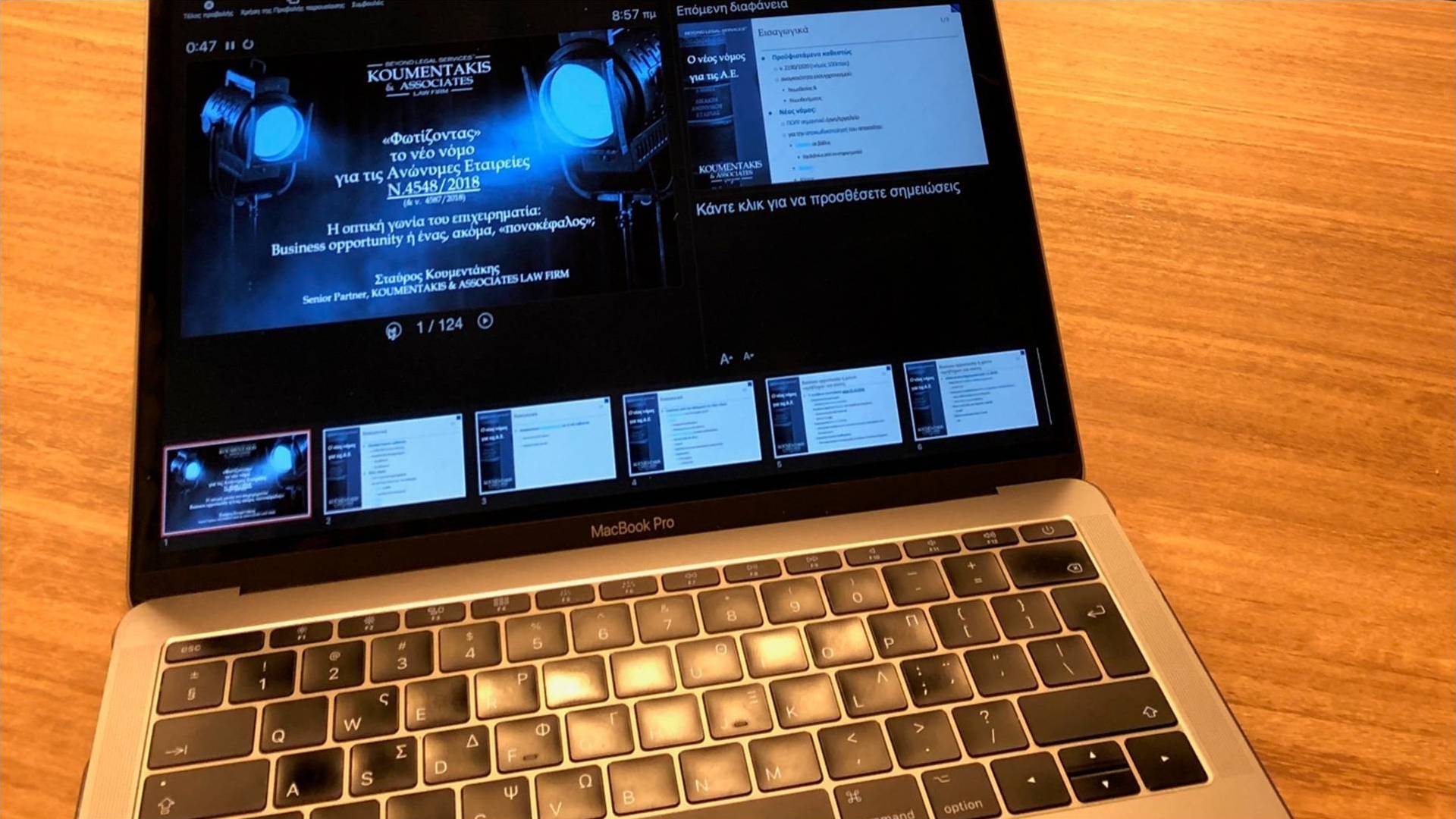
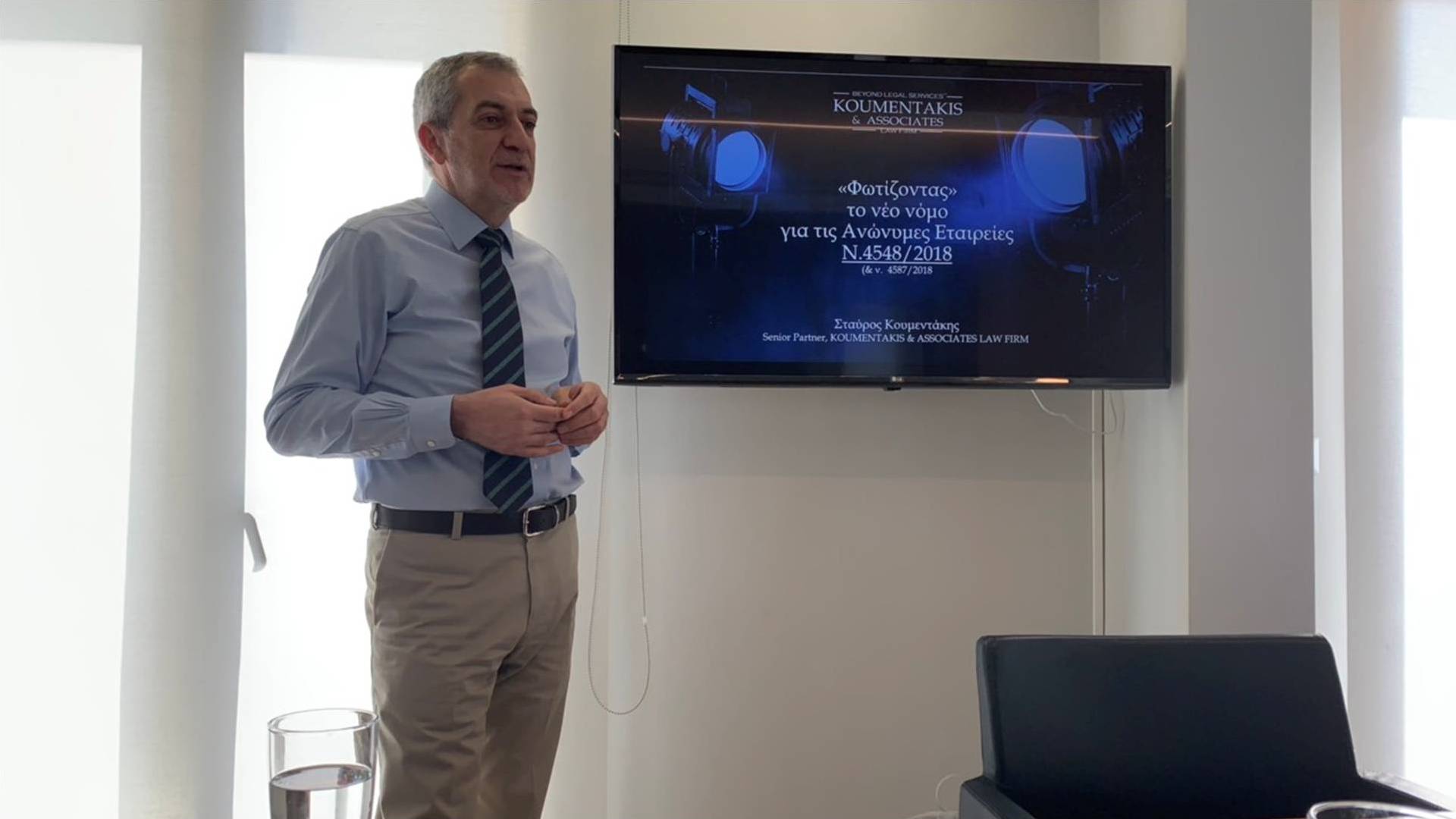
    [vc_row][vc_column][vc_column_text] The series of presentations of KOUMENTAKIS and ASSOCIATES Law Firm on Law 4548/2018 are continued with great success. The presentations are addressed to Enterprises, Business Associations, Auditors Companies, significant Tax and Accounting Services Companies and so on.

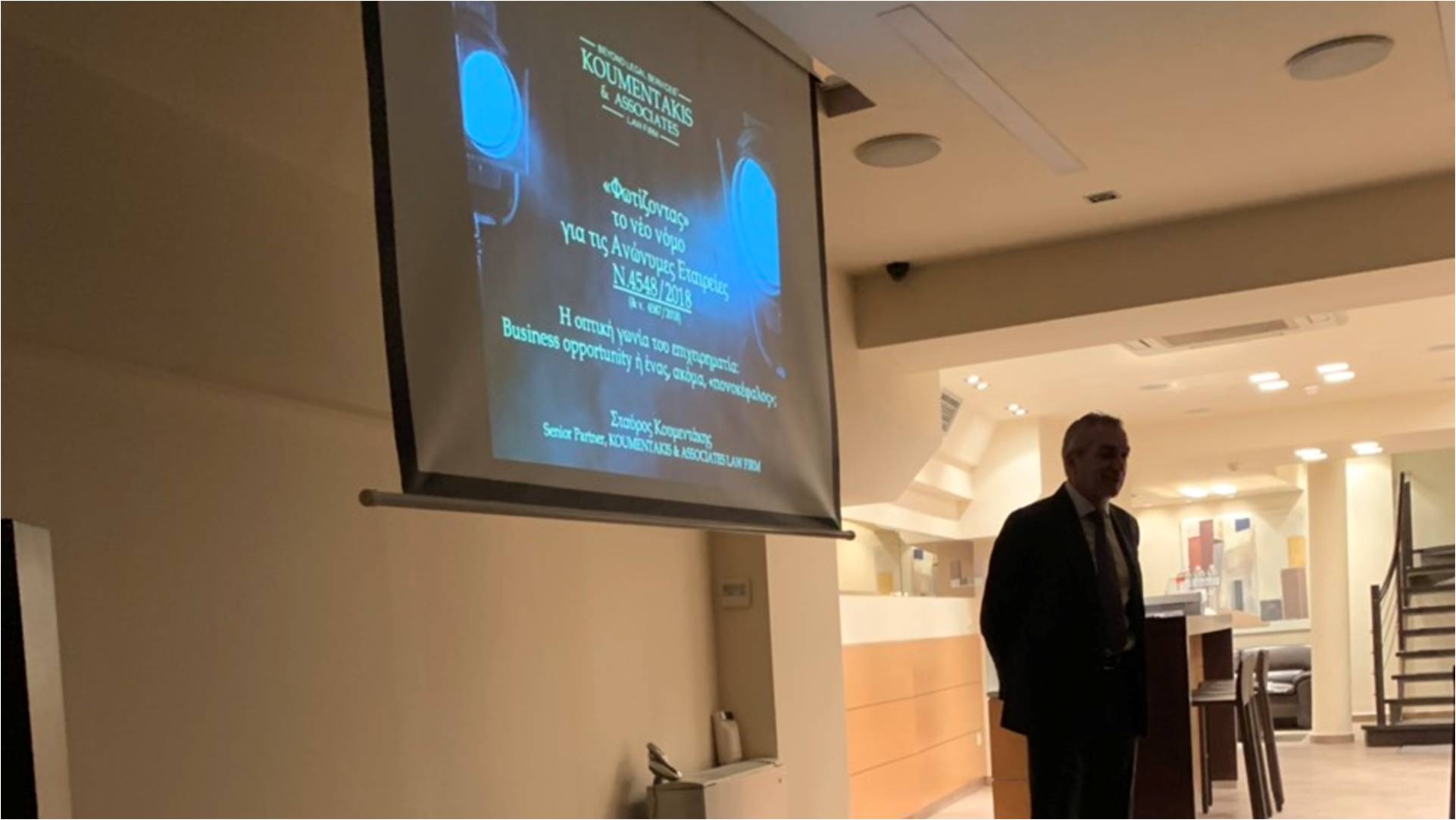
    At a recent workshop held at B. Karaoglou SA – Accounting and Taxation Support, Mr. Stavros Koumentakis, Senior Partner, presented the general framework of the new Law on Societes Anonymes and extensively referred to its individual arrangements for protection of customers against “internal and external risks” as well as the utilization of the opportunities provided by Law 4548/2018 on behalf of businesses in aspects such as:

    • reduce their costs
    • attract and retain skilful executives
    • attract investors
    • exploit technology.

    As Mr. Koumentakis states, “the new Law on Societes Anonymes is an important opportunity for businesses that should not be lost. Law 4548/2018 extends the responsibility and report of the members of the Board of Directors in terms of civil, criminal and administrative sanctions, which can be a potentially serious problem if there are no corresponding provisions and insurance coverage”.  He also points out that “there is a direct need of regulations of the SAs’ articles of association”.

    The presentation of Mr. Stavros Koumentakis on the new Law to B. Karaoglou SA – – which was attended by senior management and executives – gave the opportunity for a broad exchange of views on the specific, extremely important (for businesses, entrepreneurs and members of the Board of Directors ) units.

    [/vc_column_text][/vc_column][/vc_row][vc_row][vc_column][vc_text_separator title=”Gallery” border_width=”3″][/vc_column][/vc_row][vc_row][vc_column][vc_images_carousel images=”36840,36842,36844″ img_size=”” speed=”6000″ slides_per_view=”6″ hide_pagination_control=”yes”][/vc_column][/vc_row]

  • Warrants

    Warrants

    A. Introductory

    Warrants are a modern financial instrument, known to those who teach economics, but also to those involved with stock markets around the world. Warrants, little known to the general public, may be a means of attracting financing but also of supporting business development. Their operation is twofold: On the one hand, they align the expected future positive course of the company with the individual interests of third parties directly or indirectly involved. On the other hand, they broaden the framework of those who “struggle” for the success of the corporate venture – which is now becoming a common goal for more. Warrants may prove to be more attractive than issuing preference shares or convertible bonds.

    But let’s get to know them better.


    B. Getting acquainted with warrants, national and international experience

    What are the warrants

    Under the Law on Sociétés Anonymes (Article 56 par.1), warrants are the securities issued by a société anonyme and confer the right to the of the beneficiaries (: option) to acquire (more precisely: to buy) shares of its (of the issuer-in this case we are talking about corporate warrants).

    Reasonably, though, one could support that lawyers are not the most competent ones to talk about what warrants really are. This is because, in a wider (and correct) view, it is a stock derivative that creates the right (but not the obligation) to buy (or sell) a share at a specific price (: “exercise price”), before its expiration (an indicative definition can be found here: https://www.investopedia.com/terms/w/warrant.asp ). Thus, the institutional framework that governs the operation of warrants affects, on a multi-level basis, not only the operation of a société anonyme, but also the relationships formed around it. The relevant regulations could not therefore be missing from the new law on Sociétés Anonymes (Articles 56 to 58). It could also be impossible not to be of the concern of the legal community of the country. [The most complete, at present, work in our country is: “Warrants corporate and covered”, John Linaritis, Nomiki Bibliothiki, 2018)].

    The use of warrants in the context of the recapitalization of Greek banks (2012-2013)

    The experience of the recapitalization of Greek banks is the one that first brought us into contact with warrants (precisely with covered warrants – in contrast to the aforementioned corporate warrants). The relevant legislative framework was already in place in 2010 (from article 7a par. 1 and 2 of law 3864/2010, as it was in force with subsequent amendments of the years 2012-2013), before being replaced by Article 2 of law 4254/2014. It was further specified by the relevant Ministerial Council Acts No. 38/2012, 6/2013 and 43/2015.

    The attempts to attract private investors to recapitalize systemic banks have been achieved (even partly) through the use of warrants as “sweeteners” (as per the international terminology).

    Thus, those who decided to participate in the recapitalization of Greek banks during the period 2012-2013 were found to have warrants in their hands. Accordingly, on the basis of the MCA 38/2012, the holders of the warrants received from the Financial Stability Fund (FSF) free of charge, one Warrant for each common share of the Credit Institution they acquired. There was provision in this MCA for the readjustment of the number of shares attributable to each warrant “in the case of corporate actions”. The relative provision was further specified,by the MCA 43/2015.

    The beneficiaries of the warrants, thus, acquired the right to exercise them fifty-four (54) months from the date of issue of the securities – half – yearly. The exercise price of the warrants was set at the acquisition price of the respective shares by the FSF, plus an interest rate of 3% and a margin (proportional to time when the exercise of the relevant right) on the number of shares that the holder of the warrant was entitled to acquire while exercising the right.

    The valuation of warrants

    Since 1973, the “Black-Scholes” model has been adopted (with various supplementary interventions and adjustments) in the international literature on the valuation of warrants. This model takes into account: (a) three basic parameters for determining their value: the exercise price, the remaining time to the maturity date and the stock price of the share; and (b) at least three additional financial parameters: the expected dividend yield, the risk-free interest rate, and the expected volatility of the underlying share.

    In practice, however, for all of us non-economists: When the share price at the time of the exercise of the relevant right (i.e. that acquired by the warrant at the time of its acquisition) falls short of the amount to be paid (per share) for its exercise, it makes no sense to put any other parameter in the equation. This was done in the aforementioned case of bank recapitalization: The share price of systemic banks was downgraded, in contrast to the warrant exercise price, which was initially agreed on a constant basis over the individual periods of potential exercise.

    Thus, individuals who participated in the recapitalization of systemic banks received warrants, but they never exercised their right because the share price to which they were quoted was clearly lower than their warrants.

    This particular project was not to be successful.

    Exercising rights from warrants and related questions

    Regarding listed companies (as referred to above “systemic” banks), the aforementioned reasoning seems as self-evident and simplistic: Why exercise my warrant right when it is financially advantageous to buy the corresponding stock from the stock market with a smaller cost?

    But does the same also happens with non-listed companies? In those that their shares are not traded on a regulated market, so they are not freely available? And what happens when they can only be available in the context of a free transaction where the vendor’s and buyer’s “declarations of will” are identical?

    And, ultimately, the key question: Are warrants a failed and non-functional institution? Or can it be used multilevel in the context of boosting entrepreneurship? The answer to the specific, nodal questions is attempted below.

    The potential use and utilization of warrants

    The range of potential exploitation of warrants seems almost inexhaustible.

    Warrants can be an instrument (but most of all: a motivation) for business financing – it is not accidental that the term “sweetener” already mentioned and internationally used: I am currently participating in a share capital increase and I am excited that in the (near or far) future I will have, IF I choose, on favorable terms (in relation to the then data), an additional number of shares.

    This logic may prove attractive not only to attract equity start-ups but also to correspondingly growing and / or simply healthy businesses. On the other hand, it may prove to be appealing in the attempt to provide capital support to companies with liquidity & solvency problems and the inability or difficulty of drawing external financing or (joint) capital support. It is a strategy tool for venture capital, for individual investors, but also a tool for individual shareholders’ personal strategies.

    Moreover, it is not possible to disregard the potential use of warrants as a motivation for those who run the company, executives, associates, suppliers or creditors. And with regard to the latter (suppliers or creditors) – in addition as a means of partial or total repayment or favorable settlement of financial obligations.

    In all the above cases, warrants can have a dual function: (a) To align the (prospective) future positive course and prosperity of the company with the individual interests of third parties directly or indirectly involved (and not only shareholders) but also (b) To broaden the framework of those who (for tangible reasons of immediate interest) “struggle” for the success of the corporate venture that is now becoming a common goal.

    In all these cases, warrants may prove, multi-level, to be (and are) more attractive and preferable to the issue of preferred shares or convertible bonds.


    C. The approach (and regulation) of warrants by the law on the SAs

    Bearing in mind the above mentioned (under A) introduction, the choice of the relevant Legislative Committee (and of course of the Greek legislator) for integrating warrants into the regulatory field of the new Law on Sociétés Anonymes can be more clearly understood.

    Option to issue warrants

    By the provision of Article 56 par. 1 of the new law, the General Assembly shall be the competent body for the issue of the warrants, which shall decide with increased quorum and majority. A simple quorum and a majority of the General Assembly or a decision of the Board of Directors is sufficient if there is a relevant statutory provision (paragraph 2 applying mutatis mutandis the provisions for the extraordinary increase of the share capital – according to article 24).

    Individual decision parameters of the competent body

    The relevant competent body of Société Anonyme in its decision to issue warrants (which is subject to the publication of the law on the increase of the share capital) includes the following:

    (a) the time, the manner, the price for the issue of the warrants and the method of payment
    (b) the time limit and other conditions governing the exercise of the right which the warrants incorporate
    (c) the category and number of shares to be issued after any exercise
    (d) the value or method of calculating the value of shares to be paid when exercising the right
    (e) the number of shares to which each warrant is entitled to acquire
    (f) adjusting the terms of the warrants and of their rights in the case of corporate actions; and
    (g) any other relevant detail

     Other issues related to the issue of warrants

    Existing shareholders at the time of the issue of the warrants retain a relevant pre-emption right at the time of their issuance (Article 56 par.6) and reasonably as their future exercise would disrupt any equity balances. At the same time, it is possible to recognize (Article 56 par.7) the option of partial coverage of the warrants for which the issuance will be decided (in proportion to the application of Article 28 for the partial coverage of the share capital increase). Finally, it is stipulated (Article 56 par. 8) that the relevant warrants are nominal – reasonably also in this case as the shares of the Sociétés Anonymes can only be nominal.

    Acquisition of own warrants by the company (Article 57)

    The Société Anonyme cannot cover its warrants or take warrants of its own or its parent company.

    However, the Company may acquire warrants of its own (except in the case of a successor or a gratuitous cause) following a decision by the Board of Directors to: (a) justify the company’s interest; (b) record the purpose and (c) determine the maximum number of warrants to be acquired; (d) the duration of the approval (max 12 months); and (e) the minimum and maximum value of the acquisition.

    For the particular decision of the Board of Directors, a certified auditor’s report is required on the reasonable value of the acquisition. This specific value may not result in a reduction in the share capital to lower levels than those specified in the provision of Art. 159 §1.

    In the event that the issuer decides to acquire (and ultimately acquires) its own warrants in order to amortize them, it is obliged to immediately cancel it. Also, when the issuer acquires its own warrants either due to a succession or by a gratuitous cause, it is obliged to take a decision, within one month, either to cancel or to resell them. In any case, however, of an acquisition by the company of its own warrants (in contravention of the specific provisions) is obliged to transfer them not later than one year after their acquisition.

    Exercise of warrant rights (Article 58)

    The right resulting from warrants is, as already mentioned, a right of option. This means that the exercise of the right by the beneficiary is unilateral. The sole condition for its exercise is the payment to the company (in advance) of a given price.

    The nominal value of the shares to be issued may not, however, exceed the sum of the amount paid on the acquisition of the warrants and that paid in the exercise of the right in question.

    However, when the relevant right arising from the warrants be exercised, there is an increase in the share capital. In this increase, the old shareholders have no right of preference. The Board of the Directors is obliged to adjust, within two months, the share capital of the company.

    Finally, it is noted that the provision of a reserve to the issuing company is mandatory as long as the warrants remain valid. This reserve cannot be distributed and is at least equal to the value paid when the warrants were issued.


    D. Epilogue

    From the above, I do not think there is any doubt that the incorporation of warrants into national law provides an important (multi) tool for Sociétés Anonymes. An important tool for financing and for facilitating their financing, for creating incentives to help their productive, efficient and ultimately optimal operation and development. Above all, however, it is a tool that widens decisively the circle of natural persons and legal entities directly and indirectly (more or less) associated with it while, at the same time, with many interests in achieving the corporate objectives.

    It is up to businesses, entrepreneurs, financial (but especially our legal) advisors to optimize their use.

    stavros-koumentakis

    Stavros Koumentakis
    Senior Partner

    P.S. A brief version of this article has been published in MAKEDONIA Newspaper (January 27th, 2019).

  • Presentation of the New Law on SAs to ZIA Insurance

    Presentation of the New Law on SAs to ZIA Insurance

    [vc_row][vc_column][vc_column_text] Presentation of the New Law on SAs to ZIA Insurance – Business and Board members insurance coverage

    It is a fact that the new Law on Societes Anonymes is an important opportunity for enterprises that should not be lost.

    It is also a fact that the new law extends the responsibility and report of the members of the Board of Directors in terms of civil, criminal and administrative sanctions. This may be a potentially serious problem if there are no corresponding provisions and insurance coverage. The presentation of Mr. Stavros Koumentakis on the specific law to ZIA Insurance was an opportunity for a broad exchange of views on the specific, extremely important (for enterprises, businessmen and board members) aspects. An exchange of views also took place on the level of potential insurance coverage for individual complex products created on the basis of the new law.


    In his speech, Mr. Koumentakis presented the general framework of the new Law on Sociétés Anonymes, the differences that exist in relation to the older ones and was extensively mentioned:

    • deepening into individual regulations of the new law
    • making use of the law’s options on behalf of the businesses on its own aspects, such as:
      • reducing their operating costs
      • attracting investors and investment funds
      • exploiting technology
      • attracting and retaining competent, senior-level, executives
    • protecting the clients of the Law Firm against their “internal and external enemies”.
    • the potential, necessary and beneficial regulations of the SAs’ articles of association, where applicable, the provisions of which must, individually and directly, be adapted


    The presentation was attended by the senior management of ZIA Insurance. [/vc_column_text][/vc_column][/vc_row][vc_row][vc_column][vc_text_separator title=”Gallery” border_width=”3″][/vc_column][/vc_row][vc_row][vc_column][vc_images_carousel images=”36807,36805,36803,36801″ img_size=”” speed=”6000″ slides_per_view=”6″ hide_pagination_control=”yes”][/vc_column][/vc_row]

  • Presentation of Law 4548/2018 to ARTION Group

    Presentation of Law 4548/2018 to ARTION Group

    [vc_row][vc_column][vc_column_text] The new law on Sociétés Anonymes is a new opportunity for businesses and not yet another headache. This was the conclusion of the presentation by Mr. Stavros Koumentakis, Senior Partner of KOUMENTAKIS & ASSOCIATES Law Firm, titled: “Enlightening the New Law on Sociétés Anonymes (L.4548 / 2018), which took place at the headquarters of ARTION Group.


    Law 4548/2018 For Businesses

    In his speech, Mr. Koumentakis presented the general framework of the new Law on Sociétés Anonymes, the differences that exist in relation to the older ones and had the opportunity to make a detailed presentation of all the law and not only of its basic regulations. Through the interactive and creative exchange of views, it was possible to enlighten individual aspects of the entire law. There was also highlighted the need for the immediate adaptation of the articles of association of the sociétés anonymes to the provisions of the new law as well as the “tailor made” exploitation, for each one, of the law’s particular options and regulations.

    Mr. Koumentakis’ suggestion’s objectives were among other:

    • reporting and, where appropriate, deepening into individual regulations of the new law
    • making use of the law’s options on behalf of the businesses on its own aspects, such as:
    • reducing their operating costs
    • attracting investors and investment funds
    • exploiting technology
    • attracting and retaining competent, senior-level, executives
    • protecting the clients of the Law Firm against their “internal and external enemies”.
    • the potential, necessary and beneficial regulations of the SAs’ articles of association, where applicable, the provisions of which must, individually and directly, be adapted
    • small, non- publicly releasable secrets on individual critical issues

    The presentation was attended by the main shareholders, the senior management and executive staff of ARTION Group.


    ARTION Group

    ARTION group of companies with more than 30 years of experience in the field of supporting businesses and business activities, has gradually evolved into one of the most important units in accounting, tax consulting, specialized consulting services and computerization services.

    ARTION Group has more than 100 personnel, providing a safe, stylish and modern work environment characterized by stability, parity and opportunities for continuing education and professional development.

    [/vc_column_text][/vc_column][/vc_row][vc_row][vc_column][vc_text_separator title=”Gallery” border_width=”3″][/vc_column][/vc_row][vc_row][vc_column][vc_images_carousel images=”36723,36725,36727,36729,36731″ img_size=”” speed=”6000″ slides_per_view=”6″ hide_pagination_control=”yes”][/vc_column][/vc_row]

  • Two-day conference on the new law on Sociétés Anonymes

    Two-day conference on the new law on Sociétés Anonymes

    [vc_row][vc_column][vc_column_text]

    On the occasion of the new Law on Sociétés Anonymes (in the final form of which the firm was actively involved), the Senior Partner of the Law Firm Mr. Stavros Koumentakis, held an internal informative seminar on “Enlightening the New Law on Sociétés Anonymes (L.4548 / 2018)”.


    Law 4548/2018

    At the two-day conference, of 12 hours duration, the Senior Partner of the Law Firm Mr. Stavros Koumentakis had the opportunity to make a detailed presentation of all the legislative text and not just of its basic regulations. Through the interactive and creative exchange of views between the partners and associates of the Law Firm, it was possible to enlighten individual aspects of the entire law. There was also highlighted the need for the immediate adaptation of the articles of association of the sociétés anonymes (in particular of the Law Firm’s clients) to the provisions of the new law as well as the “tailor made” exploitation, for each one, of the law’s particular options and regulations.

    Mr. Koumentakis’ suggestion’s objective was, among other topics:

    • reporting and, where appropriate, deepening into individual regulations of the new law
    • making use of the law’s options on behalf of the businesses on its own aspects, such as:
      • reducing their operating costs
      • attracting investors and investment funds
      • exploiting technology
      • attracting and retaining competent, senior-level, executives
    • protecting the clients of the Law Firm against their “internal and external enemies”.
    • the potential, necessary and beneficial regulations of the SAs’ articles of association, where applicable, the provisions of which must, individually and directly, be adapted
    • Significant “secrets” on issues such as the management and the power of the minority


    The Law 4548 presentations

    With this particular two-day conference, KOUMENTAKIS & ASSOCIATES Law Firm has launched a series of similar presentations, which is on track to take place in Businesses, Business Associations, Auditors Companies, significant Tax and Accounting Services Companies and so on.

    [/vc_column_text][/vc_column][/vc_row][vc_row][vc_column][vc_text_separator title=”Gallery” border_width=”3″][/vc_column][/vc_row][vc_row][vc_column][vc_images_carousel images=”36707,36709,36711″ img_size=”” speed=”6000″ slides_per_view=”6″ hide_pagination_control=”yes”][/vc_column][/vc_row]

  • The New Law On Societes Anonymes

    The New Law On Societes Anonymes

    [vc_row][vc_column][vc_column_text]

    At Koumentakis & Associates Law Firm we have a deep faith in the values ​​and benefits of preventive law practicing. We are not limited to just good conventional predictions and / or developing the right strategy in our clients’ affairs. We are proceeding with the evaluation of the adverse effects of existing legislation and, consequently, with proposals for legislative interventions to prevent them.

    This includes the comments of Stavros Koumentakis, Senior Partner of our firm, on the (unfortunately poor) predictions while implementing the new Law on Sociétés Anonymes regarding its provisions for contracts between their shareholders and their directors.

    The risk of abuse of existing legal options by shareholders of the minority acting in bad faith is (more) visible. Our proposed legislative intervention has already been adopted by FINF (Federation of Industries of North Greece) and has been properly processed.

    The public debate has opened!


    THE NEW LAW ON SOCIETE ANONYMES

    The Contracts Of The S.A. With Main Shareholders, Members Of The Board Of The Directors And Related Parties: The Problem With The (Potential) Dramatic Consequences

    dikhgoriko-grafeio-koumentakis-kai-synergates-law-firm-

    A. INTRODUCTION: THE VIEW OF THE COMPANY

    1. The New Law On Societes Anonymes

    With the recent law (L. 4548/2018), a commendable effort to reform the law of Societes Anonymes as well as the replacement of a hundred-year (old) statute were concluded. Changes are, in some sections, sweeping. The (careful) adaptation of the articles of association of Societes Anonymes should take place in 2019. However, the effect of the provisions of this law begins immediately: from 1.1.2019.


    2. The Contracts Of The S.A. With Main Shareholders, Members Of The Board Of The Directors And Related Parties

    One of the most important issues that the new law is regulating is the conclusion of these contracts.

    The matter has already been dealt with by the European Union legislator in Directive 2017/828: thus, this concerns exclusively companies listed on a regulated market. The new law adopts (Articles 97, 99 et seq.) the provisions of this Directive for all companies. Is this right for non-listed?


    3. The Options Of The New Law And The (Dramatic) Risks For The Shareholders Of The Majority

    Based on the options of the new law it is NOT entitled to participate in the decision-making process in the Board of Directors and the General Assembly the member of the BoD or any shareholder, who derives interest (directly or indirectly) from the particular transaction. It is noteworthy that the final decision belongs to the General Assembly, which is convened on this issue at the request of 5% (only) of the share capital. Only the remaining shareholders – in practice, i.e. ONLY the (usually one) minority shareholder – can vote in this particular General Assembly.

    This choice (as it appears) is intended to protect the minority shareholders and the company itself from the unfair influence of the persons entitled to make decisions on its behalf.

    Unfortunately, it is expected to lead to exactly the opposite effects to those that the Legislative Committee was looking at: The privilege of 5% minority shareholders to decide unilaterally on the matters relating to the company’s relations, for example, with the shareholder of the majority is expected to lead to abusive (and / or extortionist) behaviors.

    The possibility, which tacitly is given to the majority shareholder (even if it owns 95% of the share capital of the SA) to defend himself with (multiannual and costly) legal actions, does not ensure his own interests nor the company’s.

    dikhgoriko-grafeio-koumentakis-kai-synergates-law-firm-4. The Solution of the “Gordian Knot”

    Therefore, there is no doubt that there is a strong need to find a different solution. For example, to return to the former (safer and fairer) “regime” (article 23a of Law 2190/1920): Shareholders who derive interest from a contract are entitled to participate in the General Assembly that will provide the final approval, but the authorization to conclude it will be provided only if it 1/3 of the share capital represented in it does not oppose.

    This particular issue poses serious risks to the smooth operation of Sociétés Anonymes.

    The solution should be simple and immediate!

    Otherwise: The only ones to be happy shall be the malignant shareholders of the minority and their lawyers (and of course, the lawyers of the shareholders of the majority) ….


    Β. THE DATA FROM A LEGAL POINT OF VIEW – THE PROPOSED SOLUTION

    1. Preamble

    1.1 According to the chairman of the legislative committee on the reform of the law of SA Prof. Evangelos Perakis (Evangelos Perrakis “The New Law of the Société Anonyme”, Nomiki Bibliothiki, 2018, p. 59) “two major issues of great difficulty were the subject of the new law … the question of the remuneration of the members of the board of directors … and the issue of related party transactions … of those transactions that are suspected of occurring through the unfair influence (and for the benefit of) persons controlling or managing the company …”

    1.2 The Legislative Committee, which has been set up for this purpose, successfully completed the titanium project of the transition from hundred-year (old) statute (L.2190/1920) to a modern statute (Law 4548/2018) that will govern the operation of the Société Anonyme. However, in such a large project it would be impossible to avoid problems; some, indeed, serious.

     2. Related Party Transactions Management – Selected Solutions

    2.1 The way selected by the Legislative Committee for dealing with the above mentioned (under 1.1) significant problems and finally adopted by Law 4548/2018 is basically reflected in the provisions of Art. 97, 99 & 100 as well as to that of Art. 109.

    2.2 The rule in Art. 99, par. 1, L. 4548/2018 provides for the prior authorization by the Board of Directors of the Société Anonyme for the purpose of concluding contracts with related parties (members of the BoD of the company, persons controlling the company, close members of their family, the legal entities controlled by them, General Directors and Managers of the company etc-99 par. 2)

    2.3 The rule in Art. 97, par. 3, L. 4548/2018 provides that when there is a conflict of interest between the members of the Board of Directors (or the aforesaid, under 2.2, related persons) and the Société Anonyme, these members are NOT entitled to vote. As a matter of fact, if failure to vote concerns so many members so as not to have a quorum, the issue is referred to the General Assembly. However, even if the number of remaining members is adequate for the decision by the Board of Directors to be taken, a minority shareholder holding 1/20 (i.e. 5%) of the share capital may impose (in any event) the convening of a General Meeting with the subject of the provision of or not of the relevant approval (Article 100 (3)).

    2.4 In the event that the person directly or indirectly involved in the conclusion of the contract happens to be a shareholder, the votes corresponding to his shares are not counted either in the quorum formation or in the majority (Article 100 (5)). Equally, however, neither the votes corresponding to the shares of the related parties are counted. Therefore: The minority shareholder of 5%, for example, (whether acting in good faith, or not), and he ALONE is the one who will take the decision concerning the shareholder of the majority – 95%, for example, after taking into consideration his personal view, and of course his personal interest, and not necessarily that of the company.

    2.5 The choices of the new law (L. 4548/2018) and especially the abovementioned deprivation of the right to vote are based on the provision of Art. 9c (4) of Directive 2007/36 / EC (inserted by Directive 2017/828).

    2.6 [As an aside, it is to be noted that the rule of Art. Article 99 (3) of Law 4548/2018 provides for a series of exceptions to the application of the above formal (and in our view problematic) procedure. From these exceptions, it is, in our view, to be proved more important in practice the exception provided in case (f): from the generally risky and problematic procedure are excluded the contracts of the company concluded with other directly or indirectly controlled ones, which are concluded with the objective of the interests of the company or from which the interests of the company and of the at shareholders of the minority are not jeopardized. This case is expected to be popular in practice, but it is quite vague as to its specific criteria while it concerns only part of the disputed transactions].

    2.7 The above mentioned regarding the deprivation of the voting rights in the Board of Directors and the General Assembly, unfortunately also apply when remuneration is to be paid to the members of the Board of Directors in the framework of a special relationship (in the framework, for example, of the most commonly selected contracts of employment, management contracts or mandates – Article 109 (3)): In such cases, the SOLE member to decide is the shareholder of 5% and not the 95% shareholder (if the latter is also the member of the Board of Directors whom concerns the discussion of the fees to be paid).

    2.8 Conclusion: In any of the above cases (: conclusion of a contract between the SA and related parties and / or members of the Board of Directors – the contracts for their remunerations included), and of course also in a number of others, is shown the absolute contradiction that the one to whom the power to take a potentially very important decision within a SA, is not the shareholder of 95% but the one of 5%.

     

    civil-law-dikhgoriko-grafeio-koumentakis-kai-synergates-law-firm-expertise-areas-header3. The Scientific Approach

    3.1 On the basis of what Prof. Evang. Perakis mentions (Evang. Perakis, “The New Law of Societe Anonyme”, Nomiki Bibliothiki, 2018, p. 63): “In any case, deprivation of the right to vote may be considered to be an excessive measure because of its possible consequences, as for example the ability of an obstructive minority of 1/20 of the share capital to seek for a General Assembly to convene in order to reject itself the transactions with shareholders – members of the management of the company with whom they have bad relations while the latter will be unable to vote. It must therefore be accepted that the refusal of the minority to grant the license to conclude the contract should also be reviewed under the provision of Article 281 of the Civil Code”.

    3.2 The proposed by Professor Evang. Perakis solution (the judicial ascertainment of the abusive refusal of the shareholder holding the 5%) seems to refer the issue in the distant future and at considerable cost to the companies involved and, above all, to uncertainty as to the outcome. Business decisions, however, should not wait for long lasting legal procedures. It is widely known (to all, lawyers, entrepreneurs, “institutions”, etc.) what it means to wait for the issue of a final judgment (first instance proceedings, appeal) and / or an irrevocable decision on any matter; a fortiori, a judgement on the ascertainment (or not) of the abusive exercise of a right.


    4. The Ratio of the Regulations of Directive 828/2017

    4.1 The ratio of the regulations of Directive 828/2017 (beyond any doubt) is to ensure: (a) the smooth and unhindered operation of the companies whose shares are admitted to trading on a regulated market as well as the adequate management and performance of the company and (b) the encouragement of the long-term active participation of the shareholders and the  improvement of the transparency between companies and investors; as it is already apparent from the recitals 2 and 3. The ultimate goal seems to be the smooth functioning of the “markets” in view of the participation of large sections of the population in Europe and of their general effect on the individual national economies. Particularly, in relation to the transactions of these companies with related parties, “adequate protection of the interests of the company and the shareholders who are not related, including minority shareholders” (recitals 42 and 43) is also sought.

    4.2 These objectives and, more generally, the provisions of Directive 828/2017 refer explicitly to “listed” companies and do not extend to “non-listed” companies. This choice of the EU legislator is not accidental: If the reasons for the specific arrangements for “listed” companies were at the same or at a similar level as in the case of “unlisted”, it would be obvious that the latter would also be included (even with minor variations) in the regulatory scope of the Directive.


    5. The Greek Reality

    5.1 The rule of the Directive, as already mentioned, refers ONLY to the listed companies. However, it was consciously chosen by the relevant Legislative Committee to extend to the non-listed, ignoring the harsh Greek reality that has at least two strands:

    (α) Until 2007, the creation of a single-member Société Anonyme was not allowed. Until then, we used to set up Sociétés Anonymes by providing a small percentage (for example 5%, and why not!) to a friend of the exclusive shareholder. Obviously, no one was aware that the percentage of 5% would be able to gain power in “life and death” …

    (b) The shares of unlisted Sociétés Anonymes usually belong to a narrow circle of persons (members of the same family, close relatives or friends), whereas as a rule one person is the main shareholder and “runs” the company. Shareholders with small shares in the share capital either acquired them by transfer from the main shareholder or participated in the formation of the company (in both cases with or without payment of the corresponding “price”, having full knowledge of who is managing the company) or, finally, due to succession. Vesting them with the same heightened protection that the shareholders of the “listed” companies need due to the wide dispersion of their shares would not only be unjustified but would also turn these shareholders into potential blackmailers of the majority while it would undermine the proper operation of company and could even lead it to complete depreciation.

    5.2 In view of this, the extension by Law 4548/2018 of the provisions of Article 9c (4) of the Directive (Articles 99-101 of Law 4548/2018) also to the “unlisted” companies not only is no self-evident but it is also lacking convincing justification. The legitimate weighting of the interests of the regulated entities in every legislation does not seem to justify the extension but, on the contrary, it fails to appreciate or, at the very least, does not adequately assess the reality of the “unlisted” companies mentioned above in 5.1 Thus, the reasons for the specific arrangements for “listed” companies do not apply neither in the same nor to a similar extent for “unlisted” companies”, which makes the Greek legislator’s choice for “expansion” to the latter problematic.

     

    dikhgoriko-grafeio-koumentakis-kai-synergates-law-firm-the-team-header-3d8a12726. The Proposed Solution

    The aforementioned leave no doubt that there is a major need to restrict the application of the provision of Art. 100 par. 5 of Law 4548/2018 to the listed companies and to amend it (before the beginning of the implementation of the new law-1.1.2019, with the additions in bold) as follows:

    “Article 100 ….. Par.5.

    (a) For a company with shares listed on a regulated market, in the case where the transaction concerns a shareholder of the company, that shareholder does not participate in the vote of the general assembly and is not counted for the formation of the quorum and the majority. Similarly, no other shareholders with whom the counterparty is linked by a relationship under Article 99 (2) shall participate in the vote.

    (b) For a company with shares not listed on a regulated market, in the case where the transaction concerns a shareholder of the company, that shareholder participates in the vote of the general assembly and is calculated for the formation of the quorum and the majority. Similarly, other shareholders with whom the counterparty is linked by a relationship subject to paragraph 2 of Article 99 shall likewise participate in the vote. In that case, however, the provisions for the quorum and the majority of Articles 130 (3) and 132 (2) shall apply.”


    7. Moral

    This piece of legislation (Law 4548/2018) seems to be legally in order. It will be tested along the way. It is appreciated successfully.

    The Legislative Committee seems to have done a great job. Its President continues to be, for us all, a teacher.

    However, despite all these, it is a fact that the aforementioned provision of Art. 100 par. 5 seems (and is) problematic with regard to non-listed companies.

    Its amendment is desirable, as above.

     

    stavros-koumentakis

    Stavros Koumentakis
    Senior Partner


    P.S. A shorter, Greek version of this article has been published in MAKEDONIA newspaper (November 18, 2018)
This site is registered on wpml.org as a development site. Switch to a production site key to remove this banner.