Tag: ν. 4548/2018

  • Μπορεί ο νόμος για τις ΑΕ να αξιοποιηθεί ως business opportunity;

    Μπορεί ο νόμος για τις ΑΕ να αξιοποιηθεί ως business opportunity;

    Μπορεί ο νόμος για τις ΑΕ να αξιοποιηθεί ως business opportunity;

    Τη σχετική βεβαιότητα κατέδειξε ο Managing Partner της Δικηγορικής μας Εταιρείας, κ. Σταύρος Κουμεντάκης, στα ανώτερα διοικητικά στελέχη του, από 25ετίας συνεργάτη μας, Ομίλου ARTION.

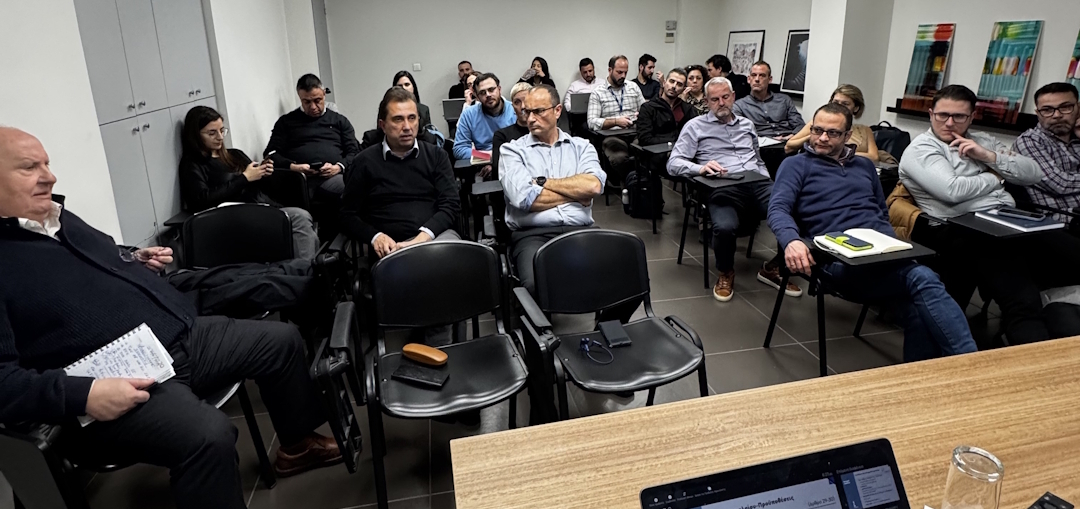
    Η σχετική ημερίδα ήταν η πρώτη της ενότητας με θέμα «Φωτίζοντας το νέο νόμο για τις Ανώνυμες Εταιρείες (Ν.4548/2018) και έλαβε χώρα στις φιλόξενες-κεντρικές εγκαταστάσεις του Ομίλου, στο Μαρούσι.


    Λίγα λόγια για την παρουσίαση

    Ο κ. Κουμεντάκης παρουσίασε το γενικότερο πλαίσιο του πρόσφατου νόμου για τις Ανώνυμες Εταιρείες και προχώρησε στην  παρουσίαση  των σημαντικότερων παραμέτρων του νομοθετήματος. Αξιοσημείωτο είναι πως οι επιμέρους πτυχές του φωτίστηκαν ακόμη περισσότερο μέσα από την σημαντική διάδραση και την ουσιαστική και συνεχή ανταλλαγή απόψεων με τους (εξαιρετικά υψηλού επιπέδου) συμμετέχοντες. Από τη συζήτηση αναδείχθηκαν καίρια ζητήματα, όπως η αναγκαιότητα της άμεσης και εξατομικευμένης προσαρμογής του καταστατικού και της λειτουργίας κάθε μίας ΑΕ στις ανάγκες της ίδιας και των μετόχων της. Ακόμη, διερευνήθηκαν οι παρεχόμενες από τον νέο νόμο ευχέρειες σε μια σειρά από κρίσιμα για τους επιχειρηματίες ζητήματα, όπως:

    • Η προστασία του επιχειρηματία και των «ανθρώπων» του
    • Η υποβοήθηση της διαδοχής
    • Η προσέλκυση (φθηνών) επενδυτικών κεφαλαίων
    • Η προσέλκυση και διατήρηση ικανών στελεχών
    • Η μείωση του λειτουργικού κόστους
    • Η αξιοποίηση της τεχνολογίας


    Λίγα λόγια για τον Όμιλο ARTION

    Ο Όμιλος Εταιρειών ARTION δραστηριοποιείται στο χώρο των λογιστικών, φοροτεχνικών, εξειδικευμένων συμβουλευτικών υπηρεσιών καθώς και υπηρεσιών μηχανογράφησης. Σήμερα, αριθμώντας ήδη περισσότερα από 40 έτη επιχειρηματικού βίου, 200+ έμπειρα/εξαιρετικά υψηλού επιπέδου στελέχη και 1.500+ πελάτες, έχει πλέον καθιερωθεί ως ένας από τους σημαντικότερους ελληνικούς ομίλους (αν όχι ο σημαντικότερος) του είδους του.

    Είμαστε περήφανοι που είμαστε συνεργάτες τους!


  • General Assembly of the SA: The Highest Corporate Body

    General Assembly of the SA: The Highest Corporate Body

    The Board of Directors is in fact of fundamental importance for SAs (Read: The Board of Directors of the SA: Operation, Power, Members).

    Introducing the chapter on General Assembly of SAs, (GA), we will be focusing in the particular importance and value of the highest body of the SA and of course the limitations of its power.

    General Assembly of SAs: The scope of its decisions and powers

    The General Assembly is established by law (: art. 116 law 4548/2018-as previously in force) art. 33 of Codified Law. 2190/1920) as the highest body” of the SA (see Explanatory Report on art. 116, paragraph a, Law 4548/2018). The hierarchical organization of the SA is therefore demonstrated, at the highest level of which the General Assembly is located. It constitutes a collective body, the members of which are, exclusively, the shareholders of the company (in practice: owners of the SA and bearers of the financial risk of its activity).

    The characterization of the General Assembly as the highest body of the SA derives from and is consistent with the nature of the responsibilities granted to it and recognized by the law: The General Assembly “…is entitled to decide on every corporate matter” (: art. 116).

    The General Assembly of the SA has the power and authority, among other things, to elect (and freely recall) the Board of Directors (and the auditors) of the SA. To also exercise control and supervision over the activity of said bodies and persons – who are accountable for the actions of the respective management period. After the end of each corporate year, it approves (or not) their overall management. Therefore, the Board of Directors of the SA functions, in principle, as an executive body of the decisive will of the General Assembly (more precisely: of the majority of shareholders).

    It would not be an exaggeration to note that the General Assembly is responsible for taking the most important (in terms of importance and gravity) decisions regarding the existence, activity and course of the company. Even regarding its dissolution. In fact, regarding certain decisions, its responsibility is exclusive (especially art. 117 – for which our next article).

    Participants and decisions

    The decisions of the General Assembly are, of course, made by the shareholders. Directly linked to the shareholder status is the right to appear (in person or by proxy) and actively participate in its meetings. Shareholders have the opportunity to request information – on the occasion of an upcoming meeting or during the work of the General Assembly. During its conduct, in fact, they have the right to take the floor and ask questions – in the framework predetermined by law. The ultimate purpose of all individual rights of this nature is, in principle, the creation of the necessary conditions for the documented exercise of the right to vote for each of the items on the agenda. It is assumed, of course, that they hold the right to vote either as full owners of their shares or, for example, as usufructuary or pledged creditors. During voting, it is not possible for them to participate, automatically, when they are deprived of the right to vote (e.g., holders of non-voting preference shares).

    In order for the decisions of the General Assembly to produce legal results, the quorum and majority percentages must be met for the adoption of each decision, as provided for in the law and the articles of association. The voting of an individual shareholder (but not the sole or majority shareholder) has no consequences. It simply contributes to the formation of the corporate will, as expressed by the General Assembly. The decisions of the General Assembly, of course, are binding on all shareholders, regardless of whether they abstain, are absent or disagree (art. 116, sub. b).

    The action of the General Assembly (in contrast to the permanent nature of the Board of Directors) is periodic. The body meets – but also exists to take decisions according to the law and its articles of association – only when convened for this purpose. Its convening is sometimes mandatory (:ordinary General Assembly) and sometimes when it is deemed necessary by the circumstances (:extraordinary General Assembly). It is important to provide the shareholders with the opportunity to participate in decision-making without necessarily holding a meeting or even by simply signing the relevant minutes (see art. 135 and art. 136 respectively).

    Separation of Powers Board of Directors & General Assembly of SA

    The management of the SA belongs, first of all, to the Board of Directors. The General Assembly, however, has the ability/power to intervene in the relevant competence of the Board of Directors. However, different views have been developed regarding the extent of this intervention. According to the prevailing (and correct) view, the General Assembly has broad and general competence. Furthermore, (art. 116 and 86) margins for (positive or negative) intervention by the General Assembly in the work of the Board of Directors are recognized.

    It is important, however, to note that the GM’s power of intervention cannot lead to arbitrary usurpation of powers that have been assigned to other corporate bodies. In this context, the complete removal of the Board of Directors’ (legally derived) managerial power is excluded (after all, this would result in the Board of Directors being irresponsible ). But what is the point of such a choice by the GM? It would be simpler for it to choose (and elect) a new Board of Directors, which it would express and which would operate according to its directions (that and its substitute bodies)…

    It is possible to limit the scope of the power of the Board of Directors on the basis of a statutory (and, therefore, general) provision. However, the limitation of the obligations of the members of the Board of Directors, as well as the alteration of their liability regime, are not issues that are amenable to statutory regulation. Any limitation of the duties of the Board of Directors is, however, tolerated by a specific-relevant decision of the General Assembly. Such a decision, usually, will concern a specific act (or unit of competences) of the Board of Directors. Regardless, however, of any theoretical concerns, the influence of the decisions of the Board of Directors should be considered, as a rule, a given, as the majority shareholders are the ones who elect – and maintain in power – the members of the Board of Directors. They, in turn (the members of the Board of Directors), express and defend the interests of the majority shareholders, which, as a rule, they promote. Sometimes even before the corporate equivalents.

    It is possible that the articles of association require prior information and/or consent or (ex post) approval of the General Assembly for the performance of specific management actions by the Board of Directors or substitute bodies. Especially when decisions are to be taken that by their nature create risks for the company (such as the transfer/sale of significant assets). It is accepted, and rightly so, that the General Assembly is not only entitled but also obliged to intervene in defense of the interests of the shareholders (Greek Commercial Code 2263/2003).

    The decision-making by the General Assembly beyond the limits of its authority does not create any obligation of compliance or commitment towards the Board of Directors. Of course, given the fluidity of the relevant limits, the scope for shareholder intervention must be assessed on a case-by-case basis and always in accordance with the prevailing circumstances. Greater freedom of intervention by the General Assembly in matters of corporate organization is recognized, provided that it is an unlisted company. On the contrary, in listed companies, given the asymmetry of interests between the General Assembly and the Board of Directors, the involvement of the General Assembly is understood in decisions that (in terms of subject matter and importance) escape the current management of the Board of Directors.

    Binding Force of General Assembly Decisions – Conditions

    The decisions of the General Assembly produce, according to the aforementioned, binding results and develop legal consequences for all shareholders of the SA. And this, regardless of whether the shareholders participated or not in the crucial meeting (and/or vote). Regardless, in fact, of whether they voted for or against.

    Binding force, however, is produced by the legal decisions of the General Assembly. Legality is examined at two levels: (a) compliance with the legal decision-making process and (b) compliance of the content of the decision taken with the law and the statutes.

    In particular, the General Assembly takes valid decisions if it has been convened, constituted and decided in accordance with the legal forms and the (possibly existing more specific) statutory provisions. In the event that a relevant defect is found, the decision will be voidable. This practically means that it will produce, normally, legal effects, until it is voided by a final court decision (: art. 137).

    As for its content, in the event that the decision taken contradicts the law and/or the statutes, it will be invalid (art. 138 – however, the possibility of curing the invalidity is provided for under §4 of the same article).

    Shareholders – as already mentioned – have the possibility to make a decision without a meeting. Either remotely at the General Assembly using electronic means (art. 135) or through the countersigning of minutes without a meeting (art. 136). Similarly, the decisions of the previous paragraph are also binding on dissenting shareholders. However, in the case of countersigning of minutes, for the decision to be valid, it is required that it bear the signatures of all shareholders.

    Finally, in the event that more than one class of shares has been issued in the SA, for the legal adoption of certain decisions by the General Assembly (e.g. to increase or decrease the share capital), relevant approval is required from the special meeting of the class of shareholders affected by the specific decision. Similarly, a decision of the special meeting is required to be taken by the shareholders representing preferred shares upon a decision of the company to abolish or limit their privilege (art. 38 §7).

    There is no doubt that the General Assembly of a company is the highest body of the company. However, this does not mean that it can abolish or replace its other bodies. It also does not mean that it can operate without rules. Moreover, its operation and decisions are subject to judicial review for their legality. We must be particularly careful in this regard at all stages: convening, conducting, decisions. However, for its exclusive competence, decisions, in our next article.


    Stavros Koumentakis
    Managing Partner


    P.S. A brief version of this article has been published in MAKEDONIA Newspaper (January 14th, 2024).


    Disclaimer: the information provided in this article is not (and is not intended to) constitute legal advice. Legal advice can only be offered by a competent attorney and after the latter takes into consideration all the relevant to your case data that you will provide them with. See here for more details.

  • Violations by members of the SA Board of Directors

    Violations by members of the SA Board of Directors

    Today we are focusing on Article 177 of Law 4548/2018 on (criminal) “offenses by board members”, which aims, among other things, to safeguard the company’s capital and the interests of creditors.

    The provision in question criminalizes five different behaviors with a common cohesive element being the status of the perpetrator: any (even non-executive) board member. We categorize the behaviors into two sections:

    (a) The first section (§§ 1, 2 & 5) includes: (aa) the primary obligation to draw up and approve essentially accurate, non-misleading (see our related article of 17.03.2022) and by the law, in terms of their content, financial or consolidated statements of the company, management reports (which are not included in the financial statements) and any other annual report required by law and (ab) the secondary prohibition of distribution of profits or other benefits to shareholders of the company or a third party, in cases where the primary (under aa ) duty of veracity, accuracy and compliance with the law is not respected, especially when the statements in question have not been drawn up, etc.

    (b) The second section (§§ 3 & 4) includes: (ba) the prohibition of the knowing acquisition of redeemable shares or of causing the acquisition by the company of its own shares or shares of its parent company or other titles of its parent company, in violation of the law ( art . 39, 48, 49, 52 & 57) but also (bb) the prohibition of granting an advance, loan or guarantee either by charging the company, with the aim of acquiring its shares by a third party, or by charging its subsidiary, in order for a third party to acquire shares of its parent company, in violation of the law (art. 51).

    Any member of the Board of Directors who commits any of the above offenses (whether of the first or the second section) is severely punished: with imprisonment (up to 5 years) and with a fine from 10,000 to 100,000 euros.

    We consider it important to underline the evaluative asymmetry (now antinomy) which is found in this case between SAs on the one hand and Limited Liability Companies (art . 60 n. 3190/1955) and Private Capital Companies (art. 119 n. 4072/2012) on the other:

    the essentially similar acts of the first section (aa, ab), in the case of the SA are punished and even most severely, while in the cases of the LLC and the PPC they are not punished even in the least – they were misdemeanors which were abolished in their entirety.

    by no means are we insinuating a preference towards LLCs and PPCs, where, in the end, the provisions of the common Criminal Code apply.

    Nor do we give in to the temptations of an unconditional criminal intervention in the other corporate forms or an unjustified repeal of art. 177: it constitutes our moral and political defeat to comply (or not) with the law simply out of fear.

    The legislator, however, must be consistent (: not to send contradictory messages), fair (: to apply, in this case, the principle of equality) and alert (: to realize when it is skewed): otherwise, it negates the reason for the existence of the provisions that establishes and proves ineffective and unfair in regulating such a complex phenomenon as entrepreneurship.

    George Karanikolas
    Senior Associate


    P.S. A brief version of this article has been published in MAKEDONIA Newspaper (May 22nd, 2022).


    Disclaimer: the information provided in this article is not (and is not intended to) constitute legal advice. Legal advice can only be offered by a competent attorney and after the latter takes into consideration all the relevant to your case data that you will provide them with. See here for more details.

  • The Extraordinary Share Capital Increase

    The Extraordinary Share Capital Increase

    The increase of an SA’s share capital has already been the focus of a previous article. We had the opportunity, there, to point out the importance of the capital increase as a way/means of financing the SA; to also refer to the distinctions of the increase and, among others, to their regular or extraordinary nature. The regular capital increase is the one decided by the General Assembly with an increased quorum and majority. The extraordinary increase is the one decided either by the General Assembly (with a simple quorum and majority) or by the Board of Directors. Regarding the extraordinary increase, see right bellow:


    The changes brought about by Law 4548/2018

    The possibility of an extraordinary share capital increase was also provided for under the previous regime (Article 13 of Legislative Decree 2190/1920). As, however, it is pointed out in the Explanatory Report of Law 4548/2018 (on Article 24), the regulations previously in place were reformed. The three most important changes were the following:

    (a) The first differentiation concerns the quantitative limits for the increase of the share capital, by the Board of Directors and the General Assembly, which is set by the law: The relevant quantitative limits are increased.

    (b) The second differentiation concerns the abolition of the prohibition of an extraordinary increase, as long as there are significant amounts of reserves. [As pointed out in the Explanatory Report of Law 4548/2018, such a prohibition is not considered necessary for the protection of the share capital. In addition, a relevant prohibition is not even provided for by the Corporate Directive 2017/1132/EU (-with the regulations of which the law on SAs complies)].

    After all, the business opportunities that the SA can benefit from, through the flexibility provided by the extraordinary increase, are clearly essential even for strong SAs with potentially significant reserves.

    (c) The third differentiation concerns the unorthodox, older regulation that the extraordinary increase does not constitute an amendment to the articles of association. It is now expressly provided that the extraordinary increase of the share capital, regardless of the body that decides on it, constitutes an amendment to the articles of association. It is further clarified that it is not subject to administrative approval (Article 24 §4). The specific provision of the law clarifies the legal nature of the extraordinary increase. Since it is provided (and rightly so) that it constitutes an amendment to the statute, the body that decides should amend the relevant articles of the latter and draw up its new, codified, text. Afterwards, it will have to satisfy the necessary publicity formalities in the Business Registry, which are of a constitutive nature. These are obligations that the body that made the decision (General Assembly or Board of Directors) did not carry under the previous regime: the registration in the Business Registry was accepted to be of a declarative character.

    As for the rest, in terms of its legal nature, the extraordinary increase is the same as the ordinary.


    Extraordinary Increase By Decision of the Board of Directors

    In principle, the corporate body responsible for increasing the share capital is the General Assembly (Article 117 §1 para. a’ and §2 para. a). However, the General Assembly, compared to the Board of Directors, is characterized by less flexibility and speed, in terms of convening and taking a decision – especially in those cases where there is a wide or even significant dispersion in the share capital of the SA. In order to speed up the relevant procedures and deadlines, the Board of Directors is granted, under conditions, the power to increase the company’s capital. Thus, the BoD, as a more flexible (compared to the General Assembly) corporate body, can more quickly decide (as well as implement) an increase in the SA’s share capital. And this, taking advantage of favorable circumstances, covering pressing, time-consuming needs and/or choosing the optimal sale price of the shares.

    However, the possibility of an extraordinary increase in the share capital by the Board of Directors requires the fulfillment of specific conditions; depending on the provision of the relevant authority by the statute or the General Assembly of the company. Specifically:

    Authority Given By The Statute

    If the relevant possibility is provided by the articles of association, the Board of Directors has the right by its decision to increase the capital, partially or fully, by issuing new shares (Article 24 §1). This possibility is subject to time and quantitative limitations.

    Time limit: The duration of the (statutory) authorization to the Board cannot exceed five years from the establishment of the company. The relevant provision may exist in the SA’s initial (at the time of its establishment) statute or, alternatively, in a subsequent amendment thereof.

    Quantitative limit: The share capital increase decided by the Board of Directors cannot exceed three times the initial capital of the SA.

    Therefore, within the specific time and quantitative limitations, the Board of Directors can, legally, decide on one or more consecutive increases of the share capital, together with their relevant more specific conditions (e.g. sale price of the new shares). The relevant decision of the Board of Directors is taken by a majority of 2/3, at least, of all its members.

    Authority Given By The General Assembly

    The authority of the Board of Directors to increase the share capital can be provided, in addition to the articles of association, by the General Assembly of the SA (Article 24 §1, para. b). In this case the General Assembly decides with an increased quorum and majority (Article 130 §3). The relevant decision is submitted to the Business Registry.

    The time and quantitative limitations, referred to above, apply, with some variations, also in the case of the granting of authorization by the General Assembly.

    Time limit: In the case of the authorization of the Board of Directors by the General Assembly, its authority to decide the capital increase cannot exceed five years as well. The five-year period in question, however, starts from the granting of the authorization to the Board by the relevant decision of the General Assembly (and not from the establishment of the SA). Noteworthy, however, is the law’s provision that “…this authority of the board of directors can be renewed by decision of the General Assembly for a period of time that cannot exceed five years for each granted renewal.” (article 24 §1, para, c΄). The five-year time limit starts, in this case, from the time point of each renewal.

    Quantitative limit: The quantitative limitation remains similar to the case of the authority granted from the statute. With an important difference, however: the amount of the increase that the Board of Directors is entitled to decide cannot exceed three times the paid-in capital, which exists on the date the relevant authority was granted.


    Extraordinary Increase By Decision of the General Assembly

    The decision regarding a regular increase of the share capital is taken, as we have already pointed out, by the General Assembly, which decides with an increased quorum and majority.

    However, the General Assembly is able, also under conditions, to decide an extraordinary increase of the SA’s share capital. This possibility also aims, in this case, to facilitate the relevant procedure (Article 24 §2). A special difference of the extraordinary, in relation to the regular, increase is the fact that the General Assembly decides the increase with a simple quorum and majority (against regular increases).

    Also in the case of the extraordinary increase of the share capital by the General Assembly, the fulfillment of specific conditions is obligatory. First of them: the relevant statutory provision. There are, however, further time and quantitative limitations.

    Time limit: In the case of the extraordinary increase of the share capital by decision of the ordinary General Meeting, the time period for exercising the power to increase cannot exceed five years from the formation of the SA as well. However, no provision is made for the possibility of renewing the authority of the General Assembly.

    Quantitative limit: The increase of the share capital cannot exceed eight times the initial capital.


    Parallel competence of the General Assembly & Board of Directors; Prohibition of Disclosure of the Possibility of Extraordinary Increase

    The legislator adopts two more options regarding the extraordinary increase of the share capital.

    The first concerns the recognition of the parallel possibility of an extraordinary increase by both the Board and the General Assembly (Article 24 §5). In this (unusual-indeed) case, however, it is necessary to meet the, as the case may be, already mentioned conditions. Also: the individual time and quantitative limitations are examined separately for each case of increase.

    The second concerns the protection of third contracting parties (Article 24 §3) from the possible abuse of such an extraordinary increase. Specifically: it would not be unprecedented (quite the contrary) to mislead third parties or to have their expectations disappointed by the promotion of the power of the individual bodies of the SA to decide on an extraordinary increase of the share capital; a power that would possibly never be exercised by the corporate bodies, as the case may be.

    In order to avoid any negative consequences of the extraordinary increase, the legislator provides that it is prohibited for SAs, whose articles of association provide for the possibility of an extraordinary increase “…to state in any form, advertisement, publication or other document, as capital, the amount up to which the board of directors or the General Assembly is entitled… to issue new shares.” (article 24 §3).


    Extraordinary Vs Ordinary Share Capital Increase

    We have already seen that the General Assembly can decide on an extraordinary increase of the company’s share capital with a common (and not increased) quorum and majority. We have also seen that the Board of Directors can decide, very quickly, on an extraordinary increase with a majority of 2/3 of its members; in fact, without the need to convene a General Assembly.

    But what do the specific powers mean in prectice?

    The General Assembly, with reduced percentages, is entitled to increase the company’s share capital up to eight times the initial amount. In other words: a shareholder who directly or indirectly owns ½ of the share capital + one share has the right to decide to increase it – up to eight times the initial amount. What if they have the necessary funds while the other (co)shareholders do not? They have the power to significantly expand their own shareholding and dramatically reduce the shareholding of other shareholders – even below critical percentages.

    Under the condition of reaching the quorum of the General Assembly (1/2 or 1/5 of the total), a shareholder holding 13.34% of all shares is entitled, subject to conditions, to take a decision on an extraordinary increase up to eight times the initial of capital. In this case, as long as they have the necessary funds, a small minority shareholder can become a majority shareholder.

    On the other hand, the implementation of an extraordinary increase in the share capital by the Board of Directors may result in the rapid achievement of a specific business goal. As the convening of a General Assembly is not required, the relevant process can be accelerated at least during its convening deadlines – in the cases where we are not talking about a General Assembly where all shareholders are present. Such a fast process can prove to be valuable in cases where very quick actions are required – e.g. capitalizing on a significant business opportunity.

    Accordingly, however, a shareholder who (regardless of the number of shares the shareholder holds) has (or can convince or join) 3/5 of the members of the Board of Directors, can decide an extraordinary increase up to three times the share capital. And if, at the same time, they have the necessary funds to cover the increase, but the other shareholders do not, they can easily become, once and for all, a major shareholder or even a majority shareholder.


    Taking advantage of the (potential) opportunity for an extraordinary increase in share capital can prove to be a valuable tool for quickly achieving a specific business goal; for taking advantage of an important business opportunity. It is possible, however, at the same time, for it to prove to be a useful tool (or, as the case may be, dangerous – depending on the perspective) for the restructuring of shareholdings, the change of critical majorities and even the surrender of the reins of the company and its management itself.

    The introduction, therefore, of the specific discretion, the composition of the share capital and the Board of Directors itself require special attention and vigilance: they can prove to be decisive in the direction of the achievement of legitimate or illegitimate goals.

    Stavros Koumentakis
    Managing Partner


    P.S. A brief version of this article has been published in MAKEDONIA Newspaper (April 2nd, 2022).


    Disclaimer: the information provided in this article is not (and is not intended to) constitute legal advice. Legal advice can only be offered by a competent attorney and after the latter takes into consideration all the relevant to your case data that you will provide them with. See here for more details.

  • The criminal liabilities in the Société Anonyme

    The criminal liabilities in the Société Anonyme

    Articles 176-181 of Law 4548/2018 standardize the conditions under which criminal liabilities are established against those who operate within an SA.

    Although this is a particularly widespread corporate type, which would justify similar rates of publication of articles and jurisprudence of criminal interest, the rates are nevertheless remarkably low.


    Within Law’s 4548/2018 criminal provisions: first approach

    The limited practical application of the provisions in question does not mean that the resulting criminal responsibilities are of minor importance.

    The misdemeanors provided for in articles 176 and 177 of Law 4548/2018, for example, threaten a prison sentence that reaches the upper limit of five years, while the suspension of the execution of a sentence of more than three years constitutes a more complex judicial judgment.

    Moreover, the stigma that inherently accompanies any sentence should not be overlooked: in the light of professional reputation, a potential criminal conviction “undermines” the development or even the survival of the legal person, even if it is imposed on a natural person.


    Criminal provisions outside of Law 4548/2018: indicative enumeration

    Criminal responsibilities also arise outside of Law 4548/2018. The source of such provisions is, primarily, the Criminal Code. These are acts of grave disrespect against legal goods, especially ownership, property, privacy, and memoranda.

    At the same time, the issue of criminal liability arises in cases of tax and insurance debts of an SA.

    Finally, it is possible to encounter a case of application of provisions which prohibit the laundering of proceeds from criminal activities and come with heavy sanctions.


    The ideological starting point of the author of Law 4548/2018

    The author of Law 4548/2018 is concerned that there is no reason to “create special criminal treatment for SAs”. The fact, therefore, that the criminal provisions of Law 4548/2018 are not justified on the merits should not surprise us, however it does displease us.

    Also, while the legislator declares as their purpose the “reformation of the law of the SA with new legislation”, as far as criminal responsibilities are concerned, they limited themselves to a “slight reformation”, as they claim, of the previous framework.

    It is therefore an open question whether with their choices respond to modern needs, for example, to completely transparent corporate operation and circulation of capital flows.

    In this light, given that the interest goes beyond narrow intra-corporate equity interests, one could evaluate the scope of articles 176-181 of Law 4548/2018, the number of threatened penalties and their place in a wider regulatory framework of a socially just business.


    Is a “plethora” of penal regulations a solution?

    Our position certainly does not advocate a “plethora” of provisions of a penal nature. The democratic criminal legislator knows the legitimate limits of the criminalization of acts, which must constitute the last means of achieving an end. The limits of the present article do not allow us to discuss other means.

    The step towards a Société anonyme involves significant non-financial risks. Those interested must be fully informed: “anonyme” (for the company) does not mean “painless” (for the natural person).

    George Karanikolas
    Senior Associate


    P.S. A brief version of this article has been published in MAKEDONIA Newspaper (March 6th, 2022).


    Disclaimer: the information provided in this article is not (and is not intended to) constitute legal advice. Legal advice can only be offered by a competent attorney and after the latter takes into consideration all the relevant to your case data that you will provide them with. See here for more details.

  • The Articles of Association of the Société Anonyme…

    The Articles of Association of the Société Anonyme…

    The Articles of Association of the Société Anonyme…(…the scope, the content, the options of the new Act and the compulsory adjustments)


    I. By way of introduction

    The Articles of Association of the Société Anonyme are (known to be) its most important document. The Articles of Association record (and regulate) very important, identifying elements of its existence and operation. The name, the purpose, the duration, the capital, the shares, the company’s bodies, the rights of the shareholders, its financial statements, its dissolution and liquidation etc. are some of them.

    Often, the founders of the Société Anonyme resorted to prefixed by the notaries texts, as it was always the privilege of those who had written them. As a rule, no lawyer expressed any view. Until the non-excellent relations between the shareholders occasionally emerged to the surface.

    In the course of time, however, things began to change: Entrepreneurs were often faced with problems which they found that could have been avoided if they had made provisions in their Articles of Association. Further: Business managers understood, over time, the value of counseling. Thus, more and more people go to their legal advisors to draft (and / or reformate) their company’s Articles of Association.


    II. The scope of the Articles of Association and of the statutory provisions

    Since the fees of notaries depend (among others) on the extent of their contracts, we have been addicted to notarial acts – Articles of Association of Société Anonymes which are (to a large extent) a copy of the relevant law. However, the senior (former) Law 2190/1920 had dozens of interventions in his hundred-year history. What happened every time the law was changed? There was a need for a modification of the Articles of Association (in accordance with the law) and, of course, new fees for the professionals involved. There are, unfortunately, still Articles of Association that have nothing to do with the current institutional framework. Containing completely obsolete provisions.

    One would have expected that this would mean that the Articles of Association would end up being brief. That they would end up containing what was absolutely necessary and, as for the rest, they would refer to the law (there was also a legislative provision in law 2190/1920 which was applicable until 31.12.2018). On the contrary: The Articles of Association are, almost indefinitely, large, even when we proposed (sometimes with pressure) to the founders the short version: That text, which contains only the minimum of what the law requires without copying all of its provisions. The choice of founders was, basically, the full version: A text that copies the law’s regulations and does not “take up” only the essential ones. The causes are varied: Basically, however, the need to refer to the Articles of Association for the issues they were interested in, and not to the law or even to their legal advisor.


    III. The new law (4548/2018) for société anonymes with reference to the Articles of Association: Notarial deed vs private document (agreement).

    The new law on société anonymes is innovating on various issues. One of the most interesting (and business-friendly) options is that a private document, not a notarial act, is sufficient for the establishment of a société anonyme. It is sufficient provided, on the one hand, that there shall not be transferred to it assets any element for the transfer of which a notarial deed is required (e.g. immovable property) and, on the other hand, that standard Articles of Association be adapted. In the latter case, the establishment of the Société Anonymes is completed in a Single Entry Point services. (essentially the General Commercial Registry (GEMI) where its seat is located).


    IV. The essential elements of the Articles of Association

    The provision of art. 5 § 1 L. 4548/2018 provides for the minimum provisions that must be contained into the articles of association of the société anonyme. These must at least include: (a) the name and purpose; (b) the seat; (c) the duration, if not indefinite; (d) the amount and method of payment of the share capital; (e) the type of shares, the number, the nominal value and the issuance; (f) the number of shares in each class, if there are more classes of shares; (g) the conditions and procedure for converting shares to the bearer into registered; (h) the convocation, establishment, operation and responsibilities of the Board of Directors; (i) the convocation, establishment, operation and responsibilities of the General Assemblies; (i) the auditors; (k) shareholder rights; (l) the annual financial statements and the appropriation of profits; (m) the dissolution of the company and the liquidation of its assets; (n) the amount of subscribed capital that is payable at the time of incorporation.

    Nevertheless: The Articles of Association of the company are not required (Article 5 § 1 of Law 4548/2018) to contain even those of the abovementioned provisions which merely repeat the provisions of the law (unless allowed derogations from its content are entered into force).

    Under the above, the Articles of Association of a Société Anonyme could be limited to the following provisions:

    (a) the company name and purpose;

    (b) the seat;

    (c) the amount and the method of payment of the share capital;

    (d) the type of shares, the number, the nominal value and the issuance;

    (e) the number (or minimum-maximum number) of the members of the Board of Directors;

    (f) the amount of the share capital payable at the time of its incorporation.

    In other words: Where the Articles of Association of the Société Anonyme contain the above six (6) provisions they are a complete Statute. But are we (lawyers and businessmen) ready to go through such Articles of Association, even when we are talking about a single-member Société Anonyme(where there are no conflicting interests)?


    V. The options that the new law offers

    The new law provides businesses with a variety of options to regulate critical issues relating to their operation as Société Anonymes.

    It takes advantage of technology as well as modern, international, tools of the law of Société Anonymes.

    Some of them:

    The elements of the company name of Société Anonymes and their duration.

    The way to cover their share capital, contributions in kind, the possibility of partial coverage and payment, the types of its share capital increase.

    The options of reduction and amortization (!) of the share capital.

    The types of titles and their sub-themes and attributes (shares, bonds, warrants, extraordinary and common founders’ shares). In particular: the types of shares [common and preference (with many kinds of utilizable and functional privileges), redeemable, reserved (with also interesting potential commitments – including drag and tag along right), the option right.

    The minority’s right to request the redemption of its shares by the majority and the right of the majority to request the redemption of the minority shares.

    The management of the issues of the acquisition of treasury shares. Issues related to the election, operation, composition of the Board of Directors (or even to the option of having a single Consultant-Manager!). Managing conflicts of interest.

    The management of remuneration-relating issues of the Board of Directors and of the Managing Directors.

    Issues relating to the invitation (even by email!) and convening the General Assembly’s meeting (even remotely!), voting (even by e-mail or postal vote!), taking decisions without a meeting.

    Minority rights and how to manage them.

    The right to audit.

    The shareholders’ associations. The distribution of profits. The minimum dividend. The provisional dividend. The dissolution, liquidation and revival of the company.

    The topics vary. The opportunities are many. The choices may be tedious but, in any case, critical for businesses and entrepreneurs.


    VI. The need of adaptation of the Articles of Association of ALL Sociétés Anonymes

    The provision of art. 183 § 1 L. 4548/2018 can not be challenged: The Articles of Association of the existing sociétés anonymes must be adapted to the provisions of the new law as soon as possible.

    It is clear that detailed information is required from (the proper) legal advisors, jointly assessing the data and the possibilities of the new law and (in particular) adapting to the needs of each business entity and activity.

    Therefore, be alert!

    stavros-koumentakis

    Stavros Koumentakis
    Senior Partner

    Υ.Γ. Part of this article has been published in MAKEDONIA Newspaper (January 6th, 2019)

    articles of association

  • Private Company vs Limited Liability Company: Which is the best way to go?

    Private Company vs Limited Liability Company: Which is the best way to go?

    Ι. Preamble

    “Prisoner’s dilemma”: A standard example of a game analysed in game theory, the study of mathematical models of strategic interaction among rational decision-makers. This dilemma, as well as this theory, probably does not regard everyone.

    Other dilemmas seem to be more familiar:

    “Oh but I think I am in trouble, don’t know if I want to choose Kiki or Koko. I do love Kiki but I also like Koko”. Us elders most likely have shared the dilemma of singers Spiros Koronis and Filandros Markou.

    The Private Company (PC) was introduced in the Greek legal system in April 2012, while Société Anonyme and Limited Liability Companies still existed.

    The boundaries between a PC and an SA were (and still are) pretty clear.

    This is not the case with the boundaries between a PC and an Limited Liability Company.

    Or is it?

    And in reality: Which was/is the best choice?

    The (pretty) “new” PC or the “already tested” Limited Liability Company?


    ΙΙ. The legal status of a PC and an Limited Liability Company

    A PC and an Limited Liability Company is somewhere between a public company limited by shares (e.g. an SA) and partnerships (e.g. a General Partnership and Limited Partnership).

    Both PC and Limited Liability Company are considered to be closer to public companies limited by shares. But they still have many similarities with partnerships. Those elements that make them resemble partnerships are either imposed by law or can be introduced with the company’s articles of association.

    What is certain is that those two companies have some distinct differences. A comparative overview will securely lead us to which one of the two is superior.


    ΙΙΙ. Establishment:

    1. Regarding PC

    A PC is established and amended with a private document. The speed and low cost of establishing and amending it is one of the main reasons why it is, at least at a first glance, so appealing.

    But the “private document rule” does have some exceptions.

    A notarized document is mandatory for a PC in some specific cases. In case, for example, that such is required by a specific law or when specific assets are contributed to the company, whose transfer requires a notarized document (e.g. immovable property or rights in rem in immovable property). Additionally, a notarized document can be chosen by the company’s founders or founder (when talking about a single member PC) (article 49 act 4072.2012).

    2. Regarding Limited Liability Company

    Until recently, the establishment and all amendments of a PPC could only take place with a notarized document (article 6§1 act 3190/1955). This rigidness of PPC was, on its own, a good enough reason to avoid this company type.

    Relatively recently (article 2 §2 ν. 4541/2018) par. 1 of article 6, act 3190/1955 was amended. This amendment introduced allowed the establishment of PPC either with a private document or a notarized one.

    A notarized document is required only in specific cases. When, for example, such a document is required by a specific law or when specific assets are contributed to the company, whose transfer requires a notarized document (e.g. immovable property or rights in rem in immovable property). Additionally, a notarized document can be chosen by the company’s founders or founder (when talking about a single member Limited Liability Company).

    A private document (and not a notarized one) is deemed enough when the official model articles of association are adopted. In this case, though, the establishment of the LLC can be realised by any “one stop shop”, as such is appointed by law (act 4441/2016). Meaning: (a) by the Business Registry departments of the Chambers of Commerce, (b) by “one stop shop” notaries, (c) online, in e- “one stop shop” (which, for the time being, only works for PC companies) -and not exclusively before a notary (1 Common Ministerial Decision No 63577/2018).

    What is, though, the main issue? In cases where the official model articles of association must be used, they must be used exactly as they are given, with no alterations. If the official model articles are altered, and the founders choose to establish the company with a private document, this will constitute a ground for the LLC’s invalidity.

    Therefore, in cases where an LLC’s founders want to deviate from the official model articles of association, a notarized document is the only option.  The relevant burden on the founders (timewise and moneywise) can simply not be avoided.

    3. Conclusion

    Based on what we established above, we come to the conclusion that, as far as the establishment of the two companies is concerned, PC is the clear winner. Therefore:

    Private Company-Limited Liability Company: 1-0


    ΙV. Capital:

    1. Regarding PC

    PC’s capital is determined by its partners without limit, it can even be a zero capital. Its partners can partake in the company with capital, non-capital contributions or guarantee duties (article 43 §3 act 4072/2012).

    2. Regarding Limited Liability Company

    LLC’s capital is determined by its partners without a limit (lowest or highest). It is formed either with cash or with contributions in kind (article 4 § 1 act 3190/1955).

    Previous version of the article required a minimum capital deposited in the LLC. It started (:1995) with a requirement of a minimum capital deposited of 200.000 drachmas. Consecutive increases had it reach 18.000€ (:2002). Consecutive decreases followed. Today, the requirement for a minimum capital deposited has been abolished (article 3 § 9 act 4156/2013). But LLC’s capital cannot be zero.

    3. Conclusion

    According to the above, we come to the conclusion that, as far as capital is concerned, at least in a theoretical level PC seems to prevail, since its capital can be zero. On the other hand, an LLC can be established with a capital of 1€. So we should probably call it a tie – no company type prevails, no point is appointed. The score remains:

    Private Company-Limited Liability Company: 1-0


    V. Partner’s contributions:

    1. Regarding PC

    We have already mentioned (above under IV.1) that several kind of capital contributions can be made in a PC. A partner can participate in a PC’s capital by contributing money (:capital contributions). Additionally, they can participate by making non-capital contributions or by having guarantee duties (article 76 § 2 α΄ act 4072/2012). A necessary precondition in order for someone to participate in a PC is to acquire one or more shares (article 75 § 1 α΄ act 4072/2012). Each share represents only one type of contribution (article 76 § 2 b΄ act 4072/2012).

    As a result: it is possible that a PC has received no capital, but only guarantees and non-capital contributions. The latter (guarantees and non-capital contributions despite that the have a value) they can render PC’s capital a zero-capital.

    But which are the non-capital contributions and what are the guarantees?

    The non-capital contributions are those contributions that cannot constitute capital contributions. Such are claims that derive from an undertaking of an obligation to execute works or to provide services. The value of these contributions undertaken when the company is established and/or afterwards, is determined in the company’s articles of association and is freely estimated by the partners (article 78 §§ 1 and 2 act 4072/2012).

    The guarantee duties undertaken by a partner mean that this partner has a guarantee duty for any company debt owed to any lender. The partner’s liability entails covering the company debt (the balance of capital, interest and other charges) up to the amount determined in the company’s articles of association. In this case the partner is liable before the lenders as if they were the principal. The lenders can turn directly against the partner. There is no preliminary procedure. It is also not a requirement for the lenders to first turn against the PC to prove that the company cannot pay them off, before they turn against the partner burdened with a guarantee duty.

    The option given for a non-capital contribution and of a contribution made by undertaking a guarantee duty makes it possible for someone to become a partner in a PC, even if they do cannot or do not want to make a capital contribution.

    The provision allowing for non-capital contributions or contributions made by undertaking guarantee duties makes a PC resemble a partnership. By providing these options, the partners are free to choose if they will be more like a partnership or an SA.

    2. Regarding Limited Liability Company

    There is no provision for non-capital contributions or contributions made by undertaking guarantee duties in an LLC. An LLC’s partners are obligated to contribute money. Alternatively: they can make contributions in kind, but they must be material.

    Even in a case were one of the LLC partners undertakes the obligation to work for the company or undertakes the obligation to pay company debt, they will not be looking at receiving company shares because of those reasons.

    3. Conclusion

    Things are simple. A PC offers the option of making non-capital contributions or contributions by undertaking guarantee duties. LLC does not.

    PC prevails. The score now clearly is:

    Private Company-Limited Liability Company: 2-0


    VI. Decision-making:

    1. Regarding PC

    Each company share carries the right for one vote (article 72 § 2 α΄ act 4072/2012). This means that PC’s partners form their decisions (in an assembly or not -under the provisions of the articles of association and of the law) with the majority of the votes/majority of the shares.

    2. Regarding Limited Liability Company

    LLC is more complex.

    According to article 13 of act 3190/1995: “Unless otherwise provided by law, the decisions are made by the majority of the partners, provided this majority is formed by more than the half of the partners, representing more than half of LLC’s capital”. This means that, in order for a decision to be made in an LLC, two majorities are required: of capital and partners.

    This legal requirement quite often creates significant problems. Even in cases where a partner has more than half (even more than 99%) of the capital, they are not entitled in making decisions. A necessary requirement for the decision to be made is for the partners who could have a minimum participation to agree with the partner holding the majority. In case that the first are outnumbering the majority partner(s), they have the opportunity to even extort, under the threat that they will oppose to a specific proposal. This fact renders LLC dysfunctional. It is quite possible that in some cases it will be impossible to reach a decision, when there are opposing partners who, even though they hold the minority share of the LLC’s capital, still outnumber the majority holder(s).

    3. Conclusion

    It is also clear. PC prevails as far as decision-making is concerned. The score now is:

    Private Company-Limited Liability Company: 3-0


    VΙI. Partner’s social security contributions:

    1. Regarding PC

    One more advantage of PC when compared with LLC is the lower social contributions owed by PC to the National Social Security Entity. The relevant issues are clarified in the National Social Security Entity’s circular no. 21/22.4.2019. Briefly:

    The partners of multi-membered PCs do not have to have a social security. The partners have the option of being insured according the provisions of the Self-Employed Workers’ Insurance (article 116 § 9 b΄, act 4072/12). Only the partner of a single-member PC must be insured accorrding the provisions of the Self-Employed Workers’ Insurance (article 116 § 9 a΄, act 4072/12).

    Nonetheless, PC’s managers must be insured. To be more precise, the following persons must be insured according to the provisions of the Self-Employed Workers’ Insurance (article 116 § 9 a΄, act 4072/12): (a) the partner of the single-member PC who is also its manager, (b) the partner of the multi-member PC who is also its manager, (c) PC’s manager who is not a partner, but has been appointed as the manager by the company’s articles of association or with a decision made by the partners.

    2. Regarding Limited Liability Company

    In contrast with PCs, LLC’s partners must be insured (article 39, act 4387/2016). Respectively, LLC’s partners who are also the company’s managers in exchange for a fee, are obligated to make relevant to their fee social security contributions as per article 38, act 4387/2016. Lastly, LLC’s manager, when they are not also a partner, they do owe social security contributions for the fees they receive, also according to article 38, act 4387/2016.

    3. Conclusion

    The financial burden imposed on LLC partners are clearly more significant than those imposed on PC partners. PC prevails here as well. The score is:

    Private Company-Limited Liability Company: 4-0


    VIΙΙ. Getting back in business

    1. Regarding PC and Limited Liability Company

    Both PC and LLC can be dissolutioned, after, among others, a decision made by the partners, because the company’s duration expired and because of bankruptcy. In both those cases, both company types can get back in business, after a unanimous decision of their partners (article 105 §7, act 4072/2012 and article 50a act 3190/1955). The difference between the two is that a PC can get back in business even after the process of distribution of its assets has started. This cannot happen in LLCs.

    2. Conclusion

    PC prevails here as well.

    The final score is overwhelmingly in favour of PC:

    Private Company-Limited Liability Company: 5-0


    IX. The trust of the market in PCs and Limited Liability Companies

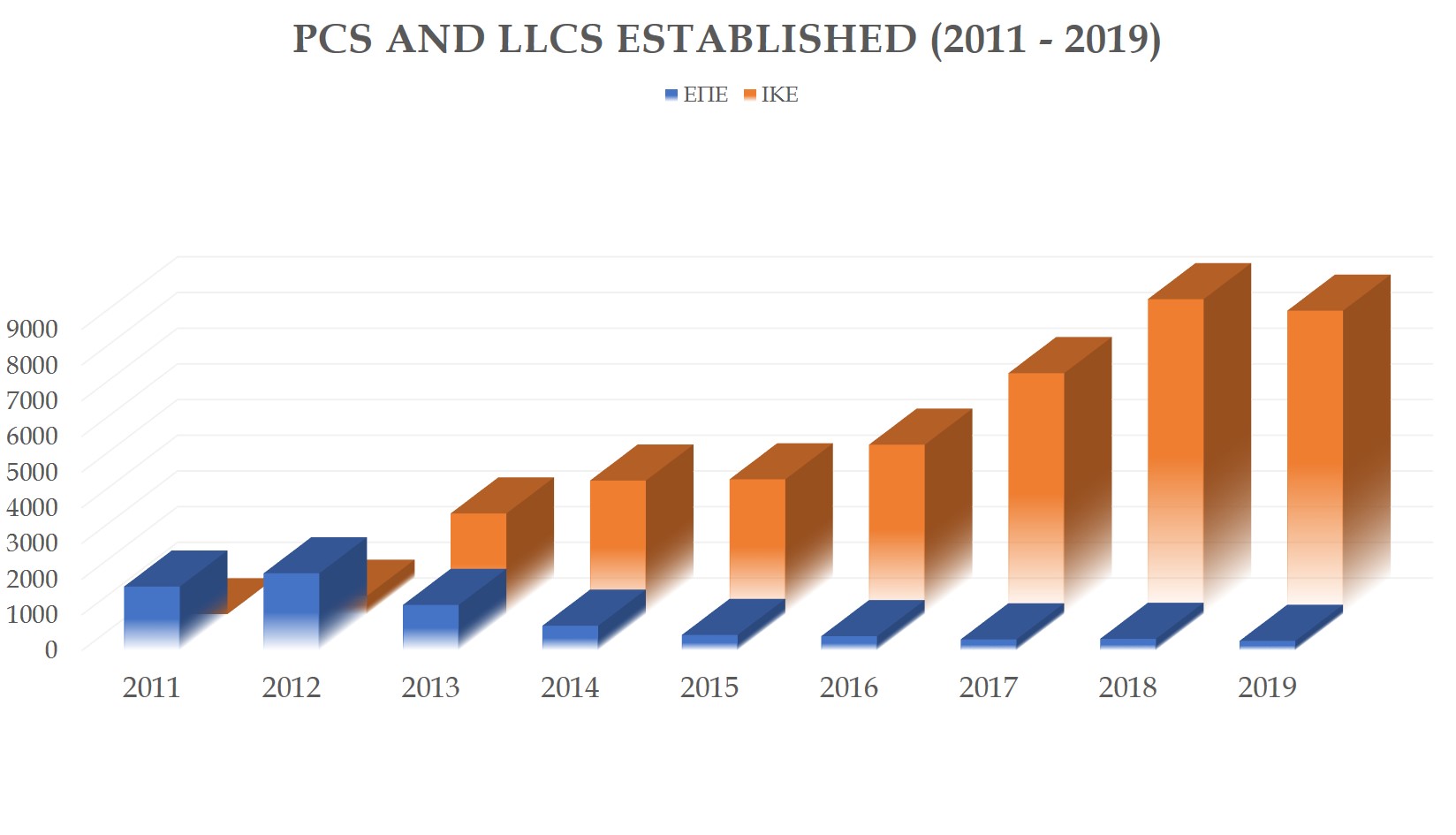
    Since the act on PCs was published (Government Gazette A’ 86/11-04-2012), businessmen, accountants and lawyers showed their complete faith in PCs. (Our Law Firm established the second ever PC in Greece.) Business Registry’s data for the years 2012 (when PC was established) until mid-October 2019 confirm the trust of the parties involved. Overwhelmingly in favour of PCs. And to be more precise:
    X. In conclusion

    PCs and LLCs have been competing each other, since the day PCs were established.

    PCs prove more cost efficient when compare to LLCs. The most important difference between the two, though, is that PCs prove to be more flexible.

    PC’s partners have a lot of room for initiatives, in order to manage important company issues as they think best. The advantages of PCs compared to LLCs are more than clear.

    The trust the market has shown in PCs is also clear. This fact is undoubtedly represented in the data published by the Business Registry -statistical information regarding establishments.

    In this case, when considering choosing between a PC and an LLC, the dilemma at hand is no equivalent to the one presented in the preamble (“…don’t know if I want to choose Kiki or Koko”).

    Not anymore.

    LLCs already seem obsolete.

    stavros-koumentakis

    Stavros Koumentakis
    Senior Partner

    P.S. A brief version of this article has been published in MAKEDONIA Newspaper (October 27th, 2019).
    ΙΚΕ vs ΕΠΕ στην εφημερίδα Μακεδονία

  • The (:ordinary or extraordinary) increase of share capital in Société Anonyme

    The (:ordinary or extraordinary) increase of share capital in Société Anonyme

    Ι. Preamble

    “No Money, no honey” is a widely known expression. It is coming, most likely, from across the Atlantic. A phrase showing the necessary give-and-take in personal relations about to be realized. Or even existing ones. A phrase that shows in a crystal clear – and at the same time cruel- way, the value of money, according to common belief. Those who possess “money”, according to common belief -unfortunately, are the ones who are entitled to “honey”.

    This does not only apply to human relations.

    Those with the financial power in a professional cooperation, business joint venture or corporate relationship have or, eventually, acquire the “upper hand”.

    The Société Anonyme could not be an exception to that rule.


    ΙΙ. The necessary capital for the operation of the Société Anonyme

    A necessary condition for the achievement of a company’s statutory objects, of course the SA included, is the adequacy of its capital. Both at its establishment and, of course, throughout its life.

    In a previous article we looked at the initial Capital of the SA: amount, coverage, payment and certification. We also looked at issues concerning the contributions in kind in the initial capital of the SA. For achieving the corporate goals, the initial capital is, in most cases, not enough. Financial needs always appear in a company. Needs that may last for long, or not.

    The main question is always the same. Share capital increase or external funding? The answers given in each case may and will vary. Depending on the facts, the needs of the company and its shareholders but also their abilities. The criteria may not be strictly financial. The increase of the share capital seems to have, at a first glance, more advantages. We see, though, that lending will often be consciously chosen by financially strong companies and shareholders. As a proof, for example, of the financial health or the good credit rating of the company. Or of the optimal use of its equity.

    If a company chooses to increase its share capital, those who want in will follow. If they have the necessary funds.

    What about the rest?

    They will watch their participation in the total share capital decrease. And in some cases, be reduced to zero. And their participation in the expected economic outturn of the company reduced accordingly.

    ΙΙΙ. The (sufficient?) justification of the share capital increase

    It is not mandatory to justify the share capital increase. It is important, thought, to have a sufficient basis. If not, the Sword of Damocles is hanging above the validity of the relevant decision, due to abuse.

    The cause for the increase cannot be other than the optimal achievement of the corporate goals. In no other case is the decrease (or reduction to zero) of the percentages of the minority shareholders allowed. The minority shareholders have the right to ownership, a right protected under the constitution. According to the European Court, they have: “indirect ownership over the company’s assets”.

    It is possible that the majority shareholder may be aiming to decrease the participation of the minority shareholders in the company. In that case, the minority shareholders are not unprotected. The shareholder affected is given the option to go to court and claim the abusive character of the relevant decision. And, of course, to ask for the protection of their ownership. If the court accepts the relevant arguments, it can rule to cancel the decision for the increase of the share capital.


    IV. The ordinary increase of the SAs share capital

    The decision to increase an SA’s share capital is usually made by the SA’s General Assembly. In this case, there should be an increased attendance quorum and an increase majority. This is called “ordinary increase” of share capital (Act 4548/2018, article 23). The ordinary increase of share capital in the most common one.

    Having an increased attendance quorum means (article 130, par. 3) that the shareholders holding ½ of the share capital or their representatives are present.  If an increased attendance quorum is not achieved, then a second meeting of the General Assembly must be held, which is valid if the shareholders holding the 1/5 of the share capital or their representatives are present (article 130, par. 4).

    Increased majority means that (article 135, par. 2) the shareholders or their representatives who voted for a subject are 2/3 of the total number of votes represented in the General Assembly.

    The articles of association can have provisions requiring higher percentages in order to achieve a quorum (article 130, par. 5) and a majority (article 130, par.3). But it cannot require the presence of every shareholder. Even more so, neither can it require unanimity.


    V. The extraordinary increase of the SAs share capital

    The decision of the General Assembly, made with an increased attendance quorum and majority, is not the only way to increase an SA’s share capital -but this under one condition: a relevant statutory provision must be in place. If that condition is fulfilled, the SA’s share capital can be increased by decision of the General Assembly, with simple (not increased) quorum and majority. It is also possible to increase an SA’s share capital by decision of the board of directors with a majority of 2/3 of its members.

    In cases like these, we are talking about an “extraordinary” increase of the share capital (article 23 Act 4548/2018).

    It must be noted that an extraordinary increase of the share capital can be decided by the board of directors as well as by the General Assembly (article 24, par.5).

    An extraordinary increase of the share capital always constitutes an amendment to the articles of association (contrary to what happened in the past).  Furthermore: the extraordinary increase does not require an administrative approval. And all these, no matter if the decision is made by the General Assembly or by the board of directors (article 24, par. 4).

    There is always the chance that the provision allowing an extraordinary increase will be used in bad faith. In order, for example, to mislead those transacting with the company. To avoid such actions, there it is strictly prohibited to mention to the press, in a commercial or in any document of the company, the amount up to which the competent body can increase the share capital (article 24, par.3).


    VI. The power of the General Assembly to decide an extraordinary increase

    We saw that a necessary requirement for an SA to make an extraordinary increase to its share capital, is the existence of a relevant provision in its statute.

    For the first five years after the establishment of the company, the statute can give to the General Assembly the power to decide an extraordinary share capital increase (article 24, par. 2). This provision may allow the General Assembly to proceed to a share capital increase up to eight times the initial capital. What is noteworthy in this case is that the GA can decide the increase by simple quorum and majority.

    But what is this simple quorum and what this simple majority?

    The simple quorum of the General Assembly (article 130, par.1) requires for the shareholders holding 1/5 of the share capital, or of their representatives to be present. In case the quorum is not attained, a second General Assembly will be validly held, regardless of the number of the shares represented (article 130, par.2).

    As for the simple majority, it is nothing but the votes of at least 50% plus one vote of the votes represented in a General Assembly (article 132 par. 1).


    VIΙ. The power of the board of directors to decide an extraordinary increase

    The board of directors has a power equivalent to that of the General Assembly, as long as there is a relevant provision in the statute, or a relevant authorization is given by the General Assembly. If any of these two requirements is met, an increase of the SA’s share capital up to three times the initial capital can be decided by the BoD. The relevant decision can be made by a minimum majority of two thirds (2/3) of all board members (article 24, par. 1).

    The power for an extraordinary increase cannot be given to the board of directors by the statute indefinitely. It is only given for the first five years -maximum- from the establishment of the company. The share capital can be totally or partially executed by the issuance of new shares (article 24, par.1a).

    Besides the statute, the General Assembly can also give the board of directors the power to decide for an extraordinary increase of the share capital. This power is given by the General Assembly for a period not longer than five years. If given, the share capital can be increased maximum up to three times the initial capital. In this case, the initial share capital is the share capital of the company at the date the relevant power was given to the board of directors (article 24, par. 1b).

    The power of the board of directors can be renewed by the General Assembly. The General Assembly can give the relevant power to the board of directors for five years, maximum. The effect of each renewal can only begin after the end of the previous one (article 24, par.1c).

    The decision for granting or renewing the power to the board of directors to increase the share capital must be published (article 24, par.1c).


    VIII. Extraordinary vs ordinary share capital increase

    We saw (above, under VI), that the General Assembly can decide for an extraordinary increase of the company’s share capital with simple (and not increased) quorum and majority. We also saw (above, under VII) that the board of directors can decide, very quickly, an extraordinary increase with a majority of 2/3 of its members, without having to convene a General Assembly.

    But what do these options mean in practice?

    The General Assembly has the right to increase the company’s share capital up to eight times the initial share capital,

    and do so with reduced percentages. In other words: a shareholder holding, directly or indirectly, ½ of the share capital has the right to decide an increase of the share capital up to 8 times the initial one. And if they have the necessary funds? They additionally have the power to significantly expand their participation in the company and dramatically decrease the participation of the rest of the shareholders.

    Under the requirement of achieving the necessary quorum in the General Assembly (1/2 or 1/5 of the total), a shareholder holding 13.34% of the shares has the right to decide an extraordinary increase up to eight times the initial share capital. In that case, provided they have the necessary funds, a minority shareholder can become the shareholder of a vast majority.

    On the other hand, the implementation of an extraordinary share capital increase by the board of directors might help quickly achieve a certain corporate goal. Since there is no need for conveying a General Assembly, the procedure can be expedited at least by the number of days needed for the convention of the GA -in cases where we are not discussing a Universal General Assembly -which means presence of all the shareholders. Such a quick procedure can be proven valuable when fast response is required -i.e. exploitation of a significant business opportunity.

    Respectively, though, a shareholder who “has” (or can convince or join sides with) 3/5 of the members of the board of directors (regardless the number of their shares), can “force” an extraordinary increase up to three times the initial share capital.  And if, at the same time, they have the necessary funds to cover the increase, but the rest of the shareholders do not, they can at once become a major or a majority shareholder.


    IX. Conclusion

    The regular increase of the SA’s share capital is decided by the General Assembly. It requires an increased attendance quorum and to be voted for by the majority of the shares. Essentially majority of 2/3 of the total number of shares.

    The extraordinary increase must be provided for by a statute.

    When decided by the General Assembly, it requires clearly reduced percentages. Half and, under certain requirements, 13.34% of the share capital could be enough for making such a decision.

    When the extraordinary increase is decided by the board of directors, a vote for the increase by 3/5 of its members suffices.

    Attention though! An extraordinary increase can be a useful tool for fast actions necessary to exploit business opportunities.

    But it can also be a tool for overthrowing shareholding balances.

    Possibly in the interest of the SA.

    But always in the interest (:“honey”) of the powerful (:“money”) shareholders.

    stavros-koumentakis

    Stavros Koumentakis
    Senior Partner

    P.S. A brief version of this article has been published in MAKEDONIA Newspaper (October 20th, 2019).

  • S.A. capital: Contributions in kind and valuating (or not) the contributions

    S.A. capital: Contributions in kind and valuating (or not) the contributions

    S.A. capital: Contributions in kind and valuating (or not) the contributions.

    1. Preamble

    “All some folks want is their fair share and yours”

    – Arnold H. Glasgow – famous American businessman (1905-1998) who was successfully, for sixty years, in the humor magazine business.

    There are quite a few people who are not satisfied with their fair share. They also want a part of your share – or maybe your whole share.

    The business world and the world of SAs could not be an exception, since producing wealth generates or fuels greedy behaviors.

    In a previous article, we saw the way the recent law on SAs tackles issues relating to the amount, coverage, payment and certification of the SA’s share capital.

    What happens, though, when, instead of money, the shareholders’ contributions are made in kind?

    How is their fair valuation (as a potential contribution to an SA’s share capital) ensured and how will potential voracious appetites of the contributing shareholder or, in some cases, of the rest of the shareholders, be handled?


    2. Contributions in kind – forming an SA’s share capital

    2.1. In General

    According to the existing legislation on SAs (article 17, par. 1, Act 4548/2019) contributions in kind can be allowed as a means of contributing to an SA’s share capital. A contribution in kind is not like a payment in cash – but it can be valued in money.

    Contributions in kind can be in the form of, among others, real estate (i.e. land, agricultural parcels, factories, buildings), movables (i.e. transportation vehicles, goods, raw materials, furniture) intangible assets (i.e. other companies’ shares, trademarks, patents), business branches or even businesses as a whole.

    2.2. When can contributions in kind take place?

    Contributions in kind can either take place at the stage of establishment of an SA, or throughout the time the SA operates. In the first case, there must be a relevant provision in the company’s statute. In the second, there must be a relevant provision in the decision of the company’s body deciding the increase of the share capital. In both cases, there must be a reference to the person that undertakes the obligation to make the contribution and the amount of capital and the number of shares the contribution in kind corresponds to.

    2.3. Undertaking the obligation to execute works or provide services as contributions in kind.

    There is a special provision in the current institutional framework for Private Companies (article 78, par. 1, Act 4072/2012) for the non-capital contributions, which are contributions that cannot be made in cash. According to this (and provided there is a relevant provision in the company’s statute) undertaking an obligation to execute works or provide services can constitute part of the Private Company’s capital (article 78, par. 2, Act 4072/2012).

    Contrary to what is happening with Private Companies, when it comes to SAs contributions in kind can only be “assets that can be valued in money”. Special reference (in order to avoid any misunderstanding regarding what is mentioned in the abovementioned provision of article 78, par. 2, Act 4072/2012) must be made to the claims that the company has against the one who undertook the obligation to execute works or provide services: such claims are not (article 17, par. 2) assets that can constitute contributions in kind.


    3. The valuation of contributions in kind

    3.1. In General

    The valuation of contributions in kind is not left up to the shareholders. This seems not only logical but also necessary, towards guarding the interests of the one making the contribution, the rest of the shareholders and, of course, the company.

    There is a specific framework provided for the persons that can valuate the contributions, mentioning their incompatibilities, the content and the assumptions of the valuation report that will be drafted.

    3.2. The valuators and the incompatibilities – the abrogation of the “Committee of Article 9”

    In the pre-existing legislation (:article 9, Act 2190/1920) there was a provision that the: “verification of the value of the contributions in kind made to the company, at the stage of its establishment, as well as in case there is an increase of its capital, is conducted after the consultation is issue by a three member committee of experts, made up by one or two employees of the Ministry of Development – Sector of Commerce, or of the competent Municipal Authority, with a university degree and at least three years of experience, or by one or two chartered auditors-accountants and an expert from the competent Chamber”. We used to call this committee the “Committee of article 9” and to use it, in a totally dispatching way, for the drafting of the, required by law, valuation report of the contributions in kind. The credibility of its results was, always, low. In 2007 (with Act 3604/2007), an alternative was introduced for the drafting of that same report (valuation of contributions in kind) by a chartered auditor-accountant or an auditing company. The “Committee of article 9” has, wisely, been abrogated but its alternative survived.

    Therefore, the only option (article 17 par. 3) for someone who needs a report of valuation of specific contributions in kind (either if the contribution is made when the SA is established or when its capital is increased) is to get that report drafted by two chartered auditors/accountants or by an auditing company or, depending on the case, by two independent certified valuators. The time that it can take for a valuation report to be issued must be less than 6 months, starting from the time the contribution in kind is made (article 17, par. 9). In case there are special circumstances, which require specialized knowledge or international experience, the auditors or the certified valuators can hire expert valuators, domestic or foreign, to valuate the assets contributed.

    3.3. Publicity if the valuation report

    The legislator recognizes the significance of the valuation report. To ensure transparency, the report must be submitted to the Hellenic Business Registry by the interested parties. The company’s Board of Directors is responsible for this submission (article 17, par.8 and article 13).


    4. The incompatibilities of those drafting the valuation report

    The persons who will be drafting the valuation report (or get involved with it in any way) cannot be any of the following (article 17, par. 4): they can’t be members of the board of directors of the company, they can’t have any business professional relation with the company or the person making the contributions in kind, or be their relatives up to the second degree or husbands or wives.

    Specifically regarding the chartered auditors-accountants and the auditing companies they work for, there should be no obstacle or incompatibility, excluding them from conducting the company’s regular audit, and they should not have conducted the regular audit of the SA or of related to the SA companies in the last three years (Act 4308/2014, article 32).


    5. The content of the valuation report

    In any case of any valuation of an asset, values appointed can significantly vary. These values must be substantiated based on widely accepted methods of valuation. In order to strengthen the reliability and the usability of the valuation report, a set of rules has been established (article 17, par 5 and 6).

    According to them, the valuation report has to include (article 17, par.5) a description of the contribution in kind, to mention the methods used to valuate and to come to conclusion, appointing a value (: final price) for the specific contribution. This final price of the valuation report is the highest limit the value the contribution in kind can have (article 17, par.7).

    There are some additional rules regarding fixed assets (article 17, par. 6): the actual and legal status of these assets as well as burdens they might have (etc reconveyances, mortgages, pledges) must be taken into consideration and mentioned in the valuation report.

    Specifically, regarding real estate, the value and the ownership titles, the marketability of the area they are in, their growth prospects, their current market values, their building permit and its relevant technical report from an engineer should also be taken into consideration.

    When valuating machinery, vehicles and furniture, their year they were purchased in, their acquisition value, the degree of their use, their maintenance and tradability, their possible technology obsolescence and the current price for the same or similar assets should be taken in to consideration and referenced.


    6. What if the contribution made to the company is not valuated?

    Conducting a valuation report is, in general, obligatory.

    It is possible for the company to avoid the valuation report altogether, if the statute or the decision of the company’s body deciding the share capital increase have a relevant provision and if:

    (a) the assets contributed are money market instruments or securities (article 18, par. 1)

    (In this case, they are valued in the weighted average price, at which they were traded on a regulated market, for the last six months, before the date of the contribution in kind.

    (b) the assets contributed have already be valued by a recognized independent expert (article 18, par. 2)

    (In this case, the valuation cannot have been done more than six months prior to the contribution in kind)

    (c) the fair value of the assets contributed has been calculated and mentioned in financial statements of the previous fiscal year, providing these statements have been audited (article 18, par. 3) as part of the annual and consolidated financial statements (Act 4336/2015 and 4449/2017).

    In each one of the abovementioned cases, the value of the assets contributed must (under certain circumstances) be readjusted. This readjustment will take place with the initiative and responsibility of the board of directors and a valuation report must be prepared. This is, i.e. when the weighted average price or, in some cases, the fair value of the contribution in kind is affected by external factors that can significantly change (or have already significantly changed) the value of those assets at the time the contribution in kind is made.

    According to the above, the company can choose to avoid the valuation report. In this case, though, the board of directors of the company is obligated (article 18, par. 4) to submit to the Hellenic Business Registry, which will in turn publish, a series of evidence that substitute it. Specifically: (a) a description of the contribution in kind, (b) the value, why this value was appointed and, if necessary, the method of valuation, (c) a statement mentioning whether the value appointed is at least equal to the value of the shares issued in exchange for the contribution (number, nominal value, additional amount that one might have paid for the shares) and (d) a statement that there are no new circumstances since the initial valuation.

    Contributions in kind can be decided during an (extraordinary) share capital increase with a decision of the board of directors (authorized by the statute or a decision of the General Assembly- under article 24, par. 1). In this case and under the condition that the contribution in kind is taking place without valuation-according to the abovementioned, a series of evidence must also be published to the Hellenic Business Registry, substituting the valuation.


    7. In conclusion

    The capital “intake” is a factor contributing to an SA’s health and it is boosting activities.  The permission given to it by law to be capitally reinforced by contributions in kind, as well as the abrogation of outdated regulations (i.e. “the committee of article 9”) is a step to the right direction.

    Setting strict rules for the valuation of the contributions in kind is, without a doubt, reassuring the justice among the shareholders and their rights. And moreover, it is discouraging those who “want their fair share – and yours”.

    stavros-koumentakis

    Stavros Koumentakis
    Senior Partner

    P.S. A brief version of this article has been published in MAKEDONIA Newspaper (September 15th, 2019).

  • Partial payment of the SA’s capital

    Partial payment of the SA’s capital

    1. Preamble

    Five days from now, it will be 81 years since the day the Edwardsville Intelligencer (a local newspaper from Edwardsville, Illinois) came out, on 19.7.1938, under the title “Corrigan Flies By The Seat Of His Pants”.

    What had happened?

    One of the few (at the time) aviators, Douglas Corrigan, had submitted a transatlantic flight plan from Brooklyn to Dublin. The flight plan was, probably fairly, rejected, since the bold aviator seemed that he did not have the proper navigational instruments. Later, a (more reasonable, as it seems) flight plan from Brooklyn to California was approved. The journey started smoothly and ended after 29 hours in Dublin(!). The bold pilot never admitted that he ignored the rejection of his flight plan: He claimed failure of the navigational instruments of his airplane.

    The phrase “fly by the seat of your pants” has since then been used to describe an action fully realized by someone’s own means, initiative and perception, without any outside help: always attractive – often reckless!

    Is this also true for investments? For business plans?

    Each one of us, depending in its personality and business profile, has already given its answer.

    But how do SAs respond? Is there a framework favoring the slightly more “reckless” investor?


    2. Partial payment of the SAs capital

    The provision allowing the partial payment of an SA’s capital is not new. But with the recent legislation regarding SAs (Act 4548/18), this provision was reintroduced, considerably stricter.

    What does a partial payment consist of and what comes with it?

    Partial payment of the share capital at the stage of a company’s incorporation (as well as at any time a company’s share capital increases), is the payment of only a part (and not its entirety) of the par value of a share (article 21 §1). The liable shareholder takes on (along with the “facilitation” provided) the obligation to pay the rest of the share’s value in a future time – depending on what is prescribed in the statute of the company.

    In case of issuing share titles that have not been fully paid, it is obligatory to write on their front side that they are partially paid as well as the terms under which their payment in full will take place (article 21 §7).

    Partial payment is not allowed in two cases: when contribution of a shareholder is made in kind and when we are referring to listed companies (article 21 §2).


    3. Why would we choose (or allow) partial payment of share capital?

    It is a fact that the bigger the capital base of a company, the stronger the company. But it is not always a given that the shareholders have the capability (or prioritize) to immediately pay their share of the capital at the time of incorporation of the company (or at the time of an increase of its share capital). It is possible, in the context of a smaller business venture, to be hoping for the participation in the business venture of a capable “partner”, associate or executive, to the traits of whom we are counting on for the venture to succeed. Another possibility is that there is a specific person who we want as part of the original shareholding scheme or who we want to join in at the company at a later stage (at an increase of the company’s share capital) but they do not have (not only the capability but also) the means to justify the wealth needed to cover their share of the capital (e.g. it could be one of the family’s children, in a family business).

    In all these cases (and not only them), partial payment of the share capital is the way to go.

    It is important to emphasize that the partially payed shares offer their beneficiaries the same rights as the fully paid ones (among these rights are voting and receiving dividends).


    4. Arrangements that must be made in case of apartial payment of share capital

    When partial payment of the initial share capital or of the capital increased is decided (in the context of statutory provisions), the following are obligatory (article 21 §3):

    (a) The deadline for the payment in full (of the outstanding amount) of the share’s par value cannot be set for more than 5 years.

    (b) At least one quarter (1/4) of each share’s par value must be paid immediately (e.g. if a share’s par value is 10€, then the minimum amount that must be paid is 2,5€). In case the shares are issued above par, the amount that equals to the sum above the par value is paid in full at the time of the payment of the first installment for the shares (e.g. if the par value of a share is 10€ and the price they are issued at is 20€, the extra 10€ must be paid along with the first installment that has (probably) been agreed on beforehand, for the payment of the outstanding amount of the par value).

    (c) The fully paid off part of the share capital cannot be, in any case, smaller than 25.000€.

    (d) In cases when shares, not yet fully paid off, are transferred, the transferor is responsible for the consideration of the shares still owed to the company for two years following the registration of the transfer of the shares to the Shareholders Book.


    5. Is it mandatory to pay the (partially payed) shares’ par value in full in one installment?

    It can be provided in the company’s statute that the payment in full of the outstanding amount owed for the par value of the partially payed off shares will take place either at once or in more installments.

    In cases when partial payments (traches) are made for the outstanding amount, these payments are “evenly spread” to all shares that have been obtained by the same person (article 21 §4). This means that the shareholder-debtor cannot just fully pay off some of their (partially payed for) shares.


    6. What is the “cost” of not paying what is owed for the partially payed for shares?

    If the liable shareholder fails to make any of the instalments for the payment of the remaining amount due for the shares, they will face (strict) -but necessary for the company- repercussions (article 21 §§5 & 6). In such a case, the company’s BoD will set a one-month deadline to the liable shareholder to fully pay off what they owe for the shares. At the same time, the BoD is required to let them know what the repercussions will be if the one-month deadline passes and the liable shareholder has not fully payed off the sum owed for the shares they hold.

    What will the repercussions be? In case the deadline passes with no results, the company will cancel the partially payed for shares and it will keep all sums already payed by the liable shareholder (instalments, a possible above par value sum). At the same time, the company will issue as many new a shares as the ones it cancelled and it will offer them to the other shareholders (:preferential right). In case the existing shareholders do not exercise their right, the company then offers the shares to the public.

    If the cancelled shares are restricted, or if offering the shares issued as a replacement to the public is (at part or in total) not fruitful, the company is obligated to decrease its capital (at its first general assembly) by the sum of the nominal value of the shares not sold.

    It must be stressed that the shareholder who has not paid a sum for their shares within the deadlines set is still, in any case, liable for the sum they owe, as well as for the legal interest, which is piling on until the invalidation of the shares. Further penalties or other claims of the company against the person liable may be provided for the company’s statute or in the decision for the increase of the capital.


    7. In conclusion

    A possible partial payment of the share capital is a “rift” on the admission that the person participating in a company’s incorporation (or in a company’s capital increase) pays for their shares in full. The aforementioned provisions allow shareholders to decide on paying only for a fraction of the par value of some (or all) of their shares. It is a given, though, that if the obligations taken on by the liable shareholders are not met, there are serious repercussions: they will not only lose their shares, but also the sum they have already paid for the shares’. It is also possible, as mentioned above, that more sanctions or other claims by the company may be in place in case of such a violation.

    Douglas Corrigan (aka «Wrong Way Corrigan») managed to successfully conclude, in 1938, on his own – without the proper navigational instruments the (transatlantic and amazing for its time) flight from Brooklyn to Berlin. The result not only vindicated him, but also gave him the opportunity to play himself in the 1938 movie: «The Flying Irishman».

    That was because he managed to finish his journey. What if he had not?Much like that, if the shareholder relies on luck, good conditions and future proceeds to pay off what they owe for their (not fully payed-for) shares:If they manage to come through, as an outstanding achievement.If not? As a disaster.

    stavros-koumentakis

    Stavros Koumentakis
    Senior Partner

    P.S. A brief version of this article has been published in MAKEDONIA Newspaper (July, 14th, 2019).

    μερική καταβολή partial payment

This site is registered on wpml.org as a development site. Switch to a production site key to remove this banner.