Tag: νομικοί σύμβουλοι

  • Two-day conference on the new law on Sociétés Anonymes

    Two-day conference on the new law on Sociétés Anonymes

    [vc_row][vc_column][vc_column_text]

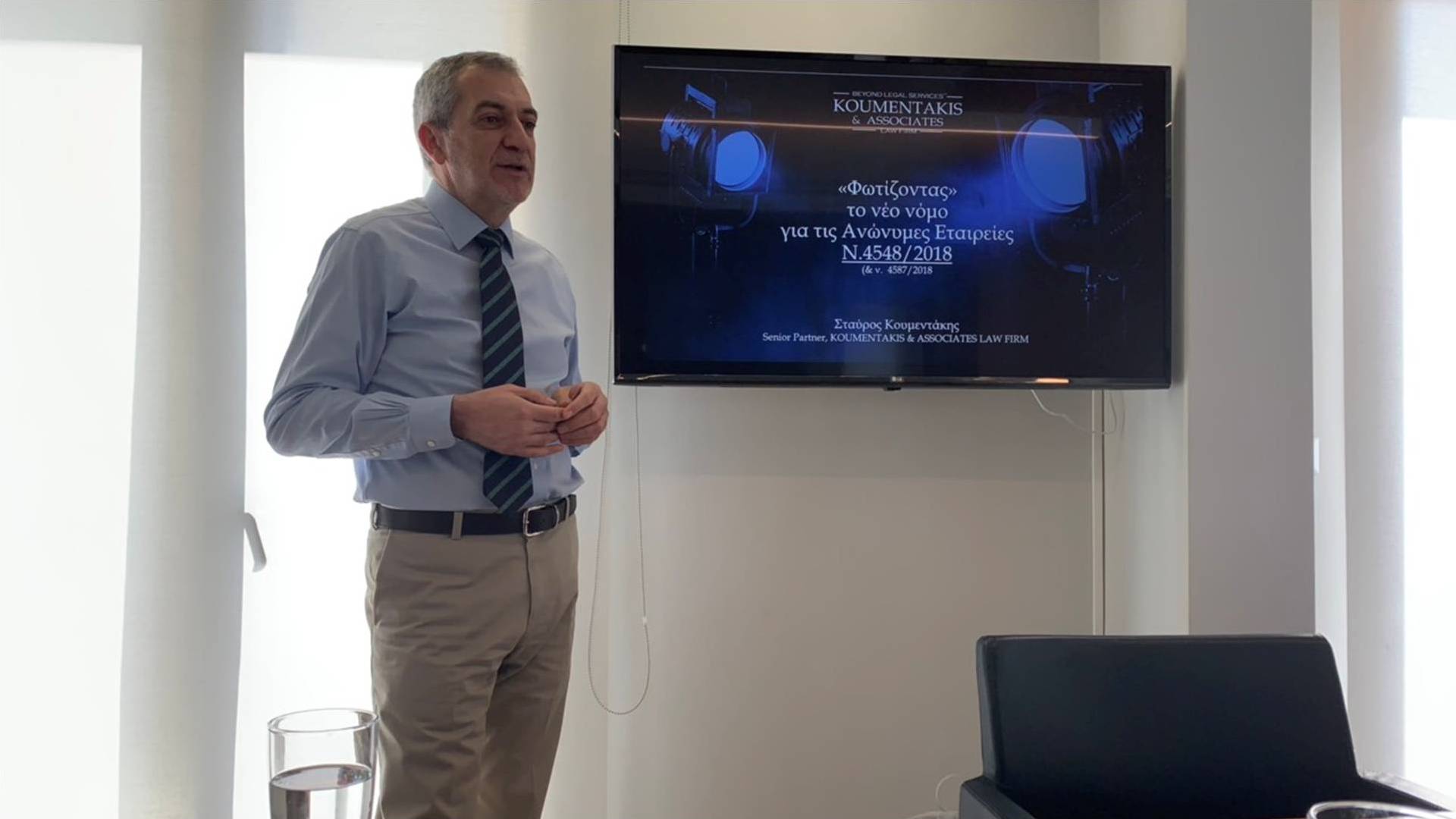
    On the occasion of the new Law on Sociétés Anonymes (in the final form of which the firm was actively involved), the Senior Partner of the Law Firm Mr. Stavros Koumentakis, held an internal informative seminar on “Enlightening the New Law on Sociétés Anonymes (L.4548 / 2018)”.


    Law 4548/2018

    At the two-day conference, of 12 hours duration, the Senior Partner of the Law Firm Mr. Stavros Koumentakis had the opportunity to make a detailed presentation of all the legislative text and not just of its basic regulations. Through the interactive and creative exchange of views between the partners and associates of the Law Firm, it was possible to enlighten individual aspects of the entire law. There was also highlighted the need for the immediate adaptation of the articles of association of the sociétés anonymes (in particular of the Law Firm’s clients) to the provisions of the new law as well as the “tailor made” exploitation, for each one, of the law’s particular options and regulations.

    Mr. Koumentakis’ suggestion’s objective was, among other topics:

    • reporting and, where appropriate, deepening into individual regulations of the new law
    • making use of the law’s options on behalf of the businesses on its own aspects, such as:
      • reducing their operating costs
      • attracting investors and investment funds
      • exploiting technology
      • attracting and retaining competent, senior-level, executives
    • protecting the clients of the Law Firm against their “internal and external enemies”.
    • the potential, necessary and beneficial regulations of the SAs’ articles of association, where applicable, the provisions of which must, individually and directly, be adapted
    • Significant “secrets” on issues such as the management and the power of the minority


    The Law 4548 presentations

    With this particular two-day conference, KOUMENTAKIS & ASSOCIATES Law Firm has launched a series of similar presentations, which is on track to take place in Businesses, Business Associations, Auditors Companies, significant Tax and Accounting Services Companies and so on.

    [/vc_column_text][/vc_column][/vc_row][vc_row][vc_column][vc_text_separator title=”Gallery” border_width=”3″][/vc_column][/vc_row][vc_row][vc_column][vc_images_carousel images=”36707,36709,36711″ img_size=”” speed=”6000″ slides_per_view=”6″ hide_pagination_control=”yes”][/vc_column][/vc_row]

  • Slitting of Vasilopita (Greek New Year’s cake with a coin)

    Slitting of Vasilopita (Greek New Year’s cake with a coin)

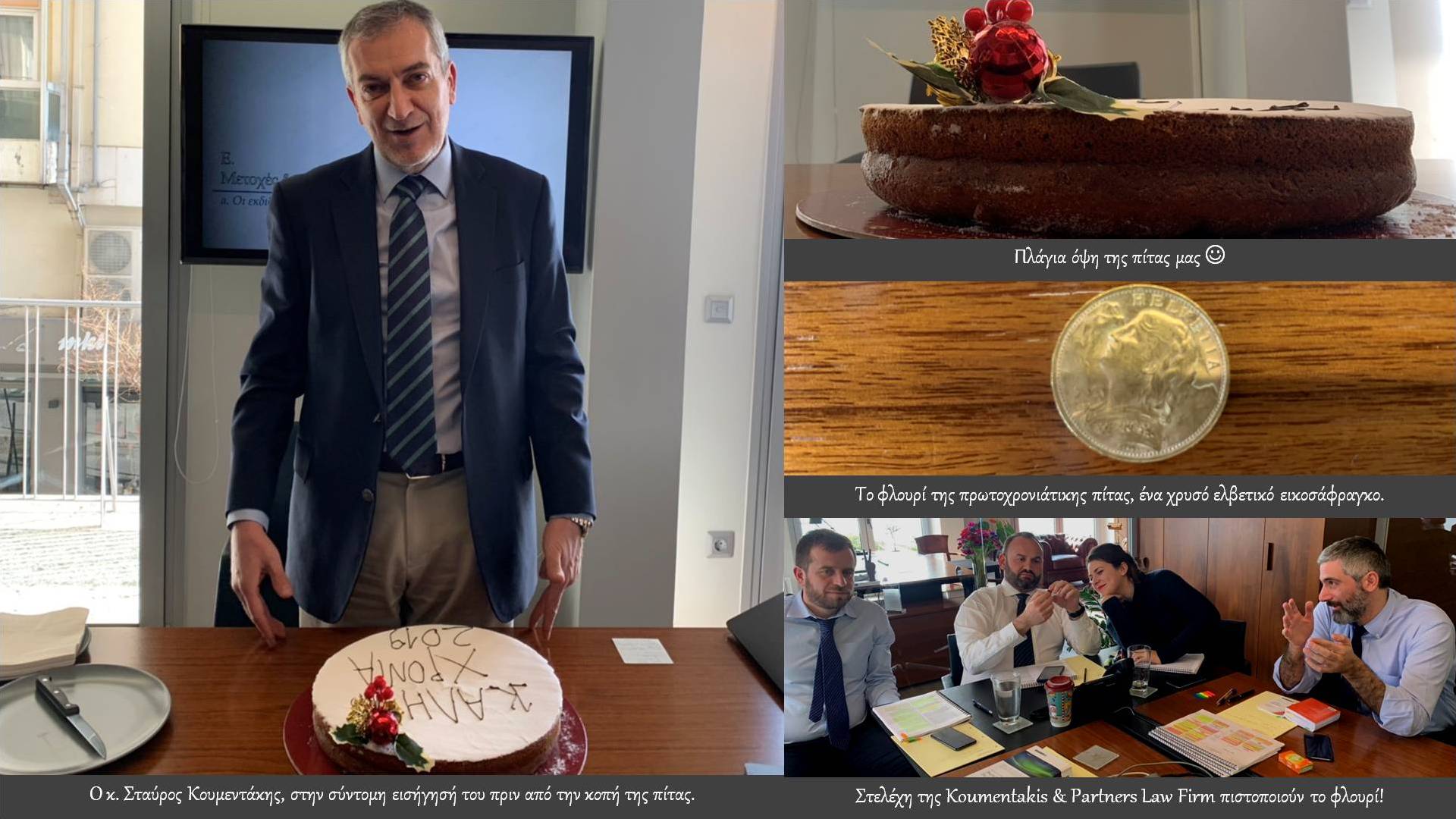
    [vc_row][vc_column][vc_column_text] The New Year was inaugurated at KOUMENTAKIS & ASSOCIATES Law Firm with the traditional ceremony of slitting Vasilopita (the Greek New Year’s cake with a coin).


    Despite the wish of Mr. Stavros Koumentakis (see the video below) that the coin – a Schweizer Goldfranken of twenty francs – be found in the slices of the younger associates, the lucky slice was that of the office. By joint decision, the equivalent of the coin was given to a soup kitchen.

    [/vc_column_text][vc_separator][/vc_column][/vc_row][vc_row][vc_column][vc_video link=”https://youtu.be/xma2sBg5BlM”][vc_separator][vc_column_text]

    The management and the associates of the firm exchanged heartfelt wishes for the new year, made the 2018 review and laid the foundations for an even brighter 2019.


    As Mr. Koumentakis said, 2019 starts dynamically with extroversion moves on many levels, starting with a series of informative presentations on the new Société Anonyme Law, for the reconfiguration and improvement of specific problematic provisions of which, the law firm has actively and dynamically participated. [/vc_column_text][/vc_column][/vc_row]

  • Technology at the service of the Société Anonyme

    Technology at the service of the Société Anonyme

    At the risk of “betraying” my age, I have to quote that I learned to typewrite in the early 1980s. One, newer then, Olivetti was the one which tolerated me (the younger ones and the eager may navigate to the internet for the relevant pictures).

    At that time, if anyone was talking about technology, perhaps we would have thought, if we thought, the (electric) typewriters (with the “ball”) that were to follow.

    At that time, we would notthing of internet, of the e-mail or of the teleconference.

    At that time, it was not possible to imagine how technology could be used by a société anonyme or by a law firm (there were not even law firms then).

    But there have been almost forty years since then.

    The changes, since then, sweeping.

    Also in the law of Societes Anonymes!

    (refer to The new law on Sociétés Anonymes and Sociétés Anonyme: The new law).


    The recent law

    The recent law (4548/2018) for sociétés anonymes provides a wealth of opportunities related to the exploitation of technology. Which, without a doubt, make our lives (entrepreneurs, accountants, lawyers) easier. Helping to the more efficient and effective operation of the société anonyme.

    It is noteworthy, however, that the use of technology is not required by law. In a number of provisions, the law regulates the option of statutory provisions for technology’s exploitation.


    The ability to exploit technology

    Solely indicatively, may one refer to the provisions of the new law that refer (provided of course that there are corresponding statutory provisions) to:

    In the operation of the Board of Directors

    • The possibility of the Board of the Directors having meetings by teleconference (Article 90).
    • The possibility of decision making by the Board of Directors by means of email exchange (Article 94).

    In exercising shareholder rights

    • The ability of the shareholders: (a) to request information by email for the forthcoming General Meetings of the companies (article 122) but also (b) to be sent to them the subject to a vote by the ordinary General Assembly financial statements of the company (Article 123).
    • The obligation for companies to comply with such requests.

    In the procedures of the General Assembly

    • The ability of shareholders to participate in a General Meeting (Article 125) on-line (real-time) by audiovisual or electronic means.
    • The ability of shareholders to participate in a vote of a General Assembly from a distance that is preceded by a “letter” vote (Article 126). This particular ability is exploited: (a) by the availability of issues and ballot papers via the Internet and (b) by filling in the ballot papers electronically. It is noted that when a distance voting takes place, it is compulsory that the vote be (reasonably) an open one (Article 131) but also that the company ensures the identity of the participant in the process as well as the electronic or other connection.
    • The ability of non-shareholder-members of the Board of the Directors, auditors or third parties to participate in a General Meeting by electronic means (Article 127)
    • The ability of shareholders to appoint, recall and replace (by electronic means) their representatives (Article 128)
    • The ability to hold General Meetings without a meeting (Article 135) when all shareholders have communicated to the company their e-mail addresses. In such cases, the proposal of the Board of Directors is sent electronically to the shareholders along with: (a) a draft decision, (b) the relevant suggestion of the Board of Directors, (c) the way of declaring acceptance or refusal but also the deadline for shareholders’ reply / vote (7-30 days). [In such a case, shareholders are also entitled to submit information requests electronically within three days of receipt of the Board’s proposal. These requests are required to be answered within two days of receipt].
    • The ability of countersigning General Meeting minutes without a meeting (Article 136), together with the ability to replace shareholders’ signatures by e-mail.

    In the Shareholders’ Unions

    • The ability to provide information from Shareholders’ Unions (Article 144) via the internet on the rights of shareholders, investors, and the ways of, among others, namely conciliation.


    The (necessary but also rational) use of technology and its capabilities.

    Almost one hundred years since the first law on sociétés anonymes (2190/1920) and almost forty years since I learned to type, are so many.

    So (I think) I have the right to “strongly qualify” to encourage (also) the exploitation of the latest law on the use of technology.

    The legal background exists.

    What remains is the (evaluated but also rational) incorporation of the respective options in the articles of association of the sociétés anonymes – which in any case must be aligned with the new data and the requirements of the law.


    stavros-koumentakis

    Stavros Koumentakis
    Senior Partner

    P.S. A short version of this article has been published in MAKEDONIA Newspaper (13 January 2019).

  • Corporate Governance: Competitiveness and Growth

    Corporate Governance: Competitiveness and Growth

    [vc_row][vc_column][vc_column_text] Corporate Governance is, in general, a set of principles and rules that must govern certain areas of the organization, operation and management of a Société Anonyme. But how are they related to Competitiveness and Growth?

    The Regulations of Corporate Governance Codes

    In the Greek Corporate Governance Code, these rules refer to the Board of Directors, internal control, fees and shareholders.

    The Corporate Governance Codes are not mandatory unless some of their provisions (or all of them) have the form of the law (e.g. some of the provisions of Law 3016/2002 on listed companies, of the recent Law 4548/2018 concerning the reform of the law of Sociétés Anonymes, the commonly known law 2190/1920).

    Objective and Purpose of Corporate Governance: The Component of Competitiveness

    The purpose of Corporate Governance under the Greek Code is “to promote good governance in the conviction that it will enhance the long-term success and competitiveness of Greek companies”.

    The reference to enhancing competitiveness is not accidental: We can be sure that there would be no investor to invest in a company that operates with the well-known methodology of most (family) businesses in Greece. A methodology in which the entrepreneur identifies the fund of the company with his “pocket”. The company, with his home.

    To what extent is the entrepreneur willing to retreat from unwavering practice and habits of years?

    Necessity and value of Corporate Governance. From theory

    Regarding the necessity and value of Corporate Governance, a great deal has been written. In the preface to the Greek Code of Corporate Governance, Iakovos Georganas (then President of HELEX – for the older the “Patriarch of the Hellenic Capital Market”) states: “… Strengthening corporate governance is a prerequisite for creating an attractive investment climate in Greece, as in every country and the adoption of the Code by the companies, helps restore investors’ and lenders’ trust, attract domestic and foreign capital, and enhancing business competitiveness …”.

    …to practice. Indicatively: Roots Programme

    Helping businesses to grow but also boosting their competitiveness requires, among other things, access to low-cost investment funds. The Athens Stock Exchange is pursuing an important step in this direction, through the Roots programme, which, with a modern methodology, attempts to facilitate the access of small and medium-sized companies to investment funds. Already, on 13.5.2018, the first event took place at the Thessaloniki Stock Exchange Center, with recipients, innovative startups and promising small and medium-sized companies in Northern Greece. Companies that think they have an interesting investment proposal and are looking for investors. “The success of the companies that will join this program will be judged by their ability to raise the funds needed to implement their investment proposal, meeting the requirements of organization, transparency and good corporate governance under the conditions demanded by investors”, says the President of HELEX Mr. Socrates Lazaridis.

    Once again, corporate governance!

    Is (quite) clear?

    Without good corporate governance, there is no access to finance!

    Without funding, there is no way for growth!


    Koumentakis-and-Associates-Stavros-Koumentakis

    Stavros Koumentakis
    Senior Partner

    Υ.Γ. The article has been published in MAKEDONIA Newspaper (December 16, 2018)

  • Earnouts: Opportunity for Business Agreements or a “stumbling block”?

    Earnouts: Opportunity for Business Agreements or a “stumbling block”?

    [vc_row][vc_column][vc_column_text] To its basic structure, earnouts are agreements concluded between (usually) a seller and a buyer of a company. It is mainly found in M&A agreements or as a tool to promote startup financing.

    When an earnout is agreed on, the buyer agrees to pay, in addition to the cost of acquiring a company itself, a “bonus” – under certain conditions.

    The necessity

    When there are strongly conflicting interests (and usually there are), a deal is almost never easy to be achieved. The seller will always claim that its company is worth more, while the buyer will claim the exact opposite. Of course, no one is able to prove the company’s “actual” value. Earnout comes in to solve this problem.

    Earnouts

    The logic is simple: The sale of a company, if an earnout is included, is agreed at a price closer to what was offered by the buyer. Nonetheless, the seller will not suffer a loss in case the company is actually worth more than what the buyer was initially offering. To achieve that, both the buyer and the seller set specific targets for the company. In case the targets are achieved, the seller will have “proved” that its company is worth more than what it has already received, and therefore will be entitled to receive a beforehand agreed upon bonus.

    This bonus will not necessarily be a specific amount: Its type and method of calculation are left to the discretion of the parties (e.g. it can be agreed that if the sold company has a certain revenue in z years, the seller of the company shall remain its CEO for x years with a salary amounting to y).

    Examples:

    • The seller will receive a percentage (e.g. 2%) of the company’s profits for the next three years.
    • The seller will be the company’s CEO for four years following its buy-out, during which, if certain revenue goals are achieved, the seller will get a bonus for every 10% the company’s revenue has exceeded that of the previous year.

    It truly can be anything. If the seller is confident about the capabilities of its company, it is easy to take the risk that his fee be dependent on his company’s performance.

    This is, of course, a simplified approach.

    Risks and Opportunities

    While earnouts seem to be simple and attractive, they entail many risks. What if, in our first example, the buyer makes sure that the profits of the company for the first few years after the buy-out are hidden, by exaggerating, say, the costs? One solution would be for the seller to remain in the company’s management, as in our second example. Another would be that the earnout will depend on other factors such as, for example, the company’s turnover or it position in the market.

    Earnouts are introduced as an attempt to solve the problem of pre-sale moral hazard. Prior to the sale, the seller will try to inflate the value of the company, while the buyer will try the exact opposite. Earnouts successfully, in my opinion, address this matter. But earnouts themselves will introduce a “new” moral hazard, after the sale of the company. After the sale, the buyer will try to “hide” the factors that will trigger the earnout while the seller will try to highlight them.

    It is obvious that earnouts have to be tailored to any case, in order for all parties involved to be as secured as possible. Nevertheless, with the right planning (when negotiating as well as drafting the agreement), earnouts can solve problems that may otherwise prevent a deal from closing.

    I believe we all agree that the most important job lawyers have is to close the deal their clients want closed, while, of course, protecting them. Earnouts are a good way to save an otherwise “dead” deal: when without an earnout the buyer and the seller do not have the same perspective, earnouts give both parties time to “look through each other’s eyes”. And, ultimately, make profitable business transactions.

    Lida Koumentaki
    Junior Associate

    Υ.Γ. The article has been published in MAKEDONIA Newspaper (December 9, 2018).

  • Acquisitions: Is it enough just to shake hands on?

    Acquisitions: Is it enough just to shake hands on?

    [vc_row][vc_column][vc_column_text]

    Acquisitions and business development

    The procedure of a company to acquire another of the same industry or of an industry in which it would like to expand its business, is connected to its growth.

    In procedural terms this is one of the agreements “concluded” between those who have the authority to do so: The, normally, strong party (that is, the acquiring party) and the, normally, weak one (that is, the party to be acquired).

    In any case, the “acquiring company” aims to its further (direct) development, utilizing the structures, the staff, the activity and the customer base of the acquired company.


    dikhgoriko-grafeio-koumentakis-kai-synergates-law-firm-The risks of an acquisition

    The acquisition of a company, however attractive it may be, poses significant risks to the acquiring party, buyer. What are these risks? Legal, economic, tax risks and so on.

    These exact risks the person who is interested in acquiring must explore and consider and the assess whether to proceed to the next steps.

    At this point, specific consultants are, perforce, involved in order to carry out the necessary legal, financial, tax, technical audits (or, as per the international terminology: legal, financial, tax, technical due diligence).

    And it is true that we have all heard of acquisitions where the entrepreneurs simply “shook hands on the deal” in the view that “everything is ok” or that they would not face serious or just unmanageable problems. Such a choice certainly could not be classified as wise as no one would want to find himself in difficult (or unmanageable) situations: If the new owner, for example, subsequently found out that a third party has initiated actions for significant amount of money against the acquired company or that there are legal actions challenging the ownership of the shares that have been transferred or that a tax audit has never been carried out in that company or that the lease of the main premises expired only a month ago …

    No one, I’m sure, would want to find himself in such situations. No one would want to risk his financial position because he did not carry out audits or because the audits conducted were proved defective.


    dikhgoriko-grafeio-koumentakis-kai-synergates-law-firm-Standard audits

    The various audits explore certain areas of the company’s life and activity and are intended to reduce the business risk of the acquiring party. Indicatively:

    Legal audit: There are analyzed (indicatively) the data concerning the company itself, its holdings, its assets (movable, immovable, intangible), its labor relations, its legal cases, its relations with the authorities (fulfillment of its obligations linked to its activity),

    Financial Audit: The company’s financial statements are audited, and the correctness of their representation is verified, the accounting books and data are checked, the potential “gray” areas are searched (and clarified), the existence (or non-existence) of financial problems is confirmed. (Or, in another, most modern version of EY Canada: “The diligence exercise probes deeply into the quality and sustainability of earnings by examining underlying risks and exploring previous financial performance to determine whether it can reasonably be expected to continue, and to understand how changing circumstances and trends may impact the future of the business”)

    Tax Audit: There is an audit on tax liabilities and corresponding outstanding issues of the company

    Technical Audit: All issues of technical nature related to the operation of the company are checked; it is differentiated according to its subject.


    dikhgoriko-grafeio-koumentakis-kai-synergates-law-firm-The acquisition contract

    Upon the completion of the above audits, is the maximum possible assurance for the acquiring party achieved? Apparently not as the “gentlemen’s agreement” should be followed by the relevant contract, which will contain the important parameters of this agreement. Indicatively:

    (a) The price and method of payment (provided, of course, that there has been the company’s value assessment)

    (b) Any supplemental agreements relating to parameters for increasing, under condition, the price and / or other earnings,

    (c) Shareholders’ individual rights (when the transferor remains with a minority stake in the acquired company, e.g. tag and drag along rights, management issues, a shareholder agreement beyond the company’s Statute),

    (d) The obligations undertaken by the acquiring party in relation to the transferor (e.g. exemption from bank guarantees, removal of any charges/mortgage prenotations in personal property),

    (e) The assurances and warranties provided by the acquired party, with regard to the data and the information provided,

    (f) Penalties in the event of ex-post liabilities occurring prior to the transfer, and so on.


    It is obviously NOT enough just to shake hands on!

    The acquisition of a company is undoubtedly an important stop for the company itself, for the transferor and, of course, for the acquiring party. The risk that the latter assumes should be reasonable and measurable. And its safeguards should be the best possible.


    Koumentakis-and-Associates-Stavros-Koumentakis

    Stavros Koumentakis
    Senior Partner

    Υ.Γ. A brief, Greek version of this article has been published in MAKEDONIA newspaper (December 2, 2018)


  • “Vertical Agreements” And Free Competition: The Risks For Companies

    “Vertical Agreements” And Free Competition: The Risks For Companies

    [vc_row][vc_column][vc_column_text]

    Recently there were published, two decisions of the Competition Commission, following an ex officio investigation in the production and placing on the market of margarine and butter. By virtue of these decisions heavy fines have been imposed on the companies involved, which also cover almost the whole of the relevant market, for illegal “vertical agreements” with their distributors.

    Vertical agreements are the agreements among undertakings operating at different levels of the production or distribution chain (e.g. producer – wholesaler or retailer – distributor). Unlike horizontal agreements (which mean agreements among competitors), vertical agreements are not considered illegal per se under antitrust laws. Thus, they are not exempt from national and European legislation to protect free competition.

    The conclusion (even tacitly) of vertical agreements on terms that unlawfully restrict competition, raises heavily fines (up to 30% of the company’s gross annual revenue from the products concerned by the infringement – cumulatively for each fiscal year with an infringement).

    dikhgoriko-grafeio-koumentakis-kai-synergates-law-firm-

    Here are the “risky” terms that most commonly appear in similar agreements:

    (a) Resale Pricing

    Often, companies want to determine the sales prices at which the distributors resell their products. Such an (explicit or “covert”) contractual term is not permitted because it, definitely, restricts intrabrand competition and gives rise to sanctions.

    The justification often put forward by companies is both well-known and serious: the introduction of a single resale price precludes the possibility of selling products at lower cost (in order to avoid actions falling under Antitrust law). But it has, rightly, been rejected by the case law.

    Only the recommended or maximum value reference is allowed. Provided, however, that there is no commitment from distributors to meet them.

    (b) Geographical Restriction of Sales 

    Often a ban on sales by the distributor to customers outside the specific geographical area assigned to it is agreed. What is critical here, is the distinction between active and passive sales.

    It is considered permissible to prohibit active sales (i.e. sales requiring the active customer approach on the part of the distributor) outside the area reserved exclusively by the producer company. Instead, the distributor should always remain free to conduct passive sales (i.e. responding to customer’s spontaneous approach) even outside its exclusive area.

    (c) Restriction On Competition

    The non – competition clause is permissible only if its duration does not exceed five years and the market share of each party does not exceed 30%. If these conditions are not met, the relevant clause is examined on a case by case basis.

    The European legislator has recorded all the above terms as “hardcore restrictions”, the existence of which, in agreements between a company and its distributors, is considered illegal.


    Conclusion: It is crucial that prior to developing a company’s commercial policy on the vertical agreements that it is interested in entering into with distributors-wholesalers-retailers, it should be preceded by close cooperation with the legal counsel of the company. It seems to be the only way to avoid the risk of imposing severe fines that may even threaten the very existence of the company.


    Konstantinos Kornilakis
    Partner


    Υ.Γ. The article has been published in Greek, in MAKEDONIA Newspaper (November 11, 2018).

  • Cyber and Internet Risk Insurance

    Cyber and Internet Risk Insurance

    [vc_row][vc_column][vc_column_text]

    Cyber and Internet Risk Insurance: The Importance of every Company and the Role of the Legal Advisor

    Coverage of the risks arising from the implementation of e-services and from the use of the internet constitutes a new insurance product. This product is expected to show strong growth in the coming years due to the continued development of technology. Further use of the internet and of social media, as well as the development of cloud computing, are parameters that highlight the importance of this new product. In addition, its aid factor is the very low – in proportion to the use and dissemination of Internet services – the number of companies and businesses that currently have insurance against this particular category of risks.


    The Necessity of Cyber and Internet Risk Insurance

    It has now been accepted that the development of technology as well as the wide use of the internet, form the ground for the development of criminal behavior, either through negligence or fraudulent one. Such criminal behavior is found both in the professional field and in the context of the privacy of citizens. Indeed, they are growing daily, as they are favored by the loopholes in the regulation of internet use. They are also favored by the corporate entities’ low insurance coverage of cyber and internet risks.

    In this context, it should also be borne in mind that today:

    (a) the protection of personal data and privacy is a fundamental human right, while

    (b) a rigorous legislative environment is built both in the European Union and particularly in Greece on the use of the Internet and cyberspace and, more specifically, on the protection of the personal data of persons and users of electronic services.

    However, it is generally recognized that the gap between e-reality and its legislative/ regulatory environment constitutes an additional risk for businesses. E-reality is changing, evolving and growing rapidly, while legislative initiatives attempt to follow cyber developments late and often incomplete.

    Consequently, there is no doubt that insurance against cyber and internet risks is now a necessity. This necessity concerns large companies, which are major targets for malicious actions. It also concerns smaller companies, which are more vulnerable to malicious actions and more vulnerable in dealing with the damage that can be caused by such.


    Choosing the Right Insurance Product

    In this corporate environment of the constantly evolving and changing e-reality, it is crucial to choose the appropriate insurance product against the specific category of risks.

    This choice can no longer be made based on the less expensive premium. Instead, this option should be part of an integrated corporate policy. This policy should aim to tackle offending/criminal behavior that have to do with the use of the internet and e-services. The concern for both the planning of an integrated corporate response and of the choice of the appropriate insurance product can only be the responsibility of the legal entity’s legal advisor.

    However, generally speaking, each company has to plan its reaction to cyber and internet risks and consequently to choose the appropriate insurance product, taking into account its object, the degree of penetration of electronic services in its operation and the type and the range of personal data it processes.


    The Insurance Market in Greece

    While checking the insurance programs offered by the insurance companies operating in Greece, one shall find wide variations and discrepancies in the coverage against cyber and internet risks. Specifically, it is noted that the largest insurance companies in Greece:

    (a) either do not provide insurance plans for such risks,

    (b) either includes coverage against specific risks within the framework of the electronic equipment insurance and as an optional and supplementary coverage of business insurance, i.e. not providing a specialized insurance program,

    (c) or have introduced specialized and innovative insurance programs, which combine insurance against these insurable risks with the provision of legal, technical and advisory services, forming a single package.

    It is therefore clear that, as far as tackling the dangers arising from the deployment of e-services and the use of the internet, the tools do exist.

    The company’s responsibility towards its entity, its partners or shareholders, its employees, and third parties is to choose the most appropriate tools. Additionally, the company is required to incorporate these tools into its Cyber Risk Management plan to address these breaches. Accordingly, the responsibility of the lawyer – legal counsel of the company is the evaluation of the offered insurance products and the assistance in choosing the optimal solution. In addition, the duty of the lawyer – legal counsel is also the maximum possible safeguard of the company through the control of the insurance contract. Finally, in the event of the insured risk occurring, the duty of the lawyer – legal counsel extends to the formation of a substantiated claim of the insured company for the fulfillment of the obligations of the insurance company.


    Petros Tarnatoros
    Senior Associate


    Υ.Γ. The article has been published in Greek in MAKEDONIA Newspaper (October 27, 2018).


  • Cyber Attacks And The Role Of The Legal Advisor

    Cyber Attacks And The Role Of The Legal Advisor

    [vc_row][vc_column][vc_column_text] “There are only two types of companies: those that have been hacked, and those that will be”, said on 2012 the then FBI Director Robert Mueller.

    Despite the digitization of information and the use of electronic networks to deal with transactions and operations, it is obvious that most companies in Greece are not aware of the risks they face as well as their customers’ data from cyber-attacks.

    The legal consequences of data leakage due to cyber-attacks are always serious. On the one hand, the injured third parties are entitled to bring legal proceedings against the company for the leakage of their data while on the other hand, the competent authorities must impose the fines provided for by law.


    The Νetwork And Information Security Directive

    Most are now aware of the General Data Protection Regulation 2016/679 (also known as GDPR). Few, however, are aware of the Network and Information Security (2016/1148), which also had to be incorporated into the domestic law of the Member States in May 2018.

    With the above-mentioned legislation, the European Union strengthens its attitude towards corporate responsibility for failing to protect and secure data management. Both of these laws provide for unfavorable consequences for the company for data leakage.


    The Role of the Legal Advisor

    The duty of the Legal Advisor is to ensure the correct implementation of legislation and best practices, to mitigate the consequences of any breach and, in particular, to harmonize the entire company to comply with the Incident Response Plan, which every company must have. A Response Plan to Cyber- Attacks indicatively includes:

    • The composition of the crisis management team and when / how it is activated.
    • The heads of the action groups, and when / how they are alerted.
    • The person who decides (and the decision-making deadline) for the total shutdown of the company’s networks or the continuation as an attempt to identify the origin of the cyber-attack.
    • The documents that will document the time of cyber-awareness and the actions that have taken place.
    • The communications officer who (possibly) will handle the communicative part of the revelation.

    Your legal advisor knows what actions are required to make clear to the authorities that the company has done its best on both preventive and post-data leakage as well as to collect the appropriate evidence. The role of the legal advisor is also critical for the preparation of a report that will clearly and easily identify the causes of the leakage and the persons responsible for such.

    Also, the company’s legal advisor will identify the most likely sources of risk and will be able to negotiate the content of the proposed insurance contracts and eventually recommend the conclusion of the appropriate insurance coverage contract against cyber-attack.

    All the above actions of the legal advisor (internal policies, Response Plan, Insurance Coverage), but mainly the alignment of the company with everything that is provided to this respect, can only result in the increase of the trust of its clients and associates towards it.


    Lambros Timotheou
    Partner


    P.S. The article has been published in MAKEDONIA Newspaper (October 21, 2018)


  • Companies Vs Investors / Banks: Balance Of Interests

    Companies Vs Investors / Banks: Balance Of Interests

    [vc_row][vc_column][vc_column_text] The financial data of the companies, the current circumstances each time, as well as the business plans often create the need to look for funds: more often in the form of a company’s capital strengthening and / or its financing.


    The Expectations of The Parties

    Business interest leads to the search for “cheap” funds (in the sense of the least possible financial burden). What is important is, on the one hand for no significant commitments and collateral to be, while on the other side for the repayment period (when it comes to lending) to be long.

    Investors (most commonly individuals, funds, venture capital, etc.) and, just recently banks, are always looking for

    a) the maximum possible return,

    b) the earliest possible return of the investment,

    c) the maximum possible collateral.


    Collateral

    Contractual undertakings and securities (guaranties, liens on mortgage, mortgage, pledges) have lost a significant part in the value scale of investors and banks. It is no longer the basic, and certainly not the only, security they are looking for. They often require (and, as a rule, achieve) important commitments from the company – contrary to their own interests and needs. The threatened sanction in the case of breach of these commitments is a kind of penalty (in the case of investors) or the recognition of a relative reason for terminating financing and claiming immediate return (in the case of banks).


    Restrictions, Commitments and Obligations

    The restrictions, commitments and obligations imposed are, generally, diverse. They may concern the company, its business activities, its management and its shareholders. Access to books and close monitoring of the company’s financial data is the minimum. It is quite indicative that one may (in the view of recent experiences) refer to the need for the investor’s or, as the case may be, the (bank) creditor’s assent in cases such as the following:

    (a) Approval of the business plan.

    (b) The composition of the Board of Directors (with the ultimate objective of the involvement of investors’ representatives in it).

    (c) The major decisions making (e.g. merger, demerger, division, interim dividend and dividend distribution, return of capital, purchase, sale, lease, rental and leasing assets, entering into significant commitments, provision of securities, and so.).

    (d) Third party financing either directly (e.g. loans) or indirectly (e.g. guarantees).

    (e) Amendment of core provisions of the Articles of Association.

    (f) Change in equity [transfers of shares either between shareholders or to third parties, including the provision of shares to executives as incentives, for example stock option (!)].

    (g) Insurance of the assets of the company and ban on the transfer of the insurance indemnity, and so on.


    The Multi-functional nature of Commitments

    The undertaking of obligations and commitments such as those mentioned above, operate on three levels:

    (a) The investor (or the Bank, as the case may be) feels the (really necessary for them) security in order to proceed with the useful, and sometimes critical, investment or financing of the company.

    (b) The company, its management and its shareholders should be ready to accept control, limitations and / or (worst case) veto rights in their significant business decisions.

    (c) The company on the one hand and the investor (or, as the case may be, the Bank), on the other hand, are linked with extremely strong ties throughout their co-operation, which cannot be broken without dramatic or even extreme adverse effects.


    The Enforcement of Commitments

    The commitments undertaken by the company are likely to prove problematic in a dual way – especially when the terms are imposed by a bank that finances:

    (a) The ability to take business decisions is transferred by the company, even partially, to (middle or senior) bankers, who are neither entrepreneurs nor have significant knowledge of the subject. Most important: they never hold a real risk for their choices, they never compromise their own personal property.

    (b) The freedom of the company, its management and its shareholders are limited regarding the implementation of its plans. The company binds to the creditor bank. No significant business decision can be taken without the consent of the latter. The bank even has the (normally uncontrolled) option to block or endorse any business move and any other funding. It also has the option to finance the company’s business itself – thus gaining a dominant position among its funding sources.


    The Balance of Interests

    In the context of a free economy like our country’s economy, nobody is obligated to conclude a contract and / or to accept specific unfavorable contractual provisions.

    In the case of searching for funds, the strong party is not, normally, the company: It will be often “drawn” into concluding contracts and to undertaking extremely problematic commitments.

    It often seems, logically, utopian to talk about “balance of interests”.

    There is only one thing for sure: The company shall not be “heard” when it attempts , in the near or distant future, either to discuss on the “small print” or to reproduce the assurance of its creditor (bank, fund or venture capital): “Come on, do not pay attention: these are typical – we are here for you” …

    stavros-koumentakis

    Stavros Koumentakis
    Senior Partner


    P.S. This article has been published in MAKEDONIA Newspaper and makthes.gr (October 14, 2018)
     

This site is registered on wpml.org as a development site. Switch to a production site key to remove this banner.