Tag: εταιρική διακυβέρνηση

  • ESG Criteria (Environment, Social, Governance), Business and Development

    ESG Criteria (Environment, Social, Governance), Business and Development

    There is a lot of discussion around the ESG criteria: for their value, the importance of their adoption by companies but also the way they are evaluated by investors, stock exchanges and the financial system. The global debate has reached our country for a long time now. The issue is no longer theoretical; it refers to attracting investment capital, to corporate creditworthiness and, ultimately, to growth. Let’s see why.

    What are the ESG criteria?

    ESG stands for Environmental, Social, and Governance. Specific the (: ESG) criteria are a set of standards for the operations of a company used by socially conscious investors to control potential investments. Environmental criteria examine a company’s performance as for the way they treat nature. Social criteria examine how the business manages its relationships with employees, suppliers, customers and the communities in which it operates. Governance deals with the leadership of a company, the remuneration of management and senior management, audits, internal audits and shareholder rights.

    However, investors and companies are not the only ones dealing with these criteria. They are already occupying the EU. In this context, one encounters a wealth of legislation related to the ESG criteria, which highlights the high interest of the latter.

    The (true) value of the ESG criteria

    In 2015, world leaders unanimously approved the 2030 Agenda for Sustainable Development. According to UN Secretary-General Antonio Guterres, “The Sustainable Development Goals are the path that leads us to a fairer, more peaceful and prosperous world, and to a healthier planet.”

    Consequently: the issue neither has just a legislative background nor is it just of legal value.

    It turns out that it has a special value for businesses as well.

    George Serafeim (Professor at Harvard Business School, Chairman of the Hellenic Corporate Governance Council and Member of the Board of Directors of the Athens Stock Exchange), when introducing The ESG Information Disclosure Guide for the Athens Stock Exchange stated: companies that improve their performance in environment, social and corporate governance (ESG)… improve their access to capital, employee engagement, customer satisfaction and their relationships with society and stakeholders”.

    In this Guide we read:

    “sustainability has become a pertinent and pressing topic across the world, mobilizing governments… Following the call to action of the UN Sustainable Development Goals (SDGs) an increasing number of companies are measuring, disclosing and managing sustainability risks and opportunities. Environmental, social and corporate governance … metrics have emerged as important factors that reflect companies’ ability to generate value and execute effective strategies…

    A growing body of research has confirmed a strong relationship between performance on ESG metrics and financial performance of companies, thus demonstrating that ESSG information is financially material and therefore relevant to investors. In the absence of ESG disclosure, investors can miss important information on a company’s operations, competitive positioning and investors can miss important information on a company’s operations, competitive positioning and long-term strategy.”

    The PRI

    The PRI [: PRI Initiative (Principles for Responsible Investment)] is an investment initiative developed in collaboration with the UNEP Finance Initiative and the UN Global Compact, an initiative that requires participants to meet the ESG criteria.

    The published data on the growing acceptance of the PRI Agreement looks impressive: This initiative already involves 170 investors managing 36 trillion (!) USD as well as 26 (!) Credit Rating Agencies (CRAs). Also: Four reports have been published as part of this initiative and more than twenty forums have been organized worldwide for industry professionals.

    The principles on which the specific investors and Organizations are committed are worth mentioning:

    Principle 1: We will incorporate ESG issues into investment analysis and decision-making processes.

    Principle 2: We will be active owners and incorporate ESG issues into our ownership policies and practices.

    Principle 3: We will seek appropriate disclosure on ESG issues by the entities in which we invest.

    Principle 4: We will promote acceptance and implementation of the Principles within the investment industry.

    Principle 5: We will work together to enhance our effectiveness in implementing the Principles.

    Principle 6: We will each report on our activities and progress towards implementing the Principles.

    ESG: Winning in the long run

    From the above, there is no doubt neither about the importance that investors attach to the adoption of the ESG criteria nor about the fact that companies should (also) focus on them.

    In the above context was the (relatively) recent event of the Athens Stock Exchange: ESG: Winning in the long run. The high participation in this event demonstrates the respectively high interest. There were also many interesting participations and presentations, which demonstrated the value of the adoption of the specific criteria by the companies.

    We will focus on only two points of those made:

    “Socially responsible companies are obviously becoming more attractive internationally and vice versa” (: Mr. Vas. Lazarakou, Chairman of the Hellenic Capital Market Commission)

    “According to estimates, in the next three or four years more than 50% of the mutual funds will be invested in strategies that will have ESG criteria. (The adoption of the ESG criteria) is not something, as we would say, nice to have but it is a must have “(: Mr. Theof. Mylonas, President of the Association of Institutional Investors)

    Base (also) on the specific data, the CEO of the Athens Stock Exchange, Mr. Socrates Lazaridis, announced the planning of the creation, by October, of an index that will include the sufficiently sensitized, ESG-conscious listed companies. As a natural consequence, the increase of investors’ interest in the shares of these (privileged) companies is expected.

    Companies that meet the ESG criteria and investment funds

    One would expect that the adoption of these criteria is only a burden (and a costly one, without any benefits) for businesses. But is that so?

    Morningstar is a world-renowned financial research and investment management services company. Highly prestigious, respectively, is its research. In a relatively recent (: 30.6.20) research (: “How Does European Sustainable Funds’ Performance Measure Up?“) We find extremely interesting facts. We also find a very interesting comparative overview of the returns of Sustainable Funds in relation to the Traditional Funds.

    Let us clarify at this point that Sustainable Funds are those that use environmental, social and corporate governance (ESG) criteria to evaluate their investment or social impact. In contrast, traditional ones (: Traditional Funds) do not focus on the existence (or not) of such criteria for evaluating either their investments and / or their potential investments.

    Yields and survival rate of Sustainable Funds in relation to Traditional Funds

    The aforementioned Morningstar survey provides a comparative overview of Sustainable and Traditional Funds in terms of their survival rate and, above all, their returns. The superiority of the former seems obvious on a global and European level in the course of a year, three years, five years and a decade. To clarify, in the present article we focus on those parts of the research that refer to investments at global and European level, but those parts do not demonstrate significant differences from the rest of the survey.

    Yields of Sustainable Funds worldwide

    Below we list the performance and returns of Sustainable Funds that invest, worldwide, in large-cap companies-Blend Equity, specifically:

    From the above data it appears that, in addition to the increased survival rate of Sustainable Funds, their average returns from the aforementioned investments range from 6.9% over a decade to 25.7% year-on-year. In contrast, the average returns of Traditional Funds are limited to 6.3% over a decade and reach 23.3% year-on-year.

    Yields of Sustainable Funds investing in Europe

    Below we list the performance and returns of Sustainable Funds investing in Europe-also in large-cap companies -Blend Equity˙ specifically:

    The survival rates of Sustainable Funds are, in this case, extremely high compared to Traditional Funds. The returns of Sustainable Funds, which invest in these European companies, are also increased: they range from 6.8% over a decade to 26.2% year-on-year. In contrast, the average returns of Traditional Funds are limited to 6.6% over a decade and reach up to 24.2% year-on-year.

    Yields of Sustainable Funds investing in the Eurozone

    Below we list the performance and returns of Sustainable Funds investing in the Eurozone in large cap companies -Blend Equity, specifically:

    The survival rates of Sustainable Funds are, in this case as well, extremely high compared to Traditional Funds. Respectively, the average returns of the Sustainable Funds that invest in the Eurozone in the specific companies range from 5.6% in a decade to 24.4% year-on-year. On the contrary, the average returns of Traditional Funds are limited to 5.5% over a decade and reach up to 23.7% year-on-year.

    Conclusion

    From the above, the conclusion is that those Funds (: Sustainable Funds) that focus on investments with ESG criteria have obviously better survival rates but also better returns than the others (: Traditional Funds). Companies, therefore, that meet these (: ESG) criteria are the ones that will receive the “lion’s share”, in terms of the interest of significant investors. The necessary funds for their growth and their development in the end seem to be, this way, easier to come across and it is safer to bet on receiving them.

    The interest of the global community, investment funds and stock exchanges (and most recently financial institutions), emerges as a clear manifestation of the adoption of the ESG criteria. Consequently, their adoption by large-cap companies, but also by those whose shares are listed on regulated markets, seems to be extremely important.

    The issue, however, should not concern the specific larger companies only. (It should) concern all businesses that are (or are likely to be) targeted by investors. Those whose creditworthiness is assessed. Those who either want to showcase their achievements in these areas or are simply evaluated by them.

    It is important to remember, however, that the younger generations of consumers are not only interested in the value for money of the product or service they buy.

    It is, therefore, obvious that the adoption of the ESG criteria by some companies, puts them in an (on many levels) advantageous position. (In this context we also find the “Equality Mark” awarded to companies provided by the bill for labor issues – see our article to follow).

    The relevant ESG “passport” is therefore necessary for the development and, in some cases, the survival of businesses.-



    Stavros Koumentakis
    Managing Partner


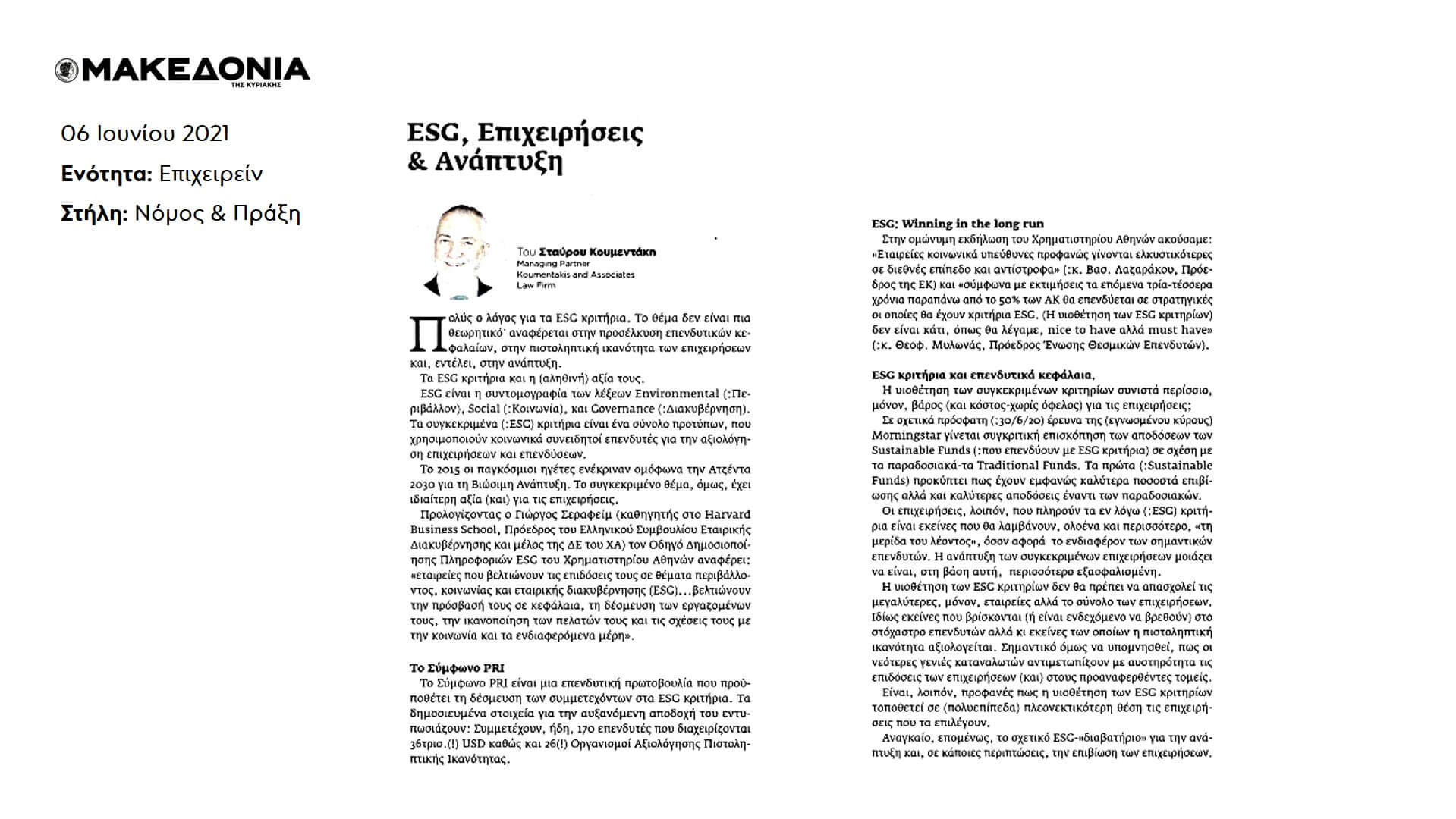
    P.S. A brief version of this article has been published in MAKEDONIA Newspaper (June 6, 2021).
    κριτήρια ESG

    Disclaimer: the information provided in this article is not (and is not intended to) constitute legal advice. Legal advice can only be offered by a competent attorney and after the latter takes into consideration all the relevant to your case data that you will provide them with. See here for more details.


  • The Remuneration Report of the members of the Board of Directors of SAs

    The Remuneration Report of the members of the Board of Directors of SAs

    The issue of remuneration of Board members has been repeatedly addressed in the context of our articles. And so has the conflict of interests of the latter with the SA for this reason; the related risks for the SA; the relevant interest of the company, the shareholders and, of course, the beneficiaries- and clearly the third parties: investors and banks. We have already noted that transparency issues and the need for shareholders to participate in the approval of remuneration are pursued through the “say on pay” principle (including: Articles 9a and 9b of Directive 2007/36 / EC, as amended by Directive 2017/828 / EU). Based on this principle, the remuneration of the members of the Board of Directors should be defined in such a way that the shareholders are able to express an opinion. Given the above, our national legislator re-approached the specific issue with the law on SAs (: Law 4548/2018). It brought, on the one hand, some changes in the procedure and the conditions for granting remuneration to the members of the Board of Directors on the basis of their organic relationship (: Societe Anonyme: Remuneration of the Members of the BoD). It incorporated, on the other hand, two important tools for the transformation of the above principle into national law: (a) the Remuneration Policy and (b) the Remuneration Report. We will then deal with the latter.


    Legislative Framework – The distinction of Remuneration Policy from the Remuneration Report

    The issues related to the Remuneration Policy and the Remuneration Report are regulated in the provisions of articles 110-112 of Law 4548/2018. In this way, the provisions of Articles 9a and 9b of the aforementioned Directive 2007/36 / EC-as in force are incorporated into Greek law.

    The two, in particular, tools aim at the transparency and the participation of the shareholders in the issue of the formation of the remuneration of the members of the Board of Directors. Mandatory for listed SAs. Optional for the others. The Remuneration Report retains its independence from the Remuneration Policy, however, it is inextricably linked to the latter. In any case, these are distinct texts, which present two main differences:

    (a) The Remuneration Policy is the means of structuring the strategy of the SA regarding the granting of remuneration to the members of the Board of Directors. It promotes, in this context, its sustainability and long-term interests. In this way, it addresses the future. On the other hand, the Remuneration Report is a comprehensive overview of the total remuneration granted per board member for the previous financial year. It concerns, that is, the previous year and is of  an accounting character.

    (b) Regarding the Remuneration Policy, the shareholders’ vote is binding. On the other hand, their vote on the Remuneration Report has an advisory character.


    Subjective and objective scope

    The Remuneration Report is drafted collectively by the Board of Directors of the SA (: article 96 §2 law 4548/2018). The responsibility they bear in case of any violation of the provisions regarding the Remuneration Report is also collective (: article 112 §6 b). Therefore, the members of the Board are responsible in cases of violation based on the provision of article 102 of law 4548/2018. They also bear criminal responsibility, based on the provision of article 179 §3 law 4548/2018.

    The Remuneration Report must include the complete overview of the remuneration of the members of the Board of Directors, which were foreseen to be paid by the Remuneration Policy of the previous financial year (: article 112 §1 law 4548/2018). This is a fact, regardless of whether the latter (: members of the Board of Directors) are newer, older, executive, non-executive or independent. The recording must be made, in each case, in a clear and comprehensible manner. However, its subjective field may occupy other persons as well. When, for example, by statutory regulation, the application of the provisions for the Remuneration Policy and Report is extended to the executives, as they are regulated by the International Accounting Standards (article 24 §9). The latter, in this case, will refer to the payments of the specific persons as well.

    The concept of remuneration, in the context of the Remuneration Report, is conceptually identical to that of the Remuneration Policy. In other words: the Remuneration Report includes the total remuneration granted (or still owed) to the members of the Board of Directors in their organic capacity and position. The Remuneration Report is not interested in other fees. Such as, for example, those that are due, in a special relationship deriving from an employment, mandate, independent services or works contract [int .: Societe Anonyme: Contracts with Members of the BoD for the Provision of (Additional) Services].


    Content

    The minimum content of the Remuneration Report is provided in the provision of article 112 §2, law 4548/2018. At the same time, the European Commission has adopted a targeted consultation with guidelines for the standard presentation of the information contained in the earnings report. The final guidelines are still pending.

    The content of the Remuneration Report concerns the remuneration of each member of the Board separately. It basically includes: (a) the total remuneration paid as well as the way the manner it was paid was in accordance with the approved Remuneration Policy; (b) the annual change in remuneration, the performance of the company and the average remuneration of employees, excluding executives, during the last five years. The Remuneration Report also mentions: (c) any remuneration of any kind coming from any company belonging to the same group; (d) participation in equity schemes; (e) the options exercised; (f) information on the possibility of reclaiming remuneration; (g) the circumstances under which derogations from the remuneration report may have taken place, in accordance with the provisions of Article 110 §6 (inadvertently in Article 112 §2 f.g. reference is made to the repealed §7).


    The advisory vote of the shareholders

    The shareholders vote (in the context of the ordinary General Assembly with the relevant item on the agenda) on the remuneration report of the last financial year. Their vote, however, is advisory. This means that the shareholders’ decision does not bind the SA, although the voting is mandatory. The Board, however, has an additional obligation regarding the outcome of this vote. Specifically, it “… must explain in the next Remuneration Report the way in which the above result of the vote was taken into account…” (art. 112 §3 Law 4548/2018). It is concluded, therefore, that the SA may not take into account the above result at all, as long as it explains the way it worked in the next Remuneration Report that it will submit to the General Assembly.


    Publicity Formalities and Personal Data

    The Remuneration Report is subject to specific publicity formalities. The SA, however, must also post the Remuneration Report on its website, immediately after the relevant vote of the General Assembly. This posting must be for a period of ten years (article 112 §4 of Law 4548/2018). The period of posting can exceed the ten years, in case it no longer includes personal data of the members of the Board.

    We therefore confirm that the provisions of Law 4548/2018 are intertwined (and) in this case, with the requirements of Regulation 679/2016 / EC for the Protection of Personal Data. As already mentioned, the Remuneration Report refers individually to each member of the Board. This means that their personal data are being processed. The legal basis of this processing is the provision of article 112 §5 of law 4548/2018. The purpose of the processing in this provision is defined as the increase of transparency “… regarding the remuneration of the members of the Board of Directors, with the aim of strengthening the accountability of the members and the supervision of the shareholders on these remunerations”. However, the special categories of personal data according to article 9 §1 of the Regulation are explicitly excluded from the above processing and the Remuneration Report. These are the personal data that reveal “… racial or ethnic origin, political views, religious or philosophical beliefs or participation in a trade union, as well as the processing of genetic data, biometric data for the purpose of unambiguous identification of health or data relating to the sexual life of a natural person or sexual orientation “. In case, for example, that the granting of an allowance depends on any illness of the member of the Board of Directors, the Remuneration Report should include only the amount of this allowance. The cause must not be mentioned.


    Judicial review and the possibility of reducing salaries

    In the case of the Remuneration Report, the provision of article 109 §7 of Law 4548/2018 applies to the possibility of reducing remuneration after the issuance of a court decision. Such a reduction may take place in cases where there was a substantial change in the conditions under which the Remuneration Policy was approved and it was not revised (article 110 §2 law 4548/2018). This is, essentially, a judicial review of the Remuneration Policy. The application to the competent court, in this case, is exercised within an exclusive period of two (2) months from the voting on the Remuneration Report.

    The compliance review with the approved Remuneration Policy of the SA is carried out by the Remuneration Report. It would not be possible, after all, to approve remuneration for the members of the Board of Directors (and / or specific executives) without providing a compliance review.


    The obligation to prepare a Remuneration Report (for the review of the approved Remuneration Policy) is borne, as we mentioned in the introduction, by companies with shares listed on a regulated market. They both contribute to increasing corporate transparency and strengthening the (necessary) corporate governance. The accountability of the members of the Board of Directors and the supervision of the shareholders on their salaries is strengthened. They therefore promote the interests of the company and its shareholders. They make the companies that adopt them more transparent (and, therefore, attractive for investors).

    Therefore, their adoption by all companies is desirable.

    Even by the non-listed ones.-


    Stavros Koumentakis
    Managing Partner


    P.S. A brief version of this article has been published in MAKEDONIA Newspaper (April 11, 2021).


    Disclaimer: the information provided in this article is not (and is not intended to) constitute legal advice. Legal advice can only be offered by a competent attorney and after the latter takes into consideration all the relevant to your case data that you will provide them with. See here for more details.

  • The Remuneration Policy of the members of the Board of Directors of the SA

    The Remuneration Policy of the members of the Board of Directors of the SA

    The remuneration of the members of the Board of Directors of an SA is a “hot” issue for everyone interested: the company, the shareholders and, of course, the beneficiary. But it also interests third parties: investors and banks. Our national legislator re-approached this issue with the law on SAs (Law 4548/2018). The procedure and conditions for granting remuneration to the members of the Board of Directors on the basis of their organic relationship were covered in our previous article (: Societe Anonyme: Remuneration of the Members of the BoD). At the present article, we will be concerned with the Remuneration Policy. A Mandatory Policy for companies with shares listed on regulated markets (Article 110 §1). A policy welcome, without a doubt, by the rest.

    Remuneration of board members and conflict of interest ˙ the (global) debate

    The remuneration received by the members of the Board of Directors may, under certain conditions, be detrimental to the SA. This is, moreover, a typical case of conflict of interests. It can be proven harmful when, for example, in some cases they are associated with the achievement of high goals (indicatively: the company’s turnover). It is then possible for the members of the Board of Directors to sacrifice the management of the SA by excessive risk-taking, on the altar of achievement of their, short-term, own benefit.

    The recent long-term financial crisis “brought” to our country the global debate over the exorbitant fees of the members of the Board. The basis of the relevant concerns is often the lack of sufficient transparency but also the substantial participation of the shareholders in their approval. Their goal is to defend, ultimately, the corporate interest.

    The achievement of this objective is pursued through the “say on pay” principle (inter: Articles 9a and 9b of Directive 2007/36/EC, as amended by Directive 2017/828/EU). Based on this principle, the remuneration of the members of the Board of Directors should be defined in such a way that the shareholders are able to express an opinion. The tool of its implementation is the Remuneration Policy (as is the Remuneration Report) which have already been transposed into national law.


    Legislative framework

    The national legislator regulated the matters related to the Remuneration Policy (and the Remuneration Report) in the provisions of articles 110-112 of law 4548/2018. In this way, it incorporated into Greek law the provisions of articles 9a and 9b of the aforementioned Directive-as in force.

    With the Remuneration Policy (article 110 and 111 of law 4548/2018), which will concern us in this article, the strategy of the SA regarding the granting of remuneration to the members of the Board of Directors is structured. The SA’s sustainability and long-term interests are also promoted. The content of the Remuneration Report (article 112 of law 4548/2018) regards the remuneration granted to the members of the Board of Directors (or that are still due) for the previous year. It is not permissible, of course, for the paid salaries to deviate from what the Remuneration Policy stipulates.


    Remuneration policy

    The obligation to establish it

    As we “hurried” to note in the introduction, not all SAs are obliged to adopt a Remuneration Policy. This obligation is typically borne only by companies with shares listed on a regulated market. Both for the members of the Board of Directors and for the general manager, if any, and their deputy (article 110 §1). However, with a relevant statutory regulation, it is possible to apply the provisions for the Policy and Remuneration Report in two more cases: (a) to the executives, as they are regulated by the International Accounting Standards (article 24 par. 9) and (b) to unlisted SAs. We aim, in these cases, for greater transparency towards the shareholders. For the benefit, in the end, of SA.

    The obligation to establish a Remuneration Policy covers the remuneration granted to the members of the Board of Directors in their organic capacity and position. It does not cover, in other words, other fees. Such as, for example, those that are due for a special relationship of employment, mandate, independent services or works [int .: Societe Anonyme: Contracts with Members of the BoD for the Provision of (Additional) Services].


    The responsibility of the General Assembly

    Competent body for the approval of the Remuneration Policy is defined by law (article 110 §2) to be the General Assembly. This is a transformation of the principle we have already mentioned: “say on pay” [principle, which, however, already existed in the pre-existing national law (art. 24 par. 2 law 2190/1920)]. The shareholders’ vote is binding. In other words: the SA has no right to deviate from the decision of its shareholders.

    A simple quorum and majority is sufficient for the decision of the General Assembly (for the approval, ie, or not of the Remuneration Policy). In the initial wording of Law 4548/2018, it was provided that in the relevant voting the shareholders who happened to be, themselves, members of the Board of Directors did not have the right to vote. This prohibition is no longer in place (: abolished by law 4587/2018).

    In case of approval of the Remuneration Policy by the General Assembly, its duration extends, at a maximum, to four years from the relevant decision. It will, however, require further submission and approval by the General Assembly, when the conditions under which it was approved change substantially (even within four years) (Article 110 §2).

    When the General Assembly is called upon to approve a new Remuneration Policy after the expiration of the previous one, it is, of course, entitled to reject it. In this case the company is bound by the Policy previously approved. The duration of the latter is extended until the next General Assembly, when a new, revised Remuneration Policy is submitted (article 110 §4).


    The possibility of deviating from the Remuneration Policy

    The obligation to re-submit for approval the Remuneration Policy should be distinguished from the possibility of derogation from it (Article 110 §6). The specific / provided for derogation is, in exceptional circumstances, permissible. As long as three, basic, conditions are met. Specifically:

    (a) There is a relevant provision in the Remuneration Policy of the procedural conditions for the derogation.

    (b) There is a relevant provision in the Remuneration Policy of the items in respect of which the derogation may occur.

    (c) The need for the derogation serves the long-term interests of the company as a whole or ensures its viability.


    The body responsible for submission of the Policy to the General Assembly

    The Board of Directors is the competent body of the company for the submission of the Remuneration Policy to the General Assembly for approval. It is true that the specific competence of the Board of Directors does not explicitly arise from the wording of the law. On the contrary, it is derived, as a collective duty of the members of the Board of Directors, to ensure the preparation and publication, inter alia, of the Remuneration Report (article 96 §2 of law 4548/2018). However, we do not find a corresponding provision for the Remuneration Policy. This, however, does not mean that the members of the Board do not have the obligation to draft the Remuneration Policy and submit it to the General Assembly.

    An different interpretation would not be compatible with the recent law on corporate governance (Law 4706/2020). As we mentioned in a previous article [The (new) law on Corporate Governance (and a comparative overview with the preexisting one)], the relevant law introduces, in addition to the Audit Committee, two additional committees of the Board (Article 10): The Nominations Committee and the Remuneration Committee. The latter is responsible for: “formulating proposals to the Board of Directors regarding the remuneration policy submitted for approval to the General Assembly, in accordance with paragraph 2 of article 110 of law 4548/2018” (: article 11 a’). In addition, it examines the information included in the Remuneration Report, providing an opinion to the Board of Directors (art. 11 par. C).


    The content of the Remuneration Policy

    The provisions of the Remuneration Policy must be recorded in a clear and comprehensible manner. Its (minimum) content is determined, in sufficient detail, in the provision of article 111 §1 law 4548/2018 (which constitutes an exact transposition of the relevant provisions of article 9a of Directive 2007/36/EC).

    The minimum content, for example, should be the way in which this Remuneration Policy contributes to the business strategy, the long-term interests and the viability of the company. In addition, the different components for the granting of fixed and variable remuneration of all kinds as well as the criteria for their granting. The methods used to assess the degree of fulfillment of the specific criteria. The conditions for the postponement of the payment of the variable remuneration and its duration. The duration and content of the employment contracts of the members of the company’s Board of Directors – any existing retirement plans. Any share disposal rights and options. The decision-making process for the approval and determination of the content of the remuneration policy and so on.


    The disclosure formalities

    The central goal of the Remuneration Policy of the members of the Board of Directors is to enhance transparency. The justification is the possibility of constant information of all interested persons (especially shareholders and investors). It is therefore not paradoxical that the Remuneration Policy is made public (articles 110 §5 as well as 12 & 13). At the same time, however, it must remain available on the company’s website for as long as it is valid (art. 110 par. 5).


    The existence and, in particular, the proper implementation of the Remuneration Policy of the members of the Board of Directors, constitutes an important obligation of the companies that have shares listed on a regulated market. This obligation arises from the (recent) law on Société’ Anonymes. However, it also has strong foundations in the (absolutely recent) law on corporate governance.

    The value of the Remuneration Policy lies in the strengthening of corporate governance. And where the latter is strengthened, the companies that invest in it end up benefiting. After all, what investor will not see positively a company that has invested in corporate governance? Which bank will not, at least, increase the creditworthiness of a company with a strong relevant performance? Any relative costs for adopting a Remuneration Policy and complying with its content seem small compared to the reasonably expected benefits.

    Obviously for unlisted companies as well.

    Especially, perhaps, for them.-


    Stavros Koumentakis
    Managing Partner


    P.S. A brief version of this article has been published in MAKEDONIA Newspaper (April 4, 2021).


    Disclaimer: the information provided in this article is not (and is not intended to) constitute legal advice. Legal advice can only be offered by a competent attorney and after the latter takes into consideration all the relevant to your case data that you will provide them with. See here for more details.

  • Societe Anonyme: Remuneration of the Members of the BoD

    Societe Anonyme: Remuneration of the Members of the BoD

    The Board of Directors of the Société Anonyme acts, in principle, collectively. However, it is possible (: a rule without exceptions) to delegate the powers to bind and represent to a specific member. It is also common for board members to associate with the SA through special relationships. Indicatively, with contracts of employment, works, independent services or mandate. These contracts (also) provide for the fees that the SA (must) pay them for their specific, additional, services. These issues have already occupied us in our previous article [: Contracts of Board Members for the Provision of (Additional) Services]. In this article we will deal with the issues of remuneration of the members of the Board of Directors that the SA (sometimes) pays them in the context of their internal relationship. In the latter case, the legal basis for the payment of remuneration must be sought in the articles of association, in a decision of the General Assembly or in the remuneration policy that may be adopted by the SA (: obligatory if it is listed).


    Establishment of a control mechanism in the remuneration of the members of the Board of Directors

    As already announced by the explanatory memorandum of law 4548/2018, the remuneration regime of the members of the Board of Directors is reformed (with articles 109 et seq.). A specific framework is chosen for the protection of the SA and the minority shareholders. The justifying reason? The risk of impairment of the corporate assets of the SA due to exorbitant fees and other, disproportionate benefits.

    It is noteworthy, however, that the specific provisions (Articles 109 et seq.) “… do not apply in the case of compensations and expenses paid under an approved by law, where required, legal relationship (eg expenses in the context of work or mandate) and / or provided by law (eg CC 723), as after all, it is still valid today, in accordance with the position of the case law”. In other words, what is regulated in independent contracts between the Company and the members of its Board of Directors: (a) is valid independently (we also addressed the specific issues in our aforementioned article) and (b) is not occupied by the regulatory scope of the provisions that we attempt to approach here.

    Therefore, based on the type of remuneration that the members of the Board of Directors may receive in the context of their organic relationship, the terms, the procedure of their granting (but also the relevant restrictions in place) are analyzed as follows:

    Fees and benefits that do not consist of participation in the profits of the year

    Types of fees and other benefits

    The remuneration of salaried consultants consists of a fixed, as a rule, “remuneration”. This, however, is not a rule without exception. The type of pay varies depending on the case. It may take, as an indication, the form of compensation per session or the award of a bonus. Other benefits may include housing, security and / or a car.

    The determination of fees in the articles of association or in the remuneration policy of the company

    Remuneration or other benefits are legally paid to the members of the Board of Directors – provided that there is a relevant provision in the articles of association or in the remuneration policy of the company (article 109 §1 law 4548/18). In more detail:

    (a) Regarding the (possible) provision in the articles of association

    The articles of association may provide for the granting of remuneration to specific (or all) members of the Board. This possibility seems more theoretical as we will rarely and in very special cases encounter it. These are fees, the granting of which concerns (obviously) the future. Retrospective forecasting is excluded. In addition: a mere reference to the articles of association regarding the right to receive remuneration is not enough. The fee must be specified (in the amount and the conditions of its payment) in the articles of association.

    In case it is required to mediate a decision of the General Assembly for its determination, it is considered (and it is) a fee which is granted after the approval of the General Assembly (see below) and not on the basis of the statutory provision.

    We should consider that the regulation of the remuneration determined by the statute also includes the provision for the maximum, the final amount of which is determined by a decision of the General Assembly. However, the same does not apply in those cases where the statute stipulates its minimum amount and it is left to the General Assembly to determine the amount to be finally paid. We must consider, in the latter case, that this is a fee determined by the General Assembly.

    The statutory provision for the payment of remuneration to the members of the Board of Directors may exist in the initial statute of the SA- the one drafted for its establishment. It is, however, possible that the relevant provision will be introduced later – after an amendment, ie, of the statute by a decision of the General Assembly. Unless otherwise provided by the Articles of Association, the relevant decision shall be taken by the usual quorum and majority.

    (b) Remuneration policy

    The determination of fees in the company policy is regulated, specifically, by articles 110-111 of law 4548 / 2018. Remuneration policy arrangements are mandatory for companies with shares listed on a regulated market. Of course, this does not rule out the possibility that other companies will adopt a similar remuneration policy. For these latter companies, the relevant statutory provision is necessary in any case. The further analysis, however, of the remuneration policy will be the subject of a different article of ours.


    The granting of fees after a special decision of the General Assembly

    In the event that there is no provision in the law or the articles of association of the SA (and without prejudice to the provisions of the remuneration policy): “… remuneration or benefit granted to a member of the board of directors… shall be borne by the company only if approved by a special decision of the General Assembly…” (article 109 §1 law 4548/18).

    In contrast to the pre-existing law (article 24 §2 b’ of law 2190/1920), article 109 refers to a decision of the General Assembly and not of an ordinary General Assembly. This does not mean, however, that the relevant responsibility is now assigned to the extraordinary General Assembly. The argument in favor of the exclusive competence of the ordinary General Assembly is not without value.

    The above, approving, decision of the General Assembly should be specific. Therefore, the approval of remuneration or other benefits to the members of the Board of Directors should be an independent item on its agenda. The decision for the approval is taken with the usual quorum and majority. However, it is possible for the articles of association to introduce increased, respectively, percentages. It follows from the wording of the provision that the approval of the General Assembly for the granting of remuneration or other benefits can only concern the previous corporate year. A corresponding approval for future payments cannot take place – but it is possible to pay sums in advance for future fees (as we will see later on).


    Fees from the participation in the profits of the year

    For the granting of remuneration consisting of corporate profits, a prerequisite is the relevant provision in the articles of association of the SA. However, the general, relevant, provision is sufficient. The determination of the amount of these fees may take place following a decision of the General Assembly. The decision shall be taken, as defined in paragraph 2 of Article 109, by a simple quorum. A GA, in this case, is considered the ordinary one.

    The fees in this case are taken from the balance of net profits that may remain after deducting the amounts corresponding to the formation of the regular reserve and the distribution of the minimum dividend (: articles 160 §2 and 161 Law 4548/2018). It is possible, however, in any case, for the articles os association to impose further restrictions.

    The specific fees, therefore, are directly dependent on the existence of profits: It is not possible to approve (and, much more, pay) such fees when there are no profits. This works in favor of the company in two ways: (a) It is not possible for the company to be burdened when it has no profits and (b) It provides (indirect) incentive to the members of the Board of Directors to maximize the profitability of the SA.


    The advance payment of fees

    As already mentioned above, it is possible to pay an advance to members of the Board of Directors: “The General Assembly may allow an advance payment for the period up to the next ordinary General Assembly. The advance payment of the fee is subject to its approval by the next regular General Assembly” (article 109 §4 law 4548/18). The law does not specify the fees that may be paid in advance. However, it is not considered possible to pay a fee in the case of:

    (a) Profit sharing

    It is not considered possible to deposit fees that will eventually consist of a participation in the company’s profits. This is because, at the time of the down payment, it is not possible to make a secure prediction of the existence of net profits; much less to determine the net profits available to board members for remuneration.

    (b) Fees provided by the articles of association

    Advance payment of fees, the granting of which is provided for in the articles of association of the SA, is also not considered possible. The reason is that these fees are paid under the terms, conditions, time and procedure provided therein.


    Judicial review of the amount of fees

    The grid of regulations set by article 109 of law 4548/2018 does not let the decisions concerning the payment of remuneration to the members of the BoD go virtually unchecked even when the set conditions are met. In fact, the relevant choice of the legislator seems reasonable as it is not uncommon for the majority of the shareholders to decide to grant unjustifiably high salaries to members of the Board. Such decisions are usually taken in those cases where the majority of the shareholders (or persons related to them) happen to be members of the Board, without the latter really being entitled to the fees decided to be paid to them.

    In these cases, the right of minority shareholders to oppose to the decision for the payment of remuneration or benefit, of any kind, to a specific member of the Board is recognized. A necessary (formal) condition is that the minority shareholders represent 1/10 of the paid up (according to the most correct point of view) capital of the SA. If the specific formal condition is met, the court may (at the request of shareholders, by those who objected, representing 1/20 of the paid up capital -article 109 §5 law 4548/2018) evaluate, based on the data which will be taken into account, that the remuneration decided to be paid to a member of the Board is excessive and should be reduced.

    The application to the court must be submitted within an exclusive period of two months from the relevant approval of the General Assembly. It is noted, however, that the fees paid to the members of the Board on the basis of a special relationship / contract are outside the framework of this judicial review.


    We should consider it reasonable and, at the same time, imperative to have a clear separation (first of all in our minds) of the qualities of the shareholder, the member of the Board of Directors but also of the employee / provider of services to the SA. In this context, we must accept that the specific persons (must) have a different benefit from their participation in the SA. The shareholder from the dividends due to them; the employee / service provider from the fees provided by the relevant contracts; the member of the Board of Directors from the fees provided (or not) by the statutory regulations and possible decisions of the General Assembly.

    It is true that (especially) in the context of family SAs the aforementioned qualities are “blurred”. It is in these cases that, above all, there should be a separation of the company’s finances from the pocket of the entrepreneur, the establishment of (not mandatory but necessary-essentially) rules of corporate governance.

    In fact, this is not only for the benefit of minority shareholders. It is mainly for the benefit of the company but also of its development.

    Stavros Koumentakis
    Managing Partner


    P.S. A brief version of this article has been published in MAKEDONIA Newspaper (March 21, 2021).


    Disclaimer: the information provided in this article is not (and is not intended to) constitute legal advice. Legal advice can only be offered by a competent attorney and after the latter takes into consideration all the relevant to your case data that you will provide them with. See here for more details.

  • BoD vs SA: The obligation to omit competition

    BoD vs SA: The obligation to omit competition

    In a previous article we dealt with the provisions of the law regarding the treatment of cases of conflict of interests of the members of the Board of Directors with the SA (BoD Vs SA: The Conflict of Interests Between them). We were concerned, in particular, with the fiduciary duty of the members of the Board of Directors towards the SA. In this context we find the obligation to promote the interests of the company against the own interests (: obligation to act). In this article we will be concerned with another aspect of it (obligation to not act): the obligation to omit making competitive acts.


    Competitive acts

    The conflict of interests of the members of the Board of Directors with that of the SA can also appear in the form of the former conducting competitive acts. In this context, the legislator introduced a specific, relevant, prohibition. This is the obligation to omit competition (article 98 of law 4548/2018). The latter also stems from the fiduciary duty. The case law treats it as the main aspect of this obligation (ind. 797/2010 Supreme Court).


    The legislation

    Article 98§1 of Law 4548/2018 provides: “It is prohibited for the members of the board of directors who participate in any way in the management of the company, as well as for its directors, to act, without the permission of the General Assembly or the relevant provision of the articles of association, for their own account or on behalf of third parties, transactions that fall under the scopes of the company, as well as to participate as partners or as sole shareholders in companies that pursue such objects”.

    This legislation seems perfectly justified. It is enough to consider the scope and type of information available to those who exercise the management of the company. This is completely confidential information that is linked, in the end, to the attempt of the SA to prevail over its competitors.

    But who are the people who have access to the above information?


    Who is affected by the non-compete?

    The non-compete concerns any person who participates in any way in the management of the SA. This means that this person can be in a relationship of a “structural” nature with the legal entity. That is, to be on the board of directors. After their election, for example, as a member. Alternatively: after their direct appointment by a shareholder (based on a relevant statutory regulation) or their temporary appointment (: based on a court decision). The non-compete, however, applies equally – according to the letter of the law – to the directors – that is, the substitute bodies of the Board. In fact, the specific prohibition does not differ in the case of a single-member administrative body. Subject to, of course, the non-coincidence in the same person of the qualities of the director and the sole shareholder (in the case of the single-member SA).

    A debate, however, has started as to whether the ban covers only the executives of the SA or extends to the non-executives as well. In the prevailing (and, we estimate, correct) view, this prohibition applies indiscriminately to both the executives and non-executives of the SA. This is because the law does not differentiate the extent of the latter’s fiduciary duty towards the SA. It is also argued that this prohibition also applies to the liquidators of the SA, to whom the provisions for management are applied (article 167 par. 2 Law 4548/2018).


    Which acts are competitive?

    Article 98 of law 4548/2018 expands the objective scope of the prohibition of competition in relation to the relevant article previously in force (: article 23 of law 2190/1920). However, the prohibition of competition still includes the performance of acts by the liable persons, which are under the company’s statutory objectives. Also, the participation of the liable persons as partners in personal companies that pursue the above objectives. Furthermore, the new provision explicitly prohibits such persons from participating as sole shareholders or as partners in companies pursuing the same objectives as the SA. In this way, the ambiguities regarding the indicative or exclusive enumeration of the previous provision and the inclusion (or not) of other corporate types in the provision of article 23 of law 2190/1920 were addressed.

    At the same time, according to the established position of the jurisprudence “… competitive acts are considered those that are similar to those that fall within the objectives of the company. Thus, the competitive activity includes the direct competition with the establishment of a competitive enterprise, but also the indirect one, with the participation in a competitive enterprise “(797/2010 Supreme Court).

    Corporate objectives mean (: as reasonably expected), those provided by the articles of association. However, the real financial activity of the company proves to be of major importance. This activity includes both the current activities of the SA and the future ones. That is, those that are likely (much more: expected) to be practiced even in a different, related, market.


    The lifting of the ban

    The statutory provision for the lifting of the ban

    The possibility of the articles of association of the company entailing a provision for the lift of the prohibition to act competitively was not expressly provided for in the pre-existing law. It therefore seemed doubtful whether the general lifting of the ban through a provision of the statutes was lawful. That is, whether the granting of a general permit was legal – without it being linked to specific persons and / or acts. The voices of the minority were in favor of this possibility. Opponents, however, held back, expressing well-founded fears of such a possibility. They argued, in particular, that the ex ante general statutory exemption constituted a source of jeopardy of the pursuit of the corporate objectives. Liable persons this way can be in a constant conflict of interests with the SA. A conflict that may pose internal risks to the SA and to its operation for the pursuit of its own interests.

    However, Article 98 §1 of Law 4548/2018 now explicitly provides for the possibility of statutory lifting of the prohibition of competition. The legislator with this provision seems to show confidence in the founders and shareholders of the SA and extends the statutory arrangements that they can make. The legislator accepts (and rightly so) that it is able to understand the disadvantages as well as the risks of such arrangements.

    Statutory provisions of this content may be included in the articles of association from the establishment of the company. However, it is also possible to add them afterwards – after a relevant amendment. This amendment obviously requires a decision of the General Assembly, which is taken by a simple quorum and majority. An exception to this decision may be made by the articles of association. In this case, an requirement for an increased quorum and majority on this issue can be provided for.


    The permission of the General Assembly

    A different way to legitimize the conduct of unauthorized competitive acts is the permission of the General Assembly. Like the act of appointment of the member of the Board of Directors, the said permission of the General Assembly is characterized as an act of an organic nature. Acceptance of this license by the one affected is not required.

    This permission can be solely granted by the General Assembly. It is not transferable. The General Assembly, therefore, as the sole competent body, has the right to decide on this permission by a simple quorum and majority. Including, in fact, the vote of the interested party, if they happen to also be a shareholder. This shareholder is not deprived of the right to vote. The relevant decision of the General Assembly is subject (like any other) to a review for unfairness. In any case: the articles of association can call for percentages higher than the simple quorum and majority.

    The decision of the General Assembly to grant the above permission must, in addition, be explicit and specific. Permission that (can be argued that) is presumed or that is implicitly inferred, is not enough. As regards its content, this permission may include specific acts or be of a general nature. It must specify the duration of exercise of the permitted competitive acts or that the permission is provided for an indefinite period. It may also be granted subject to revocation. The content of this decision is based on the avoidance of risks that may arise. Therefore, the decision of the General Assembly (as a condition for the legal exercise of competitive acts) has an advantage over the corresponding statutory authorization. The latter cannot weigh the specific risks of the case that will arise in each case, given its (necessary) generalization.

    The permission of the General Assembly should be granted before the conduct of the competitive acts. Any ex-post authorization constitutes, in the prevailing view, a waiver of any claims which may arise (Article 98).


    The legal consequences of the relevant infringement

    The legal consequences of any violation of the prohibition of conducting competitive acts are provided in article 98§2 of law 4548/2018. The SA as the beneficiary of the claims is entitled to choose between: (a) compensation, (b) to substitute the debtor in claiming any financial gain and (c) the return or assignment of the claim of the debtor. At the same time, it maintains (based on what is generally provided for) additional claims. Among them: the claim for the cessation and omission in the future of the competitive acts by the liable party, the right of revocation of the liable member of the Board of Directors or the right to terminate the contract of the offender for a great reason – when the liable person is contractually associated with the SA. It is noted that the exercise of prohibited competitive acts, as a conflict of interest between the Board of Directors and the SA may lead to a judicial appointment of an interim administration (69 Civil Code). It may even be required.

    The case of the crime of violation of the fiduciary duty (390 Penal Code) should, in any case, not be excluded.

    In particular (regarding the civil claims of the SA):

    (a) Regarding the claim for compensation

    The basis of the claim for compensation is on the one hand the provision of article 98 §2, on the other hand the provisions for torts. In order for a claim for compensation to be created, a number of conditions must be met. Among them, the legal reason for liability and the other conditions of the law of torts. Specifically: the existence of damages and the causal link between the statutory liability and the damage caused. The company suffers a loss in the cases where due to the competitive behavior of the member of the Board of Directors or Director, it lost a business opportunity which would otherwise be undertaken by it. Or, similarly, in cases where due to the above behavior it had to incur expenses and reduce its assets or increase its liabilities. The person under the non-compete is, of course, liable for the compensation, while the compensation they are required to pay must compensate the actual loss of the SA.

    However, it is important to point out the extent of the (sometimes insurmountable) difficulty we encounter in practice in accurately determining the actual damage suffered by the SA. Also, for the connection of the damage with the prohibited competitive act (: causal link).


    (b) Regarding the right of financial substitution of the SA in the position of the liable party

    As mentioned above, the difficulties of proving the causal link with the amount of damage caused are significant. This problem is tackled, in part, through the exercise of the other rights of the company recognized by article 98 §2. Such a right is the right of substitution. On the basis of this right, the SA is entitled to claim the return of the respective net benefit obtained by the debtor by violating the obligation not to conduct competitive acts. In other words, it is considered that the transactions performed on behalf of the debtor took place on behalf of the company.

    Through the exercise of this right, the SA does not enter into the contractual relations of the debtor with their counterparties and the validity of these contracts is not affected. On the contrary, the debtor is obliged to reimburse all the benefits received after deducting the expenses incurred.


    (c) Regarding the claim of return or assignment of the debtor’s remuneration claim to the SA

    The obligor may, of course, carry out competing transactions not on their own account but on behalf of third parties. In this case, the SA reserves the right to claim either the fee received by the debtor for the mediation or the assignment of the relevant claim from the third party.

    The concept of the fee must be interpreted broadly. Included in this is any property benefit that the debtor derives from their illegal behaviour. The property benefits of the obligor may derive either from a contractual relationship (between them and the third party) or from an organic relationship. In the latter category falls the case of the debtor particilating in the Board of Directors of another company that pursues the same purposes as the adversely affected SA. So, in this case, the debtor must pay in addition to any dividends, fees, etc. received by them as a member of the Board of Directors, any other benefits they obtained (eg the right to free distribution of shares or the right of option to acquire shares-stock options).


    The duration for the obligation to omit competition

    According to the settled position of the case law “… The obligation to omit competition ceases to be valid in any way upon termination of the capacity of consultant, who participates in the management of the SA or as its director…”. However, as it is accepted, it becomes possible to extend the obligation even after the termination of the above status or the departure of the obligor from the company, with an explicit contractual obligation (post-contractual non-compete clause). The latter is in principle valid (797/2010 Supreme Court). The validity of the prohibition clause, however, depends, as the case-law accepts, “… on its validity, its extent, the prohibited professional activity and the compensation to which the company is entitled if the obligor disregards their contractual obligation of non- compete…” (Indicatively 5131/2011 Court of Appeal of Athens, 797/2010 Supreme Court).


    Limitation period

    Finally, Article 98§3 provides for the limitation period of the above claims. The limitation period reserved for these claims is short. It is provided, in particular, that the claims described above expire only one (1) year after their announcement at a meeting of the Board of Directors or their notification to the company. Therefore, the action of the SA to deal with such behaviours and be compensated for the damages suffered must be immediate. In any case, the expiration of these claims occurs five (5) years after the realization of the prohibited act.


    Participation in the Board of Directors of a Societe Anonyme is not without responsibilities. Not without restrictions. One of the most important amongst them: the non-compete obligation.

    A possible breach of the relevant non-compete creates significant (and often unproven) damage to the company. Of course, it also creates an obligation to restore it by the offender. Criminal liability (sometimes serious) should not be ruled out.

    The relevant vigilance during the operation of the company is not enough. The relevant, precise and specific in content, statutory provisions become absolutely necessary.

    More necessary, however, is the absolute compliance of the members of the Board with their relevant obligation.

    The principles of Corporate Governance require it.

    The law sets strict limits and threatened (civil and criminal) sanctions.

    However: the omission of such actions to the detriment of the legal entity should be based on the ethics and conscience of the members of the Board.

    In the absence of these, the members of the Board of Directors cannot have a place in the body.


    Stavros Koumentakis
    Managing Partner


    P.S. A brief version of this article has been published in MAKEDONIA Newspaper (February 28, 2021).


    Disclaimer: the information provided in this article is not (and is not intended to) constitute legal advice. Legal advice can only be offered by a competent attorney and after the latter takes into consideration all the relevant to your case data that you will provide them with. See here for more details.

  • BoD vs SA: The conflict of interests between them

    BoD vs SA: The conflict of interests between them

    The members of the Board of Directors of an SA are elected to serve and promote its corporate interests. However, it is not necessarily true that their personal interest are not in line with that of the company. Even worse: that they are not in conflict with them. This is when we are talking about a “conflict of interests”. How is it delimited? How can anyone manage it? How is it treated? What are the provisions of the law?


    The economic point of view

    In economics the problem of the principal and the agent (agency problem) is well known. The principal selects the agent in order for the latter to conduct the affairs of the former. The latter (: agent) is responsible for decisions that affect the wealth of the principal. This problem arises when the agent acts on behalf of their client, but acts in a way that does not serve the latter’s interests. According to economists, the main reason for the existence of this problem is the “asymmetry of information”.

    There are two categories of problems owed to asymmetry of information. These are: (a) the problem of moral hazard and (b) the problem of adverse selection. Regarding the latter (: adverse selection), we find it in those cases in which the principal, due to the asymmetry of information, chooses as an agent a person who does not have the ability (or the disposition?) To act in the interests of the principal.

    The conflict of interest between a member of the Board of Directors and the SA is one of the problems of moral hazard. Specifically, the agent has the opportunity to act in the interests of the principal but chooses to act in pursuit of their own, personal, interests.


    The solution to the problem: Corporate Governance and Law of SAs

    The (general) solution to the problem of conflict of interest is twofold. The application of the rules of corporate governance on the one hand and the coexistence with the law of the SA on the other.

    The application of corporate governance rules is proposed. And this, because through the alignment with them, the transparent operation of the members of the Board becomes possible. And so does the controlled structure of mutual interests.

    However, the legislator of the law of SAs also makes more specific regulations concerning the treatment of the problem of the conflict of interests of the members of the Board of Directors with the interests of the company. It is known that each member of the Board of Directors undertakes a fiduciary obligation towards the SA. Its manifestation is the avoidance of conflict of own interests. The legislator has established mechanisms for dealing with such cases of conflict. In order to establish, however, such cases, the corporate and the own interest of the members of the Board of Directors should be conceptually determined.


    The corporate interest

    It obviously does not make sense in the context of this article to start theoretically wandering between the unitary or the pluralistic theory. Let us limit ourselves to what is, according to the author – in simple words, currently applicated: The corporate interest is nothing but the interest of the SA. We can safely identify it with the interest of its shareholders – as a whole.


    The “own interest” of the Board members

    The delimitation of corporate interest seems simple. But what is the “own interest” of the members of the Board? The “own” means the direct and personal (eg financial, moral, etc.) interest of a member, whose satisfaction is in conflict with the satisfaction of the corporate interest.

    However, the own interest of the board member does not necessarily have to be linked to the member themselves – on a personal basis. In other words, the stakeholder may be a third party. But not any third party. They must be a person with whom the board member is connected in some way and can, presumably, influence them. Precisely because of the specific relationship between the member of the Board of Directors and a third party, the benefit of satisfying the interest of the latter can be reaped, in the end, (even indirectly) by the member of the Board of Directors. Therefore, in order for an “alien” interest to be considered as “own” interest of the member of the Board of Directors, the legal relationship that connects them with said third party must be examined.

    The legislator identifies these relationships. It provides, in particular, with cases in which the foreign interest is charged as the own interest of the member of the Board. When, for example, a transaction of the company is imminent with a person of the close family environment of the member of the Board of Directors. Also, with a legal entity controlled by the member of the Board (article 97 §3 in combination with articles 99 §2 law 4548/2018 and 32 law 4308/2015).


    Conflict of interest: the spotting of such cases

    A conflict of interest, therefore, exists in those cases in which the -necessary for the benefit of the SA- independent judgment of the member of the Board is affected (or may be affected) by the involvement of their own interest. These are the cases where the aspirations of the SA do not coincide (on the contrary: they are in conflict) with those of the member of the Board. Therefore, the satisfaction of one of the mutual interests excludes (in whole or in part) the satisfaction of the other interest.

    Such conflicts may have a lasting duration, such as e.g. when the member of the Board of Directors develops an activity competitive to the SA. However, they may also arise momentarily, such as e.g. in cases of the conclusion of a sales contract between the SA and a member of its Board of Directors. However, this conflict must have a certain heft, ie to be “substantial”.

    On the opposite side are the distant conflicts, which we do not need to worry about. This fact is also confirmed by the Explanatory Memorandum of article 97 of law 4548/2019. It states, in particular, that insignificant or distant conflicts of interests do not justify the abstention of a member of the Board of Directors from making a decision on the issue in question (which, as we will see later, is the most drastic way of dealing with cases of conflict of interests).

    Some cases seem more complicated: What happens when, for example, the member of the Board in which the conflict of interest is located is also a (large) shareholder of the company? Let’s not forget that the vast majority (: 80%) of Greek companies are family businesses…


    Conflict of interest: dealing with the cases

    Law 4548/2018 deals with cases of conflict of interest in Article 97. It provides, in particular, three basic rules. Specifically: (a) the priority of the corporate interest, (b) the obligation to disclose the case of conflict of interests of a member of the Board, (c) the prohibition of exercising the voting right of a member of the Board whose own interest conflicts with that of the SA.

    In addition to the provisions of article 97 of law 4548/2018, the legislator also deals with some special cases in articles 99-101 of law 4548/2018. These are the cases concerning the conflict of interests in the cases of the transactions of the members of the Board of Directors with the SA. This issue, as it is big and interesting, will concern us in our next article.

    But let us approach the basic rules of dealing with the conflict of interests:

    (a) The priority of the corporate interest

    As already mentioned, the members of the Board of Directors are in charge, with their election / appointment, with the fiduciary obligation. An obligation that they must always fulfill towards the SA. Its content is the acceptance of the priority of the corporate interest. Therefore, cases of conflict of interest between an SA and a member of its Board of Directors should always be resolved, according to the legislator, based on the principle of the priority of the interest of the SA.

    The legislator, moreover, is absolutely clear: It provides that the members of the Board of Directors (as well as any third party to whom responsibilities have been assigned) must ” … not pursue the own interests that are contrary to the interests of the company” (Article 97 §1 par. a΄ ν. 4548/2018).

    However, the above principle does not prohibit the members of the Board of Directors, in advance and in the abstract, from seeking the satisfaction of their individual interests, which are related to the interests of the SA. On the contrary, it prohibits, in particular, this pursuit from hindering, in whole or in part, the satisfaction of the interests of the SA. Therefore: the member of the Board, clearly has the right to act in their own interest. They are entitled, for example, to negotiate the amount of their salary in those cases in which, in addition to their organic position, they are associated with the company with an employment contract or a contract for the provision of independent services.


    (b) The obligation to disclose the case of conflict of interest

    The legislator has introduced another obligation for the members of the Board, in order to prevent cases of conflict of interest that may arise. This is the obligation of immediate, and sufficient, disclosure to the other members of the Board of the own interests, which are likely to arise in forthcoming transactions of the SA. This corresponding obligation is also borne by every third person to whom responsibilities have been assigned by the Board. This obligation also includes the disclosure of respective interests of any related natural and legal persons (article 97 par. 1 par. b’ of law 4548/2018).

    The information must be addressed to all members of the Board. However, no specific type is required. The person in charge of providing the information can choose to communicate the information orally or in writing. Of course, for reasons of proof, the provision of the information in written is preferable (eg its recording in the minutes of the Board of Directors, if it takes place during its meeting or, even better) before the start of the discussion of the issue in question).

    However, the information must be provided, in any case, in a timely manner. That is, before the situation of conflict of interests occurs. At the same time, as far as its content is concerned, the information must be sufficient; a mere mention of a possible conflict of interest is not enough. The member of the Board of Directors must describe: (a) the transaction of the company, in which the conflict of interests may arise and (b) their own related interests.

    Based on this information, the other members of the Board must be able to come to a substantiated conclusion for the existence of a case of conflict of interest. Also, for the risks that are created for the company.

    In case the obligated member of the Board of Directors omits to provide the required information, questions of liability towards the company are raised. If, of course, the other conditions of the generation of any relevant liability are met.


    (c) The prohibition of voting

    The law provides (article 97 §3 law 4548/2018) the deprivation of the right to vote from the member of the Board, in which the conflict of interests is located. It seems to be the most drastic way to manage such a situation. In this way, the possible lack of objectivity and / or their influence on the other members is addressed.

    It should be noted, of course, that the member of the Board of Directors, in whom the conditions for deprivation of the right to vote are met, is not taken into account neither for the formation of a quorum of the Board of Directors nor for the formation of the majority necessary for a decision.

    It is even argued that it is not enough for the member whose own interests conflict with those of the company to abstain from voting; they must also abstain from the relevant meeting of the Board. Proponents of this view argue that the member with the conflict may have been working to influence the BoD to act in favor of their (the member’s in question) and not the company’s interests. However, an ex ante, indiscriminate ban on their participation cannot be considered, without any doubt, correct. Let us not forget, after all, that you should never convict someone without hearing their point of view. However, it would be safer to judge on a case-by-case basis the question of the participation (or not) of said member of the Board in a relevant meeting.

    The deprivation of the right to vote, however, concerns, as already mentioned, only cases where the conflict of interest is considered significant. The relevant decision rests with the members of the Board. However, a possible incorrect evaluation makes the participation of the interested member of the Board of Directors in the crucial meeting defective. The decision taken at such a meeting does not, however, become illegal (article 102 par. Law 4548/2018). What matters in the end is the importance of the interested member of the Board of Directors for the achievement of the majority, as well as for the (possible) influence they exercised on the other members.

    After the deprivation of the voting right of the member of the Board of Directors in question, the other members make the decision. It is, of course, necessary to meet the conditions for forming a quorum for a decision. If the remaining members of the Board, for whom there is no inability to vote, do not form a quorum, they must convene a General Assembly. The sole purpose of the latter will be to take the specific decision for which issues of conflict of interest are raised.


    Sanctions

    At the civil level, the possible breach of the obligation of the member of the Board of Directors, by avoiding the declaration of conflict of interests, can be the basis for the request for the restoration of the damage that may have been caused to the company. However, the legal consequences that may occur each time depend on the form that the violation will take. Such legal consequences e.g. is the invalidity of the vote of a member of the Board of Directors or, much more, the invalidity of the decision taken by the Board of Directors.

    At the criminal level, however, the case of breach of the fiduciary obligation of the article 390 of the Penal Code may also occur. In this case [“whoever knowingly damages the property of another, whose custody or management (total or partial or only for a certain act) they have under the law or under a legal act, is punished…”]. The sentence will be imprisonment of “at least three (3) months” or, in more serious cases, “imprisonment of up to ten years”.

    In short: Sanctions do not seem, nor are they, to be neglected…


    Joining an SA BoD can often seem like an easy (or plainly for the formalities) affair. Sometimes it can be. Some others, however, it is not. It may even prove to be particularly complicated. The conflict of interest of a board member is in the latter category.

    It is not always easy to manage such issues. How easily can one manage such a situation when the board member (with a conflict) is also a shareholder or, even worse, a major shareholder of the company? When the conflict of interests stems from (known or not) competitive activity of the member of the Board?

    Conflicts of interest take many forms.

    The law (correctly) only in general regulates the issue. The statutory provisions prove to be important. And so do the provisions related to corporate governance rules.

    Each case can only be approached and managed individually.

    Only then will the result be in favor of the company & its shareholders and, why not, the law.-


    Stavros Koumentakis
    Managing Partner


    P.S. A brief version of this article has been published in MAKEDONIA Newspaper (February 7, 2021).


    Disclaimer: the information provided in this article is not (and is not intended to) constitute legal advice. Legal advice can only be offered by a competent attorney and after the latter takes into consideration all the relevant to your case data that you will provide them with. See here for more details.

  • Family businesses & succession… (protection of minority successors & the company)

    Family businesses & succession… (protection of minority successors & the company)

    Many aspects of family businesses have occupied us in the past -and still do. Among other things: as an important parameter of the national economy and as a “crossword puzzle for strong solvers” in the succession process. The issue of succession proves to be dominant in these companies. It occupies, among others, the one who is preparing to hand over, always with difficulty, the baton to their successors. The process, the time and the way of the owner being “cut off” from their share rights and the transfer of said rights to the successor were the subject of our previous article. Likewise the dangers of the “next day” (that is, the one that follows the succession) and the ways of managing them. At that time, we pointed out that a major issue is always who the successor is – who is the one to whom the reins of the business will be handed over. Not infrequently, however, minority percentages should be left to others besides the main successor. It is a given that for those (the successors of the minority), appropriate provisions should be taken. Provisions that, first of all, will concern the protection of their own rights. To limit, in other words, the “monarchy” of the majority.

    The road is one and only: the appropriate statutory regulations.

    Let’s approach the most basic of them-especially in the context of an SA.


    The statutory regulations for the benefit of the successors

    It is a given, as it was implied in the introduction, that the transferring shareholder will have to add one more concern to the not so few ones surrounding succession. In particular, they must re-approach the company’s statutory provisions on the basis of prevention, at a minimum, for: (a) safeguarding minority rights, (b) safeguarding shareholder percentages and preventing “malicious” increases of the capital (c) the equalization of the financial benefits of the shareholders through the (possible) issuance of preferrence shares.

    Particularly:

    (a) The rights of the minority

    The significance of the rights of the minority and the security they provide to the minority shareholders could only have occupied us in the past (see The Minority and Its Rights in the Societe Anonyme & The Minority Rights in the Societe Anonyme: The Exceptional Auditing).

    As we have already pointed out, the relatively recent law on SAs (Law 4548/2018) recognizes (like its predecessor, after all) a series of rights to minority shareholders. Rights that depend on the amount of share capital that each individually or several together represent. The rights of the minority are clearly recorded in individual provisions of the specific law (article 141-basically but are also found, scattered, in other provisions). Of particular interest, however, are the rights recognized by law (Article 142) to minority shareholders (to those representing 1/20 and 1/5 of the share capital) regarding the control of the company.

    The percentages of representation of the share capital, which are required for the exercise of the rights of the minority, are not high. It is possible, however, to reduce them even further. The provision of article 141§13 is the one that provides that: “the articles of association may reduce, but not by more than half, the percentages of the paid-up capital required for the exercise of the rights, according to this article”. The regulation of article 142 §3 regarding the rights corresponding to the shareholders representing 1/5 of the share capital is similar.

    The provisions, possibly also the expansion, of minority rights allow the transferring shareholder to implement a “protected” succession. A dual-purpose succession: one that provides a secure majority for the management of the SA and, at the same time, one that adequately secures minorities and their rights. Significantly limiting, by choice, the “one man principle” of the majority successor.


    (b) The special provisions regarding the decision to increase the share capital

    It is possible for the transferor to choose to offer the successor an increased majority. Sometimes, in fact, a majority greater than 2/3 of the share capital. It may be useful in this case to restrict the rights of the (new) majority shareholder. The reason? The prevention of the drastic restriction of the percentages and rights of the minority shareholders through, without their approval, the increase of the share capital of the company.

    On the other hand, it seems appropriate, in some cases, to transfer to one of the successors the shares that would result in an increased majority (greater than 2/3) of the share capital. Such a transfer would be appropriate, for example, in the event that the successor in question would be the only one wishing to take up the family business. Said successor should most likely be given the appropriate incentive to: (a) move unhindered in the benefit of the family business and at the same time (b) have the conditions for smooth decision-making by the General Assembly.

    Possibly, even in this case, it would be necessary to defend the percentages of the minority from any successive increases of the share capital with unilateral, in fact, decisions of the majority. Increases that, without being necessary, could lead to the nullification of the percentages of the minorities. Especially when the minority shareholders do not have (or do not want to provide) the capital to participate in them.

    Problems arise in all the above cases. Basically the only solution is the statutory increase of the majority, of more than 2/3, for the decision to increase the share capital (articles 23, 117, 130 par. 3 and 132 par. 3 of law 4548/2018).


    (c) The issuance of preference shares

    A “heretical” way (quasi) of equalizing the different percentages and share rights of the successors is the issuance of preference shares (article 38 of law 4548/2018-provided, of course, that relevant statutory provisions are in place).

    Preference shares can become a useful tool in the hands of the transferor, so that the latter maintains the balance between their successors. The (potential) minority shareholder will be able to look forward, for example, to receiving a fixed dividend, with no additional claim on the company’s profits and management. It is, in some cases, the appropriate solution: (a) for the minority shareholder who will thus secure a livelihood and (b) for the majority, who will have an incentive to increase the financial result of the family business, which will solely benefit them.


    The adoption of provisions of the law on Corporate Governance

    Proper management of the family business (and not only) is a prerequisite for its longevity. In a family business, however, decision-making is not always free of subjective elements, personal characteristics, and emotional charges.

    Solutions to this problem are provided by the recent law on Corporate Governance (: Law 4706/2020). Although its application is not mandatory for non-listed companies, it is nevertheless appropriate for each company to adopt its own regulations. At least a few, at least in fragments. Moreover, any corporate governance arrangement increases the creditworthiness of the business concerned and, ultimately, its value.

    One of the provisions of this law (as well) is the existence of independent non-executive members on the Board of Directors. According to the law (article 9 par. 1 law 4706/2020), a non-executive member of the Board of Directors is considered independent if, by definition and during their term in office, they do not directly or indirectly hold a percentage of voting rights greater than zero point five percent (0.5%) of the share capital of the Company and is free from financial, business, family or other dependent relationships, which may influence their decisions and independence and objective judgment.”.

    These members are responsible for overseeing the executives. A more impartial and clear decision-making decision is expected from these (independent, non-executive) members. The protection, in other words, of the company and minority shareholders.

    Changing our culture in the direction of good business practices is a necessity in every type of business. However, it is also considered extremely useful in the vast majority of the cases of succession in family businesses.


    Choosing the successor to whom the “keys” of the family business will be handed over is only one (and not the first) step in the long and arduous process of the succession. It is a given that this successor should be provided with the conditions for the smooth exercise of administration. The other (usually weaker) minority shareholders, however, should be provided with the tools that adequately secure their rights.

    Each case is, without a doubt, unique. With its own peculiarities.

    The right tools available are more than enough.

    They can easily be found in the provisions of the law on Corporate Governance. Also, in the of the law on SAs – when the family business is one. It is worthwhile to start with the minority rights and the company’s articles of association.

    It is worthwhile to focus, with much care, on all the parameters of succession. And on all its details.

    One thing is for sure: the result will not disappoint us…


    Stavros Koumentakis
    Managing Partner


    P.S. A brief version of this article has been published in MAKEDONIA Newspaper and makthes.gr (January 10, 2021).


    Disclaimer: the information provided in this article is not (and is not intended to) constitute legal advice. Legal advice can only be offered by a competent attorney and after the latter takes into consideration all the relevant to your case data that you will provide them with. See here for more details.

  • The insurance of the liability of the Members of the BoD and of the Executives of the S.A.

    The insurance of the liability of the Members of the BoD and of the Executives of the S.A.

    1.Introductory

    The liability insurance of the members of the board of directors of the Société Anonyme and of its executives is referred to in the international practice as “Directors’ and Officers’ liability insurance” or “D & Os liability insurance”. This insurance covers the damages of such persons:

    (a) arising from claims against them raised by third parties (lenders, employees, shareholders) or by the company itself for injurious and negligent acts or omissions in the performance of their duties,

    (b) for the risks incurred by the insurer.

    In Greek legal terminology, as well as in the context of private insurance law, it is commonly referred to as insurance of the civil liability of members of the board of directors of Société Anonyme. However, the scope of the relevant insurance contract goes beyond civil liability, since its coverage extends to both the criminal and the pecuniary costs incurred in administrative courts or authorities, as will be set out below. Moreover, the relevant insurance cover is not limited to the persons who form the board of directors of the Société Anonyme but also extends to the members of the executive committee, to the substitute members as well as to the executives who carry out management duties. In fact, it is often agreed also the insurance cover of the external directors, even of the spouses, heirs or administrators of inheritance, in respect of the claims against them concerning breaches of the duties of the insured persons.

    Consequently, legally more correct and more compatible with the content of the relevant insurance contract is to refer to liability insurance of the members of the management of the Sociétés Anonymes.


    2.The robust growth of this insurance product

    The cover of the liability of the members of the management of the Société Anonyme is a relatively new insurance product, which has strong growth in the international business community. This growth is, among other things, due to:

    (a) the judicial and legislative strengthening of the liability of the members of the management over the company itself but also vis-à-vis third parties,

    (b) the adoption of international corporate governance rules and the gradual imposition of a single corporate regulatory framework through Union law of the European Union,

    (c) the increase in corporate insolvency as caused by the international financial crisis of 2007-2008, which has grown into an international corporate financial crisis as well as,

    (d) the tendency of corporate creditors to turn against either the managers of the corporate entity or solely against them.


    3.The economic and business benefits of the relevant insurance

    Insuring the liability of management members of the Société Anonyme has a number of advantages that make it an attractive insurance product. It would not be an exaggeration if we described it as a necessary action and expense for individual legal entities. Indicatively, some of the reasons for confirming the need to conclude the relevant insurance contract are mentioned:

    (a) such insurance cover constitutes an alternative form of financing both of the company and of the third parties in respect of the damages they have suffered under the liability of those who manage the entity,

    (b) the terms and sizes of the relevant insurance contract make it easier for third parties and, in particular, for the shareholders of the recipient company to assess the risk profile of the latter,

    (c) the conclusion of this insurance contract ensures control and oversight (monitoring) of the company and contributes to prudent risk management,

    (d) offering this insurance cover is a fairly important reason to attract competent management executives, while

    (e) the conclusion of the specific insurance contract protects the company’s reputation and credibility.


    4.The nature of this insurance contract

    4.1. In the context of private insurance law, liability insurance for members of the Société Anonyme is part of third party liability insurance, although, as mentioned above, it has a broader scope. This insurance is in principle general in character and is not legally required. It is included in the non-life insurance and not in the insurance of persons, as the particular damage caused to the insured’s property is restored from the realization of the insured risk. In addition, it is classified as liability insurance, as it safeguards the risk of the creation or increase of liabilities in the assets of the insured.

    4.2. The liability insurance of the members of the management of the Société Anonyme usually takes the form of a genuine third-party contract, as three (3) different persons are involved:

    (a) the Société Anonyme in its capacity as recipient, which concludes the relevant contract as the policyholder of the insurer and, at the same time, on behalf of third parties (that is to say, members of its management),

    (b) an insurance company in its capacity as an insurer, which assumes the above-mentioned obligation to recover the damage to property not from the policyholder company but from third parties (ie members of its management) from the realization of the insured risk; and

    (c) the members of the company’s management in their capacity as insured persons as well as the beneficiaries of the insurance, as their right to expect the insurance indemnity is born directly and directly incurred .

    4.3. The aforementioned legal construction has the legal consequence that the Société Anonyme becomes liable for the fulfillment of the obligations arising from the relevant insurance contract due to its bearing capacity as a recipient of the insurance. In addition, the Société Anonyme is also the entity in which the rights to terminate and amend the insurance contract, as well as the right to withdraw or oppose it, are granted. On the contrary, the main obligation of the members of the management of the Société Anonyme is the non-infringement of the insurance obligations, i.e. compliance with the rules of conduct laid down by the law or the relevant insurance contract, in order to fulfill the insurer’s performance and, in particular, the payment of the insurance by the latter.


    5.The insurance cover

    5.1. In accordance with the aforementioned, the scope of the relevant insurance contract exceeds the civil liability of the members of the management of the Société Anonyme. However, as the basic scope of the relevant insurance cover refers to civil claims, its main basis is the damaging act which includes any actual or presumed breach of the duties of the members of the management over the company. Also, this insurance cover includes any unjust and injurious third party act or omission, error or negligence in the performance of the duties of the members of the management of the entity. That is, any individual responsibility of a director of a corporate body is enforced, whether he issued severally or jointly or independently. In this context, it is clear that the relevant insurance cover extends to the breach of substantive rules of private law which entail liability for the directors of the company. However, damages claims based on special agreements or conditions introduced by provisions of a subordinate law that exacerbate the liability of the legal entity beyond the legal provision are not covered.

    5.2. In any case, however, the cover of the relevant insurance contract does not extend to activities which are contrary to public policy, which is unfair and immoral and directly oppose prohibitive legislation. For this reason, criminal penalties, fines, and other financial penalties are also excluded from cover. The fines include those imposed by the competent supervisory authorities. Nevertheless, the legal costs of prosecuting the insured person are valid. In some insurance policies, it is agreed that the costs of the criminal proceedings should be covered only if the managing director is found innocent.

    5.3. Furthermore, apart from breaches of private law rules, the relevant insurance cover may extend to infringements of public law rules. Criterion for the relevant insurance cover is the nature of the compensation resulting from compensation under public law provisions. That is, if the indemnity is reparable, it falls within the liability of the members of the management of the Société Anonyme. On the other hand, if the nature of the compensation is valid, it is not covered by the relevant insurance contract. Consequently, subject to compliance with the relevant criterion, it is possible to cover pecuniary claims filed before administrative courts or administrative supervisors and the costs of the investigation by any competent authority.

    5.4. Finally, the exemptions introduced in the relevant insurance contracts fall into multiple categories, depending on the practice of the insurance companies and the criteria adopted by them. In order to avoid long and unnecessary developments in the present analysis, the following clarifications are considered appropriate:

    (a) the relevant insurance cover excludes claims covered by other policies, including but not limited to claims covered by professional liability insurance policies,

    (b) in addition, such acts are excluded from such cover, which involve a high risk for the insurer, which usually includes the liability of the members of the management of a Société Anonyme for defamation and personal injury, the claims related to the bankruptcy of the company and damages associated with transformations of companies,

    (c) furthermore, claims arising out of the liability insurance of members of the management of a Société Anonyme are excluded from claims arising in courts outside the European Union or from breach of legislation of States outside the European Union,

    (d) finally, the cases of fraudulent provocation of the insurance case are reasonably excluded from this insurance cover. In particular, the claims for third-party claims or the insurance of a Société Anonyme arising out of a fraudulent breach of the management duties or the provisions of the law by the management of the corporate entity are excluded.


    6.Insurance Clauses

    Apart from the above-mentioned exceptions, the relevant insurance contract applies special clauses, which refer only to the specific insurance contract or have been formulated on the basis of the development of the relevant insurance and which substantially restrict the liability of the insurer. In particular, the insurance policy may include:

    (a) the group clause, which allows for the uniform identification and treatment of the insurance risk and, moreover, charges the group with less expense by covering, with a group insurance policy, all the corporate entities of a group,

    (b) the own contribution clause of the insured, which entails the taking over by the insured member of the management of the Société Anonyme of a part of it and, in particular, of a certain amount or percentage of the indemnity in general or per insurance case,

    (c) the clause of the serial damage (otherwise chain damage) which limits more claims arising from the same unlawful act to the same amount of insurance and the same insurance period as they are treated as a single claim,

    (d) the dismissal clause of the particular member of the management of the Société Anonyme, which requires the entity to have previously denounced the relationship with that person as a necessary condition for the activation of the insurance cover,

    (e) the policyholder’s insured clause, which does not allow the claims of an insured member of the management of the entity to be covered by another insured person either directly or by way of redemption. This clause appears in a variant of the clause as a non-coverage clause, which limits or prevents the relevant insurance cover. This limitation takes place according to the degree and extent of the involvement of the insured persons involved in the management of the recipient’s insurance and includes claims by persons directly or indirectly linked to one of the insured persons. Because of its introduction, it is recommended not to create situations of conflict of interest, collusion and abusive behavior, but also to avoid enrichment.


    7.Epilogue

    7.1. The adoption of Law 4548/2018 on the reform of the law of Sociétés Anonymes has brought about a number of changes, sometimes sweeping, in the operation of corporate entities. Regarding the responsibility of the members of their management, a previous article from the blog of this web site has provided a detailed explanation of their intra-company and criminal liabilities, as they are now formed under the new legislative status (read the first part of the article for the liability of the Members of the Board). It is easy to see the intensification of the criminalization of entrepreneurship and it is equally easy to distinguish the discretion of the corporate managers in achieving the corporate purpose.

    7.2. Furthermore, in another article of the same blog, the administrative and criminal responsibilities of corporate managers vis-à-vis the State and the Insurance Organizations, as derived from the tax, insurance and customs legislation, as well as the liabilities attributed to them by specific provisions of the Civil, the Bankruptcy and Penal Code (read the second part of the article for the liability of the Members of the Board). It is clear that the exposure of the members of the Société Anonyme’s management to extremely serious risks.

    7.3. It is obvious, therefore, that the liability insurance of corporate managing directors is an effective means of defending and safeguarding them against the risks stemming from corporate governance and the tightening of the legislative environment. The conclusion of the relevant insurance contract, according to the above mentioned, is characterized by strong economic and business advantages: better corporate organization, higher status and corporate solvency, clearer business image and the ability to attract competent executives. Let us not close our eyes on international business practices and international corporate governance rules: the dissemination and establishment of these policies also into the Greek business community is the only appropriate choice.

    7.4.  Finally, the role of the legal counsel of the company proves to be decisive in the management of the issues related to the liability insurance of the members of the management of the Société Anonyme. In this context, the legal adviser is responsible for working closely with the insurance broker, with whom the corporate entity works, to evaluate the (more) insurance options and products offered and to assist in choosing the best solution. Additionally, the duty of the legal counsel is to ensure maximum insurance of the insurance of a Société Anonyme and the insured corporate managing directors by checking the legality of the conclusion and the valid content of the relevant insurance contract. Finally, in the event of the insured risk occurring, the legal counsel must make a substantiated claim for the fulfillment of the insurer’s obligations and, in particular, for the payment of the insurance.

    It should be perfectly clear:

    At any stage (out of the above mentioned) the appropriate legal advice is not received, it is highly probable that the potential cost of the business will prove to be infrequently high.

    Petros Tarnatoros
    Senior Associate

    P.S.: The article has been published in Greek in MAKEDONIA Newspaper (March 17, 2019).

  • Corporate Governance: Competitiveness and Growth

    Corporate Governance: Competitiveness and Growth

    [vc_row][vc_column][vc_column_text] Corporate Governance is, in general, a set of principles and rules that must govern certain areas of the organization, operation and management of a Société Anonyme. But how are they related to Competitiveness and Growth?

    The Regulations of Corporate Governance Codes

    In the Greek Corporate Governance Code, these rules refer to the Board of Directors, internal control, fees and shareholders.

    The Corporate Governance Codes are not mandatory unless some of their provisions (or all of them) have the form of the law (e.g. some of the provisions of Law 3016/2002 on listed companies, of the recent Law 4548/2018 concerning the reform of the law of Sociétés Anonymes, the commonly known law 2190/1920).

    Objective and Purpose of Corporate Governance: The Component of Competitiveness

    The purpose of Corporate Governance under the Greek Code is “to promote good governance in the conviction that it will enhance the long-term success and competitiveness of Greek companies”.

    The reference to enhancing competitiveness is not accidental: We can be sure that there would be no investor to invest in a company that operates with the well-known methodology of most (family) businesses in Greece. A methodology in which the entrepreneur identifies the fund of the company with his “pocket”. The company, with his home.

    To what extent is the entrepreneur willing to retreat from unwavering practice and habits of years?

    Necessity and value of Corporate Governance. From theory

    Regarding the necessity and value of Corporate Governance, a great deal has been written. In the preface to the Greek Code of Corporate Governance, Iakovos Georganas (then President of HELEX – for the older the “Patriarch of the Hellenic Capital Market”) states: “… Strengthening corporate governance is a prerequisite for creating an attractive investment climate in Greece, as in every country and the adoption of the Code by the companies, helps restore investors’ and lenders’ trust, attract domestic and foreign capital, and enhancing business competitiveness …”.

    …to practice. Indicatively: Roots Programme

    Helping businesses to grow but also boosting their competitiveness requires, among other things, access to low-cost investment funds. The Athens Stock Exchange is pursuing an important step in this direction, through the Roots programme, which, with a modern methodology, attempts to facilitate the access of small and medium-sized companies to investment funds. Already, on 13.5.2018, the first event took place at the Thessaloniki Stock Exchange Center, with recipients, innovative startups and promising small and medium-sized companies in Northern Greece. Companies that think they have an interesting investment proposal and are looking for investors. “The success of the companies that will join this program will be judged by their ability to raise the funds needed to implement their investment proposal, meeting the requirements of organization, transparency and good corporate governance under the conditions demanded by investors”, says the President of HELEX Mr. Socrates Lazaridis.

    Once again, corporate governance!

    Is (quite) clear?

    Without good corporate governance, there is no access to finance!

    Without funding, there is no way for growth!


    Koumentakis-and-Associates-Stavros-Koumentakis

    Stavros Koumentakis
    Senior Partner

    Υ.Γ. The article has been published in MAKEDONIA Newspaper (December 16, 2018)

This site is registered on wpml.org as a development site. Switch to a production site key to remove this banner.