Tag: εναλλακτικές μορφές απασχόλησης

  • Parallel employment

    Parallel employment

    With the recent labor law (: law 5053/2023), our country incorporated, albeit late, the Directive (:2019/1152/EU) on transparent and predictable working conditions of the European Union. Even before the draft law was put into public consultation – with only its relevant announcement – there was an intense exchange of opinions and the formulation of strong objections; among other things, regarding the possibility of parallel employment. Objections were raised and distortions were subsequently identified, both on the draft law and on the ultimately passed relevant regulation. What is impressive is that they come from both the employees and the employers. Why is that?


    Regime that prevailed

    Legislative Regulation

    According to the previous law (: art. 16 §3, ed. c’ and d’ Presidential Decree 27/1932) the employer was not allowed to employ within the same day an employee who worked in another factory or in another place of work for the legal daily working time. They could only employ workers who worked on the same day for other employers, for fewer hours than those determined by the above-mentioned Presidential Decree; however, only for the remaining time until the completion of the legal upper limit of daily work.

    There arose, therefore, an explicit prohibition of the employment of any employee within the same 24 hours for the same or a different employer, after providing work throughout the legal maximum time of daily employment. As accepted by the jurisprudence, the specific regulation was intended to limit the strain on the employee’s physical forces and to protect his free time and his personal life. Therefore, any employment contract, which provided for the provision of work beyond the legal hours, was considered invalid, as contrary to a prohibitive provision of the law. In fact, the relative nullity was characterized as absolute and was therefore examined ex officio (680/2011 AP, TNP LAW).

    Any violation of this obligation by the employer will result in the imposition of an administrative fine, in the event of an inspection by the Labor Inspectorate (2684/2018 STE, TNP LAW).

    Clauses Prohibiting Concurrent Employment

    Outside the context of the above time limitation, the employee was, in principle, free, during his employment relationship, to work for another employer at the same time. However, it was not uncommon to find in employment contracts (contractual) clauses prohibiting parallel employment during the employment relationship.

    The prohibition clauses in question differed in their scope. It was possible to prohibit any parallel employment of the employee regardless of its object. Also mCivil Codee the ability to provide it dependent on the prior consent of the employer. Sometimes, in fact, it was possible that they only concerned parallel employment that affected the legitimate interest of the employer (e.g. parallel employment in a competing company).

    The theory criticized the relevant clauses in those cases where the scope of their prohibition infringed on the professional freedom of the employee. Clauses prohibiting any parallel employment (it was claimed) should be considered invalid. Alternative clauses, which, although requiring prior permission from the employer for the parallel employment, did not foresee a relative obligation of the employer to consent – as long as the parallel employment did not affect their justified interests.

    The above clauses should, according to part of the theory, be considered invalid due to “immorality” as they cause an excessive commitment of the professional freedom of the employee (art. 178 and 179 Civil Code). Otherwise, and since it was accepted that the relevant clauses could not be characterized as “immoral”, their potential abuse should be investigated (281 Civil Code). In the latter case, the relevant clauses should be considered invalid as abusive if there was a disproportion in the distribution of contractual rights and obligations.

    However, jurisprudence has hesitantly considered any clauses prohibiting parallel employment to be invalid. On the contrary, given the lack of specific legislative provision for the invalidity of relevant clauses, the jurisprudence relied on the contractual freedom of the parties in order to judge their validity. In fact, the acceptance of their validity took place even in cases of generalized restriction (e.g., when the prohibition of parallel employment concerned employment with any other employer, regardless of the object of their activity – see ind.: 1992/1992, Legal Database QUALEX).


    Directive 2019/1152/EU

    The Directive incorporated into national law (with the recent law 5053/2023) includes – among other things – a provision for parallel employment. It is specifically established (:no. 9 §§1 & 2) the obligation of the member states to ensure that the employer is not going to prohibit an employee from working for other employers, outside of the working hours determined by the first (employer). Also, not to reserve unfavorable treatment to an employee for this reason.

    At the same time, the Directive in question provides the member states with the possibility to set conditions for the use of the restrictions on incompatibility by employers for objective reasons. Examples include health and safety, the protection of business confidentiality, the integrity of the public sector or the avoidance of conflict of interest.


    The current provisions

    …On Parallel Employment

    The existing legislative regime prohibited parallel employment within the same day for the same or a different employer – as long as work was previously provided throughout the legal maximum daily employment time. It was changed by the recent labor law, which incorporated the corresponding provision of the above Directive.

    It amended (: art. 9, law 5053/2023), specifically, article 189 of presidential decree no. 80/2022 and the codified -mentioned above- article 16 of presidential decree no. 27/1932. In particular, the above sec. c and d of §3 of article 16 were repealed. It was expressly provided, among other things, that parallel employment for another employer is permissible, subject to the restrictions that apply to the daily and weekly work and rest time of employees (in particular, articles 162 to 179 of presidential decree no.  80/2022). The relevant reservation/clarification is, of course, for the safety of the employees and the removal of any doubt (see Memorandum to law 5053/2023, on art. 9). Therefore, the employee is now legally entitled to be employed by a different employer beyond the maximum daily working time, subject to compliance with the working time limits. In fact, in case of multiple insurance or multiple payment of contributions, the monthly pensionable earnings of the employee are increased, respectively (according to paragraph a of §2 of article 28 of law 4387/2016).

    Similarly, with the aim of protecting employees in case they choose to take advantage of the possibility of parallel employment, it is expressly provided that: “… any unfavorable treatment of the employee by the employer due to the provision of work to other employers is prohibited”.

    In order to avoid abuses at the expense of employees, it is clarified (Memorandum to law 5053/2023 on article 9) that “…to avoid abusive application, parallel employment is not understood between affiliated companies, as defined by the applicable legislation.”.

    …. On the Clauses Prohibiting Parallel Employment

    Furthermore, the above regulation (: art. 9, law 5053/2023) expressly provides that “it is not allowed to conclude agreements or set clauses by which the employee is prohibited from providing work to other employers outside the working hours agreed with a specific employer, unless justified by objective reasons such as health and safety, protection of business confidentiality, working for competing businesses or avoiding conflicts of interest. Agreements or clauses prohibiting the provision of work to other employers are void.”.

    The above regulation regarding the clauses prohibiting parallel employment incorporates the Directive almost to the letter and seems to be drawn up with the above-mentioned position of the theory. The relevant clauses are, in principle, void. There is now, therefore, a special provision of the law, which directly establishes the invalidity of the relevant clauses. And this without requiring recourse to the general provisions of Articles 178 and 179 or 281 of the Civil Code and invoking the assistance of their conditions.

    However, such clauses may exceptionally become permissible if they are justified by objective reasons. For example: the health and safety of the employee (reasonably, one would expect a full-time employment contract, e.g., driver, to have a relevant clause prohibiting parallel employment). Also for reasons linked to the employer’s justified and, clearly, worthy of protection, professional interests. Such, indicatively, could be the protection of business confidentiality, the prevention of employment in businesses competing with the employer or the avoidance of conflict of interest between employee and employer.

    Pending Ministerial Decision

    The procedure for implementing parallel employment is expected to be clarified by a Ministerial Decision, the issuance and publication of which is still pending. Specifically, it is foreseen that by decision of the Minister of Labor and Social Security, every necessary issue regarding informing the employer about the existence of parallel employment will be dealt with, as well as any more special/additional issue arising from the implementation of the new regulation.


    The Problems

    While waiting, however, for the immediately above-mentioned Ministerial Decision, various concerns are raised (both for employees and employers) regarding the implementation of the institution of parallel employment. In more detail:

    …For Employees

    As already mentioned, the pre-existing prohibition of the employee’s employment beyond the legal maximum daily working time was intended to prevent straining their physical capabilities. In the protection, also, of their free time and personal life. The present regulation may, according to the opponents, call into question their security.

    It could, further, be argued (in exaggeration) that any employment of an employee by more than one employer is likely to deprive them of the (extraordinary) salary increases that they would be entitled to receive in the event of their employment – in excess of the time limits work for the same employer.

    However, the most important (and more tangible) risk seems to be the possible complete circumvention of the institution and regulations for parallel employment, in the case of employment of an employee (without payment of increments) in a second company (not connected-by law) of the same employer, which will provide its services to the first (e.g. outsourcing).

    …For The Employer

    The eventual employment of the employee with a different employer is possible to prevent (sometimes for reasons of objective impossibility) their overtime and (mandatory for the employee) overwork – even if this became absolutely necessary for the first employer.

    Further, the possibility of application of the working time arrangement system, calls into question the possibility of its coexistence with any parallel employment of an employee.

    Finally, with the (as mentioned above) new regulation, it is not specified which of the most employers will bear the responsibility in case of violation of the daily and weekly employment and rest time limits of the employees. Nor is it specified which employment will be considered, e.g., main, with the result that any violation of said time limits will not establish the responsibility of the “main” employer.


    The institutionalization of, as stated above, the possibility of parallel employment of an employee for several employers was an obligation arising from the above-mentioned European Directive. We will not doubt, of course, the good intentions of the legislator in dealing with an old (and not unusual in Greek reality) problem. It managed, however, to create strong concerns – among employees and businesses. Some of them are evaluated as absolutely reasonable; neither are they of minor importance nor, would it be possible to characterize all of them as theoretical. We look forward, for the time being, to their successful tackling by the expected issuance of the relevant Ministerial Decision.-

    Stavros Koumentakis
    Managing Partner


    P.S. A brief version of this article has been published in MAKEDONIA Newspaper (October 15th, 2023).


    Disclaimer: the information provided in this article is not (and is not intended to) constitute legal advice. Legal advice can only be offered by a competent attorney and after the latter takes into consideration all the relevant to your case data that you will provide them with. See here for more details.


  • Standby Contracts

    Standby Contracts

    Standby Contracts: Blessing or a curse?

    I. Preamble

    Numerous companies are called upon to satisfy drastically changing needs. Sometimes, those needs are emerging as a result of circumstances no one could predict. It is, of course, not possible for a business to employ a significant, at times, number of employees just because “maybe, at some point, some of them may be necessary”. The costs involved would be unbearable. And, consequently, deterrent.

    A suitable solution for such businesses (and such cases) are the so called “standby contracts”. The business-employer agrees with specific employees that the latter will be available and ready to offer their work. As long as the relevant need arises. (Of course) For a fee.

    Standby contracts are an institution that, unfortunately, is not provided for by law. But how does case-law approach this institution?


    II. The concept of employment

    “In the beginning was…” (one could argue) the concept of employment, under labor law. And that one would have a strong argument. The existence of employment is a prerequisite for the application of the provisions of labor law.

    The importance of the concept of employment is fundamental. We have yet to manage, however, to agree on how employment is determined. Or, to take it a bit further, to include in a legal text a (commonly accepted) definition of it. The distinction of an employment contract from contracts and concepts close to it often proves very difficult.

    Theories on what constitutes employment vary and are constantly changing. And what is changing as well is what case-law considers as criteria for identifying employment. The Supreme Court has found that: “for the purposes of the application of the provisions of labor law, employment shall normally mean the provision of the employee’s intellectual or physical activity, which is carried out under the control of the employer and is intended to achieve an economic result”.. This assumption may, however, give rise to the misconception that employment requires the positive action of the employee in order to be understood as such. However, the Supreme Court makes clear, that “… there is an employment relationship even when simply the freedom of the employee is restricted, when the latter undertakes the obligation to be standby and ready to offer their work, when this is required by the employer”. (indicatively SC 814/2014).

    It is settled case-law that one’s readiness for work is a form of employment. Standby contracts, however, are not provided for by law. The results of this particular regulatory gap is the difficulties in defining employment and its various forms. Most importantly: the uncertainty and ambiguity around the rules that govern it.


    III. The forms of a standby contract

    1. In general

    Case-law distinguishes two basic forms of a standby contract:

    (a) actual standby contract and

    (b) non-actual standby contract (mere or on call).

    The criterion for this distinction is the degree to which the employee is standby.

    Case-law has found in some cases that there are “intermediate standby stages”. These are contracts found between the two aforementioned categories. Contracts that are entered into in the context of the freedom of contract (CC 361) and are characterized by the intensity of the alertness required from the employee (indicatively: SC 110/2014, SC 8114/2014, SC 70/2010).

    It is for the competent Court to determine the degree to which an employee is standby at any given point. Also, the degree to which an employee is required to be alert. Depending on the ruling of the court, the standby contract will fall into one of the two basic categories mentioned above.


    2. Actual standby contracts

    When actually standby, the employee must:

    (a) Be for a specific period at a predetermined location (in the business or outside of it) and

    (b) Maintain their mental and physical alertness so as to be able to offer their services the moment the employer or circumstances so require.

    That is, it is not a simple restriction of the employee’s freedom. The employee, when actually standby, is required to, simultaneously, constantly be alert and available to the employer. And do so for the time predetermined by the employer.


    3. Non-actual standby contract

    In cases of non-actual standby contracts, the employee is obliged to (only) partially limit their freedom of movement for the employer. Ultimate goal; the employee’s availability and ability to offer their work at any time. In non-actual standby contracts, the employee also retains the ability to rest or be away from the workplace. The employee is even entitled to engage in other (irrelevant) occupations. That is to say, they are not required to be physically and spiritually alert. In these cases, we are talking about mere or on call standby.

    The Greek law does not distinguish the meaning of mere or on call standby. It puts them, as a whole, in the broader category of non-actual standby.

    In contrast, the Court of Justice of the European Union considers this distinction to be significant (from merely being standby to being on call). Indeed, in both cases, the employee does not have to be constantly alert. The differences, however, between these two categories of standby is not without significance.

    The difference between the two, lies on whether or not a restriction is imposed by the employer on the employee on where they can be (on top of the time restriction).

    In particular, in cases of mere standby duty, the employee is not entitled to be away from the workplace, which is determined by the employer.

    On the other hand, when the employee is on call, they freely choose where they will be. One necessary condition: to be reachable at all times. That is, the employee must ensure that, should the employer call them, they will be able to provide, within reasonable time, their work (indicatively.: Case C-151/02 (Jaeger)).


    IV. The legal importance of distinguishing between actual and non-actual standby contracts

    1. Regarding the application (or not) of the provisions of labor law

    The distinction of the various types of standby contracts made by Greek case-law is not without significance. This is because each type is approached differently.

    In particular, the actual standby contract is fully equated with “normal” work (work offered when an employee takes some positive action) in the eyes of the law. And this, regardless of if the employee will, at the end, be required to provide their work or not. Therefore, all provisions of labor law apply in this case.

    On the other hand, a non-actual standby contract is treated by Greek case-law as a peculiar form of work. This is why it does not fall within the regulatory scope of all the provisions of labor law.


    2. Regarding the remuneration of employees

    The importance of the above distinction (actual/non-actual) is highlighted when dealing with the issue of the salaries owed.

    In particular:

    (a) In cases when an employee is actually standby, case-law applies, with no exception, all the provisions of labor law regarding the salaries owed. Specifically: the minimum wage limits and increases. Also, the allowances for night and overtime work. Finally, the increments related to work provided on Sundays, holidays or rest days.

    (b) In the case of non-actual standby contracts, however, such treatment (as the one described under a) is not reserved. Case-law exempts non-actual standby contracts from the protective provisions of labor law with regards to the minimum wages provided for by Collective Agreements. Also, from the surcharges and compensation due for overtime and night work. Lastly, from the increments related to work provided on Sundays and other public holidays.

    The specific exemptions mentioned above do not, however, mean that the employee concerned (being on non-actual standby duty) is not entitled to a remuneration for the restriction of their freedom. According to Greek case law, the remuneration to be paid to this employee is contractually agreed (between the employer and the employee). However, the remuneration agreed may be lower (or substantially lower) than the statutory minimum wage. In the event, however, that the salary is not contractually agreed upon, the ‘ordinary’ salary (653 CC) is paid. And ordinary wages may, in fact, be lower than the legal minimum wage.

    It is a fact that in case of a non-actual standby contract, a great number of protective provisions regarding the remuneration of the employees do not apply. However, case-law accepts, in these cases, that the provisions regarding the holidays, holiday and leave pay, do still apply. And that so do the provisions regarding the termination of employment contracts and the dismissal compensation owed.


    3. Regarding the working time limits

    3.1. The establishment of maximum working time

    One of the main concerns of the protective provisions of labor law is the protection of the health of the employee. This objective is achieved, inter alia, by the establishment of maximum permissible working time limits. This aims to: (a) prevent the exploitation of the employee’s financial need for work; and (b) ensure a reasonable time for rest and participation in social life.

    3.2. The connection between the maximum working time and actual standby duty.

    From the aforementioned, it becomes clear that the provisions setting time limits fully apply to the actual standby contract.

    However, the same is not true of the non-actual standby contract. Case-law does not accept the application of the relevant provisions in this type of employment contract. We are therefore led to the conclusion that the employer could agree with an employee (who is on non-actual standby duty), the latter’s availability to provide work around the clock.

    However, this extreme assumption is obstructed by EU law.

    3.3. The connection of mere standby duty with EU law

    Mere standby duty is connected with EU law via the adoption of three Directives, regulating the organization of working time. These are: (a) Directive 93/104/EC, which has been transposed into Greek law by P.D. 88/1999 (B) Directive 2000/34/EC, which amended Directive 93/104 and transposed it into Greek law by P.D. 76/2005, and lastly (c) Directive 2003/88/EC, which codified the provisions of the two previous Directives.

    EU law, therefore, provides for maximum working time limits. It requires, at the same time, that the employee be provided with at least eleven (11) consecutive hours of rest within 24 hours. Directive 93/104/EC distinguishes time between ‘working time’ and ‘rest time’. These two concepts are mutually exclusive.

    The ECJ accepts that working time is the time during which the employee is at work, at the disposal of their employer, and perform their duties in accordance with national laws or practices.

    3.4. The time while the employee is on call is not considered working time

    Moreover, the ECJ consistently held that the time while on mere standby is working time. On the basis of this assumption, protective provisions setting working time limits apply in these cases (of mere standby). Indeed, at this point the distinction of the ECJ between the concepts of mere standby and standby on call (as discussed under III.3) is essential. This is because the latter is treated differently by law.

    In particular, the ECJ does not consider as a working time the time the employee is on call. In such cases, working time starts when the employee receives a call to provide the agreed work. The end of the working time coincides with the completion of the assigned task. As a consequence, only for this period (start-end) the working time limits apply.

    3.5. Deviations from working time limits

    The needs of a business may, provided the employee agrees, lead to deviations from the maximum working time (Article 17 of Directive 93/104). Some of those deviations will mostly occur under actual or, mainly, mere standby. However, in such cases it is mandatory, in accordance with the ECJ, to provide the employees concerned with equivalent periods of compensatory rest at intervals, immediately following the corresponding working time. In addition, such a reduction in the daily rest period should not result in exceeding the maximum weekly working hours.


    V. Technology and standby

    The employee’s continued availability/standby by utilizing/using digital technology should be equated with on call duty. A readiness to provide work that is practically possible through a laptop, a tablet and even the employee’s smartphone.

    The employee is at the disposal of their employer (only theoretically?) on a continuous basis. The employee can, and is no longer unusual, undertake and perform a task that does not require their physical presence.

    It is obvious that reading a professional e-mail could be seen as tantamount to interfering with the employee’s private life and time. And it can happen at any time. Off-hours included. So, combining digital technology with the non-application of legal work time limits regarding the on call standby duty is problematic. This is because it may deprive the employee, at least in part, of their right to rest.


    VI. In conclusion

    Standby contracts for specific activities, sectors and businesses are, undisputedly, a real and present need. Many businesses are adopting standby contracts and they have seen positive results because of them. And those contracts also have satisfactory (and often desirable) results for employees.

    So, there can be no doubt that the existence of standby contracts is absolutely necessary.

    The legality of this conclusion is not in dispute. Their regulatory framework, however, is only determined by case law. Unfortunately, there is no relevant legislation. This inevitably results in legal uncertainty. Of course, for employees as well. But especially for businesses.

    The involvement of the legislator proves necessary. After all, it is the legislator who is able to make the necessary adjustments.

    The basis for a legislation on standby contracts should be based on: (a) the particular circumstances of particular sectors and businesses, (b) their increased need to have employees on standby at specific times and/or for specific activities and (c) the potential of digital technology and the reality that it shapes.

    The relevant legislative intervention is not a luxury.

    It is simply an undue need.

    stavros-koumentakis

    Stavros Koumentakis
    Senior Partner

    P.S. A brief version of this article has been published in MAKEDONIA Newspaper (March 8th, 2020).


    Disclaimer: the information provided in this article is not (and is not intended to) constitute legal advice. Legal advice can only be offered by a competent attorney and after the latter takes into consideration all the relevant to your case data that you will provide them with. See here for more details.

  • Employee suspension or Contract termination?

    Employee suspension or Contract termination?

    Employee suspension (: The other measure that is milder than terminating an employment contract)

    I. Preamble

    “Profit is the brother of loss” mentions a well-known Turkish saying.

    This saying is, unfortunately, proved right in the context of business. This is when the (healthy) attempt to make a profit turns out to be ineffective.

    What is crucial is how the businessman evaluates each case. Is the situation reversible or not? Is the cessation of business temporary or permanent? Does it affect the whole business or only part of it?

    In any case: the effort to reduce a business’s expenses turns out to be particularly significant. Wage cost reduction is the first thought.

    Layoffs? Is that the only solution?

    Are there milder measures? Rotational work or employee suspension?

    We have already referred to rotational work.

    In this article we will examine employee suspension.


    II. Suspension-in general

    1. In general

    Termination of an employment contract is a permanent (but also socially burdensome) measure. But what is basically crucial is the support of the business. Rescuing it will mean the (socially desirable) survival of jobs. Employee suspension is, as mentioned, the other milder measure (along with rotational work). Jobs are saved this way, even temporarily. The expectation of a definitive recovery of the business is kept alive. The prospect of a permanent rescue of (endangered) jobs survives.

    2. The legislative framework

    Suspension is regulated by Article 10 of Law 3198/1995, as in force (after its last amendment in 2010). This provision states:

    “Businesses and holdings, if their activity is restricted, may, instead of terminating the employment contract, suspend their employees in written, and the suspension shall not exceed a total of three (3) months per year, unless they have previously consulted the legal representatives of employees in accordance with the provisions of p.d. 240/2006 (Government Gazette 252 A) and Law 1767/1988 (Government Gazette 63 A).

    If there are no employee representatives in the company, all employees are informed and consulted. information may be provided by a one-time notice at a prominent and accessible place in the business. The consultation shall take place at the place and time specified by the employer. During suspension, the employee receives half the average of the last two months’ full-time wage of full-time employment. After the three months have expired, at least three (3) months must pass before the same employee can be suspended again. The employer must inform the relevant services of the Labor Inspection Body, IKA and OAED in any manner regarding the relevant statement of suspension, affecting part or all of their staff. “

    3. Purpose and basic principles

    3.1. Suspension has a dual purpose:

    (a) To contribute in the reorganization of the business with the restricted activity; and

    (b) To support the employees to look for a job during their suspension.

    3.2. The business that is called upon to deal with its restricted activity achieves, through suspension, a reduction in its redundant staff and employment costs.

    Most important: No layoffs.

    Suspension may extend to all of the employees (: complete suspension). But it may also extend to some of them (: partial suspension).

    In no case, however, can suspension be applied as a measure against a specific employee. Suspension is a collective measure (like that of rotational work).

    Thus, the company can suspend the employment relationship for its redundant staff.

    During suspension, the obligation to pay for salaries is limited: The employer pays (to the suspended employees) half (1/2) of the average full-time salary of the last two months.

    3.3. An employee who is suspended does not, of course, have to present themselves to the business and provide their work for the duration of the implementation of the measure.

    During this time, the employee has the opportunity to work for another employer. Alternatively: to engage in any other activity. They shall not in any event be deprived of their right to receive ½ of their salary. These salaries are not offset by what the employee receives from their (potential) employment under another employer to supplement their income.

    Additionally: the time period of suspension is considered as if the employee was actually working. This means that it is taken into account for the determination of the amount of compensation due in case of dismissal, for increasing the salary due to seniority, etc.


    III. Conditions for enforcing suspension

    1. It is clear from the wording of the law that the measure of suspension is, in some respects, identical to that of the unilaterally imposed rotational work. The same applies to what is accepted (and we have already analyzed) in the context of rotational work.

    The conditions laid down by law for the suspension of employees to be valid are, in particular, the following:

    (a) Restriction of the activity of the enterprise;

    (b) Prior information and consultation with employee representatives;

    (c) The written form,

    (d) The maximum length of suspension and

    (e) Notification to the competent departments of the Labor Inspection Body, EFKA. and OAED.

    2. In more detail:

    (a) Restricting the economic activity of the enterprise

    The first essential prerequisite is that the business’s “activity is reduced”. This requirement is also met with the unilateral imposition of rotational work. There we said: “The law does not further specify what “the reduction of business” really means. In any case, there is no need to jeopardize the viability of the business. However, any (minor) reduction of the operation of the enterprise, of the establishment or of a sector of the business and/or if the business is operating at a loss are not sufficiently meeting the relevant legal requirement. Nor is it sufficient for an employer to have financial or liquidity issues that result in their difficulty to pay employees for a certain period. It is required that the “volume of activity” should be such that “there will be a surplus of staff as a result of the reduction in available work” (Circular 35958/666/2017).”

    As suspension is imposed as an extreme measure, but also a measure milder than that of the termination of the employment contract, it is a reasonable premise that the reduction of the activity poses a real threat to jobs. In other words, it must be such a reduction that it could lead to dismissals for economic and technical reasons.

    (b) Prior information and consultation with employee representatives

    i. Prior to the employer’s decision on the suspension measure, the law requires prior information and consultation with employee representatives (in accordance with the provisions of Presidential Decree 240/2006 and Law 1767/1988). This is another (formal) requirement, which we met and analyzed in the case of a rotational system. Fortunately, even in the case of suspension, they do not need to end well.

    ii. The above (under i) obligation applies to all undertakings to which the employer intends to impose the measure. And this, regardless of the number of employees. (Irrespective of whether they employ fewer employees than those provided for their implementation, as set forth in Articles 3 of Presidential Decree 240/2006 and 1 of 1767/1988).

    iii. In addition, according to the abovementioned provision, “information may be provided by a one-time notice at a prominent and accessible place in the business. The consultation shall take place at the place and time specified by the employer.”

    iv. In any case: The information should contain the reasons why the employer needs to enforce the suspension measure. Indicatively: evidence of a significant restriction on the activity, its likely duration, and the proposed extent of suspension (eg, application to certain parts of the business or to the whole business).

    It is noted that in businesses with a small number of employees, this information may also be provided by an oral communication to employees.

    v. The invitation of the employer to consult the employees’ representatives, or in the absence of them, all employees, should, in addition, include the place and time of the consultation. The interval between the communication and the consultation should be sufficient for the employees to prepare. The (sufficient) time is a real issue and is judged on a case by case basis. This is because it depends on several factors. Indicatively: number of employees, number and complexity of issues to be consulted on etc.

    vi. Consultation under Article 4 of Law 3846/2010 is fairly broad. Of course, it is the exchange of views between the employer and employee representatives (or employees). It will focus on the measures and decisions that need to be taken to tackle the difficulties of the business with the significantly reduced activity. Specifically, the creation of a system of distributing the remaining work to all the staff of the enterprise (or to a specific part of it) in order to save jobs.

    vii. What is encouraging, however, is that, as stated above, the positive outcome of the consultation is not a requirement for the implementation of the suspension measure. There is no need for the employer and employees to reach an agreement.

    However, the imposition of the measure of suspension by the employer, without prior notice and consultation, is invalid.

     (c) The written form

    i. The written form (that is, the written statement of the employer’s decision to impose the measure of suspension) is required by the law itself. It is therefore an integral part of the validity of suspension, without which suspension is not possible. Consequence of this omission? The employee is entitled to full remuneration and not half of it, which they should be getting, if they had been lawfully suspended.

    ii. The requirement for the written form is not replaced by any general disclosure that is posted on display in the workplace. According to case law, the employer must send an individual written statement to each employee they are about to suspend (SC 499/1990). It is advised to keep two copies of this statement, one of which will be delivered to the employee. In his statement, the employer is not required to state in detail the incidents which have led them to take the above measure. However, it must be concluded that the application of this measure is a consequence of the restriction of the economic activity of his business. As already mentioned (under III.2.a.), it is only under this condition that the suspension of employees is allowed.

    iii. In the individual written statement, however, the employer must specify the commencement and duration of the measure. Notification of the employee’s forthcoming suspension must take place within a reasonable time prior to its commencement. Such an obligation is not required by law. It is, however, accepted by the courts as a manifestation of good faith (464/2013 First Instance Court of Xanthi). The purpose of timely notification is to allow the employee to seek other employment while suspended, so that they can supplement their income.

    (d) The maximum duration of suspension

    i. The law explicitly specifies the maximum length of time that the suspension measure can be implemented. In particular, its duration may not exceed three months in the same calendar year. The above quarter includes both business days, Sundays and holidays, with the term “year” being the period from 1 January to 31 December.

    ii. This maximum duration of suspension may be imposed either at once or in fractions. It is therefore possible for employees to be suspended once or more times during the year. Under no circumstances, however, can multiple suspensions turn into rotational work. Suspension requires continuous and total abstinence from work. Otherwise, the dual purpose of the imposed measure (the relief of the business and the employee’s opportunity to seek work elsewhere) is circumvented.

    iii. But there is one more time limit. It is about the time it takes to (re)suspend the employee. Therefore, if the abovementioned quarter is exhausted, three months of work are required in order for and employee to be suspended.

    (e) Notification to the competent departments of the Labor Inspection Body, EFKA and OAED.

    The last condition (of legality) of the suspension is that the employer notifies the relevant decision “by any means” to the relevant authorities of the Labor Inspection Body, EFKA (former IKA) and OAED.


    IV. In conclusion

    Alternation between profit and loss is not a theoretical possibility in a business. No matter how well organized it is.

    In the event of damages, it is the rescue of the business that must be dealt with first.

    It is up to the employer to choose the appropriate measures, where appropriate.

    The utilization by the employer of milder measures (compared to the termination of employment contracts) is, of course, preferable.

    Making use of the institution of suspension can be a step to the right direction…

    stavros-koumentakis

    Stavros Koumentakis
    Senior Partner

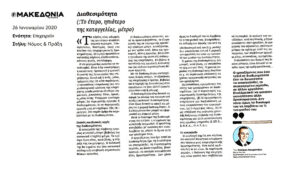
    P.S. A brief version of this article has been published in MAKEDONIA Newspaper (January 26th, 2020).

    διαθεσιμότητα εργαζομένου

This site is registered on wpml.org as a development site. Switch to a production site key to remove this banner.