
Tag: διοικητικό συμβούλιο ανωνύμων εταιρειών

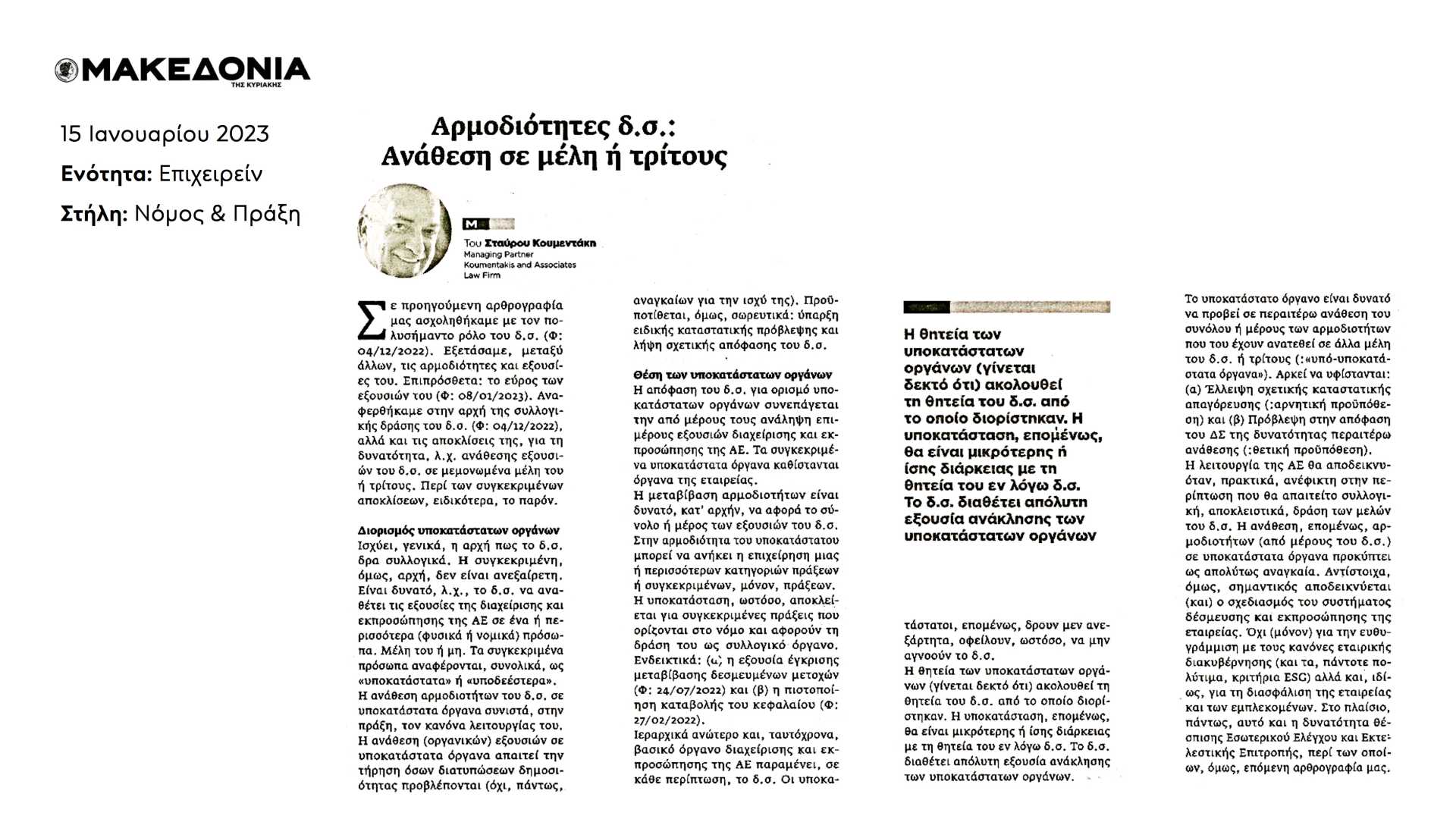
  • Responsibilities of the Board of Directors: Assignment to Members or Third Parties

    Responsibilities of the Board of Directors: Assignment to Members or Third Parties

    In our previous article we dealt with the important role of the Board of Directors. We examined, among other things, his powers and powers; additionally: the scope of his powers. We referred to the principle of the collective action of the Board (art. 77 §2 ed. 2 of law 4548/2018) but also to its deviations; for the possibility, e.g. of delegation of powers of the Board of Directors, to individual members or third parties. In the present article we will examine the specific deviations from the rule.


    Appointment of Substitute Bodies

    In General

    In general, the principle (under domestic law) that the Board of Directors acts collectively applies. This particular principle, however, is not without exception. It is possible, e.g., for the Board of Directors to delegate the powers of management and representation of the SA to one or more persons (natural or legal). Members or not. The specific persons are referred to, collectively, as “substitutes” or “subordinates”.

    The delegation of powers of the Board of Directors to substitute bodies constitutes, in practice, the rule under which it operates: the Board of Directors operates through its substitute bodies. This seems reasonable. In this way, the everyday operations of the SA is simplified. The speed of its transactions is ensured. The exercise of the tasks and work of the Board of Directors becomes more efficient. Complex issues are easier to manage.

    Conditions

    The delegation of (organizational) powers to substitute bodies requires compliance with the publicity formalities provided for (not, however, necessary for its validity). Presupposed, however, are cumulatively: the existence of a special statutory provision (art. 87 §1 ed. a΄-1096/1976 plenary session of the Supreme Court) and a relevant decision of the Board of Directors. In more detail:

    (a) Statutory Provision: The requirement for the existence of a special statutory provision as a condition for the delegation of organizational powers to substitute bodies does not derive only from the law on SAs (: art. 87 §1 ed. a’). Corresponding provisions are also found in other laws (: art. 65, 67 and 68 CC-1085/2019 QUALEX Legal Database). The provisions, however, of the law on SAs prevail over those, as they are more specific (1510/2006 Supreme Court, NOMOS Legal Database).

    In the absence of a special statutory provision, any delegation of power of representation to a member of the Board of Directors or a third party is equated with the granting of a power of attorney (art. 211 et seq. CC -1252/2016 Supreme Court, NOMOS Legal Database).

    The articles of association may define the areas for which the Board of Directors will be entitled to delegate management and representation powers. It is also possible to set additional conditions. To limit, e.g., the pool of possible substitute persons by excluding, for example, third parties. Adherence to such terms will constitute an additional condition for the legality of any assignment. The articles of association can, at the same time, define the way of action of the substitute bodies (e.g. with the cooperation of several persons or for specific transactions only).

    It is not excluded that the appointment of substitute bodies by the Board of Directors is defined by the statute as mandatory/obligatory. However, there is a difference of opinion as to the binding nature of such an appointment. According to the jurisprudence (and the correct) opinion, it is accepted that the Board must comply with the statutory “order” (ind. 7119/2004 Court of Appeal of Athens, NOMOS Legal Database). In theory, on the other hand, it seems to hold the position that the Board of Directors retains the discretion to choose whether to make a substitution and, if so, which individual persons to appoint.

    However, the condition of the special statutory provision is open to deviations. Among other things: (i) the judicial appointment of a special representative of the company to conduct judicial proceedings to annul a decision of the Board of Directors (art. 137 §3) and (ii) the judicial appointment of a special representative of the company to bring a lawsuit against members of the Board of Directors (art. 105).

    (b) Decision of the Board of Directors: As long as the required statutory provision/possibility exists, the relevant decision of the Board of Directors for the transfer of its powers can take place.

    It is noted, however, that any delegation by the Board of Directors to another body (e.g. the General Assembly or a third party) of its authority to be substituted (the Board of Directors) in the exercise of its powers is invalid. This prohibition, in fact, seems reasonable as it goes against the principle of its autonomy. Besides, the Board of Directors is the most suitable body, not only to assign and identify its substitute persons, but also to distribute – at its discretion – the responsibilities between them.

    Also, for the same reasons, the direct delegation of responsibilities to members of the Board of Directors or third parties is excluded by the statute. And even more so on the basis of an extra-company agreement (68/2014 Supreme Court, NOMOS Legal Database). However, it is permissible, exceptionally, to appoint the first Board of Directors upon the establishment of the SA. Also, the performance of individual offices (incl.: president, vice-president, managing director or authorized advisor). And the same goes for the delegation of responsibilities to its members or third parties. The Board of Directors, of course, can (also in the latter case) proceed, at any time, to redistribute and/or revoke the specific offices and responsibilities (art. 87 §3). Any limitation of its specific right will be null and void.

    (c) Publicity: The validity of the appointment of a substitute body does not require the observance of specific formalities. The special provision of the articles of association and the relevant decision of the Board of Directors recorded in the minutes are sufficient. The latter is not required to be formally stated (1085/2019 QUALEX Legal Database). It is sufficient that such a will clearly emerges from the delegation decision (:in this context it is argued, rather extremely, that even the implied delegation of powers is valid).

    However, the observance of publicity formalities is deemed necessary for opposing the assignment against bona fide third parties. The relevant publication is for informational purposes only.


    Appointment Of Substitute Bodies

    The Nature of Powers

    The decision of the Board of Directors to appoint substitute bodies entails the assumption by them of individual powers (: organizational) of management and representation of the SA. The specific substitute bodies have authority through the law and the statute and their link with the SA is the same as that of the Board of Directors (1086/2019 Supreme Court, QUALEX Legal Database).

    Substitute bodies become, in other words, bodies of the company. Equal, in fact, to each other, as all substitute bodies are assimilated in terms of powers (and therefore responsibility), regardless of their status as members of the Board of Directors or not. An organic relationship is created between them and the SA. Hence the name “substitutes” or otherwise “subordinates”.

    In a logical sequence, therefore, the bodies in question do not act as trustees/representatives of the SA; a special power of attorney is not required for the exercise of management acts.

    The Responsibilities

    The transfer of powers can, in principle, concern all or part of the powers of the Board of Directors. The responsibility of the substitute may include the business of one or more category of acts (conclusion of contracts with customers, banking transactions) or specific, only, acts (e.g. conclusion of a specific, only, contract). In the latter case, however, there is no need to comply with publicity formalities.

    Substitution, however, is excluded for those powers of the Board of Directors that are assigned by law and concern, exclusively, its action as a collective body. Indicative: (a) the authority to approve the transfer of restricted shares (art. 43) and (b) the certification of payment of the capital (art. 20).

    From the articles of association or, more commonly, from the decision of the Board of Directors, it is expected to become clear whether the substitute bodies will act individually or collectively. Otherwise, the collective representation rule will apply.

    The Relationship of Actions of Substitutes & the Board

    The substitute bodies have parallel authority with the Board of Directors to exercise the powers assigned to them (330/2006 Supreme Court, NOMOS Legal Database). Hierarchically higher and, at the same time, the main body of management and representation of the SA remains, in any case, the Board of Directors. The substitutes, therefore, act independently, but must not ignore the Board. Thus, the autonomy they have in the context of their organic relationship with the company is limited.

    The Board of Directors is entitled and obliged to supervise the substitute bodies. At the same time, it is entitled to be informed about the progress of the corporate affairs it has assigned to them. It is also entitled, of course, to modify (even revoke) their powers.

    The Duration of Powers

    The term of office of the substitute bodies (it is assumed that) follows the term of the Board by which they were appointed. Therefore, in the prevailing opinion, the power given will be shorter or equal in duration to the term of the said Board. Reasonably so, as the delegation of their responsibilities takes place within the framework of a decision of a specific Board of Directors. The opposite point of view is also supported – not correctly in our opinion: of absolute independence and lack of connection between the bodies in question and the Board of Directors, in terms of the temporal scope of their powers.

    Therefore, the termination of the term of the Board of Directors (or any recall of its members) will automatically bring about corresponding consequences for the substitute bodies.

    The Board of Directors has, as already mentioned, absolute power to revoke the substitute bodies. If the revoked person is a member of the Board of Directors, the powers assigned to them will cease, but the status of the member will remain.

    In principle, the General Assembly does not have the power to revoke the substitute bodies. If the General Assembly revokes, however, members of the Board (as always, only it has the right to act) any parallel status as substitute bodies will be automatically revoked. It is noted, however, that if it is a third (non-member of the Board of Directors) substitute body, appointed with the establishment of the SA (art. 87 §3), the General Assembly has the power to revoke it by simply amending the relevant statutory regulation.

    Ability to Further assign powers

    The substitute body may further delegate all or part of the responsibilities assigned to it to other members of the Board of Directors or third parties. As long as there is (art. 87 §2): (a) Absence of a relevant statutory prohibition (: negative prerequisite) and (b) Provision in the decision of the Board of the possibility of further assignment (: positive prerequisite).

    The further assignment takes place under the same conditions as those required for the assignment. At the same time, the further delegation of powers from substitute bodies to other “sub-substitutes” implies, for them, the acquisition of organizational powers of the company. They clearly exercise their powers alongside the substitute bodies and are subject to the supervision of the latter.


    The operation of the SA would prove, practically, unfeasible in the event that collective, exclusive action of the members of the Board of Directors would be required to take any decision related to its daily operations. Therefore, the assignment of responsibilities (by the Board of Directors) to substitute bodies is absolutely necessary. Correspondingly, however, of significant importance is the design of the company’s engagement and representation system. Not (only) for the alignment with corporate governance rules (and the always valuable ESG criteria) but also, in particular, for the safety of the company and those involved. In the context, however, of this and also of the possibility of establishing an Internal Audit and an Executive Committee, about which, however, see our next article.-

    Stavros Koumentakis
    Managing Partner


    P.S. A brief version of this article has been published in MAKEDONIA Newspaper (January 15th, 2022).
    Disclaimer: the information provided in this article is not (and is not intended to) constitute legal advice. Legal advice can only be offered by a competent attorney and after the latter takes into consideration all the relevant to your case data that you will provide them with. See here for more details.


  • The scope of the authority of the board of directors

    The scope of the authority of the board of directors

    The important role of the Board of Directors has already concerned us in our previous article. We referred there, among other things, to the management duty of the Board. Also, to the scope of its powers and responsibilities. We closely approached its responsibilities for management and representation of the SA (: internal relations and relations with third parties – respectively). Here, too, we will be looking into the specific powers in light of the rule of the unlimited and unrestricted power of representation.


    The Responsibilities of the Board of Directors

    While examining the responsibilities of the Board of Directors, we were already explored the relevant provisions of the law (art. 77 §1 Law 4548/2018). According to them, the SA is managed by the Board of Directors. The content of the administration is the management as well as its judicial and extrajudicial representation. Every management act belongs to the management of the SA. Also: every act of representation constitutes, at the same time, an act of management. Every act of management, however, does not constitute an act of representation.

    However, the other provisions of the law also apply. Among them is the one (art. 86§1) which provides that the Board of Directors is competent to decide on every act concerning the management of the company, the management of its property and, in general, the pursuit of its objectives. As far as the fulfillment of the corporate purpose is concerned, the management of the SA is the function that tends, primarily, to its realization – in the narrow sense.


    The Corporate Objectives

    The term “corporate objective” has two meanings.

    In its broadest sense, the corporate objective is what determines the general direction of the SA: it refers to the type of its activity. On the other hand, the exercise of administration and management are carried out with the aim and goal of realizing, as already noted, the corporate objectives – in the narrow sense of the term. The implementation and promotion, i.e., of the object of the corporate activity, as described in the company’s articles of association.

    In this specific sense, it is accepted that the corporate objective is not limited only to acts that fall clearly within the exercise of the corporate activity. It includes, on the contrary, an expanded area of actions that serve the long-term goals of the business, based on the perception of transactions. According to the jurisprudence, such actions constitute, indicatively, the acceptance of bills of convenience or the provision of guarantees in favor of a third party (67/2019 Court of Appeal of Dodekanisa, QUALEX Legal Database).


    Board Actions unrelated to the Corporate Objectives

    The Rule of Unlimited Power of Representation

    The rule of the unlimited representation power of the Board of Directors is based on the law (art. 86 §2). It aims, in fact, at the protection of third parties and transactions.

    According to the specific regulation, acts of the Board of Directors, even if they do not serve the corporate objectives (either in its broad and/or narrow sense), bind the company vis-à-vis third parties. This rule is not, however, without any exceptions.

    The national legislator made use of the exemption provided by the first corporate Directive (2009/101/EC). The Directive in question allows, in particular, an exemption from the commitment of the company from acts outside the corporate purpose in the event that the third parties were, in fact, aware of the relevant violation. And this knowledge can either be proven or indirectly inferred from the fact that the third party could not, given the circumstances, ignore it (see Explanatory Report law 4548/2018 on art. 86).

    The national legislator, contrary to the previous law (2190/1920), did not provide for an exception in the case where the third party should have known of the excess exercise of power. That is, they deleted the phrase “or should have known”, which also included third parties who were not aware of the excess of the corporate objective because they did not exercise due diligence. And this is because the specific possibility did not seem to be in line with the aforementioned Directive (see Explanatory Report of law 4548/2018 on art. 86).

    The non-commitment of the SA (according to the prevailing opinion in the legal theory), does not occur only in the cases of knowledge by the third party of exceeding the corporate purpose, but also in the cases of their gross negligence.

    It is noted, further, that the SA itself bears the burden of proving the incidents that cancel its commitment. The specific, indeed, burden of proof is justified by the purpose of the rule of the unlimited power of representation: the protection, i.e., of third parties and transactions (art. 86 §2. ed. b). However, in cases where there is a clear excess of the corporate purpose, it is accepted that proof of knowledge on the part of the third party is not required. In the case, e.g., of the sale of all the company’s assets (4839/1979 Court of Appeal of Athens, “Epitheorisi Emporikou Dikaiou”, 1980, 249, which concerns the sale of raw materials and equipment of an LLC).

    In fact, it is expressly provided that the mere observance of the publicity formalities regarding the company’s statute or its amendments does not constitute proof of the knowledge of the third party (art. 86 §2. ed. c).

    It is argued, reasonably, however, that the protection of the third party (even a bona fide one) does not reach, in any case, to the point of binding the SA (also) for actions for which by law the board cannot bind the company. In the case, e.g., when actions are exclusively in the competence of the General Assembly.

    Legal Consequences

    If the Board of Directors acts in excess of the corporate purpose and the third party-dealer is in bad faith regarding the fact of the excess, concerns arise regarding the legal consequences.

    From a point of view, the contract that the Board of Directors enters into with the bad-faith third party is of absolute nullity. The SA is not bound in this case. And in fact, anyone can invoke the invalidity.

    From another point of view, the invalidity is relative in favor of the SA: only it is able to project and implement it.

    According to a third point of view, however, the provisions of the law (229 et seq. CC) regarding the abuse of power of attorney should be applied, in this case-analogously. According to it, a contract of the Board of Directors, in excess of the corporate purpose with a bad-faith third party, is pending for as long as the Board of Directors does not decide for or against it. Specifically, in the event that the General Assembly, with an increased quorum and majority, approves the above contract, it becomes effective and binds the SA. However, if the SA expressly decides not to approve it, it is not bound.

    It should be noted that the SA can take action against the members of the Board of Directors who act in excess of the corporate purpose – as long as the conditions of the law are met (art. 102).


    Restrictions From the Articles of Association or the General Assembly

    The Rule of Unrestricted Power of Representation

    The law, in addition, is what establishes (article 86§3) the rule of non-limitation of the organic power of representation – aiming, likewise, at the protection of third parties and transactions. It provides, in particular, that limitations of the authority of the Board of Directors by the statute or by a decision of the General Assembly are not opposed by third parties. Even if they have been made public.

    This provision takes into account the limitation of administrative authority that becomes permissible. In particular, the members of the Board of Directors are obliged to observe the limitations of their authority, whether they are set by the statute or by the General Assembly.

    Legal consequences

    However, in case of non-observance of these restrictions by members of the Board of Directors, they are not opposed to third parties – even if the latter were aware of them. These restrictions have – as a rule – effect only in the context of internal relations.

    The specific regulation (no. 86§3) does not provide for an exception to the non-limitation rule. It is important, however, to note that its absolute and unexceptional wording creates risks for the SA: even in the case of collusion between the Board of Directors and a third party with the aim of not complying with any restrictions, the SA (should be) bound by the carried out transaction with the third party acting in bad faith. Such an approach would, obviously, be dangerous for the SA. The teleological contraction of the provision in question is argued, and rightly so: bad faith third parties should not be protected by the non-limitation of the power of representation.


    The protection of those acting in bad faith vis-à-vis the SA should not prevail over the latter. And rightly so. Consequently, acts of the Board, even outside the corporate purpose, bind the company against those who either did not know or were unreasonably unaware of the relevant excess. At the same time, limitations of the power of representation of the Board of Directors set by the statute or the General Assembly will (and must) be opposed against those, only, who operate based on bad faith and with intent to harm the interests of the SA. But often the boundaries between good and bad faith are, unfortunately, indiscernible. Therefore, special attention is required in transactions of particular importance and/or value. The risks, otherwise, will not be negligible for the SA, the (bona fide) third parties and the transactions themselves. –

    Stavros Koumentakis
    Managing Partner


    P.S. A brief version of this article has been published in MAKEDONIA Newspaper (January 8th, 2022).


    Disclaimer: the information provided in this article is not (and is not intended to) constitute legal advice. Legal advice can only be offered by a competent attorney and after the latter takes into consideration all the relevant to your case data that you will provide them with. See here for more details.

  • Exceptions to the Rule of Election of the Board of Directors by the General Assembly

    Exceptions to the Rule of Election of the Board of Directors by the General Assembly

    In a previous article, we were concerned with the election of the members of the Board of Directors by the General Assembly (: rule). We pointed out, however, that this specific rule is not without exceptions. On those exceptions: the present article.


    Appointment of the First Board of Directors in the Initial Articles of Association

    An exception to the rule of the election of the Board of Directors by the General Assembly is, first of all, the case of the appointment of the first Board of Directors in the initial statute of the SA (in essence, by the founders of the SA – art. 78 §2, section a’ and §117 2 c. c.). Its term of office will last until the first regular General Assembly, unless otherwise (and specifically) provided for by the statute. The first Board of Directors can also be elected by a universal and without an invitation to the shareholders General Assembly (art. 121 §5, as expressly provided for in art. 78 §2 section b), by signing the minutes of the General Assembly without a meeting (art. 136) or by court decision (art. 69 of the Civil Code, as expressly provided in art. 78 §2 ed. b’).


    Direct Appointment of Member(s) by Shareholder

    An exception to the rule of election of the Board of Directors by the General Assembly is (also) the personal right to directly appoint a member/members of the Board of Directors. The specific right can be granted to one or more shareholders of the SA (art. 79) – by way of derogation from the principle of equality of shareholders (art. 36 §2). In this case, the representation of the minority in the management of the SA is guaranteed. Also, possibility aids in attracting investors: the participants in the Board of Directors have, moreover, a wider right to information than that of the minority shareholders (see art. 141 §§6 & 7 and art. 142 §4). Said right is non-transferable and non-inheritable-unless otherwise provided by the articles of association; it also is waivable.

    Prerequisites

    A necessary condition for the granting of the right to directly appoint a member/members of the Board of Directors is (apart from the shareholder status) the relevant statutory provision. It is possible for the articles of association to specify by name the bearer of the relevant right or the qualities or characteristics they must bear (e.g. a minimum percentage of participation in the share capital). It is necessary, in general, to determine the conditions for its exercise; in particular, with regard to the percentage of participation of the shareholder in the capital and the declaration of appointment (art. 79 §1 in fine).

    This right can be granted individually to a shareholder(s) or, jointly, to several of them. In the latter case, a joint act of the beneficiaries is required for the appointment of a member/members of the Board of Directors-obviously the same goes for their revocation (art. 79 §5).

    The relevant statutory provision may be initial or consequential. In the latter case, an increased quorum and a majority is required at the General Assembly that will decide it (similar to the case of preferred shares – art. 36 §6). According to others, unanimity is required (invoking the proportional application of art. 89, sec. b΄ of the Civil Code)

    In any case: this right cannot be revoked without the consent of its beneficiary.

    Restrictions

    The number of members of the Board of Directors that can be appointed directly, individually or jointly, by a shareholder/shareholders cannot exceed 2/5 of the total number of members of the Board of Directors (art. 79 §1, section a). According to the articles of association, the relevant ratio is maintained even in the event of a change in the number of members of the Board of Directors (art. 79 §4). The other members of the Board of Directors are elected by the General Assembly.

    Mode of Exercise

    The exercise of said right by the beneficiary-shareholder takes place before the election of the Board of Directors by the General Assembly. The latter, in case of direct appointment, is limited to the election of the remaining members. Shareholder(s) who exercise the right in question shall notify the appointment of the members of the Board of Directors in the company at least three full days before the meeting of the said General Assembly; and, in fact, they do not participate in the election of the rest of the Board of Directors (art. 79 §2). Their shares, respectively, are not counted in the formation of quorum and majority.

    There is no legislative provision for the cases of the General Assembly conducted without a formal invitation of the shareholders (art. 121 §5) and the signing of the minutes of the General Assembly (art. 136). However, the non-observance of the above three-day deadline in these cases should be accepted. Also, the simple, relevant, declaration of the beneficiary-shareholder immediately before the election of the Board of Directors.

    The shareholder-holder of the right to directly appoint a member of the Board of Directors may not exercise their specific right. In this case they will normally participate in the General Assembly for the election of the Board of Directors.

    Revocation

    The directly appointed members of the Board of Directors are also freely revoked – at any time – by the holder of the relevant right (art. 79 §3). The latter, in fact, may appoint a new member to replace the revoked one. If they fail or are late to do so, the Board normally operates with its other members – as long as there are not less than three.

    If there is a serious reason on the person of the appointed member regarding their incompetence (e.g. non-fulfillment of their duties), shareholders (other than those who appointed them) may legally request their revocation. A necessary prerequisite is that they represent at least 1/10 of the paid-up capital. The relevant judicial process is developed in the framework of the ‘ex parte’ proceedings.


    Replacement of (Incomplete) BoD

    Another exception to the rule of election of the Board of Directors by the General Assembly is (also) that of the election of a member, by the Board itself, in case of an incomplete (“stump”) Board (art. 82 §1 and 117 §2, para. d)). If there is resignation or death or in any other way loss of the status of a member or of members of the Board, the latter may elect their replacement for the remainder of their term. A relevant statutory provision is not required (see Memorandum to law 4548/2018 on art. 82). Any powers of the replaced are not automatically transferred to their replacement.

    Prerequisites

    For this election on its part, the following are required (cumulatively): (a) Loss of Member Status, (b) Absence (:non-election) of Substitute Members by the General Assembly (according to article 81) and (c) Legal Composition of the Board (: its remaining members not to be less than three)

    Publicity & Notice of Decision

    The decision of the election, on the one hand, is submitted to the Business Registry in a declaratory manner (art. 82 §1 in fine) on the other hand, it should be announced at the next General Assembly. The GA can replace the elected member/members, even if there is no relevant item on the agenda (art. 82 §1 in fine).

    Incomplete Board Continuation Clause of the Articles of Association

    According to the law, a statutory provision for the continuation of the operation of the Board of Directors without replacement of its missing members is permissible (art. 82 §2). As long as the remaining members are more than half of those elected/appointed and not less than three.

    Convocation of General Assembly by Incomplete Board of Directors

    The members of the incomplete Board of Directors are, however, able to convene a General Assembly with the sole purpose of electing a new Board of Directors – even if they are less than three (art. 82 §3).


    Judicial Appointment of the Board of Directors

    The last exception to the rule of the election of the Board of Directors by the General Assembly is their appointment by court decision. In addition, the law on SAs refers to the relevant possibility, in case the first board of directors is not defined by the articles of association (art. 78 §2, sec. b΄).

    Appointment of temporary administration by virtue of a court decision is imposed (art. 69 CC) as a last resort, in case of “lack of management”; specifically, when: (a) the persons required for the administration of the legal entity are missing or (b) interests conflict between the administration and the counterparts of the legal entity.

    Such an appointment can be decided by the court following the application of anyone with a legal interest – during the process of ‘ex parte’ proceedings (art. 786 of the Code of Civil Procedure).

    Regarding, in particular, the aforementioned prerequisites:

    (a) Case of Absence of Management: It occurs in cases where no members of the Board of Directors are appointed or they have resigned or a member is absent (e.g. due to death or illness). In the cases, also, of the election of the Board of Directors with an invalid decision as well as (in the right opinion) when there is a fictitious lack of management (e.g. refusal to exercise duties by the members).

    The appointment of a temporary administration by a court decision is significantly limited, given the provisions of the law on SAs. And this is because, before the legal action, it is possible: to replace the missing members (art. 81) or to elect others from the Board itself (art. 82 §2). Also, the continuation of the operation of the incomplete Board of Directors in the context of the relevant statutory provision (art. 82 §2). It is possible, in any case, to convene a General Assembly by the remaining members of the Board of Directors for the purpose of electing a new Board of Directors (art. 82 §3).

    If a request for appointment is made on the basis of one of the above-mentioned cases, the court appoints all the members of the temporary Board of Directors – even if only some of its members have dropped out. Consequently, a mixed temporary Board of Directors, already existing of the judicially appointed members, is not formed. The temporary Board of Directors must proceed, based on what the court decision will determine, to immediately convene a General Assembly for the election of a new Board of Directors.

    (b) Case of Conflict of Interests: Occurs in cases where the individual interests of the member of the Board of Directors are contrary to those of the SA. Or takes advantage of business opportunities for their own benefit or the benefit of a third party at the expense of the SA.

    In this case, judicial involvement is significantly limited (according to article 69 CC) – given the provisions of the law on SAs: In the context of the duty of loyalty, a member of the board of directors is not entitled to vote on matters in which there is a conflict of interest with their company of the same or related persons (97 §3). It is also possible for the member in question to be replaced (provided this is provided for in the act of election or appointment of the replacement – art. 81 §2).

    However, once a relevant application for appointment has taken place, the court appoints (in the most correct opinion) as many members of the Board of Directors as are prevented by the conflict of interest from performing their duties. The temporary administration, in this case, carries out those acts for the performance of which the members being replaced are prevented and/or those, specifically, designated by the court.


    The (well-known) rule of electing the Board of Directors by the SA’s General Assembly has particularly interesting exceptions: the appointment of the first Board of Directors (usually by the articles of association), the direct appointment of member(s) by a shareholder or/shareholders, the replacement of absent members by the (“stump”) Board, the appointment of a temporary Board based on a court order. However, the specific exceptions are (in addition to being interesting, also) particularly important – potentially, in fact, problematic: they do not only ensure the smooth operation of the SA, but they also may, under certain conditions, overturn important balances in the management of the company – possibly also the shareholders balances. Therefore, we should all be particularly careful when managing them.

    Important issues arise (also) regarding the eligibility and defects in the appointment of the members of the Board of Directors. We will look into them, however, due to their extent and seriousness, in our next article.-

    Stavros Koumentakis
    Managing Partner


    P.S. A brief version of this article has been published in MAKEDONIA Newspaper (December 18th, 2022).

    Disclaimer: the information provided in this article is not (and is not intended to) constitute legal advice. Legal advice can only be offered by a competent attorney and after the latter takes into consideration all the relevant to your case data that you will provide them with. See here for more details.

  • Election of the Board of Directors and Alternate Members

    Election of the Board of Directors and Alternate Members

    In our previous article, we looked into the Board of Directors of the SA. Specifically: their operation, authority, members and term of office. However, as its members are not elected only by the General Assembly, interesting issues arise regarding the manner of their election. In the present article we will explore the rule (:election by the General Assembly). In the next article we will explore its exceptions.


    The election of the Board of Directors from the G.A.

    The rule

    As mentioned in the introduction, the members of the Board of Directors are elected (: rule) by the General Assembly – subject to a different regulation in the law, (art. 78 §1, Law 4548/2018 – Memorandum to Law 4548/2018 on Art. 78). We find a similar provision in the provisions concerning the exclusive competence of the General Assembly (art. 117 §1, para. b). The principle of autonomy and self-governance of the SA is served through the election of the BoD by the General Assembly. Its owners (shareholders) have a say and participate in the management of the latter.

    The relative competence of the General Assembly cannot be delegated (neither by the General Assembly or the statute) to another body of the SA or a third party. The General Assembly takes the decision to elect the Board of Directors with a simple quorum and majority (art. 130 §1 and 132 §2, respectively). Subject, of course, to the fact that the statute does not require, in this case, greater quorum and majority rates (art. 130 §5 and 132 §3, respectively). It is possible, however, for the statute to require unanimity.

    The Exceptions

    The rule of electing the board by the General Assembly, however, is not without exceptions. The exceptions established by law (for which see our next article)- are summarized in the following: (a) In the appointment of the first Board of Directors in the initial statute of the SA (art. 78 130 §2). (b) In the direct appointment of a member/members of the Board of Directors by a shareholder (art. 79). (c) In the election of members by the Board of Directors, in case of an incomplete Board of Directors (art. 82 130 §1). (d) In the appointment of a (temporary) Board of Directors pursuant to a court decision (art. 69 of the Civil Code).


    Election of the Board of Directors based on lists

    In General

    The election of the Board of Directors by the General Assembly usually takes place on the basis of the majority system: those who receive the most votes are elected. However, another way of election is also provided for (art. 80 §1): the possibility, specifically, of electing members of the Board of Directors based on lists (: ballots). This is a possibility that was introduced in 2007 (law 3604/2007) in order to remove previous doubts set forth by the legal theory.

    In the context of the specific system, it is provided that, subject to a relevant statutory provision, the candidates for election as members of the Board of Directors are proposed to the General Assembly based on lists. The General Assembly elects from among them as members of the Board of Directors according to the proportion of the votes received by each list (art. 80 §1 paragraph a’).

    Through this regulation, the proportional election system by the General Assembly is introduced. As a result, there is a more proportional representation of the shareholders in the management of the SA; with a particular interest, of course, for the minorities. Proportional representation in the management of the SA carries, however, risks for the possibility of decision-making by the Board of Directors. Especially for those that (on the basis of a statutory provision or the law) require an increased quorum and majority. The members of the Board of Directors coming from the minority shareholders will be entitled (and it is probable), in this case, that they will vote against.

    It is argued (and rightly so) that proportional and majority systems can coexist: a certain number of board members can be elected on the basis of the majority system and the remaining on the basis of lists.

    Conditions

    (a) Statutory Provision: As we have already mentioned, the election based on lists requires a relevant statutory provision (: positive prerequisite).

    The articles of association, however, should specify the procedure to be followed for the election of the members of the Board of Directors based on lists, in order to avoid any disputes. Election methods using list election vary. In fact, it is possible to have only one list. The need for detail concerns (in particular) the way seats are allocated.

    Depending on the relevant statutory provisions, from each list are elected: either the persons who received the most votes or those who precede in the order of the list. The rest are considered alternates (art. 80 §1, ed. c and d), who are considered, by law, as substitute members (art. 81 §1, ed. b).

    Such a statutory provision may be provided for in the initial statute of the SA. However, it can be introduced and/or abolished by decision of the General Assembly. The relevant decision is taken by a simple quorum and majority, unless the articles of association require higher percentages (art. 80 §1 in fine).

    (b) Absence of Statutory Provision for Direct Appointment: In order for the election of Board members to take place on the basis of lists, the absence of a statutory provision for the direct appointment of a Board member/members by a shareholder is assumed (: negative condition) (art. 80 §2). This seems reasonable, as (: Memorandum to law 4548/2018 on art. 80) the two possibilities serve the same purpose: the representation of the minority on the Board.


    Alternate Members

    Definitive Replacement

    In addition to the (in any way elected) members of the Board of Directors, any substitutes may be called upon to play an important role. As such are meant those that are (basically) elected or appointed with the purpose of replacing a member/members in the event of their loss of status.

    The possibility of electing or appointing substitute members (art. 81) is intended to deal with the case of a “stump”, as it is called, of the Board. By extension, to prevent legal action for the appointment of a temporary administration (69 CC) , which must be opted for in exceptional cases only. Indeed, given the relevant legislative provision, a corresponding statutory provision is not required (Memorandum to law 4548/2018 on art. 81).

    The person who elects or appoints the Board of Directors (or its members) may also elect or appoint substitute members in the event of the resignation or death of the persons elected or appointed by them; also those who, for any other reason, have lost their status of member case of election of members of the Board of Directors based on lists (art. 80), the runners-up are considered as alternate members.

    Contrary to the previous regime, the relative possibility of replacement is provided in all cases of election or appointment of the Board of Directors (Memorandum to law 4548/2018 on art. 81). Therefore: not only in case of election by the General Assembly. In turn, the alternate members: (a) will either be elected by the General Assembly and designated in the election decision of the Board of Directors, (b) or will be notified to the SA together with the member appointed, directly, by a shareholder, (c) or the runners-up will be considered as such, in case of election based on lists.

    Appointment of substitute members is not, however, possible to take place (as accepted) in the original statute of the SA.

    The election or appointment of an alternate member may concern the replacement of a specific member or any of them – depending, of course, on the act of election or appointment of the alternate members. If no relevant reference is made, any replacement may occur for any existing member.

    Furthermore, it is required that the appointment of substitute members be published (art. 81 §1 in fine).

    Temporary Replacement Due to Conflict of Interests

    The replacement of a member of the Board of Directors takes place for the remainder of their term. Any replacement cannot take place due to the temporary unavailability of an existing member.

    A deviation from the above, by virtue of a more specific regulation, is introduced in the case of a conflict of interests of a member of the Board of Directors with those of the SA (art. 97 & 81 §2). A necessary condition is that this is provided for in the deed of election or appointment of the substitute member. As expressly stated, in this case the replacement is temporary and concerns the acts for which the conflict exists.

    Presence of Substitute Members at Board Meetings

    The law provides (art. 81 §3) the possibility of representation of the substitute members at the meetings of the Board of Directors – before they replace a (regular) member. This option is considered necessary, in order for the substitute members to be informed about corporate issues; to be able, consequently, to assume their duties, in case there is a reason for replacement.

    In the said meetings, the substitute members do not have the right to vote nor is it necessary for them to be invited to the meetings (Memorandum to law 4548/2018 on art. 81). It is, however, possible for them to take the floor and express their opinion – at the discretion of the president. It is also possible for them to represent another member of the Board of Directors at the meetings (art. 92 §4).


    It is common knowledge that (most of the time) the members of the board of an SA are elected by its General Assembly. The latter elects the members of the Board either on the basis of individual nominations or nominations included in lists-ballots. The latter would be a beneficial option for the minority shareholders, but problematic (and therefore is avoided) for the majority. However, the selection of alternate members of the Board of Directors is optimal in order to deal with (potentially) problematic situations (e.g. incomplete composition of the Board of Directors or conflict of interests of its members). Eligible, also, in some cases (and not unusual, and sometimes, in fact, necessary) is the election/appointment of members of the Board of Directors-outside the General Assembly. About them, however, see our next article.-

    Stavros Koumentakis
    Managing Partner


    P.S. A brief version of this article has been published in MAKEDONIA Newspaper (December 11th, 2022).


    Disclaimer: the information provided in this article is not (and is not intended to) constitute legal advice. Legal advice can only be offered by a competent attorney and after the latter takes into consideration all the relevant to your case data that you will provide them with. See here for more details.

  • The Board of Directors of the SA: Operation, Authority, Members

    The Board of Directors of the SA: Operation, Authority, Members

    One of the most important bodies of the SA is its Board of Directors. It is the body through which exercises the management and representation of the SA; through which the SA expresses its will and manifests its action both internally and to the outside world. The important role of the Board of Directors, as well as issues regarding its members and their term of office will be the approached in the present article.


    The Role of the Board of Directors – The Management Task

    As expressly provided for in the law on SAs (law. 4548/2018), the company is managed by the BoD (art. 77 §1, section a’, law 4548/2018). The administration of the SA includes: (a) management and (b) its judicial and extrajudicial representation (art. 77 §1 sec. b’).

    The law, therefore, generates a range of powers (and responsibility) of the BoD, which are distinguished from the corresponding ones of the General Assembly. The latter, moreover, is the one that decides on structural changes concerning the SA.

    The SA acts through its BoD. Its existence therefore becomes mandatory. This obligation does not mean, however, that in case the Board of Directors disappears (e.g. due to the resignation of its members) the SA ceases to exist. Its existence, in this case, is not disputed. It is necessary, however, to ensure its operation through the election of a new Board of Directors by the General Assembly or the judicial appointment of its temporary administration (69 Civil Code).

    The obligation of the BoD for exercising management is not limited to the management and representation of the SA. It generally includes all actions of administration. In this context: the determination-coordination of the business policy and strategy and ensuring its compliance. Although the law on SAs adheres to the traditional way of governing the SA through the Board of Directors, it also provides for its (potential) substitute: the “executive committee” (art. 87 §4). The latter, once its appointment is chosen, can make decisions for the daily administration of the SA; the rest of the Board of Directors will, in this case, exercise supervisory duties (see Explanatory Report of law 4548/2018 on the 6th section).

    A question arises regarding the content of the corporate interest at the promotion of which the Board of Directors should aim, while exercising the duty of administration. In one view, the corporate interest of the SA is identified with the aspirations of its shareholders for the long-term profitability of the SA and, by extension, an increase in the shareholding value (: monist theory). On the other hand, not only the interests of the shareholders should be taken into account, but also those of e.g. the SA workers and even the environment (: pluralist theory). In any case, however, and through the serving of such interests by the Board of Directors, for example of the interests of the employees, the interests of the shareholders are served in the end.


    Legal Relationship Between Board Members & SA

    The members of the Board of Directors are linked by a legal relationship (: organic) with the SA. This legal relationship may or may not be in exchange for a numeration.

    It is possible that a member of the Board of Directors provides the SA, in addition, with services that go beyond the narrow limits of its administration. These services are provided in the context of a “special relationship” (art. 109 §3). The specific, special, relationship can include, indicatively, the type of employment contract, project, independent services or mandate (e.g. a member of the Board of Directors provides, at the same time, legal or accounting services to the SA).


    Principle Of Autonomy

    The members of the Board act independently. Therefore, they are not subject to instructions and orders, e.g. of the General Assembly or the majority shareholder of the SA. The only obligation of the members of the Board of Directors towards the shareholders (in the context, mainly, of the General Assembly) is the obligation of provision of information (: art. 141).

    The members of the BoD have (against the SA – only) an obligation of loyalty and diligence when fulfilling their duties – in the context of the organic relationship between them (and this regardless of any underlying relationship – e.g., contract of mandate or of independent services).

    Except in the case where the BoD itself requests it, no consent/approval of the GA is required in the making of management decisions by the BoD. Statutory clauses for approval of the decisions of the Board by the General Assembly will therefore be void. However, the possibility of the latter to elect, at any time, a new Board of Directors, undoubtedly works in the direction of the compliance of its members with the directions (formal or informal, explicit or implicit) of the majority shareholders.

    Finally, it should be noted that, even more so, not even the Board of Directors of a subsidiary company is obliged to carry out the orders of the parent company (regardless, of course, that in practice it will be aligned with its orders).


    Management Authority: Content, Scope & Responsibility

    Content

    The Board of Directors is competent to decide on every act concerning the administration of the SA, the management of its property and, in general, the pursuit of its corporate objectives (art. 86).

    Extent

    The Authority of the Board of Directors is limited: the Board of Directors does not have the right to carry out actions in excess of the corporate objectives as well as actions that are prohibited by the articles of association or contrary to decisions of the General Assembly. It is, however, possible to further limit its authority by the statute or by decisions of the General Assembly.

    Responsibility

    Any actions in excess of the management authority of a member of the Board of Directors gives rise to an obligation to compensate. However, the relevant act is evaluated as valid and carries legal consequences, as long as the potential third party is in good faith.


    Representation: Content, Scope & Liabilities

    Content

    The Board of Directors, as a collective body of the SA, represents the latter judicially and extrajudicially. Exceptions are found in special cases – e.g.: (a) at the stage of establishment of the SA (: when neither a legal entity exists nor, much less, a BoD), (b) at the stage of liquidation (: when representatives are the liquidators), (c) at the stage of bankruptcy (when the liquidator acts as a representative).

    In the context of the out-of-court representation of the SA by the BoD fall the execution of legal transactions and the conclusion of contracts with third parties. Also, the acts of a corporate nature towards the shareholders (e.g. the approval of the transfer of reserved shares).

    In the context of legal representation, the Board of Directors represents the SA legally, as the SA, as a legal entity, has the capacity to be a party and appear before any court.

    Scope

    The scope of the board’s representation authority is unlimited: the SA is bound to bona fide third parties (who did not know or could not have known of the relevant excess of exercise of power) – even if the board acts beyond the corporate objectives.

    The extent of the power of representation of the Board of Directors is (also) unlimited: Any limitations of it by the statute or the General Assembly cannot be opposed against third parties (art. 86 §3). Even if these have been made public.

    Limitations, however, on the Authority of the Board of Directors may be set by law. Such cases constitute the transactions of the SA with members of the Board of Directors (art. 99 et seq.). Also, the cases in which the function of representation is exercised by the Board of Directors, but the consent of the General Assembly is required (e.g. transactions with related parties – art. 100 §3).

    Liabilities

    The consequences and actions of the members of the Board of Directors are attributed to the SA itself. Liability, therefore, arises at the expense of the latter for (unjust, mainly) actions or omissions of the members of the Board of Directors (art. 71 CC). It gives rise, however, at the same time, on the joint responsibility of the guilty persons.


    Principle Of Collective Action

    The Board of Directors when exercising its powers but taking its decisions (art. 92 par. 2) acts, in principle, collectively (art. 77 §2 sub. b’). It is therefore important that the members of the Board of Directors participate in the collective proceedings. On the contrary, it is not required that all members participate in every act of representation.

    Permissible, however, are specific statutory deviations, such as e.g. the assignment of representation for one or more issues to specific, only, members or member of the Board of Directors. Also, the sovereignty of the president’s vote in the event of a tie (art. 92 par. 2 sec. b’). As well as the appointment of a substitute body, which acts in parallel with the Board of Directors (art. 87).


    The Members of the Board of Directors; In particular

    Election & Possibility of Re-election

    The methods of electing the members (shareholders or non-shareholders) of the BoD are expressly provided for in the law (art. 77 §2 section a’, with reference to art. 78-80). Specifically, these methods include: (a) election by the General Assembly (art. 78), (b) direct appointment by a shareholder (art. 79) and (c) election based on lists (art. 80).

    The members of the Board of Directors remain, at all times, eligible for re-election (even before the expiry of their term – article 77, §2, section b’). In this way, the need – often – for unity and continuity in the administration of the SA is met. Any statutory clause prohibiting re-election will be considered invalid (art. 77 §2 section b’).

    The Free Revocation

    The members of the Board of Directors can be revoked freely – at any time (art. 77 §2 sec. b’). Their tenure, therefore, is always subject to their recall.

    Revocation takes place, basically, by decision of the General Assembly (by simple quorum and majority). If, however, a member was appointed by direct appointment, by the shareholder who appointed them (or they were appointed judicially, if 1/10 of the paid-up share capital made such a request and there is a great reason).

    The revocation of the members of the Board of Directors-consultants usually expresses the lack of confidence in them or, in general, the disapproval of the management they exercise. Statutory clauses that remove or limit the right of revocation are void.

    The act of revocation is subject to (declarative) publicity.

    Number

    The number of members of the Board of Directors is determined by the articles of association. Alternatively by the General Assembly, within the limits provided by the articles of association. However, it cannot (art. 77 §3) be less than three (3) or exceed fifteen (15) members. Failure to comply with these limits renders the composition of the Board of Directors illegal.

    A Legal Entity as a Board Member

    As long as there is an express statutory provision, it is possible for any legal entity to become a member of a Board of Directors. (art. 77 §4).

    The legal entity-member is obliged, within 15 days from its designation as a member of the Board, to indicate, a natural person as its representative. The latter will exercise all the responsibilities with which the member of the Board of Directors is charged. The natural person in question is revoked/replaced at any time by the legal person-member. However both the legal entity and its representative have full liability vis-à-vis SA in terms of corporate management operations.

    The Tenure

    The status of a member of the Board is related to the duration its his term – unless the member resigns (expressly or implicitly) before its expiration. The term of office is determined, in particular, by the statute and cannot, in any case, exceed six years. In the event that the election or appointment is made for a longer period, then they apply for a maximum of six years (art. 85 §1 sec. a’ & b’). A minimum term, however, is not foreseen – it is not common, however, for it to fall short of a year.

    It is within the competence of the General Assembly to specify the term of office, since the statutes simply set its limits (e.g. “between one and five years”). As an exception, in fact, it can elect a Board of Directors with a shorter (statutory) term. However, if both the statute and the General Assembly do not address its duration, it is assumed that the term of office of the members is six years.

    A legal extension of the term of office of the BoD – the duration of which has expired – is provided for, until a decision is taken to elect a new one in the context of the regular General Assembly of Art. 119 (art. 85 §1 ed. c΄). In this way, phenomena of the SA’s lack of governance are avoided.

    It is, however, possible that there is a provision for extending the term of office of the Board either in the statute or in the decision of the General Assembly for the election of the Board. Implied extension is not accepted.

    Finally, it is allowed, by law, to make a decision – optional or statutory mandatory – on behalf of the General Assembly for partial renewal of the members of the Board of Directors. Also, the provision of differentiated, among the members, expiry times of their term of office (: staggered BoD) – under the terms of the law (art. 85 §2).


    The SA’s Board of Directors is not its most powerful body (the power of the General Assembly always prevails), but it is the most important one. And this is because the Board of Directors is responsible for the internal management and external bounding and representation of the SA. It is the one to which every failure will be attributed (but also every success will be credited) in the effort to fulfill the corporate objectives and serve the interest of the shareholders. The BoD is a collective body (and is treated as such by the law and the statutes of the SA), but in practice one or, at best, only a few of its members are responsible for the day-to-day management of the SA. In this context (according to Thucydides, Historiai, 2.65.9): “Thus the state was ostensibly a democracy, while in reality it was ruled by one citizen”. And so happens in the SA. And rightly so. The rules, however, are there. Their compliance is supervised and their circumvention (even if it is deliberate) is controlled. And rightly so.

    However, the interesting issues of the election of the members of the Board of Directors will concern us in our next article.-

    Stavros Koumentakis
    Managing Partner


    P.S. A brief version of this article has been published in MAKEDONIA Newspaper (December 4th, 2022).


    Disclaimer: the information provided in this article is not (and is not intended to) constitute legal advice. Legal advice can only be offered by a competent attorney and after the latter takes into consideration all the relevant to your case data that you will provide them with. See here for more details.

  • Derivative Acquisition of SA’s Own Shares

    Derivative Acquisition of SA’s Own Shares

    In a previous article we explored the prohibition of the original acquisition of own shares by the SA. In the present article we will look into the permissibility, under conditions, of the derivative acquisition of own shares by the SA and the legal status of the shares that are ultimately acquired by the SA.


    Concept & Scope

    The possibility of derivative acquisition of own shares by the SA is regulated in the law (art. 49 Law 4548/2018). This is a similar regulation to that of art. 16 of the previous law 2190/1920. However, instead of the administrative penalties, which were foreseen in cases of violation of the relevant conditions and procedures set by the previous law, there is now a criminal provision (see Explanatory Report of law 4548/2018 on art. 49).

    The concept in question is broad. It covers, in principle, any acquisition, in a derivative manner, of shares – even if subject to a condition or deadline: with a definitive contract or preliminary agreement, by full or limited right of ownership but also by usufruct. It covers the expropriation as well as the promissory note. Finally, it covers the cases of acquisition, in a derivative way, of own shares through the SA itself through its competent bodies and through a third person, acting in its name and on behalf of the SA (: indirect representative).


    Purpose, Risks & Protection

    The acquisition, in a derivative manner, of own shares from the SA naturally involves risks. The payment of the relevant consideration by the SA may constitute a return of contributions to the existing shareholders (prohibited in principle). At the same time, in cases where the disputed shares are traded on a regulated market, their acquisition by the SA is likely to constitute an act of manipulation. While, in addition, the possibility of the Board of Directors to acquire these shares for the SA may disturb the equity balances, based on their potentially biased managerial choices.

    Despite the above risks, however, the derivative acquisition of own shares by the SA reserves significant advantages for the latter. It is necessary, however, to establish strict conditions and procedures, by law, to minimize the associated risks. All of these are aimed at safeguarding the nature of the share capital vis-à-vis corporate creditors and at protecting the shareholding structure.

    The derivative acquisition of own shares provided for by law serves legitimate business and financial interests of SA. It is often included in its investment plans and aims to improve its financial structure.

    As a managerial act of the corporate property, it is implemented through the allocation of profits or free reserves of the SA. It does not, therefore, entail the reduction of the SA’s share capital and does not lead to a return of contributions to the shareholders. The SA, on the contrary, increases its flexibility and its adaptability to market developments (1832/2019 Court of Appeal of Thessaloniki sitting with three Judges – Qualex legal database).


    Conditions for Acquisition of Own Shares

    Adherence to the principle of equal treatment of shareholders

    An essential condition for the permissibility of the derivative acquisition of own shares by the SA is the observance of the principle of equal treatment of shareholders of the same category (art. 49 §1, section a), in the sense of ensuring equal opportunities for their participation in the process of acquiring own shares from the SA.

    It is argued, from a part of the legal theory, that any own shares acquired by the SA do not change the equity balances within the SA. Therefore, the principal in question does not grant the shareholders the right to dispose of their shares to the SA in accordance with the percentage of their participation in the company’s share capital. However, the opposite opinion is also supported.

    Furthermore, reasons of superior corporate interest, as well as the possibility of shareholders waiving the protection of the specific principle, may justify any deviations.

    Compliance with market abuse provisions

    The next condition for the legality of the acquisition of own shares, in a derivative manner, is the observance of the provisions on the abuse of the market (art. 49 §1, section a’). This condition aims to prevent the risk of market manipulation by listed SAs.

    The approval of the General Assembly

    For the derivative acquisition of own shares, the law requires the “approval” of the General Assembly. The relevant decision is taken by simple quorum and majority (art. 49 §1, section a) and is publishable (art. 49 §1 section b). Approval is considered to be the prior permission or consent of the General Assembly (1832/2019 Court of Appeal of Thessaloniki sitting with three Judges –Qualex Legal Database) which must be provided, at the latest, until the conclusion of the promissory note. The subsequent consent (according to art. 238 of the Civil Code), is not accepted in this case.

    The decision of the General Assembly must include, in particular: (a) the maximum number of shares to be acquired, (b) the duration of the granted approval and (c) the upper and lower limits of the acquisition value, in the case of burdensome acquisitions, with the determination of amounts or percentages.

    The mention of the purpose of acquiring own shares remains optional, although crucial.

    The maximum time limit for the approval of the General Assembly is set at 24 months. A decision of the General Assembly without specifying the duration of validity of the approval will be defective, and therefore invalid. The same consequence applies to exceeding this maximum time limit. Instead, it is possible to predict minimum time limits.

    The date of the reception of the approval decision is considered as the starting date in case of omission of a relevant reference. It is possible, however, to set a later starting date.

    If the General Assembly grands more authorizations to the Board, these will apply consecutively. Their renewal, before their expiry, is permissible in all respects.

    The competence of the Board of Directors

    The derivative acquisition of own shares, as an act of management and representation of the company, falls within the competence of the Board of Directors; it takes place under its responsibility – within the framework of the authorization provided to it.

    The acquisition of said shares by existing shareholders, as a result of an individual or public offer (or through the stock market for listed SAs), presupposes (art. 49 § 2):

    (a) The nominal value of the shares acquired by the SA to not exceed 1/10 of the paid-up share capital on the date of the decision of the General Assembly. The aforementioned shares include: (i) those previously acquired by the company and retained and (ii) those acquired through any indirect agent.

    (b) The acquisition of own shares by the SA may not result in the reduction of equity to an amount lower than that prescribed by law (art. 159 §1). Therefore, the exclusive way of acquiring own shares – due to compelling reasons – is through the utilization of any undistributed profits of past corporate years or relative, for the specific purpose, reserves of the SA.

    (c) The transaction may only be in fully paid up shares. This is an application of the principle of formation (payment) of the share capital.


    Acquisition For The Benefit Of Employees

    Special regulation governs the case of a predetermined, in the decision of the General Assembly, purpose of acquiring own shares in order to distribute them later – free of charge or against consideration (art. 49 §3): (a) to its staff and/or (b) to the employees of an affiliated company (within the meaning of Article 32 of Law 4308/2014). In principle, the aforementioned conditions apply – without, however, the quantitative limitation of 10%.

    The contract on the basis of which the employees of the SA provide their services is not of interest -either if it is an employment, independent services, project or mandate contract. It is possible for the recipients to be members of the Board of Directors. In any case, the principle of equal treatment must be observed.

    The distribution of shares, usually in exchange for employee performance, is done free of charge or for a price.

    The distribution must also take place within twelve months from the date of acquisition of the shares by the SA. With the impracticable passing of the subversive deadline, the acquisition becomes problematic and may arise, under conditions, the obligation of the SA to transfer them within three years. But more on that later.


    Variations in Conditions

    Exceptions to the rule of strict conditions for the acquisition of own shares are the cases mentioned below (art. 49 §4). Under the condition, however, of not reducing the equity capital of the SA below the minimum levels set for by law (art. 159§1). Their characteristic: The decision of the Board of Directors and the absence of approval by the General Assembly.

    The cases in which the acquisition of own shares is permissible, in more detail:

    (a) for the purpose of implementing an (actual) capital reduction decision or due to a takeover (pursuant to art. 39),

    (b) due to universal transfer of property – in the context of transformation (merger or division by absorption) or succession;

    (c) as a donation of fully paid-up shares or from credit institutions and other credit organizations as a commission for a purchase;

    (d) due to an obligation arising from the law or a court decision with the aim of protecting the minority shareholders; mainly, in the cases (art. 45) of a merger, change of objective or form of the company, transfer of the headquarters abroad or imposition of restrictions on transfer of the shares as well as the shares acquired for the purpose of satisfying the company’s obligations from a convertible bond loan,

    (e) by auction with SA as the bidder and, therefore, confiscation of its own shares.

    The maximum time limit for the SA holding the shares in the above, under (b)-(e), cases is three years (art. 49 §5) – on the condition that the nominal value of the total own shares exceeded 1/ 10 of the paid-up capital. The case under (a) is, however, expressly excluded from the relevant transfer obligation within three years.

    Upon expiry of the above deadline, the transfer is impossible. The expiry also leads to the cancellation of the own shares with a corresponding reduction of the company’s share capital, following a decision of the General Assembly. The latter is taken by simple quorum and majority (art. 49 §6).


    Illegal Acquisition; Liability of Board Members

    The acquisition of own shares, in derogation of the provisions of art. 49, entails the obligation to transfer them from the SA (art. 49 §7). The transfer, in particular, must take place within a period of one year from the date of their acquisition. Otherwise, they will be canceled with a corresponding reduction of the SA’s share capital.

    The members of the Board of Directors are liable on a civil  (art. 102 § 1) and criminal level (art. 177 §3) against the company for any act or omission during the acquisition of the own shares. Further liability (due to a breach of another protective provision of law, e.g. the principle of equal treatment of shareholders, or the articles of association) is not excluded.


    The Legal Status of Own Shares

    In any way, direct or indirect, the acquisition of own shares does not provide the SA with the rights of shareholder status, which are suspended (art. 50 § 1). Therefore, the company is not entitled to the right to be represented and vote at the General Assembly. For the sake of preserving the share balances, the shares of the SA are not included in the formation of the quorum.

    Furthermore, the dividends of the other shareholders are increased by the corresponding ones of the own shares. This happens to avoid confusion, as the SA cannot be, at the same time, a debtor and creditor of the dividend.

    At the same time, in the event of a (non-nominal) increase in the share capital with new contributions, the corresponding right of preference increases, in principle, the right of the other shareholders. Unless the body responsible for the increase decides to transfer the right of preference to a person who does not act on behalf of the SA.

    The suspension of the above rights applies until the own shares are transferred to third parties.

    In addition, the management report, for the purposes of informing the shareholders, at a minimum includes: (a) the reasons for acquiring own shares, (b) the number, nominal value and the part of the share capital to which they correspond, (c) the value of shares upon acquisition or transfer, and finally (d) the number and nominal value of the total number of shares held by the company and the part of the share capital to which they correspond (art. 50 §2).


    The derivative acquisition of own shares provides a series of important advantages for the SA – but also involves not negligible risks. It is therefore (and rightly) governed by a series of strict rules and restrictions, in order not to circumvent protective regulations in favor of the shareholders, the SA and its creditors. It should be further looked into, in the same context, the possibility (or not) of providing credit by the SA for the purchase of its own shares. Regarding this, however, see our article to follow.

    Stavros Koumentakis
    Managing Partner


    P.S. A brief version of this article has been published in MAKEDONIA Newspaper (September 3rd, 2022).


    Disclaimer: the information provided in this article is not (and is not intended to) constitute legal advice. Legal advice can only be offered by a competent attorney and after the latter takes into consideration all the relevant to your case data that you will provide them with. See here for more details.

  • Violations by members of the SA Board of Directors

    Violations by members of the SA Board of Directors

    Today we are focusing on Article 177 of Law 4548/2018 on (criminal) “offenses by board members”, which aims, among other things, to safeguard the company’s capital and the interests of creditors.

    The provision in question criminalizes five different behaviors with a common cohesive element being the status of the perpetrator: any (even non-executive) board member. We categorize the behaviors into two sections:

    (a) The first section (§§ 1, 2 & 5) includes: (aa) the primary obligation to draw up and approve essentially accurate, non-misleading (see our related article of 17.03.2022) and by the law, in terms of their content, financial or consolidated statements of the company, management reports (which are not included in the financial statements) and any other annual report required by law and (ab) the secondary prohibition of distribution of profits or other benefits to shareholders of the company or a third party, in cases where the primary (under aa ) duty of veracity, accuracy and compliance with the law is not respected, especially when the statements in question have not been drawn up, etc.

    (b) The second section (§§ 3 & 4) includes: (ba) the prohibition of the knowing acquisition of redeemable shares or of causing the acquisition by the company of its own shares or shares of its parent company or other titles of its parent company, in violation of the law ( art . 39, 48, 49, 52 & 57) but also (bb) the prohibition of granting an advance, loan or guarantee either by charging the company, with the aim of acquiring its shares by a third party, or by charging its subsidiary, in order for a third party to acquire shares of its parent company, in violation of the law (art. 51).

    Any member of the Board of Directors who commits any of the above offenses (whether of the first or the second section) is severely punished: with imprisonment (up to 5 years) and with a fine from 10,000 to 100,000 euros.

    We consider it important to underline the evaluative asymmetry (now antinomy) which is found in this case between SAs on the one hand and Limited Liability Companies (art . 60 n. 3190/1955) and Private Capital Companies (art. 119 n. 4072/2012) on the other:

    the essentially similar acts of the first section (aa, ab), in the case of the SA are punished and even most severely, while in the cases of the LLC and the PPC they are not punished even in the least – they were misdemeanors which were abolished in their entirety.

    by no means are we insinuating a preference towards LLCs and PPCs, where, in the end, the provisions of the common Criminal Code apply.

    Nor do we give in to the temptations of an unconditional criminal intervention in the other corporate forms or an unjustified repeal of art. 177: it constitutes our moral and political defeat to comply (or not) with the law simply out of fear.

    The legislator, however, must be consistent (: not to send contradictory messages), fair (: to apply, in this case, the principle of equality) and alert (: to realize when it is skewed): otherwise, it negates the reason for the existence of the provisions that establishes and proves ineffective and unfair in regulating such a complex phenomenon as entrepreneurship.

    George Karanikolas
    Senior Associate


    P.S. A brief version of this article has been published in MAKEDONIA Newspaper (May 22nd, 2022).


    Disclaimer: the information provided in this article is not (and is not intended to) constitute legal advice. Legal advice can only be offered by a competent attorney and after the latter takes into consideration all the relevant to your case data that you will provide them with. See here for more details.

  • The Remuneration Report of the members of the Board of Directors of SAs

    The Remuneration Report of the members of the Board of Directors of SAs

    The issue of remuneration of Board members has been repeatedly addressed in the context of our articles. And so has the conflict of interests of the latter with the SA for this reason; the related risks for the SA; the relevant interest of the company, the shareholders and, of course, the beneficiaries- and clearly the third parties: investors and banks. We have already noted that transparency issues and the need for shareholders to participate in the approval of remuneration are pursued through the “say on pay” principle (including: Articles 9a and 9b of Directive 2007/36 / EC, as amended by Directive 2017/828 / EU). Based on this principle, the remuneration of the members of the Board of Directors should be defined in such a way that the shareholders are able to express an opinion. Given the above, our national legislator re-approached the specific issue with the law on SAs (: Law 4548/2018). It brought, on the one hand, some changes in the procedure and the conditions for granting remuneration to the members of the Board of Directors on the basis of their organic relationship (: Societe Anonyme: Remuneration of the Members of the BoD). It incorporated, on the other hand, two important tools for the transformation of the above principle into national law: (a) the Remuneration Policy and (b) the Remuneration Report. We will then deal with the latter.


    Legislative Framework – The distinction of Remuneration Policy from the Remuneration Report

    The issues related to the Remuneration Policy and the Remuneration Report are regulated in the provisions of articles 110-112 of Law 4548/2018. In this way, the provisions of Articles 9a and 9b of the aforementioned Directive 2007/36 / EC-as in force are incorporated into Greek law.

    The two, in particular, tools aim at the transparency and the participation of the shareholders in the issue of the formation of the remuneration of the members of the Board of Directors. Mandatory for listed SAs. Optional for the others. The Remuneration Report retains its independence from the Remuneration Policy, however, it is inextricably linked to the latter. In any case, these are distinct texts, which present two main differences:

    (a) The Remuneration Policy is the means of structuring the strategy of the SA regarding the granting of remuneration to the members of the Board of Directors. It promotes, in this context, its sustainability and long-term interests. In this way, it addresses the future. On the other hand, the Remuneration Report is a comprehensive overview of the total remuneration granted per board member for the previous financial year. It concerns, that is, the previous year and is of  an accounting character.

    (b) Regarding the Remuneration Policy, the shareholders’ vote is binding. On the other hand, their vote on the Remuneration Report has an advisory character.


    Subjective and objective scope

    The Remuneration Report is drafted collectively by the Board of Directors of the SA (: article 96 §2 law 4548/2018). The responsibility they bear in case of any violation of the provisions regarding the Remuneration Report is also collective (: article 112 §6 b). Therefore, the members of the Board are responsible in cases of violation based on the provision of article 102 of law 4548/2018. They also bear criminal responsibility, based on the provision of article 179 §3 law 4548/2018.

    The Remuneration Report must include the complete overview of the remuneration of the members of the Board of Directors, which were foreseen to be paid by the Remuneration Policy of the previous financial year (: article 112 §1 law 4548/2018). This is a fact, regardless of whether the latter (: members of the Board of Directors) are newer, older, executive, non-executive or independent. The recording must be made, in each case, in a clear and comprehensible manner. However, its subjective field may occupy other persons as well. When, for example, by statutory regulation, the application of the provisions for the Remuneration Policy and Report is extended to the executives, as they are regulated by the International Accounting Standards (article 24 §9). The latter, in this case, will refer to the payments of the specific persons as well.

    The concept of remuneration, in the context of the Remuneration Report, is conceptually identical to that of the Remuneration Policy. In other words: the Remuneration Report includes the total remuneration granted (or still owed) to the members of the Board of Directors in their organic capacity and position. The Remuneration Report is not interested in other fees. Such as, for example, those that are due, in a special relationship deriving from an employment, mandate, independent services or works contract [int .: Societe Anonyme: Contracts with Members of the BoD for the Provision of (Additional) Services].


    Content

    The minimum content of the Remuneration Report is provided in the provision of article 112 §2, law 4548/2018. At the same time, the European Commission has adopted a targeted consultation with guidelines for the standard presentation of the information contained in the earnings report. The final guidelines are still pending.

    The content of the Remuneration Report concerns the remuneration of each member of the Board separately. It basically includes: (a) the total remuneration paid as well as the way the manner it was paid was in accordance with the approved Remuneration Policy; (b) the annual change in remuneration, the performance of the company and the average remuneration of employees, excluding executives, during the last five years. The Remuneration Report also mentions: (c) any remuneration of any kind coming from any company belonging to the same group; (d) participation in equity schemes; (e) the options exercised; (f) information on the possibility of reclaiming remuneration; (g) the circumstances under which derogations from the remuneration report may have taken place, in accordance with the provisions of Article 110 §6 (inadvertently in Article 112 §2 f.g. reference is made to the repealed §7).


    The advisory vote of the shareholders

    The shareholders vote (in the context of the ordinary General Assembly with the relevant item on the agenda) on the remuneration report of the last financial year. Their vote, however, is advisory. This means that the shareholders’ decision does not bind the SA, although the voting is mandatory. The Board, however, has an additional obligation regarding the outcome of this vote. Specifically, it “… must explain in the next Remuneration Report the way in which the above result of the vote was taken into account…” (art. 112 §3 Law 4548/2018). It is concluded, therefore, that the SA may not take into account the above result at all, as long as it explains the way it worked in the next Remuneration Report that it will submit to the General Assembly.


    Publicity Formalities and Personal Data

    The Remuneration Report is subject to specific publicity formalities. The SA, however, must also post the Remuneration Report on its website, immediately after the relevant vote of the General Assembly. This posting must be for a period of ten years (article 112 §4 of Law 4548/2018). The period of posting can exceed the ten years, in case it no longer includes personal data of the members of the Board.

    We therefore confirm that the provisions of Law 4548/2018 are intertwined (and) in this case, with the requirements of Regulation 679/2016 / EC for the Protection of Personal Data. As already mentioned, the Remuneration Report refers individually to each member of the Board. This means that their personal data are being processed. The legal basis of this processing is the provision of article 112 §5 of law 4548/2018. The purpose of the processing in this provision is defined as the increase of transparency “… regarding the remuneration of the members of the Board of Directors, with the aim of strengthening the accountability of the members and the supervision of the shareholders on these remunerations”. However, the special categories of personal data according to article 9 §1 of the Regulation are explicitly excluded from the above processing and the Remuneration Report. These are the personal data that reveal “… racial or ethnic origin, political views, religious or philosophical beliefs or participation in a trade union, as well as the processing of genetic data, biometric data for the purpose of unambiguous identification of health or data relating to the sexual life of a natural person or sexual orientation “. In case, for example, that the granting of an allowance depends on any illness of the member of the Board of Directors, the Remuneration Report should include only the amount of this allowance. The cause must not be mentioned.


    Judicial review and the possibility of reducing salaries

    In the case of the Remuneration Report, the provision of article 109 §7 of Law 4548/2018 applies to the possibility of reducing remuneration after the issuance of a court decision. Such a reduction may take place in cases where there was a substantial change in the conditions under which the Remuneration Policy was approved and it was not revised (article 110 §2 law 4548/2018). This is, essentially, a judicial review of the Remuneration Policy. The application to the competent court, in this case, is exercised within an exclusive period of two (2) months from the voting on the Remuneration Report.

    The compliance review with the approved Remuneration Policy of the SA is carried out by the Remuneration Report. It would not be possible, after all, to approve remuneration for the members of the Board of Directors (and / or specific executives) without providing a compliance review.


    The obligation to prepare a Remuneration Report (for the review of the approved Remuneration Policy) is borne, as we mentioned in the introduction, by companies with shares listed on a regulated market. They both contribute to increasing corporate transparency and strengthening the (necessary) corporate governance. The accountability of the members of the Board of Directors and the supervision of the shareholders on their salaries is strengthened. They therefore promote the interests of the company and its shareholders. They make the companies that adopt them more transparent (and, therefore, attractive for investors).

    Therefore, their adoption by all companies is desirable.

    Even by the non-listed ones.-


    Stavros Koumentakis
    Managing Partner


    P.S. A brief version of this article has been published in MAKEDONIA Newspaper (April 11, 2021).


    Disclaimer: the information provided in this article is not (and is not intended to) constitute legal advice. Legal advice can only be offered by a competent attorney and after the latter takes into consideration all the relevant to your case data that you will provide them with. See here for more details.

  • The Remuneration Policy of the members of the Board of Directors of the SA

    The Remuneration Policy of the members of the Board of Directors of the SA

    The remuneration of the members of the Board of Directors of an SA is a “hot” issue for everyone interested: the company, the shareholders and, of course, the beneficiary. But it also interests third parties: investors and banks. Our national legislator re-approached this issue with the law on SAs (Law 4548/2018). The procedure and conditions for granting remuneration to the members of the Board of Directors on the basis of their organic relationship were covered in our previous article (: Societe Anonyme: Remuneration of the Members of the BoD). At the present article, we will be concerned with the Remuneration Policy. A Mandatory Policy for companies with shares listed on regulated markets (Article 110 §1). A policy welcome, without a doubt, by the rest.

    Remuneration of board members and conflict of interest ˙ the (global) debate

    The remuneration received by the members of the Board of Directors may, under certain conditions, be detrimental to the SA. This is, moreover, a typical case of conflict of interests. It can be proven harmful when, for example, in some cases they are associated with the achievement of high goals (indicatively: the company’s turnover). It is then possible for the members of the Board of Directors to sacrifice the management of the SA by excessive risk-taking, on the altar of achievement of their, short-term, own benefit.

    The recent long-term financial crisis “brought” to our country the global debate over the exorbitant fees of the members of the Board. The basis of the relevant concerns is often the lack of sufficient transparency but also the substantial participation of the shareholders in their approval. Their goal is to defend, ultimately, the corporate interest.

    The achievement of this objective is pursued through the “say on pay” principle (inter: Articles 9a and 9b of Directive 2007/36/EC, as amended by Directive 2017/828/EU). Based on this principle, the remuneration of the members of the Board of Directors should be defined in such a way that the shareholders are able to express an opinion. The tool of its implementation is the Remuneration Policy (as is the Remuneration Report) which have already been transposed into national law.


    Legislative framework

    The national legislator regulated the matters related to the Remuneration Policy (and the Remuneration Report) in the provisions of articles 110-112 of law 4548/2018. In this way, it incorporated into Greek law the provisions of articles 9a and 9b of the aforementioned Directive-as in force.

    With the Remuneration Policy (article 110 and 111 of law 4548/2018), which will concern us in this article, the strategy of the SA regarding the granting of remuneration to the members of the Board of Directors is structured. The SA’s sustainability and long-term interests are also promoted. The content of the Remuneration Report (article 112 of law 4548/2018) regards the remuneration granted to the members of the Board of Directors (or that are still due) for the previous year. It is not permissible, of course, for the paid salaries to deviate from what the Remuneration Policy stipulates.


    Remuneration policy

    The obligation to establish it

    As we “hurried” to note in the introduction, not all SAs are obliged to adopt a Remuneration Policy. This obligation is typically borne only by companies with shares listed on a regulated market. Both for the members of the Board of Directors and for the general manager, if any, and their deputy (article 110 §1). However, with a relevant statutory regulation, it is possible to apply the provisions for the Policy and Remuneration Report in two more cases: (a) to the executives, as they are regulated by the International Accounting Standards (article 24 par. 9) and (b) to unlisted SAs. We aim, in these cases, for greater transparency towards the shareholders. For the benefit, in the end, of SA.

    The obligation to establish a Remuneration Policy covers the remuneration granted to the members of the Board of Directors in their organic capacity and position. It does not cover, in other words, other fees. Such as, for example, those that are due for a special relationship of employment, mandate, independent services or works [int .: Societe Anonyme: Contracts with Members of the BoD for the Provision of (Additional) Services].


    The responsibility of the General Assembly

    Competent body for the approval of the Remuneration Policy is defined by law (article 110 §2) to be the General Assembly. This is a transformation of the principle we have already mentioned: “say on pay” [principle, which, however, already existed in the pre-existing national law (art. 24 par. 2 law 2190/1920)]. The shareholders’ vote is binding. In other words: the SA has no right to deviate from the decision of its shareholders.

    A simple quorum and majority is sufficient for the decision of the General Assembly (for the approval, ie, or not of the Remuneration Policy). In the initial wording of Law 4548/2018, it was provided that in the relevant voting the shareholders who happened to be, themselves, members of the Board of Directors did not have the right to vote. This prohibition is no longer in place (: abolished by law 4587/2018).

    In case of approval of the Remuneration Policy by the General Assembly, its duration extends, at a maximum, to four years from the relevant decision. It will, however, require further submission and approval by the General Assembly, when the conditions under which it was approved change substantially (even within four years) (Article 110 §2).

    When the General Assembly is called upon to approve a new Remuneration Policy after the expiration of the previous one, it is, of course, entitled to reject it. In this case the company is bound by the Policy previously approved. The duration of the latter is extended until the next General Assembly, when a new, revised Remuneration Policy is submitted (article 110 §4).


    The possibility of deviating from the Remuneration Policy

    The obligation to re-submit for approval the Remuneration Policy should be distinguished from the possibility of derogation from it (Article 110 §6). The specific / provided for derogation is, in exceptional circumstances, permissible. As long as three, basic, conditions are met. Specifically:

    (a) There is a relevant provision in the Remuneration Policy of the procedural conditions for the derogation.

    (b) There is a relevant provision in the Remuneration Policy of the items in respect of which the derogation may occur.

    (c) The need for the derogation serves the long-term interests of the company as a whole or ensures its viability.


    The body responsible for submission of the Policy to the General Assembly

    The Board of Directors is the competent body of the company for the submission of the Remuneration Policy to the General Assembly for approval. It is true that the specific competence of the Board of Directors does not explicitly arise from the wording of the law. On the contrary, it is derived, as a collective duty of the members of the Board of Directors, to ensure the preparation and publication, inter alia, of the Remuneration Report (article 96 §2 of law 4548/2018). However, we do not find a corresponding provision for the Remuneration Policy. This, however, does not mean that the members of the Board do not have the obligation to draft the Remuneration Policy and submit it to the General Assembly.

    An different interpretation would not be compatible with the recent law on corporate governance (Law 4706/2020). As we mentioned in a previous article [The (new) law on Corporate Governance (and a comparative overview with the preexisting one)], the relevant law introduces, in addition to the Audit Committee, two additional committees of the Board (Article 10): The Nominations Committee and the Remuneration Committee. The latter is responsible for: “formulating proposals to the Board of Directors regarding the remuneration policy submitted for approval to the General Assembly, in accordance with paragraph 2 of article 110 of law 4548/2018” (: article 11 a’). In addition, it examines the information included in the Remuneration Report, providing an opinion to the Board of Directors (art. 11 par. C).


    The content of the Remuneration Policy

    The provisions of the Remuneration Policy must be recorded in a clear and comprehensible manner. Its (minimum) content is determined, in sufficient detail, in the provision of article 111 §1 law 4548/2018 (which constitutes an exact transposition of the relevant provisions of article 9a of Directive 2007/36/EC).

    The minimum content, for example, should be the way in which this Remuneration Policy contributes to the business strategy, the long-term interests and the viability of the company. In addition, the different components for the granting of fixed and variable remuneration of all kinds as well as the criteria for their granting. The methods used to assess the degree of fulfillment of the specific criteria. The conditions for the postponement of the payment of the variable remuneration and its duration. The duration and content of the employment contracts of the members of the company’s Board of Directors – any existing retirement plans. Any share disposal rights and options. The decision-making process for the approval and determination of the content of the remuneration policy and so on.


    The disclosure formalities

    The central goal of the Remuneration Policy of the members of the Board of Directors is to enhance transparency. The justification is the possibility of constant information of all interested persons (especially shareholders and investors). It is therefore not paradoxical that the Remuneration Policy is made public (articles 110 §5 as well as 12 & 13). At the same time, however, it must remain available on the company’s website for as long as it is valid (art. 110 par. 5).


    The existence and, in particular, the proper implementation of the Remuneration Policy of the members of the Board of Directors, constitutes an important obligation of the companies that have shares listed on a regulated market. This obligation arises from the (recent) law on Société’ Anonymes. However, it also has strong foundations in the (absolutely recent) law on corporate governance.

    The value of the Remuneration Policy lies in the strengthening of corporate governance. And where the latter is strengthened, the companies that invest in it end up benefiting. After all, what investor will not see positively a company that has invested in corporate governance? Which bank will not, at least, increase the creditworthiness of a company with a strong relevant performance? Any relative costs for adopting a Remuneration Policy and complying with its content seem small compared to the reasonably expected benefits.

    Obviously for unlisted companies as well.

    Especially, perhaps, for them.-


    Stavros Koumentakis
    Managing Partner


    P.S. A brief version of this article has been published in MAKEDONIA Newspaper (April 4, 2021).


    Disclaimer: the information provided in this article is not (and is not intended to) constitute legal advice. Legal advice can only be offered by a competent attorney and after the latter takes into consideration all the relevant to your case data that you will provide them with. See here for more details.

  • Societe Anonyme: Remuneration of the Members of the BoD

    Societe Anonyme: Remuneration of the Members of the BoD

    The Board of Directors of the Société Anonyme acts, in principle, collectively. However, it is possible (: a rule without exceptions) to delegate the powers to bind and represent to a specific member. It is also common for board members to associate with the SA through special relationships. Indicatively, with contracts of employment, works, independent services or mandate. These contracts (also) provide for the fees that the SA (must) pay them for their specific, additional, services. These issues have already occupied us in our previous article [: Contracts of Board Members for the Provision of (Additional) Services]. In this article we will deal with the issues of remuneration of the members of the Board of Directors that the SA (sometimes) pays them in the context of their internal relationship. In the latter case, the legal basis for the payment of remuneration must be sought in the articles of association, in a decision of the General Assembly or in the remuneration policy that may be adopted by the SA (: obligatory if it is listed).


    Establishment of a control mechanism in the remuneration of the members of the Board of Directors

    As already announced by the explanatory memorandum of law 4548/2018, the remuneration regime of the members of the Board of Directors is reformed (with articles 109 et seq.). A specific framework is chosen for the protection of the SA and the minority shareholders. The justifying reason? The risk of impairment of the corporate assets of the SA due to exorbitant fees and other, disproportionate benefits.

    It is noteworthy, however, that the specific provisions (Articles 109 et seq.) “… do not apply in the case of compensations and expenses paid under an approved by law, where required, legal relationship (eg expenses in the context of work or mandate) and / or provided by law (eg CC 723), as after all, it is still valid today, in accordance with the position of the case law”. In other words, what is regulated in independent contracts between the Company and the members of its Board of Directors: (a) is valid independently (we also addressed the specific issues in our aforementioned article) and (b) is not occupied by the regulatory scope of the provisions that we attempt to approach here.

    Therefore, based on the type of remuneration that the members of the Board of Directors may receive in the context of their organic relationship, the terms, the procedure of their granting (but also the relevant restrictions in place) are analyzed as follows:

    Fees and benefits that do not consist of participation in the profits of the year

    Types of fees and other benefits

    The remuneration of salaried consultants consists of a fixed, as a rule, “remuneration”. This, however, is not a rule without exception. The type of pay varies depending on the case. It may take, as an indication, the form of compensation per session or the award of a bonus. Other benefits may include housing, security and / or a car.

    The determination of fees in the articles of association or in the remuneration policy of the company

    Remuneration or other benefits are legally paid to the members of the Board of Directors – provided that there is a relevant provision in the articles of association or in the remuneration policy of the company (article 109 §1 law 4548/18). In more detail:

    (a) Regarding the (possible) provision in the articles of association

    The articles of association may provide for the granting of remuneration to specific (or all) members of the Board. This possibility seems more theoretical as we will rarely and in very special cases encounter it. These are fees, the granting of which concerns (obviously) the future. Retrospective forecasting is excluded. In addition: a mere reference to the articles of association regarding the right to receive remuneration is not enough. The fee must be specified (in the amount and the conditions of its payment) in the articles of association.

    In case it is required to mediate a decision of the General Assembly for its determination, it is considered (and it is) a fee which is granted after the approval of the General Assembly (see below) and not on the basis of the statutory provision.

    We should consider that the regulation of the remuneration determined by the statute also includes the provision for the maximum, the final amount of which is determined by a decision of the General Assembly. However, the same does not apply in those cases where the statute stipulates its minimum amount and it is left to the General Assembly to determine the amount to be finally paid. We must consider, in the latter case, that this is a fee determined by the General Assembly.

    The statutory provision for the payment of remuneration to the members of the Board of Directors may exist in the initial statute of the SA- the one drafted for its establishment. It is, however, possible that the relevant provision will be introduced later – after an amendment, ie, of the statute by a decision of the General Assembly. Unless otherwise provided by the Articles of Association, the relevant decision shall be taken by the usual quorum and majority.

    (b) Remuneration policy

    The determination of fees in the company policy is regulated, specifically, by articles 110-111 of law 4548 / 2018. Remuneration policy arrangements are mandatory for companies with shares listed on a regulated market. Of course, this does not rule out the possibility that other companies will adopt a similar remuneration policy. For these latter companies, the relevant statutory provision is necessary in any case. The further analysis, however, of the remuneration policy will be the subject of a different article of ours.


    The granting of fees after a special decision of the General Assembly

    In the event that there is no provision in the law or the articles of association of the SA (and without prejudice to the provisions of the remuneration policy): “… remuneration or benefit granted to a member of the board of directors… shall be borne by the company only if approved by a special decision of the General Assembly…” (article 109 §1 law 4548/18).

    In contrast to the pre-existing law (article 24 §2 b’ of law 2190/1920), article 109 refers to a decision of the General Assembly and not of an ordinary General Assembly. This does not mean, however, that the relevant responsibility is now assigned to the extraordinary General Assembly. The argument in favor of the exclusive competence of the ordinary General Assembly is not without value.

    The above, approving, decision of the General Assembly should be specific. Therefore, the approval of remuneration or other benefits to the members of the Board of Directors should be an independent item on its agenda. The decision for the approval is taken with the usual quorum and majority. However, it is possible for the articles of association to introduce increased, respectively, percentages. It follows from the wording of the provision that the approval of the General Assembly for the granting of remuneration or other benefits can only concern the previous corporate year. A corresponding approval for future payments cannot take place – but it is possible to pay sums in advance for future fees (as we will see later on).


    Fees from the participation in the profits of the year

    For the granting of remuneration consisting of corporate profits, a prerequisite is the relevant provision in the articles of association of the SA. However, the general, relevant, provision is sufficient. The determination of the amount of these fees may take place following a decision of the General Assembly. The decision shall be taken, as defined in paragraph 2 of Article 109, by a simple quorum. A GA, in this case, is considered the ordinary one.

    The fees in this case are taken from the balance of net profits that may remain after deducting the amounts corresponding to the formation of the regular reserve and the distribution of the minimum dividend (: articles 160 §2 and 161 Law 4548/2018). It is possible, however, in any case, for the articles os association to impose further restrictions.

    The specific fees, therefore, are directly dependent on the existence of profits: It is not possible to approve (and, much more, pay) such fees when there are no profits. This works in favor of the company in two ways: (a) It is not possible for the company to be burdened when it has no profits and (b) It provides (indirect) incentive to the members of the Board of Directors to maximize the profitability of the SA.


    The advance payment of fees

    As already mentioned above, it is possible to pay an advance to members of the Board of Directors: “The General Assembly may allow an advance payment for the period up to the next ordinary General Assembly. The advance payment of the fee is subject to its approval by the next regular General Assembly” (article 109 §4 law 4548/18). The law does not specify the fees that may be paid in advance. However, it is not considered possible to pay a fee in the case of:

    (a) Profit sharing

    It is not considered possible to deposit fees that will eventually consist of a participation in the company’s profits. This is because, at the time of the down payment, it is not possible to make a secure prediction of the existence of net profits; much less to determine the net profits available to board members for remuneration.

    (b) Fees provided by the articles of association

    Advance payment of fees, the granting of which is provided for in the articles of association of the SA, is also not considered possible. The reason is that these fees are paid under the terms, conditions, time and procedure provided therein.


    Judicial review of the amount of fees

    The grid of regulations set by article 109 of law 4548/2018 does not let the decisions concerning the payment of remuneration to the members of the BoD go virtually unchecked even when the set conditions are met. In fact, the relevant choice of the legislator seems reasonable as it is not uncommon for the majority of the shareholders to decide to grant unjustifiably high salaries to members of the Board. Such decisions are usually taken in those cases where the majority of the shareholders (or persons related to them) happen to be members of the Board, without the latter really being entitled to the fees decided to be paid to them.

    In these cases, the right of minority shareholders to oppose to the decision for the payment of remuneration or benefit, of any kind, to a specific member of the Board is recognized. A necessary (formal) condition is that the minority shareholders represent 1/10 of the paid up (according to the most correct point of view) capital of the SA. If the specific formal condition is met, the court may (at the request of shareholders, by those who objected, representing 1/20 of the paid up capital -article 109 §5 law 4548/2018) evaluate, based on the data which will be taken into account, that the remuneration decided to be paid to a member of the Board is excessive and should be reduced.

    The application to the court must be submitted within an exclusive period of two months from the relevant approval of the General Assembly. It is noted, however, that the fees paid to the members of the Board on the basis of a special relationship / contract are outside the framework of this judicial review.


    We should consider it reasonable and, at the same time, imperative to have a clear separation (first of all in our minds) of the qualities of the shareholder, the member of the Board of Directors but also of the employee / provider of services to the SA. In this context, we must accept that the specific persons (must) have a different benefit from their participation in the SA. The shareholder from the dividends due to them; the employee / service provider from the fees provided by the relevant contracts; the member of the Board of Directors from the fees provided (or not) by the statutory regulations and possible decisions of the General Assembly.

    It is true that (especially) in the context of family SAs the aforementioned qualities are “blurred”. It is in these cases that, above all, there should be a separation of the company’s finances from the pocket of the entrepreneur, the establishment of (not mandatory but necessary-essentially) rules of corporate governance.

    In fact, this is not only for the benefit of minority shareholders. It is mainly for the benefit of the company but also of its development.

    Stavros Koumentakis
    Managing Partner


    P.S. A brief version of this article has been published in MAKEDONIA Newspaper (March 21, 2021).


    Disclaimer: the information provided in this article is not (and is not intended to) constitute legal advice. Legal advice can only be offered by a competent attorney and after the latter takes into consideration all the relevant to your case data that you will provide them with. See here for more details.

This site is registered on wpml.org as a development site. Switch to a production site key to remove this banner.