Tag: Δίκαιο Ανωνύμων Εταιρειών

  • BoD vs SA: The conflict of interests between them

    BoD vs SA: The conflict of interests between them

    The members of the Board of Directors of an SA are elected to serve and promote its corporate interests. However, it is not necessarily true that their personal interest are not in line with that of the company. Even worse: that they are not in conflict with them. This is when we are talking about a “conflict of interests”. How is it delimited? How can anyone manage it? How is it treated? What are the provisions of the law?


    The economic point of view

    In economics the problem of the principal and the agent (agency problem) is well known. The principal selects the agent in order for the latter to conduct the affairs of the former. The latter (: agent) is responsible for decisions that affect the wealth of the principal. This problem arises when the agent acts on behalf of their client, but acts in a way that does not serve the latter’s interests. According to economists, the main reason for the existence of this problem is the “asymmetry of information”.

    There are two categories of problems owed to asymmetry of information. These are: (a) the problem of moral hazard and (b) the problem of adverse selection. Regarding the latter (: adverse selection), we find it in those cases in which the principal, due to the asymmetry of information, chooses as an agent a person who does not have the ability (or the disposition?) To act in the interests of the principal.

    The conflict of interest between a member of the Board of Directors and the SA is one of the problems of moral hazard. Specifically, the agent has the opportunity to act in the interests of the principal but chooses to act in pursuit of their own, personal, interests.


    The solution to the problem: Corporate Governance and Law of SAs

    The (general) solution to the problem of conflict of interest is twofold. The application of the rules of corporate governance on the one hand and the coexistence with the law of the SA on the other.

    The application of corporate governance rules is proposed. And this, because through the alignment with them, the transparent operation of the members of the Board becomes possible. And so does the controlled structure of mutual interests.

    However, the legislator of the law of SAs also makes more specific regulations concerning the treatment of the problem of the conflict of interests of the members of the Board of Directors with the interests of the company. It is known that each member of the Board of Directors undertakes a fiduciary obligation towards the SA. Its manifestation is the avoidance of conflict of own interests. The legislator has established mechanisms for dealing with such cases of conflict. In order to establish, however, such cases, the corporate and the own interest of the members of the Board of Directors should be conceptually determined.


    The corporate interest

    It obviously does not make sense in the context of this article to start theoretically wandering between the unitary or the pluralistic theory. Let us limit ourselves to what is, according to the author – in simple words, currently applicated: The corporate interest is nothing but the interest of the SA. We can safely identify it with the interest of its shareholders – as a whole.


    The “own interest” of the Board members

    The delimitation of corporate interest seems simple. But what is the “own interest” of the members of the Board? The “own” means the direct and personal (eg financial, moral, etc.) interest of a member, whose satisfaction is in conflict with the satisfaction of the corporate interest.

    However, the own interest of the board member does not necessarily have to be linked to the member themselves – on a personal basis. In other words, the stakeholder may be a third party. But not any third party. They must be a person with whom the board member is connected in some way and can, presumably, influence them. Precisely because of the specific relationship between the member of the Board of Directors and a third party, the benefit of satisfying the interest of the latter can be reaped, in the end, (even indirectly) by the member of the Board of Directors. Therefore, in order for an “alien” interest to be considered as “own” interest of the member of the Board of Directors, the legal relationship that connects them with said third party must be examined.

    The legislator identifies these relationships. It provides, in particular, with cases in which the foreign interest is charged as the own interest of the member of the Board. When, for example, a transaction of the company is imminent with a person of the close family environment of the member of the Board of Directors. Also, with a legal entity controlled by the member of the Board (article 97 §3 in combination with articles 99 §2 law 4548/2018 and 32 law 4308/2015).


    Conflict of interest: the spotting of such cases

    A conflict of interest, therefore, exists in those cases in which the -necessary for the benefit of the SA- independent judgment of the member of the Board is affected (or may be affected) by the involvement of their own interest. These are the cases where the aspirations of the SA do not coincide (on the contrary: they are in conflict) with those of the member of the Board. Therefore, the satisfaction of one of the mutual interests excludes (in whole or in part) the satisfaction of the other interest.

    Such conflicts may have a lasting duration, such as e.g. when the member of the Board of Directors develops an activity competitive to the SA. However, they may also arise momentarily, such as e.g. in cases of the conclusion of a sales contract between the SA and a member of its Board of Directors. However, this conflict must have a certain heft, ie to be “substantial”.

    On the opposite side are the distant conflicts, which we do not need to worry about. This fact is also confirmed by the Explanatory Memorandum of article 97 of law 4548/2019. It states, in particular, that insignificant or distant conflicts of interests do not justify the abstention of a member of the Board of Directors from making a decision on the issue in question (which, as we will see later, is the most drastic way of dealing with cases of conflict of interests).

    Some cases seem more complicated: What happens when, for example, the member of the Board in which the conflict of interest is located is also a (large) shareholder of the company? Let’s not forget that the vast majority (: 80%) of Greek companies are family businesses…


    Conflict of interest: dealing with the cases

    Law 4548/2018 deals with cases of conflict of interest in Article 97. It provides, in particular, three basic rules. Specifically: (a) the priority of the corporate interest, (b) the obligation to disclose the case of conflict of interests of a member of the Board, (c) the prohibition of exercising the voting right of a member of the Board whose own interest conflicts with that of the SA.

    In addition to the provisions of article 97 of law 4548/2018, the legislator also deals with some special cases in articles 99-101 of law 4548/2018. These are the cases concerning the conflict of interests in the cases of the transactions of the members of the Board of Directors with the SA. This issue, as it is big and interesting, will concern us in our next article.

    But let us approach the basic rules of dealing with the conflict of interests:

    (a) The priority of the corporate interest

    As already mentioned, the members of the Board of Directors are in charge, with their election / appointment, with the fiduciary obligation. An obligation that they must always fulfill towards the SA. Its content is the acceptance of the priority of the corporate interest. Therefore, cases of conflict of interest between an SA and a member of its Board of Directors should always be resolved, according to the legislator, based on the principle of the priority of the interest of the SA.

    The legislator, moreover, is absolutely clear: It provides that the members of the Board of Directors (as well as any third party to whom responsibilities have been assigned) must ” … not pursue the own interests that are contrary to the interests of the company” (Article 97 §1 par. a΄ ν. 4548/2018).

    However, the above principle does not prohibit the members of the Board of Directors, in advance and in the abstract, from seeking the satisfaction of their individual interests, which are related to the interests of the SA. On the contrary, it prohibits, in particular, this pursuit from hindering, in whole or in part, the satisfaction of the interests of the SA. Therefore: the member of the Board, clearly has the right to act in their own interest. They are entitled, for example, to negotiate the amount of their salary in those cases in which, in addition to their organic position, they are associated with the company with an employment contract or a contract for the provision of independent services.


    (b) The obligation to disclose the case of conflict of interest

    The legislator has introduced another obligation for the members of the Board, in order to prevent cases of conflict of interest that may arise. This is the obligation of immediate, and sufficient, disclosure to the other members of the Board of the own interests, which are likely to arise in forthcoming transactions of the SA. This corresponding obligation is also borne by every third person to whom responsibilities have been assigned by the Board. This obligation also includes the disclosure of respective interests of any related natural and legal persons (article 97 par. 1 par. b’ of law 4548/2018).

    The information must be addressed to all members of the Board. However, no specific type is required. The person in charge of providing the information can choose to communicate the information orally or in writing. Of course, for reasons of proof, the provision of the information in written is preferable (eg its recording in the minutes of the Board of Directors, if it takes place during its meeting or, even better) before the start of the discussion of the issue in question).

    However, the information must be provided, in any case, in a timely manner. That is, before the situation of conflict of interests occurs. At the same time, as far as its content is concerned, the information must be sufficient; a mere mention of a possible conflict of interest is not enough. The member of the Board of Directors must describe: (a) the transaction of the company, in which the conflict of interests may arise and (b) their own related interests.

    Based on this information, the other members of the Board must be able to come to a substantiated conclusion for the existence of a case of conflict of interest. Also, for the risks that are created for the company.

    In case the obligated member of the Board of Directors omits to provide the required information, questions of liability towards the company are raised. If, of course, the other conditions of the generation of any relevant liability are met.


    (c) The prohibition of voting

    The law provides (article 97 §3 law 4548/2018) the deprivation of the right to vote from the member of the Board, in which the conflict of interests is located. It seems to be the most drastic way to manage such a situation. In this way, the possible lack of objectivity and / or their influence on the other members is addressed.

    It should be noted, of course, that the member of the Board of Directors, in whom the conditions for deprivation of the right to vote are met, is not taken into account neither for the formation of a quorum of the Board of Directors nor for the formation of the majority necessary for a decision.

    It is even argued that it is not enough for the member whose own interests conflict with those of the company to abstain from voting; they must also abstain from the relevant meeting of the Board. Proponents of this view argue that the member with the conflict may have been working to influence the BoD to act in favor of their (the member’s in question) and not the company’s interests. However, an ex ante, indiscriminate ban on their participation cannot be considered, without any doubt, correct. Let us not forget, after all, that you should never convict someone without hearing their point of view. However, it would be safer to judge on a case-by-case basis the question of the participation (or not) of said member of the Board in a relevant meeting.

    The deprivation of the right to vote, however, concerns, as already mentioned, only cases where the conflict of interest is considered significant. The relevant decision rests with the members of the Board. However, a possible incorrect evaluation makes the participation of the interested member of the Board of Directors in the crucial meeting defective. The decision taken at such a meeting does not, however, become illegal (article 102 par. Law 4548/2018). What matters in the end is the importance of the interested member of the Board of Directors for the achievement of the majority, as well as for the (possible) influence they exercised on the other members.

    After the deprivation of the voting right of the member of the Board of Directors in question, the other members make the decision. It is, of course, necessary to meet the conditions for forming a quorum for a decision. If the remaining members of the Board, for whom there is no inability to vote, do not form a quorum, they must convene a General Assembly. The sole purpose of the latter will be to take the specific decision for which issues of conflict of interest are raised.


    Sanctions

    At the civil level, the possible breach of the obligation of the member of the Board of Directors, by avoiding the declaration of conflict of interests, can be the basis for the request for the restoration of the damage that may have been caused to the company. However, the legal consequences that may occur each time depend on the form that the violation will take. Such legal consequences e.g. is the invalidity of the vote of a member of the Board of Directors or, much more, the invalidity of the decision taken by the Board of Directors.

    At the criminal level, however, the case of breach of the fiduciary obligation of the article 390 of the Penal Code may also occur. In this case [“whoever knowingly damages the property of another, whose custody or management (total or partial or only for a certain act) they have under the law or under a legal act, is punished…”]. The sentence will be imprisonment of “at least three (3) months” or, in more serious cases, “imprisonment of up to ten years”.

    In short: Sanctions do not seem, nor are they, to be neglected…


    Joining an SA BoD can often seem like an easy (or plainly for the formalities) affair. Sometimes it can be. Some others, however, it is not. It may even prove to be particularly complicated. The conflict of interest of a board member is in the latter category.

    It is not always easy to manage such issues. How easily can one manage such a situation when the board member (with a conflict) is also a shareholder or, even worse, a major shareholder of the company? When the conflict of interests stems from (known or not) competitive activity of the member of the Board?

    Conflicts of interest take many forms.

    The law (correctly) only in general regulates the issue. The statutory provisions prove to be important. And so do the provisions related to corporate governance rules.

    Each case can only be approached and managed individually.

    Only then will the result be in favor of the company & its shareholders and, why not, the law.-


    Stavros Koumentakis
    Managing Partner


    P.S. A brief version of this article has been published in MAKEDONIA Newspaper (February 7, 2021).


    Disclaimer: the information provided in this article is not (and is not intended to) constitute legal advice. Legal advice can only be offered by a competent attorney and after the latter takes into consideration all the relevant to your case data that you will provide them with. See here for more details.


  • Equity Instruments

    Equity Instruments

    Preamble

    “When there is something in written, no one can dare question it” -this is a Greek quote referring to the necessity of putting all agreements in writing. It also captures, in a neat and crystal-clear way, the relationship we elders have with “tangible pieces of paper” but also the insecurity that comes with their absence. This is how we were raised: with the need to hold “paper proof” engraved to our subconscious!

    Different times.

    Different times, but this “entry” in our subconscious is, more or less, still with us.

    Besides those “paper proofs”, in the general sense, there are some kind of “pieces of paper” that, as security instruments, have some special weight and value to them. One example would be the equity instruments. In the past, when discussing share transfers in a Stock Exchange Market, we were referring to nicely (and securely?) printed equities that “changed hands” through contracts made by the shouting pit brokers.

    Just before the dawn of this millennium (when we left behind the stockbrokers and were “introduced” to brokerage firms) we started talking about “the dematerialization of shares”. Printed shares of listed public limited liability companies would gradually be replaced by a simple entry in a ledger and transfers would no longer be done in the pit, but through the Automated Integrated Trading System of the Athens Stock Exchange.

    This is as far as the listed companies are concerned.

    Today, in the age of technology, the “paper” -the printed document- is gradually starting to lose its value. The certification of share ownership and some tangible piece of paper could no longer remain indissociable.


    The obligatory publishing of equity instruments (final, no longer temporary ones).  

    The share capital of a company is divided to shares (Article 34, sub. 1, Act 4548/2018). Shares can from now on only be registered (Article 40, par. 1, sub. A). When no regulation is providing otherwise, all companies have to (Article 40, par. 3) issue and deliver to their shareholders equity instruments, incorporating one or more shares (: single or multiple equity instruments). In most cases (of issuing equity instruments that incorporate multiple shares), the company has to replace existing equities with new ones, incorporating fewer shares.

    Pre-existing legislation (Article 8b, par. 3, Act 2190), provided for the right to issue temporary equity instruments. This provision no longer exists, thus the era when (in common practice) only temporary equity instruments where issued by limited liability companies, is well gone. From this point forward, we will only have permanent equity instruments.

    In any case, shareholders have the right to decide whether they will issue equity instruments or not (Article 40, par. 4 sub. A). A decision to not issue equity instruments will result in the need to define a way to certificate who is holding ownership over the company’s shares, in order for them to exercise the rights that come with said ownership. The shareholders are the ones to choose (and state in the company’s article of incorporation) the exact way the certification of ownership of said company’s shares will take place and thus be proven. In case they do not do so, the law defines (Article 40, par.4 sub. c) that the way to prove one is a shareholder is through the data entered into the company’s Shareholders Book. Since we have entered the “paperless era”, the law gives all S.A.s (listed or not, article 34, sub. a) the freedom to choose to either issue printed shares or intangible ones -shares not incorporated in some “piece of paper” and are nothing more than an entry in a ledger.


    The company’s Shareholders Book

    The certification of share ownership is mainly given through the company’s Shareholders Book, which all S.A.s must keep (Article 40, par. 2, sub. 5). The shareholders’ information (full name or company name, address or seat, occupation and nationality) are registered in the company’s Shareholders Book (Article 40, par. 2, sub. 2&3). But not only that. In this Book, the number and the class of shares (i.e. ordinary, preferred, redeemable etc.) that each shareholder owns is registered, along with the rights they have on them and the rights that derived from them (i.e. full or bare ownership, usufruct, voting, receiving dividends etc.).

    Experience has shown that the company’s Shareholders Boos is a rather “sour subject” for S.A.s: Sometimes it is kept, sometimes not. And the times it is kept, we are surprised (most of the times negatively) by the findings, because it is kept by people that do not know how to properly update it. The problems companies face because the Book is not properly updated are showing more and more during the past few years: the companies are now receiving more request for access to the Book’s data, by those who have the right to make such requests (e.g. banks, funds, interested investors, interested shareholders, courts etc.).

    When the company’s Shareholders Book is properly kept, things are simple: Not only the company’s shareholders information are shown in it, but also the number of shares they hold and all other necessary, and specified by law, information and rights. The (commonly) improper keeping of the Shareholders Book seems to be the reason (with the law accepting it) that the certification of the shareholder capacity cannot exclusively rely on the Book’s entries (article 40, par. 4, sub. c). In case of emergency (when there is simply no relevant entry in the Book, or there is an entry that is wrong or incomplete) the shareholders can provide any other document they hold, that is stating or proving their shareholder capacity and the relevant rights that come with it.


    Keeping the company’s Shareholder Book in an electronic format

    The very important for the company and the shareholders keeping of the Shareholders Book does not have to be done in paper. According to law (article 40, par. 2, sub. 4), the Book can be kept electronically by the company itself or by a third party. The keeping of the Book in an electronic format by the S.A. itself will, most likely, not solve the problems that have since this day been arising by the Book being held in a tangible paper format.

    Third parties that are allowed (by law) to electronically keep Shareholder Books on behalf of S.A.s are credit institutions, investment companies (that specifically have that right) as well as Central Securities Depositories. Under the current conditions of the Greek market, it does not seem safe for an S.A. to opt out to let the keeping of its Shareholder Book to a bank or an Investment Services Firm. The safest solution seems to be the digital keeping of the Shareholders Book by the Central Repository of the Athens Stock Exchange, which now offers this service not only to listed, but to not listed S.A.s as well. The relevant procedure is in progress.


    Keeping the S.A.’s shares in book entry form

    A company’s shares, as mentioned above, do not have to be issued -and even more so, do not have to be issued in paper form. The law (article 40, par. 5) provides that the S.A.s can keep them in a book entry form. For the procedures that lead to the dematerialization or immobilization of the shares, Regulation (EU) No 909/2014 of the European Parliament and of the Council of 23 July 2014 applies.  The company’s articles of incorporation should, in any case, predefine the specific method that will be used for the issuing and keeping of the shares in a Central Securities Depository.


    In Conclusion

    The day we will no longer be using actual and tangible pieces of paper is not far. The new law on S.A.s has chosen to give the freedom of either issuing or not shares and, in case someone opts out for issuing shares, the choice of either issuing them on tangible pieces of paper or as intangible entries in a log. Respectively, the company’s Shareholders Book, with the special place is holds to this day, can either be held as a tangible, thick and old actual book or as an electronic log that can easily be fed data and be easily held on a computer in an office, on a cloud etc.

    It seems that the value of the infamous quote “when there is something in written, no one can dare question it” seems more old fashioned by the day. All the more when it comes to S.A.s. The obsession with using tangible pieces of paper because it (supposedly) provide us with more security as well as with past practices and experiences will with not so much doubt be characterized by the younger amongst us with one, condescending word: inflexibility.

    If we do not manage to be amongst those who guide the rest to the future, at least we should try to be amongst the first who walk towards the future.


    stavros-koumentakis

    Stavros Koumentakis
    Senior Partner

    P.S. A brief version of this article has been published in MAKEDONIA Newspaper (June 2nd, 2019).

  • Minority Shareholders. Part C: The right of the majority to buy-out the minority

    Minority Shareholders. Part C: The right of the majority to buy-out the minority

    Minority Shareholders

    Part C: The right of the majority shareholder to buy-out the minority shareholder

    1. Preamble

    I have always been a strong believer that “Justice is nothing but the advantage of the stronger”. I could easily claim this quote’s paternity if not: (a) Plato had not beaten me to it (just twenty-four centuries ago) in his work Republic (:“Listen—I say that justice is nothing but the advantage of the stronger”) and (b) if that quote was not all over the internet.

    Plato, as proven through the course of history, wasn’t wrong. This specific position Plato took has proven to be true in general – in inter-state relations, in exercising public authority, in family and personal relations… the list goes on! Especially when it comes to intra-company relations, this general principal has even been endorsed by legislators. An example could be the power given to the majority over the minority. Notwithstanding the many restrictions of that authority introduced in the Greek S.A. law, the great power held by the majority is without question.

    The opinions of the minority and the positions it takes are not always attractive. Sometimes, not even tolerated. Especially when a company is (or appears to or is anticipated to be) flourishing or when the minority is trying to force its rights (or the rights it thinks it has).

    The shareholders holding, on their own or with others, between 50% and 95% of an S.A.’s shares cannot simply decide that “it’s high time we rid of the minority shareholders”. There are of course ways to act -within or outside the law- in such a manner that could push to that direction. But if a shareholder is holding a percentage of 95% or higher over a company’s shares, they do have the right to directly exercise all the rights the Greek law gives them, in article 47 of law 4548/2019.

    We have already referred to the (legal) request a minority shareholder can make to be bought-out of a company by either the company itself or by the majority shareholder, as well as the relevant requirements and procedure (read related articles “Minority shareholders. Part A: The claim of redemption of their shares by the S.A.” and  “Minority shareholders. Part B: Claim for buy-out by the majority shareholders“). In this article, we will study the obligation imposed on the minority shareholder to be bought-out by the majority shareholder (to be squeezed out). This provision seems and is directly opposing to the principle of freedom of contract (article 361 of the Greek Civil Code) and the right to economic freedom, as stated article 5 paragraph 1 of the Greek Constitution.


    2. The right of the majority shareholder to buy-out the minority shareholder

    2.1 The requirement for the majority shareholder to be holding at least 95% of the company’s shares

    In the case of a private S.A., (as far as public S.A.s are concerned, the rules of public offerings apply, supplemented by the Greek law of S.A.s), the first and most crucial requirement refers to the percentage over the company’s shares held by the majority shareholder. The relevant provision of the Greek law of S.A.s (article 47 of law 4548/2018) strictly refers to the shareholder holding at least 95% of the company’s shares. Needless to say, this percentage of 95% is calculated as a percentage of the nominal value of shares held over the overall nominal value of all the company’s shares. It is irrelevant whether a shareholder is holding 95% or more of the ordinary or of the preferred shares of the company. What is only important is the percentage of the company’s shares held.

    2.2 Requirement for at least 95% of the company’s shares to be held by one shareholder

    The right to force a buy-out on a minority shareholder lies only with the shareholder holding at least 95% over an S.A.’s shares who accumulated that percentage after the company was established. In case a majority shareholder covered from day one (at the stage of the establishment of the S.A.) at least 95% of the company’s share capital is not entitled to force a buy-out. In other words: the majority shareholder who set up the company and at that time was holding at least 95% of the company’s shares is not entitled to force a buy-out over the minority shareholder at any time.

    It is important to stress that this specific provision provides only one shareholder with the right to force a buy-out. So we have to rule out the possibility of a cooperation-occasional or not- amongst two or more shareholders in order to gather up amongst all of them the percentage of 95% of a company’s shares in order to force a buy-out on the minority shareholders.

    Let’s remember what happens when you take a look from the “other side”, where non-such restriction applies: the minority shareholder holding 5% or less of the company’s shares has the right (article 46 paragraph 1) to request to be bought out by the shareholder holding at least 95% of the company’s shares. As we already examined (see related article), when calculating the percentage held by the majority shareholder, we count in the shares held by their related parties (ascendants, descendants, spouses, live-in partners and related legal entities). But in the case we are examining in this article, the law requires for only one shareholder to be holding at least 95% of the company’s shares.

    We of course have to note that when the majority shareholder is a legal entity (e.g. a holding company or any other kind of company with more than one shareholders) holding at least 95% of the company’s shares, this legal entity will be considered as one shareholder, no matter how many persons are holding said shareholders shares. In that same spirit, when calculating the percentage held by the majority shareholder, we have to count in the shares that they are holding as a security for their claims, but whose ownership they have.

    2.3 Time Limit

    The right given to the majority shareholder (holding at least 95% of the company’s shares) to force a buy-out is subject to a five-year limitation period. This five-year period starts the moment the majority shareholder accumulates at least 95% of the company’s shares. After the lapse of this five-year period, the aforementioned majority shareholder no more has the right to force a buy-out on the minority shareholder.

    Needless to say, the law does not force the majority shareholder to notify (when the five-year time starts counting, that is when:) the moment the percentage they hold over the company’s shares reaches or exceeds that of 95%.

    2.4 The procedure leading to the buy-out

    The majority shareholder that wishes to buy-out one or more minority shareholders has to submit the relevant request to the competent court (article 47 par. 2 of law 4548/2018). The latter will rule whether the requirements set by law are met. If the majority shareholder’s action is upheld, the court will rule on a just and equitable price per share, as well as on the specific terms the buy-out will be implemented. In order to determine the price per share, the court will take into consideration the value of the company. The majority shareholder will provide the court with an independent expert report (article 47 par. 2 and article 17 par. 3 of law 4548/2018) which in most cases is conducted by either two chartered accountants or an audit firm. When conducting the report, said experts are given access to all the company’s financial data by the company’s B.O.D.. This expert report, although required by law, does not bind the court.

    2.5 The obligation to deposit the financial compensation in a Credit Institution

    Following the publication of the ruling of the court and in case the request filed by the majority shareholder is allowed, the latter has to deposit the financial compensation owed, as determined by the court, to a Credit Institution in the name of the shareholder being bought out. Said deposit will take place only after their identities of the beneficiaries are confirmed. In case six months after said deposit go by without them (the shareholders being bought out) withdrawing their compensation, the Credit Institution reserves the right to “transfer” the sum to the Deposits and Loans Fund.

    2.6 Public Declaration

    In order to exercise their right to buy-out the minority shareholders, the majority shareholders have to make a public declaration (published on the HELLENIC BUSINESS REGISTRY). This declaration will have to include (article 47 paragraph 4):

    • The company’s and majority shareholder’s information, as well as the percentage of the company’s shares the latter is holding.
    • Information regarding the court’s decision -its data and ruling
    • Information regarding the Credit Institution in which the financial compensation set by court will be deposited and
    • Any requirements set in order for the minority shareholders to withdraw their compensation.

    2.7 The Obligation of the majority shareholder for a public declaration or personal notification of the minority shareholders.

    The transfer of shares from the minority shareholders does not require, in this case, any written agreement. This specific transfer can be completed in two, possible, ways. The choice is left to the discretion of the majority shareholder. Specifically:

    • The abovementioned (under 2.6) announcement of the majority shareholder is subjected to publicity (article 47 paragraph 4). Starting from the day of the announcement (in the G.E.MI. (GENERAL COMMERCIAL REGISTRY), the ownership of the shares is automatically transferred to the majority shareholder. The only right the minority shareholder maintains from the shares, following said announcement, is to obtain the compensation for their buy-out, as determined by court.
    • The publicity of the discussed (under a) announcement, can be substituted by personal notifications of the majority shareholder to each one for the minority shareholders being bought-out (preferably served to the latter by a bailiff). The automated passing of ownership of the shares takes place after the second personal notification to the minority shareholder (which is done in no more than fifteen days after the first one). A third personal notification of the minority shareholder is also required, referring to the first to.

    2.8 Is it possible to delay the enforcement of the judgement for the buy-out of the minority shareholder’s shares?

    The law explicitly states (Article 47 par. 7), that it is not possible to delay the enforcement of the ruling allowing the application of the majority shareholder. Any appeals before the court, request of cancellation, reform or application initiating third-party proceedings, will not result in any legal obstacle or delay to the transferring of the ownership of the shares to the majority shareholder, in exchange for the compensation set for the buy-out.


    3. In Conclusion

    Plato has already spoken, as mentioned in the introduction, for the advantage of the stronger and the protection provided to them by law. No need to repeat his opinion on the subject.

    It is true that the power given to the majority shareholder (who holds at least 95% of the S.A.’s shares) to buy-out the shares of the remaining minority, is primarily intended to serve their (the majority’s) interests.

    It is most likely, though, that this provision serves the minority’s rights and claims as well. And that is because it provides the shareholders with a (objectively fair) price for shares that in reality (a) provide them with limited rights, (b) could, most likely, only be sold to the majority shareholder and after having a court force the latter to buy them, with the minority shareholders paying for the judicial cost this time.

    We should accept that this specific procedure will, most likely, have positive results on the S.A. as well. Restoring the, possibly, severed unity and peace amongst the shareholders cannot have negative results in perusing the corporate goals.

    But let’s not be delusional: our experience has shown that the minority is treated, in most cases, as annoying. It doesn’t even have to act in an annoying manner -even stating an opposing to that of the majority opinion will do. A century ago, in “The Trial” by Kafka, it was stated the rather roughly put but otherwise very real statement that “everyone has the right to their own opinion, as long as they agree with me”: more or less, this regards all of us.

    We can safely assume that this provision is one of the safest (legal) ways for the majority shareholder to rid of those opinionated minority shareholders and establish their monarchy!

    stavros-koumentakis

    Stavros Koumentakis
    Senior Partner

    P.S. A brief version of this article has been published in MAKEDONIA Newspaper (May 19th, 2019).

    εξαγορά μετοχών μειοψηφίας

  • Minority Shareholders. Part Β΄: Claim for a buy-out by the Majority Shareholder(s)

    Minority Shareholders. Part Β΄: Claim for a buy-out by the Majority Shareholder(s)

    Minority shareholders.

    Part Β΄: Claim for a buy-out by the Majority Shareholder(s)

    1. Preamble

    It is redundant to say that in any country that respects its laws, the principle of freedom of contract stands strong. In Greece, this principle is introduced in our legal system in article 361 of the Greek Civil Code (: “For the establishment or modification of any legal obligation a contract is required, unless the law provides otherwise”). This principle is based on article 5 paragraph 1 of the Greek Constitution, which refers, amongst other things, to the [right to] economic freedom.

    Specific aspects of the principle of freedom of contract are the freedom to enter (or not) into an agreement, as well as the freedom to choose what said agreement (should one choose to enter into one) will provide.

    According to this, no one is obligated to enter into an agreement (even more so in a predefined one), unless a specific law “provides otherwise”.

    Respectively, when it comes to S.A.s,  no one is obligated to buy the shares of any minority shareholder -especially when the latter’s share is so small that it has no real value in terms of assisting to the formation of the so needed majority. In this case, it is highly likely that nobody will be interested (or nobody will let show they are interested) to purchase such kind of a minority shareholding.

    Amongst his other quotes, the actor and director Clint Eastwood has infamously said that “if you want a guarantee, buy a toaster”. If the minority shareholder decides that their investment is not profitable or even problematic, they cannot just simply return it for a refund: shares are not toasters. Shares are not covered by guarantees, as are toasters.

    A safe assumption could be that, at least at a first glance, no one can be obliged to acquire a minority share package, unless some specific requirements are met…

    There has already been a reference to the legal claim a minority shareholder may have against the company, for the latter to buy them out, as well as all the relevant requirements and procedures (read related article). In this article, we will mainly focus on a minority shareholder’s possible claim against the majority shareholder to buy them out.


    2. The right of the minority shareholders to request a buyout by the majority shareholder

    The requirement for the minority shareholding to be holding shares that do not exceed 5% of the total of the company’s shares

    In the case of a private S.A., (as far as public S.A.s are concerned, the rules of public offerings apply, supplemented by the Greek law of S.A.s) the main requirement is in regard of the percentage of the minority shareholding. The Greek law of S.A.s (article 45 paragraph 1 of law 4548/2018) is strictly limited to shareholders holding a maximum of 5% of a company’s shares. This percentage is calculated as a percentage of the nominal value of the shares the minority shareholders hold on the overall total of the total nominal value of all the shares of the company. It is irrelevant whether a shareholder is holding 5% or less of the ordinary or of the preferred shares of the company. Only the percentage of the company’s shares held matters.

    Furthermore: Minority shareholders holding a percentage higher than 5% of the company’s shares are not entitled to require a buy-out by any shareholder. Not even for a sum of shares equaling to less or up to 5%.

    This provision seems fair. Most of the minority rights recognized under Greek law are recognized to the minority shareholders that are holding more than 5% of a company’s shares. If a shareholder is not holding 5%, their protection seems, and is, extremely limited.

    The requirement for at least 95% of the company’s shares to be held by one (?) shareholder

    The majority shareholder -of 95% or more, a percentage gathered after the company was set up- has (originally) the obligation to buy-out the minority shareholder. In case the minority shareholder accepted at the stage of the very establishment of the company that they would have a percentage lower to 5%, the law assumes that they also consciously accepted that they would have limited protection under the law. Because of that assumption, Greek law has chosen not to “force” the majority shareholder to buy-out such a minority shareholder.

    It is noteworthy that in calculating the required 95% of the shares held by the majority shareholder, one must also count in the shares held by the parties related to them. The legal entities characterized as “related parties” to the majority shareholder and whose shares are considered as shares of the majority shareholder when calculating the percentage of shares the latter is holding, are identified as such by article 32 of law 4308/2014. The persons characterized as “related parties” to the majority shareholder and, again, whose shares are considered to be shares of the majority shareholder when calculating the percentage of shares the latter is holding, are identified as such by Appendix A of the aforementioned law. To be more precise:

    Regarding the related parties that are legal entities, article 32 of law 4308/2014 is extremely detailed. It is redundant, in the context of this article, to get into great detail. One general rule that would be useful to keep in mind is that related parties are generally considered to be the parent company and the subsidiaries of the majority shareholder or of a company that is related to the majority shareholder. It should also be noted that those legal entities that choose to or legally have to prepare consolidated financial statements with the majority shareholder or with related to the latter legal entities are also related parties to the majority shareholder.

    Annex A of law 4308/2014 instructs us in counting in shares held by natural persons- members of the majority shareholder’s close family- when calculating the latter’s share over the company. According to this law, such persons are the majority shareholder’s ascendants, descendants, spouses, and live-in partners.

    Time Limit

    The right given to the minority shareholder (holding a 5% or less of the company’s shares) to request a buy-out is subject to a five-year limitation period. This five-year period starts the moment the majority shareholder (along with their related parties) is holding at least 95% of the company’s shares. After the lapse of this five-year period, the aforementioned minority shareholder no more has the right to request a buy-out by the majority shareholder holding 95+% of the company’s shares.

    The shareholder obligated to buy

    Article 45 of law 4548/2019 refers to the obligation of the majority shareholder to buy-out the minority shareholder holding less or equal to 5% of the company’s shares. As already stated, in calculating the majority shareholder’s share over the company (in order to determine whether they are holding 95% or more) one must also account in the shares held by related parties of the shareholder (legal entities or members of their family). In case there actually are related to the majority shareholder parties holding company shares, one should take it as a given that the related parties will be obligated to acquire the shares sold by the minority shareholder analogically to the company shares they hold prior to the buy-out. It goes without saying, these related parties will have to pay for the shares they are acquiring, at the price determined by the competent court. This approach seems the only logical one since anything else would disturb existing balance amongst the remaining shareholders.

    The procedure leading to the buy-out

    The minority shareholder that wishes to be bought-out has to submit the relevant request to the competent court (article 46 par. 2 and article 46 par. 4 of law 4548/2018). The latter will rule whether the requirements set by the law are met. If the minority shareholder’s action is upheld, the court will rule on a just and equitable price per share, as well as on the specific terms the buy-out will be implemented. In order to determine the price per share, the court will take into consideration the value of the company. In this case it is more than fair (as well as allowed by law) for a report to be requested by an independent expert regarding the value of the shares sold; In most cases, the independent experts that will provide said report to the court will usually be either two chartered accountants or an audit firm. This independent expert report will evaluate the arguments made by the opposing parties.


    3. In conclusion

    The protection offered to the minority shareholder holding a percentage of less than 5% of the company’s shares is extremely limited by law. To counterbalance this extreme risk exposure (and in contrast to the right to economic freedom and the principle of freedom of contract, as they are both stated and protected by the Greek constitution) the above-mentioned minority shareholder has the right to request to be bought out from the company by the company’s majority shareholder of 95% or more.

    The law does not force S.A.’s shareholders to notify the moment the percentage either they or their related parties hold over the company’s shares reaches or exceeds that of 95%. As a result, the minority shareholder has to be alert as for when their rights kick in, otherwise said minority shareholder on the one hand risks to miss their opportunity to exercise their rights to be bought-out altogether, on the other to fail to achieve a good price for their shares.

    As for the majority shareholder, they have every reason to avoid holding 95% of the company’s shares. If they succeed in doing so, they will be able to enforce onerous terms on the minority shareholder while negotiating a possible buy-out of the latter. Such a negotiation could easily start by reminding the minority shareholder of the infamous abovementioned quote by Clint Eastwood…

    stavros-koumentakis

    Stavros Koumentakis
    Senior Partner

    P.S. A brief version of this article has been published in MAKEDONIA Newspaper (May 12th, 2019).

  • Minority Shareholders. Part A: The Claim of redemption of their shares by the S.A.

    Minority Shareholders. Part A: The Claim of redemption of their shares by the S.A.

    Minority Shareholders.

    Part A’: The Claim for Redemption Of Their Shares By The Société Anonyme.

    The existence and exercise of minority rights – as described in an earlier article – “Minority and its rights in the Société Anonyme” and “Minority rights in the SA: the exceptional auditing” – are not always enough to achieve of the necessary balance in its (the minority’s) relationships with the company. Nor, in the end, in the company itself.

    Sometimes “divorce” seems necessary …

    The majority of shareholders exercising their voting rights are entitled (and rightly) to make critical decisions about the future of the company. Critical, in a logical sequence, also for the future of minorities. Sometimes even potentially damaging to the latter.

    What are these potentially harmful decisions? And, if they are taken, the minority shareholders remain unprotected? And under what conditions would it be possible to implement a “divorce” between the company and the minority shareholders?

    According to English actor Carrie Grant: “Divorce is a game played by lawyers”. And from this particular “divorce” they could not miss …


    Causes For The Claim Of Shares Redemption

    It is a fact that within the framework of democracy (and of the law of the Société Anonyme) the majority shareholders are the decision makers. Sometimes, however, these same decisions could be assessed as making it “in an obvious manner, particularly unprofitable” to retain the minority shareholders in the company (Article 45 par.1, section an of the l. 4548/2019). The assessment, of course, belongs to the minority shareholders themselves. The latter will exercise their statutory rights if they adopt this position.

    The Law on the SAs (Article 45 par.2) recognizes as potentially harmful to minority shareholders decisions concerning: (a) the transfer of the registered office of the company to another State; (b) the introduction of restrictions on the transfer of shares; (c) the change of corporate purpose and finally (d) any other event which, according to the company’s articles of association, activates respective rights of the respective shareholders. In the latter case, however, it is necessary to provide for a time limit for their exercise.


    The “Way Out” Of Minority Shareholders And The Relevant Conditions For The Shares Redemption Claim  

    In the event that any of the above events occurs, the law provides (significant) protection to minority shareholders: they are entitled to address to the competent court asking for the redemption of their shares by the company (Article 45 par.1: “redemption by right”-internationally known under the Anglo-Saxon term as sell-out). It imposes, however, a double condition on the applicants (and claiming to be protected): Firstly, there having been represented in the General Meeting which took the disputed decisions and, on the other, their opposition. Possible absence from the relevant General Meeting, voting in favor of the relevant decision or abstaining from the vote, it removes the aforementioned right (i.e. to appeal to the Court asking for the redemption of their shares). However, if a statutory provision refers to an event not related to a decision of the General Meeting, this (double) condition does not stand.

    The term within which “the injured” minority shareholder must “take action” – i.e. bring the claim and exercise his / her right – is three months from the completion of the amendment of the articles of association. This time limit applies in cases of transfer of the company’s registered office to another state, of the introduction of restrictions on the transfer of shares and the change of the corporate purpose. In the other cases provided for by the Articles of Association, the deadlines indicated therein shall apply.


    The Case Of Introducing Restrictions On The Transfer Of Shares

    The company’s interest requires that the company’s continuity be safeguarded. And this is sometimes, to a considerable extent, dependent on its shareholder structure. The introduction of restrictions on the transfer of shares sometimes proves to be crucial (refer to the article on Restricted Shares). The relevant provisions in the Articles of Association at the time of the establishment of the company appear to be a “sine qua non” element to ensure the relations between the shareholders and the achievement of the corporate purpose.

    In the vast majority of cases, unfortunately, such statutory restrictions are not provided for when establishing the company. When the need is identified subsequently, the majority shareholders are in fact able to impose the necessary statutory change. However, the minority shareholders are then (reasonably) entitled to request the redemption of their shares and, ultimately, their exit from the company. It is for the court to decide on the reasonableness of the request of the minority shareholders and, in particular, “if their stay in the minority becomes manifestly unprofitable”. In other words: minor restrictions on the transfer of shares could not justify meeting the request of minority shareholders.

    However, for the cases where the necessary restrictions on the transfer of the shares have been provided since the company’s establishment, there is no reason for the corresponding minority shareholders’ rights.


    The Case Of Modifying The Company’s Purpose

    A similar assessment will, of course, be made by the Court even if the minority shareholder complains (and exercises his/her rights) due to a change in the corporate purpose. It would reasonably be considered to be particularly unprofitable for the applicant to convert, for example, a holding company into a CD production company. On the other hand, it would not be possible to (severely) support the minority shareholder requesting the redemption of his shares from a (painless) expansion of corporate activities.


    The Court’s Judgment On The Claim For Shares Redemption

    The minority shareholder’s claim for the redemption of its shares by the company is assessed by the competent court (Article 45 par.4). The latter is to determine whether the conditions laid down by the law and the substantive merits of the applicant’s arguments are fulfilled. If the claim is accepted, the Court shall determine the fair and reasonable consideration (in exchange for the redemption of the minority shares) and the terms of payment. In determining the price, the value of the company is taken into account. It is logically expected (and not only legally permissible) to request a relevant expert report, which is usually carried out by two auditors- chartered accountants or an auditing firm. This expert opinion is also the one to evaluate both sides’ arguments.

    The court decision is always binding on the company (Article 45 par.5). In the event of the fault being breached within the time limit set by the court order, it may be decided the company’s dissolution.

    However, the judgment is not binding on the requesting shareholder. If the price to be determined by the court decision is not evaluated by the applicant as satisfactory, it is entitled to refuse to complete the relevant procedure (transfer of its shares to the company). In that case, of course, he/she is charged with the costs of the relevant proceedings.


    In Conclusion

    Coexistence in life is not always easy – possibly once and unacceptable. Respectively in business – much more when particularly important (sometimes) economic interests are at stake. The law recognizes the minority shareholder’s right to ask for “dissolution” and for “compensation” by the company when certain important conditions are met. It is, however, particularly important to stress that the importance of the Articles of Association is once again as distinct. Its provisions should either take place in a timely manner (i.e. when the company is established) or in a way that does not affect minority shareholders (unless the aim is precise to affect their rights) …

    There is no doubt that the specific legislation is a means of protecting minority shareholders. But as this divorce, as already mentioned, “is a game played by lawyers”, it is likely to become a weapon, important in the hands of the majority.

    Particular attention, therefore, in both the articles of association and the lawyers …

    stavros-koumentakis

    Stavros Koumentakis
    Senior Partner

    P.S. A brief version of this article has been published in MAKEDONIA Newspaper (May 5th, 2019).

  • Workshop on the New Law on the SAs At the Money Show 2019

    Workshop on the New Law on the SAs At the Money Show 2019

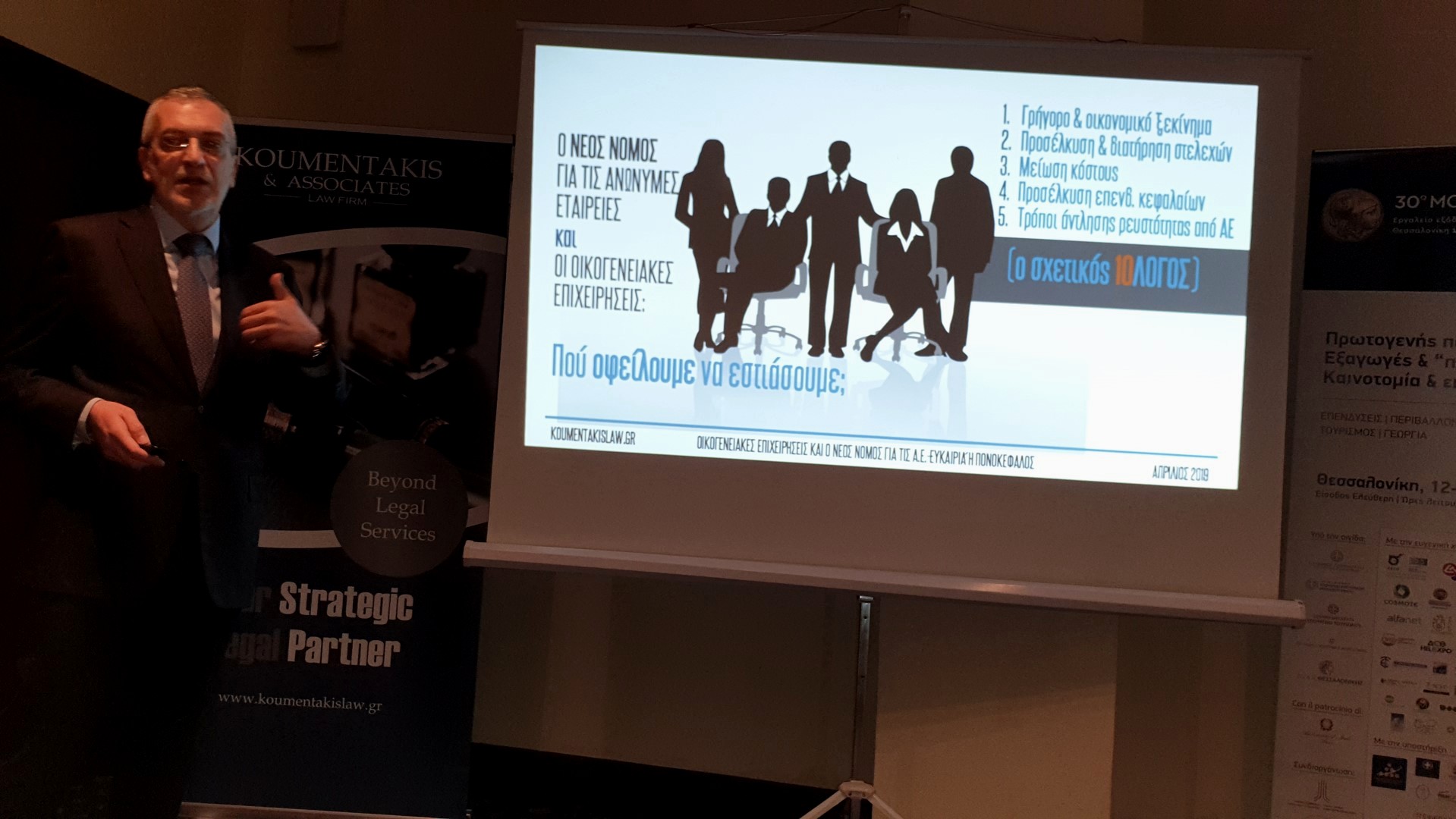
    [vc_row][vc_column][vc_column_text] On Saturday, April 13th, at the Hyatt Hotel, within the framework of the 30th Money Show 2019, a workshop on “Family Businesses in the New Business Environment” was held. The event was co-organized by Capital Markets Experts, the Institute of the Association of Greek Financial Managers (SEODI) and the law firm of KOUMENTAKIS & ASSOCIATES.

    In a packed room, those interested had the opportunity to listen to speeches on three different axes. More specifically, the President of SEODI referred to the role of the Ecumenical Director as part of a family business, Mr. Vasilios Margaris, founder and chief executive of Capital Markets Experts, referred to the necessity of entering a family business on the Stock Exchange, while Mr. Stavros Koumentakis, Senior Partner of KOUMENTAKIS & ASSOCIATES Law Firm briefly presented the new Law on Sociétés Anonymes and referred to its application in family businesses.

    Stavros Koumentakis highlighted the multiple business opportunities that the changes brought by the new Law on Sociétés Anonymes are making and noted that Law 4548/2018, which has already begun to be implemented, offers many benefits that we need to focus on. In the relevant DECALOGUE, Mr. Koumentakis stressed that the new Law on Sociétés Anonymes offers options for:
    (1) Quick and economic start;
    (2) Attracting & retaining executives;
    (3) Cost reduction;
    (4) Attracting investment funds;
    (5) Various ways of raising liquidity;
    (6) For managing small shareholders;
    (7) Exploiting technology;
    (8) The preparation of succession
    (9) Protection of investment and
    (10) Protection of persons.

    As Mr. Koumentakis characteristically mentioned: “The new law is an important opportunity to get to know the operation of our Société Anonyme. With proper guidance and implementation of the new law, we can ensure better protection for founders, shareholders and the investment, redesign on the right bases and reduce operating costs. We can also attract new people and maintain the most capable executives, create the conditions for access to “cheap” funds and use modern technology, and finally, we can better prepare for the next day of our business”.

    In the relevant presentation and video briefing, the most important of the changes were briefly described and a special emphasis was placed on the need to inform entrepreneurs who need to understand the new law and ensure that this knowledge exists among executives and close associates. Lastly, the urgent need for immediate adaptation of the articles of association has been highlighted not only as compliance with the new law but, in particular, to meet the needs of each entrepreneur and each company to adequately meet present and future requirements – particularly those relating to their safe development course.

    [/vc_column_text][/vc_column][/vc_row][vc_row][vc_column][vc_text_separator title=”Gallery” border_width=”3″][/vc_column][/vc_row][vc_row][vc_column][vc_images_carousel images=”37166,37164,37162,37160″ img_size=”full” speed=”6000″ slides_per_view=”5″ hide_pagination_control=”yes”][/vc_column][/vc_row]

  • Minority rights in the Sosiete Anonyme. Part II. The Exceptional Auditing

    Minority rights in the Sosiete Anonyme. Part II. The Exceptional Auditing

    Minority Rights In The Société Anonyme: An Internal Enemy Or A Determinant Of Health? 

    Part B’- The Exceptional Auditing

    According to Solon the Athenian: “Best governance is where the people obey the rulers and the rulers obey the laws”. In the course of history, it has turned out that everyone who rules embraces (apparently, or even deeply) Louis Ludwig’s XIV saying “L ‘etat c’ est moi” (“the state is me” – for which we have already referred to in Part A of the present). In order to ensure legitimacy in the parliamentary democracy, the principle: “the government rules and the opposition controls” (rightly) applies.

    All of this, of course, does not concern politics alone, as it would be easy (and reasonably) able to make the visibility in life and business: Thus, obviously, brought birth to the need for control of the (small or large) majority of each minority. To safeguard the property of the latter but also the property of the enterprise. To ensure its prosperity and its growth.

    And finally: A company under the watchful eye of multiple controls and auditors pretends (and potential investors and/or creditors) for clear financial and “clean” representations …


    Regular And Exceptional Auditing In The Société Anonyme

    We have referred to minority rights (interests) in the Société Anonyme in a previous article. In the present, our reference is limited to the minority rights that are linked to the exercise of exceptional auditing.

    The regular auditing is distinguished for its periodicity as it relates to the approval of the annual financial statements by the General Meeting of the companies concerned (but not necessarily for those designated as small and very small entities). Therefore, exceptional auditing may be carried out in a company under regular auditing.

    In this context, it is not paradoxical to overlap (partial or total) specific auditing areas: for example, checking the fund is subject to regular auditing but it may also be the subject of exceptional auditing.

    In any case, the exceptional auditing may:

    (a)  also cover areas not covered by the regular auditing such as, for example, the feasibility of managing the company;

    (b) be always more targeted than the regular;

    (c) be carried out, in principle, by persons other than those carrying out the regular auditing and in different ways by the appointed ones;

    (d) result in a finding that is not primarily addressed to the same recipients.


    Types, Conditions and Exceptional Auditing Procedure

    In the event that the conduct of acts contrary to the law, the articles of association and/or resolutions of the General Meeting is assumed, shareholders representing more than 1/20 of the share capital of the Société Anonyme (or, for listed companies, by the Securities and Exchange Commission) are entitled to submit a request to the competent Court for the purpose of carrying out the relevant auditing (article 142, par. 1 & 2, l. 4548/2018). The relevant application shall be submitted within three years from the approval of the financial statements for the year in which the transactions in question appear to relate.

    However, if the circumstances show that the management of the company is not exercised in a proper or prudent manner, shareholders representing more than one fifth (1/5) of its share capital shall be entitled to apply to the competent court for the purpose of carrying out the audit ( Article 142 par.3, l. 4548/2018).

    The court decides whether or not to accept the verification request after checking whether or not the aforementioned conditions are met. It is likely that the requesting minority shareholders are represented in the Board of Directors (either because they have directly appointed members or because they have been elected members of the list of potential shareholders nominated by the shareholders). In this case, the court may also assess that there is no justification for the submission of such a request which, in such a case, will be rejected.


     The Auditors And the Conduct Of The (Exceptional) Auditing

    f the court accepts the request for auditing, it specifies the persons who will carry it out (Article 143). The persons entrusted with the auditing may be:

    (a) an audit firm or, at least, a statutory auditor;

    (b) Holders of an A class accountant’s license from the relevant Economic Chamber and, in addition (when it comes to the legitimacy or good governance)

    (c) persons with any specific knowledge, if required.

    The court, when accepting the request, also determines the amount of the remuneration of the appointed auditors, as well as the procedural issues regarding the time of payment, the possible advance payment and the person charged (if the applicants are liable for payment or the company under auditing).

    The auditors appointed will have to complete the auditing assigned to them in the shortest possible time. The relevant result is handed over to the applicant as well as to the Company. The Board of Directors is obliged to inform the shareholders of the company (no later than the next General Meeting) and the Hellenic Capital Market Commission – in the case of a listed company.

    However, it is important to underline that there is an independent obligation for auditors to submit their findings to the competent public prosecutor in case they find that criminal offenses have been committed.


     Exceptional Auditing: A Blessing or A Curse

    The exceptional auditing is usually conducted either when there is evidence or suspicion of mismanagement or when the demand for applicants is to exert pressure on the managers.

    Taking into account the potential scope and depth of the auditing being carried out, the exceptional auditing may work:

    (a) dissuasive or unlawful or unauthorized acts;

    (b) as a means of exerting pressure on their executives or (under certain conditions) of their extortion;

    (c) as (critical) evidence in the context of claims against the persons involved.

    It follows from the above that the right to conduct exceptional auditing is of particular importance in the operation and (conditionally) in the life of the société anonyme itself. This is even more perceptible when criminal offenses are identified, so the competent prosecutor must also be involved.

    In any case: The emergence of unauthorized or unlawful acts through an official (legally ordered) auditing procedure can only cause problems for the company itself – and not only to the case-by-case, insolvent or legally culpable persons.


     Minority rights in Conclusion

    The recognition of the (exceptional) auditing of the société anonyme by minority shareholders is of no doubt that it sometimes works positively (sometimes even beneficial) in the exercise of its management and in the achievement of the corporate purpose. There is also no doubt that it works in the direction of assisting the development of entrepreneurship as well as potential synergies.

    The mediation of the competent court to investigate the fulfillment of the conditions for carrying out the exceptional auditing adds value to the procedure, but also to the seriousness of its outcome. It is basically a result that can hardly be ignored by the members of the Board of Directors, the shareholders and the competent authorities. (And especially with regard to the latter let’s always keep in mind that no business is able to work absolutely thoroughly …).

    Accordingly, any abuse (sometimes simple exercise) of the right in question is harmful not only to the majority shareholder but also to the legal entity it concerns, itself. From this perspective, we all (majority and minority shareholders, legal representatives, courts dealing with such cases) work towards balancing potentially opposed interests and, ultimately, towards safeguarding the interests of the société anonyme.

    Only.-

    stavros-koumentakis

    Stavros Koumentakis
    Senior Partner

    P.S. A brief version of this article for minority rights has been published in MAKEDONIA Newspaper (April 27th, 2019).

    δικαιώματα μειοψηφίας

  • Seminar At the Piraeus Chamber of Commerce and Industry On the New Law on the SAs

    Seminar At the Piraeus Chamber of Commerce and Industry On the New Law on the SAs

    [vc_row][vc_column][vc_column_text] Within the framework of the presentations and informative meetings organized by KOUMENTAKIS & ASSOCIATES LAW FIRM, a seminar was held at the Piraeus Chamber of Commerce & Industry on the needs as well as on the opportunities created for the entrepreneur regarding the regulations of the new Law on Sociétés Anonymes.

    With the participation of representatives from the PCCI and the co-organizers associations and federations (Association of Industries of Attica and Piraeus, Piraeus Trade Association, Pan-Hellenic Association of ship and exporter suppliers and Association of Piraeus Commercial Representatives and Distributors) Stavros Koumentakis, Senior Partner of the firm, enlightened the multiple business opportunities that constitute the changes brought by the new law on the SAs.

    As Mr. Koumentakis characteristically mentioned: “The new law is an important opportunity to become better aware of the operation of our Société Anonyme, to ensure the better protection for founders, shareholders and for the investment, to redesign on the right bases and to limit the operating costs, to attract new and to retain the most capable executives, to create the conditions for access to cheap capital, to make use of modern technology, and finally to prepare the next day of our business”.

    In the informative video presented as an introduction to the Seminar (you can see it below) the most important of the changes were briefly outlined, while the in the presentation that followed there were analyzed in depth the most important axes of Law 4548/2018. Particular emphasis was given on the need to inform entrepreneurs who need to understand the new law and ensure that this knowledge is available to their executives and to their close associates. Lastly, the urgent need for immediate adaptation of the articles of Association has been highlighted not only in compliance with the new law but, in particular, to meet the needs of each entrepreneur and each undertaking to adequately meet present and future requirements – particularly those relating to their safe growth course.

    At the event, besides Mr. Koumentakis, also participated with a presentation on the economic and tax issues of the new law, Mr. Panayiotis Papaspyrou, economist, Chairman of the Board of Directors. & Managing Director of “Financial Management Consultants S.A.”

    Mr. Koumentakis and the team of the Legal Advisors of KOUMENTAKIS & ASSOCIATES Law Firm continues to respond, as far as possible, to requests for relevant workshops and seminars throughout Greece. Next stop: The Money Show in Thessaloniki.

    [/vc_column_text][/vc_column][/vc_row][vc_row][vc_column][vc_text_separator title=”Gallery” border_width=”3″][/vc_column][/vc_row][vc_row][vc_column][vc_images_carousel images=”37018,37020,37022,37024″ img_size=”full” speed=”6000″ slides_per_view=”5″ hide_pagination_control=”yes”][/vc_column][/vc_row]

  • The insurance of the liability of the Members of the BoD and of the Executives of the S.A.

    The insurance of the liability of the Members of the BoD and of the Executives of the S.A.

    1.Introductory

    The liability insurance of the members of the board of directors of the Société Anonyme and of its executives is referred to in the international practice as “Directors’ and Officers’ liability insurance” or “D & Os liability insurance”. This insurance covers the damages of such persons:

    (a) arising from claims against them raised by third parties (lenders, employees, shareholders) or by the company itself for injurious and negligent acts or omissions in the performance of their duties,

    (b) for the risks incurred by the insurer.

    In Greek legal terminology, as well as in the context of private insurance law, it is commonly referred to as insurance of the civil liability of members of the board of directors of Société Anonyme. However, the scope of the relevant insurance contract goes beyond civil liability, since its coverage extends to both the criminal and the pecuniary costs incurred in administrative courts or authorities, as will be set out below. Moreover, the relevant insurance cover is not limited to the persons who form the board of directors of the Société Anonyme but also extends to the members of the executive committee, to the substitute members as well as to the executives who carry out management duties. In fact, it is often agreed also the insurance cover of the external directors, even of the spouses, heirs or administrators of inheritance, in respect of the claims against them concerning breaches of the duties of the insured persons.

    Consequently, legally more correct and more compatible with the content of the relevant insurance contract is to refer to liability insurance of the members of the management of the Sociétés Anonymes.


    2.The robust growth of this insurance product

    The cover of the liability of the members of the management of the Société Anonyme is a relatively new insurance product, which has strong growth in the international business community. This growth is, among other things, due to:

    (a) the judicial and legislative strengthening of the liability of the members of the management over the company itself but also vis-à-vis third parties,

    (b) the adoption of international corporate governance rules and the gradual imposition of a single corporate regulatory framework through Union law of the European Union,

    (c) the increase in corporate insolvency as caused by the international financial crisis of 2007-2008, which has grown into an international corporate financial crisis as well as,

    (d) the tendency of corporate creditors to turn against either the managers of the corporate entity or solely against them.


    3.The economic and business benefits of the relevant insurance

    Insuring the liability of management members of the Société Anonyme has a number of advantages that make it an attractive insurance product. It would not be an exaggeration if we described it as a necessary action and expense for individual legal entities. Indicatively, some of the reasons for confirming the need to conclude the relevant insurance contract are mentioned:

    (a) such insurance cover constitutes an alternative form of financing both of the company and of the third parties in respect of the damages they have suffered under the liability of those who manage the entity,

    (b) the terms and sizes of the relevant insurance contract make it easier for third parties and, in particular, for the shareholders of the recipient company to assess the risk profile of the latter,

    (c) the conclusion of this insurance contract ensures control and oversight (monitoring) of the company and contributes to prudent risk management,

    (d) offering this insurance cover is a fairly important reason to attract competent management executives, while

    (e) the conclusion of the specific insurance contract protects the company’s reputation and credibility.


    4.The nature of this insurance contract

    4.1. In the context of private insurance law, liability insurance for members of the Société Anonyme is part of third party liability insurance, although, as mentioned above, it has a broader scope. This insurance is in principle general in character and is not legally required. It is included in the non-life insurance and not in the insurance of persons, as the particular damage caused to the insured’s property is restored from the realization of the insured risk. In addition, it is classified as liability insurance, as it safeguards the risk of the creation or increase of liabilities in the assets of the insured.

    4.2. The liability insurance of the members of the management of the Société Anonyme usually takes the form of a genuine third-party contract, as three (3) different persons are involved:

    (a) the Société Anonyme in its capacity as recipient, which concludes the relevant contract as the policyholder of the insurer and, at the same time, on behalf of third parties (that is to say, members of its management),

    (b) an insurance company in its capacity as an insurer, which assumes the above-mentioned obligation to recover the damage to property not from the policyholder company but from third parties (ie members of its management) from the realization of the insured risk; and

    (c) the members of the company’s management in their capacity as insured persons as well as the beneficiaries of the insurance, as their right to expect the insurance indemnity is born directly and directly incurred .

    4.3. The aforementioned legal construction has the legal consequence that the Société Anonyme becomes liable for the fulfillment of the obligations arising from the relevant insurance contract due to its bearing capacity as a recipient of the insurance. In addition, the Société Anonyme is also the entity in which the rights to terminate and amend the insurance contract, as well as the right to withdraw or oppose it, are granted. On the contrary, the main obligation of the members of the management of the Société Anonyme is the non-infringement of the insurance obligations, i.e. compliance with the rules of conduct laid down by the law or the relevant insurance contract, in order to fulfill the insurer’s performance and, in particular, the payment of the insurance by the latter.


    5.The insurance cover

    5.1. In accordance with the aforementioned, the scope of the relevant insurance contract exceeds the civil liability of the members of the management of the Société Anonyme. However, as the basic scope of the relevant insurance cover refers to civil claims, its main basis is the damaging act which includes any actual or presumed breach of the duties of the members of the management over the company. Also, this insurance cover includes any unjust and injurious third party act or omission, error or negligence in the performance of the duties of the members of the management of the entity. That is, any individual responsibility of a director of a corporate body is enforced, whether he issued severally or jointly or independently. In this context, it is clear that the relevant insurance cover extends to the breach of substantive rules of private law which entail liability for the directors of the company. However, damages claims based on special agreements or conditions introduced by provisions of a subordinate law that exacerbate the liability of the legal entity beyond the legal provision are not covered.

    5.2. In any case, however, the cover of the relevant insurance contract does not extend to activities which are contrary to public policy, which is unfair and immoral and directly oppose prohibitive legislation. For this reason, criminal penalties, fines, and other financial penalties are also excluded from cover. The fines include those imposed by the competent supervisory authorities. Nevertheless, the legal costs of prosecuting the insured person are valid. In some insurance policies, it is agreed that the costs of the criminal proceedings should be covered only if the managing director is found innocent.

    5.3. Furthermore, apart from breaches of private law rules, the relevant insurance cover may extend to infringements of public law rules. Criterion for the relevant insurance cover is the nature of the compensation resulting from compensation under public law provisions. That is, if the indemnity is reparable, it falls within the liability of the members of the management of the Société Anonyme. On the other hand, if the nature of the compensation is valid, it is not covered by the relevant insurance contract. Consequently, subject to compliance with the relevant criterion, it is possible to cover pecuniary claims filed before administrative courts or administrative supervisors and the costs of the investigation by any competent authority.

    5.4. Finally, the exemptions introduced in the relevant insurance contracts fall into multiple categories, depending on the practice of the insurance companies and the criteria adopted by them. In order to avoid long and unnecessary developments in the present analysis, the following clarifications are considered appropriate:

    (a) the relevant insurance cover excludes claims covered by other policies, including but not limited to claims covered by professional liability insurance policies,

    (b) in addition, such acts are excluded from such cover, which involve a high risk for the insurer, which usually includes the liability of the members of the management of a Société Anonyme for defamation and personal injury, the claims related to the bankruptcy of the company and damages associated with transformations of companies,

    (c) furthermore, claims arising out of the liability insurance of members of the management of a Société Anonyme are excluded from claims arising in courts outside the European Union or from breach of legislation of States outside the European Union,

    (d) finally, the cases of fraudulent provocation of the insurance case are reasonably excluded from this insurance cover. In particular, the claims for third-party claims or the insurance of a Société Anonyme arising out of a fraudulent breach of the management duties or the provisions of the law by the management of the corporate entity are excluded.


    6.Insurance Clauses

    Apart from the above-mentioned exceptions, the relevant insurance contract applies special clauses, which refer only to the specific insurance contract or have been formulated on the basis of the development of the relevant insurance and which substantially restrict the liability of the insurer. In particular, the insurance policy may include:

    (a) the group clause, which allows for the uniform identification and treatment of the insurance risk and, moreover, charges the group with less expense by covering, with a group insurance policy, all the corporate entities of a group,

    (b) the own contribution clause of the insured, which entails the taking over by the insured member of the management of the Société Anonyme of a part of it and, in particular, of a certain amount or percentage of the indemnity in general or per insurance case,

    (c) the clause of the serial damage (otherwise chain damage) which limits more claims arising from the same unlawful act to the same amount of insurance and the same insurance period as they are treated as a single claim,

    (d) the dismissal clause of the particular member of the management of the Société Anonyme, which requires the entity to have previously denounced the relationship with that person as a necessary condition for the activation of the insurance cover,

    (e) the policyholder’s insured clause, which does not allow the claims of an insured member of the management of the entity to be covered by another insured person either directly or by way of redemption. This clause appears in a variant of the clause as a non-coverage clause, which limits or prevents the relevant insurance cover. This limitation takes place according to the degree and extent of the involvement of the insured persons involved in the management of the recipient’s insurance and includes claims by persons directly or indirectly linked to one of the insured persons. Because of its introduction, it is recommended not to create situations of conflict of interest, collusion and abusive behavior, but also to avoid enrichment.


    7.Epilogue

    7.1. The adoption of Law 4548/2018 on the reform of the law of Sociétés Anonymes has brought about a number of changes, sometimes sweeping, in the operation of corporate entities. Regarding the responsibility of the members of their management, a previous article from the blog of this web site has provided a detailed explanation of their intra-company and criminal liabilities, as they are now formed under the new legislative status (read the first part of the article for the liability of the Members of the Board). It is easy to see the intensification of the criminalization of entrepreneurship and it is equally easy to distinguish the discretion of the corporate managers in achieving the corporate purpose.

    7.2. Furthermore, in another article of the same blog, the administrative and criminal responsibilities of corporate managers vis-à-vis the State and the Insurance Organizations, as derived from the tax, insurance and customs legislation, as well as the liabilities attributed to them by specific provisions of the Civil, the Bankruptcy and Penal Code (read the second part of the article for the liability of the Members of the Board). It is clear that the exposure of the members of the Société Anonyme’s management to extremely serious risks.

    7.3. It is obvious, therefore, that the liability insurance of corporate managing directors is an effective means of defending and safeguarding them against the risks stemming from corporate governance and the tightening of the legislative environment. The conclusion of the relevant insurance contract, according to the above mentioned, is characterized by strong economic and business advantages: better corporate organization, higher status and corporate solvency, clearer business image and the ability to attract competent executives. Let us not close our eyes on international business practices and international corporate governance rules: the dissemination and establishment of these policies also into the Greek business community is the only appropriate choice.

    7.4.  Finally, the role of the legal counsel of the company proves to be decisive in the management of the issues related to the liability insurance of the members of the management of the Société Anonyme. In this context, the legal adviser is responsible for working closely with the insurance broker, with whom the corporate entity works, to evaluate the (more) insurance options and products offered and to assist in choosing the best solution. Additionally, the duty of the legal counsel is to ensure maximum insurance of the insurance of a Société Anonyme and the insured corporate managing directors by checking the legality of the conclusion and the valid content of the relevant insurance contract. Finally, in the event of the insured risk occurring, the legal counsel must make a substantiated claim for the fulfillment of the insurer’s obligations and, in particular, for the payment of the insurance.

    It should be perfectly clear:

    At any stage (out of the above mentioned) the appropriate legal advice is not received, it is highly probable that the potential cost of the business will prove to be infrequently high.

    Petros Tarnatoros
    Senior Associate

    P.S.: The article has been published in Greek in MAKEDONIA Newspaper (March 17, 2019).

This site is registered on wpml.org as a development site. Switch to a production site key to remove this banner.