At the risk of “betraying” my age, I have to quote that I learned to typewrite in the early 1980s. One, newer then, Olivetti was the one which tolerated me (the younger ones and the eager may navigate to the internet for the relevant pictures).
At that time, if anyone was talking about technology, perhaps we would have thought, if we thought, the (electric) typewriters (with the “ball”) that were to follow.
At that time, we would notthing of internet, of the e-mail or of the teleconference.
At that time, it was not possible to imagine how technology could be used by a société anonyme or by a law firm (there were not even law firms then).
But there have been almost forty years since then.
The changes, since then, sweeping.
Also in the law of Societes Anonymes!
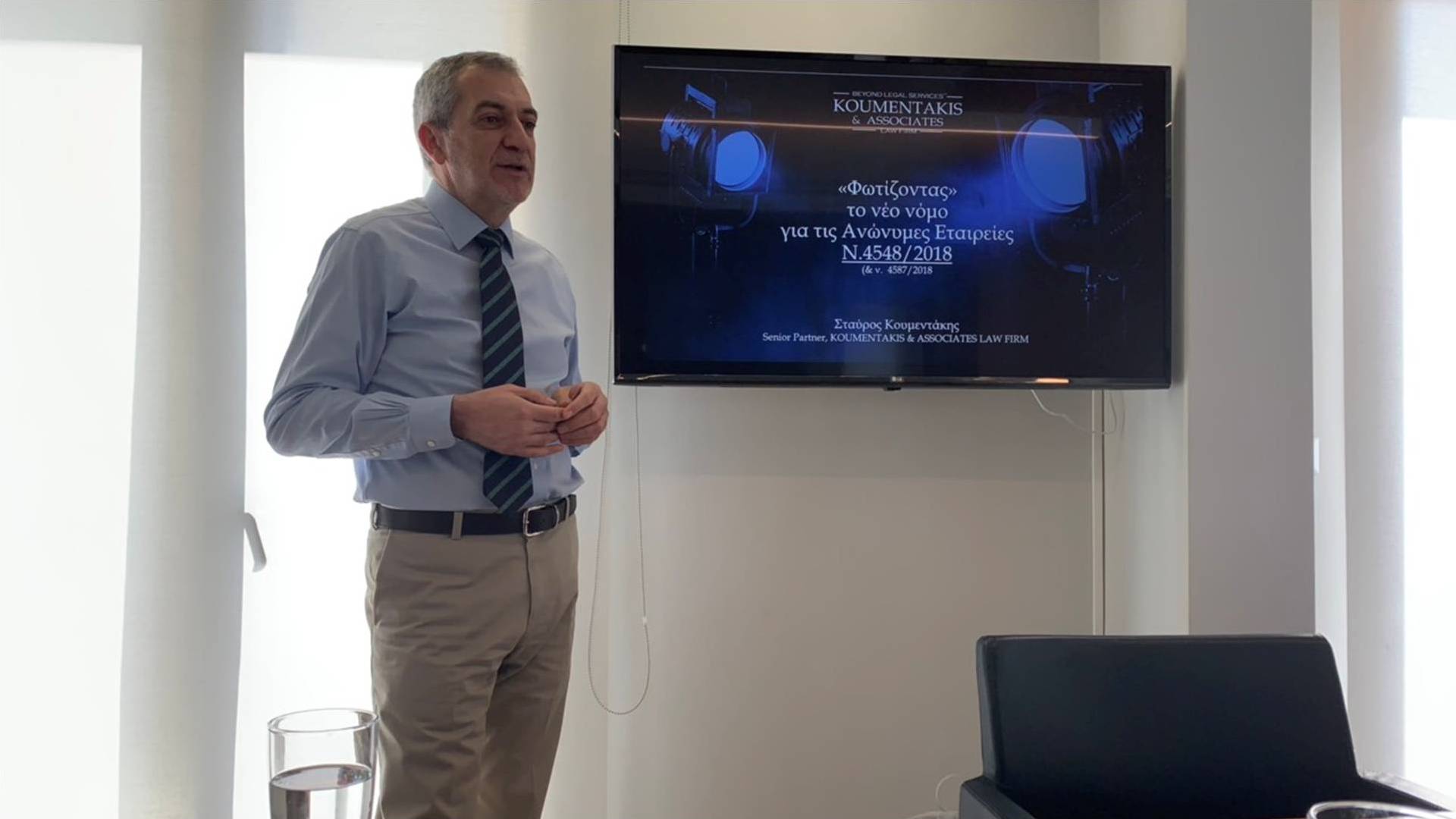
(refer to The new law on Sociétés Anonymes and Sociétés Anonyme: The new law).
The recent law
The recent law (4548/2018) for sociétés anonymes provides a wealth of opportunities related to the exploitation of technology. Which, without a doubt, make our lives (entrepreneurs, accountants, lawyers) easier. Helping to the more efficient and effective operation of the société anonyme.
It is noteworthy, however, that the use of technology is not required by law. In a number of provisions, the law regulates the option of statutory provisions for technology’s exploitation.
The ability to exploit technology
Solely indicatively, may one refer to the provisions of the new law that refer (provided of course that there are corresponding statutory provisions) to:
In the operation of the Board of Directors
- The possibility of the Board of the Directors having meetings by teleconference (Article 90).
- The possibility of decision making by the Board of Directors by means of email exchange (Article 94).
In exercising shareholder rights
- The ability of the shareholders: (a) to request information by email for the forthcoming General Meetings of the companies (article 122) but also (b) to be sent to them the subject to a vote by the ordinary General Assembly financial statements of the company (Article 123).
- The obligation for companies to comply with such requests.
In the procedures of the General Assembly
- The ability of shareholders to participate in a General Meeting (Article 125) on-line (real-time) by audiovisual or electronic means.
- The ability of shareholders to participate in a vote of a General Assembly from a distance that is preceded by a “letter” vote (Article 126). This particular ability is exploited: (a) by the availability of issues and ballot papers via the Internet and (b) by filling in the ballot papers electronically. It is noted that when a distance voting takes place, it is compulsory that the vote be (reasonably) an open one (Article 131) but also that the company ensures the identity of the participant in the process as well as the electronic or other connection.
- The ability of non-shareholder-members of the Board of the Directors, auditors or third parties to participate in a General Meeting by electronic means (Article 127)
- The ability of shareholders to appoint, recall and replace (by electronic means) their representatives (Article 128)
- The ability to hold General Meetings without a meeting (Article 135) when all shareholders have communicated to the company their e-mail addresses. In such cases, the proposal of the Board of Directors is sent electronically to the shareholders along with: (a) a draft decision, (b) the relevant suggestion of the Board of Directors, (c) the way of declaring acceptance or refusal but also the deadline for shareholders’ reply / vote (7-30 days). [In such a case, shareholders are also entitled to submit information requests electronically within three days of receipt of the Board’s proposal. These requests are required to be answered within two days of receipt].
- The ability of countersigning General Meeting minutes without a meeting (Article 136), together with the ability to replace shareholders’ signatures by e-mail.
In the Shareholders’ Unions
- The ability to provide information from Shareholders’ Unions (Article 144) via the internet on the rights of shareholders, investors, and the ways of, among others, namely conciliation.
The (necessary but also rational) use of technology and its capabilities.
Almost one hundred years since the first law on sociétés anonymes (2190/1920) and almost forty years since I learned to type, are so many.
So (I think) I have the right to “strongly qualify” to encourage (also) the exploitation of the latest law on the use of technology.
The legal background exists.
What remains is the (evaluated but also rational) incorporation of the respective options in the articles of association of the sociétés anonymes – which in any case must be aligned with the new data and the requirements of the law.

P.S. A short version of this article has been published in MAKEDONIA Newspaper (13 January 2019).