
Blog

  • The Partial Payment of the Share Capital

    The Partial Payment of the Share Capital

    In a previous article we focused with the share capital of the SA. We dealt, among other things, with the meaning and importance of its payment. As we identified there, the capital both during the establishment of the SA and in the context of its increase process, is not required to be paid up in full. It is expressly and clearly stated by law that its partial payment is permissible. The partial payment, however, requires specific procedural steps, presents advantages and risks. About them, see immediately below.


    The advantages and the risks

    The possibility of partial payment of the share capital has significant advantages. It allows, among other things, the accumulation – even in the future – of higher sums of capital (than those which, in a different case, could be collected and paid in full from the beginning). It binds the participants (shareholders) to a specific mix of equity composition – despite the fact that the funds will not, at the time of the (co)decision, be fully available. It facilitates (but also binds) those shareholders who make the partial payment to make up the missing amount. It binds the shareholders who fully paid up their share to the participation of the shareholders who partially paid their share in the share capital at a certain percentage. It facilitates tax planning and the justification of wealth (“πόθεν έσχες”). It saves costs for the business that any process of increasing the share capital entails.

    This possibility, however, also holds risks for the SA, its shareholders and creditors. These risks concern the potential inability of the partially paying shareholders to make the full payment. For this reason, Law 4548/2018 provides, through provisions of mandatory nature, strict procedural conditions; stricter, however, are the consequences provided for shareholders who do not make (timely) payment.


    The Concept Of Partial Payment

    As a partial payment by law (Article 21 §1) “… is considered the payment at the establishment of the company, as well as the payment at each increase of its capital, of part of the nominal value of the share, with simultaneous assumption of the obligation to pay the remaining value of the share, in accordance with the provisions of the articles of association”.

    However, it is noted that the repayment of the due value of the share can also take place by netting.


    Conditions for Permissible Partial Payment

    As we have already mentioned, partial payment entails risks. In order to minimize it, the legislator provides specific conditions in order for partial payment to be accepted as valid. These conditions aim, among other things, at the transparency of the partial payment process, at ensuring the payment of the share capital and at protecting the SA, the other shareholders – and of course third parties.

    Statutory Provision

    A necessary condition, on which the valid start of the partial payment procedure exclusively depends, is the relevant provision being in the statute of the SA (article 21 §1 in fine). The more specific terms will be provided, as the case may be, either in the statute itself and/or in the decision for the increase of the share capital with its partial payment (by the body that decides on the increase: General Assembly or Board of Directors).

    Contribution In Money vs Contribution In Kind

    Partial payment can only be provided for monetary contributions. It is not possible to adopt this specific procedure in the case of contributions in kind (art. 21§2).

    The law’s prohibition seems perfectly reasonable. The agreed contribution in kind will not, as a rule, be possible to be paid in installments (transfer of, e.g., property ownership). It should be noted, however, that a necessary condition for the validity of the payment of the contribution in kind is its previous valuation (subject to the exceptions of Article 18 of Law 4548/2018). The valuation, however, is valid for 6 months (Article 17 §9). This time limitation cannot serve the partial payment of the capital as the latter extends, as a rule, over a longer period of time.

    SA With Shares Not Listed on a Regulated Market

    Only SAs with their shares not listed on a regulated market can be subject to partial payment of their shares (Article 21 §2). This prohibition is rightly intended to protect the capital market on the one hand and investors on the other: we have already mentioned the risks that partial payment entails.

    Time During Which A Share Can Be Partially Paid

    The special arrangements that apply mandatorily if the partial payment procedure is provided for include the maximum credit period for the payment of the installment or installments to repay the shares. Specifically: “The time during which the share value may remain only partially paid cannot exceed five (5) years” (article 21 §3, para. a’). The starting point of the five-year period must be considered: (a) Regarding the initial capital: the registration of the establishment of the SA in the Business Registry (b) Regarding cases of increase: the taking of the relevant decision by the competent body.

    Therefore: the due date of the individual installments cannot be determined later than five years.

    The Minimum Immediately Payable Portion of the Value of Each Share

    Furthermore, the law specifies the minimum immediately payable portion of the value of each share, which is mandatorily and immediately payable without credit. That is, within the deadlines for full payment, as provided for in Article 20 of Law 4548/2018. In particular, this part (minimum-immediately payable) “…cannot be lower than 1/4 of the nominal value of each unpaid share”. At the same time, the immediately payable part of the share cannot be less than the minimum, according to the law, nominal value of the share, i.e. 0,04€ (Article 35 §1)

    It is also clarified that in the event that shares are to be issued at a premium, “…the difference is paid in full, along with the payment of the first installment.” (article 21 §3, para. b΄).

    The Minimum Immediately Payable Portion of the Share Capital

    In addition, in the case of partial payment, the directly paid part of the capital, either during the formation of the SA or during its increase “…must be at least equal to the minimum limit defined in paragraph 2 of article 15” (article 21 §3, para. c).

    Therefore: the sum of the individual, partial payments cannot fall short of the minimum, by law, limit of the share capital (€25,000).


    Issued Securities

    In the event that “…share securities are issued that have not been fully paid up, the fact of the incomplete payment and the terms of the latter must be written on their front side” (Article 21 §7). This provision is, of course, intended to protect those who acquire the shares at a later time. Of course, the transferor of the specific, not fully paid-up, shares has a corresponding obligation to inform the acquirer for the share’s partial payment, otherwise there is an obligation to, at the least, compensate the latter.


    Consequences of Partial Payment

    As long as the above conditions are met and while the partial payment process lasts, the following applies:

    Shareholder Status

    Shareholder status is already acquired from the time of coverage of the shares (in other words: the conclusion of the contract to undertake them). This, in practice, means that any partial payment does not deprive the respective shareholder of any of the rights deriving from their shareholding status. It is pointed out, however, that for the calculation of the quorum at the General Assemblies, the law takes into account the paid-up share capital only, article 130 of law 4548/2018).

    Proration of Payments on Outstanding Shares

    In case of partial payment, the imputation of the payments of the accrued installments and payments takes place in a specific way. In particular, in the event that the respective shareholder has taken over more than one share, the payment they make is proportionally attributed to each of these shares (Article 21 §4 Law 4548/2018). Practical: it is not possible to pay off some, only, of the total of the unpaid shares.

    Full Liability for Transfer of Shares not paid for in full

    In the context of the partial payment procedure, the law specifies the liability of the transferor of unpaid shares for the remaining, unpaid and due, sum: “the transferor of a share not paid in full remains liable for the due part of the share for a period of two years from the registration of the transfer…in the shareholders’ book of the company.” (article 20 §3, par. d’).

    Therefore: Responsibility for the remaining-due part of the value of the share falls on the one who transfers; however, it also falls on the one who acquires as the latter (: acquirer) enters into the shareholding relationship. The relative liability of both (the transferor and the acquirer) is considered joint liability.


    The Legal Consequences of Non-Payment (On Time).

    The legal consequences for not paying an installment on time are, undoubtedly, severe (Article 21 §§5 & 6).

    Through these and the proportional imputation of payments, which we examined above, it is sought to compel the shareholder to fulfill their obligations regarding the unpaid shares.

    It is pointed out that the above provisions related to the consequences are applied proportionally in every case of late payment. Whether it is contributions in money or in kind (Article 20 §9).


    The specific legal consequences are, in particular, the following:

    Social Consequences

    Σωματειακού Χαρακτήρα Συνέπειες

    (a) In any case of late payment of any installment, the Board of Directors gives the shareholder a deadline of one month, with the following warning: “…in the event that this deadline has not been fulfilled, the unpaid shares will be canceled and any payments made will remain with the company as a penalty.”.

    The above deadline is inflexible and must be communicated (together with the relevant warning) by any suitable means to the shareholders who have not paid the due installment. It is even recommended, for evidentiary reasons, to keep a formal document (e.g. an extrajudicial letter or even an e-mail). However, it is noted that the imposition of the specific deadline cannot be omitted.

    (b) If the monthly deadline passes, the company takes the following actions:

    (i) It notifies the non-paying shareholder that it cancels their shares and withholds in favor of it (the company) any advances or installments paid, including any premium difference. The cancellation, in this case, does not constitute a reduction of the SA’s capital, but a termination of the non-paying shareholder’s shareholding relationship with the latter.

    (ii) It issues new shares, equal in number to those canceled and offers them to the other shareholders. If none of them buys them, they are freely available. Therefore, prior recourse to the right of pre-emption is necessary (: article 26).

    (c) Furthermore, the law provides that: “…if the shares are restricted or if their offer is wholly or partially unsuccessful, the company is obliged to reduce the capital by the amount of the nominal value of the unsold shares in the first General Assembly to be convened, even if the relevant issue is not listed on the agenda”. The specific decision of the General Assembly to reduce the share capital is taken, exceptionally, by simple quorum and majority.

    Consequences according to the Law of Obligations

    A legal consequence deriving from the Law of Obligations (:§6), is the interest on the debt of the untimely paid contribution, with the legal interest rate, until the cancellation of the shares. Furthermore, in the articles of association of the SA or in the decision on the possible increase of the share capital with its partial payment, it is possible to provide for the forfeiture of further penal clauses, in the cases of late payment. Finally, the law does not exclude the possibility of the raise of other, additional, claims by the SA against the defaulting shareholders.

    Alternative Legal Consequences

    In addition to the consequences mentioned immediately above (§§5 and 6), the Recitals of Law 4548/2018 on Article 21 provides for the following consequence (among others). The possibility, i.e., of recourse to the provisions “…for the exemption of shareholders from the obligation to pay paid and unpaid capital through reduction or depreciation of the capital” (articles 30 §4, 32 §3).


    The rule is the full payment of the share capital, which each shareholder undertakes to cover. An exception is, under certain conditions, its partial payment. The relevant conditions are, justifiably, extremely strict. They intend to protect, in advance, the legal entity and the third parties who look to the share capital of the SA. In case of violation of the specific conditions, the liable shareholder will lose their (partially paid) shares. However, their damages are not limited to the loss of their specific (often of significant value) assets. It also extends to the total of the money they paid for their (incomplete) repayment. However, as mentioned above, further penalty clauses and/or other claims of the company against the obligor may be in place.

    In other words: the possibility of partial payment of the share capital constitutes a significant opportunity for the shareholder to whom it is granted, but it also entails significant risks. In this regard, special attention is required to be paid to the terms set in the articles of association as well as in the decision to increase the share capital.-

    Stavros Koumentakis
    Managing Partner


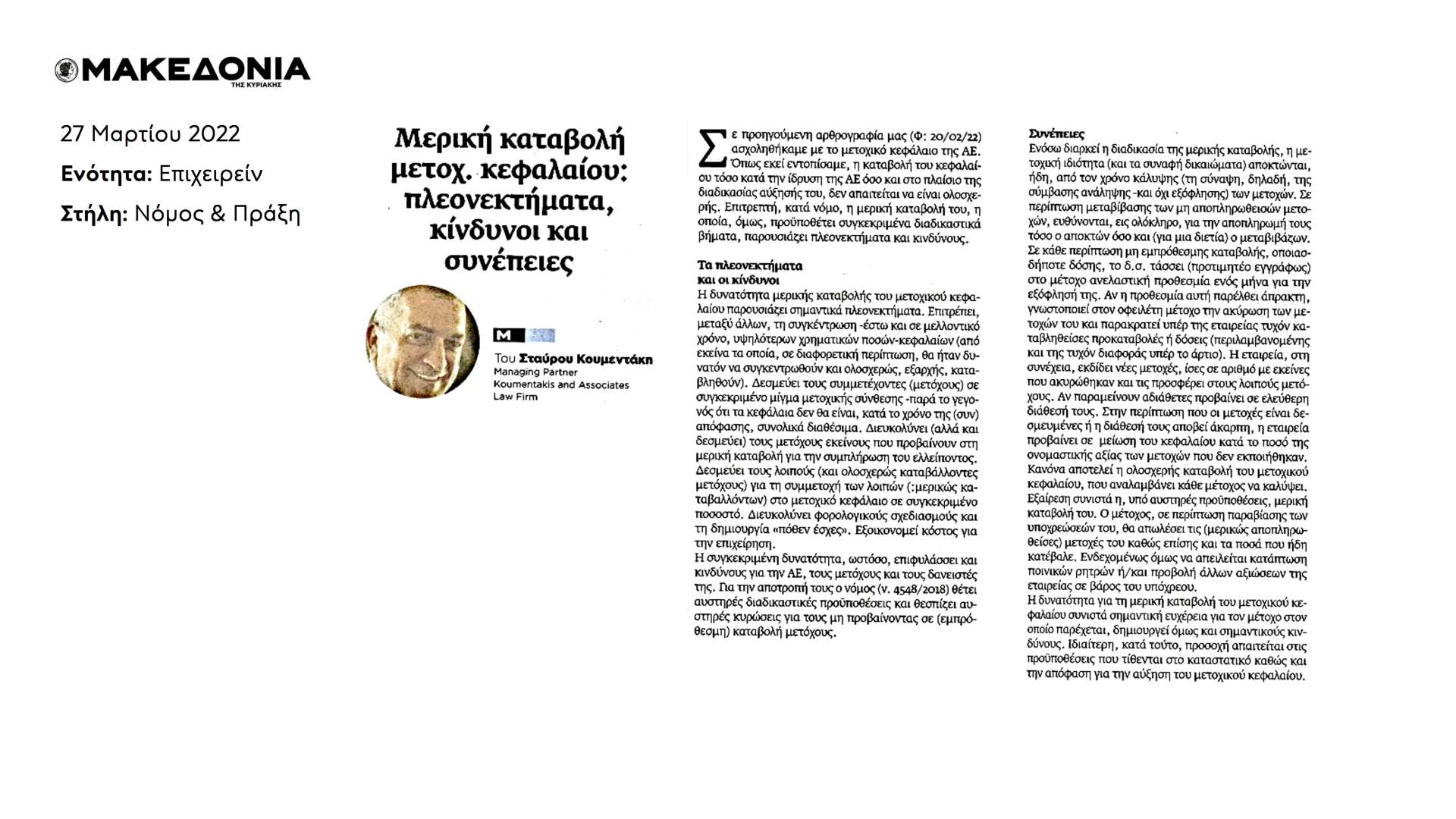
    P.S. A brief version of this article has been published in MAKEDONIA Newspaper (March 27th, 2022).
    Disclaimer: the information provided in this article is not (and is not intended to) constitute legal advice. Legal advice can only be offered by a competent attorney and after the latter takes into consideration all the relevant to your case data that you will provide them with. See here for more details.

  • The Share Capital Increase

    The Share Capital Increase

    In a previous article we had the opportunity to understand the importance of equity capital, as well as its differentiation from the property of the SA, which is subject to continuous-successive changes. The share capital, on the contrary, “…constitutes an “unchangeable” mathematical quantity, which is written in the company’s articles of association and which, upon its establishment, corresponds to the sum of the value of the contributions” (: Memorandum to the Law on SAs-4548/2018) . This does not mean, however, that the share capital cannot, under conditions, fluctuate. We will focus now on its growth as well as on specific, interesting (some, perhaps, critical) points of it. In other words: stay tuned!


    The dangers

    The increase of the share capital (with the exception of the “nominal increase” – for which see immediately below) is one of the main forms of financing of the SA: the “opposite “, so to speak, of financing through (bank) lending. The financing of the company through the increase of its share capital presents a number of advantages over its (bank) borrowing. However, as our subject is not the financing of the SA, we will limit ourselves to the most significant of them.

    Specifically: Between the investors/financiers/shareholders and the SA, an equity and not a credit relationship is created. The SA is therefore not obliged – and, in principle, not allowed – to return the capital to its investors/shareholders. But neither does it owe them interest – at least as a rule. The shareholders of the SA, on the other hand, look forward (also as a rule) to receiving, under conditions, dividends and their participation in its profits – if any. Further: increasing the share capital of the SA strengthens the latter’s solvency, as opposed to taking on debt through borrowing.

    However, it should not elude us that financing through a capital increase can lead, if the existing shareholders choose/accept/tolerate it, to the entry of new shareholders into the SA. This is especially the case when funding is sought from a crowd of funders/potential shareholders through a regulated market. The increase of the share capital of the SA is therefore possible to bring about changes, sometimes significant, in the (share) balances and the management of the company.


    The Distinctions Of Raising Equity Capital

    However, the term increase of share capital does not always imply a way of financing it. Let’s see why:

    Nominal & Actual Increase

    This distinction is a consequence of the distinction between equity capital and corporate property. Particularly:

    Nominal Increase

    This type of (nominal) increase in the share capital does not constitute an increase in the SA’s corporate assets. It is simply an accounting adjustment of the share capital. An adjustment to be opted by the shareholders, in order to capture the greater value, which the corporate property has acquired due to the existence of (apparent or hidden) reserves.

    In this case, the SA may increase the nominal value of its existing shares. Alternatively, however, it is possible to issue new shares and grant them, without consideration, to its existing shareholders – on the basis of their participation in the share capital. In this case, the shareholders do not pay contributions. On the contrary, “…they acquire the new shares automatically… without the need for any declaration of intent. In fact, the acquisition of the new shares by the old shareholders… is mandatory in the sense that no deviating regulation is allowed by decision of the General Assembly. or an arrangement such that this acquisition will depend on the fulfillment of conditions” (ind.: 577/2010 Court of Appeal of Thessaloniki).

    It is noteworthy that the decision on a nominal increase is taken by the General Assembly with a simple quorum and majority (Article 130 §3).

    Actual Increase

    The actual increase constitutes, at the same time, an increase in the share capital of the SA and its corporate property as, through it, new assets flow in.

    Further, the actual increase is distinguished into capital increase: (a) by capitalization of profits and (b) by payment of contributions. The conditional capital increase is also actual (: cases of issuing a convertible bond loan -article 71 and granting the option to acquire shares -article 113). The practice of advance payments to shareholders for future capital increases is a variant of the increase by contributions. Further:

    (a) Actual increase by capitalization of profits: This is the increase realized by capitalization (of the whole or part) of the net profits, to be distributed, of the SA. The capitalized profits may correspond to the minimum and/or the additional dividend of the shareholders (Article 161 §3).

    In this case, the shareholders receive no dividend or, at least, not all of it. The otherwise distributable amount is capitalized. Shares are distributed to the beneficial shareholders, in proportion to the participation of each one in the share capital.

    The decision on the specific increase is taken by the General Assembly with a simple quorum and majority.

    (b) Actual increase by paying contributions: This is an increase in the share capital by paying contributions in money or in kind.

    In this case, new shares are issued to cover the additional (numerical) value of the capital or until it is covered. These shares are taken over (:undertake contract) either by existing and/or (as the case may be) new shareholders. The shareholders are therefore obliged to pay the nominal (and/or, where applicable, the premium) value of the new shares.

    The actual increase by paying contributions will concern us below.

    Regular & Extraordinary Increase

    With the criterion of the body that decides the actual increase by payment of contributions, the latter is further distinguished into regular and extraordinary (article 23 section a’).

    Ordinary Increase: It is the increase of the SA’s share capital, which is decided by the General Assembly with an increased quorum and majority.

    Extraordinary Increase: It is that increase, which is decided either by the General Assembly with simple quorum and majority or by the Board of Directors. This particular increase, due to its special interest, will concern us in our next article.


    The Content of the Decision on the Increase

    The minimum content of the decision of the competent, as the case may be, body of the SA to increase its share capital is specified in the law (Article 12 §1, par. d); whether it is a regular or an extraordinary increase. The relevant decision is always published in the Business Registry.

    Specifically, in any case of capital increase, the decision of the competent body of the company must state -at least (article 25 §1):

    (a) The amount of the increase in share capital. The competent body is, in principle, free to define the amount of the increase. However, in the case of the extraordinary increase, the legislator places specific restrictions on the upper limits of the increase (Article 24 §§1 and 2).

    (b) The method of covering the increase (accordingly, i.e. if contributions are to be paid in money or in kind). In the case of contributions in kind, as we have pointed out in a previous article, the relevant decision must meet the conditions of the law (article 17).

    (c) The deadline for covering the increase (see related previous article).

    (d) The number of shares to be issued.

    (e) The type of shares to be issued: whether they are common, preferred or redeemable (nominal, in any case) shares.

    (f) The nominal value of the shares. The determination of the nominal value must fall within the limits set by the law: the nominal value of each share cannot be set at an amount lower than €0.04 nor higher than €100 (article 35 §1, section a’).

    (g) The sale price of the shares. Setting the sale price is extremely critical. Any low price compared to its true value constitutes underfunding of the SA. In addition, in case of entry of new shareholders, it constitutes a (partial at least) depreciation of the existing shares. On the contrary, any high price makes it difficult to participate in the increase and, by extension, to finance the SA.

    In any case, the sale price cannot be less than the nominal value of the share. In particular, it is provided that “…it is prohibited to issue shares below par” (Article 35 §1).

    It is possible for the General Assembly, in the case of an ordinary increase only, to authorize the Board of Directors (with the decision of the increase) in order to “…determine the sale price of the new shares, or, in the case of the issue of preferred shares with the right to draw interest, the interest rate and the method of its calculation”. The authorization is submitted to the public and its validity cannot exceed one year (Article 25 §2). This feature gives the Board the opportunity to find the most appropriate time within the year from the increase decision to determine the best possible price. If, however, the Board does not take advantage of the relevant possibility, the increase is aborted.


    The Approval of a Class or Classes of Shareholders

    The existence of several categories of shareholders (e.g. preferred shareholders) is often found in SAs. It is provided, for these cases, that the decision of the General Assembly for a regular or extraordinary capital increase as well as its decision granting authority to the Board of Directors for an extraordinary increase “…are subject to the approval of the class or classes of shareholders, whose rights are affected from these decisions” (Article 25 §3).

    The approval of the decision of the General Assembly, provided by a decision of the shareholders of the affected class, is taken in a special meeting with an increased quorum and majority (Article 25 §3 and 4).


    The Control Abuse

    The decision on the (regular or extraordinary) increase of the share capital is subject to an abuse control. According to the jurisprudence, the decision of the General Assembly on an increase conflicts with the general prohibition of the abuse of rights based on Article 281 of the Civil Code when the following conditions are met, cumulatively:

    “(a) the company does not have any special and specific need to increase its share capital,

    (b) the majority shareholders are aware that their respective minority shareholders are in fact unable to participate in the planned increase due to financial incapacity and not simply because of their opposition to the increase; and

    (c) the exclusive pursuit and purpose of the majority to achieve through the increase of the share capital is the strengthening of its own position and the corresponding weakening of the position of the minority…” (ind.: 265/2011 Court of First Instance of Athens and 155/1985 Supreme Court, 832/1976 Supreme Court).

    In case of abuse of the decision of the body that made it, it is possible to cancel it (articles 137 on the General Assembly and 95 on the Board).


    The Possibility of Partial Coverage

    The decision to increase the capital modifies, as we have already pointed out, the statute of the SA. The coverage of the increase follows the specific amendment. The coverage, however, may not be complete or may not occur at all. In this case the increase is aborted. However, it is possible to “rescue” the increase when it is not complete – it is sufficient for the relevant decision to provide for this possibility (Article 28).

    If partial coverage takes place, the Board of Directors is required to adjust the article of the articles of association on the capital to the amount of the partial coverage. This decision of the Board of Directors does not constitute an amendment to the articles of association.

    The law provides that the above decision is carried simultaneously with the certification of the payment of the capital. However, as we have pointed out in a previous article, the certification can also be carried out by another person (chartered accountant or auditing firm). A fact that, in this case, the law overlooks.


    The increase of the SA’s share capital, which concerned us above, is, in any case, a factor speaking of the health of the company. Its realization, however, always needs careful planning. Key parameters in this direction: the statutory regulations, the observance of (according to the law) procedural requirements and the relevant “strategic” choices. All of these are able to help either (purely) in the direction of strengthening the company and/or in the direction of strengthening the majority, shrinking the minority or, as the case may be, protecting the latter. The perspective will vary according to the design and interests of the one who has the ability to make decisions but also of the one who feels “affected”.

    However, the provisions of the law are important but also, to a significant extent, capable of defending individual interests.

    Especially the company’s. –

    Stavros Koumentakis
    Managing Partner


    P.S. A brief version of this article has been published in MAKEDONIA Newspaper (March 20th, 2022).


    Disclaimer: the information provided in this article is not (and is not intended to) constitute legal advice. Legal advice can only be offered by a competent attorney and after the latter takes into consideration all the relevant to your case data that you will provide them with. See here for more details.

  • Contributions In Kind

    Contributions In Kind

    In our previous article we dealt with the share capital of SA. We had the opportunity to approach its undeniable importance for the existence, survival and development of the AU. We dealt, among other things, with its potential composition. We referred, regarding the latter, to the type of contributions (monetary and in kind) that may constitute the share capital. The latter (:contributions in kind), due to their importance and particularities, will be the focus of he present article.


    Concept And Content

    The concept of contributions in kind arises from the law itself (: article 17 of law 4548/2018). In fact, they are defined negatively (§1): These are those contributions “…that are not in money”. Furthermore, in fact, it is specified (§2) that “contributions in kind consist only of assets, which can be subject to a monetary valuation”. However, this position raises questions. And this is because all assets, without exception, can have a cash value (more precisely: they can be “measured” according to the Greek Accounting Standards – chapter 5, law 4308/2014).

    The context of the valuation is sometimes clearer and specific and other times more blurred and debatable. Ambiguities and significant discrepancies are what the legislator wanted to limit. They therefore explicitly excluded from the contributions in kind those claims that are uncertain as to their fulfillment: claims which may be overestimated arbitrarily.

    The following can also not constitute contributions in kind (§2), “…claims arising from the undertaking of an obligation to perform work or provide services”. This provision differs from those applicable in PCC. In the specific type of company, the contribution of work or services is permissible as a non-capital contribution (: article 78 of Law 4072/2012). The SA, on the other hand can, in a corresponding case, grant those who provide work or services (not shares but) founding securities. They become, in this way, creditors of the SA.

    Examples of contributions in kind include, among others, the transfer of ownership or the concession of use of movable or immovable property, the transfer of rights, e.g. industrial property (: trademark, patent), of a business or a sector, receivables and securities.


    The Determinants of Contributions in Kind

    Any contribution in kind to the share capital of the SA presupposes (Article 17 §1) the reporting of specific information; specifically: (a) the type of contribution, (b) the person who undertakes the obligation to pay it and (c) the amount of the capital to which the specific contribution corresponds. The specific references take place in the articles of association (:if it is a payment of the initial capital of the SA) or, as the case may be, in the decision of the competent corporate body, General Assembly or Board of Directors, (:if it is a share capital increase):

    At the establishment of the SA: The method of payment of the capital is included among the elements that constitute the minimum mandatory content of the articles of association (Article 5 §1, paragraph d’). Therefore, the mention of the specific information is mandatory. Failure to do so may, in fact, lead to judicial annulment of the company (article 11 par. 1, par. a’).

    During the increase of its share capital: Negative legal consequences can also occur in the event that the decision of the body that decides on the increase of the share capital (Board of Directors or General Assembly) omits to mention the aforementioned information. These decisions are subject to nullity (articles 138 on the General Assembly and 95 on the Board of Directors).

    It should be noted, however, that in the event that the articles of association or the decision to increase the share capital “…does not define the category of contributions (that is, whether they will be in money or in kind), then it is considered that all contributions are in money” (ind.: 2331/2006 Court of Appeal of Thessaloniki).


    The Obligation for Valuation

    A condition for the valid payment of contributions in kind is their valuation, the “official”, i.e., verification of their value. The specific verification takes place when the contribution is made (during the formation of the SA or, as the case may be, the increase of its capital).

    The estimation of contributions in kind aims to avoid the risk of overestimating these contributions and creating, in excess, a fictitious share capital.

    Competent Persons

    The legislator particularly aims at the reliability of the persons who will carry out the valuation of contributions in kind. Therefore, they provide that the valuation report is drawn up “…by two chartered accountants or an auditing firm or, as the case may be, by two independent certified valuers” (Article 17 §3).

    Through the assignment of the valuation to the specific persons, Law 4548/2018 aims, and rightly so, to reduce the state supervision of the SA. In order to achieve this goal, after all, they proceeded to the necessary abolition of the (known, of dubious reliability and, in any case, obsolete) Committee of article 9 of Law 2190/1920 (ie: the three-member assessment committee, which was most commonly composed of civil servants). The latter was tasked, however not exclusively – under the previous regime, with carrying out the valuation.

    Furthermore, it becomes permissible for chartered accountants or certified valuers to hire special valuers, domestic or foreign, for the valuation of assets that require specialized knowledge or international experience.

    Avoiding Conflicts of Interest & Ensuring Independence

    The legislator wanted, reasonably so, to ensure the reliability of the assessment of contributions in kind. They sought to avoid a conflict of interests of the persons carrying out the assessment. Also, to safeguard their independence and impartiality.

    For this purpose, they provided for a series of requirements, which cannot be bypassed by the aforementioned competent persons. Specifically, these persons cannot: (a) be the ones making the contribution in kind, (b) be members of the board of directors of the SA, (c) maintain a business or have other professional relationship with the company or the contributor or (d) be related to the specified persons up to the second degree or being their spouses.

    Furthermore, the law provides that: (e) “…for the chartered accountants and for the auditing companies, of which they are members, there must not be any obstacles or incompatibilities that would preclude the carrying out of a regular audit by these persons, nor can they have carried out the regular audit of the company or of a company connected to it…within the last three years.” (article 17 §4).

    Content of Valuation Report

    The Valuation Report should, by law (Article 17 §5) contain: (a) the description of each contribution in kind, (b) reference to the valuation methods applied – the choice of which is left to the appraiser and (c) the opinion for the value of each contribution. In fact, in the event that the valuation results in a price range, the report must indicate a final price.

    Furthermore, the law specifies the factors to be taken into account in the report for the valuation of fixed assets (Article 17 §6). The characterization of an element depends on its continuous use by the company (which must exceed a one-year period-law 4308/2014, Annex A΄). The price at which the valuation report ends is the highest possible price, with which the contribution in kind may be equal to (Article 17 §7).

    Duration of Utilization of the Valuation Report

    The payment of contributions in kind, based on the valuation report, may not take place after six months from the time of its drawing up. If the six-month period expires, a new valuation should take place so that the payment of contributions in kind is not affected (Article 17 §9).

    Publicity of the Valuation Report

    Valuation reports of contributions in kind must be published in the Business Registry. The ones concerned are responsible for the publication. It is noted, however, that each valuation report is sent directly to the Business Registry, without being subject to any approval or acceptance by the Administrative Authority (: Recitals of n. 4548/2018 on article 17). It is also underlined that, for new companies, the publicity takes place simultaneously with the registration of the company in the Business Registry (article 17 §8, section b).


    Exemptions from the Obligation for a Valuation Report

    Valuation of contributions in kind is not mandatory in every case. The provisions of article 18 of Law 4548/2018 provide the SA with the possibility to avoid, if it so wishes, the valuation of specific assets that are being contributed (see immediately below). This possibility is provided both during the establishment of the SA and in any increase of its capital. It is decided, respectively, either by the founders in the SA statute or by the body that decides on the increase.

    This specific (facilitating) possibility is provided in three cases, only and if the special conditions provided for by law are met. In particular, no valuation is required when the subject of the contribution in kind:

    (a) They are money market instruments or transferable securities.

    (b) Are assets, other than transferable securities or money market instruments, which have already been the subject of a valuation for their fair value by a recognized independent expert.

    (c) They are assets, other than securities or money market instruments, the fair value of which is determined, for each of them, from the Balance Sheet of the previous financial year.

    A common feature of the above exceptions is the fact that the value of the contributed assets has already been determined by reliable sources. A new valuation is required, however, in the event that since the time of calculating the value of the assets contributed, an event affecting their value has occured.

    As long as contributions are made in kind without valuation, the Board of Directors is obliged to make a declaration, which contains clarifying data (Article 18). This statement aims to inform any interested parties and must be made within one month of making the above contributions. In case of omission, responsibility of the members of the Board of Directors arises.


    The Risks For SA, Shareholders & Creditors

    Through the strict regulations, as analyzed above, the legislator sought to minimize the risks deriving from contributions in kind. Some of them:

    (a) Risk of overvaluation of the contributions in kind and the (total) share capital: Any overvaluation would result in the (true) value of the contributions falling short of the apparent value, which would affect the (final) value of the share capital. This possibility carries risks, especially for the creditors of the SA.

    (b) Risk for minority shareholders: Majority shareholders may resort to contributions in kind, with the aim of reducing (or eliminating) the presence, initially, and then expelling the minority. However, such a decision could, under certain conditions, be evaluated as abusive (and, therefore) voidable, in the event that it proved not to serve the corporate interest.

    (c) Risk for the interests of third parties and in particular, lenders of the SA: through the so-called hidden contributions (: during the establishment or increase, a contribution in money is first paid, which is, however, returned to the contributor through the conclusion of a transfer contract to the SA of a specific asset in order to avoid valuation). In order to reduce this risk, specific restrictions and prohibitions are set by law.

    Indeed, in order to avoid this specific risk, it is prohibited, in principle, for the SA to acquire, within the first two years of its establishment, its own assets (Article 19), when the sellers are: the founders, shareholders representing a percentage more than 1/20 of the paid-up capital or members of the Board of Directors, persons related to them or persons controlled by them. Also when the seller acquired from these persons during the last 12 months before the transfer. It should, however, be noted that the limited scope of the above prohibition does not adequately cover the risk in question.


    There can be no doubt that the adequacy (even better: the excess) of the share capital in the SA is a factor showing the health of the company: It facilitates the achievement of its statutory purposes and also its development. It increases its creditworthiness and makes it more attractive to potential investors. It always facilitates the administration in its work and, on multiple levels, promotes the interests of its shareholders.

    Things are simple, if not self-evident, when the contributions that make up the share capital are monetary; they are complicated when they are in kind. Especially with regard to the last case (:contributions in kind) for the protection of the company, the shareholders (minority as a rule) but also the third-party lenders, a series of conditions are set, by law – and rightly so, in order for them to be incorporated into the share capital. The question is, always, the health of the business. It is therefore desirable not only to support its capital, but also to faithfully (substantially – and not only “superficially”) apply the rules governing the integration of contributions in kind. The benefit will be, in this case, multi-layered. Besides, contrary practices or lack of compliance not only harm the business (among others), but can also be successfully tackled by the law.-

    Stavros Koumentakis
    Managing Partner


    P.S. A brief version of this article has been published in MAKEDONIA Newspaper (March 13th, 2022).


    Disclaimer: the information provided in this article is not (and is not intended to) constitute legal advice. Legal advice can only be offered by a competent attorney and after the latter takes into consideration all the relevant to your case data that you will provide them with. See here for more details.

  • The criminal liabilities in the Société Anonyme

    The criminal liabilities in the Société Anonyme

    Articles 176-181 of Law 4548/2018 standardize the conditions under which criminal liabilities are established against those who operate within an SA.

    Although this is a particularly widespread corporate type, which would justify similar rates of publication of articles and jurisprudence of criminal interest, the rates are nevertheless remarkably low.


    Within Law’s 4548/2018 criminal provisions: first approach

    The limited practical application of the provisions in question does not mean that the resulting criminal responsibilities are of minor importance.

    The misdemeanors provided for in articles 176 and 177 of Law 4548/2018, for example, threaten a prison sentence that reaches the upper limit of five years, while the suspension of the execution of a sentence of more than three years constitutes a more complex judicial judgment.

    Moreover, the stigma that inherently accompanies any sentence should not be overlooked: in the light of professional reputation, a potential criminal conviction “undermines” the development or even the survival of the legal person, even if it is imposed on a natural person.


    Criminal provisions outside of Law 4548/2018: indicative enumeration

    Criminal responsibilities also arise outside of Law 4548/2018. The source of such provisions is, primarily, the Criminal Code. These are acts of grave disrespect against legal goods, especially ownership, property, privacy, and memoranda.

    At the same time, the issue of criminal liability arises in cases of tax and insurance debts of an SA.

    Finally, it is possible to encounter a case of application of provisions which prohibit the laundering of proceeds from criminal activities and come with heavy sanctions.


    The ideological starting point of the author of Law 4548/2018

    The author of Law 4548/2018 is concerned that there is no reason to “create special criminal treatment for SAs”. The fact, therefore, that the criminal provisions of Law 4548/2018 are not justified on the merits should not surprise us, however it does displease us.

    Also, while the legislator declares as their purpose the “reformation of the law of the SA with new legislation”, as far as criminal responsibilities are concerned, they limited themselves to a “slight reformation”, as they claim, of the previous framework.

    It is therefore an open question whether with their choices respond to modern needs, for example, to completely transparent corporate operation and circulation of capital flows.

    In this light, given that the interest goes beyond narrow intra-corporate equity interests, one could evaluate the scope of articles 176-181 of Law 4548/2018, the number of threatened penalties and their place in a wider regulatory framework of a socially just business.


    Is a “plethora” of penal regulations a solution?

    Our position certainly does not advocate a “plethora” of provisions of a penal nature. The democratic criminal legislator knows the legitimate limits of the criminalization of acts, which must constitute the last means of achieving an end. The limits of the present article do not allow us to discuss other means.

    The step towards a Société anonyme involves significant non-financial risks. Those interested must be fully informed: “anonyme” (for the company) does not mean “painless” (for the natural person).

    George Karanikolas
    Senior Associate


    P.S. A brief version of this article has been published in MAKEDONIA Newspaper (March 6th, 2022).


    Disclaimer: the information provided in this article is not (and is not intended to) constitute legal advice. Legal advice can only be offered by a competent attorney and after the latter takes into consideration all the relevant to your case data that you will provide them with. See here for more details.

  • Certification of the Payment of the Share Capital

    Certification of the Payment of the Share Capital

    The importance of share capital in the life and operation of the SA is a given. It concerned us, for this reason, in our previous article. In this context, we referred, among other things, to the purpose of the share capital, its coverage and payment. Especially, however, with regard to the actual (and timely) payment of the share capital, we concluded that “it is extremely important for the SA. Precisely for this reason, its verification takes place through the (strictly defined) process of certification…” The will of the legislator to exclude past practices of false certifications is clear from this provision. We hereby undertake to make a more thorough reference to the procedural but extremely important issues of the certification of the payment of the share capital. Besides, the faithful implementation of what the law demands prevents the creation of (civil and criminal) responsibilities for the liable persons-members of the Board of Directors and chartered accountants.


    Discretionary Option or Legal Obligation?

    The certification of the payment of the SA’s share capital is not at the discretion of the company; it constitutes an obligation arising from the law (Article 20 §5 section a’ Law 4548/2018).

    This obligation concerns both the initial capital of the SA (when it was established) and the capital of any subsequent increase. In the latter case, it does not matter if it is a common or extraordinary increase in share capital. Also, it does not matter what type of shares are issued.

    In the event, however, that “the capital increase is not made with new contributions”: “certification of payment is not required” (article 20 §5 section b of Law 4548/2018). This exception seems reasonable as, in this case, there is no actual payment. On the contrary, a nominal increase of the share capital takes place, after capitalization of assets of the SA’s net position (e.g. reserves).


    Certification of Partial Coverage & Payment

    However, the coverage of the share capital increase (by decision of the competent body) may not be complete. In this case, the increase is carried out up to the point of actual coverage. It is sufficient that the relevant possibility has been provided for in the decision of the increase. The certification of the increase, when only partial coverage has taken place, will refer to the amount of the increase that was actually paid. [In addition, it should be reminded that if only partial coverage takes place, the Board of Directors is obliged to adapt accordingly the article of the SA’s articles of association concerning its capital (article 28 of Law 4548/2018)].

    Likewise, certification of payment must also take place in case of partial payment. Specifically, every time an installment is payable (Article 21 of Law 4548/2018).


    Certification Time And Publicity In the Business Registry

    The time period within which payment certification should take place is strictly limited. Specifically: the certification of the payment of the initial capital should take place within the first two months of the establishment of the company. Accordingly, in cases of capital increase, the certification of its payment should take place within one month of the expiry of the deadline for payment of the amount of the increase.

    The certification of the payment, in any case, is published by the Business Registry (articles 12 §1 f. e) and 20 §7 in fine Law 4548/2018). However, the law does not provide for a specific deadline for the publication. However, we should take into account that copies of minutes of meetings of the Board of Directors, for which there is an obligation to register them in the Business Registry (according to article 12), are submitted to the competent Business Registry service within twenty (20) days of the meeting of the Board of Directors. This deadline also applies to the submission to the public of the certification of payment. Either it is carried out by the Board of Directors or by a chartered accountant or audit firm, as analyzed below. Therefore: The relevant document should be submitted to the Business Registry within 20 days from the certification of payment.


    The Competent Body

    In derogation of what was in force under the existing law (:law 2190/1920) “…the certification of the payment of the capital is done by a chartered accountant or auditing firm, except for small or very small ones in which the competence of the Board of Directors is retained. » [: specifically, also see the Memorandum to the Law 4548/2018 on Article 20]. The Board of Directors, however, has the possibility to certify each payment in more additional cases. Particularly:


    The Competence of a Chartered Accountant or Audit Firm

    An innovation of Law 4548/2018 is the transfer, in principle, of the authority to certify the payment of the initial capital or the capital of the increase to a chartered accountant or audit firm (retaining, in special cases, the exclusive authority of the Board of Directors).

    The specific deviation from the previous regime is clearly aimed at the legislator’s effort to ensure the credible and fair nature of each certification.

    In fact, in order to ensure credible and fair judgment during the certification, the legislator provides that: “the chartered accountant or the auditing firm that certifies the payment of the capital…cannot also carry out the regular audit of the company. Also, the chartered accountant cannot be in an auditing company that carries out this audit.” (Article 20 §10 Law 4548/2018).

    The Authority of the Board of Directors

    The highest organ of the SA is, as is well known, the General Assembly. It is the General Assembly that retains particularly important authority, decisive and exclusive powers (:117 §1 Law 4548/2018). The Board of Directors retains, however, in some cases, authority to take decisions concerning the SA.

    Such a case constitutes the certification of the payment of the share capital, carried out by the Board of Directors, in the cases mentioned below. In accordance with this competence, the Board of Directors acts collectively. It is not entitled to further delegate this authority and competence. In particular, the Board of Directors can itself certify the payment of the share capital:

    (a) Upon the formation of the SA (: the initial capital) for all the types of SAs (Article 20 §6 in fine Law 4548/2018).

    (b) When increasing the capital of the SA, as long as it concerns very small or small companies, the shares of which are not listed on a regulated market (article 20 §6, section c of Law 4548/2018). We note that very small or small companies are those (: article 2 k’ of Law 4548/2018) entities that on the date of their balance sheet do not exceed the limits of at least two of the following three criteria: (i) total assets, 350.000 euros, (ii) net turnover, 700.000 euros, (iii) average number of employees during the period, 10 people.

    (c) Both during the formation of the SA and during the increase of its capital, when it comes to a contribution in kind (: article 17 of law 4548/2018). Indeed, the authority of the Board of Directors applies regardless of the size of the SA and after the transfer process has been completed (Article 20 §8 Law 4548/2018).


    The Content Of The Report or The Minutes

    The law provides (among others) the content that, depending on the body that carries out the certification, either the report of the chartered auditor or the auditing firm or the minutes of the Board of Directors must have.

    The report or minutes must certify, as already pointed out, the timely (or not) payment of the contributions. That is, it must certify the exact time each contribution was paid, regardless of its type, under the statute or decision for the increase.

    However, depending on the type of contribution, the content of the report or minutes differs (Article 20 §7 Law 4548/2018).


    Regarding cash contributions:

    (a) When paid into a special bank account of the SA: both the report and the minutes must be based on an account statement provided by the bank where the specific account is kept. In fact, the relevant excerpt must be attached to the above report or minutes.

    (b) When the financial contributions are considered to have been made using the corresponding amount for the purposes of the company, as long as this is specifically provided for in the articles of association or in the decision on the capital increase (according to article 20 §3 section b’ of Law 4548/2018 ): both the report and the minutes must state the special circumstances of non-payment in cash due to expenses incurred for corporate purposes.

    (c) When the payment takes place by offsetting debt, as long as this is provided for in the decision to increase the capital (according to Article 20 §4 Law 4548/2018): both the report and the minutes must be mentioned in the chartered accountant’s or audit firm’s certification, accompanying the settlement. The latter certifies that the debt being set off is existing and overdue and does not depend on any conditions. In case of a debt that is not due, a valuation takes place (according to Article 17 of Law 4548/2018).

    Furthermore, the report or minutes certify that the netting has taken place and indicate the number of shares undertaken as a result from it.

    In the Memorandum of the Law 4548/2018 on Article 20, it is pointed out that with the provision of contractual set-off, “…the Greek law is in line with the trend of relaxing the provisions that have to do with the contribution of capital, mainly it does not recognize the positive contribution of compensation (debt-equity swap) in the consolidation of the company, in the context of which, of course, “fresh money” does not flow into the company (in other words, its assets are not increased), but it is freed from obligations.”

    In addition, we do stress the fact that for a debt offset to take place, it is assumed that: “…if the payer is not a shareholder…the pre-emptive right of the existing shareholders has been abolished (or has not been exercised).”.

    Regarding contributions in kind

    In the case of contributions in kind, the report or minutes must refer to the relevant provision of the original statute or decision on the increase. Furthermore, it must contain a description of the contribution and the liable person, as well as the valuation of this contribution (according to article 17 of Law 4548/2018-subject to article 18). Lastly, the completion of the transfer process must be certified, as required by law, depending on the object being contributed.


    Criminal And Civil Liability

    The confirmation of the payment of the share capital (and accordingly the process of its certification) is of particular value. It is also assessed as particularly important by the legislator.

    This is also confirmed by the criminal liability that has been established for the case where: “…the member of the board of directors … violates the obligation to certify the payment of the capital within the period defined in article 20 or falsely certifies the payment in question” (article 179 §2 of Law 4548/2018). In this case, the member of the Board of Directors is punished with imprisonment of up to three years or with a fine from €5,000 to €50,000. The penalty for the chartered accountant who makes a false certification of payment is the same. Especially, however, with regard to the member of the Board of Directors who violates their specific obligations, the objective and subjective condition of article 176 of Law 4548/2018, which concerns false or misleading statements to the public, may additionally be met.

    However, civil liability of the specific persons (: members of the Board of Directors and chartered accountant) against the SA and/or against third parties is not excluded.

    As regards, finally, the shareholders to whom the false certification concerns, it is obvious that they are not fulfilling their assumed obligations for the payment of the SA’s capital. In this case, the provisions for late payment will be applied (Article 20 §9 with further reference to the proportional application of Article 21 §§5 & 6 of Law 4548/2018).


    The share capital of the SA constitutes an important parameter of its existence, operation and development. An important parameter, also, for its liability, in the eyes of third parties, who transact with it. The required-increased formality and excessive seriousness with which the process of certifying its payment is treated (by the legislator as well) seems natural. In this regard, the need for reverent compliance with what the law demands appears as absolutely obvious. Past practices, which resulted in false certification of the payment of the initial capital (or subsequent increases), have no place anymore.

    Heavy, moreover, is the ax of justice on the head of the lawless.-

    Stavros Koumentakis
    Managing Partner


    P.S. A brief version of this article has been published in MAKEDONIA Newspaper (February 27th, 2022).


    Disclaimer: the information provided in this article is not (and is not intended to) constitute legal advice. Legal advice can only be offered by a competent attorney and after the latter takes into consideration all the relevant to your case data that you will provide them with. See here for more details.

  • The Share Capital of the S.A.

    The Share Capital of the S.A.

    The share capital of the S.A. is the sum of the value of the contributions (in money and in kind) of its shareholders. There is no S.A. without such contributions. In fact, it is required that they add up to a minimum amount: the legal minimum capital. The share capital of the SA is divided into shares. The sum of the nominal value of the shares equals this share capital. Share capital is particularly important in the operations of the SA. It is therefore worth looking into its key parameters.


    Share capital vs Property of the SA

    The concept of share capital is often confused with that of corporate property. But-as a rule, the only moment in time when the two concepts are identical, in terms of value, is at the time of the initial payment of the share capital; immediately, i.e., after the incorporation of the company.

    However, these are two concepts that are clearly distinguishable from each other.

    The share capital, on the one hand, “…constitutes an “unchangeable” mathematical quantity that is written in the company’s articles of association and which, at the time of its establishment, corresponds to the sum of the value of the contributions” (: Memorandum to the Law of S.A.s-4548/2018). This fixed sum can be changed as long as the strictly formal procedures for its reduction and/or increase are followed, according to the law. An amendment to the SA’s statute is always required in these cases.

    Corporate property, on the other hand, includes all of the company’s assets (eg real estate, receivables, deposits, etc.). Corporate property is, as a rule, constantly changing, in contrast to the “invariant mathematical quantity” of the share capital.


    The Purpose Of the Share Capital

    The share capital of the SA contributes (sometimes decisively) to the achievement of the company’s objects. In any case: it is a means of financing its activity. Also: an important indication of its solvency.

    The importance of the share capital is linked to the nature of the SA as a capital company. Precisely because of its specific nature, shareholders are not personally liable for its debts. The company itself remains liable to its creditors, exclusively – except in exceptional cases.

    The share capital (Memorandum to the Law 4548/2018): “…has traditionally been reduced to a basic means of protection for creditors”. However, it is pointed out, then, that “… in recent decades it has been subjected to strong criticism, which focuses on the ineffectiveness of this protection and the costs of the mechanisms to ensure the payment and preservation of the capital. Other ways of protecting creditors are therefore proposed by legal science, in particular through a “solvency test”’. The conclusion is that: “… given that capital issues are still regulated by the “second” company directive (Directive (EU) 2017/1132), the scope for circumventing the capital rules is very narrow and definitely it is not appropriate to have double protection, both through the EU capital protection rules and through a solvency test”.


    The Minimum Amount of Share Capital

    One of the provisions which, as required by law, must be included in the articles of association of an SA, is the one concerning the amount of its share capital, which is defined as an absolute number (Article 5 §1 f. d’ Law 4548/2018). In fact, any omission of the above provision renders the company defective. This, in other words, means that it is possible, in this case, to declare its establishment invalid by a court decision (Article 11 §1 f. a’ Law 4548/2018).

    The shareholders of the SA are not completely free to determine the amount of the share capital. They are bound, by the law – as already mentioned, in terms of its minimum limits. Any non-observance of the specific minimum limits also renders the SA defective.

    The minimum capital of the SA is set (Art. 15 §2 Law 4548/2018) at the amount of €25,000 and must be paid in full upon the formation of the company. Special legislative regulations specify at higher levels the share capital of special categories of SAs (e.g. insurance, banking SAs, investment companies, etc.).

    Under the previous regime, the minimum share capital was set at €24,000. The increase by €1,000 is for the compliance of the relevant national provision with the corresponding provision of Article 45 of Directive 2017/1132/EU.

    Furthermore, the share capital of the SA must be expressed in euro (Article 15 §1 Law 4548/2018). As pointed out in the Memorandum to the Law, “any reference to the statute of another currency (subject to special provisions) is not permissible”.


    The Type Of Contributions

    The share capital of the SA is formed, as we have already mentioned, from the shareholders’ contributions, usually in cash and sometimes in kind.

    Contributions in kind should be valued in money. The performance of work or the provision of services cannot constitute a contribution in kind, based on an express provision of the law (Article 17 §3 Law 4548/2018). However, it is possible to grant Common Founding Shares, during the establishment -only- of the SA, to those who undertake the provision of work or other services.

    Contributions in kind (for which, in more detail, find our following article) are allowed, but they must be paid validly. They should also be assessed: (a) by two independent certified chartered accountants or (b) an auditing firm or, as the case may be, (c) by two independent Certified Appraisers, who carry the necessary guarantees of independence and reliability.

    The law defines in detail the procedure to be followed for the valuation of contributions in kind (Article 17 of Law 4548/2018). Furthermore, however, it also provides for certain exceptions; that is, it lists some cases for which assessment of contributions in kind is not required (Article 18 of Law 4548/2018). When, e.g., the contributions consist of money market instruments or securities.

    Finally, it is pointed out that, under the relevant provisions of the law, it is prohibited: on the one hand, any exemption from the obligation to pay contributions, on the other hand, the return of said contributions (Article 22 of Law 4548/2018).


    The Coverage Of Share Capital

    The coverage of share capital should not be confused with its payment. These are concepts that are related but different from each other. Specifically:

    Coverage of the share capital means the assumption by the shareholders of the obligation towards the SA, for the contribution of property equal, at least, to the amount of the share capital (art. 16 of law 4548/2018). Coverage, specifically: either of the initial share capital, undertaken to be paid in full at the time of the company’s establishment, or of that determined in each subsequent increase.

    The share capital can be covered by the founders of the SA (at the time of establishment) and/or by specific third parties or, in special cases, by a public offering (at the time of an increase).

    The extraordinary importance of the coverage of the share capital is also shown by the following: the shareholder status is originally acquired by the assumption of the obligation to pay the share capital (subscription contract) (:4293/2006 Court of Appeal of Athens).


    The Payment Of Share Capital

    The payment of the share capital is directly linked to its coverage (Articles 20 & 21 Law 4548/2018).

    The term payment of the share capital means the fulfillment of the obligation to pay the share capital, undertaken by the shareholder at the time of the assumption of the relevant obligation. It is even possible for it to take place, under conditions (for which see our following article) and with the offset of an equal amount of the company’s debt.

    In any case, the actual (and timely) payment of the share capital is extremely important for the SA. Precisely for this reason, its determination takes place through the (strictly defined) certification process (art. 20 §§5-8, 10 law 4548/2018).

    The payment of the share capital can be either immediate or total or partial. Especially in terms of immediate or full payment:

    During the establishment of the SA, the payment of the share capital should take place “…upon the establishment of the company” (Article 21 §1 Law 4548/2018). The wording of this provision is problematic.

    Until the completion of the establishment process of the SA (ie: its registration in the Business Registry), the latter does not have legal personality. Therefore, it is not possible to pay contributions to it (e.g. the transfer of property ownership to it, in the case of a contribution in kind).

    Therefore, it is supported by part of the legal theory (correctly in our view) that the payment in this case can take place after the formation of the SA and until the expiry of the two-month period for its certification.

    After the decision to increase the share capital, the payment deadline is set by the body that decided on the increase. However, the law sets minimum and maximum limits on the competent body. Specifically, this deadline “…cannot be less than fourteen (14) days nor more than four (4) months from the day this decision was registered in the Business Registry ” (Art. 20 §2 Law 4548/2018).

    The certification of payment, in this case, must take place within one month of the expiry of the deadline for payment of the amount of the increase. We will also deal with certification in our following article.


    The share capital of the S.A. constitutes one of the key parameters for achieving its corporate purpose. It is governed, therefore, by a series of regulations regarding, among other things, the coverage, payment and type of the relevant contributions, the proof of their processing and also the assurance of certain minimum limits.

    Common ground of the regulations related to the capital: Ensuring the legal minimum limits, the smooth operation of the SA and, as far as possible, securing its creditors. This is where the interest of the shareholders, the managers, the statutory bodies of the SA, the State (and all of us) in the relevant regulations is found, for which we refer you to our following article.

    Stavros Koumentakis
    Managing Partner


    P.S. A brief version of this article has been published in MAKEDONIA Newspaper (February 20th, 2022).


    Disclaimer: the information provided in this article is not (and is not intended to) constitute legal advice. Legal advice can only be offered by a competent attorney and after the latter takes into consideration all the relevant to your case data that you will provide them with. See here for more details.

  • Business Privacy: Protection

    Business Privacy: Protection

    In a previous article we attempted to approach the content and value of business secrets. We were given the opportunity to confirm its value and special importance to the business. Also: the competitive edge it gives in the market. But this, precisely, its (undeniable) value and importance is what makes its multi-level protection absolutely necessary. It takes various forms – both criminal and civil. It is provided against the company’s employees who, due to their position, have knowledge of confidential information and data. Of course also against third parties.


    Confidentiality Clauses & Agreements

    It is often necessary to disclose business secrets to persons outside the company (e.g. in the context of conducting due diligence for an upcoming acquisition or merger).

    However, the employees always have, to a lesser or greater extent, knowledge of business secrets. Thus, they are burdened with a series of ancillary obligations. Among them the obligation of confidentiality. In our previous article, we defined it as “… prohibition of the employee to make use for their own (or for a third party’s) benefit or disclose to third parties business (commercial and industrial) secrets” of the employing company. Violation of this obligation justifies significant sanctions against the offender (among them the termination of their employment contract).

    Confidentiality clauses and obligations can also be enforced through (standalone) non-disclosure agreements (:NDA). They may concern employees. It is, however, possible to enter into such agreements with third parties who, for any reason, are “exposed” to business secrets. Their duration may coincide with the duration of (any) contractual relationship. It may, however, extend beyond it (:post-contractual clauses).

    The written confidentiality agreements specify, each time, its content. Also: the context (and/or scope) of the harm that its breach might cause, which is otherwise difficult to prove. It should not elude us that the prior agreement on the method of determining the (potential) damage facilitates the calculation of the compensation due. It is possible, in this context, among other things, to agree: (a) a specific method of calculating the damage, (b) a specific amount as a lump sum compensation, (c) a specific amount as a penalty clause.


    Criminal Protection

    The provisions of the law on unfair competition

    Law 146/1914 on unfair competition aims to safeguard business confidentiality; to protect, in particular, the entity holding the business secret against offensive acts (1717/2013 Supreme Court, NOMOS legal Data Base). This protection is of a criminal, at a first level, nature (art. 16 & 17).

    In this context, four criminal acts are covered, which fall under the scope of economic crime. These are the following:

    (a) The disclosure of confidential information by an employee during their employment. Specifically, article 16 §1 provides that “With imprisonment of up to six months and with a fine (up to three thousand drachmas *editor ‘s note: as converted into euros based on art. 1 and 2 of law 2842/2000) or with one of these penalties shall be punished the one who, as an employee, worker or apprentice of any commercial or industrial shop or enterprise, without right discloses to third parties, during the period of their service, secrets of the shop or enterprise entrusted to them as part of their service, or otherwise coming to their attention, for the purpose of competition or with the intention of harming the owner of the shop or business”.

    It is a criminal offense that can only be committed by an employee (even an apprentice) of the company and in fact by one with an active employment contract. The latter must, precisely because of their position and duties, have knowledge of information which fall under the concept of informational confidentiality, and communicate them to third parties. Obviously, without being entitled to do so.

    The employee’s specific announcement presupposes fraud on their part. Also: there must be a purpose of competition or intent to harm the business.

    (b) The Prohibited Use or Disclosure of Privacy. With the aforementioned (under a) penalty, any person who uses or discloses, without a right, confidential information of the business is also punished (art. 16 §2).

    The knowledge of the secret by the perpetrator must have been made either through its announcement by an employee of the company or by an act of the perpetrator themselves, contrary to the law or good morals. At the same time, the perpetrator must have intended to use or disclose the business secret and carry out this act for the purpose of competition.

    The perpetrator of the specific criminal act may also be an ex employee of the business  – holder of the secret. In particular “…if the non-disclosure obligation after the termination of the relationship has also been agreed” (664/2019 Court of Appeal of Thessaloniki, NOMOS legal Data Base).

    (c) The prohibition of use or disclosure of confidential designs, rules of a technical nature, etc. (no. 17). Similarly with the penalty mentioned below, “…the one who uses or communicates to third parties the plans or rules of a technical nature entrusted to them during the transactions, as well as designs, standards, types, models, directives” is punished.

    The subject of the aforementioned criminal act can only be a third party, who has a transactional relationship with the company in the context of their business activity. In the context of this relationship, the business holding the secret must have entrusted the third party with the limited categories of privacy listed in the provision. Therefore, the perpetrator cannot, in this case, be an employee of the company.

    It is also worth pointing out that the privacy categories mentioned in art. 17 fall under the concept of industrial secrecy and confidential know-how (664/2019 Court of Appeal of Thessaloniki, NOMOS legal Data Base).

    (d) The unsuccessful instigation for the execution of the above (under a-c) criminal acts. Specifically, Article 18 §2 provides that anyone who unsuccessfully forces another to commit any of the above-mentioned unjust acts is punished with the penalties of Article 16 reduced by half. The instigator must have as their objective acts of competition.


    The provisions of the Criminal Code

    In addition to the provisions of Law 146/1914, criminal protection of individual categories of business secrecy is provided through a series of provisions of the Criminal Code when the breach of confidentiality relates to confidential computer programs or data (370B and 370C Criminal Code).

    An aggravating circumstance exists when the perpetrator is in the service of the owner of the data, as well as when privacy is of particularly great financial importance.


    Civil Protection

    The provisions of Law 146/1914

    Law 146/1914 establishes, in addition to criminal, civil protection of business confidentiality.

    In particular, Article 18 §1 provides that the commission of the above criminal acts (Articles 16 & 17 of Law 146/1914) gives rise to an obligation to compensate for the damage caused.

    However, the provision of article 18 §1 is characterized, rather, as unnecessary. The violation of the criminal provisions of articles 16 and 17 covers, in any case, the prerequisite of illegality of article 914 of the Civil Code (and also meets the other conditions of this article). Therefore, even if the relevant legislative provision of article 18 was missing, the company that suffered damage would be able to claim the restoration of its damage in the form of compensation. (2709/2021 Court of Appeal of Athens, where it is stated that the provisions of Law 146/1914 on tortious liability have precedence over the general provisions of 914 and 919 of the Civil Code).

    At the same time, Law 146/1914 provides a right to compensation in the case of the general clause of art. 1. This specific provision provides that any act that is done for the purpose of competition and is contrary to good morals is prohibited in commercial, industrial or agricultural transactions. The violator can be sued for omission and for the repair of the damage caused.

    Therefore, for the implementation of this article, the following must apply “…, on the one hand, the violation was for the purpose of competition, on the other hand, it was contrary to accepted principles of morality, the criteria of which are the ideas of the average reasonable person who, according to the general perception, thinks with virtue and prudence, within the trading cycle in which the act is carried out or the use of methods and means contrary to the orderly morality of transactions.” (76/2020 Court of Appeal of Peraeus, NOMOS legal Data Base).

    This specific provision could be applied, e.g., in the case that an employee disclosed without right the business secrets of a certain company for the purpose of competition, but not with intent (therefore, articles 16 §1 and 18 §2 of the same law).


    The provisions of Law 4605/2019

    Civil protection of business confidentiality is strengthened through the provisions of Law 4605/2019. The latter integrated into the national legal order Directive 2016/943 ” on the protection of undisclosed know-how and business information (trade secrets) against their unlawful acquisition, use and disclosure”, adding articles 22A-22K to law 1733 /1987.

    This law defined, as we mentioned in our aforementioned, previous article, the concept of commercial secrecy. In addition, it provided for the conditions under which the acquisition, use or disclosure of a trade secret becomes illegal.


    Temporary Judicial Protection

    The strengthening of the protection offered by this law is due, first of all, to the provision of the possibility of providing temporary judicial protection through injunctive measures (and temporary injunction). An option that was disputed before the entry into force of the specific provision.

    According to article 22E of Law 1733/1987, if there is a suspected breach of commercial secrecy, the following injunctive measures may be ordered:

    (a) Suspension or Prohibition of Use or Disclosure of the Trade Secret.

    (b) Prohibition of the manufacture, supply, marketing or use of illegal merchandise. Also, the importation, exportation or storage of illegal goods for the aforementioned purposes.

    (c) Seizure or delivery of goods suspected of being illegal.

    Alternatively, the competent Court (Single Member Court of First Instance) may make the continuation of the deemed illegal use of the trade secret conditional on the filing of guarantees. It is, however, expressly prohibited to disclose trade secrets in return for the deposit of guarantees.


    Definitive Judicial Protection

    Upon the issuance of a court decision on the action of the injured party in which the illegal acquisition, use or disclosure of a trade secret is established, the court may order one or more of the following measures (article 22F n. 1733/1987):

    (a) Suspension or Prohibition of Use or Disclosure of the Trade Secret.

    (b) Prohibition of the manufacture, supply, marketing or use of illegal goods or the import, export or storage of illegal goods for the above purposes.

    (c) Taking remedial measures (in detail: art. 22F §2).

    (d) Destruction of all or part of a document, object, material, substance or electronic file containing or embodying the trade secret or delivery to the claimant of all or part of said document, object, material, substance or electronic file.

    In addition, Article 22I provides an additional possibility against the unlawful acquisition, use or disclosure of a trade secret: the claimant may ask the court to order measures to disseminate the information related to the judgment at the expense of the infringer. Including, in fact, the full or partial publication of the decision.


    Damages & Monetary Penalties

    Compensation is granted (art. 22H) following the claimant’s request. It is required that the offender knew or should have known that they were illegally acquiring, using or disclosing a trade secret. In this case, the infringer pays the owner of the trade secret compensation commensurate with their actual loss. The law, in fact, provides factors that the court takes into account when determining the compensation. Among them, the moral damages caused to the legal owner. A rather unfortunate provision, as the recovery of moral damages constitutes a distinct and independent fund in relation to that of property damage

    It is further provided that the liability for the payment of damages by employees to their employers for the unlawful acquisition, use or disclosure of the employer’s trade secret is limited, accordingly, if the employees acted without malice.

    Further, where the infringer neither knew nor should have known under the circumstances that the trade secret was the product of illegal acquisition by a third party, it is possible to order compensation to be paid to the owner of the trade secret. This compensation is imposed as an alternative measure, instead of the measures provided for in article 22F, (mentioned above). Provided that no disproportionate harm would be caused to the offender and compensation would be reasonable for the party suffering the damage (article 22G).

    At the same time, the court can impose sanctions (financial penalties) on any person who does not comply with any of the measures of articles 22D, 22E and 22F that it imposes (art. 22J).

    Finally, in the above-mentioned court proceedings, the protection of the confidential nature of trade secrets is expressly required by the parties involved (e.g. litigants, lawyers, witnesses, – art. 22H).


    As we have already pointed out, business confidentiality covers a very wide range of information and data, related to all business activity. Its protection, therefore, proves to be of major importance. The threatened (criminal and civil) sanctions, although extensive, do not seem to act as a deterrent for the offenders. Therefore, it is necessary to carefully, retrospectively, manage potential leaks (on a practical and legal level). But prevention is more important and absolutely necessary in this case as well. The creation, in other words, of a protective “wall” to secure it. And, of course, the necessary deterrent and, to the maximum extent possible, guarantee contractual and legal “safety net”.


    Finally, in the above-mentioned court proceedings, the protection of the confidential nature of trade secrets is expressly required by the parties involved (e.g. litigants, lawyers, witnesses, – art. 22I).


    Stavros Koumentakis
    Managing Partner


    P.S. A brief version of this article has been published in MAKEDONIA Newspaper (February 13th, 2022).

    Disclaimer: the information provided in this article is not (and is not intended to) constitute legal advice. Legal advice can only be offered by a competent attorney and after the latter takes into consideration all the relevant to your case data that you will provide them with. See here for more details.

  • Employees and Craftsmen, Salary and Daily Wage

    Employees and Craftsmen, Salary and Daily Wage

    An old Labor Law distinction is that between employees and workers/craftsmen. A distinction that often resulted in significantly more favorable arrangements for the former. The legislative provisions, however, equalize, more and more over time, the specific categories. The recent labor law (:n. 4808/2021), which abolished the most important differentiation in force (:the amount of severance pay due), is another step to this direction. However, the specific distinction (: employees and craftsmen) still creates problems. And so do the regulations of the relevant Ministry. Is there an inseparable link between the salary and the employee and between the daily wage and the craftsman? Can we agree that they will be compensated the other way around?


    Employees and craftsmen: the criteria of distinction

    The substantive criterion

    The criterion for distinguishing between employees and craftsmen is the type of work provided. Physical labor is intertwined with the craftsman; intellectual labor with the employee.

    According to the law: “An employee of the private sector, within the meaning of this Law, is considered to be any person who is professionally occupied in exchange for remuneration, regardless of the method of payment, by a private shop, office or in general a business or any work and is one who provides work exclusively or mainly of a non-physical nature. They are not considered employees of the private sector those who are providing work in production directly as an Industrial, Craftsman, Mining or Agricultural worker or as an assistant or apprentice of the categories in above or who provide servile service in general” (art. 1 legislative decree 2655/53 “on amendment… of law 2112/1920 on termination of the employment contract”).

    The Supreme Court, specifying the specific-substantive criterion, consistently accepts: “…The work of a worker is considered to be that who provides exclusively or mainly physical labor, while, when the work is a product of mental labor, then and if the worker has the training and experience required for it and performing it responsibly, is considered the work of an employee and those who exercise it belong to the category of employees of the private sector.

    Therefore, in order to qualify a person as an employee, specialized experience, theoretical education and especially the development of initiative and taking responsibility during the execution of the work are required, because only when these elements are present during the execution of the work, the mental element outweighs the physical (Plenary Session of the Supreme Court 295/1969, Supreme Court 661/2019, Supreme Court 1391/2018, Supreme Court 1114/2017, Supreme Court 1405/2014).” (ind.: 355/2021 Supreme Court).

    In the above context of determining the content of the substantive criterion, the following have been ruled as employees (incl.): the supervisor of workers in a textile factory (257/1990 Supreme Court), the maintenance engineer (743/1993 Supreme Court), the foreman in a soap factory who is charged with the responsibility of production (591/1953 Supreme Court), the hairdresser (1437/2004 Supreme Court). On the contrary, they were found to be workers: the usher (132/1990 Supreme Court), the cleaner (464/2014 Supreme Court), the factory guard (932/1983 Supreme Court), the cutter of men’s clothes who uses technical means (1461/1987 Supreme Court).

    The formal criterion

    In some cases, however, there is no point in checking, under the prism of the substantive criterion, for the characterization of an employed person as an employee or craftsman. This happens when the law itself assigns to some categories of workers the status of an employee – subject to the presence of specific formal conditions (: formal qualifications).

    The legislator has characterized, e.g., as employees: junior health workers (legislative decree 199/1936), graduates of the School of Tourism Professions (law 567/1937), electricians, welders, radio technicians and shore heaters (law 3763/1957) etc.

    It is true that some of the above-mentioned cases of workers could possibly be characterized as craftsmen, using the essential, only, criterion – without the relevant legislative provision.


     The irrelevance of the payment method

    The distinction between employees and craftsmen is particularly difficult in some cases. Accordingly, so is the characterization of an employee as an employee or craftsman. One thing is certain: the method of remuneration of the employee cannot be a criterion for the characterization.

    The usual method of remuneration for craftsmen is the daily wage. On the other hand, common the method of remuneration for employees is the salary. However, despite the common practice, it is clearly permissible to pay a salary to the craftsmen and correspondingly, a daily wage to the employees.

    This is clearly evident from the above-mentioned provision (: article 1, legislative decree 2655/53), where an employee of the private sector is defined as “…any person whose main occupation is engaged for remuneration regardless of the method of payment…”.

    The exact same position is adopted by jurisprudence. Specifically, it is accepted that: “…the distinction of the employed person as a worker or an employee depends on the type of work provided and not on the content of the contract characterizing them or the method of their remuneration.” (ent.: 9671/1999 Court of Appeal of Athens, 839/1987 Supreme Court).


    Employees and craftsmen: the importance of the distinction

    They regime previously in force

    Before the entry into force of Law 4808/2021, the distinction between employees and craftsmen continued to be of particular importance (almost exclusively) in the case of termination of an indefinite-term employment contract.

    The first distinction between the two categories concerned the condition of warning before termination. While such a condition was (and is) provided for employees, there was no corresponding provision for craftsmen.

    More important, however, was the second and dubious constitutional differentiation, which related to the amount of severance pay. The severance pay of employees was significantly higher than that of craftsmen.

    The current regime

    As we already pointed out, in a previous article, the above differences were equated with Law 4808/2021.

    Specifically, the provision of art. 64 Law 4808/2021 is titled: “Abolition of discrimination between employees and craftsmen” – and its provisions have recently (from 01.01.2022) entered into force (Article 80 §2 Law 4808/2021). Of course, the provisions of this article are limited, in the end, to the abolition of discrimination in terms of the termination of the employment contract of indefinite duration. Based on the specific provision (§1), any distinction “…with regard to the notice period and the termination of labor contracts” is abolished.

    And further: “Law 2112/1920…, Law 3198/1955… and any other provision, which governs the termination of the contract or employment relationship of employees, are also applied to craftsmen. For the implementation of this, twenty-two (22) daily wages are considered as the monthly salary of the craftsman, unless they are already paid a monthly salary” (§§ 2 & 3).


    The question of the remuneration of the craftsmen

    Minimums (salary and daily wage)

    The choice of 22 daily wages by the legislator raises some questions (art. 64§3 Law 4808/2021). The connection of the craftsman’s monthly salary with the sum of 22 daily wages has no previous legislative basis.

    However, it could be argued that this choice of the legislator reflects the impasse in the way of determining the remuneration of the craftsman.

    Specifically, the very recent Decree No. 107675/2021 of the Minister of Labor and Social Affairs (Government Gazette B’ 6263/27.12.2021) provides for the determination “…in accordance with the provisions of Article 103 of Law 4172/2013 (A’ 167), of the legal minimum wage and the legal minimum daily wage, for full-time employment, for employees and craftsmen throughout the country, without age discrimination, as follows:

    a) For employees, the minimum salary is set at six hundred and sixty-three euros (€663.00).

    b) For craftsmen, the minimum daily wage is set at twenty-nine euros and sixty-two minutes (€29.62)”.


    The concerns

    The method of payment (:salary vs daily wage)

    First of all, the very letter of the above Ministerial Order is troubling. As we have already pointed out, the way employees and craftsmen are paid is not a criterion for distinguishing them. Both employees and craftsmen may be paid in whichever way they agree with their employer.

    However, the MO unfortunately links the minimum wage to employees and the minimum daily wage to craftsmen.

    How compensation is calculated

    Furthermore, as we mentioned above, the legislator in article 64 §3 of Law 4808/2021, in order to calculate the craftman’s severance pay, considers that their assumed monthly salary is equal to 22 days’ wages. That is: (22 X €29.62:) €651.64. It therefore falls short compared to the employee’s minimum wage.


    The distinction of workers in the two major categories (: employees and craftsmen) is a given. Indeed, the specific distinction exists at a theoretical level and will remain so as will the relevant legislative regulation mentioned in the introduction. However, the intention of the legislator for the equalization of the two separate categories is already apparent (see severance compensation equation).

    The way we see it, however, the connection of employees with a monthly salary and workers with a daily salary is a given, albeit incorrect. Even the relevant Ministry continues, completely missing the mark, to adopt this specific, without any legs to stand on, position and matching; we look forward to its amendment.

    Lastly, the complete elimination, in time, of the distinction between employees and workers is a given (and is expected).

    However, until the complete elimination of this discrimination, any of its effects will become less and less visible.

    However, of course we are entitled, until then, to agree on the payment of wages to craftsmen (as well as daily wages to employees).-

    Stavros Koumentakis
    Managing Partner


    P.S. A brief version of this article has been published in MAKEDONIA Newspaper (February, 6th, 2022).


    Disclaimer: the information provided in this article is not (and is not intended to) constitute legal advice. Legal advice can only be offered by a competent attorney and after the latter takes into consideration all the relevant to your case data that you will provide them with. See here for more details.

  • Trademark: significance, registration and protection

    Trademark: significance, registration and protection

    Saturday morning. There is no more coffee. We are forced, and we are not happy about it, to go to the supertrademarket in our neighborhood. Among the numerous options, we are looking for the specific brand, for “our” coffee. We take it from the shelf, pay for it to the cashier and then enjoy it. The same happens with a variety of products and choices. But it is not just about us. Each consumer, as a rule, distinguishes (and often chooses) a specific product or service from those of other companies on the basis (among other things) of the (distinctive) trademark of the business from which it is produced. The value of the trademark is obvious. In a logical sequence: the need to secure and protect it is also obvious.


    The significance of the trademark

    It is well known that the trademark is one of the important assets of a business. Let’s think about some of the global business giants: Nike, Apple, Mercedes, Harley Davidson, CocaCola, Google. What would be the impact on their sales and, ultimately, their value, if their brand (and its distinctive power) was not there?

    But the value of the trademark does not only concern the giants. It concerns every business. Ours as well.

    Precisely, however, due to the importance and value of the brand, every business (must) invest the necessary (sometimes significant) capital in order for their brands to be an element of personalization of its products. The trademark, in this way, manages to maintain and develop its most important function – what we call the function of indicating origin. It is the function that connects the product (or service) with the business from which it comes.

    Consumers easily perceive, based on the discretionary power of the brand, the connection of product/service with the business of origin. In this way, they are facilitated in their choice. And this final choice is the one that creates (and/or develops) the relationship of consumer confidence in relation to a particular business. And the specific trust of the consumers is what drives, in turn, the business to maintain and improve the quality of its products and services.


    The concept of the trademark

    But what are the distinctive features that fall within the concept of the trademark?

    The recent law (Law 4679/2020) defines (among other things) the content of the concept of the trademark. It provides in particular (: Article 2 §1) that: “The national trademark may consist of any sign, in particular words, including the name of persons, or of designs, letters, numbers, colors, the shape of the product or the packaging of the product, or by sounds, provided that these signs:

    1. a) are able to distinguish the products or services of one undertaking from the products or services of undertakings; and
    2. b) they may be represented in the register in such a way as to enable the competent authorities and the public to identify clearly and precisely the object of the protection awarded to the holder.”

    An innovation of this law is the elimination of the obligation of graphic representation of the trademark during its submission. It is sufficient for the representation of the trademark “… to be submitted to the register in any appropriate form, using widely available technology, which makes it possible to represent it clearly, accurately, independently, makes it easily accessible, comprehensible, permanent and objective” (art. 2 § 2).

    This arrangement now allows audiovisual and dynamic 3D trademarks to be accepted in the register. Also: audio and motion trademarks.


    The right on the trademark

    The duration of the right

    As provided by article 3 of law 4679/2020 “The right on the trademark is acquired by registering it in the register” (art. 3 of law 4679/2020). The registration of the trademark lasts for a decade and it is possible to renew it every decade (art. 36 §§1, 2).

    Power of the beneficiary to act

    Once the registration has taken place, the beneficiary acquires a formal, absolute and exclusive right to use the trademark (int .: 1418/2021 Single-Member Court of First Instance of Athens). They acquire, in particular, the right to use the trademark, to attach it on the products they wish to distinguish, to classify the services provided, to attach it on the wrappers and packaging of goods, on postal paper, on invoices, price lists, notices, all kinds of advertisements, as well as other printed material, and use it in electronic or audiovisual media or social media (art. 7 §1). They can, at the same time, exploit the trademark in any other way, e.g. transfer to a third party or grant an exclusive or non-exclusive license (art. 16 & 17).

    The beneficiary can, through the registration of the trademark, prevent third parties from exploiting their own effort and investment. Possibly, we could characterize the registration as a way of solving the problem of the smuggler (the free-rider problem) -as this is reflected in this case.

    Power of the beneficiary to prevent/forbid

    The proprietor of the trademark, following the trademark’s registration, has the right (: art. 7 §3) to prohibit any third party from using in transactions (without their consent), a mark for products or services, which:

    (a) is identical to the trademark and is used for goods or services identical to those for which the trademark is registered;

    (b) is identical or similar to the trademark and is used for products or services which are identical or similar to the goods or services for which the trademark has been registered, if there is a likelihood of confusion for the public. The risk of confusion includes the risk of the mark being associated with the trademark,

    (c) is identical or similar to the trademark, whether used for products or services identical, similar or not similar to those for which the trademark has been registered, if it enjoys a reputation within Greece and the use of the trademark, without reasonable cause, would create an unjust benefit from the distinctive character or reputation of the trademark or would be detrimental to that distinctive character or reputation.

    In fact, the recent law, aiming at more complete protection of the beneficiary, gives them the right to prohibit third parties- non-beneficiaries from committing preparatory acts, such as, for example, supply, possession, trade of trademarks, labels, packaging, etc. (art. 8).


    The trademark registration process

    In order for the registration of a national trademark to start and take place, the interested party must submit a trademark registration statement (paper or electronic) to the Trademark Directorate of the Ministry of Development and Investment (art. 20).

    To clarify, not any mark for which a relevant application is submitted is registered as a trademark. The law explicitly provides grounds for inadmissibility. The grounds of invalidity are either absolute (eg when the trademark lacks a distinctive character – art. 4) or relative (Article 5). The relative grounds of invalidity are related to any previous registration of an identical or similar trademark.

    Another innovation of the recent law is the abolition of ex officio rejection of a trademark for relative grounds of invalidity. A prior objection is now required from the proprietor of an earlier trademark in order for the registration not to be accepted. This change is based on the legislator’s choice to protect the beneficiary who actually uses the trademark, which, in fact, they have to prove (art. 28).

    Trademark registration can be done on a national, European, and international level. Respectively, the national, European, and international trademarks coexist in the legal order of our country (and their content is defined in art. 1 §3 a’, b’ and c’ respectively).


    Protection against trademark infringement

    Despite its registration, the right to a trademark may be infringed. The law provides for a number of behaviors that may, inter alia, infringe on the trademark, and are common grounds for infringement (art. 7 §§4 & 5). The case law recognizes that ‘… In the event of an infringement of a right on a trademark by the use of a counterfeiting third party… the goods or services of the proprietor and the third party, for the distinction of which the trademark is used by them, must be the same or similar “(ind .: Cour of Appeal of Thessaloniki 1261/2016 Review of Commercial Law (ΕΕμπΔ) 2017,449, 1918/2021 Single-Member Court of First Instance of Athens – Court for Interim Measures). The proprietor of the trade trademark is protected in cases of infringement. This protection can be on an administrative, civil, criminal level.

    Administrative protection

    The administrative protection is related to the relative grounds of invalidity, which have already been mentioned above. When the conditions of the law are met, if a beneficiary object, a sign identical or similar to their registered trademark will not be accepted for registration. In addition, if any identical or similar trademark has been registered, then it is canceled after the application for annulment (art. 5 §1 and 52 Law 4679/2020).

    Civil protection

    Temporary judicial protection (: taking precautionary measures) can be requested by anyone who has a claim for removal and omission due to infringement of the registered trademark of the same (art. 42 §1 and, int., 1918/2021 Single-Member Court of First Instance of Athens – Court for Interim Measures).

    Furthermore, the beneficiary can request final protection by bringing an action based on the provisions on torts (art. 914 et seq. Of the Civil Code) and the special provisions of the law (art. 38).

    First, the beneficiary can sue the person who infringed their right to remove the infringement and omit it in the future (art. 38 §1). The court decision that will be issued, in order to achieve its indirect execution, can threaten for each violation a fine of up to one hundred thousand (100,000) euros in favor of the beneficiary as well as personal detention for up to one (1) year against the offender (art. 38§3).

    The beneficiary is entitled, in addition in case of infringement, to claim compensation. However, Law 4679/2020 requires compensation and monetary satisfaction for the claim for moral damage deceit, or gross negligence. It is not enough that the one infringing is simply at fault. Conversely, if there is no deceit or gross negligence on the part of the debtor, the proprietor may claim the amount which the former benefited from the exploitation of the trade trademark without the consent of the proprietor. Alternatively: the return of the profit that the debtor obtained from this exploitation (§8).

    Among the major changes to the recent law is the transfer of jurisdiction from the administrative to the civil courts regarding the adjudication of annulment applications.

    It should be noted, however, that the new law provided that in the event of a claim for infringement, the defendant was entitled to seek a rebuttal or annulment of the trademark on which the action was based. In this case, the acceptance of the counterclaim will result not only in the rejection of the action but also in the annulment of the trademark.

    Criminal protection

    Infringement of the right on the trademark constitutes a criminal offense of a serious misdemeanor nature (art. 45). The offender is threatened with imprisonment and, cumulatively, a fine.


    The trademark is an important asset for businesses. Its value and importance prove, at times, inconceivably great. Recent legislation has modernized the outdated institutional framework – in the right direction. But one thing is certain: legislation will never prevent trademark abusers (those who choose to reap the benefits of the efforts, investments, and trademarks of third parties) from committing illegal activities.

    It is therefore up to the businesses themselves to protect their trademarks and interests. On a practical level: it is desirable to be constantly vigilant and ready for judicial, often long, actions and engagements with not negligible costs.-

    Stavros Koumentakis
    Managing Partner


    P.S. A brief version of this article has been published in MAKEDONIA Newspaper (January 30th, 2022).


    Disclaimer: the information provided in this article is not (and is not intended to) constitute legal advice. Legal advice can only be offered by a competent attorney and after the latter takes into consideration all the relevant to your case data that you will provide them with. See here for more details.

  • Business Secrets

    Business Secrets

    Among the most important assets of businesses are, without a doubt, their business secrets. What would be the value of well-known global business giants (eg Amazon, Apple, Google, Huawei, Samsung, Pfizer, Coca-Cola, etc.) if their business secrets were not sufficiently secured? And yet, what would be the value of the businesses we know (and / or our own business) if their business secrets were well known to all? We all know the consequences of a leak in any business. But those who know said consequences better are those who have suffered them.

    It is appropriate, given the (indisputable) value of business secrets, to try to understand some basics -especially the content of business secrecy. This will be a necessary condition for us to better approach, in our next article, the relevant protection provided by our legislation. Also, the consequences for offenders.


    Holder and Content of the Right

    The holder of the property of a business secret can be any natural or legal person engaged in business activity.

    As for the content of a business secret: According to Greek case law, a business secret “… consists of a wide range of information, which incorporate significant economic value for the entity and are related to the conduct of business” (664/2019 Court of Appeal of Thessaloniki, NOMOS).

    Provisions for the content (and protection) of business secrets are also found in international legal texts. Specifically: the International TRIPs Agreement (which was ratified by Law 2290/1995 and already constitutes domestic law) attributes to business secrecy the very broad characterization of undisclosed information.


    Value and importance

    Business secrecy is directly linked to the operation of a business at an organizational, production and / or commercial level. It is, at times, the result of the work, research and / or cooperation of the business’s executives, management and property, and sometimes of its employees. Others are an asset acquired, for a price (often high). Some others are acquired through acquisitions and mergers. The ultimate goal, in any case, is to enhance the development course of the business in the competitive, as a rule, economic environment of its activity.

    Business secrets are just a set of important information of a technical, scientific and / or commercial nature. It is easy to understand that the preservation of the secrecy that governs the sensitive and confidential elements of a business is the one that can help, decisively at times, in creating and maintaining a competitive edge. And for this very reason, it has economic value – a very significant one for some businesses.

    The value and importance of business confidentiality increases according to the scope and, respectively, the importance of its sensitive and confidential elements: The greater the competitive advantage it gives to the business, the greater its value. This is, however, a complex concept. Following, we will attempt to decode it.


    Sub-categories

    The concept of business confidentiality covers a wide range of information. It contains, in particular, “… more specific categories of confidentiality, such as trade secrets, confidential information, industrial secrets and confidential know-how” (664/2019 Court of Appeal of Thessaloniki, NOMOS). These categories, which are not very clearly distinct, are:

    Trade Secrets

    “Trade secret” means information which cumulatively meets the following conditions:

    (aa) are confidential, in the sense that, either as a whole or in terms of the exact content and layout of their components, they are not widely known to persons belonging to the circles usually dealing with this type of information or can be directly available these persons,

    (bb) have commercial value arising from their confidentiality;

    (cc) the person who has legally acquired control over the information in question has made reasonable efforts, taking into account the circumstances, to protect its confidentiality [: article 22A §4 a’ of law 1733/1987-as amended by law 4605/2019 (: which transposed into national law the provisions of Directive 2016/943 on the protection of commercial secrecy) ˙ we must note that the content of the specific provision is identical to the provision of Article 39 §2 of the above International TRIPs Agreement on undisclosed information]

    According to Greek case law, which meets the above definition, “… trade secret is any important commercial information that is not widely known and accessible to third parties, it has real or potential value to its holder, because it gives the business a competitive advantage, and its holder takes the appropriate measures to keep it secret. ” (664/2019 Court of Appeal of Thessaloniki, NOMOS).

    This concept includes commercial and organizational secrets of the business. Among other things, business organization and management strategies, such as customer statements, network of distributors or suppliers, studies to promote products and services – research and marketing methods, pricing policy design, sales evaluation lists and forecasts for their development, its design or means of promoting the products of a business, etc. (inter: 76/2020 Court of Appeal of Piraeus, 664/2019, Court of First Instance of Athens 1141/2016, 1717/2013 Supreme Court – NOMOS). Also, information regarding data of upcoming bids in tender procedures (1643/2020 Court of Auditors, NOMOS). As well as investment information.

    Confidential information

    Confidential information is distinguished from trade secrets, as it is not directly (but only indirectly) linked to the business of the entity.

    Other confidential information includes information “other than business secrets which may be considered confidential in so far as their disclosure could substantially harm a person or a business” (C-162/2015 ECJ).

    The distinction between confidential information and trade secrets is particularly important in relation to the obligation of confidentiality in the context of employment relationships. Specifically, after the termination in any way of the employment relationship, the employee is responsible for the observance of business secrets only. Regarding confidential information, on the other hand, such continue to be safeguarded as long as there is a relevant, explicit, provision for the maintenance of a (post-contractual) obligation of confidentiality.

    Industrial Secrets

    According to rulings of case law regatding industrial secrets, industrial secrecy is “… any matter relating to a certain undertaking known only to a narrow circle of persons, who are bound by secrecy and whose observance is in accordance with will and financial interests of the owner of the business. Especially the industrial secrets are of technical nature, as designs and methods of construction, product compositions, technical types, standards, designs and models” (7440/1999 Multimember Court of First Instance of Athens, NOMOS). However, it is possible to include studies that led to negative conclusions (regarding, for example, the impossibility of manufacturing a product with a specific methodology). Also, software, computer programs, results of experiments etc, they are also under industrial secrecy.

    We find the meaning and content of industrial secrecy, at the legislative level, also in the regulations concerning the technology transfer contract. The framework identifies as possible the “announcement of industrial secrets with drawings, diagrams, models, standards, instructions, proportions, conditions, procedures, specifications and production methods that refer to the production holding. Such industrial secrets are mainly the technical information, data or knowledge concerning methods, experiences or skills, which have a practical application especially in the production of goods and provision of services, as long as they have not become more widely known” (art. 21 §1 law 1733/1987).

    Confidential know-how

    The concept of confidential know-how includes knowledge, methodology and technical experience, regarding the kind and the way of construction and marketing, e.g. products and goods (2/1979 Fair Trade Commission). And this information is undoubtedly confidential and plays an important role in the competitiveness of the business.

    Confidential know-how, despite its distinction by jurisprudence (inter: 664/2019 Court of Appeal of Thessaloniki, NOMOS) is usually treated as a more specific manifestation of commercial or industrial secrecy (depending on whether it is commercial or industrial know-how, respectively).


    The content of business secrecy is extremely extensive. It covers a wide range of information and data, related to the whole business activity. Thus, its value and importance for the business and, much more, the importance of securing it, is easily understood.

    The legislator has already taken the relevant provisions for its protection; it has already determined the consequences and sanctions for violators.

    It is up to the business to utilize the relevant facilities and up to its legal representatives to facilitate the relevant planning. But about them, see our article to follow.

    Stavros Koumentakis
    Managing Partner


    P.S. A brief version of this article has been published in MAKEDONIA Newspaper (January 23rd, 2022).


    Disclaimer: the information provided in this article is not (and is not intended to) constitute legal advice. Legal advice can only be offered by a competent attorney and after the latter takes into consideration all the relevant to your case data that you will provide them with. See here for more details.

This site is registered on wpml.org as a development site. Switch to a production site key to remove this banner.