
Blog

  • Right of Minorities to Redeem Their Shares from the SA

    Right of Minorities to Redeem Their Shares from the SA

    In a previous article we referred to the rights and obligations arising from the shareholding relationship. Among the latter is the right of the minority to request the redemption of its shares by the SA. This right is regulated in Article 45 of Law 4548/2018, in a similar manner to the previous Article 49a of Law 2190/1920. We will be concerned with this right in the present article.


    Meaning

    The redemption right mentioned above constitutes an exit right (usually) of the minority shareholders in return for monetary compensation; however, a court decision is required. This specific right, as analyzed below, occurs in exceptional cases and under specific conditions. It cannot, however, be applied to companies whose shares are listed on a regulated market or on a stock exchange (art. 45 §7) .

    However, it is important to note that the bearers of this right can claim with a lawsuit from the court the redemption of their shares by the SA in one case only: If, for reasons stated in the law, their stay in the SA becomes, in an obvious manner, particularly burdersome.


    Purpose (:obvious and less obvious…)

    The specific redemption right is an obvious compensation for the right of the majority shareholders to take binding, decisive decisions: for the SA itself and/or the minority shareholders. The recognition of a specific («sell out») right manifestly promotes the interests of the shareholder worthy of protection; the one who wishes to withdraw from an SA that no longer serves their interests and does not satisfy their expectations; the one who wants to be released from the SA, in which they have suffered fundamental changes, which did not occur at the time of their entry.

    However, it should not be ignore that only the rights of the (affected) shareholder are served. Correspondingly, the reasonable/justified interests of the SA are also served: through the departure of the complaining /afflicted shareholder, it is freed from their (obviously, in this case, annoying) presence; from the (smaller or bigger) problems that they are causing or would be possible to cause the company; from a (potentially) “disturbing” minority shareholder.


    Reasons for Exercising the Redemption Right

    The enumeration of the reasons for which the shareholder can claim the redemption of their shares by the SA is restrictive (art. 45 §2).

    This primarily regards the taking of particularly important decisions of the General Assembly; decisions that are recognized by law for shareholders as “particularly burdensome in the case of the preservation of their shares”. Specifically:

    (a) The decision of the General Assembly to transfer the headquarters of the company to another state ( art . 45 §2 para. a) : The specific, exceptionally serious, decision creates, among other things, a financial burden on the shareholders; it also makes it difficult to exercise their shareholder rights.

    (b) The introduction of restrictions on the transfer of shares (art. 45 §2 para. b) : Such a decision binds, often excessively, the freedom of the minority shareholder to transfer their shares; also their justified expectation of liquidation of their participation and of their immediate exit. With this specific provision, in the end, the legislator attempts to protect the shareholder from the adverse consequences of corporate decisions that, even if legal, are against the principle of the free transfer of shares (401/2019 Court of Appeal of Athens, 2038/2016 Multimember Court of First Instance of Athens, NOMOS legal database).

    (c) The change of the company’s objectives (art . 45 §2 para. B.) A decision of this nature negates (or could be argued to negate) the minority shareholder’s expectations of maintaining a profitable (in their view) corporate activity. The statutory purpose of the SA is often one of the main criteria for participation in it. Therefore, the amendment, extension or abolition of the statutory purpose justifies the activation of the right of redemption (2760/2014 Court of Appeal of Athens, 3635/2012 Multimember Court of First Instance of Athens, 5723/2010 Multimember Court of First Instance of Athens, NOMOS legal database).

    (d) Any other case which, according to the articles of association, activates the relative right of the shareholders to redeem their shares from the SA (art. 45 §2 para. c): The statutory, relevant reasons should correspond, in terms of importance and severity, to those provided for by law. It is therefore required that the statutory provisions consist of decisions that substantially change the corporate reality and, in addition, make it particularly burdensome for the minority shareholders to maintain their shares. It is necessary, for reasons of rapid clearing of corporate relations, to provide for a deadline for exercising the right of redemption (817/2018 Supreme Court, 1832/2019 Court of Appeal of Thessaloniki , 107/2014 Multimember Court of First Instance of Katerini, NOMOS legal database) .


    The “Extremely Burdensome” Effect Of Maintaining The Shareholder Relationship

    A condition for the exercise of the redemption right is also its “particularly burdensome” effect it has on the shareholder’s stay in the SA. And, in fact, in an obvious way. The legislator is not content, therefore, simply with the unpleasantness or non-beneficial of their stay.

    The concept of “burdensome” stay is a vague legal concept. The concretization, evaluation and application of it (or not), in each case, is done by the court based on the objective judgment of the average, prudent, person. Also taken into account are the facts that pushed the minority shareholder to the buyout mechanism (817/2018 Supreme Court, 401/2019 Court of Appeal of Athens, 2760/2014 Court of Appeal of Athens, 5723/2010 Multimember Court of First Instance of Athens, NOMOS legal database).

    The burden of staying is found on two levels: moral and material. Regarding the first (:moral), “burdensome” is determined by personal reasons (ind.: the tarnishing of the shareholder’s reputation). On the material level, on the contrary, it is determined by the financial disadvantage of the shareholder staying in the SA.

    Therefore, based on the reason the shareholder invokes, the law mandates the externalization/invocation, but of course also proof of the unfavorable situation in which they find themselves. Probability is not enough; full proof is required.


    Participation & Objection to the Decision of the General Assembly

    A necessary formal condition for the exercise of the redemption right is the express opposition (and not only the participation) of the shareholder in the General Assembly that took any of the restrictive decisions referred to in the law or the articles of association. Therefore, it is necessary to vote against the relevant decision in an explicit and solemn manner and also to record it (also for evidentiary reasons) in the minutes of the relevant meeting of the General Assembly.

    The specific condition is not claimed to be met, if the summons of the (damaged) shareholder did not take place legally. Furthermore, it is not required to occur when the reason for redemption is provided as such by the articles of association and is not related to a decision of the General Assembly (art. 45 §1 in fine , §2 c. c) .


    Exercise Deadline

    The action by which the shareholder claims the redemption of their shares is subject to a three-month exclusive amortization period (art. 45 §3 paragraph a’).

    The specific deadline typically starts from the completion of the amendment of the articles of association (observance, i.e., of the publicity formalities). The shareholder, however, as long as they are aware of the relevant decision of the General Assembly, can exercise their right even before the completion of the publicity formalities. However, after the expiry of the above three-month period, the specific right expires; in fact, it is not presented even by way of objection (3635/2012 Multimember Court of First Instance of Athens, NOMOS legal database).

    As pointed out above, the law provides that the reason for redemption may be defined in the articles of association; therefore, it should not be linked to a decision of the General Assembly. In this case, the action is brought within the period provided for there. It is argued, however, that when the reason for the acquisition concerns an amendment to the articles of association, the above-mentioned three-month deadline must be observed.


    The Exercise of the Redemption Right

    The aforementioned right of redemption (art. 45) is exercised by a lawsuit before the Single Member Court of First Instance of the seat of the SA, which hears according to the regular procedure. The relevant action of the shareholder is diagnostic regarding the existence of the redemption right and the calculation of the value of the shares. It is opposed in terms of its request for the condemnation of the company to buy back its shares at a specific price.

    The court is, of course, competent to judge with regard to the presence (or not) of the necessary, by law, conditions. Also, to determine a fair and reasonable consideration for the shares, if the lawsuit is accepted (3635/2012 Multimember Court of First Instance of Athens, NOMOS legal database).

    The price the shareholder leaving will receive is determined based on the company’s assets and valuation. The court, in order to determine them, can order an expert opinion from certified auditors-accountants (art. 45 §4, sec. b’ 2038/2016 Multimember Court of First Instance of Athens, NOMOS legal database).

    There is always the possibility that the redemption will not be completed within the specified period, due to the fault (or choice) of the debtor. In order to prevent this uncertainty, the court reserves the right to decide (for this case) the dissolution of the company – then its liquidation will follow (art. 45 §5, 107/2014 Multimember Court of First Instance of Katerini, 3635/2012 Multimember Court of First Instance of Athens, 5723/2010 Multimember Court of First Instance of Athens, NOMOS legal database) .

    Given the acquisition by the SA of its (own) shares, the relevant provisions apply (art. 45 §6, 49 §§4-7 and 50) and regulations that will concern us, however, see our article to follow.


    Minority shareholders retain, in specific, serious, cases (and under specific, but strict, conditions), the right to impose on the SA the redemption of their shares. They are thus freed from their stay in an SA that (they consider) no longer satisfies their interests and expectations. And as for the SA: in this way, it is unhooked from potentially annoying shareholders; it is freed from potential (present or future) problems; it focuses on the development and achievement of its business goals. Although, therefore, the specific regulations are included in the category of minority shareholder protection, beneficial for the SA, nevertheless, it could be considered that they end. Possibly, therefore, from the latter it would be advisable to choose their activation; and not unfairly – as experience has shown (and proved).

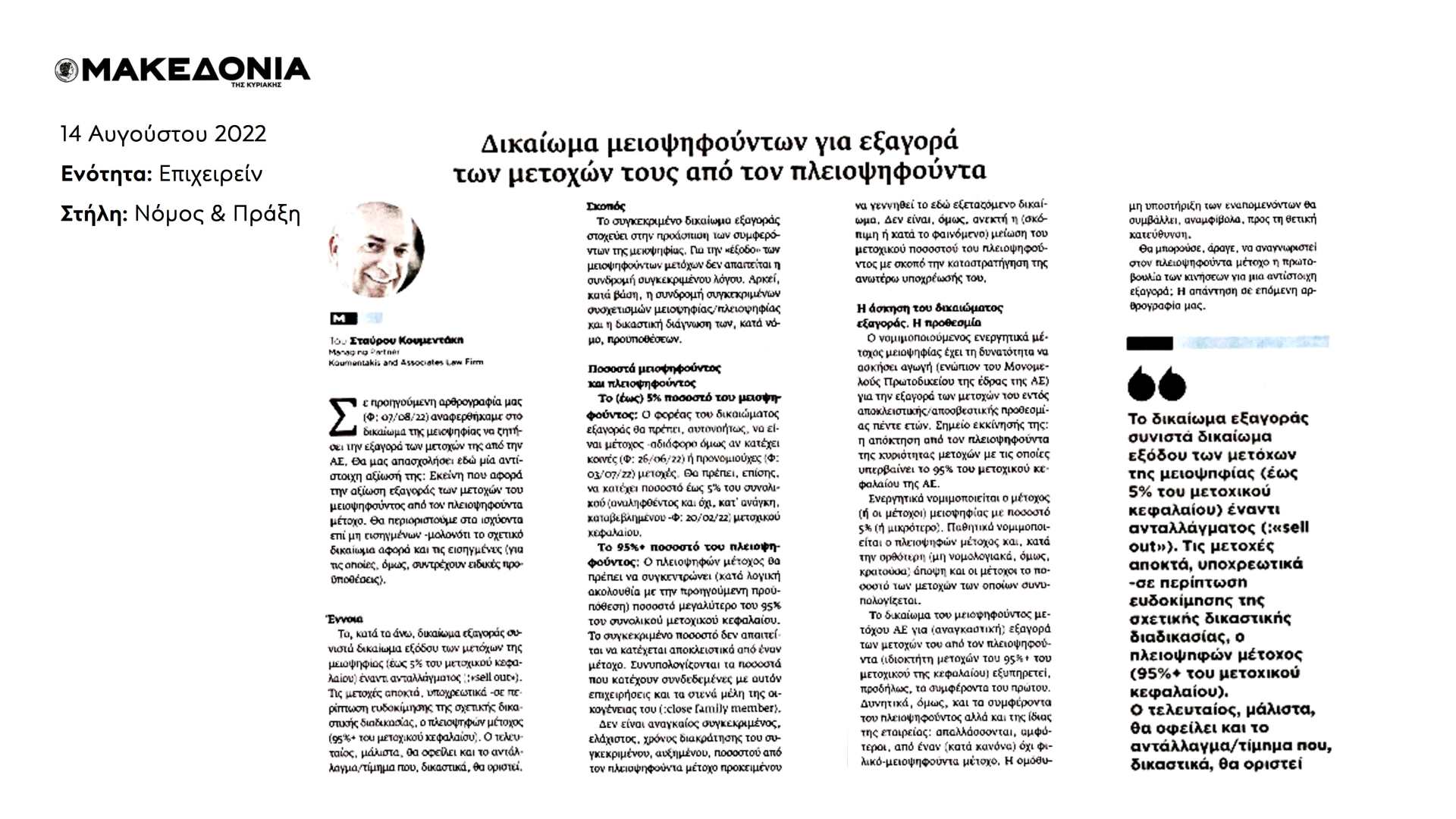
    The majority shareholder’s right to redeem the minority’s shares is of particular as is, respectively, the claim of the latter to redeem their shares from the majority. About them, however, see our article to follow.-

    Stavros Koumentakis
    Managing Partner


    P.S. A brief version of this article has been published in MAKEDONIA Newspaper (August 14th, 2022).
    Disclaimer: the information provided in this article is not (and is not intended to) constitute legal advice. Legal advice can only be offered by a competent attorney and after the latter takes into consideration all the relevant to your case data that you will provide them with. See here for more details.


  • Right of minority shareholders to sell their shares to the majority

    Right of minority shareholders to sell their shares to the majority

    In a previous article we referred to the right of the minority to request the redemption of its shares by the SA (art. 45 of Law 4548/2018). We will be concerned here with a corresponding claim: The one concerning the claim of redemption of the minority’s shares (this time not by the SA but) by the majority shareholder. This right of redemption is regulated in article 46 of Law 4548/2018, in a similar way to the previous article 49b of Law. 2190/1920.


    Meaning

    The redemption right that we are trying to approach here, constitutes an exit right of the minority shareholders (up to 5% of the share capital) against consideration (: “sell out”). The shares are mandatorily acquired by the majority shareholder (95%+ of the share capital) in case of success of the relevant court proceedings; the latter, in fact, will also owe the consideration/price that will be determined by the court.


    Purpose

    The specific redemption right is yet another arrow in the minority’s quiver to defend its interests. The “exit” of the minority shareholders does not require the presence of a specific reason or a finding that their stay in the SA is “particularly burdensome” (as, respectively, is required for the application of Article 45 – for the acquisition, i.e., of minority shares from the SA). The reason is completely irrelevant in this case. Specific minority/majority correlations and the judicial finding of the statutory conditions are sufficient.

    The release of the minority from the SA takes place with a simultaneous-direct strengthening of the shareholding position of the majority shareholder. The minority shareholder is released from a share scheme in which the power balances have significantly changed, in relation to those that applied when the SA was established or when they joined it. At the same time, the majority shareholder is likely to be the sole shareholder of the SA. That is, to get rid of (even small percentages – often, however, annoying) minorities. The potentially formed, with the exercise of the specific redemption right, “one man principle” is likely to be problematic on a substantive and, in particular, legal level; however, it may also be, under conditions, beneficial. In any case: the sole or majority shareholder of the SA has the right to choose. However, they retain, in any case, the right to allow the entry of new shareholders they choose.


    Public Offer(?)

    The case of acquisition of minority shares by the SA cannot occur in the case of listed companies (art. 45 §7). This, however, is not the case here.

    The redemption right explored here (for the purchase of the minority’s shares by the majority shareholder) also applies to listed companies. Subject, however (art. 46 §1, section a), to the provisions and procedure regarding the submission of a public offering for the purchase of securities (art. 28 Law 3461/2006). The latter, as more specialized, should be considered to have priority of application. Moreover, their parallel application is excluded as they require the fulfillment of different conditions. In the present, however, we will exclusively limit ourselves to the conditions of article 46 – to non-listed, that is, SAs.


    Minority & Majority Percentages

    The (up to) 5% percentage of the minority

    The entity for the right of redemption should, of course, be a shareholder. It does not matter, however, the type or category of shares they own (e.g. if they are common or preferred).

    The minority shareholder must own up to 5% of the total (submitted and not necessarily paid up) share capital. This means that the specific right can be born to more than one minority shareholder. It is then up to each of them to claim (or not) the redemption of their shares by the majority (with 95%+ percentage of the total share capital).

    The 95%+ percentage of the majority

    The configuration of the 95%+ rate

    The majority shareholder should gather (in logical sequence with the previous condition) a percentage greater than 95% of the total (even if only taken up) share capital. The collection of said percentage should have taken place at a time subsequent to the establishment of the SA. The legislator’s specific choice seems reasonable: the rights of the minority are deemed worthy of protection precisely because of the change in the shareholding balances of the SA. On the contrary, during its establishment, the minority shareholder consciously chooses to participate – on the basis of any shareholding scheme. The right to regret is not recognized in this case.

    It is accepted, however, that this right is also exercised in the event that the majority shareholder held a percentage greater than 95% at the time of establishment, then decreased below this by transferring their shares, and exceeded it again.

    The calculation of 95%+

    This percentage (in excess of 95%) is not required to be held exclusively by one shareholder. The percentages held by the following persons are also calculated (ar. 46§1 b’):

    (a) businesses connected to it (within the meaning of article 32 of Law 4308/2014) and

    (b) their close family members (: close family member – Par. A of Law 4308/2014). A close family member of a person is defined as that member of their family, who can be expected to influence or be influenced by that person during their dealings with the entity (meaning, in this case, with the SA). Close members are expressly defined as: “…The spouse or partner with whom the person lives together (meaning, in this case, the majority shareholder). …Dependents, including ascendant or descendent relatives, of the person or his/her spouse or partner, with whom the person cohabits.”. Necessary, however, is the narrowing of the interpretation of the specific provision when the majority shareholder does not exert influence on the specific persons and they do not, as a result, act as a group.

    Getting & Keeping 95%

    It is not necessary (according to article 46) for a specific, minimum, holding time of the specific, increased, percentage by the majority shareholder in order to birth the right under consideration here. However, it is not reasonable, on the other hand, to tolerate the (intentional or accidental) reduction of the majority’s shareholding in order to circumvent the above obligation. It is accepted, in this context, that if the majority shareholder (or persons connected or closely related to them) transfer the shares after the initiation of a relevant trial, the minority shareholder does not lose their claim. Nor does the trial become moot. Instead, the decision issued will bind the universal, quasi -universal or special successors of the aforementioned shareholders.


    Exercise Deadline

    The legitimized minority shareholder has the possibility to bring an action for the redemption of their shares within an exclusive/depreciation period of five years (art. 46 §1, section a’). The specific period starts with the acquisition by the majority shareholder of the ownership of shares with which it exceeds 95% of the SA’s share capital. With the lapse of the five-year period, the minority shareholder definitively loses the possibility to pursue, judicially, the acquisition of their shares by the majority.


    The Exercise of the Redemption Right

    The right of redemption (art. 46) is exercised by a lawsuit before the Single-Member Court of First Instance of the seat of the SA, which hears according to the regular procedure. The one who can submit such a lawsuit, as already mentioned, it the minority shareholder (or shareholders) with a percentage of 5% (or less).

    The lawsuit can, of course, only be filed against the majority shareholder. However, in the event that percentages are combined, there is no agreement between theory and jurisprudence regarding the issue of who the lawsuit is against. It is argued in theory that, in this case, all the shareholders whose percentage of shares is included are passively legitimized. The jurisprudence, however, has judged that only the majority shareholder is passively legitimized in this case (1716/2016 Court of Appeal of Athens, QUALEX legal database). This position is evaluated as incorrect. On the one hand, because, after the acquisition, the percentages of participation of those shareholders included will change. On the other hand, because the majority shareholder may not be one (in the case of, e.g., spouses with 46% each).

    The action that will be brought is declaratory in its part concerning the existence of the right of redemption and the calculation of the value of the shares; counter-voting, in its part and request for the conviction of the majority shareholder in the redemption of the minority’s shares at a specific price.

    If the lawsuit is successful, the court order will determine the fair and reasonable consideration that the minority shareholder will receive. To determine the compensation, the court may order an expert opinion from two certified auditors or an auditing company.


    The right of the minority shareholder SA for (forced) redemption of their shares by the majority (owner of shares of 95%+ of its share capital) is evidently serving the interests of the former. From another perspective, however, both the interests of the majority and the company itself are served and promoted: they are both relieved of a (usually) unfriendly minority shareholder. The like-minded support of the Remainers will undoubtedly contribute in a positive direction.

    Would it be possible for the majority shareholder to recognize the initiative of the movements for a corresponding acquisition? The answer is found in our next article.-

    Stavros Koumentakis
    Managing Partner


    P.S. A brief version of this article has been published in MAKEDONIA Newspaper (August 7th, 2022).


    Disclaimer: the information provided in this article is not (and is not intended to) constitute legal advice. Legal advice can only be offered by a competent attorney and after the latter takes into consideration all the relevant to your case data that you will provide them with. See here for more details.

  • Put and Call Options

    Put and Call Options

    The SA’s shares are freely transferable: during its operation, during its liquidation stage, during its submission to collective proceedings. The admissibility of the free transfer of SA shares results from the principle of the free transfer – about which our previous article ( art . 41 §1 and on this explanatory memorandum of law 4548/2018). We have pointed out, however, that this principle is not applied in two cases – as regards SAs with shares not listed on a regulated market. We have already dealt with the first of these (: restricted shares – art . 43) ˙ these are those which are subject to statutory restrictions regarding their transfer. Here we will be concerned with the second, but equally interesting, case: the put and call options.


    Concept & Content

    Έννοια & Περιεχόμενο

    It is, by law, possible (art. 44 of Law 4548/2018) to conclude a shareholders’ agreement, among themselves or with third parties, which provides the option to buy (: call option ) or sale (: put option ) of nominal shares.

    With such an agreement (:option), the right is granted to the beneficiary to draw up on their own (“unilateral”) declaration another main contract with their bound-under a relevant obligation counterparty. The cooperation, that is, in this case, of the obligee is not required; this, moreover, is what differentiates the option agreement from the commonly known preliminary contract.

    The option constitutes, respectively, a property right and a transfer right, which works as follows: The shareholder or a third party in whose favor the relevant right is found, can, as a result, proceed , alone, to buy or sell shares. Also, to acquire or transfer them. An agreement that grants option must be in place. The agreement must specify the shares it bounds; it must also deduce its object: the right to buy or sell them as well as the individual conditions. In order for the beneficiary to enter into the final contract of purchase or sale of the shares for which they have the option, their unilateral declaration to their bound/under the relevant obligation counterparty is sufficient. The latter (the obligor) is not entitled to deny the occurrence of the legal consequences of the beneficiary’s unilateral declaration: they have already provided them with the relevant authority.

    The option agreement may involve the payment of consideration by the beneficiary to the obligee/obligor. The possible agreement of such a consideration sufficiently explains the reason why the purchase price of the shares may be higher than their value (see 4648/2014 Court of Appeal of Athens , CJEU, 2/2015, pp. 145 – 151).

    Forms of Options

    The agreement of the option can also refer to the content of the forms of restrictions of the shares, which we have already dealt with (art. 43). Among them (and according to the explanatory memorandum of Law 4548/2018 on Article 44) the obligation (: drag along ) or right agreements (: tag along ) of the minority to sell together with the majority shareholders. The restricted shares presuppose, according to the aforementioned, a statutory provision; the option agreement does not (:43 §2 para. c΄ and d΄).

    Activation Time of the Option

    The option agreement may be subject to a suspensive condition or term. In this case the relevant right (:option) will not be activated in the first place. It will be activated either as soon as the term is fulfilled (that is, the agreed future and uncertain event has occurred) or as soon as the agreed deadline has passed (see 4648/2014 Court of Appeal of Athens).

    Registration of the Option Agreement

    Such an agreement (in the context of which an option is granted) can be recorded in the shareholders’ book or, in the case of intangible shares, in the register, with the care of the contracting parties ( art . 44 §1) . As the registration of the relevant agreement is potential for the parties, the completion or non-completion of the registration does not affect the validity of the agreement. Through it, however, its transparency and “publicity” is achieved. It is, therefore, necessary in the vast majority of cases.


    The Exercise of the Option

    The option, as already pointed out, is exercised by a unilateral declaration of the beneficiary to the one bound/obligor (and not to the SA).

    With the declaration to the obligor regarding the exercise of the right (CC 176), the agreed main contract is drawn up. In this case, the rights and obligations arising from it kick in (if, for example, it is a sale, the rights and obligations of 513 et seq., 534 et seq. of the Civil Code are activated; the buyer becomes the bearer of the rights and obligations that derived from the shares).

    No specific form is required for this declaration of the beneficiary. This is normal, as a written contract is not mandatory for the valid transfer of shares either. The exercise, therefore, of the option can be done in writing or orally, explicitly or implicitly (see 4648/2014 Court of Appeal of Athens). However, the written exercise of the right is advisable (if not necessary – for proof purposes only).

    In the event that the SA’s Board of Directors (or the person who keeps the shareholders’ register) confirms that the option has been duly exercised (: fulfillment, among other things, of the agreed conditions and formalities – including the payment of any price) it must register “immediately” the change of the shareholder in the book or register (art. 44 §1) . In fact, for this specific registration, cooperation of the parties to the transfer is not required (by express exception of what is required by art . 41). Also: the registration is neither dated nor signed by the transferring shareholder, the acquirer or their proxies (art. 41 §2, section b) .

    This registration legitimizes the beneficiary vis-à-vis the company. Its realization (or not), however, does not affect the validity of the transfer.


    The Bending of the Principle of the Free Transfer of Shares

    The principle of free transfer of shares still applies even when an option agreement has been drawn up. In order to prevent the possibility of such (unnecessary for the holder of the option) transfer, a relevant clause is required in the option agreement. Specifically, as the law expressly provides, in the option agreement “…a clause may be set that until the option is exercised or amortized, no transfer of the shares may take place” ( art . 44 §2, section a)

    However, even the existence of such a clause does not, in the first place, invalidate the expropriation deed (: transfer) between the obligor and the third party, in terms of the option agreement. Any exercise, therefore, of the option cannot reverse said transaction.

    On the contrary, the above clause applies to third parties only if it is specifically noted in the shareholders’ book or in the relevant register of intangible shares. It is in the latter case that the so-called ” implementation ” of the prohibition of transfer takes place. Therefore, in case of non-recording of the clause prohibiting transfer or non-specific mention of it in the book or in the register of shareholders, any transfer of the shares by the obligor to a third party is valid. The holder of the option may, however, claim damages against their counterparty. Possibly, they may also be entitled to seek recourse against the third party from the provisions on tort or deception of creditors ( art . 914 et sec., 919 and 939 et sec. of the Civil Code); provided, however, that the third party was aware of the option agreement.

    However, in case of specific mention of the specific clause in the book of shareholders (or register), any transfer of the shares by the obligor to a third party becomes invalid. It is, as is accepted, a nullity which the beneficiary of the option can assert (:relative nullity).


    The Amortization Of The Option

    The cases of amortization of the option are also of particular importance (see 4648/2014 Court of Appeal of Athens).

    The option (it is assumed) must be exercised within a reasonable time. However, given the vagueness of the relevant concept (“reasonable time”), it is necessary for the contracting parties to agree, expressly, on a deadline or dissociative clause (after the expiration or, respectively, the fulfillment of which), the relevant right is extinguished.

    The option may also be extinguished by subsequent contrary agreement of the parties (361 Civil Code). Also: in case of subsequent (express or implied) resignation of the beneficiary.

    In addition, its abusive exercise or the weakening of the relevant right may lead to amortization of the relevant right (art. 281 of the Civil Code). Also, in case of contradictory behavior of the debtor: when, e.g., the owner of the shares has encumbered the shares with a pledge, they are not entitled to claim from the obligor to acquire them.

    Finally, any unforeseeable change in circumstances can lead to the depreciation of the option, which makes the consequences of the exercise of the right of option extremely burdensome (art. 388 of the Civil Code).


    Restrictions on the transfer of unlisted SA shares may be set by its articles of association (so we are talking about restricted shares) or by agreement between the obligor and the beneficiary. In the latter case (: option to buy or sell shares) no formula is required. However, the risks posed by the “informality” of this agreement are extremely important. It is precisely this fact that mandates the publication of the relevant agreement in the book or register of shareholders. And even more: the written, detailed, but especially careful delimitation of the rights and obligations of the parties involved. Also: of the individual parameters of their agreement.-

    Stavros Koumentakis
    Managing Partner


    P.S. A brief version of this article has been published in MAKEDONIA Newspaper (July 31st, 2022).


    Disclaimer: the information provided in this article is not (and is not intended to) constitute legal advice. Legal advice can only be offered by a competent attorney and after the latter takes into consideration all the relevant to your case data that you will provide them with. See here for more details.

  • Restricted Shares

    Restricted Shares

    On the occasion of our previous article regarding the transfer of shares, we approached the particularly important principle of their free transfer (art. 41 §1 Law 4548/2018). A principle that does not apply, however, in the case of two categories of shares: (a) that of the reserved shares (art. 43) and (b) those for which there is an option to transfer or acquire them (art. 44). In the present article we will be concerned with the first ones.


    Concept & Purpose of Issuance of Restricted Shares

    Meaning

    According to the law (: art. 43 law 4548/2018) restricted shares exist when statutory restrictions are placed on their transfer inter vivos, which ceases, for this reason, to be free. Transfers, which take place in violation of the relevant statutory prohibitions, are void (art. 43 §2 in fine ).

    The articles of association may allow the issuance of restricted shares, the transfer of which depends on the approval (of the Board of Directors or the General Assembly) of the SA ( art . 43 §1). Furthermore, the articles of association must define the procedure, the conditions and the deadline, within which the SA approves the transfer or nominates a buyer. If, however, the specified deadline elapses, the transfer of the shares is free.

    The articles of association may define the reasons for which the competent body is allowed to refuse the approval of the respective transfer of the restricted shares. In the absence of a relevant provision, the competent body acts at its own discretion. In any case, however, the discretion cannot be exercised by abuse of right ( art . 281 Civil Code).

    Purpose of Publication

    Through the issuance of restricted shares, the share balance of the SA is maintained. And so does the prevention of the entry into the SA, as shareholders, of unwanted third parties ( incl .: competitors or insolvent persons).

    The control of the entry of new shareholders is of particular importance and value in the cases of family SAs and SAs with only a few shareholders. Maintaining their character and equity balances is, in the vast majority of cases, a vital feature for their continued operation.

    The reserved shares are therefore used to serve the (corporate) interest of the SA on the one hand and the interest of the majority shareholders on the other – in particular, those who exercise (directly or indirectly) its management.


    Establishment & Termination of Transfer Commitments

    The issuance of restricted shares presupposes, as mentioned above, a relevant statutory provision ( art . 43 §1, section a΄). The relevant clause may have been established by the articles of association. The provision can bind the shares issued at the establishment of the SA but also those (or only those) that will result from future increases in its share capital.

    It is, however, possible to establish this specific clause in a subsequent amendment to the statute. In the latter case, an increased quorum and majority of the General Assembly is required, which will take the relevant decision ( art . 130 §3 and 132 §2). The minority shareholders will be entitled, in this case, to request the redemption of their shares by the SA ( art . 45 §2, para. b’).

    The articles of association may allow, simply, the issuance of restricted shares. The decision to issue them or not will then rest with the body that will be entitled to take the relevant decision.

    It is also possible to abolish any statutory regulation regarding the restriction of shares. It is assumed that the time for which the commitment was intended has expired. Alternatively: decision of the General Assembly on the relevant statutory amendment, which is taken with an increased quorum and majority. In case of cancellation of the restriction, the principle of free transfer of the shares shall apply again.


    Transfer Restrictions

    As a basic limitation of the free transfer of shares, according to the aforementioned, the provision of approval by the competent body (: General Assembly or Board of Directors) is provided for. It is, however, possible to establish further statutory restrictions ( art . 43 §2). The relevant reference in the law is specified as indicative. However, it is important to note that (despite the poor wording of the law), the restrictions imposed are not allowed to make the transfer impossible. The limitations listed in §2 are the following:

    Right of Preemption

    The potential restrictions on the transfer of shares include: “…a) the impermissibility of the transfer, if the shares are not previously offered to the other shareholders or to some of them” (art. 43 §2, par. a’).

    Based on the specific legislative regulation, the articles of association may establish, as a limitation, a right of preference in favor of the existing shareholders or some of them (right of first refusal). The shareholder who intends to transfer the shares is obliged, in this case, to first offer their shares to the already existing (or to specific) shareholders of the SA.

    The respective statutory regulation is the one that will determine the content of the preemptive right as well as the procedure for exercising it (e.g. method of notifying the transferor, response deadline of existing shareholders).

    The specific preemptive right should not be confused with the preemptive right in the share capital increase of the SA. The right of preference, in the latter case, consists of a right of the existing shareholders for preferential/original acquisition of newly issued shares – in the context of an increase in the SA’s share capital.

    Indication Of The Acquirer From SA

    Another restriction that can be set by the articles of association is the “…indication, on behalf of the company, of a shareholder or a third party who will acquire the shares, if the shareholder wishes to transfer them” (art. 43 §2, par. b).

    The shareholder who wishes to transfer their shares communicates, in this specific context, their relative wish to the SA and/or the terms of transfer offered by a third party. The SA, in this case, can indicate another person, to whom, only, the shareholder is obliged to transfer their shares.

    This specific restriction differs from the corresponding right of pre-emption as a person designated by the SA may be a third party to it, not just an existing shareholder. Also, in this particular case, the SA maintains a more active role, as it, through its competent bodies, is the one that indicates the specific shareholder, who will acquire the shares available for sale.

    Tag Along Right

    As a potential restriction, the condition according to which “…in order to approve the transfer of shares to a third party, the third party will undertake to acquire shares of other shareholders, which will be offered under the same conditions as the transfer is approved, or different conditions, according to the provisions of the statute” (art . 43 §2, para. c΄).

    In this case, it is a right to co-transfer shares of the other shareholders who have not negotiated with the third party who wishes to acquire SA shares. This right is also called the tag along right. It aims to facilitate the exit of the minority, whose rights it ensures. Through this, any minority is protected in case it does not wish to be trapped in the SA with an unknown/unacceptable majority shareholder.

    Drag Along Right

    Finally, as a limitation, the condition under which “…in the event of a transfer of shares from a shareholder to a third party, the other shareholders will also be obliged to transfer the corresponding percentage of shares to the third party, in accordance with the provisions of the articles of association” (art. 43 §2 d’).

    This specific provision establishes the drag along right. It refers to the case of an offer to buy all the shares or the majority package from a third party. If, in this case, the shareholders of a specific majority agree to the purchase (of the entire SA) from the third party, the other shareholders are obliged to (co)transfer to the latter their own shares as well. In fact, under the same terms and conditions that the majority agreed to.

    This particular right serves the majority. Also, the completion of the purchase by the third party, who reasonably may not want the existence of a minority in the SA.


    Obligation to Redeem Restricted Shares

    The law establishes the possibility of foreseeing the obligation of the SA to redeem the reserved shares. In particular: “…the articles of association may provide that … if the company refuses to approve the transfer of shares or does not respond to the shareholder within the period provided for by the articles of association, it is obliged upon the request of the shareholder and within… 3 months from the submission to redeem the shares…” ( art . 43§3).

    Despite the poor wording of the relevant regulation, it must be accepted that the option of redemption can be provided by statute for any intended transfer restriction in which the SA is involved. Thus, the possibility of being trapped in the SA of a shareholder who wants to leave it is avoided.


    Cases of Death, Confiscation, Bankruptcy, Other Collective Foreclosure Proceedings

    The restrictions on the transfer of the shares do not apply, basically, in case of death, confiscation, bankruptcy or submission of the shareholder to another collective process of foreclosure of their property (art. 43 §4).

    The articles of association, however, may stipulate that in specific cases the shares are purchased by a person indicated by the SA (or by those of its shareholders who will exercise a preemptive right). The price to be paid will be determined by the competent court, through the process of “ex parte” proceedings.

    The specific indication, on the part of the SA, must take place within an exclusive period of one month since (the SA) was informed of any of the specific events. It must also be notified, as the case may be, to the shareholder, the heir or legatee, the creditor, the trustee or the body of the other collective process.

    The relevant provision serves the corporate interest and the other shareholders. The determination of the purchase price by the competent court is certain to significantly delay the completion of the relevant procedure. It would be desirable if the relevant statutory definition of it were jurisprudentially accepted.


    Restrictions on Transfer of Bonds

    The restrictions on the transfer of the shares can respectively be applied in the case of the bond loan. In particular, the law provides that the relevant application of these restrictions can be a decision of the body that decides on the issuance of a bond loan with nominal, convertible or exchangeable bonds. In fact, in case of transfer of bonds in violation of the restrictions that may be decided, this is invalid ( art . 43 §5).


    The issuance of restricted shares, i.e. shares for which statutory restrictions are placed on their transfer, is related to the preservation of shareholder balances but also, to a significant extent, to the very existence of the SA. Experience shows that their eventual non-establishment can have disastrous results for the latter. Imperative, therefore (and not only desirable) is the careful establishment of the best, in each case, restrictions. Equally important, however, is the agreement, subject to conditions, to grant an option to transfer or acquire shares not listed on a regulated market. About this, however, see our next article.-

    Stavros Koumentakis
    Managing Partner


    P.S. A brief version of this article has been published in MAKEDONIA Newspaper (July 24th, 2022).


    Disclaimer: the information provided in this article is not (and is not intended to) constitute legal advice. Legal advice can only be offered by a competent attorney and after the latter takes into consideration all the relevant to your case data that you will provide them with. See here for more details.

  • The Transfer of Shares

    The Transfer of Shares

    In a series of our previous articles, we were looked into stocks. We dealt, specifically, with their meaning and value and the rights and obligations arising from them. We dealt with their issue as well as with their specific categories: preference and redeemable.

    However, the transfer of shares and its extremely important parameters are of particular interest. This article is about them.


    Transfer of Shares Due to Succession in Title

    The shares, first of all, can be transferred (either by full or only partial ownership) due to succession in title (art. 41 of Law 4548/2018). The concept of succession in title includes all cases of transfer, except that of hereditary succession, which we will approach later.

    The Principle of the Free Transfer of Shares

    The principle of free transfer of SA shares is of major importance (art. 41 §1 and Memorandum to the law 4548/2018 on this). Based on it, the SA’s shares are freely transferable: during its operation, during its liquidation stage, during its submission to collective proceedings. It is not possible, in principle, to place restrictions on their free transfer.

    On the basis of this principle, shares are marketable. This is how the financing of the SA. The shares’ transfer can result to the disinvestment on the part of the existing shareholders – as the return of their contributions is, in the first place, prohibited.

    The cause of the (inter vivos) transfer of the shares may take place in various ways. Indicative: due to sale, parental benefit or donation.

    The principle of free transfer of shares is applied in the cases of: (a) restricted shares (art. 43) and (b) those for which there is an option to transfer or acquire them (art. 44). About them: our next article.

    The Transfer of Shares by Registration in the Book of Shareholders

    The transfer of the (nominal-always) shares, which are not kept in accounting form (: the intangible shares, about which see below) is done by entry in the (compulsorily kept – art. 40 §2, section a) shareholders’ book. This entry shall be dated and signed by the transferring shareholder and the transferee or their proxies. Given the insufficiently kept, over time and in most cases, shareholder books, exceptions from the obligation to sign were established, and rightly so, when: (a) the company receives a copy of the share transfer agreement with the signatures of the parties or is informed of its preparation in another way – provided for by the articles of association, (b) the shareholder book is maintained electronically by a central securities depository, credit institution or by an investment firm.

    When the transfer takes place, a new title is issued. Alternatively, the SA shall note on the title already issued the completed transfer as well as the details of the acquirer (name/surname, address/headquarters, profession and nationality – Art. 41 §2 and 40 §2). All this, of course, as long as the statute does not limit or exclude the issuance of securities (art. 40 §4).

    The above procedure for the transfer of shares regulates, in reality, the legalization of the acquiring shareholder vis-à-vis the SA. The person who is registered in the shareholders’ book exercises rights and assumes obligations arising from the shareholding relationship. The transfer agreement, however, between the parties (the transferor and the acquiring shareholder) is binding on the parties and is not affected by this registration.

    Regarding the transfer between old and new shareholder, the rules on registered securities apply. Therefore, only the agreement between them and the delivery of the title of the share is sufficient for the transfer of the share relationship to take place. In fact, in the event that the shareholding relationship is not incorporated into a security, the transfer takes place by assignment (art. 455 et seq. Civil Code, art. 470 Civil Code). It is desirable, however, with regard to shares not listed on an organized market, that a written contract for each transfer always be in place.

    The Transfer of Intangible Shares

    Regarding the issue of shares, we have already referred to the intangible ones: the shares, i.e., issued and kept in accounting form compulsorily for the SAs listed (and potentially unlisted) on a regulated market. We pointed out, there, that the case of intangible shares should not be confused with the case of non-issue of equity securities.

    In derogation of what was mentioned above, the transfer of shares kept in accounting form (:immaterial shares) is done through securities accounts (art. 41 §3). The latter are kept in a central securities depository or by an intermediary (law 4569/2018).

    The registration of the transfer of intangible shares is a condition of its validity vis-à-vis the company and also, between the transferor and the acquirer (art. 13§1 Law 4569/2018). However, it should be noted that it is possible, under certain conditions, to transfer shares – that are kept in accounting form – of listed companies outside the stock market as well.


    Transfer Due to (Quasi) Universal Succession in Title

    Shares (as well as the share relationship, considering its property character) can be inherited. In this case, the provisions of inheritance law apply. At the time of induction of the inheritance (1710 Civil Code) the hereditary succession on the shares takes place automatically. However, the provision of article 42 of Law 4548/2018 (which constitutes the transfer to the national legal order of Regulation 909/2014/EU) is the one that regulates the issue of legalization of heirs and legatees vis-à-vis the SA.

    Inheritance With Registration in the Book of Shareholders

    In order for the heir or legatee to be legitimized vis-à-vis the SA, it is required (art. 42) to be registered in the shareholders’ book mandatorily maintained by the SA. After the specific registration, the heir or legatee has the possibility to exercise their rights – assuming, of course, also any obligations – deriving from the shareholding relationship.

    The registration takes place as soon as the documents proving the succession (e.g. inheritance certificate, court decision publishing a will, etc.) are presented to the issuing SA, or to the person who keeps the shareholders’ book.

    Inheritance of Intangible Shares

    Also in the case of intangible shares, the succession takes place at the time of induction of the inheritance. However, according to article 42 of Law 4548/2018, the successor (:heir) is legalized against the SA from the time of their registration in the register of the central securities depository or in the securities account of the registered intermediary.

    In this case as well, the registration takes place as soon as the person with a legal interest presents the documents certifying the inheritance to the one who keeps the register or the securities account.

    However, it is important to note that ” for securities held in a central securities depository or through an intermediary… law 5638/1932 may be applied proportionally, after a relevant agreement with the clients” (art. 13 §6 of Law 4569/2018). In the event, therefore, that a contractual term has been agreed on the basis of which, in the event of the death of a spouse in a joint account of intangible shares, the shares automatically pass to the surviving joint owners, then the aforementioned succession does not take place. We are talking, in this case, about the Joint Investment Account that provides its joint owners with the important benefits of depositing in a joint bank account.


    Taxation of the Transfer of Shares

    Taxation for the transfer of shares is regulated by articles 42 and 43 of the Civil Code (Law 4172/2013, as applicable after Law 4549/2018).

    Specifically, any income resulting from the transfer of capital: (a) shares in a company not listed on a stock market, (b) shares or other securities not listed on a stock market (as long as the transferor participates in the company’s share capital with a percentage of at least 0, 5% and since the transferred shares have been acquired from 01.01.2009 onwards), is subject to personal income tax (art. 42 §1, par. a’ and b’ of the Tax Code).

    As expressly defined, surplus value means the difference between the purchase price paid by the taxpayer and the sale price received (art. 42 §2 Income Tax Code).

    Furthermore, the law determines the method of calculation of the purchase and sale price. It is noted, however, that if the acquisition price cannot be determined, it is considered zero.

    Specifically:

    (a) In the event that the transferred securities are listed on a stock market, the acquisition price and the sale price are determined by the transaction supporting documents, which are issued by the stockbroking company or the credit institution or “any entity that conducts transactions”.

    (b) In the case of a transfer of unlisted securities, the sale price is determined based on the value of the equity of the company issuing the transferred securities at the time of the transfer or the price “or market value” stated in the transfer agreement, if this is higher.

    (c) In addition, it is provided that the value on the basis of which the inheritance, gift or parental benefit tax was calculated or exempted from is to be taken as the acquisition price for securities acquired due to inheritance or charitable transfer (art. 42 §4 Income Tax Code).

    The income obtained from capital gains from the transfer of shares is taxed at a rate of 15% (art. 43 of the Tax Code). A tax is imposed on the transfer of shares as a result of a parental benefit, as a gift or in the context of inheritance based on the respective scales that apply each time. Especially for parental benefit, there is a tax-free amount of €800,000 (art. 44§1 in fine, law 2961/2001) for all assets transferred as a parental benefit, while in terms of donation and inheritance, the value of the transferred assets is of paramount importance elements as well as the degree of kinship between transferor and acquirer.


    Shares, as an asset, are freely transferable inter vivos by full or bare ownership only. The basis of transfer can be (more commonly) sale, parental benefit and donation. In any case, the optimal fiscal option should be carefully chosen. The shares, however, are also transferred mortis causa – in the context of inheritance. In order to be entitled to exercise their rights against the SA, the new owner needs to hand over their legalization documents. It is also necessary that they are registered in the book of shareholders of the issuing SA. We must, therefore, be particularly careful regarding the possession of the necessary, legalizing, documents as well as registration in the shareholders’ book. It should be noted, however, that the provisions on the free transfer of shares apply when there are no restrictions on the transfer of shares – when, i.e., the shares are not restricted. Regarding them, however, see our article to follow.-

    Stavros Koumentakis
    Managing Partner


    P.S. A brief version of this article has been published in MAKEDONIA Newspaper (July 17th, 2022).


    Disclaimer: the information provided in this article is not (and is not intended to) constitute legal advice. Legal advice can only be offered by a competent attorney and after the latter takes into consideration all the relevant to your case data that you will provide them with. See here for more details.

  • Redeemable shares

    Redeemable shares

    The financing of the SA is a matter that always concerns its management and ownership. And when its self-financing turns out to be unfeasible, its external financing proves necessary. In the context of the latter (apart from the obvious- ie the banking lending) and the issuance of securities. In this context, we have already dealt with the issue of common and preferred shares. More attractive, however, are the redeemable shares– both for the company and its shareholders and for the investors themselves. Let’s try to approach the reason as well as the data around them.


    Redeemable shares: Concept

    Redeemable shares are those that provide the possibility of their redemption by the issuer SA (: callable shares), from their shareholder (: puttable shares) and/or from both (art. 39 of Law 4548/2018). They are issued as common or preferred with (or without) voting rights.


    Redeemable shares: Basic function, purpose and advantages

    The redeemable shares are basically a means of financing businesses. The individual terms of their issuance are particularly malleable; they are easily adapted to the needs of the business as well as the wishes of the investor.

    The possibility (or, as the case may be, the obligation) of their redemption by the issuing company serves different needs: of its (old) shareholders, of the company and their owners:

    In the case of their acquisition by declaration of the company, the company and the old shareholders preserve (and ensure) the pre-existing (and usually family) shareholding structure. Also: the equity balances.

    In the case of their acquisition with a declaration of their owners, the disinvestment expectation/agreement is implemented according to the agreed terms and, in particular, the agreed time. The security of the contributor of the capital-holder of redeemable shares is achieved, to a significant extent, since the company itself is its counterparty and liable for performance. In order to further secure their position, further safeguards (eg personal guarantees and collateral from the other shareholders) cannot, of course, be excluded.


    Their hybrid character

    Their redeemability is what primarily gives redeemable shares their hybrid character. They present, as shares, equity characteristics. At the same time (and because of their redeemability) they present elements of debt – especially when they are deprived of the right to vote. They differ, however, from the cases of taking on debt, as their acquisition presupposes the existence of profits in the SA, a reduction of its capital or the issuance of new shares.


    Issuance process

    The issuance of the redeemable shares requires a statutory provision (art. 39 §1 paragraph a’). However, they are issued, exclusively, in the context of (regular or extraordinary) increase of the share capital – and not during the establishment of the SA. It is possible to limit or exclude the pre-emptive right of the old shareholders. At the same time, however, if any rights of preferred shareholders are affected, approval of their assembly is required.

    It is also possible to convert existing common shares into redeemable shares. A relevant statutory provision is also required as well as a decision of the General Assembly – with an increased quorum and majority (39 §6). The principle of equal treatment of shareholders must be observed when choosing common shares, which will be redeemable. It should be noted, however, that this particular case does not serve the financing of the SA, but the disinvestment of its shareholders, subject to conditions.


    Redemption conditions and procedure

    The possibility, basic terms, conditions and procedure of redemption of redeemable shares must be clearly defined in the articles of association. As mentioned above, there is great flexibility for their specialization by the competent statutory body that decides on their issuance. The specific body is the one that will decide, therefore, the issue of redeemable (common or preferred) shares with (or without) voting rights (25 §1) as well as the individual terms that concern them – especially with regard to the terms of the redemption.


    Redemption conditions

    The redemption of the specific shares may be linked to the passage of a specific period of time. However, it is possible to relate their redemption to future and uncertain events (eg: non-admission of the company to a regulated market).

    It is also possible to threaten the activation of their buyout as a means of preventing anti-corporate actions and ousting illegal shareholders (eg: breach of fiduciary duty or conduct of competitive acts).

    With regard, in particular, to the acquisition price, it is possible that it be fixed or dependent on certain pre-defined parameters (e.g. EBITDA).

    For redeemable shares, the redemption conditions set by the law (art.39 §3) include the existence of (initial or introduced with an amendment) statutory provision, the full payment of the shares to be redeemed, the observance of specific redemption rules and the observance of publicity formalities. In case of non-compliance with any of the legal conditions (apart from the compliance with the publicity formalities), it will be null and void.

    Regarding, in particular, the statutory provision, it is possible for it to be initial or introduced later on – it can even take place with the decision of the General Assembly, which will decide to increase the share capital by issuing redeemable shares.


    Financing

    Particularly important conditions for carrying out the acquisition are those concerning its financing. Provided (art. 39 §3 c’) amounts that can be distributed exist (according to art. 159 and 160). The corporate property which is returned to the shareholder of the redeemable shares must be paid from the reserves or profits of the SA.

    The acquisition in question, alternatively, can be financed from the proceeds of issue of new shares, which is carried out for this specific (and only) purpose. The share capital, in this case, will remain unchanged: a share capital increase will take place, which will cover the “gap” of the corresponding decrease that will result from the redemption of the redeemable shares.

    As a second alternative to the financing of the acquisition is through amounts that are released after a reduction of the capital (according to art. 29 et seq.): the amounts in question will not be returned to the beneficial shareholders but will be used to finance the acquisition.


    Creation of a reserve

    According to the law (art. 39 §3 d’), it is necessary to create a reserve equal to the nominal value of the shares identified as redeemable. However, this specific condition applies, exclusively, in the event that the acquisition is carried out using distributable amounts. It does not apply, on the contrary, when the acquisition takes place “…using the product of a new issue, which was carried out for the purpose of this acquisition, or amounts released by reducing the capital” (art. 39 §3 par. d’ in fine Law 4548/2018).


    Possible premium

    The additional amount agreed to be paid to the shareholders, beyond the amount of the redemption price, must be covered by profits that can be distributed (art. 159 and 160). Alternatively, this amount can be paid either by capital reduction (art. 29 et seq.) or from a reserve, which, however, differs from the aforementioned reserve of par. d’ of the same article.


    Publicity

    The last condition of the law is the publication of the redemption (art. 39 §3 para. f) which, however, has a declaratory nature. Failure to do so does not affect the validity of the redemption.


    The declaration for the redemption

    The redemption declaration, as already mentioned, can be submitted either by the SA or by the shareholder (art. 39 §1).

    In the event that the declaration is made by the shareholder, it brings about its results, under conditions (art. 39 §4). Initially, the conditions stipulated, if any, in the articles of association must be met. However, the SA, in addition, should have available (at the time the SA receives the shareholder’s declaration for redemption) sufficient (to satisfy the declaration) amounts from those that are allowed to be distributed (according to no. 159 and 160). Otherwise, the shareholder’s declaration has no effect (art. 39 §4 in fine).

    As long as the declaration for the redemption takes place and the redemption process is completed with the payment of the redemption price, its legal consequences occur. The owner of the redeemable shares loses, in this case, their shareholder status and the redeemed shares return to the SA (art. 39 §5). Completion of the acquisition process, therefore, will not result in a reduction of the SA’s share capital.


    The use of the institution (and individual options) of redeemable shares is yet another arrow in the company’s quiver to achieve its financing. Further: The use of the option to convert existing shares into redeemable ones is a means of return to the shareholders (part or all) of their participation in the SA’s share capital.

    The optimal utilization of the multiple possibilities of the specific institution depends (and must depend) on the current data, the needs and choices of the company; mainly: of the majority shareholders.

    Do with that, therefore, as you may.-

    Stavros Koumentakis
    Managing Partner


    P.S. A brief version of this article has been published in MAKEDONIA Newspaper (July 10th, 2022).


    Disclaimer: the information provided in this article is not (and is not intended to) constitute legal advice. Legal advice can only be offered by a competent attorney and after the latter takes into consideration all the relevant to your case data that you will provide them with. See here for more details.

  • Preference shares

    Preference shares

    We have already addressed the shares of the SA, their operation and value. Also: the rights and obligations arising from them. We have also addressed their distinction into common, nominal and intangible shares, the obligation (or not) to issue equity securities as well as their under/over par issue. In the present article we will address an (on many aspects) interesting class of shares: the preference shares.


    Preference shares: Concept and purpose

    Preference shares (art. 38 of Law 4548/2018) are those which (in deviation from the principle of equality governing shares – art. 36 §1), provide more property rights and privileges to their owners.

    Deposits in banks and investments in banking products are no longer a profitable investment. Safe places (which would justify zero or negative interest rates) do not exist. Different – even more “aggressive” – alternatives have been investigated for a long time. Among them: and participation in the SA’s share capital – through preference shares.

    The SA, on the other hand, is able to offer, through the preference shares, the appropriate incentives in order to attract capital. It achieves, in this way, its financing, without the obligation to return capital and (as a rule) interest – as, under normal conditions – in the case of borrowing, it would have to do.


    The preference shares and the benefits for the SA

    Even if the agreed “consideration” for the holder of preference shares is the interest, there are significant differences from a financing of the same amount in the form of a simple or bond loan. Among them: the payment of interest to the shareholder-holder of preference shares is for the SA an expense (deductible from the income), in contrast to the profits it distributes.

    Preference shares expand the SA’s capital base, improve its financial ratios and creditworthiness. The credit risk of the next financier will be (objectively) more reduced: the capital base and financial ratios of the SA will be improved. An inevitable consequence will be the easier sourcing of (new and cheaper) financing – based on the logic of reducing credit risk. The SA will become, for the same reasons, more attractive to potential new investors.


    The procedure for issuing preference shares

    The issuance of preference shares requires an initial (or consequential) statutory provision. The relevant decision (if it is an amendment to the statutes) is taken by the General Assembly with the usual quorum and majority. However, in the case of the issuance of preference shares through the increase of the SA’s share capital, a relevant decision of the General Assembly is required: it is taken with an increased quorum and majority (art. 130 §§3 and 4 and art. 132 §2). And let’s not forget that the specific decisions (amendment of the articles of association and decision to increase the capital) can coexist in the same General Assembly (art. 4 §5). In case shareholders of preference shares preexist, the approval decision of their assembly must be taken beforehand, and so must their exercise of their right of preference (art. 25 §§3 and 4 and 25 §1).

    It is also possible to convert common shares into preference shares – without increasing the share capital of the SA – subject to the principle of equal treatment of shareholders (art. 38 §7). And in this case, however, an increased quorum and majority of the General Assembly that will take the relevant decision is required.


    The perks

    The partial or total receiving of the distributed dividend before the holders of the common shares.

    The preferential contribution to the beneficiaries of the shares from the share capital reduction product or the liquidation product, including their participation in the premium amounts, which may have been paid.

    The receiving of a cumulative dividend (and as such we mean the dividends of previous fiscal years which were not paid to the preferred shareholders due to the non-distribution of profits).

    The receiving of a fixed dividend or only a partial participation in the company’s profits.

    The receiving of interest, either with a parallel provision of the condition of non-participation in the company’s profits for a specific period of time or without a relevant provision.

    The right to vote

    Preference shares may be issued with (or without) voting rights. In the case of their issuance without the right to vote, they are not counted in the quorum and majority for the decision of the General Assembly. Their nominal value is taken into account, however, regarding the exercise of minority rights. There is no limit to the number of non-voting preference shares that SA can issue. Let’s just remember that it is, in every case, necessary to have at least one common share in the SA (art. 37 §2).

    It is also possible to issue preference shares with limited voting rights (only for certain matters specified in the articles of association of AE – art. 37 §4).


    The convertible preference shares

    Preference shares may be issued as convertible into common or preference shares of another category (art. 38 §3), on the basis of a relevant (initial or consequential) statutory provision. The articles of association must define the terms and deadlines as well as the obligation (or not) of the conversion. The conversion right can be foreseen, for the first time, with the decision of the General Assembly on the issue of the preference shares (art. 38 §3). In the event the relevant decision follows their issuing, an increased quorum and majority is required both from the General Assembly of the holders of common shares and from that of the privileged shareholders (art. 38 §8 paragraphs a and b).


    Removal or limitation of privileges

    The complete abolition of the privileges of preference shares leads to their conversion into ordinary shares. Their limitation takes place in the event that one of the most privileges is removed or limited as well as when new privileges are issued. In each such case, a decision of the special meeting of the privileged shareholders taken with an increased quorum and majority is required.


    The ” Way Out” of the investment

    The liquidity of any investment is an important factor for choosing to make it in the first place. And when the acquisition of preference shares is chosen as an investment, it is possible to make it more attractive by simultaneously issuing them as redeemable: as an additional, i.e., “privilege”. In this context, the time and method of liquidation of the investment will be determined in advance, as will, moreover, the total-final benefit of the investor.


    Issuance of preference shares is often an extremely interesting option for both the SA and the investor. The first (issuance) attracts investment funds, strengthens the company’s capital base, increases its credit rating, renders it more attractive to prospective investors. Owning preference shares, on the other hand, is an alternative (and often very interesting) investment option. The addition (or not) of voting rights can satisfy individual needs and choices of the persons involved. In fact, in the event that the preference shares are agreed to be redeemable, the scheme can become more attractive, both for existing and new shareholders. But about them, see our article to follow.

    Stavros Koumentakis
    Managing Partner


    P.S. A brief version of this article has been published in MAKEDONIA Newspaper (July 3rd, 2022).


    Disclaimer: the information provided in this article is not (and is not intended to) constitute legal advice. Legal advice can only be offered by a competent attorney and after the latter takes into consideration all the relevant to your case data that you will provide them with. See here for more details.

  • Issue of Shares: Common, Registered and Intangible

    Issue of Shares: Common, Registered and Intangible

    In a previous article we dealt with shares, their fanctions and value. Also: with the rights and obligations deriving from the shareholding relationship.

    At present, we will be concerned with their issuance. We will be concerned, in particular, with common, registered and intangible shares, the obligation (or not) to issue equity securities as well as their under/over par issues.


    The Common Shares

    The shares issued by an SA belong, according to the law (art. 37 law 4548/18), to the category of common shares – provided they do not fall into any other category (: preferred, redeemable and amortized – according to the Memorandum to the Law on the specific article).

    The SA is required to have at least one common share (art. 37 §2). This is a provision that was first introduced by Law 4548/2018. Under the regime that prevailed, on the contrary, there were quantitative restrictions, concerning the issuance of preferred and redeemable shares (art. 4 Law 876/1979). These restrictions were, however, abolished with the entry into force of Law 4548/2018.

    Common shares provide all the rights provided by law (art. 37 §3). With the exception, of course, of those that concern specific classes of shares. In any case, however, they provide the right to vote as well as the right to participate in the profits and the product of the liquidation of the company.


    The Issue Price of the Shares

    In our previous article we mentioned, among other things, the nominal value of the share (€0.04-€100). Its issue price, on the contrary, is, in principle, freely set by the SA. It is not permissible, however (art. 35 §2), to issue shares at a price lower than par (at a price, i.e., that falls short of their nominal value). This is reasonable, as, in the absence of the relevant provision, the entire share capital would not be paid.

    It is possible, on the other hand, to issue shares at a price greater than their nominal value: their issue, i.e., at a premium (art. 35 §3). In some cases, in fact, the premium issue of shares is assessed as necessary. In some cases of increase, e.g., of the share capital, the shareholder is appropriate to pay consideration for the goodwill acquired by the SA. Moreover, in this way, the principle of equal treatment of shareholders is preserved.

    The premium amounts constitute an element of the net position of the SA (art. 26 §1, par. a1 and examples Par. B΄). Although they are part of the “paid-in capital”, they should not, however, be confused with the share capital: they constitute supplementary capital, the existence of which establishes the obligation to pay capital accumulation tax (113/2009 Legal Council of the State, 1044/03.02.2014 Ministerial Decision).

    The premium amounts cannot be allocated for the payment of dividends or percentages (art. 35 §3 Law 4548/2018). It is possible, however, for them (a) to be capitalized or (b) to be set off to offset losses of the SA, following a decision of the General Assembly (art. 35 §3).

    The possibility of offsetting the premium with the amortization of losses is ancillary (Memorandum to the Law on 49§4 Law 4587/2018, which amended §3 of Article 35 Law 4548/2018). This means that the above amount can be used for the amortization of losses, as long as the SA does not have reserves or other funds that can, in the first place, be used for the above purpose.

    In the case of partial payment of the share capital, as long as the issue of shares at a premium is foreseen, the difference is paid in full, once, upon payment of the first installment (art. 21 §3, para. b΄, sub. b΄).


    Issuance of Shares: Registered Shares & Abolition of Shares

    The SA is obliged to issue, exclusively, registered shares (art. 40 §1). The unregistered shares have already been abolished (from 1.1.2020).

    The reasons for the abolition of unregistered shares are several (see Memorandum to the Law 4548/2018). To begin with: the abolition of unregistered shares is aimed at regulatory simplification, as now uniform rules apply to the shares of the SA; there is no longer any distinction between registered and unregistered shares.

    After all, the specific distinction and the advantage of unregistered shares in terms of their easier transfer had already been relativized. With regard to listed shares, the same, uniform, provisions for the transfer of registered shares (the overwhelming majority at the time) and unregistered (about ten at the time of the law’s enactment) applied (and before the enactment of Law 4548/2018). Also, the national legal order contained rules of law, and in particular, rules of tax law, which required the drawing up of a document also for the transfer of unregistered shares.

    Furthermore, the abolition of unregistered shares is the most effective measure and the simplest means of avoiding the risks that they entail precisely because of their anonymity. The institutions of the European Union, through their work, have, for a long time, asked the member states to ensure that unregistered shares will not be a means of abusive practices (e.g. money laundering).

    It should be noted that Greece has incorporated into the national legal order Directive 2015/849/EU on the prevention of the use of the financial system for the laundering of proceeds from illegal activities or for the financing of terrorism, with Law 4557/2018. Further reference to this law is beyond the scope of this article. It is pointed out, however, that the parallel processing of the above-mentioned law and the new law on SAs played an important role in the choice of the simplest measure of the abolition of unregistered shares.

    Obligation to Issue Equity Securities

    The importance of stocks is significant on many levels. The term share means, among other things, the title in which the shareholding relationship is incorporated.

    In particular, the SA is obliged to issue and deliver to the shareholders share certificates (art. 40 §3). In fact, under the current regime, only definitive and not temporary equity securities are issued. The Board of Directors is in charge of issuing and delivering the shares. The latter (BoD) acts within the limits of possible within the stricter limits set by the statute of the SA, if such are in place. Accordingly, a claim is made to the SA for the issuance and delivery of the shares in favor of the shareholders.

    It is also expressly provided that equity securities may be single or multiple. Multiple equity securities incorporate more equity relationships and, correspondingly, more equity rights. This very fact, however, may make their marketability more difficult. However, the law expressly establishes the obligation of the SA to replace any existing multiple securities with new ones, which incorporate a smaller number of shares – provided there is a relevant application.

    Issuance of shares performs a legitimizing role for the shareholders on the one hand and for the SA on the other. However, as we already pointed out in our previous article, their publication is merely declarative and not constitutive in nature. That is, it is a prior obligation of the establishment of the shareholding relationship.

    The articles of association may exclude or limit the obligation of the SA to issue shares (art. 40 §4, section a’). In this case, the relevant statutory clause defines the method of proof of shareholder status (art. 40 §4, section b). In the event of its absence, the proof of shareholder status is then based on the details of the shareholders’ book. Additionally, if the shareholders’ book leaves doubt or has not been properly updated, based on documents held by the shareholder (art. 40 §4 in fine).


    The Shareholders’ Book

    Keeping the shareholders’ book constitutes an obligation of the SA in any case (art. 40 §2 section a’). The law, in fact, explicitly numbers the details of the shareholders that this book must include. These are: (a) their name or company name, (b) their address or registered office, (c) their profession, (d) their nationality, (e) the number of shares they own and (f) the category of these shares (art. 40 §2 sec. b’ and c’). Also, (g) the details of their (possible) transfer (art. 41 §2).

    The law does not provide for a specific procedure for keeping the shareholders’ book. However, it provides the possibility, through a statutory provision, for it to be kept electronically. Alternatively: from the central securities depository, from a credit institution or from an investment service firm, which have the right to hold financial instruments. As long as there is no relevant statutory provision, the rule of it being kept in written is in place.

    The shareholders’ book provides major facilities in terms of proof of one’s shareholder status. It carries the evidentiary power of commercial books (art. 444 no. 1 of the Code of Civil Procedure). In fact, its evidentiary importance is highlighted by the law itself: vis-à-vis the company, the person registered in the book in question is considered to be a shareholder (art. 40 par. 2 in fine). Clearly, however, its significance is intertwined with its proper updating, otherwise it has no evidential power.

    Any non- (correct) updating by the SA of the shareholders’ book entails adverse legal consequences. First of all, this is a tax violation, which entails a fine. At the same time, not (correctly) complying with it may establish civil liability of the SA towards third parties. Possibly, also personal liability of the members of the Board of Directors, who are charged with its update (71 Civil Code).


    Issuance of Shares: Intangible Shares

    The case for non-issuance of shares should not be confused with the case of intangible shares. In the latter case there are shares, but these are shares that are issued and kept in an accounting form.

    The obligation to dematerialize the shares had already become mandatory for SAs listed on a regulated market, with Law 2396/1996. On the basis of dematerialization, shares are not on paper. On the contrary, they are registered in an accounting form and are tracked in an electronic file, in a register of securities (e.g. in the Dematerialized Securities System, in the case of the Athens Stock Exchange). The purpose of this specific obligation is security and the reduction of transactional costs as well as the faster and simpler transfer of these shares.

    The issuance of intangible shares is already possible for non-listed SAs.

    The shares of SAs can be kept in accounting form, not only after dematerialization, but also after immobilization (for both cases: art. 40 §5 Law 4548/2018 and Regulation (EU) 909/2014). The term immobilization refers to the act of gathering material securities in a central securities depository, so that all the transfers that will follow can be carried out with an accounting entry. The SA’s articles of association must provide for the more specific method of issuing and maintaining its shares in a central securities depository, out of the above two.

    In the case of shares that have been issued in accounting form, a shareholder vis-à-vis the company is considered (art. 40 §6) not only the person registered in the register of the central securities depository, but also the person identified as such through the registered intermediaries.


    Shares are, as we have already pointed out, the most common and important securities of those issued by any SA. Of these, the more important and necessary: ​​the common shares. Other distinctions/declarations and provisions of the law (e.g. registered and intangible shares, obligation (or not) to issue equity securities as well as their under/over-par issue) make it easier to understand their operation, according to the law, and, of course, their optimal business utilization. Our next article is also about this.-

    Stavros Koumentakis
    Managing Partner


    P.S. A brief version of this article has been published in MAKEDONIA Newspaper (June 26th, 2022).


    Disclaimer: the information provided in this article is not (and is not intended to) constitute legal advice. Legal advice can only be offered by a competent attorney and after the latter takes into consideration all the relevant to your case data that you will provide them with. See here for more details.

  • Shares: Concept, Value, Rights and Obligations

    Shares: Concept, Value, Rights and Obligations

    In a previous article we referred to the securities an SA is entitled to issue –in the context of its financing (among others). Among them the (better known and familiar to all of us) shares. Some of their aspects will concern us in the present. Among them: their meaning and value, the rights and obligations of their owners.


    The Concept Of The Share

    We have already identified the concept of the share as “multifaced!”. And this is because, as accepted by jurisprudence, the term “share” means: (a) “…the share of the corporate capital”. Also, (b) “…the right to participate in the company“. Finally, (c) “…the title in which this right is incorporated” (ind. 1227/2011 Multimembered Court of First Instance of Athens, 4968/1993 Court of Appeal of Athens). Particularly:

    Section/Share of Share Capital

    We have already established, in our aforementioned article, that a share means, first of all, a part/share of the share capital. The latter (share capital) of the SA is divided into equal shares. The sum of their nominal value constitutes the share capital (art. 1 §1, sec. b’ and 34, sec. a’ Law 4548/2018).

    Equity Relationship

    The Equity Relationship it the legal relationship that connects the shareholder with the SA. The shareholding relationship, according to jurisprudence, begins to exist after the company acquires legal personality. Only then can its transfer take place.

    The shareholder status is acquired originally by undertaking at least one share during the establishment of the SA or, in the context of a share capital increase, by the issuance of new shares; in fact, before the payment of the capital. It is acquired, alternatively, in a derivative way – by transfer “inter vivos or mortis causa” (1227/2011 Multimembered Court of First Instance of Athens).

    The shareholder status ceases for reasons related to: (a) the shareholder (e.g. transfer of shares, exercise of redemption right by the shareholder), (b) the SA itself (e.g. cancellation of shares due to non-payment of contributions, exercise of right of redemption by the SA) or (c) for other reasons (e.g. completion of liquidation of the SA).

    The creation of the equity relationship is linked to the establishment of specific rights and obligations.


    Rights From The Shareholding Relationship

    Management as well as property rights derive from the shareholding relationship:

    Management Rights

    The shareholder is entitled to participate and vote in the General Assembly, which (is entitled to) decide on every corporate matter, in accordance with the law (art. 116). The shareholder, in this way, participates in the decision-making regarding the most important, according to the law and the articles of association, corporate issues (see related art. 130 §3). Also: to be informed about corporate affairs and control the management of the SA. Minority rights, according to the law, constitute a minimum guarantee for the shareholder.

    It is possible, however, that some shareholders are deprived of the right to vote (eg: holders of non-voting preference shares). The specific shareholders look to, as the case may be, property rights.

    Property Rights

    The main kind of property rights are the rights relating to the participation: (a) in the profits and (b) in the product of the liquidation. However, despite the fact that the shareholder maintains, due to their status, the specific monetary claims against the SA, they do not, for this reason, become its creditor.

    But especially with regard to the pre-emptive right: it has a mixed nature, as it falls under both of the above-mentioned categories of share rights (article 3403/2006 Court of Appeal of Athens) – see and our previous article.

    Obligations From The Shareholding Relationship

    The sole obligation of the shareholder, deriving from the shareholding relationship, seems to be, at a first glance, the payment of a contribution: upon the establishment of the SA or the increase of its share capital. However, this principle seems to be broken by the existence of additional obligations (e.g. fiscal and/or those arising from the removal of the legal autonomy of the SA). Also from the obligation of loyalty but also from the obligation of the non-abusive exercise of Management rights. In more detail:

    Obligation of Non-Abusive Exercise of Management Rights

    The shareholder is obliged not to abuse their rights. The exercise of the right to vote is free, but it is prohibited to be exercised abusively (according to Article 281 of the Civil Code). The majority shareholder is not entitled, i.e., to take decisions with the intention of harming the minority. In this context, any abusive vote of the shareholder suffers from invalidity. By extension, as long as the conditions of the law are met (art. 137), the relevant decision of the General Assembly is also voidable. The same applies to minority rights.

    Obligation of Faith

    The shareholder bears the (significant, although disputed by some lawyers) obligation of loyalty – both to the SA and to the other shareholders (432/2016 Supreme Court). Its content refers to the shareholder’s obligation not to take advantage of their status and influence in order to cause harm/damage to the SA and/or to the other shareholders.

    Title

    The shareholding capacity is incorporated, as we have already mentioned, in the share. In this sense, the share denotes the title (art. 34, sec. b’ of Law 4548/2018). The title in question belongs to the category of securities which enshrine the share right (1053/2012 Single membered Court of First Instance of Rhodes); they do not incorporate, i.e., a monetary claim.

    As mentioned above, the shareholding relationship begins to exist after the company acquires legal personality. Not, that is, from the issuance of the shares, which is not mandatory for the SA. This means that the issuance of the securities has a declaratory and not a constitutive nature (1227/2011 Multimembered Court of First Instance of Athens).

    In any case, as expressly provided, the shares of the SA may be intangible, as long as the conditions of the law are met (art. 34 in fine Law 4548/2018).

    The Value of the Share

    Shares carry value, which is a reflection of the value of the corporate assets. The value has a different content in each case (1227/2011 Multimembered Court of First Instance of Athens, with further reference to Nisyraio, Law of the SA, edited by E. Perakis, first volume, pp. 438-439):

    (a) Nominal Value: This is the value written on the security (no. 35). It indicates the portion of the share capital represented by the share (: the quotient of the share capital divided by the total number of shares).

    The nominal value of each share cannot fall below €0.04 nor exceed €100 (art. 35 §1). Its exact amount is determined, freely within the specific limits, in the statute. Alternatively: in the decisions of the competent corporate bodies – in case of an increase in the share capital.

    The nominal value of each share must be the same for all shares. It is possible, exceptionally, that shares belonging to a specific series or class have a different nominal value from the rest.

    (b) Actual (Intrinsic) Value: It is obtained by dividing the real value of the property of the SA by the number of its shares. More precisely: the sum of the valuation of all the assets and liabilities of the SA (at their actual value at a given time) divided by the total number of its shares.

    (c) Market (or Current) Value: This is the price of the share in the market: it is formed based on the conditions of supply and demand, but also by other factors, such as: forecasts of profits or losses, the prospects for the success of corporate operations, the ability of the management bodies and the course of the company.

    (d) Stock Market Value: It refers to companies whose shares are listed on an organized market. It is the value of the specific shares, as formed in the stock market at a given time.

    (e) Book Value: It results from the division of the accounting net worth of the SA by the total number of shares.

    The Principle of Equality & Equal Treatment of Shareholders

    The principle of the equality of the rights of the shareholders as well as the equal treatment of those (the shareholders) who are in the same position, is established by law (art. 36). Specifically:

    Principle of equality

    The rights of the shareholders, deriving from the share, are compulsorily proportional to the percentage of the capital it represents. Equality, that is, is provided as proportional and not numerical. However, in case of several classes of shares, the principle of equality concerns all the shares of the same class.

    In addition: each share provides voting rights. It is therefore not possible to place limitations on this right – unless the law provides otherwise. The preferred shares are expressly excempt, according to art. 36 §1, (art. 38 n. 4548/2018), which provide property rights, but not, necessarily, the right to vote.

    The law further provides for and makes permissible other inequalities (e.g. direct appointment of a member of the Board of Directors by a shareholder).

    Principle Of Equal Treatment

    The equal treatment of all shareholders, who are in the same position, is legally guaranteed (art. 36 §2). Therefore, the SA is not entitled to grant or take away rights (just through its bodies) from specific shareholders. A typical example is the conversion of common shares to preferred shares. The choice of shares to be converted should be sufficiently justified. In any case: the criterion for respecting the equal treatment of shareholders is the corporate interest and the principle of proportionality.

    Deviations from this principle may, however, be permitted. The consent of the affected person is a condition for the validity of the relevant decision. In some cases, in fact, unanimity of the shareholders is required.


    Among the majority of securities that the SA is entitled to issue, shares hold an important position. They are recognized to come with a series of rights as well as specific obligations. The knowledge of both and, in particular, the exercise of the rights that derive from them is what gives them their value. However, the “journey” of understanding shares does not stop here! In our next article, we will proceed with their further investigation (incl.: nominal, intangible, issue price, obligation to issue equity securities). In this way, their importance and value will be better understood!

    Stavros Koumentakis
    Managing Partner


    P.S. A brief version of this article has been published in MAKEDONIA Newspaper (June 19th, 2022).


    Disclaimer: the information provided in this article is not (and is not intended to) constitute legal advice. Legal advice can only be offered by a competent attorney and after the latter takes into consideration all the relevant to your case data that you will provide them with. See here for more details.

  • The securities issued by the SA (also) as a means of financing it

    The securities issued by the SA (also) as a means of financing it

    An obvious, as well as necessary, condition for the achievement of the (corporate) objects of the SA is its financing. It may prove possible for the SA to finance itself-through its business activity and/or its reserves. And though often unfeasible, external financing is a safe alternative. Among the sources of the latter, in addition to the most obvious and common (:bank lending), is the issuance of securities. About them, as a foretaste, the present article. In more detail, for the individual securities and possibilities, see our articles to follow.


    Types of Securities Issued

    The SA is entitled to issue specific securities (: art. 33 §1 n. 4548/2018). The relevant list is in principle, and according to the Memorandum to the Law, restrictive (:“numerus clausus”). The types of securities, which can be issued by SA, are those listed below:

    Shares

    Their concept is important on so many levels!

    A share means, first of all, a part of the share capital. The latter (: share capital ) of the SA is divided into equal, such, shares. The sum of the nominal value of the individual shares/shares constitutes the share capital.

    A share also means the shareholder’s right, the shareholding, i.e., relationship.

    In addition, it also means the title -the security, i.e., in which the share right is incorporated, if the SA issues shares.

    Shares are regulated in articles 34 to 55 of Law 4548/2018.

    Bonds

    The bond loan issued by the SA is divided into bonds (art. 59 §1 a’ law 4548/2018). More specifically: the amount of the bond loan is divided into equal parts, each of which constitutes the nominal value of the bond, in which it is incorporated. Bonds can be nominal or anonymous. It is possible to issue a single bond for a bond loan.

    Bonds are regulated in articles 59 to 74 of Law 4548/2018.

    Warrants

    These are also securities issued by the SA. They provide the transferable right to their beneficiaries (: option) to acquire, with just a declaration on their part, shares of the issuer for a pre-agreed price. This statement must be addressed to the SA within a (pre)determined deadline.

    Warrants are regulated in articles 56 to 58 of Law 4548/2018.

    Founders’ Shares

    They are distinguished into ordinary (Article 75) and extraordinary (Article 76).

    The first (:ordinary) are granted to founders of the SA, as a reward for services rendered during its formation. These securities have no nominal value and do not grant the right to participate in the management of SA nor in the product of its liquidation. However, they provide the right to withdraw up to ¼ of the net profits, after deducting the amounts for the formation of the regular reserve and the distribution of the first dividend.

    The extraordinary founders’ shares, on the other hand, constitute consideration for the granting to the company, during its establishment or its operation, of specific objects (not money). These objects, however, do not constitute contributions in kind and their value does not represent part of the share capital.

    The founders’ shares are regulated in articles 75 and 76 of Law 4548/2018.

    Other(?) Securities

    The law (art. 33) provides the possibility for the SA to issue, in addition to the above, other securities – which may be provided by special provisions. However, other securities, different from the above – ones that are not provided for by special legislation – cannot be issued.

    It is argued, however, that the quoted principle of numerus clausus does not apply in an absolute manner: the SA can proceed to issue different securities or to issue their individual categories. The free transfer of property rights deriving from them is also possible.

    The individual classes of securities may lead to new forms (:hybrids), which combine characteristics of several, e.g., shares and bonds. Such examples are bonds convertible into shares as well as redeemable shares (art . 71 & 39 respectively).


    Possibility of Issuing More Classes of Securities

    The law (art. 33 §2) allows the SA to issue securities of individual categories – however, within the context of the decisions of its competent bodies and the law. In the case of shares, for example, such categories are preference and redeemable.

    At the same time, shares of the same “type”, e.g. the preference shares, may be distinguished in more categories – depending on the privilege they provide.

    Furthermore, the SA may issue securities of the same category in consecutive, chronological, series. This issue of them may result in the different nominal value of the shares of each series. Shares of different series, however, are not necessarily required to be issued at different points in time.


    Ability to Connect More Securities

    The law on SAs (art. 33 §3) introduces an innovative possibility: that of connecting several types or classes of securities (stapling). As pointed out in the Memorandum to the Law, on the specific provision, this is a practice known in the international markets.

    This practice can take place in case of simultaneous issuance of several types or classes of shares. If this condition is met, it is possible to stipulate in the conditions of issuance of these securities (e.g. in the articles of association for shares or in the bond issuance program for bonds) that: “…the acquisition of a security of a type or category is only permitted with the condition of simultaneous acquisition of a certain number of issued securities of another type or another category”.

    At the same time, in the terms of issue of the securities in question, it may also be provided that the linked securities may be transferred or encumbered only jointly. The obligation, in fact, of common disposition, can be provided for a certain time or until the fulfillment of a certain condition. However, it can also be provided for the entire duration of the SA. This obligation to share the securities may reduce their marketability and ultimately make their transfer more difficult. In particular, if it is set without a time limit or under the fulfillment of a condition.

    This particular practice “…allows for a relaxation of the closed number principle” (see Memorandum to the Law on Article 33). This does not mean, however, that the exercise of this practice creates a new kind of title. It creates, on the contrary, beneficiaries of different titles, in the person of whom different qualities co-exist vis-à-vis the SA.

    It is possible, for example, for someone to become a shareholder and a creditor of the SA at the same time. This will be the case when the link is for stocks and bonds. In this case, however, there may be conflicting interests in the specific beneficiary.

    Such conflicts of interest appear, above all, in times of financial difficulty. During these periods, shareholders are likely to resort to entering into high-risk investments. They may also decide on distributions or the payment of additional dividends in favor of themselves. This practice has the effect of reducing the amounts available for the SA itself and the bondholders. Therefore, the operator of linked securities will be asked, each time, to choose the interests that they will attempt to satisfy.

    The (Non?) Possibility of Separate Disposal of Securities Rights

    The law (art. 33, §§4 & 5) maintains the principle, in the first place, of the indivisible security. This means that the rights to the securities can only be disposed of in their entirety. A security, therefore, cannot be broken down into individual rights, subject to the provisions on partnership, pledge and usufruct.

    However, the above rule is not strictly followed. Exceptionally, the possibility of separate transfer of property rights deriving from the security is provided. Specifically: “…claims to withdraw profits, interest or debts, as well as other independent property rights arising from the securities are freely transferable”. This specific possibility, which also existed under the previous law, does not, however, cover the management rights of the SA (e.g. the right to vote).

    The Explanatory Report of Law 4587/2018 -which amended §5- lists among the other independent property rights, indicatively, the preference right , the right to the product of the capital reduction or amortization and the right to the liquidation product.

    However, the above exceptions can be excluded, resulting in a return to the rule of indivisibility. In particular, the law provides that the aforementioned exceptions are subject to the different provision of the articles of association or the terms of issuance of the relevant securities (article 33 §5 in fine).

    However, this prediction has been criticized. This criticism is based on the fact that the articles of association or the terms of issuance of the other securities may, in this way, interfere and set barriers in the decisions concerning the property of the holder of the security. Also, in the creation of an insecurity regime in transactions. And this is because it is possible for the holder of the security to transfer rights without even having the relevant right.


    SA may issue more classes of securities, utilizing the facilitations granted to it by law. Despite the fact that the law refers to their limited number, it is nevertheless possible to create and exploit their hybrids – securities with characteristics of more categories. In any case: the possibilities provided by the law for SAs are multiple and can be utilized in the direction of satisfying the corporate interest and its individual (financial and other) needs. It is up to them (the SAs) and their advisors to choose the best; also: to design them (in the optimal way).

    Regarding those topics, however, see our articles to follow.-

    Stavros Koumentakis
    Managing Partner


    P.S. A brief version of this article has been published in MAKEDONIA Newspaper (June 12th, 2022).


    Disclaimer: the information provided in this article is not (and is not intended to) constitute legal advice. Legal advice can only be offered by a competent attorney and after the latter takes into consideration all the relevant to your case data that you will provide them with. See here for more details.

This site is registered on wpml.org as a development site. Switch to a production site key to remove this banner.