
Blog

  • Defects in Election/Appointment of SA Representatives

    Defects in Election/Appointment of SA Representatives

    In a previous article we dealt with the election of the members of the Board of Directors: the rule (election by the General Assembly) and its exceptions. We also dealt with the conditions for electing and appointing members of the Board of Directors. But what happens when there are defects in the election or appointment of the members of the Board of Directors and/or the representatives of an SA?


    The unenforceability of Defects

    Reasons, of any nature, that make the election/appointment of the members of the Board of Directors and the representatives of the company defective are not presented against to bona fide third parties. On the contrary, such defects burden the company itself. A prerequisite: (a) the observance of the relevant publicity formalities on the part of the SA and (b) the ignorance of third parties regarding the relevant internal defect (art. 84 – which maintains the provision of article 7 e of the previous law 2190/1920 and is simply transferred systematically to the chapter on the Board; see ret., Memorandum to Law 4548/2018 on Art. 84).

    With the specific legislative choice/regulation (: manifestation of the general principle of legal certainty) the (justifiably) increased trust of third parties who do business with the SA is protected; the trust they demonstrate in the content (: truth and legality) of the defective but nonetheless published company’s data. The transactional risk is therefore borne by the SA itself. This seems fair, as oversights and irregularities in the appointment of the administration can be due even to a decision (or omission) of the highest organ of the SA, the General Assembly. The protection of third parties necessarily (and rightly so) prevails.


    Application conditions

    Representatives: Organic Power of Attorney & Publicity

    The scope of the provision covers the representatives of the SA; the persons, i.e., who have been granted (organic) authority to represent the SA and their election/appointment is submitted to the publicity formalities of the law (: art. 12 law 4548 /2018).

    The concept of the representative of the SA includes the members of the company’s main representative body: the members, i.e., of the Board of Directors. In fact, regardless of the way they are elected or appointed (ie: by the General Assembly, directly by a shareholder, by the original articles of association or by a court decision). Also, the substitute members of the Board of Directors and substitute bodies (: representatives of the SA – members of the Board of Directors or third parties). Also, the liquidator (according to art. 167§ 5) and the bankruptcy trustee (who has authority to manage the corporate property).

    On the other hand, they do not fall under the above concept of the representative of the SA and, therefore, under the protection of the law (art. 84) regarding the representatives of the SA. Those, i.e., who have not been granted (organic) power of representation but operate for very specific actions on the basis of a power of attorney, granted to them by the material authorities (according to art. 211 et seq. of the Civil Code). In this case, both the power of attorney and the power granted to them to act in the name and on behalf of the SA are not submitted to the public.

    Bona fide third parties

    The protection of bona fide third parties by law (: art. 84) concerns those who are, in fact, third parties vis-à-vis the SA. As third parties are understood, initially, those who maintain business relations with SA and trust the publicity of the Business Registry. A third party, in this sense, can also be considered a shareholder of the company, who transacts with the SA. However, if it is proved that they knew of the defectiveness of the appointment, they are not protected by the law. This happens, e.g., in the case of their active participation in the election of the defectively appointed representative.

    In order for the third party to benefit from the protection of the law, they must, in addition, be in good faith. It is required, that is, that they were not aware, during the critical time of their dealings with the SA representative, of the latter’s appointment defect. Possibility of knowledge of the relevant defect (and not positive, ultimately, knowledge – even if it is due to gross negligence of the third party), does not suffice.

    The company bears the burden of proof of knowledge. Subsequent knowledge or bad faith of the third party neither affects the data nor harms them.

    Defect of Election/Appointment

    The protection of the law for the bona fide third party is activated in cases of defect in the election or appointment of the representative of the SA. However, the law does not define what constitutes a defect. We should consider as such any legal reason that makes the appointment or, respectively, the election of a representative of the SA non-existent, invalid or voidable: any defect that can be traced, in time, to the election or appointment and/or their acceptance by the representative in question.

    Legal reasons that constitute a defect are the legal incapacity of the appointed member of the Board of Directors and the existence of obstacles to their election/appointment; the defectiveness of the decision of the General Assembly on the election of the Board of Directors; the defectiveness of the declaration of the will of the shareholder in case of direct appointment of a member of the Board of Directors (Art. 79) ˙ the defectiveness of the declaration of will of the one who appoints a substitute member (art. 87 §2).

    It is noted, lastly, that any error in the court decision which appoints members of the Board of Directors (art. 78 §2 in combination with art. 69 CC) – which justifies the exercise of an appeal, does not constitute a defect in the sense of the law (art. 84).

    Publicity

    Publicity is an additional condition for the application of the law (art. 84) and, consequently, for the protection of the bona fide third party. Specifically, the prior observance of the required formalities (declarative and not constitutive) publicity for the election or appointment of the representatives or liquidators of the SA (: “positive” publicity).

    It is noted that commercial publicity, in general, takes place for the SA and the obliged persons by: (a) the registration or entry of deeds, elements or data in the Business Registry and (b) the simultaneous publication, on the website of the Business Registry, as the case may be, either in whole or in part, of the act or of the element that was registered, or with a reference to the registration of acts and elements for which an obligation of commercial publicity is foreseen (art. 17 of Law 4919/2022).

    As long as the specific publicity procedure for the election or appointment of the SA representatives is observed, any defect in the appointment cannot be brought against third parties who trusted this publicity. Any publication, however, does not imply the cure of the defect that has become known.

    And looking at the same issue from a different perspective: reasonably, the SA is not entitled to object against third parties for any act/fact that, although it should have been, was not published in the Business Registry (: “negative” publicity). The SA is not entitled, e.g., to object to a bona fide third party who traded with its representative who was replaced by another one- without the required publicity formalities having taken place. In this way, third parties are similarly protected from facts they are justifiably unaware of, trusting the inaction of the Business Registry.


    Legal Consequences

    In the event that the aforementioned conditions are cumulatively met (: observance of publicity formalities on the part of the SA and ignorance of the third parties as to the relevant internal defect), the defective appointment of a representative of the SA cannot be opposed to third party who transacted with them. In this context, the SA is bound by the acts/declarations of will (express or implied) of its defectively appointed representatives. As an exception, no binding results will be produced for the SA, in the event that “positive” knowledge of the defect on the part of third parties is proven.


    It is normal for defects to intrude, sometimes, in the election or appointment of members of the Board of Directors and/or representatives of the SA. In the event that a bona fide third party transacts with them the SA is bound, as long as the (due) publicity formalities have been observed. And on the other hand: the SA cannot oppose to third parties important corporate events that were not published by law (replacement, e.g., of its representatives). Therefore, given that the responsibilities of the SA may prove to be extremely important and broad, the care that should be exercised in these matters should be correspondingly greater. As far as, however, the matters related to the commitment and representation of the SA are concerned, we will look into them in our next article.-

    Stavros Koumentakis
    Managing Partner


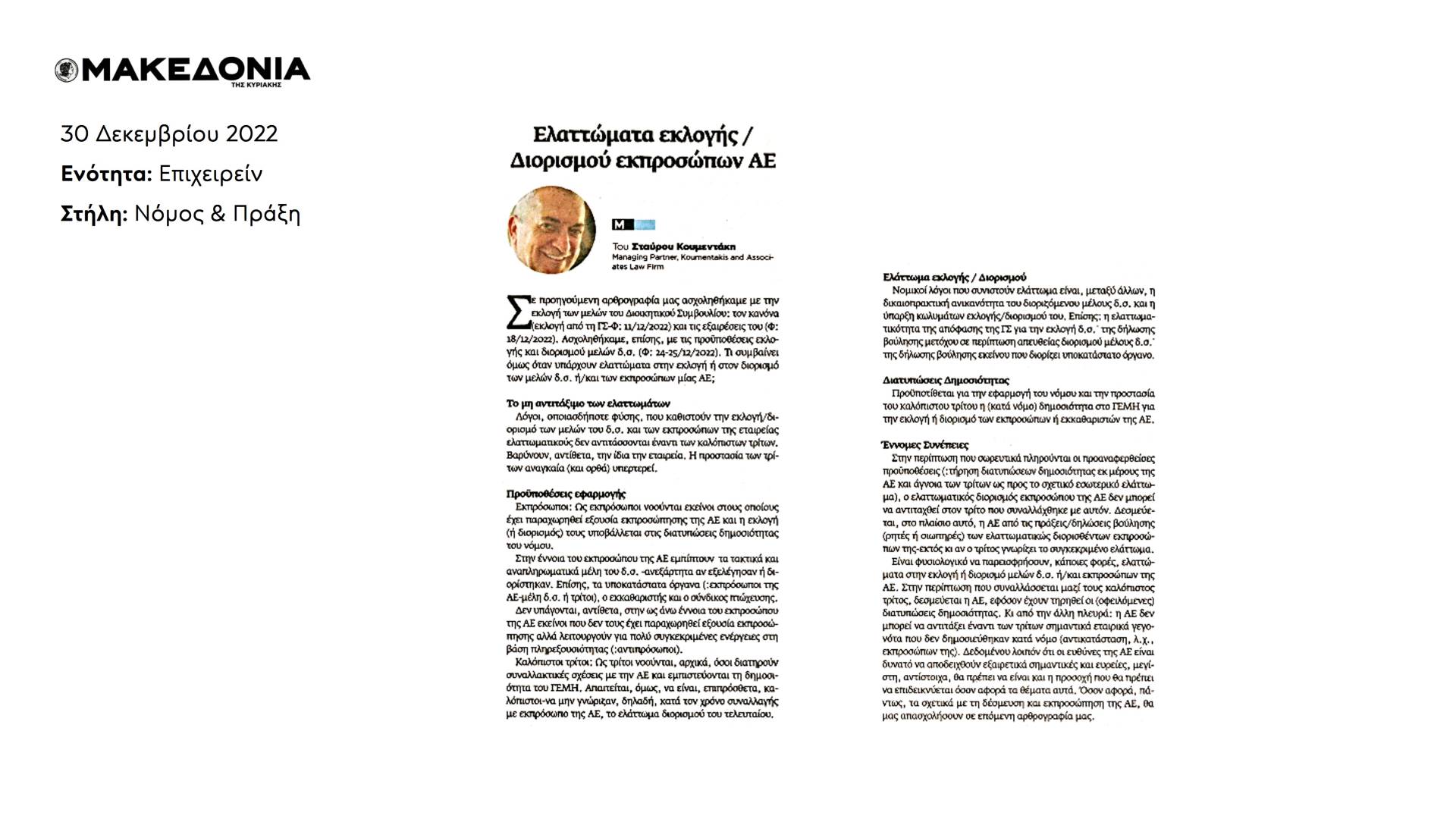
    P.S. A brief version of this article has been published in MAKEDONIA Newspaper (December 30th, 2022).
    Disclaimer: the information provided in this article is not (and is not intended to) constitute legal advice. Legal advice can only be offered by a competent attorney and after the latter takes into consideration all the relevant to your case data that you will provide them with. See here for more details.

  • Conditions for Eligibility of members of the SA Board of Directors

    Conditions for Eligibility of members of the SA Board of Directors

    In a previous article we dealt with the election of the members of the Board of Directors: the rule (election by the General Assembly) and its exceptions. Can everyone be elected as a member? And if not, what are the conditions for electing (or appointing) Board members? The present article holds the answers.


    Conditions for Board Eligibility

    By the law

    The law on SAs introduces a single limitation (art. 83 §1, law 4548/2018) to the discretion of the General Assembly and the shareholder making a direct appointment (art. 79): the existence of full legal capacity for natural persons who are elected/appointed (according to art. 127 of the Civil Code). Limited legal capacity is not enough (Memorandum to law 4548/2018 on art. 83).

    However, additional special conditions, inabilities or incompatibilities are foreseen in individual provisions of the legislation. The specific provisions are not affected; they remain in force (art. 83 §3, section a’). Such arrangements are found in specific forms of companies, such as e.g. credit institutions. Incompatibilities mentioned in the position of the ordinary members of the Board of Directors, the managing director or the representative (according to article 87 §2) are also provided for certain professions (e.g. prosecutors, judges or secretaries of courts are not allowed to be members of the Board of Directors). Also, with regard to listed SAs, a series of irreconcilables for the independent non-executive parties is established by the special, relevant legislation (art. 9 Law 4706/2020).

    It should be clarified here that the law does not impose restrictions on the election or appointment of a member of the Board of Directors, related to citizenship (: local or foreign natural or legal person), residence (: in Greece or abroad), existence (or non) shareholding.

    By The Statute

    Additional eligibility conditions may, by express legislative regulation (art. 83 § 3 sec. b’), be specified in the SA’s statutes-original or by amendment. Such a “qualitative” limitation of the candidate members of the Board of Directors, on the basis of statutory provisions, is basically dictated by the corporate interest. It seems reasonable to require, sometimes, special knowledge, skills, experience and qualifications that must be present in the person of the board members. The nature and corporate purpose may warrant it. And practical reasons may require the introduction of statutory provisions regarding conditions of eligibility related to the residence of the board members (e.g. in the country of the headquarters or in the place of exercise of the administration). And this, despite the use of technology and the expansion of teleconferences often makes physical presence at the meetings of the individual bodies – the Board of Directors included- unnecessary.

    It should be noted, however, that relevant statutory restrictions cannot be tolerated if they lead to the circumvention of the compulsory legal provisions for SAs. To limit, e.g., the number of persons eligible for election to such an extent that the possibility of electing members of the Board of Directors from the General Assembly is practically abolished. Also, to result in discrimination due to gender, religion or other protected characteristics (see related, Memorandum to law 4548/2018 on art. 83).


    Legal Consequences of Lack/Loss of Eligibility

    Election or appointment of a member of the Board of Directors without the required legal capacity is invalid (art. 83§ 2).

    But: since the loss of legal capacity is a consequence of the election/appointment of the member of the Board of Directors, the disqualification from the specific position of the member of the Board of Directors occurs automatically. This, of course, applies prospectively. The validity of the member’s actions, before they lose their status, is not affected: there are no retroactive consequences.

    If a member of the Board of Directors is elected as such, in violation of an irreconcilable provision established by law, their election should not be considered invalid because of its opposition to a special provision of law. The members of the Board of Directors will, in this case, be subject to administrative or other sanctions in accordance with what, as the case may be, the specific legislation stipulates. Subsequent appearance of irreconcilable circumstances, however, is argued to result in automatic disqualification.

    However, in the event of non-compliance with the statutory eligibility conditions at the time of obtaining the membership status, the relevant decision of the General Assembly will be invalid. The subsequent appearance of a statute incompatible with the person of a member of the Board of Directors should lead, here as well, to their automatic dismissal.

    It should be noted, however, that the existence of reasons that make the election or appointment of the members of the Board of Directors-representatives of the company defective are not brought against bona fide third parties. It is sufficient that the publicity formalities prescribed by law have been observed. However, in addition, the (bona fide) third parties must be unaware of the relevant (internal) defect (art. 84 – more detail on those, however, will be found in our next article).


    The only (general) eligibility condition for the position of a member of the Board of Directors (besides the special ones imposed by special provisions) is the existence of legal capacity in the person of the candidate. The Board of Directors, however, is not (should not be) a decorative body of the SA but an administrative and, above all, strategy-making body. If this specific admission coincides with the choices of the shareholders of the SA, it would be desirable to impose (by the articles of association and/or apart from them) the existence of minimum, specific qualifications for someone to occupy such a position. The utilization of the most useful persons for the SA in its Board of Directors can only work positively for the pursuit of the corporate objectives. If, however, the intention of the shareholders is to (according to the formalities-only) fill the positions of the specific body and the management of the SA on the basis of the “one man principle”, it is advisable to choose those who will adequately support it.-

    Stavros Koumentakis
    Managing Partner


    P.S. A brief version of this article has been published in MAKEDONIA Newspaper (December 24th, 2022).

    Disclaimer: the information provided in this article is not (and is not intended to) constitute legal advice. Legal advice can only be offered by a competent attorney and after the latter takes into consideration all the relevant to your case data that you will provide them with. See here for more details.

  • Exceptions to the Rule of Election of the Board of Directors by the General Assembly

    Exceptions to the Rule of Election of the Board of Directors by the General Assembly

    In a previous article, we were concerned with the election of the members of the Board of Directors by the General Assembly (: rule). We pointed out, however, that this specific rule is not without exceptions. On those exceptions: the present article.


    Appointment of the First Board of Directors in the Initial Articles of Association

    An exception to the rule of the election of the Board of Directors by the General Assembly is, first of all, the case of the appointment of the first Board of Directors in the initial statute of the SA (in essence, by the founders of the SA – art. 78 §2, section a’ and §117 2 c. c.). Its term of office will last until the first regular General Assembly, unless otherwise (and specifically) provided for by the statute. The first Board of Directors can also be elected by a universal and without an invitation to the shareholders General Assembly (art. 121 §5, as expressly provided for in art. 78 §2 section b), by signing the minutes of the General Assembly without a meeting (art. 136) or by court decision (art. 69 of the Civil Code, as expressly provided in art. 78 §2 ed. b’).


    Direct Appointment of Member(s) by Shareholder

    An exception to the rule of election of the Board of Directors by the General Assembly is (also) the personal right to directly appoint a member/members of the Board of Directors. The specific right can be granted to one or more shareholders of the SA (art. 79) – by way of derogation from the principle of equality of shareholders (art. 36 §2). In this case, the representation of the minority in the management of the SA is guaranteed. Also, possibility aids in attracting investors: the participants in the Board of Directors have, moreover, a wider right to information than that of the minority shareholders (see art. 141 §§6 & 7 and art. 142 §4). Said right is non-transferable and non-inheritable-unless otherwise provided by the articles of association; it also is waivable.

    Prerequisites

    A necessary condition for the granting of the right to directly appoint a member/members of the Board of Directors is (apart from the shareholder status) the relevant statutory provision. It is possible for the articles of association to specify by name the bearer of the relevant right or the qualities or characteristics they must bear (e.g. a minimum percentage of participation in the share capital). It is necessary, in general, to determine the conditions for its exercise; in particular, with regard to the percentage of participation of the shareholder in the capital and the declaration of appointment (art. 79 §1 in fine).

    This right can be granted individually to a shareholder(s) or, jointly, to several of them. In the latter case, a joint act of the beneficiaries is required for the appointment of a member/members of the Board of Directors-obviously the same goes for their revocation (art. 79 §5).

    The relevant statutory provision may be initial or consequential. In the latter case, an increased quorum and a majority is required at the General Assembly that will decide it (similar to the case of preferred shares – art. 36 §6). According to others, unanimity is required (invoking the proportional application of art. 89, sec. b΄ of the Civil Code)

    In any case: this right cannot be revoked without the consent of its beneficiary.

    Restrictions

    The number of members of the Board of Directors that can be appointed directly, individually or jointly, by a shareholder/shareholders cannot exceed 2/5 of the total number of members of the Board of Directors (art. 79 §1, section a). According to the articles of association, the relevant ratio is maintained even in the event of a change in the number of members of the Board of Directors (art. 79 §4). The other members of the Board of Directors are elected by the General Assembly.

    Mode of Exercise

    The exercise of said right by the beneficiary-shareholder takes place before the election of the Board of Directors by the General Assembly. The latter, in case of direct appointment, is limited to the election of the remaining members. Shareholder(s) who exercise the right in question shall notify the appointment of the members of the Board of Directors in the company at least three full days before the meeting of the said General Assembly; and, in fact, they do not participate in the election of the rest of the Board of Directors (art. 79 §2). Their shares, respectively, are not counted in the formation of quorum and majority.

    There is no legislative provision for the cases of the General Assembly conducted without a formal invitation of the shareholders (art. 121 §5) and the signing of the minutes of the General Assembly (art. 136). However, the non-observance of the above three-day deadline in these cases should be accepted. Also, the simple, relevant, declaration of the beneficiary-shareholder immediately before the election of the Board of Directors.

    The shareholder-holder of the right to directly appoint a member of the Board of Directors may not exercise their specific right. In this case they will normally participate in the General Assembly for the election of the Board of Directors.

    Revocation

    The directly appointed members of the Board of Directors are also freely revoked – at any time – by the holder of the relevant right (art. 79 §3). The latter, in fact, may appoint a new member to replace the revoked one. If they fail or are late to do so, the Board normally operates with its other members – as long as there are not less than three.

    If there is a serious reason on the person of the appointed member regarding their incompetence (e.g. non-fulfillment of their duties), shareholders (other than those who appointed them) may legally request their revocation. A necessary prerequisite is that they represent at least 1/10 of the paid-up capital. The relevant judicial process is developed in the framework of the ‘ex parte’ proceedings.


    Replacement of (Incomplete) BoD

    Another exception to the rule of election of the Board of Directors by the General Assembly is (also) that of the election of a member, by the Board itself, in case of an incomplete (“stump”) Board (art. 82 §1 and 117 §2, para. d)). If there is resignation or death or in any other way loss of the status of a member or of members of the Board, the latter may elect their replacement for the remainder of their term. A relevant statutory provision is not required (see Memorandum to law 4548/2018 on art. 82). Any powers of the replaced are not automatically transferred to their replacement.

    Prerequisites

    For this election on its part, the following are required (cumulatively): (a) Loss of Member Status, (b) Absence (:non-election) of Substitute Members by the General Assembly (according to article 81) and (c) Legal Composition of the Board (: its remaining members not to be less than three)

    Publicity & Notice of Decision

    The decision of the election, on the one hand, is submitted to the Business Registry in a declaratory manner (art. 82 §1 in fine) on the other hand, it should be announced at the next General Assembly. The GA can replace the elected member/members, even if there is no relevant item on the agenda (art. 82 §1 in fine).

    Incomplete Board Continuation Clause of the Articles of Association

    According to the law, a statutory provision for the continuation of the operation of the Board of Directors without replacement of its missing members is permissible (art. 82 §2). As long as the remaining members are more than half of those elected/appointed and not less than three.

    Convocation of General Assembly by Incomplete Board of Directors

    The members of the incomplete Board of Directors are, however, able to convene a General Assembly with the sole purpose of electing a new Board of Directors – even if they are less than three (art. 82 §3).


    Judicial Appointment of the Board of Directors

    The last exception to the rule of the election of the Board of Directors by the General Assembly is their appointment by court decision. In addition, the law on SAs refers to the relevant possibility, in case the first board of directors is not defined by the articles of association (art. 78 §2, sec. b΄).

    Appointment of temporary administration by virtue of a court decision is imposed (art. 69 CC) as a last resort, in case of “lack of management”; specifically, when: (a) the persons required for the administration of the legal entity are missing or (b) interests conflict between the administration and the counterparts of the legal entity.

    Such an appointment can be decided by the court following the application of anyone with a legal interest – during the process of ‘ex parte’ proceedings (art. 786 of the Code of Civil Procedure).

    Regarding, in particular, the aforementioned prerequisites:

    (a) Case of Absence of Management: It occurs in cases where no members of the Board of Directors are appointed or they have resigned or a member is absent (e.g. due to death or illness). In the cases, also, of the election of the Board of Directors with an invalid decision as well as (in the right opinion) when there is a fictitious lack of management (e.g. refusal to exercise duties by the members).

    The appointment of a temporary administration by a court decision is significantly limited, given the provisions of the law on SAs. And this is because, before the legal action, it is possible: to replace the missing members (art. 81) or to elect others from the Board itself (art. 82 §2). Also, the continuation of the operation of the incomplete Board of Directors in the context of the relevant statutory provision (art. 82 §2). It is possible, in any case, to convene a General Assembly by the remaining members of the Board of Directors for the purpose of electing a new Board of Directors (art. 82 §3).

    If a request for appointment is made on the basis of one of the above-mentioned cases, the court appoints all the members of the temporary Board of Directors – even if only some of its members have dropped out. Consequently, a mixed temporary Board of Directors, already existing of the judicially appointed members, is not formed. The temporary Board of Directors must proceed, based on what the court decision will determine, to immediately convene a General Assembly for the election of a new Board of Directors.

    (b) Case of Conflict of Interests: Occurs in cases where the individual interests of the member of the Board of Directors are contrary to those of the SA. Or takes advantage of business opportunities for their own benefit or the benefit of a third party at the expense of the SA.

    In this case, judicial involvement is significantly limited (according to article 69 CC) – given the provisions of the law on SAs: In the context of the duty of loyalty, a member of the board of directors is not entitled to vote on matters in which there is a conflict of interest with their company of the same or related persons (97 §3). It is also possible for the member in question to be replaced (provided this is provided for in the act of election or appointment of the replacement – art. 81 §2).

    However, once a relevant application for appointment has taken place, the court appoints (in the most correct opinion) as many members of the Board of Directors as are prevented by the conflict of interest from performing their duties. The temporary administration, in this case, carries out those acts for the performance of which the members being replaced are prevented and/or those, specifically, designated by the court.


    The (well-known) rule of electing the Board of Directors by the SA’s General Assembly has particularly interesting exceptions: the appointment of the first Board of Directors (usually by the articles of association), the direct appointment of member(s) by a shareholder or/shareholders, the replacement of absent members by the (“stump”) Board, the appointment of a temporary Board based on a court order. However, the specific exceptions are (in addition to being interesting, also) particularly important – potentially, in fact, problematic: they do not only ensure the smooth operation of the SA, but they also may, under certain conditions, overturn important balances in the management of the company – possibly also the shareholders balances. Therefore, we should all be particularly careful when managing them.

    Important issues arise (also) regarding the eligibility and defects in the appointment of the members of the Board of Directors. We will look into them, however, due to their extent and seriousness, in our next article.-

    Stavros Koumentakis
    Managing Partner


    P.S. A brief version of this article has been published in MAKEDONIA Newspaper (December 18th, 2022).

    Disclaimer: the information provided in this article is not (and is not intended to) constitute legal advice. Legal advice can only be offered by a competent attorney and after the latter takes into consideration all the relevant to your case data that you will provide them with. See here for more details.

  • Election of the Board of Directors and Alternate Members

    Election of the Board of Directors and Alternate Members

    In our previous article, we looked into the Board of Directors of the SA. Specifically: their operation, authority, members and term of office. However, as its members are not elected only by the General Assembly, interesting issues arise regarding the manner of their election. In the present article we will explore the rule (:election by the General Assembly). In the next article we will explore its exceptions.


    The election of the Board of Directors from the G.A.

    The rule

    As mentioned in the introduction, the members of the Board of Directors are elected (: rule) by the General Assembly – subject to a different regulation in the law, (art. 78 §1, Law 4548/2018 – Memorandum to Law 4548/2018 on Art. 78). We find a similar provision in the provisions concerning the exclusive competence of the General Assembly (art. 117 §1, para. b). The principle of autonomy and self-governance of the SA is served through the election of the BoD by the General Assembly. Its owners (shareholders) have a say and participate in the management of the latter.

    The relative competence of the General Assembly cannot be delegated (neither by the General Assembly or the statute) to another body of the SA or a third party. The General Assembly takes the decision to elect the Board of Directors with a simple quorum and majority (art. 130 §1 and 132 §2, respectively). Subject, of course, to the fact that the statute does not require, in this case, greater quorum and majority rates (art. 130 §5 and 132 §3, respectively). It is possible, however, for the statute to require unanimity.

    The Exceptions

    The rule of electing the board by the General Assembly, however, is not without exceptions. The exceptions established by law (for which see our next article)- are summarized in the following: (a) In the appointment of the first Board of Directors in the initial statute of the SA (art. 78 130 §2). (b) In the direct appointment of a member/members of the Board of Directors by a shareholder (art. 79). (c) In the election of members by the Board of Directors, in case of an incomplete Board of Directors (art. 82 130 §1). (d) In the appointment of a (temporary) Board of Directors pursuant to a court decision (art. 69 of the Civil Code).


    Election of the Board of Directors based on lists

    In General

    The election of the Board of Directors by the General Assembly usually takes place on the basis of the majority system: those who receive the most votes are elected. However, another way of election is also provided for (art. 80 §1): the possibility, specifically, of electing members of the Board of Directors based on lists (: ballots). This is a possibility that was introduced in 2007 (law 3604/2007) in order to remove previous doubts set forth by the legal theory.

    In the context of the specific system, it is provided that, subject to a relevant statutory provision, the candidates for election as members of the Board of Directors are proposed to the General Assembly based on lists. The General Assembly elects from among them as members of the Board of Directors according to the proportion of the votes received by each list (art. 80 §1 paragraph a’).

    Through this regulation, the proportional election system by the General Assembly is introduced. As a result, there is a more proportional representation of the shareholders in the management of the SA; with a particular interest, of course, for the minorities. Proportional representation in the management of the SA carries, however, risks for the possibility of decision-making by the Board of Directors. Especially for those that (on the basis of a statutory provision or the law) require an increased quorum and majority. The members of the Board of Directors coming from the minority shareholders will be entitled (and it is probable), in this case, that they will vote against.

    It is argued (and rightly so) that proportional and majority systems can coexist: a certain number of board members can be elected on the basis of the majority system and the remaining on the basis of lists.

    Conditions

    (a) Statutory Provision: As we have already mentioned, the election based on lists requires a relevant statutory provision (: positive prerequisite).

    The articles of association, however, should specify the procedure to be followed for the election of the members of the Board of Directors based on lists, in order to avoid any disputes. Election methods using list election vary. In fact, it is possible to have only one list. The need for detail concerns (in particular) the way seats are allocated.

    Depending on the relevant statutory provisions, from each list are elected: either the persons who received the most votes or those who precede in the order of the list. The rest are considered alternates (art. 80 §1, ed. c and d), who are considered, by law, as substitute members (art. 81 §1, ed. b).

    Such a statutory provision may be provided for in the initial statute of the SA. However, it can be introduced and/or abolished by decision of the General Assembly. The relevant decision is taken by a simple quorum and majority, unless the articles of association require higher percentages (art. 80 §1 in fine).

    (b) Absence of Statutory Provision for Direct Appointment: In order for the election of Board members to take place on the basis of lists, the absence of a statutory provision for the direct appointment of a Board member/members by a shareholder is assumed (: negative condition) (art. 80 §2). This seems reasonable, as (: Memorandum to law 4548/2018 on art. 80) the two possibilities serve the same purpose: the representation of the minority on the Board.


    Alternate Members

    Definitive Replacement

    In addition to the (in any way elected) members of the Board of Directors, any substitutes may be called upon to play an important role. As such are meant those that are (basically) elected or appointed with the purpose of replacing a member/members in the event of their loss of status.

    The possibility of electing or appointing substitute members (art. 81) is intended to deal with the case of a “stump”, as it is called, of the Board. By extension, to prevent legal action for the appointment of a temporary administration (69 CC) , which must be opted for in exceptional cases only. Indeed, given the relevant legislative provision, a corresponding statutory provision is not required (Memorandum to law 4548/2018 on art. 81).

    The person who elects or appoints the Board of Directors (or its members) may also elect or appoint substitute members in the event of the resignation or death of the persons elected or appointed by them; also those who, for any other reason, have lost their status of member case of election of members of the Board of Directors based on lists (art. 80), the runners-up are considered as alternate members.

    Contrary to the previous regime, the relative possibility of replacement is provided in all cases of election or appointment of the Board of Directors (Memorandum to law 4548/2018 on art. 81). Therefore: not only in case of election by the General Assembly. In turn, the alternate members: (a) will either be elected by the General Assembly and designated in the election decision of the Board of Directors, (b) or will be notified to the SA together with the member appointed, directly, by a shareholder, (c) or the runners-up will be considered as such, in case of election based on lists.

    Appointment of substitute members is not, however, possible to take place (as accepted) in the original statute of the SA.

    The election or appointment of an alternate member may concern the replacement of a specific member or any of them – depending, of course, on the act of election or appointment of the alternate members. If no relevant reference is made, any replacement may occur for any existing member.

    Furthermore, it is required that the appointment of substitute members be published (art. 81 §1 in fine).

    Temporary Replacement Due to Conflict of Interests

    The replacement of a member of the Board of Directors takes place for the remainder of their term. Any replacement cannot take place due to the temporary unavailability of an existing member.

    A deviation from the above, by virtue of a more specific regulation, is introduced in the case of a conflict of interests of a member of the Board of Directors with those of the SA (art. 97 & 81 §2). A necessary condition is that this is provided for in the deed of election or appointment of the substitute member. As expressly stated, in this case the replacement is temporary and concerns the acts for which the conflict exists.

    Presence of Substitute Members at Board Meetings

    The law provides (art. 81 §3) the possibility of representation of the substitute members at the meetings of the Board of Directors – before they replace a (regular) member. This option is considered necessary, in order for the substitute members to be informed about corporate issues; to be able, consequently, to assume their duties, in case there is a reason for replacement.

    In the said meetings, the substitute members do not have the right to vote nor is it necessary for them to be invited to the meetings (Memorandum to law 4548/2018 on art. 81). It is, however, possible for them to take the floor and express their opinion – at the discretion of the president. It is also possible for them to represent another member of the Board of Directors at the meetings (art. 92 §4).


    It is common knowledge that (most of the time) the members of the board of an SA are elected by its General Assembly. The latter elects the members of the Board either on the basis of individual nominations or nominations included in lists-ballots. The latter would be a beneficial option for the minority shareholders, but problematic (and therefore is avoided) for the majority. However, the selection of alternate members of the Board of Directors is optimal in order to deal with (potentially) problematic situations (e.g. incomplete composition of the Board of Directors or conflict of interests of its members). Eligible, also, in some cases (and not unusual, and sometimes, in fact, necessary) is the election/appointment of members of the Board of Directors-outside the General Assembly. About them, however, see our next article.-

    Stavros Koumentakis
    Managing Partner


    P.S. A brief version of this article has been published in MAKEDONIA Newspaper (December 11th, 2022).


    Disclaimer: the information provided in this article is not (and is not intended to) constitute legal advice. Legal advice can only be offered by a competent attorney and after the latter takes into consideration all the relevant to your case data that you will provide them with. See here for more details.

  • The Board of Directors of the SA: Operation, Authority, Members

    The Board of Directors of the SA: Operation, Authority, Members

    One of the most important bodies of the SA is its Board of Directors. It is the body through which exercises the management and representation of the SA; through which the SA expresses its will and manifests its action both internally and to the outside world. The important role of the Board of Directors, as well as issues regarding its members and their term of office will be the approached in the present article.


    The Role of the Board of Directors – The Management Task

    As expressly provided for in the law on SAs (law. 4548/2018), the company is managed by the BoD (art. 77 §1, section a’, law 4548/2018). The administration of the SA includes: (a) management and (b) its judicial and extrajudicial representation (art. 77 §1 sec. b’).

    The law, therefore, generates a range of powers (and responsibility) of the BoD, which are distinguished from the corresponding ones of the General Assembly. The latter, moreover, is the one that decides on structural changes concerning the SA.

    The SA acts through its BoD. Its existence therefore becomes mandatory. This obligation does not mean, however, that in case the Board of Directors disappears (e.g. due to the resignation of its members) the SA ceases to exist. Its existence, in this case, is not disputed. It is necessary, however, to ensure its operation through the election of a new Board of Directors by the General Assembly or the judicial appointment of its temporary administration (69 Civil Code).

    The obligation of the BoD for exercising management is not limited to the management and representation of the SA. It generally includes all actions of administration. In this context: the determination-coordination of the business policy and strategy and ensuring its compliance. Although the law on SAs adheres to the traditional way of governing the SA through the Board of Directors, it also provides for its (potential) substitute: the “executive committee” (art. 87 §4). The latter, once its appointment is chosen, can make decisions for the daily administration of the SA; the rest of the Board of Directors will, in this case, exercise supervisory duties (see Explanatory Report of law 4548/2018 on the 6th section).

    A question arises regarding the content of the corporate interest at the promotion of which the Board of Directors should aim, while exercising the duty of administration. In one view, the corporate interest of the SA is identified with the aspirations of its shareholders for the long-term profitability of the SA and, by extension, an increase in the shareholding value (: monist theory). On the other hand, not only the interests of the shareholders should be taken into account, but also those of e.g. the SA workers and even the environment (: pluralist theory). In any case, however, and through the serving of such interests by the Board of Directors, for example of the interests of the employees, the interests of the shareholders are served in the end.


    Legal Relationship Between Board Members & SA

    The members of the Board of Directors are linked by a legal relationship (: organic) with the SA. This legal relationship may or may not be in exchange for a numeration.

    It is possible that a member of the Board of Directors provides the SA, in addition, with services that go beyond the narrow limits of its administration. These services are provided in the context of a “special relationship” (art. 109 §3). The specific, special, relationship can include, indicatively, the type of employment contract, project, independent services or mandate (e.g. a member of the Board of Directors provides, at the same time, legal or accounting services to the SA).


    Principle Of Autonomy

    The members of the Board act independently. Therefore, they are not subject to instructions and orders, e.g. of the General Assembly or the majority shareholder of the SA. The only obligation of the members of the Board of Directors towards the shareholders (in the context, mainly, of the General Assembly) is the obligation of provision of information (: art. 141).

    The members of the BoD have (against the SA – only) an obligation of loyalty and diligence when fulfilling their duties – in the context of the organic relationship between them (and this regardless of any underlying relationship – e.g., contract of mandate or of independent services).

    Except in the case where the BoD itself requests it, no consent/approval of the GA is required in the making of management decisions by the BoD. Statutory clauses for approval of the decisions of the Board by the General Assembly will therefore be void. However, the possibility of the latter to elect, at any time, a new Board of Directors, undoubtedly works in the direction of the compliance of its members with the directions (formal or informal, explicit or implicit) of the majority shareholders.

    Finally, it should be noted that, even more so, not even the Board of Directors of a subsidiary company is obliged to carry out the orders of the parent company (regardless, of course, that in practice it will be aligned with its orders).


    Management Authority: Content, Scope & Responsibility

    Content

    The Board of Directors is competent to decide on every act concerning the administration of the SA, the management of its property and, in general, the pursuit of its corporate objectives (art. 86).

    Extent

    The Authority of the Board of Directors is limited: the Board of Directors does not have the right to carry out actions in excess of the corporate objectives as well as actions that are prohibited by the articles of association or contrary to decisions of the General Assembly. It is, however, possible to further limit its authority by the statute or by decisions of the General Assembly.

    Responsibility

    Any actions in excess of the management authority of a member of the Board of Directors gives rise to an obligation to compensate. However, the relevant act is evaluated as valid and carries legal consequences, as long as the potential third party is in good faith.


    Representation: Content, Scope & Liabilities

    Content

    The Board of Directors, as a collective body of the SA, represents the latter judicially and extrajudicially. Exceptions are found in special cases – e.g.: (a) at the stage of establishment of the SA (: when neither a legal entity exists nor, much less, a BoD), (b) at the stage of liquidation (: when representatives are the liquidators), (c) at the stage of bankruptcy (when the liquidator acts as a representative).

    In the context of the out-of-court representation of the SA by the BoD fall the execution of legal transactions and the conclusion of contracts with third parties. Also, the acts of a corporate nature towards the shareholders (e.g. the approval of the transfer of reserved shares).

    In the context of legal representation, the Board of Directors represents the SA legally, as the SA, as a legal entity, has the capacity to be a party and appear before any court.

    Scope

    The scope of the board’s representation authority is unlimited: the SA is bound to bona fide third parties (who did not know or could not have known of the relevant excess of exercise of power) – even if the board acts beyond the corporate objectives.

    The extent of the power of representation of the Board of Directors is (also) unlimited: Any limitations of it by the statute or the General Assembly cannot be opposed against third parties (art. 86 §3). Even if these have been made public.

    Limitations, however, on the Authority of the Board of Directors may be set by law. Such cases constitute the transactions of the SA with members of the Board of Directors (art. 99 et seq.). Also, the cases in which the function of representation is exercised by the Board of Directors, but the consent of the General Assembly is required (e.g. transactions with related parties – art. 100 §3).

    Liabilities

    The consequences and actions of the members of the Board of Directors are attributed to the SA itself. Liability, therefore, arises at the expense of the latter for (unjust, mainly) actions or omissions of the members of the Board of Directors (art. 71 CC). It gives rise, however, at the same time, on the joint responsibility of the guilty persons.


    Principle Of Collective Action

    The Board of Directors when exercising its powers but taking its decisions (art. 92 par. 2) acts, in principle, collectively (art. 77 §2 sub. b’). It is therefore important that the members of the Board of Directors participate in the collective proceedings. On the contrary, it is not required that all members participate in every act of representation.

    Permissible, however, are specific statutory deviations, such as e.g. the assignment of representation for one or more issues to specific, only, members or member of the Board of Directors. Also, the sovereignty of the president’s vote in the event of a tie (art. 92 par. 2 sec. b’). As well as the appointment of a substitute body, which acts in parallel with the Board of Directors (art. 87).


    The Members of the Board of Directors; In particular

    Election & Possibility of Re-election

    The methods of electing the members (shareholders or non-shareholders) of the BoD are expressly provided for in the law (art. 77 §2 section a’, with reference to art. 78-80). Specifically, these methods include: (a) election by the General Assembly (art. 78), (b) direct appointment by a shareholder (art. 79) and (c) election based on lists (art. 80).

    The members of the Board of Directors remain, at all times, eligible for re-election (even before the expiry of their term – article 77, §2, section b’). In this way, the need – often – for unity and continuity in the administration of the SA is met. Any statutory clause prohibiting re-election will be considered invalid (art. 77 §2 section b’).

    The Free Revocation

    The members of the Board of Directors can be revoked freely – at any time (art. 77 §2 sec. b’). Their tenure, therefore, is always subject to their recall.

    Revocation takes place, basically, by decision of the General Assembly (by simple quorum and majority). If, however, a member was appointed by direct appointment, by the shareholder who appointed them (or they were appointed judicially, if 1/10 of the paid-up share capital made such a request and there is a great reason).

    The revocation of the members of the Board of Directors-consultants usually expresses the lack of confidence in them or, in general, the disapproval of the management they exercise. Statutory clauses that remove or limit the right of revocation are void.

    The act of revocation is subject to (declarative) publicity.

    Number

    The number of members of the Board of Directors is determined by the articles of association. Alternatively by the General Assembly, within the limits provided by the articles of association. However, it cannot (art. 77 §3) be less than three (3) or exceed fifteen (15) members. Failure to comply with these limits renders the composition of the Board of Directors illegal.

    A Legal Entity as a Board Member

    As long as there is an express statutory provision, it is possible for any legal entity to become a member of a Board of Directors. (art. 77 §4).

    The legal entity-member is obliged, within 15 days from its designation as a member of the Board, to indicate, a natural person as its representative. The latter will exercise all the responsibilities with which the member of the Board of Directors is charged. The natural person in question is revoked/replaced at any time by the legal person-member. However both the legal entity and its representative have full liability vis-à-vis SA in terms of corporate management operations.

    The Tenure

    The status of a member of the Board is related to the duration its his term – unless the member resigns (expressly or implicitly) before its expiration. The term of office is determined, in particular, by the statute and cannot, in any case, exceed six years. In the event that the election or appointment is made for a longer period, then they apply for a maximum of six years (art. 85 §1 sec. a’ & b’). A minimum term, however, is not foreseen – it is not common, however, for it to fall short of a year.

    It is within the competence of the General Assembly to specify the term of office, since the statutes simply set its limits (e.g. “between one and five years”). As an exception, in fact, it can elect a Board of Directors with a shorter (statutory) term. However, if both the statute and the General Assembly do not address its duration, it is assumed that the term of office of the members is six years.

    A legal extension of the term of office of the BoD – the duration of which has expired – is provided for, until a decision is taken to elect a new one in the context of the regular General Assembly of Art. 119 (art. 85 §1 ed. c΄). In this way, phenomena of the SA’s lack of governance are avoided.

    It is, however, possible that there is a provision for extending the term of office of the Board either in the statute or in the decision of the General Assembly for the election of the Board. Implied extension is not accepted.

    Finally, it is allowed, by law, to make a decision – optional or statutory mandatory – on behalf of the General Assembly for partial renewal of the members of the Board of Directors. Also, the provision of differentiated, among the members, expiry times of their term of office (: staggered BoD) – under the terms of the law (art. 85 §2).


    The SA’s Board of Directors is not its most powerful body (the power of the General Assembly always prevails), but it is the most important one. And this is because the Board of Directors is responsible for the internal management and external bounding and representation of the SA. It is the one to which every failure will be attributed (but also every success will be credited) in the effort to fulfill the corporate objectives and serve the interest of the shareholders. The BoD is a collective body (and is treated as such by the law and the statutes of the SA), but in practice one or, at best, only a few of its members are responsible for the day-to-day management of the SA. In this context (according to Thucydides, Historiai, 2.65.9): “Thus the state was ostensibly a democracy, while in reality it was ruled by one citizen”. And so happens in the SA. And rightly so. The rules, however, are there. Their compliance is supervised and their circumvention (even if it is deliberate) is controlled. And rightly so.

    However, the interesting issues of the election of the members of the Board of Directors will concern us in our next article.-

    Stavros Koumentakis
    Managing Partner


    P.S. A brief version of this article has been published in MAKEDONIA Newspaper (December 4th, 2022).


    Disclaimer: the information provided in this article is not (and is not intended to) constitute legal advice. Legal advice can only be offered by a competent attorney and after the latter takes into consideration all the relevant to your case data that you will provide them with. See here for more details.

  • Founders’ Shares: Common & Extraordinary

    Founders’ Shares: Common & Extraordinary

    Shareholding status (the corporate, that is, participation in the SA) presupposes the possession of shares. However, it is possible for the SA to issue, in order to serve its interests (for its financing – e.g.) other securities besides shares. Among the other securities are also the founders’ (: common or extraordinary), which serve the SA, the shareholders and also their owners on many levels. About the common and extraordinary titles, but also their particularities, the present.


    Concept & Definitions

    The possibility of issuing ordinary and extraordinary founders’ shares on behalf of the SA is expressly regulated in Law 4548/2018 (art. 75 and 76 respectively). This is basically a regulation similar to that of art. 15 of the previous law 2190/1920.

    The issuance of these securities is intended to reward or attract the founders of the SA or third parties (e.g. employees, executives or members of its management), for specific actions beneficial to it, or, simply, synergies with it.

    The distinction between ordinary and extraordinary founders’ shares is based on: (a) the nature of the benefit for which they are issued and (b) the time of their issuance. Particularly:

    Common Founders’ Shares: These specific securities are issued by the SA at the time of its incorporation; their issuance at a later time is excluded (in the context, e.g., of any increase in its share capital). These titles are granted as an exchange/reward for services provided either by the founding shareholders or by third parties during the stage of the establishment of the SA (art. 75 §1). These services include actions that cannot be valued in money (e.g. providing work during the establishment of the company).

    Extraordinary Founders’ Shares: Unlike ordinary founders’ shares, extraordinary founders’ shares can be issued at any time – both during the formation of the SA and during its operation. In addition to their time of issue, extraordinary founders’ shares are also distinguished from ordinary founders’ shares in terms of the nature of the benefit against which they are granted. The extraordinary founders’ shares constitute a reward of the shareholder or the third party for benefits in kind to the SA- valuators, however in money (art. 76 §1). In this case, it is enough to simply grant the object to the SA – the transfer of ownership, i.e., is not required. An object in kind does not, therefore, mean the payment of money nor benefits not valued in money (e.g. the provision of work – given the reference of art. 76 §2 to art. 17 on contributions in kind).


    Rights

    Both common and extraordinary charters have no par value. Their monetary value does not, therefore, correspond to a part of the company’s share capital; they do not provide share rights to their beneficiaries. Their holder does not have the right to participate in the administration and management of the company, nor in the product of its liquidation (art. 75 §2 and art. 76 §1 sub. b).

    The only right they provide to their holders is the (limited) right to participate in the SA’s profits. The reward, in other words, of their owners presupposes a profitable, only, course of the SA – with which they are closely related.

    The right to withdrawals in the extraordinary founders’ shares is limited in amount, based on what the statutes of the SA and also the law (art. 76 §3 & 159) define for the distribution of amounts to the shareholders. With regard to the common founders’ shares, an additional, quantitative, limitation is set (art. 75 §3): the amounts distributed to them cannot exceed ¼ of the net profits of the SA, after deducting the amounts for the formation of the ordinary reserve (art. 158) as well as the amount for the distribution of the minimum dividend to the company’s shareholders (art. 161). Therefore, payments against the above are illegal.

    In order to ensure their right, which is exclusively of a property nature, the beneficiaries have, in addition, the right to attend the meetings of the General Assembly – without, however, the right to vote in them. They are also entitled to be informed about the property status of the SA, without, however, having a claim to see the corporate books.


    Common Founders’ Shares

    Conditions for Issuance

    The exclusive reason/purpose of issuing the common founders’ shares, as pointed out above, may be the reward of the founder-shareholders or third parties for services provided during the establishment of the company. However, a relevant statutory provision is required, which should be detailed in terms of their beneficiaries (founders of the SA or third parties) and the services that are rewarded. It should also make an explicit reference to the number of founders’ shares issued, which cannot exceed 1/10 of the number of shares – calculated of any type (e.g. common or preferred shares) – (art. 75 §1). Finally, their duration, which may be indefinite, should also be determined; i.e. it should be identified with the duration of the SA itself – subject to their redemption.

    The Redemption Right of the SA

    As the common founders’ shares aim to reward their owners for their actions at the time of formation of the SA, it is reasonable for their rights to exist for a limited time. In this context, the -issuer of the founders’ shares- SA itself is entitled to purchase them. The redemption takes place after ten years have passed since their issuance; however, it is possible for the SA to redeem them even earlier, as long as there is a relevant statutory provision (art. 75 §4). The relevant provision of the law confirmed the already formed position of the legal theory, which accepted the possibility of redemption in a shorter period of time (see in relation Explanatory Report of law 4548/2018 on article 75).

    The (statutory) right, and not obligation, to redeem the founders’ shares on behalf of the SA is formative right and is exercised unilaterally. In fact, the company’s right does not expire after the decade has passed, nor can it be limited or abolished.

    The taking of the decision to redeem the common founders’ shares can belong to the General Assembly (preferable – as it is related to the property rights of the shareholders); however, it is also possible to assign it to the Board of Directors.

    The purpose of the redemption is the cancellation of the founders’ shares against the payment of a consideration to their beneficiaries. The redemption consideration must be determined by the company’s articles of association and cannot exceed what the law stipulates (art. 159) for the distribution of amounts to shareholders. The exchange/price of the redemption may vary for each beneficiary. However, it is not allowed, under any circumstances, to exceed ten times the average annual dividend received in total by the beneficiaries of the founders’ shares during the last five years before the redemption (art. 75 §5).


    Extraordinary Founders’ Shares

    Competence of the General Assembly

    As pointed out above, the extraordinary founders’ shares can be issued by the SA during its operation. The relevant decision, which amends its statutes, is taken by the General Assembly, with an increased quorum and majority (76 §2).

    This decision of the General Assembly must be based (art. 76 §2) on a valuation report of the objects in kind that can be evaluated. Their valuation takes place with the corresponding application of what is provided for the valuation of contributions in kind (art. 17 and 18). In this way, the protection of the minority shareholders is achieved, as well as the control of any abuse of the relevant decision of the General Assembly. It should be clarified here, in any case, that the objects granted do not constitute contributions in kind and, consequently, do not form part of share capital of the SA.

    The Free Of Terms

    Contrary to what the law stipulates for common founders’ shares, the terms referring to extraordinary founders’ shares are freely determined (art. 76 §3). Depending on the time of issuance of the extraordinary founders’ shares (at the time of the formation of the SA or later), their terms will be determined either by its original articles of association or by a subsequent amendment thereof.

    A maximum on the amount that can be paid to the beneficiaries of the extraordinary founders’ shares is what the law prescribes (art. 159) for the distribution of amounts to the shareholders. It is therefore valid to determine the participation in the profits of the holders of the founders’ shares, preferentially, before the distribution of the minimum dividend to the shareholders.

    It should be noted here that the duration of the extraordinary founders’ shares is independent of the duration of the concession of the objects in kind. In fact, the right to redeem them from the SA is unlimited in time and can be exercised even while the aforementioned concession lasts.


    Issuance, Registration & Transfer of the Founders’ shares

    Matters related to the issuance, registration & transfer of common and extraordinary founders’ shares are treated analogically to those applicable to shares (art. 40-42, 75 § 6 and 76 § 4).

    The issuance of the founders’ shares, in paper or accounting form, is optional and declaratory-legitimizing. The founders’ shares, if issued, are exclusively nominal. This is dictated, among other things, by the need for control and secure identification of the beneficiaries of the founders’ shares. The latter, in fact, in order to facilitate their identification, are registered in the special book kept, even electronically, by the SA, according to the standards of the shareholders’ book (of art. 40 § 2).

    The transfer of the founders’ shares (in the context of special or universal succession) is free.


    The common and extraordinary founders’ shares are an extraordinary, literally, tool in the hands of the SA, its founding shareholders and its management. They provide a limited right to participate in its profits to the beneficiaries – but without making them shareholders or offering them shareholder rights (e.g. minority, participation in decision-making, in the election of management, etc.). On the other hand: the beneficiaries enjoy, correspondingly, one of the most important equity rights (that of participation in profits), which under other circumstances they would not be entitled to. Consequently, the founders’ shares can be an excellent tool for attracting executives, partners, co-investors, but also for reducing costs for the SA; in the end: maximizing the benefit for its shareholders.-

    Stavros Koumentakis
    Managing Partner


    P.S. A brief version of this article has been published in MAKEDONIA Newspaper (November 27th, 2022).


    Disclaimer: the information provided in this article is not (and is not intended to) constitute legal advice. Legal advice can only be offered by a competent attorney and after the latter takes into consideration all the relevant to your case data that you will provide them with. See here for more details.

  • Warrants: Exercise of Right to Acquire Shares

    Warrants: Exercise of Right to Acquire Shares

    In our previous article we dealt with the issuance of warrants and their acquisition by the SA that issued them (or by its subsidiary). However, how is the option to acquire the shares resulting from the warrants exercised? Let’s see.


    The Exercise of the Right to Acquire Shares

    As we have already established, the one who is entitled to exercise (or not) the right to acquire shares, a right incorporated in the warrants, is their beneficiary. The relevant issues are regulated in the law on SAs (art. 58, law 4548/18).

    The exercise of the specific (formative) right is what initiates the increase of the SA’s share capital.

    It should, of course, be clarified here that the specific right concerns the third-party holders of the warrants: It is not possible for the issuer SA to exercise it, insofar as it concerns the same share acquisition warrants or shares acquisition warrants of its parent company, which it may own (No. 58 §1 in fine).


    Legal Exercise – Conditions

    Manner And Type

    The exercise of the option of the warrant is similar to the exercise of the convertible bond conversion right (see also Explanatory Memorandum of Law 4548/2018- art. 58). It is carried out with an explicit (unilateral and addressable) declaration of the beneficiary of the warrants to the SA (art. 58 §1 paragraph a’). Specific formalities are not required by law, however, in transactional practice, the document is chosen. In the case of listed warrants, the procedure specifically provided for should be followed.

    At the same time, however, with this particular declaration, the payment of the consideration already agreed, at the time of issuance, by the beneficiary is also required. The SA does not need to take any other action in order to increase the share capital by issuing new shares. The relevant decisions have already been taken by the time the warrants are made available. The SA, for its part, has already committed itself. It is now up to the relevant decision of the beneficiary to exercise their related rights.

    Terms and Conditions

    The exercise of the right by the beneficiary of the warrants is not, however, completely free of terms and conditions. It is reasonable for the warrants to provide for various, relevant, commitments and procedures (referring, for example, to the procedure for submitting the relevant declaration, the deadline and the price for acquiring the shares attributable). It is also possible to provide for special rights of the issuing company, which will potentially limit, in time or quantity, the corresponding ones of the beneficiary of the warrants (the time-limited, e.g., right of the SA to suspend or block the exercise of the option right).

    The Payment of Consideration

    The acquisition of the shares by the beneficiary of the warrants does not automatically occur with their relevant declaration. A prerequisite is, of course, the full payment of the (pre-agreed and predetermined) price of the shares to be issued (art. 58 § 1 sub. a’). Partial payment is not an option.

    If the beneficiary of the warrants fails to pay the agreed price in full, they will not acquire the shares corresponding to their option (in contrast to what applies in the case of a share subscription agreement). Unless the contrary has been expressly agreed during the issuance of the warrants.

    The Irrevocable of the Declaration

    The declaration of the beneficiary of the warrants for the acquisition of the shares corresponding to them is, first of all, irrevocable. This is consistent with the character of the option as formative. However, it is possible for the parties involved to agree on a right of withdrawal on the part of the beneficiary (under specific conditions and within strict time limits). In this way, risks and doubts regarding the timing of changes in the capital of the SA will be mitigated. The non-payment, however, of the price by the beneficiary of the warrants – when this is mandatory – can only be deduced (at a practical level, in fact) the revocation of the declaration for the exercise of the right to acquire the shares.

    The Delivery Of The Title

    As long as the warrants are incorporated into a paper security, their beneficiary is obliged to deliver it to its issuer.


    Consequences of the Declaration of Exercise of the Option

    The declaration of exercise of the option by the beneficiary of the warrants finally removes the uncertainty status of the SA and also of the existing shareholders. The decision for corporate participation is solemnly manifested and, subject to the payment of the (probably) pre-agreed price, the acquisition of shares and shareholder status by them will immediately follow.


    Consequences of the Exercise of the Option

    The Increase Of Share Capital

    The exercise of the option, which derives from the warrants (: relevant declaration and payment of the agreed price) results in: (a) the increase of the share capital of the issuing SA (art. 58 § 3), (b) the (primary) acquisition shares by the holder of the title and (c) the cancellation of the title of the latter in terms of the option – to the extent that it has already been exercised.

    In this particular increase, the time of coverage and payment of the share capital, as a matter of fact, coincide. The amount of the new shareholder’s contribution will consist, cumulatively, of the price they will have paid and the consideration, if any, for the acquisition of the warrants in the past. The latter, in fact, consideration should have been registered in a special reserve “from the issuance of the warrant certificates”.

    The nominal value of the shares issued may not exceed the sum of the two amounts (: price and consideration paid in the past – art. 58 §2). This, moreover, is imposed by the prohibition of issuing shares below par. The latter aims to ensure payment of the entire share capital.

    The beneficiary of the warrants becomes, originally, a shareholder of the SA – without, in fact, the latter’s involvement. Consequently, the existing shareholding balances are changed as no right of preference is recognized in favor of the existing shareholders in the specific share capital increase (art. 58 § 4). These, moreover, used up their relevant right (by exercising it or not) during the stage of issuing the warrants.

    Obligations of the SA

    With the increase of the share capital, the (former owner of the warrants) now shareholder maintains a claim (of a declaratory nature, however) against the company for registration in the shareholders’ book. In addition, however, they have a claim to recieve paper stock certificates – provided, of course, that the SA issues such.

    In the event that the holder of the warrants was granted by the issuer SA the right to partially exercise the options, new warrants must be delivered for their remaining rights and the warrants that will be issued – if there are any.

    Obligations of the Board of Directors

    The time limits for the exercise of the right of the holder of the warrants are what determine the time for the amendment, on behalf of the BoD, of the article of its articles of association regarding the share capital. In any case, the Board of Directors is obliged within two (2) months, from the exercise of said right, to complete its adjustment (art. 58 § 3 ed. b’). It is supported, from a portion of the theory, an obligation of the SA to certify the payment of the relevant increases in the share capital.


    Consequences of Not Exercising the Right

    In the event that the expiry time of the warrants (and therefore the built-in option) elapses, on the one hand, the relevant warrants will be canceled and, at the same time, the increase in the share capital will be cancelled.

    The former, now, beneficiary of the warrants will not have a claim for a refund of the price that, possibly, they paid in an earlier time (when they were issued), for their acquisition. This seems reasonable for an additional reason: this amount will have been registered by the SA, in a special reserve that cannot be distributed.


    As we have already stated on many levels, the warrants are a means of attracting investment funds and investors for the SA – advantageous, i.e. an option for the same. On the other hand, the holder of the warrants is attracted to their acquisition bearing in mind that at some later point in time, if he himself chooses it and it is an advantageous option for him, he will become its shareholder. In order for the warrants to remain attractive, the exercise of the rights of their beneficiary and the acquisition of his share status should be done easily and quickly. Proceedings: The beneficiary of the warrants, if he so chooses, pays the agreed amount and becomes a shareholder of the SA. Just like that. –

    Stavros Koumentakis
    Managing Partner


    P.S. A brief version of this article has been published in MAKEDONIA Newspaper (November 20th, 2022).


    Disclaimer: the information provided in this article is not (and is not intended to) constitute legal advice. Legal advice can only be offered by a competent attorney and after the latter takes into consideration all the relevant to your case data that you will provide them with. See here for more details.

  • Acquiring warrants from the SA

    Acquiring warrants from the SA

    Warrants are an excellent tool for attracting investors and capital to an SA. We approached, among other things, in the context of our related article, issues regarding the issuance of the warrants and the relationship between the issuing SA and their third-party holder. In the direction of the further investigation of this specific institution, we will be concerned, here, with an interesting question: Is it allowed for an SA to become the beneficiary of its own or its parent company’s warrants? And, if so, under what conditions?


    Acquisition of Warrants

    The matters related to the original and derivative acquisition of the same warrants are regulated in the law (art. 57 n. 4548/2018) in an application by analogy of the provisions on the, original and derivative, acquisition of own shares by the SA.

    For reasons of protection of the shareholders, the SA and the corporate lenders, it is prohibited (art. 57 §1 paragraph a’) to undertake (primary acquisition) of warrants by the same – upon their issuance. In this way, the future increase of the SA’s share capital with its own participation is avoided (after the exercise, that is, of the options included in the warrants). The taking of warrants by a third party (e.g. a member of the Board of Directors or another), who acts in their own name on behalf of the SA, is also, logically, prohibited.

    It is also prohibited, according to a logical sequence, the pledging of warrants, to secure claims of the SA that it issued itself (art. 57 §1 paragraph a’).

    On the contrary, (art. 57§2) the derivative-secondary acquisition of warrants (e.g. through purchase) by the SA is allowed. The conditions, in this case, are stricter than those concerning the derivative -secondary acquisition of its own shares.

    Finally, the SA is allowed to finance third parties to acquire their own warrants (art. 57 §1 sec. b’). After all, the financial support of third parties often serves the purpose of leveraged buy-outs. A necessary condition, however, is compliance with the conditions for the acquisition of own shares by the SA.


    In particular: Derivative Acquisition of Warrants

    Scope, Risks & Purpose

    The acquisition of warrants, in a derivative way, refers to acquisitions (through sale, for example – as already mentioned), carried out by the SA. It also refers to acquisitions, by a third party, who operates in their own name on behalf, however, of the SA (:indirect representative).

    The acquisition of warrants by the SA involves risks. The payment of consideration by the company violates the principle of protection of the share capital. Its cash reserves are used, in this case, for prohibited, in principle, purposes: for the acquisition, i.e. of an option to acquire its own shares (which, as such, the SA is forbidden to undertake).

    At the same time, in this case, the company’s solvency towards its creditors is reduced. And so is its creditworthiness, the value of the investment for the shareholders and the potential interest of prospective investors.

    Despite the obvious risks, however, the acquisition of warrants by the SA is likely to serve its reasonable business and investment interests.

    This same acquisition by the SA may, first of all, be the way to avoid the exercise of the option by the transferor-beneficiary of the warrants. In this case, the SA will not be obliged to increase the share capital and issue new shares in the future.

    However, there is another, also interesting perspective for the SA: the investment perspective. With the same acquisition of the warrants on its part, it is possible to achieve: (a) More effective utilization of the market conditions for the benefit of the latter (:SA) – as it will then be able to redistribute the warrants at a higher price, in new investors. (b) Diversification of the beneficiaries of the warrants – as long as such a choice serves its strategic goals.

    Method of Acquisition

    The acquisition by an SA of the warrants issued by itself cannot, of course, take place unilaterally; on the contrary, the cooperation of the respective beneficiary-holder is a prerequisite. The most common way is to sell and transfer them from the latter (their beneficiary) to the SA. A redemption (“withdrawal”) clause of the warrant purchase agreements in international trading practice, is not, however, rare. Such a clause is placed in the issue contract of the specific warrants and makes them redeemable by the issuer. In this way, an option is formed (of a speculative-profit nature) in favor of the SA. Its exercise is subject to predetermined conditions regarding, in particular, the time of exercise as well as the price of the acquisition.


    Derivative Acquisition Conditions

    Cases of transactions involving the derivative acquisition of warrants for consideration (e.g. through sale) are permitted, but stricter prerequisites are provided (compared to those for the acquisition of own shares). And this is because, although it is possible for the proprietary warrants to present an investment interest, the exercise by the company of the options embedded in its own or its parent’s warrants is prohibited (art. 58 § 1 section b’).

    Competence

    The SA’s decision on the acquisition of warrants it issued itself belongs to its Board of Directors – as a collective body. The relevant approval is provided prior to the acquisition and has a specific duration of validity. The authorization of a substitute body is expressly prohibited (art. 57 §2 section a’).

    In its relevant decision, the Board of Directors should justify and link the specific acquisition to the service of the corporate interest (art. 57 §2 paragraphs a’ and b’). In the same decision, the minimum and maximum limits of the acquisition value should also be determined, as they result from the mandatory report of a chartered accountant or accounting firm (art. 57 §3 para. a). The onerous acquisition may not result in the reduction of equity to an amount lower than that prescribed by law (art. 57 §3 para. b and 159§1).

    In the event that there are exceptional financial reasons, the decision to acquire the same shares should be taken by the ordinary GA of the SA.

    The questions regarding the responsibility of the members of the Board of Directors are determined by the rules of diligent management (art. 96 et seq.). Their criminal liability is also not excluded (art. 177 par. 3).

    More Special Terms

    The issuer’s contract with the holder of the warrants (and/or special legislative regulations) may further limit the acquisition of the same warrants. In any case, however, the SA, both during the process of purchase and redemption-withdrawal of the warrants, must observe the principle of equal treatment of their holders (art. 57 § 2 section a’). If the warrants are traded on a regulated market or MTF, the provisions to avoid market abuse must also be observed.

    Universal Transfer of Property Or us a Donation

    Contrary to the limitations and conditions mentioned immediately above regarding the acquisition of warrants for a consideration, the acquisition of the same warrants by the SA in the context of a universal transfer of property (e.g. acquisition by absorption) or for a gratuitous reason (e.g. donation) their observance is not required (art. 57§ 2 section c’).


    Consequences of Ownership-Liabilities of the SA

    The same warrants that the SA acquires, even its own, are assets (: securities) of the company. However, the fate of the warrants that the SA will potentially acquire is, as it appears, predetermined (Art. 57 § 4); it must cancel the specific warrants immediately, since with the same acquisition it sought to repay its obligations as an issuer. However, if the SA became the owner of them without payment of consideration, then it has a window of one month to cancel the warrants or reallocate them.

    Companies with listed warrants must inform the investing public about any own acquisition.

    Acquisition of own warrants in violation of the above creates an obligation to transfer them within one year, otherwise the warrants are canceled (art. 57 §5).


    We have already established, in the context of our previous article, that the acquisition of warrants is an excellent investment tool. Their utilization, however, requires special attention. Their acquisition, e.g., by the SA that issued them is prohibited to take place at the time of their issuance. On the other hand, and under strict conditions, it is possible for the issuing SA to acquire them at a time subsequent to their issue – by purchasing them, e.g., from their owner. The purposes and interests of the SA that can be served in this case are not negligible! In any case: in order to complete our view of the warrants, we should also approach the way of exercising the option embodied in them to increase the SA’s share capital. About this, however, see in our next article. –

    Stavros Koumentakis
    Managing Partner


    P.S. A brief version of this article has been published in MAKEDONIA Newspaper (November 13th, 2022).


    Disclaimer: the information provided in this article is not (and is not intended to) constitute legal advice. Legal advice can only be offered by a competent attorney and after the latter takes into consideration all the relevant to your case data that you will provide them with. See here for more details.

  • Issuance of Warrants

    Issuance of Warrants

    Among the securities that can be issued by an SA are the warrants. Warrants are a modern financial instrument with an ever-increasing international popularity. They appeared in our country in the context of the recapitalization of Greek banks in the years 2012/2013 and on. Investors were then attracted (with warrants among others) to participate in their capital increases: by providing, i.e., the right to later acquire their shares – at a seemingly preferential price. However, they gained legislative support later – in 2018, with the inclusion of the relevant provisions in the law on SAs. Their history as well as international practice prove this, at least: warrants work in the direction of attracting investors and investment funds to the SA; therefore, there are highly interesting.


    Concept-Content

    Warrants are a form of securities, written or intangible, that embody or represent the (conventional) right of their beneficiary (: option) to acquire, with their own declaration alone, other securities – e.g. shares, for a pre-agreed price.

    Warrants require the conclusion of an option agreement. This is the agreement between the beneficiary of the (formative) right and their counterparty, which describes the terms of establishment, exercise and amortization of this right.

    Depending on the counterparty of the beneficiary, the title deeds are divided into:

    (a) covered warrants, when the issuer of the right is a third party,

    (b) corporate (: stock warrants), when the issuer of the right is the SA (art. 56 law 4548/18): through them the power of unilateral intervention and modification of the capital composition of the SA is provided.

    The warrants for the acquisition of shares may be traded on a regulated market or MTF (art. 56 §1 sub. b). Therefore, the (subject to conditions) possibility of parallel trading of warrants and shares on the stock exchange is recognised.


    Purpose of Issuance

    It is said (partially jokingly) that the warrants are used as “sweeteners” to attract investors. Those, e.g., who choose to become shareholders of the SA are offered the possibility to acquire, at a future time and at a predetermined price, shares of the SA – even if their true/market/internal/stock price will be, then, significantly higher. To obtain, in other words, high profits.

    Warrants are not only attractive to investors. By issuing them, the promotion of the SA’s corporate objectives is achieved, primarily, through the attraction of funds. They mainly serve business needs, strategic and development goals.


    Consequences of Issuance

    The decision to issue the warrants pursues (obviously) benefits for the SA as well. But it also carries (not negligible) risks – especially for existing shareholders. With the issuance of the warrants, their holders are given the possibility to increase the SA’s share capital, at a later point in time, by exercising the rights they grant them. This will mean, as an inevitable consequence, the change (possibly a reversal) of the shareholding relationships and balances of the issuing SA. The existing shareholders will, until the redemption of the relevant right of the holders of the warrants, be in uncertainty as to the occurrence (or not) of the relevant changes as well as their extent – in case they are realized.

    The holders of the warrants until (and if) they exercise the rights deriving from them and acquire (if they acquire) the shares corresponding to them, do not for this reason have the status of a shareholder of the SA nor the related rights from the shareholder relationship (see e.g. participation and voting in the General Assemblies). It should be noted that in the event that they hold shares for another reason, they retain their share rights.


    Conditions for Common Issuance

    Competence

    Regular Issuance

    Issues related to the authority to issue warrants are regulated analogically to the corresponding provisions regarding the increase of the SA’s share capital.

    The role of the General Assembly: The decision on the regular issuance of warrants is made by the establishing-extraordinary General Assembly (art. 56 §1 paragraph a’). The GA, therefore, decides on an increased quorum and majority.

    The role of the Board of Directors: In the case of the regular issuance of warrants, the Board of Directors has a suggestive role, but of essential importance: it is the body that will present the reasons and purposes of the issuance, comment on the -reasonable or not- financial terms, submit its judgment on the suitability and appropriateness of the measure. It is not excluded, however, that the Board of Directors will acquire a more active role, as long as it is authorized so by the General Assembly to determine the sale price of the warrants as well as the exercise price of the built-in option – in proportion to the increase in the share capital (art. 25 §2).

    Extraordinary Issuance

    At the same time as the regular issuance of the warrants, their extraordinary issuance is also permitted (art. 56 §2). In this case, a relevant decision of the ordinary General Assembly with a simple quorum and majority or of the Board of Directors is sufficient. However, the analogical application of the provisions for the extraordinary increase of the share capital is required and, of course, the alignment with the relevant statutory provisions (art. 24 §§ 1, 2 and 5).


    Approval of (the Class of) Shareholders

    Other categories of shares may exist in the SA, in addition to the common ones (e.g. preference – art. 33 §2). For the legality of the decision to issue the warrants, the prior approval of the General Assembly of any affected category of shareholders is required, provided with an increased quorum and majority (art. 56 §4 and 25 § § 3 & 4).


    Publicity And Administrative Approval

    The decision to issue warrants has the characteristics of a conditional share capital increase. Both the issue and its terms are subject to the publicity rules that apply to the increase of the share capital (art. 56 §5) – but not to administrative approval.


    Right of Preference of Existing Shareholders

    Compensation for the adverse legal consequences to the detriment of the old shareholders in case of issuing warrants, constitutes the existence in favor of them of a right of preference – analogically to those that apply to the increase of share capital (art. 56 §6 and art. 26).

    Reasonable interests of the company may lead, under certain conditions, to a limitation or even exclusion of the right of pre-emption (art. 56 §6, sec. b’, and art. 27).


    Material Terms of Release

    In the decision to issue warrants (no. 56 §3) should, basically, state:

    (a) The time, the method, the possible price of issuing a warrant and the method of its payment. In this context, the extradition on the issuance must define how the issuance is to be covered (: the persons to whom it is addressed). Also, the monetary consideration for acquiring the warrant and the deadline for its payment. At the time of payment of the consideration, an equal, special non- distributable reserve is formed (art. 58). Granting of the warrants without consideration is not excluded. When, in particular, it results from another transactional relationship with the SA (e.g. acquisition of shares).

    (b) The deadline for exercising the rights. This is the amortization period within which it is possible to exercise the beneficiary’s conversion right. A motivation for the acquisition of the warrants is the longest possible amortization period: while this increases their economic value, it acts as a deterrent to the entry of new investors through subsequent increases in share capital.

    (c) The other conditions for exercising the option. The contracting parties, in particular, may associate the exercise of the option with further formalities and consequences.

    (d) The class of shares to be issued. The category of shares, which the beneficiaries will be able to acquire, should fully comply with the statutory provisions regarding the type of shares that the SA can issue (e.g. preference shares) .

    (e) The number of shares to be issued and their nominal value. In this way, the determination of the size of the “potential capital” of the SA is achieved. Also, the determination of the percentage of the beneficiaries’ participation in the capital.

    (f) The value or method of calculating the value of the shares to be paid upon exercise of the right. The specific term refers to the exercise price of the option of the warrants: the price, i.e., that will be paid by the beneficiary of the warrants for the acquisition of the shares based on the option. The price must be fixed and paid in full. Its amount, however, should be at least equal to the nominal value of each share to be issued.

    (g) The number of shares each security gives the right to purchase. This regards the determination of the so-called multiplier, with a key business interest for both the issuer SA and the holder of the security: it is the multiplier that determines the maximum number of shares that the beneficiary of the warrant will acquire if they fully exercise their option. Holding a security usually gives the right to own a share. It is possible, however, to provide a multiplier as a variable size or one less than a unit (<1).

    (h) The adjustment of terms of warrants and rights in case of corporate actions. For the purpose of protecting the rights of the warrants throughout the usually long amortization period of exercising the option, it is possible to provide clauses to (fairly) deal with unexpected (or not) changes.

    (i) Any other relevant detail.


    Defective Issuance

    Legal consequences

    In the event of a defect during the issuance of the warrants, the regulations for defective resolutions of the General Assembly and Board of Directors shall apply, respectively (art. 137-139 and 95). Violations cause, as the case may be, invalidity or annulment of the relevant decision. It is possible, in any case, to temporarily suspend the validity of an invalid decision.

    Responsibility of Board Members

    The responsibility of the members of the Board of Directors for actions or omissions, regarding their proposal on the issuance of the warrants, is judged on the basis of the rules of diligent management (art. 96 et seq.). Decisions, however, issued by the Board of Directors without (or in excess of) the authorization of the General Assembly do not generate responsibilities.


    Other Issues

    Partial Coverage of Warrants

    In the corporate decision for the issuance of the warrants, it is possible to provide for the possibility of partial coverage – in analogy to what applies in case of partial coverage of a share capital increase (art. 56 §7 and art. 28).

    Nominal warrants

    As is the case with shares, warrants are issued, exclusively, as nominal (art. 56 §8).

    Assessment

    An important feature of the warrants is their paper or intangible character – depending on the relevant statutory provision.

    Beneficiaries of stock purchase certificates vis-à-vis the issuing SA are considered, in principle, those registered in the respective company books – unless it has been contractually defined otherwise (art. 56 §9 & art. 40-43).

    The incorporation of rights in registered warrants has primarily a legitimizing/ declarative function for the holder of the warrants. The importance of their notation is enhanced when they reflect the more specific conditions for exercising the incorporated option.

    Transfer And Encumbrance

    The transfer of warrants is, first of all, permissible, free and non-casual (even if the shares to be acquired are to be earmarked). It is required, in any case, to enter into a contract of transfer and to register the successor (special or universal) in the relevant book. It is, however, possible to block the transfer of the warrants. It is possible (if not expressly excluded) to set up rights in rem on the warrants. It is required that they be notified to the issuer as well as the person entitled to exercise the option to acquire the shares.


    The older and more widely known, worldwide, institution of warrants has already proven to be effective in our country as well: in the context of the aforementioned recapitalization of Greek banks. At that time, the funds necessary for their rescue were attracted, despite the fact that the conditions were not ideal or satisfactory. And since, under the extremely unfavorable conditions at the time, it proved to be effective, much more so it proves to be so in other, more favorable circumstances – in the context of the process and effort to attract investors & investment funds to SAs. In this light, their value has increased and their (further) utilization in our country is a given, even in the long run. And even in our SA to. Why not?

    Stavros Koumentakis
    Managing Partner


    P.S. A brief version of this article has been published in MAKEDONIA Newspaper (November 6th, 2022).


    Disclaimer: the information provided in this article is not (and is not intended to) constitute legal advice. Legal advice can only be offered by a competent attorney and after the latter takes into consideration all the relevant to your case data that you will provide them with. See here for more details.

  • Bonds: Convertible, Exchangeable and Profitable

    Bonds: Convertible, Exchangeable and Profitable

    We have already approached the concept and basic principles governing the Bond Loan as well as its issue. Bonds, also, both in their common form and their special (hybrid) categories (incl.: “Perpetual”, “Catastrophe”, “Reduced Coverage”). The possibility, lastly, of the Bond Lenders to capitalize, under conditions, their claims. However, there are some special categories of bonds with special interest: Convertible, Exchangeable and Profitable; this article is about them.


    Bond loan categories

    In the law on SAs (law 4548/2018) we find four categories of bond loans – corresponding to the bonds issued under each one. Specifically – those with: (a) common (art. 69), (b) exchangeable (art. 70), (c) convertible (art. 71) and (d) profitable bonds (art. 72). We looked into the common bond loan (with the common, i.e., bonds) in its basic form. It is, moreover, the one most commonly used. It represents a pure form of financing with foreign capital – as long as some hybrid element (referring to capital financing) does not intrude into its terms. The other categories of bond loans, however, constitute forms of intermediate financing. Let’s take that approach too.


    Exchangeable bonds

    Basic features

    It is possible (art. 70 §1 Law 4548/2018) to issue a bond loan with exchangeable bonds. The bondholders retain, in this case, the right (option) to request, with their own declaration, the (partial or total) repayment of their bonds, based on what is defined in the loan agreement. This repayment is not carried out in monetary terms but by transferring to them other bonds or shares or other securities of the issuer or third parties.

    A corresponding right of exchange may (also) be reserved in favor of the issuer.

    At the same time, it is possible for the bond loan to stipulate that the exchange becomes mandatory at a certain time or when a certain event occurs. It is also possible for it (the exchange) to depend on some suspensory condition.

    In the event that the issuer SA or a third party grants the right to exchange the (exchangeable) bonds, it is obliged to have and keep in its ownership free from any encumbrance (with the possible exception of ones existing in favor of the bondholders) the underlying bonds, (own) shares or other securities. This obligation extends, at the latest, until the time of payment/repayment of the loan (no pre-emptive right of existing shareholders is therefore established). The issuing SA, alternatively, is obliged to have drawn up a contract, which ensures the possibility of timely delivery, through a third party, of the bonds, shares or other securities in fulfillment of their relative obligation (art. 70 §2).

    The bond loan with exchangeable bonds acquires a hybrid form, in which case the bonds will be exchanged for shares. The bond lender, in this case, will become its shareholder.

    It should, however, be noted that the bond holder acquires shares that exist at the time of the exchange and are not then issued for the first time. On the other hand, the holder of convertible bonds (analyzed below) acquires SA shares that are issued for the first time when the bonds are converted (art. 71).

    The terms of the convertible bond form part of its contract. However, their configuration depends (also) on the securities with which the exchange is imminent. When, e.g., the bondholders are to receive securities that are registered (ind.: shares), then, correspondingly, the exchangeable bonds should also be issued, compulsorily, as registered (art. 59 §5 section a’). When the exchangeable bonds are to be listed on a regulated market, the securities with which they are to be exchanged (incl.: shares) should either already be listed or be listed at the same time as them (art. 6 §7 n. 3371/2005).

    The advantages

    The possibility provided to the bondholder to claim the repayment of their bonds from the SA or (instead) to be request the transfer to them of other, agreed upon securities (incl.: bonds, shares of the SA or of third parties) can function as a means of attracting investors and facilitating the financing of the SA. When, respectively, the specific possibility is provided to the SA, the background is created for the optimal choice on its part (either paying off bonds or exchanging them for the agreed securities).


    Convertible bonds

    Basic features

    It is possible, in accordance with what has already been mentioned, to issue a bond loan with convertible bonds (: convertible bonds- article 71 Law 4548/2018). They give the bond lenders the right to return their capital as well as interest. However, they provide, at the same time, the possibility of their (potential or mandatory) conversion into a predetermined number of shares. The bond lender of the issuing SA will then become its shareholder. This feature is also found, as mentioned above, in convertible bonds; however, in the case of the latter, the bond lender acquires existing (and not newly issued) shares of the issuer.

    By converting convertible bonds, new shares are created. The issuance, therefore, of the bond loan will end up as a capitalization of liabilities through an increase in share capital. The amount of the loan that will be converted into capital will also constitute the contribution necessary for the increase.

    Issuance

    The issuance of the convertible bond loan follows the procedure of either the ordinary (Article 71 §1 para. a) or the extraordinary increase (Article 71 §1 para. b) of share capital.

    In case of an ordinary issuance, the General Assembly takes the relevant decision with an increased quorum and majority. Such a decision constitutes an amendment to the statute (article 71). The Board of Directors of the SA is obliged until the end of the next month from the day of the exercise of the conversion right to ascertain the increase and to adjust the article of the statute referred to in the chapter, observing the formalities of publicity (art. 71 par. 4 sub. b).

    In the case of an emergency bond loan issue with convertible bonds, the competent body for making a decision to issue convertible bonds can be either the Board of Directors or the General Assembly – subject to the provisiona of the articles of association and the law.

    The decision on the issuance

    The decision to issue the convertible bond loan by the competent body of the SA must include (71 §2, section b) the time and method of exercising the conversion right, the price or the reason for conversion or their range. Also: the time or period of exercise of the conversion right as well as any denominations that need to be filled. It is also possible to determine the type of exercise of the relevant right or the competent person to whom the relevant exercise of the conversion right should be addressed.

    A potential content of the issuance decision can be “…the way to readjust the price or the conversion ratio, if events occur that may affect the value or marketability of the shares” (art. 71 §2 section b) Law 4548/2018). If there is no relevant provision, the relevant risk (e.g. on a bad business course of the SA) is borne by the respective bond holder.

    The Board of Directors is defined as the competent body for defining the final price or the final adjustment ratio before issuing the loan – even if the Board of Directors determines them precisely.

    Preemptive right

    The existing shareholders have a right of preference in the case of the issuance of bonds with the right to convert into shares (art. 26 §1). However, such a right is expressly excluded at the time of conversion of the bonds into shares (art. 71 §4 in fine). A corresponding right is not reserved, however, to the already existing bond lenders, whether an increase in the SA’s share capital or the issuance of convertible bonds takes place – at least not without a relevant statutory provision.

    The advantages

    The (potential) opportunity given to the bondholder to retain their loan claims or to become a shareholder of the SA, can make the bond loan a means of attracting investors and facilitating the financing of the SA. When, respectively, the specific possibility is provided to the SA, the choice of the optimal option, based on its financial data, is facilitated.


    Profitable bonds

    Key features & issuance

    The profitable bonds (participating bonds- article 72 law 4548/2018) have the effect of giving the bond lenders the right to receive either a percentage of the company’s profits (and, in fact, beyond the agreed interest) or another benefit linked to the company’s position.

    The receipt of a percentage of the profits can take place before (and not only after) the minimum dividend is distributed to the (common or preferred) shareholders.

    The competent body for the decision to issue profitable bonds is the General Assembly, which decides by simple quorum and majority. This seems normal, as through the exercise of the right to take a percentage of the profits from the bond lenders a significant influence is exerted on the profits of the shareholders. Thus, the shareholders are the ones who have to decide on a potential realization of such a reduction. Through an application by analogy of the extraordinary capital increase, it is possible to provide authorization to the Board of Directors, in order for the latter to proceed with an ” extraordinary ” issue of profitable bonds.

    The right to receive a percentage of profits is also the element that classifies profitable bonds in intermediate financing. Through them, the bond lenders have claims that directly dependent on the results of the SA. Profitable bonds, despite their differences, are similar to preferred shares (non-voting) which, at the same time, provide the right to receive interest.

    The advantages

    Profitable bonds become attractive to investors as they imply the reduction or elimination of currency risks or reduced return on capital, since in times of profitable corporate years bondholders enjoy an additional investment benefit. At the same time, however, they become attractive for the SA as a lower burden (low interest rate) is achieved due to the additional claims/expectations they provide to the bondholders (: participation in profits).


    Convertible, exchangeable and profitable bonds are not the most common in a bond loan. They are, accordingly, not common as a more specialized option for funding of the SA. However, as they offer attractive solutions both for (potential) investors and for the SA itself, they can be a means of attracting investment funds as well as an important alternative for the SA itself: an alternative capable of contributing not only to its survival but also to its development. –

    Stavros Koumentakis
    Managing Partner


    P.S. A brief version of this article has been published in MAKEDONIA Newspaper (October 30th, 2022).


    Disclaimer: the information provided in this article is not (and is not intended to) constitute legal advice. Legal advice can only be offered by a competent attorney and after the latter takes into consideration all the relevant to your case data that you will provide them with. See here for more details.

This site is registered on wpml.org as a development site. Switch to a production site key to remove this banner.