Blog

  • Earnouts: Opportunity for Business Agreements or a “stumbling block”?

    Earnouts: Opportunity for Business Agreements or a “stumbling block”?

    [vc_row][vc_column][vc_column_text] To its basic structure, earnouts are agreements concluded between (usually) a seller and a buyer of a company. It is mainly found in M&A agreements or as a tool to promote startup financing.

    When an earnout is agreed on, the buyer agrees to pay, in addition to the cost of acquiring a company itself, a “bonus” – under certain conditions.

    The necessity

    When there are strongly conflicting interests (and usually there are), a deal is almost never easy to be achieved. The seller will always claim that its company is worth more, while the buyer will claim the exact opposite. Of course, no one is able to prove the company’s “actual” value. Earnout comes in to solve this problem.

    Earnouts

    The logic is simple: The sale of a company, if an earnout is included, is agreed at a price closer to what was offered by the buyer. Nonetheless, the seller will not suffer a loss in case the company is actually worth more than what the buyer was initially offering. To achieve that, both the buyer and the seller set specific targets for the company. In case the targets are achieved, the seller will have “proved” that its company is worth more than what it has already received, and therefore will be entitled to receive a beforehand agreed upon bonus.

    This bonus will not necessarily be a specific amount: Its type and method of calculation are left to the discretion of the parties (e.g. it can be agreed that if the sold company has a certain revenue in z years, the seller of the company shall remain its CEO for x years with a salary amounting to y).

    Examples:

    • The seller will receive a percentage (e.g. 2%) of the company’s profits for the next three years.
    • The seller will be the company’s CEO for four years following its buy-out, during which, if certain revenue goals are achieved, the seller will get a bonus for every 10% the company’s revenue has exceeded that of the previous year.

    It truly can be anything. If the seller is confident about the capabilities of its company, it is easy to take the risk that his fee be dependent on his company’s performance.

    This is, of course, a simplified approach.

    Risks and Opportunities

    While earnouts seem to be simple and attractive, they entail many risks. What if, in our first example, the buyer makes sure that the profits of the company for the first few years after the buy-out are hidden, by exaggerating, say, the costs? One solution would be for the seller to remain in the company’s management, as in our second example. Another would be that the earnout will depend on other factors such as, for example, the company’s turnover or it position in the market.

    Earnouts are introduced as an attempt to solve the problem of pre-sale moral hazard. Prior to the sale, the seller will try to inflate the value of the company, while the buyer will try the exact opposite. Earnouts successfully, in my opinion, address this matter. But earnouts themselves will introduce a “new” moral hazard, after the sale of the company. After the sale, the buyer will try to “hide” the factors that will trigger the earnout while the seller will try to highlight them.

    It is obvious that earnouts have to be tailored to any case, in order for all parties involved to be as secured as possible. Nevertheless, with the right planning (when negotiating as well as drafting the agreement), earnouts can solve problems that may otherwise prevent a deal from closing.

    I believe we all agree that the most important job lawyers have is to close the deal their clients want closed, while, of course, protecting them. Earnouts are a good way to save an otherwise “dead” deal: when without an earnout the buyer and the seller do not have the same perspective, earnouts give both parties time to “look through each other’s eyes”. And, ultimately, make profitable business transactions.

    Lida Koumentaki
    Junior Associate

    Υ.Γ. The article has been published in MAKEDONIA Newspaper (December 9, 2018).

  • Acquisitions: Is it enough just to shake hands on?

    Acquisitions: Is it enough just to shake hands on?

    [vc_row][vc_column][vc_column_text]

    Acquisitions and business development

    The procedure of a company to acquire another of the same industry or of an industry in which it would like to expand its business, is connected to its growth.

    In procedural terms this is one of the agreements “concluded” between those who have the authority to do so: The, normally, strong party (that is, the acquiring party) and the, normally, weak one (that is, the party to be acquired).

    In any case, the “acquiring company” aims to its further (direct) development, utilizing the structures, the staff, the activity and the customer base of the acquired company.


    dikhgoriko-grafeio-koumentakis-kai-synergates-law-firm-The risks of an acquisition

    The acquisition of a company, however attractive it may be, poses significant risks to the acquiring party, buyer. What are these risks? Legal, economic, tax risks and so on.

    These exact risks the person who is interested in acquiring must explore and consider and the assess whether to proceed to the next steps.

    At this point, specific consultants are, perforce, involved in order to carry out the necessary legal, financial, tax, technical audits (or, as per the international terminology: legal, financial, tax, technical due diligence).

    And it is true that we have all heard of acquisitions where the entrepreneurs simply “shook hands on the deal” in the view that “everything is ok” or that they would not face serious or just unmanageable problems. Such a choice certainly could not be classified as wise as no one would want to find himself in difficult (or unmanageable) situations: If the new owner, for example, subsequently found out that a third party has initiated actions for significant amount of money against the acquired company or that there are legal actions challenging the ownership of the shares that have been transferred or that a tax audit has never been carried out in that company or that the lease of the main premises expired only a month ago …

    No one, I’m sure, would want to find himself in such situations. No one would want to risk his financial position because he did not carry out audits or because the audits conducted were proved defective.


    dikhgoriko-grafeio-koumentakis-kai-synergates-law-firm-Standard audits

    The various audits explore certain areas of the company’s life and activity and are intended to reduce the business risk of the acquiring party. Indicatively:

    Legal audit: There are analyzed (indicatively) the data concerning the company itself, its holdings, its assets (movable, immovable, intangible), its labor relations, its legal cases, its relations with the authorities (fulfillment of its obligations linked to its activity),

    Financial Audit: The company’s financial statements are audited, and the correctness of their representation is verified, the accounting books and data are checked, the potential “gray” areas are searched (and clarified), the existence (or non-existence) of financial problems is confirmed. (Or, in another, most modern version of EY Canada: “The diligence exercise probes deeply into the quality and sustainability of earnings by examining underlying risks and exploring previous financial performance to determine whether it can reasonably be expected to continue, and to understand how changing circumstances and trends may impact the future of the business”)

    Tax Audit: There is an audit on tax liabilities and corresponding outstanding issues of the company

    Technical Audit: All issues of technical nature related to the operation of the company are checked; it is differentiated according to its subject.


    dikhgoriko-grafeio-koumentakis-kai-synergates-law-firm-The acquisition contract

    Upon the completion of the above audits, is the maximum possible assurance for the acquiring party achieved? Apparently not as the “gentlemen’s agreement” should be followed by the relevant contract, which will contain the important parameters of this agreement. Indicatively:

    (a) The price and method of payment (provided, of course, that there has been the company’s value assessment)

    (b) Any supplemental agreements relating to parameters for increasing, under condition, the price and / or other earnings,

    (c) Shareholders’ individual rights (when the transferor remains with a minority stake in the acquired company, e.g. tag and drag along rights, management issues, a shareholder agreement beyond the company’s Statute),

    (d) The obligations undertaken by the acquiring party in relation to the transferor (e.g. exemption from bank guarantees, removal of any charges/mortgage prenotations in personal property),

    (e) The assurances and warranties provided by the acquired party, with regard to the data and the information provided,

    (f) Penalties in the event of ex-post liabilities occurring prior to the transfer, and so on.


    It is obviously NOT enough just to shake hands on!

    The acquisition of a company is undoubtedly an important stop for the company itself, for the transferor and, of course, for the acquiring party. The risk that the latter assumes should be reasonable and measurable. And its safeguards should be the best possible.


    Koumentakis-and-Associates-Stavros-Koumentakis

    Stavros Koumentakis
    Senior Partner

    Υ.Γ. A brief, Greek version of this article has been published in MAKEDONIA newspaper (December 2, 2018)


  • Byron Nicolaides, President of Peoplecert, awarded by the AUEB

    Byron Nicolaides, President of Peoplecert, awarded by the AUEB

    [vc_row][vc_column][vc_column_text]

    It is with great pleasure that we share with you the news that our friend and companion for 25 years, Byron Nicolaides, President of PeopleCert was honored with the award “Excellence of Entrepreneurship 2018” by the Athens University of Economics and Business.

    Mr. Nicolaides was awarded in recognition of his successful business activity, as he managed in the midst of the financial crisis to develop PeopleCert, so that it can now carry out examinations for the certification of professional skills and operate in more than 200 countries worldwide.

    The prize was awarded during the postgraduate graduation ceremony of the Postgraduate Program in Administrative Science and Technology, by Mr. George Lekakos, Associate Professor at the University of Economics and Business, in the presence of prominent academics, including professors George Doukidis, Georgios Xylomenos, Ioannis Nikolaou and Ioannis Mourtos.


    Peoplecert: A World Leader in Qualification Certification

    The award was in recognition of Nikolaidis’s efforts to expand the professional qualification testing company in the midst of the Greek crisis and develop it into a company that is active in more than 200 countries today and employs more than 320 people.

    Professor Lekakos, while introducing Mr. Nicolaides, referred to the “other Greece of creation” that excels abroad as well as to the entrepreneurial route of the chairman of PeopleCert: “When the country was in the grip of the economic crisis, Mr. Nicolaides managed to pull his company out of the swirl of Greek economic reality, turning all its dynamics abroad. He has fully internationalized it in 2008, spreading its activity, which is now being shown in more than 200 countries, where millions of tests are conducted in 25 languages. And all this while preserving the company’s capacity in Greece, where today more than 320 people are employed. Mr. Nicolaides from his headquarters in the center of Athens has transformed PeopleCert into a world leader in conducting examinations and certifying human resources qualifications”.

    Mr. Lekakos concluded: “We honor Mr. B. Nicolaides because he is one of the few known cases of entrepreneurs who, in the midst of the crisis of the Greek economy, created in Athens an internationally successful company”.

    The Key Elements Of Success

    Addressing the graduates of the postgraduate program of the Athens University of Economics and Business, Mr. Byron Nicolaides made the mark of business in Greece and abroad, through the experience of his company’s route internationally, with the following statement: “The main component of the success was and remains the teamwork in conjunction with the four principles: Quality, Innovation, Passion and Integrity that govern every action not only of the administration but of all the company’s personnel”.

    PeopleCert’s president urged young scientists, no matter what they do, to remain committed to their goal, not to hesitate to chase their dreams, to have flexibility and adaptability: “The only way to do your job perfectly is to love what you are doing”, Mr. Nicolaides said and underlined: ”Remember the three alpha- first letters of the following words in Greek: Love (in Greek: Agapi), passion for what you do, Confidence (in Greek: Aftopepithisi) , trust in your strengths, your abilities, and Integrity (in Greek Akeraiotita). Integral people are complete people”.

    At the award ceremony, Mr. Nicolaides stressed that “being awarded by an important “lighthouse of knowledge”, such as the University of Economics and Business, is a contribution to highlighting the certification of skills as a factor that adds value to companies”.

  • Transactions using an electronic signature

    Transactions using an electronic signature

    [vc_row][vc_column][vc_column_text]

    Conducting transactions using an electronic signature:

    Its legal significance

    The legislative framework for electronic signature

    The electronic signature is a mathematical system of electronic data used to prove the authenticity of a message or document.

    The concept of e-signature was introduced into the Greek legal system by P.D. 150/2001, which incorporated Directive 1999/93 / EC. The latter set the legal framework for the use and legal validity of the e-signature. This Directive was repealed by Regulation 910/2014 (“eIDAS Regulation”), which regulates, also in our country, the issues of e-signature.

    Types of electronic signature

    The Regulation introduces, among other, new regulations for electronic transactions – the distinction between “electronic signature”, “advanced electronic signature” and (for the first time adopted) “qualified electronic signature”. The latter is based on a qualified certificate for electronic signature. This certificate is issued (and it is unique for any person or legal entity) only by the Qualified Trust Services Providers, which have been recognized as such by the competent supervisory body (in Greece, such is the Hellenic Telecommunications & Post Commission).

    In the broad sense of e-signatures, there is also included the “digitized signature”, i.e. the digital image of the handwritten signature. The latter is laid usually by using a special pen on a tablet. With the pen the signatory marks (“draws”) the image of his signature. The “digitized signature” is widespread in banking (known as e-signature).

    Various electronic applications (already) enable traders to put their “digitized signature” in electronic documents.

    The legal effects and the importance of electronic signature

    According to the above Regulation, the qualified e-signature has legal validity equivalent to the handwritten signature. At the same time, however, the legal validity and admissibility of e-signature as evidence in legal proceedings is maintained. This despite the fact that the (simple) e-signature does not meet the requirements of the qualified e-signature.

    The above legislative provisions are of particular legal significance: The person who lays a qualified e-signature cannot contest the legal consequences of his signature. Every other e-signature produces – in principle – the legal consequences of the handwritten signature. However, it is permitted for the signatory to prove that he is not the signatory and that he is not bound by it.

    The differentiation in reliability and consequently in the legal “gravity” of the above signatures arises from the Greek legislation: Public organizations are obliged to use only a qualified e-signature, and only with this it is possible to participate in an e-procurement.

    Should we finally choose to use it?

    In the context of ever-increasing electronic transactions, the use of all types of electronic signatures has considerable advantages. The speed in the completion of a transaction, reduced costs, environmental protection are only some of them. Of course, the assurance of its credibility depends on the technical means used each time.

    It is very important for the enterprises to get a full picture of the different types of electronic signatures as well as of the consequences of their use. This particular road seems to be safer for their business interests in a constantly evolving environment.


    Evdokia Kornilaki
    Senior Associate

    Υ.Γ. This article has been published in MAKEDONIA Newspaper, on 25th of November 2018

  • The New Law On Societes Anonymes

    The New Law On Societes Anonymes

    [vc_row][vc_column][vc_column_text]

    At Koumentakis & Associates Law Firm we have a deep faith in the values ​​and benefits of preventive law practicing. We are not limited to just good conventional predictions and / or developing the right strategy in our clients’ affairs. We are proceeding with the evaluation of the adverse effects of existing legislation and, consequently, with proposals for legislative interventions to prevent them.

    This includes the comments of Stavros Koumentakis, Senior Partner of our firm, on the (unfortunately poor) predictions while implementing the new Law on Sociétés Anonymes regarding its provisions for contracts between their shareholders and their directors.

    The risk of abuse of existing legal options by shareholders of the minority acting in bad faith is (more) visible. Our proposed legislative intervention has already been adopted by FINF (Federation of Industries of North Greece) and has been properly processed.

    The public debate has opened!


    THE NEW LAW ON SOCIETE ANONYMES

    The Contracts Of The S.A. With Main Shareholders, Members Of The Board Of The Directors And Related Parties: The Problem With The (Potential) Dramatic Consequences

    dikhgoriko-grafeio-koumentakis-kai-synergates-law-firm-

    A. INTRODUCTION: THE VIEW OF THE COMPANY

    1. The New Law On Societes Anonymes

    With the recent law (L. 4548/2018), a commendable effort to reform the law of Societes Anonymes as well as the replacement of a hundred-year (old) statute were concluded. Changes are, in some sections, sweeping. The (careful) adaptation of the articles of association of Societes Anonymes should take place in 2019. However, the effect of the provisions of this law begins immediately: from 1.1.2019.


    2. The Contracts Of The S.A. With Main Shareholders, Members Of The Board Of The Directors And Related Parties

    One of the most important issues that the new law is regulating is the conclusion of these contracts.

    The matter has already been dealt with by the European Union legislator in Directive 2017/828: thus, this concerns exclusively companies listed on a regulated market. The new law adopts (Articles 97, 99 et seq.) the provisions of this Directive for all companies. Is this right for non-listed?


    3. The Options Of The New Law And The (Dramatic) Risks For The Shareholders Of The Majority

    Based on the options of the new law it is NOT entitled to participate in the decision-making process in the Board of Directors and the General Assembly the member of the BoD or any shareholder, who derives interest (directly or indirectly) from the particular transaction. It is noteworthy that the final decision belongs to the General Assembly, which is convened on this issue at the request of 5% (only) of the share capital. Only the remaining shareholders – in practice, i.e. ONLY the (usually one) minority shareholder – can vote in this particular General Assembly.

    This choice (as it appears) is intended to protect the minority shareholders and the company itself from the unfair influence of the persons entitled to make decisions on its behalf.

    Unfortunately, it is expected to lead to exactly the opposite effects to those that the Legislative Committee was looking at: The privilege of 5% minority shareholders to decide unilaterally on the matters relating to the company’s relations, for example, with the shareholder of the majority is expected to lead to abusive (and / or extortionist) behaviors.

    The possibility, which tacitly is given to the majority shareholder (even if it owns 95% of the share capital of the SA) to defend himself with (multiannual and costly) legal actions, does not ensure his own interests nor the company’s.

    dikhgoriko-grafeio-koumentakis-kai-synergates-law-firm-4. The Solution of the “Gordian Knot”

    Therefore, there is no doubt that there is a strong need to find a different solution. For example, to return to the former (safer and fairer) “regime” (article 23a of Law 2190/1920): Shareholders who derive interest from a contract are entitled to participate in the General Assembly that will provide the final approval, but the authorization to conclude it will be provided only if it 1/3 of the share capital represented in it does not oppose.

    This particular issue poses serious risks to the smooth operation of Sociétés Anonymes.

    The solution should be simple and immediate!

    Otherwise: The only ones to be happy shall be the malignant shareholders of the minority and their lawyers (and of course, the lawyers of the shareholders of the majority) ….


    Β. THE DATA FROM A LEGAL POINT OF VIEW – THE PROPOSED SOLUTION

    1. Preamble

    1.1 According to the chairman of the legislative committee on the reform of the law of SA Prof. Evangelos Perakis (Evangelos Perrakis “The New Law of the Société Anonyme”, Nomiki Bibliothiki, 2018, p. 59) “two major issues of great difficulty were the subject of the new law … the question of the remuneration of the members of the board of directors … and the issue of related party transactions … of those transactions that are suspected of occurring through the unfair influence (and for the benefit of) persons controlling or managing the company …”

    1.2 The Legislative Committee, which has been set up for this purpose, successfully completed the titanium project of the transition from hundred-year (old) statute (L.2190/1920) to a modern statute (Law 4548/2018) that will govern the operation of the Société Anonyme. However, in such a large project it would be impossible to avoid problems; some, indeed, serious.

     2. Related Party Transactions Management – Selected Solutions

    2.1 The way selected by the Legislative Committee for dealing with the above mentioned (under 1.1) significant problems and finally adopted by Law 4548/2018 is basically reflected in the provisions of Art. 97, 99 & 100 as well as to that of Art. 109.

    2.2 The rule in Art. 99, par. 1, L. 4548/2018 provides for the prior authorization by the Board of Directors of the Société Anonyme for the purpose of concluding contracts with related parties (members of the BoD of the company, persons controlling the company, close members of their family, the legal entities controlled by them, General Directors and Managers of the company etc-99 par. 2)

    2.3 The rule in Art. 97, par. 3, L. 4548/2018 provides that when there is a conflict of interest between the members of the Board of Directors (or the aforesaid, under 2.2, related persons) and the Société Anonyme, these members are NOT entitled to vote. As a matter of fact, if failure to vote concerns so many members so as not to have a quorum, the issue is referred to the General Assembly. However, even if the number of remaining members is adequate for the decision by the Board of Directors to be taken, a minority shareholder holding 1/20 (i.e. 5%) of the share capital may impose (in any event) the convening of a General Meeting with the subject of the provision of or not of the relevant approval (Article 100 (3)).

    2.4 In the event that the person directly or indirectly involved in the conclusion of the contract happens to be a shareholder, the votes corresponding to his shares are not counted either in the quorum formation or in the majority (Article 100 (5)). Equally, however, neither the votes corresponding to the shares of the related parties are counted. Therefore: The minority shareholder of 5%, for example, (whether acting in good faith, or not), and he ALONE is the one who will take the decision concerning the shareholder of the majority – 95%, for example, after taking into consideration his personal view, and of course his personal interest, and not necessarily that of the company.

    2.5 The choices of the new law (L. 4548/2018) and especially the abovementioned deprivation of the right to vote are based on the provision of Art. 9c (4) of Directive 2007/36 / EC (inserted by Directive 2017/828).

    2.6 [As an aside, it is to be noted that the rule of Art. Article 99 (3) of Law 4548/2018 provides for a series of exceptions to the application of the above formal (and in our view problematic) procedure. From these exceptions, it is, in our view, to be proved more important in practice the exception provided in case (f): from the generally risky and problematic procedure are excluded the contracts of the company concluded with other directly or indirectly controlled ones, which are concluded with the objective of the interests of the company or from which the interests of the company and of the at shareholders of the minority are not jeopardized. This case is expected to be popular in practice, but it is quite vague as to its specific criteria while it concerns only part of the disputed transactions].

    2.7 The above mentioned regarding the deprivation of the voting rights in the Board of Directors and the General Assembly, unfortunately also apply when remuneration is to be paid to the members of the Board of Directors in the framework of a special relationship (in the framework, for example, of the most commonly selected contracts of employment, management contracts or mandates – Article 109 (3)): In such cases, the SOLE member to decide is the shareholder of 5% and not the 95% shareholder (if the latter is also the member of the Board of Directors whom concerns the discussion of the fees to be paid).

    2.8 Conclusion: In any of the above cases (: conclusion of a contract between the SA and related parties and / or members of the Board of Directors – the contracts for their remunerations included), and of course also in a number of others, is shown the absolute contradiction that the one to whom the power to take a potentially very important decision within a SA, is not the shareholder of 95% but the one of 5%.

     

    civil-law-dikhgoriko-grafeio-koumentakis-kai-synergates-law-firm-expertise-areas-header3. The Scientific Approach

    3.1 On the basis of what Prof. Evang. Perakis mentions (Evang. Perakis, “The New Law of Societe Anonyme”, Nomiki Bibliothiki, 2018, p. 63): “In any case, deprivation of the right to vote may be considered to be an excessive measure because of its possible consequences, as for example the ability of an obstructive minority of 1/20 of the share capital to seek for a General Assembly to convene in order to reject itself the transactions with shareholders – members of the management of the company with whom they have bad relations while the latter will be unable to vote. It must therefore be accepted that the refusal of the minority to grant the license to conclude the contract should also be reviewed under the provision of Article 281 of the Civil Code”.

    3.2 The proposed by Professor Evang. Perakis solution (the judicial ascertainment of the abusive refusal of the shareholder holding the 5%) seems to refer the issue in the distant future and at considerable cost to the companies involved and, above all, to uncertainty as to the outcome. Business decisions, however, should not wait for long lasting legal procedures. It is widely known (to all, lawyers, entrepreneurs, “institutions”, etc.) what it means to wait for the issue of a final judgment (first instance proceedings, appeal) and / or an irrevocable decision on any matter; a fortiori, a judgement on the ascertainment (or not) of the abusive exercise of a right.


    4. The Ratio of the Regulations of Directive 828/2017

    4.1 The ratio of the regulations of Directive 828/2017 (beyond any doubt) is to ensure: (a) the smooth and unhindered operation of the companies whose shares are admitted to trading on a regulated market as well as the adequate management and performance of the company and (b) the encouragement of the long-term active participation of the shareholders and the  improvement of the transparency between companies and investors; as it is already apparent from the recitals 2 and 3. The ultimate goal seems to be the smooth functioning of the “markets” in view of the participation of large sections of the population in Europe and of their general effect on the individual national economies. Particularly, in relation to the transactions of these companies with related parties, “adequate protection of the interests of the company and the shareholders who are not related, including minority shareholders” (recitals 42 and 43) is also sought.

    4.2 These objectives and, more generally, the provisions of Directive 828/2017 refer explicitly to “listed” companies and do not extend to “non-listed” companies. This choice of the EU legislator is not accidental: If the reasons for the specific arrangements for “listed” companies were at the same or at a similar level as in the case of “unlisted”, it would be obvious that the latter would also be included (even with minor variations) in the regulatory scope of the Directive.


    5. The Greek Reality

    5.1 The rule of the Directive, as already mentioned, refers ONLY to the listed companies. However, it was consciously chosen by the relevant Legislative Committee to extend to the non-listed, ignoring the harsh Greek reality that has at least two strands:

    (α) Until 2007, the creation of a single-member Société Anonyme was not allowed. Until then, we used to set up Sociétés Anonymes by providing a small percentage (for example 5%, and why not!) to a friend of the exclusive shareholder. Obviously, no one was aware that the percentage of 5% would be able to gain power in “life and death” …

    (b) The shares of unlisted Sociétés Anonymes usually belong to a narrow circle of persons (members of the same family, close relatives or friends), whereas as a rule one person is the main shareholder and “runs” the company. Shareholders with small shares in the share capital either acquired them by transfer from the main shareholder or participated in the formation of the company (in both cases with or without payment of the corresponding “price”, having full knowledge of who is managing the company) or, finally, due to succession. Vesting them with the same heightened protection that the shareholders of the “listed” companies need due to the wide dispersion of their shares would not only be unjustified but would also turn these shareholders into potential blackmailers of the majority while it would undermine the proper operation of company and could even lead it to complete depreciation.

    5.2 In view of this, the extension by Law 4548/2018 of the provisions of Article 9c (4) of the Directive (Articles 99-101 of Law 4548/2018) also to the “unlisted” companies not only is no self-evident but it is also lacking convincing justification. The legitimate weighting of the interests of the regulated entities in every legislation does not seem to justify the extension but, on the contrary, it fails to appreciate or, at the very least, does not adequately assess the reality of the “unlisted” companies mentioned above in 5.1 Thus, the reasons for the specific arrangements for “listed” companies do not apply neither in the same nor to a similar extent for “unlisted” companies”, which makes the Greek legislator’s choice for “expansion” to the latter problematic.

     

    dikhgoriko-grafeio-koumentakis-kai-synergates-law-firm-the-team-header-3d8a12726. The Proposed Solution

    The aforementioned leave no doubt that there is a major need to restrict the application of the provision of Art. 100 par. 5 of Law 4548/2018 to the listed companies and to amend it (before the beginning of the implementation of the new law-1.1.2019, with the additions in bold) as follows:

    “Article 100 ….. Par.5.

    (a) For a company with shares listed on a regulated market, in the case where the transaction concerns a shareholder of the company, that shareholder does not participate in the vote of the general assembly and is not counted for the formation of the quorum and the majority. Similarly, no other shareholders with whom the counterparty is linked by a relationship under Article 99 (2) shall participate in the vote.

    (b) For a company with shares not listed on a regulated market, in the case where the transaction concerns a shareholder of the company, that shareholder participates in the vote of the general assembly and is calculated for the formation of the quorum and the majority. Similarly, other shareholders with whom the counterparty is linked by a relationship subject to paragraph 2 of Article 99 shall likewise participate in the vote. In that case, however, the provisions for the quorum and the majority of Articles 130 (3) and 132 (2) shall apply.”


    7. Moral

    This piece of legislation (Law 4548/2018) seems to be legally in order. It will be tested along the way. It is appreciated successfully.

    The Legislative Committee seems to have done a great job. Its President continues to be, for us all, a teacher.

    However, despite all these, it is a fact that the aforementioned provision of Art. 100 par. 5 seems (and is) problematic with regard to non-listed companies.

    Its amendment is desirable, as above.

     

    stavros-koumentakis

    Stavros Koumentakis
    Senior Partner


    P.S. A shorter, Greek version of this article has been published in MAKEDONIA newspaper (November 18, 2018)

  • Participation in the Hellenic- Serbian Forum for Tourism

    Participation in the Hellenic- Serbian Forum for Tourism

    [vc_row][vc_column][vc_column_text]

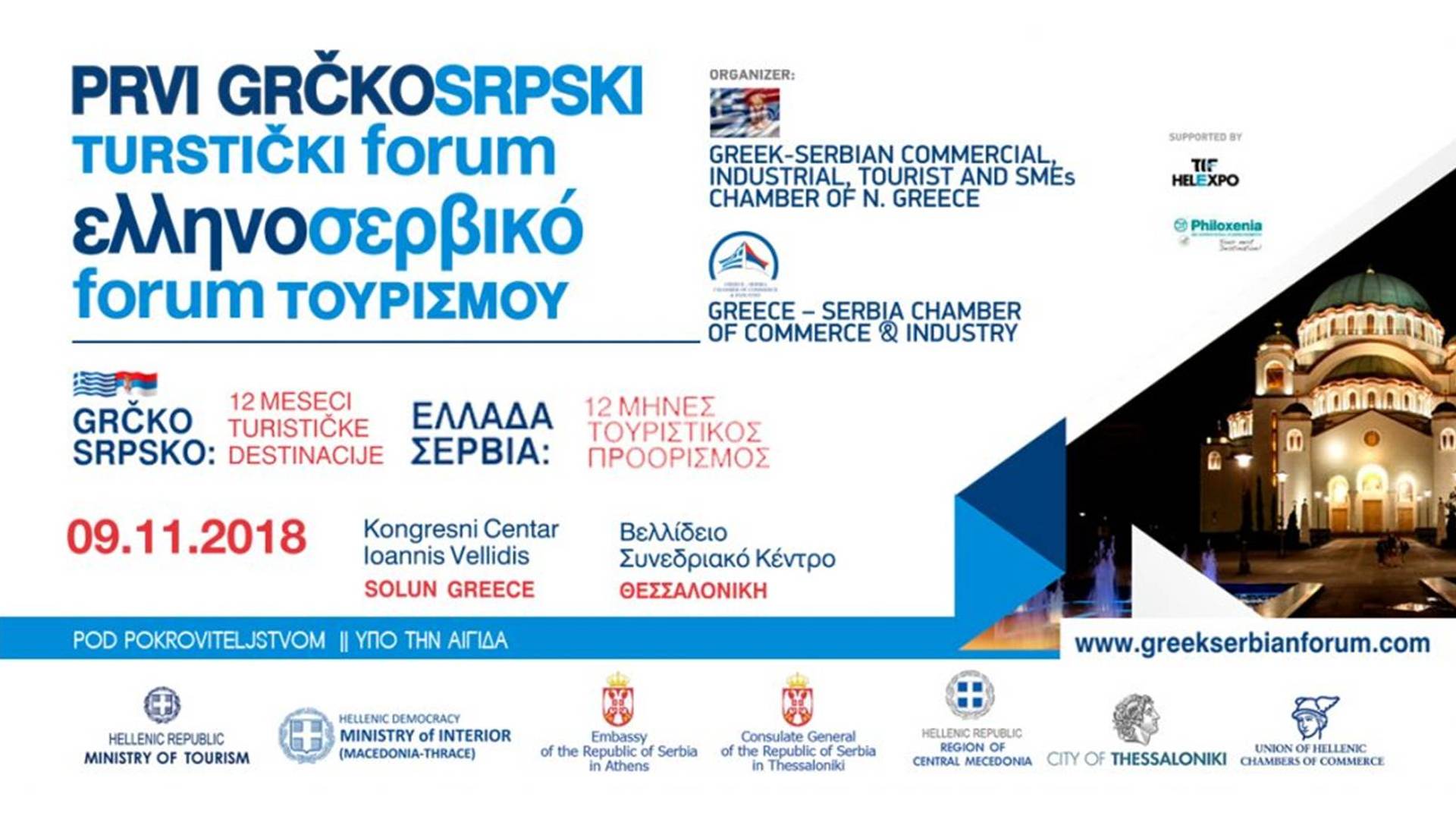
    Koumentakis & Associates Law Firm participated in the 1st Hellenic- Serbian Forum for Tourism, organized by the Hellenic-Serbian Chamber of Commerce, Tourism, Industry and Business of Northern Greece and by the Hellenic-Serbian Chamber of Commerce in Vellidio Conference Center.

    In the forum, held on November 9, titled “Greece – Serbia: 12 Months Tourism Destination”, Mr. Petros Tarnatoros, Senior Associate of the Firm, was coordinator in Panel 1, attended by Mrs. Liiljana Alajebogovic, Danijela Mirjanic, Ana Dudukovic, representing the tourist organizations of Belgrade, Savski Venac and Cukarica respectively.

    The Tourism Forum was widely recognized and 97 tourist agencies and agents from Serbia and 135 from Greece participated in it. At the center of the forum were the possibilities and opportunities for increasing the tourist flows between the two countries throughout the year as well as the development of cooperation in different forms of tourism, educational, scientific, religious and athletic.

    The Forum was welcomed by the General Secretary of the Ministry of Tourism, Mrs. Eurydice Kournetas, the General Consel of the Republic of Serbia in Thessaloniki, Mr. Sinisa Pavic, the CEO of TIF Helexpo, Mr. Kyriakos Posrikidis, the representative of the Hellenic-Serbian Chamber of Northern Greece in Serbia, Mr. Milivoje Miletic, the President of the Vojvodina Chamber of Commerce and Industry, Mr. Bosko Vucurevic and the President of the Republika Srpska Chamber of Commerce and Industry , Mr Borko Djuric.

    The General Secretary of the Ministry of Tourism, Mrs. Eurydice Kournetas, announcing the opening of the Forum, referred to the dynamic opening of Greece in recent years in Serbia with the aim of strengthening tourist cooperation. Particularly she said that “Serbia is a dynamic market, as well as a favorite destination for Greeks. In the past two years there has been a double-digit increase in tourist arrivals from Serbia to Greece, which remains the most popular holiday destination for Serbian tourists”.

    In his greeting, the President of the Hellenic-Serbian Chamber of Northern Greece, Mr. Konstantinos Georgakos, said “We need and want Greece to become a destination for 12 months for the Serbs. We need and want Serbian visitors to experience the other beauties of Greece. We also want Greeks to be first in traffic in Serbia”.

    Representatives of tourism organizations in Serbian regions and municipalities presented tourism destinations such as Vojvodina, Novi Sad, Nis, Belgrade and the municipalities of Cukarica and Savski Venac, while the representative of the Hellenic-Serbian Chamber of Northern Greece in Serbia Mr. Milivoje Miletic as well as the President of the Vojvodina Chamber of Commerce and Industry, Mr Bosko Vucurevic, spoke about the bilateral cooperation.

    At the 1st Hellenic Serbian Tourism Forum, apart from Mr. Tarnatoros, who was coordinator of Panel 1, Koumentakis & Associates Law firm was represented by Konstantinos Cornilakis, Partner and Petrini Naidou, Senior Associate.

    Koumentakis & Associates Law Firm has significant experience and expertise in the sector as a Legal Consultant, or in areas such as Insurance Law, Regulation, Labor Law or Contracts.


    [/vc_column_text][/vc_column][/vc_row][vc_row][vc_column][vc_text_separator title=”Gallery” border_width=”3″][/vc_column][/vc_row][vc_row][vc_column][vc_images_carousel images=”36411,36407,36403,36401,36399″ img_size=”full” speed=”6000″ slides_per_view=”3″ hide_pagination_control=”yes”][/vc_column][/vc_row]

  • “Vertical Agreements” And Free Competition: The Risks For Companies

    “Vertical Agreements” And Free Competition: The Risks For Companies

    [vc_row][vc_column][vc_column_text]

    Recently there were published, two decisions of the Competition Commission, following an ex officio investigation in the production and placing on the market of margarine and butter. By virtue of these decisions heavy fines have been imposed on the companies involved, which also cover almost the whole of the relevant market, for illegal “vertical agreements” with their distributors.

    Vertical agreements are the agreements among undertakings operating at different levels of the production or distribution chain (e.g. producer – wholesaler or retailer – distributor). Unlike horizontal agreements (which mean agreements among competitors), vertical agreements are not considered illegal per se under antitrust laws. Thus, they are not exempt from national and European legislation to protect free competition.

    The conclusion (even tacitly) of vertical agreements on terms that unlawfully restrict competition, raises heavily fines (up to 30% of the company’s gross annual revenue from the products concerned by the infringement – cumulatively for each fiscal year with an infringement).

    dikhgoriko-grafeio-koumentakis-kai-synergates-law-firm-

    Here are the “risky” terms that most commonly appear in similar agreements:

    (a) Resale Pricing

    Often, companies want to determine the sales prices at which the distributors resell their products. Such an (explicit or “covert”) contractual term is not permitted because it, definitely, restricts intrabrand competition and gives rise to sanctions.

    The justification often put forward by companies is both well-known and serious: the introduction of a single resale price precludes the possibility of selling products at lower cost (in order to avoid actions falling under Antitrust law). But it has, rightly, been rejected by the case law.

    Only the recommended or maximum value reference is allowed. Provided, however, that there is no commitment from distributors to meet them.

    (b) Geographical Restriction of Sales 

    Often a ban on sales by the distributor to customers outside the specific geographical area assigned to it is agreed. What is critical here, is the distinction between active and passive sales.

    It is considered permissible to prohibit active sales (i.e. sales requiring the active customer approach on the part of the distributor) outside the area reserved exclusively by the producer company. Instead, the distributor should always remain free to conduct passive sales (i.e. responding to customer’s spontaneous approach) even outside its exclusive area.

    (c) Restriction On Competition

    The non – competition clause is permissible only if its duration does not exceed five years and the market share of each party does not exceed 30%. If these conditions are not met, the relevant clause is examined on a case by case basis.

    The European legislator has recorded all the above terms as “hardcore restrictions”, the existence of which, in agreements between a company and its distributors, is considered illegal.


    Conclusion: It is crucial that prior to developing a company’s commercial policy on the vertical agreements that it is interested in entering into with distributors-wholesalers-retailers, it should be preceded by close cooperation with the legal counsel of the company. It seems to be the only way to avoid the risk of imposing severe fines that may even threaten the very existence of the company.


    Konstantinos Kornilakis
    Partner


    Υ.Γ. The article has been published in Greek, in MAKEDONIA Newspaper (November 11, 2018).

  • Blockchain: a revolution in safety

    Blockchain: a revolution in safety

    [vc_row][vc_column][vc_column_text]

    Blockchain is one of the most promising new technologies of the future.

    Blockchain has been around for quite some time now, but the markets only became aware of this technology because of the “bitcoin madness” let’s call it.

    Blockchain is the technology that, until this day, is mostly used to facilitate the creation and movement of cryptocurrency from one individual to another.

    In this article we will approach the matter theoretically and refrain from making references to the actual technical parts. We will try to explain the concept that is blockchain by approaching the subject only from the view of financial transactions.


    Without Blockchain

    In order to make a transaction in an environment other than blockchain you most likely have to go through a third party that both you and your counterparty trust. Don’t think about it from the perspective of technology: black screens and white signs only programmers with black T-shirts can read.

    Let’s say you want to transfer a sum of money; to do so you have to order a third party to make the transfer for you. That third party will most likely be a bank, since till this day in the West very few people can envision a world where not banks but other entities will be holding their money. In Asia, on the other hand, Alipay and WeChat have a huge chunk of the market of money in their role as the third party in most everyday financial transactions.

    In any case, entities (banks or other) that hold money for or receive money from persons are selling the service of transferring money. To be more precise after these entities confirm that the sender of the payment has available funds they identify the receiver of the payment and deposit the money in its account, while withdrawing the same sum from your account. But of course, this service costs. At the same time, depending on the specific banks involved in the process and the countries they reside in, this transfer can take a few days to go through.

    So now we have two problems, both resulting from the involvement of the third party/intermediary: (i) there is a fee owed to that third party and (ii) it takes time for the transfer to actually go through.

    This is where blockchain comes in.


    The innovation of blockchain

    Blockchain resembles a database. Of course that, on its own, is not revolutionary. The innovation is that, while databases have traditionally been centralized, blockchain is decentralized. This means that there has until now always been a need of a “central authority” (a third party, as described above) recording and verifying data transactions happening on those databases. This is not the case with blockchain.

    The need for third parties to intermediate transactions has until now seemed like the only way: parties who wish to transact cannot blindly trust each other. Thus, a need for verification/insurance from a prestigious third party emerged.

    But what if the transaction had no risk at all? What if the verification of data was automatic? What if there was a way to ensure that even if the slightest of the data represented by one of the parties did not check out, the transaction would be automatically blocked and no risk regarding what was communicated would be assumed?

    What blockchain does is exactly that.


    The Mechanics

    As promised, a visualization of blockchain technology:

    (a) Blocks

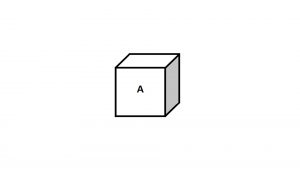
    Each block contains a single piece of information, in the form of a code. That code gives a specific ID to each block. To better understand it, let’s say that code is a letter of the alphabet. In this case, one block would contain the letter A.

     (b) Chain (chainm of transactions)

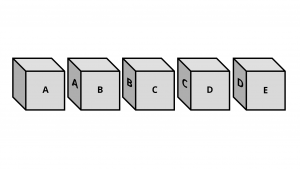
    Blockchain consists of a series of blocks, each one containing a single piece of information on the “inside”, and ID and the “IDs” of the blocks that come before and after them on the sides “touching them”, like so:

    This “function” makes sure that no one can hack the code contained in blocks, because if you hack one block (which would on its own take a ridiculous amount of time), the ID of that block would change (since the IDs of blocks depend on and adjust to the code in the block). So if you hacked Block B, it would no longer be called B. But Block C would still witness that block B should come before it. Now if you hacked block in order for it to witness that not Block B, but the block with the new ID (taken after block B was hacked) was the one that came right before it, then the name of block C would change and so on…


    For a blockchain to function (for a transaction to be valid, as we will see below), the chain has to at any point verify itself.

    One might say that you could try and hack all the blocks in the chain and all the copies of the chain (see below), but, with blockchain technology being as strong as it is today, there is not enough time and computational power in the world to do so.

    (c) Introducing a different way to record transactions.

    Those chains of blocks are much like a ledger in accounting. They record all transactions, all debits and credits. A simplified example would have as follows:

    1. X has 10 (Block A)
    2. Y has 2 (Block B)
    3. X gives 10 to Y (Block C)
    4. X has 0 (Block D)
    5. Y has 12 (Block E)

    A blockchain can simultaneously tell us how much (money) there is and where it is (who has how much). So it truly does not matter what is represented by any party that wishes to transact. We do not have to trust anyone regarding the truthfulness of any representations -not someone we know or don’t, not a third party. We do not even have to trust blockchain. Anything recorded in a blockchain is a fact.

    Any transaction not verified by blockchain is not valid. Anything not validated do not actually happen (technology will not allow an invalid order for a transaction to create and add a new block in the blockchain). Those safeguards result in creating the safest, till this day, environment to transact in.

    In our example, if X tried to give 20 to Y instead of 10 in step one above, blockchain would not allow the transaction to go through, simply because X does not have 20 to give.

    But how can blockchain know? Well … it does not exactly know. But thanks to the principles following, all persons in the network do know and their knowledge alone ensures that the blockchain is valid and protected, through a distributed and decentralized system, which up until this day seems unhackable.


    The principles behind blockchain

    All the essence of blockchain, what renders it the most secure environment to transact in, is its principles:

    (a) Open Ledger Principle

    Everyone in the environment of blockchain, under circumstances, can see all the data (open and public information), but they cannot actually make up the information, because they can only have bits and pieces of it. Thus, everything is public and private at the same time!

    (b) Distributed Ledger Principle

    The open ledger principle on its own would not go far without the distributed ledger principle. The latter ensures that anyone who wishes can hold a copy of the ledger (chain of blocks).

    (c) Shared Ledger Principle

    When you wish to make a transfer through blockchain, you have to make that intention of yours public. The network will immediately see the declaration of your intention. At this point, the transaction is still unvalidated, and thus not yet part of the blockchain – it has not yet created a new entry in the ledger, a new block, so it has not yet taken place. Blocks are created and added to the blockchain only through mining.

    All the above principles can only reassure anyone who chooses to transact using blockchain. Just imagine how much easier it would be to hack a central authority (eg a bank), than the thousands that may have a copy of the ledger (hack all the blocks of the blockchain and all the copies of the blockchain held by all the peers).


    Mining

    Anyone can mine. Miners are persons that choose to hold a copy of the ledger. What they do is compete amongst each other (amongst those who hold a copy of the same chain) in order to be the first to validate a transaction and put it in the ledger (make a new entry – add a new block).

    Mining comes in two steps:

    • Validation: miners essentially check that a transaction is valid according to the data already validated and in blocks.
    • Connecting that new block to the chain: to connect a new block miners have to “find a key” that will mathematically allow them to add that new block. Imagine it like solving an extremely complicated riddle by using computational power.

    The first to validate a transaction and add a block to the blockchain gets a financial reward.


    Application of blockchain

    The very concept behind blockchain technology is unconceivably groundbreaking. Theoretically, if applied, it will eliminate the need for any middle man, including banks, even governments, while simultaneously ensuring that transactions are as secure as can be!

    Many governments have felt uncomfortable with all those changes happening. Some more than others: China has “banned” the trading of bitcoin altogether.

    With bitcoin having almost reached USD 20.000 per bitcoin at its peak, billions of dollars have exchanged hands without anyone having any record of those transactions, without any banks having gotten any fees, without governments having any control over the exchange rates in order to protect their currencies. And all that happened because just one application of blockchain became popular!

    Recently, the World Bank launched a new debt instrument (bond-i) that is blockchain operated. In Cyprus big law firms accept payment in bitcoin, and the relevant laws are in the making.

    Blockchain is not a technology for the dark web, but a technology for all of us. Today.


    To that new reality that blockchain is leading us to we all (and of course businesses and lawyers) have to adapt.

    And soon!

    Lida Koumentaki
    Junior Associate


    P.S. A shorter, Greek version of this article has been published in MAKEDONIA newspaper (November 4, 2018)

  • Cyber and Internet Risk Insurance

    Cyber and Internet Risk Insurance

    [vc_row][vc_column][vc_column_text]

    Cyber and Internet Risk Insurance: The Importance of every Company and the Role of the Legal Advisor

    Coverage of the risks arising from the implementation of e-services and from the use of the internet constitutes a new insurance product. This product is expected to show strong growth in the coming years due to the continued development of technology. Further use of the internet and of social media, as well as the development of cloud computing, are parameters that highlight the importance of this new product. In addition, its aid factor is the very low – in proportion to the use and dissemination of Internet services – the number of companies and businesses that currently have insurance against this particular category of risks.


    The Necessity of Cyber and Internet Risk Insurance

    It has now been accepted that the development of technology as well as the wide use of the internet, form the ground for the development of criminal behavior, either through negligence or fraudulent one. Such criminal behavior is found both in the professional field and in the context of the privacy of citizens. Indeed, they are growing daily, as they are favored by the loopholes in the regulation of internet use. They are also favored by the corporate entities’ low insurance coverage of cyber and internet risks.

    In this context, it should also be borne in mind that today:

    (a) the protection of personal data and privacy is a fundamental human right, while

    (b) a rigorous legislative environment is built both in the European Union and particularly in Greece on the use of the Internet and cyberspace and, more specifically, on the protection of the personal data of persons and users of electronic services.

    However, it is generally recognized that the gap between e-reality and its legislative/ regulatory environment constitutes an additional risk for businesses. E-reality is changing, evolving and growing rapidly, while legislative initiatives attempt to follow cyber developments late and often incomplete.

    Consequently, there is no doubt that insurance against cyber and internet risks is now a necessity. This necessity concerns large companies, which are major targets for malicious actions. It also concerns smaller companies, which are more vulnerable to malicious actions and more vulnerable in dealing with the damage that can be caused by such.


    Choosing the Right Insurance Product

    In this corporate environment of the constantly evolving and changing e-reality, it is crucial to choose the appropriate insurance product against the specific category of risks.

    This choice can no longer be made based on the less expensive premium. Instead, this option should be part of an integrated corporate policy. This policy should aim to tackle offending/criminal behavior that have to do with the use of the internet and e-services. The concern for both the planning of an integrated corporate response and of the choice of the appropriate insurance product can only be the responsibility of the legal entity’s legal advisor.

    However, generally speaking, each company has to plan its reaction to cyber and internet risks and consequently to choose the appropriate insurance product, taking into account its object, the degree of penetration of electronic services in its operation and the type and the range of personal data it processes.


    The Insurance Market in Greece

    While checking the insurance programs offered by the insurance companies operating in Greece, one shall find wide variations and discrepancies in the coverage against cyber and internet risks. Specifically, it is noted that the largest insurance companies in Greece:

    (a) either do not provide insurance plans for such risks,

    (b) either includes coverage against specific risks within the framework of the electronic equipment insurance and as an optional and supplementary coverage of business insurance, i.e. not providing a specialized insurance program,

    (c) or have introduced specialized and innovative insurance programs, which combine insurance against these insurable risks with the provision of legal, technical and advisory services, forming a single package.

    It is therefore clear that, as far as tackling the dangers arising from the deployment of e-services and the use of the internet, the tools do exist.

    The company’s responsibility towards its entity, its partners or shareholders, its employees, and third parties is to choose the most appropriate tools. Additionally, the company is required to incorporate these tools into its Cyber Risk Management plan to address these breaches. Accordingly, the responsibility of the lawyer – legal counsel of the company is the evaluation of the offered insurance products and the assistance in choosing the optimal solution. In addition, the duty of the lawyer – legal counsel is also the maximum possible safeguard of the company through the control of the insurance contract. Finally, in the event of the insured risk occurring, the duty of the lawyer – legal counsel extends to the formation of a substantiated claim of the insured company for the fulfillment of the obligations of the insurance company.


    Petros Tarnatoros
    Senior Associate


    Υ.Γ. The article has been published in Greek in MAKEDONIA Newspaper (October 27, 2018).


  • E. Mandoulides Schools Stand out As Microsoft Showcase Schools

    E. Mandoulides Schools Stand out As Microsoft Showcase Schools

    [vc_row][vc_column][vc_column_text] Mandoulides Schools have been announced for a consecutive year by Microsoft as Showcase School 2018-2019, due to the best practices they use to harness technology in the educational process and to provide a personalized teaching.

    Mandoulides Schools, stood out for their remarkable and valuable work, which aims to integrate technology and innovation into the modern classroom. In particular, they have succeeded, through Microsoft’s innovative mobile and cloud technologies, to enhance the learning process by offering their pupils new and more personalized ways of learning by providing them with the skills of the 21st century.

    In this year’s announcement, Microsoft has selected a photo of Mandoulides Schools. Click on the photo to view the original article.

    Among the Leading Schools in the World

    With their nomination as Microsoft Showcase Schools, the schools become part of an exclusive community made up of 400 leading schools from around the world. Participation in the program enables, through their close collaboration with Microsoft, to further upgrade their leadership in the application of innovative practices, through their interaction with consultants from Microsoft and with international mentors, but also through sharing experience and know-how with the other schools involved in the community.


     Microsoft Showcase Schools

    The schools participating in this community are distinguished educational institutes with a leading vision for change and with an innovative teaching environment in which students promote innovative actions and build new capabilities and skills.

    Also, Microsoft Showcase Schools can take part in Microsoft product testing as well as in company pilot projects on digital reforming of the educational process. In addition, for the schools involved, the program is a unique opportunity to promote their pioneering work, while giving school teachers an impetus to their professional development.

    This recognition gives Mandoulides Schools unique opportunities to collaborate with other schools and educational institutions worldwide to foster fruitful collaboration in innovative projects. It also gives the opportunity to participate in a community of pilot schools, while teachers have access to professional development programs that focus on their leading educational profiles.


    Microsoft Showcase Schools – Education Transformation Framework

    The Schools had a dynamic presence at Microsoft’s top event in Dublin!

    Dr. Maria Tsitiridou, Head of the Academic & Educational Sector of Preschool and Primary Education of the Schools, and Mrs. Maria Papadopoulou, New Technologies Coordinator of the School, took part on September 28 and 29 at the Microsoft Showcase Schools Meeting in Dublin.

    During the Meeting, the pillars of the vision and concerted efforts of these schools for a modern, novelty and innovative educational system were discussed. The Education Transformation Framework is based on four key “pillars”:

    • ​Leadership & Policy
    • Modern Teaching & Learning
    • Intelligent Environments
    • Technology Blueprint

    In cooperation with Microsoft, these schools open a new chapter on integrating technology into the teaching process, providing students with attractive learning experiences. Their aim is to be a lighthouse for the technological transformation of the other schools.

This site is registered on wpml.org as a development site. Switch to a production site key to remove this banner.