Blog

  • Minority Shareholders. Part C: The right of the majority to buy-out the minority

    Minority Shareholders. Part C: The right of the majority to buy-out the minority

    Minority Shareholders

    Part C: The right of the majority shareholder to buy-out the minority shareholder

    1. Preamble

    I have always been a strong believer that “Justice is nothing but the advantage of the stronger”. I could easily claim this quote’s paternity if not: (a) Plato had not beaten me to it (just twenty-four centuries ago) in his work Republic (:“Listen—I say that justice is nothing but the advantage of the stronger”) and (b) if that quote was not all over the internet.

    Plato, as proven through the course of history, wasn’t wrong. This specific position Plato took has proven to be true in general – in inter-state relations, in exercising public authority, in family and personal relations… the list goes on! Especially when it comes to intra-company relations, this general principal has even been endorsed by legislators. An example could be the power given to the majority over the minority. Notwithstanding the many restrictions of that authority introduced in the Greek S.A. law, the great power held by the majority is without question.

    The opinions of the minority and the positions it takes are not always attractive. Sometimes, not even tolerated. Especially when a company is (or appears to or is anticipated to be) flourishing or when the minority is trying to force its rights (or the rights it thinks it has).

    The shareholders holding, on their own or with others, between 50% and 95% of an S.A.’s shares cannot simply decide that “it’s high time we rid of the minority shareholders”. There are of course ways to act -within or outside the law- in such a manner that could push to that direction. But if a shareholder is holding a percentage of 95% or higher over a company’s shares, they do have the right to directly exercise all the rights the Greek law gives them, in article 47 of law 4548/2019.

    We have already referred to the (legal) request a minority shareholder can make to be bought-out of a company by either the company itself or by the majority shareholder, as well as the relevant requirements and procedure (read related articles “Minority shareholders. Part A: The claim of redemption of their shares by the S.A.” and  “Minority shareholders. Part B: Claim for buy-out by the majority shareholders“). In this article, we will study the obligation imposed on the minority shareholder to be bought-out by the majority shareholder (to be squeezed out). This provision seems and is directly opposing to the principle of freedom of contract (article 361 of the Greek Civil Code) and the right to economic freedom, as stated article 5 paragraph 1 of the Greek Constitution.


    2. The right of the majority shareholder to buy-out the minority shareholder

    2.1 The requirement for the majority shareholder to be holding at least 95% of the company’s shares

    In the case of a private S.A., (as far as public S.A.s are concerned, the rules of public offerings apply, supplemented by the Greek law of S.A.s), the first and most crucial requirement refers to the percentage over the company’s shares held by the majority shareholder. The relevant provision of the Greek law of S.A.s (article 47 of law 4548/2018) strictly refers to the shareholder holding at least 95% of the company’s shares. Needless to say, this percentage of 95% is calculated as a percentage of the nominal value of shares held over the overall nominal value of all the company’s shares. It is irrelevant whether a shareholder is holding 95% or more of the ordinary or of the preferred shares of the company. What is only important is the percentage of the company’s shares held.

    2.2 Requirement for at least 95% of the company’s shares to be held by one shareholder

    The right to force a buy-out on a minority shareholder lies only with the shareholder holding at least 95% over an S.A.’s shares who accumulated that percentage after the company was established. In case a majority shareholder covered from day one (at the stage of the establishment of the S.A.) at least 95% of the company’s share capital is not entitled to force a buy-out. In other words: the majority shareholder who set up the company and at that time was holding at least 95% of the company’s shares is not entitled to force a buy-out over the minority shareholder at any time.

    It is important to stress that this specific provision provides only one shareholder with the right to force a buy-out. So we have to rule out the possibility of a cooperation-occasional or not- amongst two or more shareholders in order to gather up amongst all of them the percentage of 95% of a company’s shares in order to force a buy-out on the minority shareholders.

    Let’s remember what happens when you take a look from the “other side”, where non-such restriction applies: the minority shareholder holding 5% or less of the company’s shares has the right (article 46 paragraph 1) to request to be bought out by the shareholder holding at least 95% of the company’s shares. As we already examined (see related article), when calculating the percentage held by the majority shareholder, we count in the shares held by their related parties (ascendants, descendants, spouses, live-in partners and related legal entities). But in the case we are examining in this article, the law requires for only one shareholder to be holding at least 95% of the company’s shares.

    We of course have to note that when the majority shareholder is a legal entity (e.g. a holding company or any other kind of company with more than one shareholders) holding at least 95% of the company’s shares, this legal entity will be considered as one shareholder, no matter how many persons are holding said shareholders shares. In that same spirit, when calculating the percentage held by the majority shareholder, we have to count in the shares that they are holding as a security for their claims, but whose ownership they have.

    2.3 Time Limit

    The right given to the majority shareholder (holding at least 95% of the company’s shares) to force a buy-out is subject to a five-year limitation period. This five-year period starts the moment the majority shareholder accumulates at least 95% of the company’s shares. After the lapse of this five-year period, the aforementioned majority shareholder no more has the right to force a buy-out on the minority shareholder.

    Needless to say, the law does not force the majority shareholder to notify (when the five-year time starts counting, that is when:) the moment the percentage they hold over the company’s shares reaches or exceeds that of 95%.

    2.4 The procedure leading to the buy-out

    The majority shareholder that wishes to buy-out one or more minority shareholders has to submit the relevant request to the competent court (article 47 par. 2 of law 4548/2018). The latter will rule whether the requirements set by law are met. If the majority shareholder’s action is upheld, the court will rule on a just and equitable price per share, as well as on the specific terms the buy-out will be implemented. In order to determine the price per share, the court will take into consideration the value of the company. The majority shareholder will provide the court with an independent expert report (article 47 par. 2 and article 17 par. 3 of law 4548/2018) which in most cases is conducted by either two chartered accountants or an audit firm. When conducting the report, said experts are given access to all the company’s financial data by the company’s B.O.D.. This expert report, although required by law, does not bind the court.

    2.5 The obligation to deposit the financial compensation in a Credit Institution

    Following the publication of the ruling of the court and in case the request filed by the majority shareholder is allowed, the latter has to deposit the financial compensation owed, as determined by the court, to a Credit Institution in the name of the shareholder being bought out. Said deposit will take place only after their identities of the beneficiaries are confirmed. In case six months after said deposit go by without them (the shareholders being bought out) withdrawing their compensation, the Credit Institution reserves the right to “transfer” the sum to the Deposits and Loans Fund.

    2.6 Public Declaration

    In order to exercise their right to buy-out the minority shareholders, the majority shareholders have to make a public declaration (published on the HELLENIC BUSINESS REGISTRY). This declaration will have to include (article 47 paragraph 4):

    • The company’s and majority shareholder’s information, as well as the percentage of the company’s shares the latter is holding.
    • Information regarding the court’s decision -its data and ruling
    • Information regarding the Credit Institution in which the financial compensation set by court will be deposited and
    • Any requirements set in order for the minority shareholders to withdraw their compensation.

    2.7 The Obligation of the majority shareholder for a public declaration or personal notification of the minority shareholders.

    The transfer of shares from the minority shareholders does not require, in this case, any written agreement. This specific transfer can be completed in two, possible, ways. The choice is left to the discretion of the majority shareholder. Specifically:

    • The abovementioned (under 2.6) announcement of the majority shareholder is subjected to publicity (article 47 paragraph 4). Starting from the day of the announcement (in the G.E.MI. (GENERAL COMMERCIAL REGISTRY), the ownership of the shares is automatically transferred to the majority shareholder. The only right the minority shareholder maintains from the shares, following said announcement, is to obtain the compensation for their buy-out, as determined by court.
    • The publicity of the discussed (under a) announcement, can be substituted by personal notifications of the majority shareholder to each one for the minority shareholders being bought-out (preferably served to the latter by a bailiff). The automated passing of ownership of the shares takes place after the second personal notification to the minority shareholder (which is done in no more than fifteen days after the first one). A third personal notification of the minority shareholder is also required, referring to the first to.

    2.8 Is it possible to delay the enforcement of the judgement for the buy-out of the minority shareholder’s shares?

    The law explicitly states (Article 47 par. 7), that it is not possible to delay the enforcement of the ruling allowing the application of the majority shareholder. Any appeals before the court, request of cancellation, reform or application initiating third-party proceedings, will not result in any legal obstacle or delay to the transferring of the ownership of the shares to the majority shareholder, in exchange for the compensation set for the buy-out.


    3. In Conclusion

    Plato has already spoken, as mentioned in the introduction, for the advantage of the stronger and the protection provided to them by law. No need to repeat his opinion on the subject.

    It is true that the power given to the majority shareholder (who holds at least 95% of the S.A.’s shares) to buy-out the shares of the remaining minority, is primarily intended to serve their (the majority’s) interests.

    It is most likely, though, that this provision serves the minority’s rights and claims as well. And that is because it provides the shareholders with a (objectively fair) price for shares that in reality (a) provide them with limited rights, (b) could, most likely, only be sold to the majority shareholder and after having a court force the latter to buy them, with the minority shareholders paying for the judicial cost this time.

    We should accept that this specific procedure will, most likely, have positive results on the S.A. as well. Restoring the, possibly, severed unity and peace amongst the shareholders cannot have negative results in perusing the corporate goals.

    But let’s not be delusional: our experience has shown that the minority is treated, in most cases, as annoying. It doesn’t even have to act in an annoying manner -even stating an opposing to that of the majority opinion will do. A century ago, in “The Trial” by Kafka, it was stated the rather roughly put but otherwise very real statement that “everyone has the right to their own opinion, as long as they agree with me”: more or less, this regards all of us.

    We can safely assume that this provision is one of the safest (legal) ways for the majority shareholder to rid of those opinionated minority shareholders and establish their monarchy!

    stavros-koumentakis

    Stavros Koumentakis
    Senior Partner

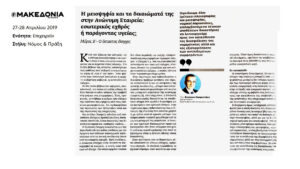
    P.S. A brief version of this article has been published in MAKEDONIA Newspaper (May 19th, 2019).

    εξαγορά μετοχών μειοψηφίας

  • Minority Shareholders. Part Β΄: Claim for a buy-out by the Majority Shareholder(s)

    Minority Shareholders. Part Β΄: Claim for a buy-out by the Majority Shareholder(s)

    Minority shareholders.

    Part Β΄: Claim for a buy-out by the Majority Shareholder(s)

    1. Preamble

    It is redundant to say that in any country that respects its laws, the principle of freedom of contract stands strong. In Greece, this principle is introduced in our legal system in article 361 of the Greek Civil Code (: “For the establishment or modification of any legal obligation a contract is required, unless the law provides otherwise”). This principle is based on article 5 paragraph 1 of the Greek Constitution, which refers, amongst other things, to the [right to] economic freedom.

    Specific aspects of the principle of freedom of contract are the freedom to enter (or not) into an agreement, as well as the freedom to choose what said agreement (should one choose to enter into one) will provide.

    According to this, no one is obligated to enter into an agreement (even more so in a predefined one), unless a specific law “provides otherwise”.

    Respectively, when it comes to S.A.s,  no one is obligated to buy the shares of any minority shareholder -especially when the latter’s share is so small that it has no real value in terms of assisting to the formation of the so needed majority. In this case, it is highly likely that nobody will be interested (or nobody will let show they are interested) to purchase such kind of a minority shareholding.

    Amongst his other quotes, the actor and director Clint Eastwood has infamously said that “if you want a guarantee, buy a toaster”. If the minority shareholder decides that their investment is not profitable or even problematic, they cannot just simply return it for a refund: shares are not toasters. Shares are not covered by guarantees, as are toasters.

    A safe assumption could be that, at least at a first glance, no one can be obliged to acquire a minority share package, unless some specific requirements are met…

    There has already been a reference to the legal claim a minority shareholder may have against the company, for the latter to buy them out, as well as all the relevant requirements and procedures (read related article). In this article, we will mainly focus on a minority shareholder’s possible claim against the majority shareholder to buy them out.


    2. The right of the minority shareholders to request a buyout by the majority shareholder

    The requirement for the minority shareholding to be holding shares that do not exceed 5% of the total of the company’s shares

    In the case of a private S.A., (as far as public S.A.s are concerned, the rules of public offerings apply, supplemented by the Greek law of S.A.s) the main requirement is in regard of the percentage of the minority shareholding. The Greek law of S.A.s (article 45 paragraph 1 of law 4548/2018) is strictly limited to shareholders holding a maximum of 5% of a company’s shares. This percentage is calculated as a percentage of the nominal value of the shares the minority shareholders hold on the overall total of the total nominal value of all the shares of the company. It is irrelevant whether a shareholder is holding 5% or less of the ordinary or of the preferred shares of the company. Only the percentage of the company’s shares held matters.

    Furthermore: Minority shareholders holding a percentage higher than 5% of the company’s shares are not entitled to require a buy-out by any shareholder. Not even for a sum of shares equaling to less or up to 5%.

    This provision seems fair. Most of the minority rights recognized under Greek law are recognized to the minority shareholders that are holding more than 5% of a company’s shares. If a shareholder is not holding 5%, their protection seems, and is, extremely limited.

    The requirement for at least 95% of the company’s shares to be held by one (?) shareholder

    The majority shareholder -of 95% or more, a percentage gathered after the company was set up- has (originally) the obligation to buy-out the minority shareholder. In case the minority shareholder accepted at the stage of the very establishment of the company that they would have a percentage lower to 5%, the law assumes that they also consciously accepted that they would have limited protection under the law. Because of that assumption, Greek law has chosen not to “force” the majority shareholder to buy-out such a minority shareholder.

    It is noteworthy that in calculating the required 95% of the shares held by the majority shareholder, one must also count in the shares held by the parties related to them. The legal entities characterized as “related parties” to the majority shareholder and whose shares are considered as shares of the majority shareholder when calculating the percentage of shares the latter is holding, are identified as such by article 32 of law 4308/2014. The persons characterized as “related parties” to the majority shareholder and, again, whose shares are considered to be shares of the majority shareholder when calculating the percentage of shares the latter is holding, are identified as such by Appendix A of the aforementioned law. To be more precise:

    Regarding the related parties that are legal entities, article 32 of law 4308/2014 is extremely detailed. It is redundant, in the context of this article, to get into great detail. One general rule that would be useful to keep in mind is that related parties are generally considered to be the parent company and the subsidiaries of the majority shareholder or of a company that is related to the majority shareholder. It should also be noted that those legal entities that choose to or legally have to prepare consolidated financial statements with the majority shareholder or with related to the latter legal entities are also related parties to the majority shareholder.

    Annex A of law 4308/2014 instructs us in counting in shares held by natural persons- members of the majority shareholder’s close family- when calculating the latter’s share over the company. According to this law, such persons are the majority shareholder’s ascendants, descendants, spouses, and live-in partners.

    Time Limit

    The right given to the minority shareholder (holding a 5% or less of the company’s shares) to request a buy-out is subject to a five-year limitation period. This five-year period starts the moment the majority shareholder (along with their related parties) is holding at least 95% of the company’s shares. After the lapse of this five-year period, the aforementioned minority shareholder no more has the right to request a buy-out by the majority shareholder holding 95+% of the company’s shares.

    The shareholder obligated to buy

    Article 45 of law 4548/2019 refers to the obligation of the majority shareholder to buy-out the minority shareholder holding less or equal to 5% of the company’s shares. As already stated, in calculating the majority shareholder’s share over the company (in order to determine whether they are holding 95% or more) one must also account in the shares held by related parties of the shareholder (legal entities or members of their family). In case there actually are related to the majority shareholder parties holding company shares, one should take it as a given that the related parties will be obligated to acquire the shares sold by the minority shareholder analogically to the company shares they hold prior to the buy-out. It goes without saying, these related parties will have to pay for the shares they are acquiring, at the price determined by the competent court. This approach seems the only logical one since anything else would disturb existing balance amongst the remaining shareholders.

    The procedure leading to the buy-out

    The minority shareholder that wishes to be bought-out has to submit the relevant request to the competent court (article 46 par. 2 and article 46 par. 4 of law 4548/2018). The latter will rule whether the requirements set by the law are met. If the minority shareholder’s action is upheld, the court will rule on a just and equitable price per share, as well as on the specific terms the buy-out will be implemented. In order to determine the price per share, the court will take into consideration the value of the company. In this case it is more than fair (as well as allowed by law) for a report to be requested by an independent expert regarding the value of the shares sold; In most cases, the independent experts that will provide said report to the court will usually be either two chartered accountants or an audit firm. This independent expert report will evaluate the arguments made by the opposing parties.


    3. In conclusion

    The protection offered to the minority shareholder holding a percentage of less than 5% of the company’s shares is extremely limited by law. To counterbalance this extreme risk exposure (and in contrast to the right to economic freedom and the principle of freedom of contract, as they are both stated and protected by the Greek constitution) the above-mentioned minority shareholder has the right to request to be bought out from the company by the company’s majority shareholder of 95% or more.

    The law does not force S.A.’s shareholders to notify the moment the percentage either they or their related parties hold over the company’s shares reaches or exceeds that of 95%. As a result, the minority shareholder has to be alert as for when their rights kick in, otherwise said minority shareholder on the one hand risks to miss their opportunity to exercise their rights to be bought-out altogether, on the other to fail to achieve a good price for their shares.

    As for the majority shareholder, they have every reason to avoid holding 95% of the company’s shares. If they succeed in doing so, they will be able to enforce onerous terms on the minority shareholder while negotiating a possible buy-out of the latter. Such a negotiation could easily start by reminding the minority shareholder of the infamous abovementioned quote by Clint Eastwood…

    stavros-koumentakis

    Stavros Koumentakis
    Senior Partner

    P.S. A brief version of this article has been published in MAKEDONIA Newspaper (May 12th, 2019).

  • Minority Shareholders. Part A: The Claim of redemption of their shares by the S.A.

    Minority Shareholders. Part A: The Claim of redemption of their shares by the S.A.

    Minority Shareholders.

    Part A’: The Claim for Redemption Of Their Shares By The Société Anonyme.

    The existence and exercise of minority rights – as described in an earlier article – “Minority and its rights in the Société Anonyme” and “Minority rights in the SA: the exceptional auditing” – are not always enough to achieve of the necessary balance in its (the minority’s) relationships with the company. Nor, in the end, in the company itself.

    Sometimes “divorce” seems necessary …

    The majority of shareholders exercising their voting rights are entitled (and rightly) to make critical decisions about the future of the company. Critical, in a logical sequence, also for the future of minorities. Sometimes even potentially damaging to the latter.

    What are these potentially harmful decisions? And, if they are taken, the minority shareholders remain unprotected? And under what conditions would it be possible to implement a “divorce” between the company and the minority shareholders?

    According to English actor Carrie Grant: “Divorce is a game played by lawyers”. And from this particular “divorce” they could not miss …


    Causes For The Claim Of Shares Redemption

    It is a fact that within the framework of democracy (and of the law of the Société Anonyme) the majority shareholders are the decision makers. Sometimes, however, these same decisions could be assessed as making it “in an obvious manner, particularly unprofitable” to retain the minority shareholders in the company (Article 45 par.1, section an of the l. 4548/2019). The assessment, of course, belongs to the minority shareholders themselves. The latter will exercise their statutory rights if they adopt this position.

    The Law on the SAs (Article 45 par.2) recognizes as potentially harmful to minority shareholders decisions concerning: (a) the transfer of the registered office of the company to another State; (b) the introduction of restrictions on the transfer of shares; (c) the change of corporate purpose and finally (d) any other event which, according to the company’s articles of association, activates respective rights of the respective shareholders. In the latter case, however, it is necessary to provide for a time limit for their exercise.


    The “Way Out” Of Minority Shareholders And The Relevant Conditions For The Shares Redemption Claim  

    In the event that any of the above events occurs, the law provides (significant) protection to minority shareholders: they are entitled to address to the competent court asking for the redemption of their shares by the company (Article 45 par.1: “redemption by right”-internationally known under the Anglo-Saxon term as sell-out). It imposes, however, a double condition on the applicants (and claiming to be protected): Firstly, there having been represented in the General Meeting which took the disputed decisions and, on the other, their opposition. Possible absence from the relevant General Meeting, voting in favor of the relevant decision or abstaining from the vote, it removes the aforementioned right (i.e. to appeal to the Court asking for the redemption of their shares). However, if a statutory provision refers to an event not related to a decision of the General Meeting, this (double) condition does not stand.

    The term within which “the injured” minority shareholder must “take action” – i.e. bring the claim and exercise his / her right – is three months from the completion of the amendment of the articles of association. This time limit applies in cases of transfer of the company’s registered office to another state, of the introduction of restrictions on the transfer of shares and the change of the corporate purpose. In the other cases provided for by the Articles of Association, the deadlines indicated therein shall apply.


    The Case Of Introducing Restrictions On The Transfer Of Shares

    The company’s interest requires that the company’s continuity be safeguarded. And this is sometimes, to a considerable extent, dependent on its shareholder structure. The introduction of restrictions on the transfer of shares sometimes proves to be crucial (refer to the article on Restricted Shares). The relevant provisions in the Articles of Association at the time of the establishment of the company appear to be a “sine qua non” element to ensure the relations between the shareholders and the achievement of the corporate purpose.

    In the vast majority of cases, unfortunately, such statutory restrictions are not provided for when establishing the company. When the need is identified subsequently, the majority shareholders are in fact able to impose the necessary statutory change. However, the minority shareholders are then (reasonably) entitled to request the redemption of their shares and, ultimately, their exit from the company. It is for the court to decide on the reasonableness of the request of the minority shareholders and, in particular, “if their stay in the minority becomes manifestly unprofitable”. In other words: minor restrictions on the transfer of shares could not justify meeting the request of minority shareholders.

    However, for the cases where the necessary restrictions on the transfer of the shares have been provided since the company’s establishment, there is no reason for the corresponding minority shareholders’ rights.


    The Case Of Modifying The Company’s Purpose

    A similar assessment will, of course, be made by the Court even if the minority shareholder complains (and exercises his/her rights) due to a change in the corporate purpose. It would reasonably be considered to be particularly unprofitable for the applicant to convert, for example, a holding company into a CD production company. On the other hand, it would not be possible to (severely) support the minority shareholder requesting the redemption of his shares from a (painless) expansion of corporate activities.


    The Court’s Judgment On The Claim For Shares Redemption

    The minority shareholder’s claim for the redemption of its shares by the company is assessed by the competent court (Article 45 par.4). The latter is to determine whether the conditions laid down by the law and the substantive merits of the applicant’s arguments are fulfilled. If the claim is accepted, the Court shall determine the fair and reasonable consideration (in exchange for the redemption of the minority shares) and the terms of payment. In determining the price, the value of the company is taken into account. It is logically expected (and not only legally permissible) to request a relevant expert report, which is usually carried out by two auditors- chartered accountants or an auditing firm. This expert opinion is also the one to evaluate both sides’ arguments.

    The court decision is always binding on the company (Article 45 par.5). In the event of the fault being breached within the time limit set by the court order, it may be decided the company’s dissolution.

    However, the judgment is not binding on the requesting shareholder. If the price to be determined by the court decision is not evaluated by the applicant as satisfactory, it is entitled to refuse to complete the relevant procedure (transfer of its shares to the company). In that case, of course, he/she is charged with the costs of the relevant proceedings.


    In Conclusion

    Coexistence in life is not always easy – possibly once and unacceptable. Respectively in business – much more when particularly important (sometimes) economic interests are at stake. The law recognizes the minority shareholder’s right to ask for “dissolution” and for “compensation” by the company when certain important conditions are met. It is, however, particularly important to stress that the importance of the Articles of Association is once again as distinct. Its provisions should either take place in a timely manner (i.e. when the company is established) or in a way that does not affect minority shareholders (unless the aim is precise to affect their rights) …

    There is no doubt that the specific legislation is a means of protecting minority shareholders. But as this divorce, as already mentioned, “is a game played by lawyers”, it is likely to become a weapon, important in the hands of the majority.

    Particular attention, therefore, in both the articles of association and the lawyers …

    stavros-koumentakis

    Stavros Koumentakis
    Senior Partner

    P.S. A brief version of this article has been published in MAKEDONIA Newspaper (May 5th, 2019).

  • Workshop on the New Law on the SAs At the Money Show 2019

    Workshop on the New Law on the SAs At the Money Show 2019

    [vc_row][vc_column][vc_column_text] On Saturday, April 13th, at the Hyatt Hotel, within the framework of the 30th Money Show 2019, a workshop on “Family Businesses in the New Business Environment” was held. The event was co-organized by Capital Markets Experts, the Institute of the Association of Greek Financial Managers (SEODI) and the law firm of KOUMENTAKIS & ASSOCIATES.

    In a packed room, those interested had the opportunity to listen to speeches on three different axes. More specifically, the President of SEODI referred to the role of the Ecumenical Director as part of a family business, Mr. Vasilios Margaris, founder and chief executive of Capital Markets Experts, referred to the necessity of entering a family business on the Stock Exchange, while Mr. Stavros Koumentakis, Senior Partner of KOUMENTAKIS & ASSOCIATES Law Firm briefly presented the new Law on Sociétés Anonymes and referred to its application in family businesses.

    Stavros Koumentakis highlighted the multiple business opportunities that the changes brought by the new Law on Sociétés Anonymes are making and noted that Law 4548/2018, which has already begun to be implemented, offers many benefits that we need to focus on. In the relevant DECALOGUE, Mr. Koumentakis stressed that the new Law on Sociétés Anonymes offers options for:
    (1) Quick and economic start;
    (2) Attracting & retaining executives;
    (3) Cost reduction;
    (4) Attracting investment funds;
    (5) Various ways of raising liquidity;
    (6) For managing small shareholders;
    (7) Exploiting technology;
    (8) The preparation of succession
    (9) Protection of investment and
    (10) Protection of persons.

    As Mr. Koumentakis characteristically mentioned: “The new law is an important opportunity to get to know the operation of our Société Anonyme. With proper guidance and implementation of the new law, we can ensure better protection for founders, shareholders and the investment, redesign on the right bases and reduce operating costs. We can also attract new people and maintain the most capable executives, create the conditions for access to “cheap” funds and use modern technology, and finally, we can better prepare for the next day of our business”.

    In the relevant presentation and video briefing, the most important of the changes were briefly described and a special emphasis was placed on the need to inform entrepreneurs who need to understand the new law and ensure that this knowledge exists among executives and close associates. Lastly, the urgent need for immediate adaptation of the articles of association has been highlighted not only as compliance with the new law but, in particular, to meet the needs of each entrepreneur and each company to adequately meet present and future requirements – particularly those relating to their safe development course.

    [/vc_column_text][/vc_column][/vc_row][vc_row][vc_column][vc_text_separator title=”Gallery” border_width=”3″][/vc_column][/vc_row][vc_row][vc_column][vc_images_carousel images=”37166,37164,37162,37160″ img_size=”full” speed=”6000″ slides_per_view=”5″ hide_pagination_control=”yes”][/vc_column][/vc_row]

  • Minority rights in the Sosiete Anonyme. Part II. The Exceptional Auditing

    Minority rights in the Sosiete Anonyme. Part II. The Exceptional Auditing

    Minority Rights In The Société Anonyme: An Internal Enemy Or A Determinant Of Health? 

    Part B’- The Exceptional Auditing

    According to Solon the Athenian: “Best governance is where the people obey the rulers and the rulers obey the laws”. In the course of history, it has turned out that everyone who rules embraces (apparently, or even deeply) Louis Ludwig’s XIV saying “L ‘etat c’ est moi” (“the state is me” – for which we have already referred to in Part A of the present). In order to ensure legitimacy in the parliamentary democracy, the principle: “the government rules and the opposition controls” (rightly) applies.

    All of this, of course, does not concern politics alone, as it would be easy (and reasonably) able to make the visibility in life and business: Thus, obviously, brought birth to the need for control of the (small or large) majority of each minority. To safeguard the property of the latter but also the property of the enterprise. To ensure its prosperity and its growth.

    And finally: A company under the watchful eye of multiple controls and auditors pretends (and potential investors and/or creditors) for clear financial and “clean” representations …


    Regular And Exceptional Auditing In The Société Anonyme

    We have referred to minority rights (interests) in the Société Anonyme in a previous article. In the present, our reference is limited to the minority rights that are linked to the exercise of exceptional auditing.

    The regular auditing is distinguished for its periodicity as it relates to the approval of the annual financial statements by the General Meeting of the companies concerned (but not necessarily for those designated as small and very small entities). Therefore, exceptional auditing may be carried out in a company under regular auditing.

    In this context, it is not paradoxical to overlap (partial or total) specific auditing areas: for example, checking the fund is subject to regular auditing but it may also be the subject of exceptional auditing.

    In any case, the exceptional auditing may:

    (a)  also cover areas not covered by the regular auditing such as, for example, the feasibility of managing the company;

    (b) be always more targeted than the regular;

    (c) be carried out, in principle, by persons other than those carrying out the regular auditing and in different ways by the appointed ones;

    (d) result in a finding that is not primarily addressed to the same recipients.


    Types, Conditions and Exceptional Auditing Procedure

    In the event that the conduct of acts contrary to the law, the articles of association and/or resolutions of the General Meeting is assumed, shareholders representing more than 1/20 of the share capital of the Société Anonyme (or, for listed companies, by the Securities and Exchange Commission) are entitled to submit a request to the competent Court for the purpose of carrying out the relevant auditing (article 142, par. 1 & 2, l. 4548/2018). The relevant application shall be submitted within three years from the approval of the financial statements for the year in which the transactions in question appear to relate.

    However, if the circumstances show that the management of the company is not exercised in a proper or prudent manner, shareholders representing more than one fifth (1/5) of its share capital shall be entitled to apply to the competent court for the purpose of carrying out the audit ( Article 142 par.3, l. 4548/2018).

    The court decides whether or not to accept the verification request after checking whether or not the aforementioned conditions are met. It is likely that the requesting minority shareholders are represented in the Board of Directors (either because they have directly appointed members or because they have been elected members of the list of potential shareholders nominated by the shareholders). In this case, the court may also assess that there is no justification for the submission of such a request which, in such a case, will be rejected.


     The Auditors And the Conduct Of The (Exceptional) Auditing

    f the court accepts the request for auditing, it specifies the persons who will carry it out (Article 143). The persons entrusted with the auditing may be:

    (a) an audit firm or, at least, a statutory auditor;

    (b) Holders of an A class accountant’s license from the relevant Economic Chamber and, in addition (when it comes to the legitimacy or good governance)

    (c) persons with any specific knowledge, if required.

    The court, when accepting the request, also determines the amount of the remuneration of the appointed auditors, as well as the procedural issues regarding the time of payment, the possible advance payment and the person charged (if the applicants are liable for payment or the company under auditing).

    The auditors appointed will have to complete the auditing assigned to them in the shortest possible time. The relevant result is handed over to the applicant as well as to the Company. The Board of Directors is obliged to inform the shareholders of the company (no later than the next General Meeting) and the Hellenic Capital Market Commission – in the case of a listed company.

    However, it is important to underline that there is an independent obligation for auditors to submit their findings to the competent public prosecutor in case they find that criminal offenses have been committed.


     Exceptional Auditing: A Blessing or A Curse

    The exceptional auditing is usually conducted either when there is evidence or suspicion of mismanagement or when the demand for applicants is to exert pressure on the managers.

    Taking into account the potential scope and depth of the auditing being carried out, the exceptional auditing may work:

    (a) dissuasive or unlawful or unauthorized acts;

    (b) as a means of exerting pressure on their executives or (under certain conditions) of their extortion;

    (c) as (critical) evidence in the context of claims against the persons involved.

    It follows from the above that the right to conduct exceptional auditing is of particular importance in the operation and (conditionally) in the life of the société anonyme itself. This is even more perceptible when criminal offenses are identified, so the competent prosecutor must also be involved.

    In any case: The emergence of unauthorized or unlawful acts through an official (legally ordered) auditing procedure can only cause problems for the company itself – and not only to the case-by-case, insolvent or legally culpable persons.


     Minority rights in Conclusion

    The recognition of the (exceptional) auditing of the société anonyme by minority shareholders is of no doubt that it sometimes works positively (sometimes even beneficial) in the exercise of its management and in the achievement of the corporate purpose. There is also no doubt that it works in the direction of assisting the development of entrepreneurship as well as potential synergies.

    The mediation of the competent court to investigate the fulfillment of the conditions for carrying out the exceptional auditing adds value to the procedure, but also to the seriousness of its outcome. It is basically a result that can hardly be ignored by the members of the Board of Directors, the shareholders and the competent authorities. (And especially with regard to the latter let’s always keep in mind that no business is able to work absolutely thoroughly …).

    Accordingly, any abuse (sometimes simple exercise) of the right in question is harmful not only to the majority shareholder but also to the legal entity it concerns, itself. From this perspective, we all (majority and minority shareholders, legal representatives, courts dealing with such cases) work towards balancing potentially opposed interests and, ultimately, towards safeguarding the interests of the société anonyme.

    Only.-

    stavros-koumentakis

    Stavros Koumentakis
    Senior Partner

    P.S. A brief version of this article for minority rights has been published in MAKEDONIA Newspaper (April 27th, 2019).

    δικαιώματα μειοψηφίας

  • Minority and its rights in the Société Anonyme

    Minority and its rights in the Société Anonyme

    Minority and its rights in the Société Anonyme: an internal enemy or a determinant of health? 

    Part A’

    «L’ etat c’ est moi» (: “The state is me”) is the most well-known saying, more known than him himself – of Louis IV, that refers to the omnipotence of the ruler and, consequently, to the inability of the existence of a different view. In France in the seventeenth and eighteenth centuries, every minority view was obviously judged to be repugnant: The Ruler knew!

    For the opposition, various views have been formulated over time (where and when) its existence has been accepted. One of the most characteristic views was that of Vladimir Ilic Lenin: “The best way to control the opposition is to guide them”. In this case, we have recognized the right of the (minority) opposition to existing with (yet acknowledged) rights of “guiding” it by the ruling (and majority) filiation.

    Needless to refer in both cases mentioned above, to the protection of minorities.

    Let us consider, accordingly, what the non-recognition of any right to minorities would mean in any business formation.

    So, is the (in substance) recognition and safeguarding of minority rights in corporate formations a safety factor not only for the minority but also for potential investors and creditors?


    1. Minority rights in the Société Anonyme

    In the light of the above considerations, the recognition of minority interests in the (corresponding) shareholders – and not only in the light of the constitutionally protected right of property – seems more obvious. It is also perfectly normal for the current legislator to (slightly) strengthen the rights of minority shareholders in the recent law on sociétés anonymes.

    It is true, of course, that we should always “weigh” the rights of the majority shareholders with the corresponding ones of the minority shareholders. The result, in any case, cannot be either the frustration of the proper functioning of the company or the rights of the latter (the minority). The right balance, at least as far as the legislator’s intentions are concerned, seems to be significantly reflected in the recent law.

    The recognition (on a formal level) and the existence of (in essence) minority rights, sometimes those that the law imposes on those who the investor (or the creditor) requires, is a prerequisite for seeking and finding investment (or loan) funds – as a rule critical for the smooth operation of the société anonyme.


    2. The extent and the nature of minority rights in the société anonyme

    The already in force Law on Societes Anonymes recognizes (like its predecessor) a series of rights to minority shareholders depending on the amount of share capital each one or more of them represents. Minority rights are mentioned on the one hand into the provision of article 141 of the new law and, on the other, are spread into its other provisions. Of particular interest, however, are the rights recognized by the law to minority shareholders (those representing 1/20 and 1/5 of the share capital) as regards the control of the company. However, because of their seriousness, we will deal with than in an article to follow.

    For the rest, an indicative escalation of the minority rights is attempted, divided into two sections: The one which concerns the (presumably) more important and the other, concerning the remaining, individual rights


    3. The most important issues

    3.1 Approval of the conclusion of (in principle) prohibited agreements

    Shareholders representing 1/20 of the share capital are entitled (Article 100 par. 3) to request the convening of a General Meeting for a final decision on the granting of an authorization to conclude an agreement for the cases in which the conclusion is prohibited without a special authorization granted by the Board of Directors (Article 99 et seq.). In the General Meeting that convenes to this respect (:Article 100 par. 4), the right of shareholders to oppose to the granting of an authorization to conclude the agreement is granted as follows: (a) for listed companies to the shareholders representing a percentage equal to or greater than 1/20 of the share capital and (b) for non-listed companies to the shareholders representing a percentage equal to or greater than 1/3 of the share capital (especially for the latter subject see related article<).

    3.2 The critical issues of GM’s competence

    Shareholders representing a percentage equal to or greater than 1/3 of the share capital are entitled (:Article 132 par.3) to oppose a decision-making on critical matters pertaining to the operation of the company (indicatively: change of the company’s nationality, its subject, the increase of shareholder obligations, the regular increase of the share capital, the change in the way the profits are distributed, the merger, the division, the transformation, the revival, the extension or the dissolution of the company, or renewing the power to the Board of the Directors for an increase in capital, etc.).

    3.3 The distribution of the minimum dividend

    A right is recognized (:Article 161 par.2) to shareholders representing a percentage equal to or greater than 1/3 of the share capital to be involved in the decision of the General Meeting to reduce the distribution of the minimum dividend to a percentage less than 35% of the net of profits (after deduction of the reservation for the statutory reserve and other credit lines of the statement of results that are not derived from realized profits). Shareholders representing a percentage equal to or greater than 1/5 of the share capital are entitled to oppose the decision of the General Meeting to not (in whole) distribute or reduce the distribution of the minimum dividend to less than 10% of the net profits.


    4. Individual rights of the shareholders

    4.1 Rights of individual shareholders

    In the law on sociétés anonymes a series of rights is recognized to the individual shareholders of the société anonyme. Indicatively:

    The right (: article 79 par.1), if provided for in the Articles of Association, for a shareholder to appoint directly members of the Board of Directors, the number of which should not exceed 2/5 of the total number of its members.

    The right (on a non-listed company – under Article 122 par.4) for the shareholder to require the company to send to him by email individual information for forthcoming general meetings at least ten (10) days prior to the date of the General Meeting.

    The right (: article 123 par.1) to require the company to make available to him the annual financial statements of the company and the relevant reports of the Board of Directors at least ten (10) days prior to the date of the Ordinary General Meeting.

    The right (: article 141 par.10) to require the company to make available, within 20 days, information on the amount of the company’s capital, the classes of shares issued and the number of shares in each class, especially preferred, (with the rights granted by each class) and the number of the restricted shares, with the restrictions, per case.

    The (conditional) right (: article 141 par.11) to require the company to make available to him the company’s shareholders holding a percentage of more than 1%.

    The right in case of dissolution of a company (: article 168 par.4) to require the competent court within three months of the dissolution of the company to determine the minimum selling price of the property, branches or divisions or of the enterprise under liquidation, as a whole.

    The right (: article 184 par.5) of any shareholder with bearer shares to request by 31.12.2019 from the competent court to oblige the company to register him/her in the shareholders’ registry, to issue and deliver new registered shares.

    4.2 Rights pertaining to a minority of 1/20 of the share capital

    The same law recognizes a series of rights to shareholders that accrue more than 1/20 of the share capital. Indicatively:

    The right (: article 102 par.7 case b) to consent to the resignation or reconciliation of the company with respect to its claims for compensation against members of the Board of Directors after the relevant action has been brought.

    The right (: article 104 par.1) of filling a claim for the company’s claims against members of the Board of Directors (as part of their intragroup liability).

    The right (: article 109 par.5 case b) to apply to the competent court to reduce the amount of remuneration or benefit paid or decided to be paid to a specific member of the Board of Directors (subject to the objection, in the relevant General Assembly) of shareholders representing 1/10 of the share capital).

    Right (: article 137 par.3 case b) to bring an action for annulment of a decision taken without the information demanded having been given to the claimants.

    The right to submit a request to the Company’s Board of Directors for the convening of a General Meeting (article 141 par. 1) for the inclusion of items on the Agenda of the General Meeting (article 141 par. 2), for the provision of information about paid-up amounts and payments to members of the Board of Directors and the Managing Directors (article 141 par. 6), to postpone the decision of the General Meeting (article 141 par. 5) and finally to make an explicit vote (article 141, par.9).

    The right (: article 142 par.1) to submit a request to the competent court for an extraordinary audit of the company in the case of acts that violate provisions of the law or the company’s articles of association or decisions of the General Meeting.

    The right (: article 169 par.2) in the event of rejection or non-approval of the acceleration and liquidation plan, submission to the competent court for approval of the above plan or other appropriate measures.

    4.3 Rights pertaining to a minority of 1/10 of the share capital

    For shareholders holding more than 1/10 of the share capital, a series of rights are recognized. Particularly:

    The right (: article 79 par.3 case (c)) to apply to the competent court for the revocation of a counselor appointed by a shareholder (in the context of exercising the relevant right provided by the articles of association- in accordance with paragraph 1 of same article), for a significant reason related to the person appointed.

    The right (: article 102 par. 7 cases (a)) to consent to the resignation or reconciliation of the company with respect to its claims for compensation against members of the Board of Directors, before the possible exercise of the relevant claim.

    The right to information on the course of corporate affairs and the assets of the company (Article 141 par.7).

    Finally, the right to request a court to interrupt or omit the liquidation stage and to immediately take the company out of GEMI – if the company’s assets are not expected to be sufficient to cover the costs of the liquidation (article 167 par.6).

    4.4 Rights pertaining to a minority of 1/5 of the share capital

    For non-listed companies the right is granted (: article 135 par.1 case d) to shareholders representing a percentage equal to or greater than 1/5 of the share capital to be involved in the decision-making by the General Meeting by a vote without a meeting.

    In addition, the minority of 1/5 of the share capital is granted with the right (: article 142 par.3) to seek extraordinary insolvency by the court if the management of corporate affairs is not exercised as required by sound and prudent management.


    5. Shareholder’s Unions

    The Shareholders’ Unions (: institution first emerging in the new Law on Sociétés Anonymes – Article 144) are entitled to exercise the rights granted to the individual shareholders but not those relating to each one of them individually.


    In conclusion

    The Law on Sociétés Anonymes recognizes (and correctly) a set of rights for shareholders with minority shareholding interests. Naturally, minority rights become more important as greater is the percentage of the share capital held by a shareholder. Of the most important are those of controlling the majority and its actions, which, however, because of their seriousness, will concern us in the next article.

    The existence and the ability to exercise minority rights are, in principle, beneficial for the company and the achievement of corporate goals – of course, for attracting investment funds as well. However, it is absolutely harmful to the company to abuse minority rights as well as to exercise it for the benefit of the existing shareholder rather than the company. However, given that what is (and is) the priority of the company rather than that of the individual shareholders, such situations need to be prevented, and, if necessary, decisive. It is important, however, not to forget, in any case, that what matters is the corporate interest.

    And that_ Only.-

    stavros-koumentakis

    Stavros Koumentakis
    Senior Partner

    P.S. A brief version of this article has been published in MAKEDONIA Newspaper (April 21st, 2019).

    dikaiomata-meiopsifias

  • Amortization of capital

    Amortization of capital

    The first reference to the issue of the amortization of capital dates, back, to 1920 – in the original text of the previous Law on Sociétés Anonymes (: Law 2190/1920). The Patriarch of the Law of Sociétés Anonymes I. Passias in the first volume of his monumental work (“The Law of the Société Anonyme”) referred to it giving its historical dimension.

    The legislative regulation of this issue, after more systematically dealing with it (in the second phase of its “life”), dates thirty-five years. Yet, despite its centuries-old life, this institution is, however, the least well-known and well-established institutions in the law of sociétés anonymes. And as little is known, so profitable it could prove to be for the shareholders. This is because in our country we “confuse” (often – without really needing) our pocket with the fund of our company, although there are other legitimate (and not just legitimate) ways of transferring liquidity from that fund (: of the société anonyme) in the pocket of his (the shareholders). In the broader known legal ways, one could include profit distribution and share capital amortization.


    So, what is the amortization of capital? Could it constitute a decrease?

    One of the legitimate ways of transferring liquidity from the company’s fund is also the amortization of the share capital. The legislator “felt” the need (albeit, as it is known, an insoluble one) to note, in one – separate paragraph of the relevant provision, that “amortization does not constitute a decrease of the capital”. But why did he need to make this specific clarification? Reasonable, as the question of “decrease?” was created in each of us when we first came into contact with this particular institution.

    Therefore, the amortization of the share capital does NOT constitute a decrease. The decrease of the share capital results in its reorganization – its dilution, i.e. by the amount decided by the General Meeting and its determination at a new, lower level.

    It is important to repeat that the amortization does NOT affect the share capital, which remains stable even after amortization.


    The conditions for the amortization

    The conditions for the amortization (partial or total of the share capital) are, just, two:

    (a) For the commencement of the relevant procedure: Decision of the General Meeting either with increased quorum and majority or (if there is a statutory provision) with a simple quorum and majority and

    (b) For the implementation of the relevant decision: Use of reserves or amounts of profits for the current year (see immediately below).


    The implementation of the amortization

    In accordance with the law, the amortization is implemented, by paying to the shareholders all or part of the nominal value of their shares. However, the specific payment is made (not with capital dilution but) by using special reserves that can be distributed. For the sake of completeness, this payment could of course also take place from the remaining profits of the year after the distribution of the first dividend, the formation of the statutory reserve and (of course) the payment of the due tax. Due to the fact that the money paid to the shareholder in the context of amortization is not taken from the share capital, its naming (“capital amortization”) is rather unfortunate. Rather right as it is the one that creates the above-mentioned reflection (: “i.e. decrease?”).


    Beneficiaries and the “price”

    Amortization does not (necessarily) benefit all shareholders. With amortization, it is possible to transfer liquidity from the company to either all or only certain shareholder / shareholders.

    It is said that “everything in life comes with a price”. Regardless of whether a person adopts this position in general, the “price” in this case is clear: Shareholders whose shares have been amortized retain their rights from the equity relationship but not those relating to their participation in the distribution of the first dividend and their right to reimbursement for their contribution if the company is liquidated.

    Therefore: The right to the first dividend is limited to those only from shares for which no amortization of their nominal value has taken place. The excess of the minimum dividend is allocated to all the shares, including those whose nominal value is written off. As regards the right to the distribution of the proceeds of the liquidation, the other shares (except for those for which the amortization) are preceded and then the excess is distributed in the totality of the shares (thus, the shares whose nominal value has been written off).


    The distinction of shares

    After the amortization of the nominal value of some shares, their share options are differentiated (better: diluted) in relation to the others. The protection of the rights of the remaining shares and of the bona fide third parties imposes (albeit not foreseen in the law) two alternative options: (a) the cancellation of the old (full rights) shares in combination with the issuance of new – with a respective note to their bodies or, more simply, (b) the note on the body of the specific shares of the amortization of their nominal value.

    In any case, the new shares (diluted by the aforementioned rights) are in practice and theoretically also called (incomprehensible to why so) “jouissance shares” – in addition to identifying them as common or privileged (i.e: “common jouissance shares” or where appropriate, “privileged jouissance shares”).


    The participation of “jouissance shares” in a possible decrease of the share capital

    The relevant question was put to the writer, in more than one case, by entrepreneurs who, with much interest, listened to the description of the particular institution. It is true that this particular issue does not seem to have been particularly dealt with in theory and by case law. On the occasion of the repetition of the relevant institution in the new Law on Sociétés Anonymes, as well as the discussions in the previous paragraph, diametrically opposed views were heard. I have no doubt that the better one is the one that recognizes the right of participation of jouissance shares in a consequential decrease of the share capital, which may take place with the return of part of the capital to shareholders. Argumentation in this direction has two very important axes:

    (a) The (non-disputable) wording of the law, which restrictively refers to the rights that the jouissance shares are deprived of (among which the right to participate in a decrease through the payment of a part of the capital to the shareholders, is not included) and

    (b) The fact that the return to the shareholders of the amortization product takes place either through the use of special reserves that are permitted to be distributed or by using profits for the current year after the first dividend and the formation of the statutory reserve – therefore the “share capital” account, which (in any case) remains unchanged after the amortization, is not used.


    The “restoration” of jouissance shares to the status before the amortization

    One more, extremely interesting, question the writer has accepted in one of the presentations of this particular institution is the possibility that jouissance shares returned to their pre-existing status. This question (due to the limited application of the institution) does not seem to have been dealt with by case law – nor in theory. But for the answer with (relative) ease, we could positively (that is, in favor of the validity) accept the assumption that such a possibility is not forbidden by law. However, reservations are made as regards the accounting management of the whole matter as the return (permanently) of distributed reserves does not appear to be an acceptable solution.


    In conclusion

    The institution of the amortization of the share capital is an old institution of the law of sociétés anonymes. However, since it has not become widely known, it has not received the adequate attention at the scientific and, most importantly, business level. As a result, it has not been sufficiently exploited. However, from the above, I do not think there is any doubt about its usefulness or the possibility of multi-level exploitation for the shareholders of the société anonyme.

    stavros-koumentakis

    Stavros Koumentakis
    Senior Partner

    P.S. A brief version of this article has been published in MAKEDONIA Newspaper (April 14th, 2019).

    aposbesh-kefalaiou

  • The new law on SAs: Preferred shares

    The new law on SAs: Preferred shares

    Preferred shares (as a means of attracting investment funds)

    The notion of heroism is connected to our thinking, on a first level, with battlefields and national struggles – it is well known what Winston Churchill said to this respect for the heroes and the Greeks. But true heroes are also those of everyday life-those of the next door. Not only today but always. It has been written that “in the Odyssey, heroism is not that of battlefields but the endless struggle of the survival and success of post-war peaceful purposes such as development, trade …”.

    It is, therefore, a rule for companies to have the need (and, sometimes, a lust) to obtain liquidity. Other times the basic one and sometimes the necessary for investments. As the banking system does not tend to “prosper” to such demands, entrepreneurs (smaller or bigger heroes of everyday life) seek to create the necessary conditions and incentives to attract capital. Such incentives, taking advantage of the law’s options, can be given, as already stated in our previous articles, through warrantsand/or redeemable shares.

    The “privileges” of investors and the benefits for the business

    Why, however, preferred shares are seen as an instrument or form of financing and, moreover, more attractive than others (e.g. a bond loan or common stock)?

    The investor (whether a retail investor or not) is looking for alternatives other than to date to place his savings. Most of it and its participation in the share capital of the company-as owner of preferred shares.

    The privileges that can be given to the shares in question can be moved in a very broad context. In some cases, however, more interesting for the investor (and probably also for the business) would be: (a) the provision of a fixed dividend, (b) the drawing of interest and (c) the participation, in priority, to the company’s profits from particular business activity.

    The ability to liquidate them could also be a special “privilege”: As we can redeem preferred shares, the time and manner of liquidation of the investment will be predetermined. As well as the overall-final benefit of the investor.

    And in terms of business? It is important to stress that preferred shares broaden their capital base and improve its financial ratios and creditworthiness. Voting rights may not be a problem as preferred shares may be issued without voting rights.

    In conclusion

    The institution of the issue of preferred shares is, to a considerable extent, unknown in terms of its potential exploitation at the business level. However, the options and flexibility of the law and the possibility of combining it with similar institutions (e.g. redeemable shares) can make preferred shares an important tool in trying to attract investment funds. Finally, the potential claim of investors to place their funds in a company through the acquisition of shares with privileges focused on their desires, needs and requirements, and with a predetermined time and price for their disintegration, can make their respective investment more attractive and safer.

    stavros-koumentakis

    Stavros Koumentakis
    Senior Partner

    P.S. A brief version of this article has been published in MAKEDONIA Newspaper (April 7th, 2019).

  • The new law on SAs: Redeemable shares

    The new law on SAs: Redeemable shares

    Redeemable shares as a business financing tool

    It is clear that companies lacking the necessary liquidity are looking for sources of external financing. The banking system has always chosen to attract (and lend) companies that have little or no funding needed – especially in times of recession.

    Alternatively, a solution for companies is their capital enhancement either by the shareholders or by third parties – non-shareholders. In this case, however, it is reasonable for the candidates to participate in to consider: (a) the return on their investment; (b) to ensure their ability to withdraw from the investment; and (c) to ensure that the benefit which, at least initially, they were looking forward to, can be reaped.


    The basic function of redeemable shares

    Businesses that face liquidity or solvency problems or that simply seek to finance the business plans they have drawn up may have recourse to the issue of redeemable shares. These shares may be issued by the company either as common or as privileged with (or without) voting rights. The important thing, in this case, is that these shares are required to be redeemed by the issuing company either through a statement from the latter or from the shareholder to participate. Regardless of the obligation, the redemption is likely to be the (appropriate) strategic choice of the majority shareholder.


    The treatment of redeemable shares by the new law

    The new law on Sociétés Anonymes includes a set of arrangements for redeemable shares. The most important of them is the requirement of the takeover statement: when the relevant terms of the statutes are met and, at the same time, there are amounts available for the redemption available for distribution. This latter condition proves to be very important, since otherwise (lack of available funds) the relevant statement of the shareholder’s acquisition does NOT take effect. The provision of guarantees or other collateral to the holder of redeemable shares is worthless: Collateral, as an ancillary contract, can only work when funds are available for redemption. Otherwise, it proves to be irrelevant.

    Another important provision is that the General Meeting with an increased quorum and majority may decide to convert some of the existing shares into redeemable-always respecting the principle of equal treatment (pari passu) of the shareholders.


    In conclusion

    The capitalization of redeemable shares is also an arrow in the quotient of the company so as to make it attractive to increase its share capital in the effort to implement its business goals (with the point of note, of course, that the acquisition of redeemable shares presupposes the existence of corresponding available funds to the company).

    Further, leveraging the ability of the law to convert shares into redeemable may also be a means of return to the shareholders of a part of their share in the share capital.

    The potential (optimal and/or multilevel) utilization of the particular institution is (and must be) related to the data and needs of the business. But, like any other business decision, it is (and indeed even more) dependent on the strategy and interests of majority shareholders.

    The latter and their consultants are responsible for optimal planning and its effective implementation.

    stavros-koumentakis

    Stavros Koumentakis
    Senior Partner

    P.S. A brief version of this article has been published in MAKEDONIA Newspaper (March 31st, 2019).

    εξαγοράσιμες μετοχές, σταύρος κουμεντάκης

  • Transfer of business: The critical issues

    Transfer of business: The critical issues

    Transfer of business: The critical issues behind the apparent business opportunity

    The economic crisis that continues (despite the claims of the opposite) to plague our country, highlights business opportunities. Acquisition of businesses at low prices, due to the accumulated economic problems, is one of them. However, the acquisition of a business other than a business opportunity can at the same time constitute a serious risk to the interests of the acquirer.

    This risk arises from the provision of Article 479 of the Civil Code. Under this provision, the acquirer of the undertaking is responsible also for the undertaking’s debts at the time of the transfer, up to the value of the transferred assets. Particular attention should be paid to the fact that the same liability lies for the acquirer in the event of the transfer of an individual asset of the undertaking when this asset is the sole or the most valuable (significant) asset of the undertaking. Thus, for example, the transfer of a significant value property or the clientele of an undertaking, which is it’s sole or the most important asset, entails the liability of the acquirer for the debts of the undertaking, provided that the acquirer knows that acquires the sole or the most important asset of the undertaking.

    What is crucial is that for this liability to incur, the acquirer is not required to be aware of the existence of the debts at the time of the transfer.

    The acquirer is, by the letter of the law, liable “up to the value of the transferred assets”. Under what seems to be prevailing view, for these debts, there are liable towards the creditors of the undertaking not only the assets transferred but also the other assets of the acquirer. The position of the acquirer becomes (financially) more difficult when he has paid in exchange for the acquisition of the undertaking: his liability is born regardless of whether the transfer was made under an acquisition or due to a gratuitous cause.

    From the above, what becomes evident is the necessity of the conduct of “due diligence” before acquiring an undertaking/ a business. The pre-contractual, i.e., auditing process from a legal, financial, etc., view of the business to be sold. In particular, with the assistance of its legal and financial adviser, the interested acquirer is informed on the liquidity, debts, assets and legal relationships of the undertaking to be sold. This audit significantly restricts – if not completely – the risk of finding the buyer obliged to pay debts of the transferred business, which he was unaware of.

    Finally, a potential acquirer of a business should be aware that, as a result of the transfer, it automatically enters the employer’s position vis-à-vis the employees of the transferred business and is liable to them, provided that the undertaking continues to operate by maintaining its economic unity. In case a part of a business is transferred, the buyer automatically substitutes the transferor only for the employment relationship with the employees of that specific part.

    In conclusion, each potential acquirer of business, before starting negotiations for its acquisition, is required, in order to avoid problems, to keep in mind all the above factors and to receive appropriate guidance from its legal and financial advisors.

    Evdokia Kornilaki
    Senior Associate

    Υ.Γ. This article has been published in MAKEDONIA Newspaper, on the 23rd of March 2019.


This site is registered on wpml.org as a development site. Switch to a production site key to remove this banner.