Blog

  • Blockchain & Businesses

    Blockchain & Businesses

    Ι. Preamble

    In 1956, American President Eisenhauer announced the US satellite program. Dr Richard Woolley, Astronomer Royal, rather hastily publicly characterized the discussions made at the time about space travel as “utter bilge!”. On 4.10.1957, the Soviet Union launched “Sputnik1”.

    Could blockchain be “utter bilge”?


    ΙΙ. 4IR, DLT & Blockchain

    We are at the age of the 4th Industrial Revolution (4IR). As analyzed in a previous article, 4IR emerged as the answer on how to boost production. The main idea behind it was to render factories “smart” and, as a result, more functional and effective. Soon enough, 4IR broke through those limits and started affecting most aspects of our lives.

    4IR has already blurred the boundaries between the natural, biological and digital world.

    We have already talked about the technologies constituting 4IR, among which is the Distributed Ledger Technology/DLT. As far as DLT is concerned, we came to the conclusion that it is “a database which, instead of being kept in a central location, it is distributed in a network of computers. The users of the computers with access to the network, depending on the licenses they hold, are able to access the information and/or add data.”

    We also saw that the most common DLR is the, widely known, blockchain. We understood that this “chain” “is protected in its entirety by complex mathematical algorithms, aiming to ensure the integrity and safety of the data. This chain is a complete recording of all the transactions recorded in the database. The most known application of blockchain is the creation and circulation of cryptocurrencies, as well as the accommodation of transactions entailing cryptocurrencies.” We also understood that blockchain has revolutionized the safety of transactions.

    And all that of course, even if they are hard to understand, seem (and are) extremely interesting. Especially for businesses. As long as the relevant questions are answered.

    Among those:

    What is the value of blockchain for businesses?

    How is blockchain steadily rendering itself necessary and those who ignore it irrelevant?

    Which are the opportunities to utilize it in order to achieve one’s business goals?


    ΙΙΙ. Utilizing blockchain

    Blockchain technology already applies in most sectors, private and public.

    Gradually, more and more businesses and organizations are considering the benefits and possible applications of blockchain in various aspects of their operations. Pilot projects are running. Some, innovators, are enjoying blockchain’s applications and advantages.

    The private sector is, at least for now, at the forefront when it comes to utilizing this technology.

    With banks leading the way (mostly). Internationally.

    Nevertheless, although hesitating at first, now steadily more and more states, public authorities, national and international organizations are coming to terms with the existence of blockchain and are starting to look forward to its benefits. With some of them already enjoying them.


    IV. Blockchain and businesses

    Businesses are set apart by their objects and way of operating. This is why a (possible) application of blockchain would differ, depending on the business applying it. It is a fact that businesses can utilize blockchain on many levels, thus rendering themselves innovators in their respective fields. The main goal always being turning this innovation into business profits. Blockchain can assist in this direction.

    Attaining business profits can be achieved (mainly) in two ways:

    • by incorporating blockchain in everyday operations of the business (in general or in specific aspects of its operations) -essentially by utilizing it as a business advantage.


    (and, as far as those who specialize in this technology are concerned)

    • by incorporating blockchain in the specialized services offered (e.g. offering advisory services to businesses for its utilization as a business advantage or offering tech support for incorporating it, as a tool, for the operation of the business).

    Given the number of possible applications of this technology, it would be impossible to try to mention all of them. We will confine ourselves to only mentioning the most important ones.


    V. Utilizing blockchain in business operations

    Blockchain works as a decentralized ledger. It offers disintermediation, safe and fast transactions. Those advantages have nothing to do with specific fields or objects. All businesses can benefit.

    Blockchain renders mediation and mediators unnecessary.  The relevant expenses are no longer applicable. Blockchain minimizes final costs and bureaucracy. It substantially speeds up the conclusion of transactions.

    Companies are now able to utilize blockchain for recording any data. Especially the data that they consider to add value to their product or service, as well as data verifying that said products or services originated from them. This application is available because any asset (financial, physical or virtual) can be digitalized and depicted in a blockchain ledger.

    In this regard, any business can blindly trust the data stored in a blockchain. Since data can be verified in no time, no one could really successfully claim something untrue in a blockchain world. The authenticity of a product, the country of its origin and the conditions under which it was manufactured could not be disputed in case a blockchain was used for keeping all the relevant information. The consumer, when they are confident about the criteria they used for making their choice, would much rather buy a product from a company with this “seal” than from a company without one.

    The authenticity of a certification of knowledge or of a degree is easily ascertained when the one issuing it has recorded it in a blockchain. This certification (or degree) is more prestigious and has an advantage compared to the ones not stored in a blockchain. In this regard, any employer will have no reason to doubt the authenticity of the titles submitted by a (prospective) employee, when those titles are stored in a blockchain and have a (unique and easily verifiable) “hash value”.


    VI. Cryptocurrencies and businesses

    Cryptocurrencies are digital currencies based on an open source software. The most popular cryptocurrency with the highest circulation is bitcoin.

    Cryptocurrencies allow for the transfer of value between transacting parties, eliminating the need for the mediation of a central authority (e.g. a Bank or a State). Being digital, those currencies do not take a physical form. All cryptocurrency transactions are confirmed by the users of the decentralized monetary system and are recorded in a blockchain. Cryptocurrencies resist inflation. And, with the technology that currently exists, it is impossible to forge them. The characteristics described render all transactions taking place with cryptocurrencies cheaper, faster and safer compared to transactions that take place using traditional currencies and payment networks.

    In general, most of us had a negative reaction when we first heard about the use of cryptocurrencies. The facts that those currencies are not issued by any government authority and they do not correspond to any other asset were enough. Additionally: they cannot be deposited in any bank, which would in turn verify their existence and ownership status. And besides, it was common knowledge that transactions conducted with cryptocurrencies where “shady”: either completely illegal or not so clearly legal.

    Cryptocurrencies are still treated with caution, maybe even fear. Ignorance is what will lead one down that path.

    Nonetheless, it is a fact that businesses can benefit on many levels from the use of cryptocurrencies. Some are already benefitting. In reality, there are many wallets holding a considerable number of cryptocurrencies. The ability of some businesses to transact with the owners of those wallets is already giving the first an advantage compared to their competition.

    The number of businesses accepting cryptocurrencies (mainly bitcoins) in our country is increasing rapidly. What is more interesting is the range of services and products offered. One, for example, could easily receive services offered at vehicle roadworthiness centres, web hosting services or services offered by a lawyer or a dentist and pay for them in cryptocurrencies. It is as easy for someone to buy toner, medical equipment and/or medicine from a drugstore and pay in bitcoin. Also, to pay off tuition fees to the University of Nicosia.

    A simple search at the world wide web gives the full picture.

    Regardless of a business’s day to day operations (sale of products, offer of services, profit-making) cryptocurrencies can be of a significant value when pursuing the corporate goals. Through, for example, a process of raising funds. And that, in some cases, may be more important.

    A business’s need for capital support can arise either at the stage of the establishment of a company or during the time it operates. It is well known that, on a national level, there are several platforms getting perspective investors and interested companies in touch.

    Cryptocurrencies offer companies the ability to raise funds (with incurring close to no expense and really fast) from international investment pools. Using blockchain and cryptocurrencies, crowdfunding no longer needs a third party to mediate investments.

    And even more so: businesses can raise funds that are useful for their operation, via issuing their own digital coins.


    VII. Smart contracts and businesses

    Smart contracts can most effectively operate in a blockchain environment. Smart contracts are concluded between two or more parties, but they are not reflected on pieces of paper. They are “written” and “signed” digitally by the contracting parties, in encrypted algorithm software codes.

    They are self-executed contracts and contain terms agreed upon by the contracting parties. It is obvious that businesses can replace most, if not all, contracts (i.e. employment contracts) with a smart contract.

    The usefulness of smart contracts has proven (and will be further proven in the future) to be extremely important in business transactions. For example, businesses that trade with geographically remote buyers and suppliers, are able, by using blockchain technology and the traceability it provides, to certify the origin, integrity and agreed upon quality of their intermediaries or final products. Respectively, they can verify the same characteristics for products they acquire from the global market.

    It is very important to stress that any violation in a smart contract is automatically identified. Such violation cannot be disputed. The consequences of both the execution of the contract (i.e. the payment of its price) and the violation of the obligations deriving from the contract (i.e. no execution of the contract) occur immediately.  These facts lead to the rapid decrease of the cost of transactions, the avoidance of conflicts and of the necessity of extensive involvement by humans. The decrease of the relating costs if self-evident. Lawyers lose business, which is good for businesses…


    VIII. Blockchain technology as a business activity

    Many people claim that blockchain is a technological revolution more significant than that of the internet. It is a revolutionary technology, which full potential is yet to be discovered. And while its use is steadily, day by day, established, this technology has existed only for a few years. And just like anything new, it has a lot of room for improvement and development. A great number of sectors are suggested as sectors to which this technology could contribute significantly.  Just to name a few of these sectors, blockchain could contribute to the economy, medical care, supply chains, education, creative industries and copyrights, transportation, maritime and energy (areas described in the European Parliament resolution of 3 October 2018 on distributed ledger technologies and blockchains: building trust with disintermediation (2017/2772(RSP)).

    So, it is certain that the businesses that will get involved in utilizing, improving and expanding this technology will be looking towards a more promising future.


    ΙΧ. The example set by Cyprus

    Blockchain technology cannot function on its own. It might cause lawyers to lose part of their business, but other occupational sectors will benefit significantly. Blockchain requires technical infrastructure and skilled personnel.

    Nonetheless, it is very important to understand that it is absolutely necessary for the proper legislative system to be in place and functional. Cyprus is already moving towards that direction.

    The Republic of Cyprus has already announced, in May 2019, the “Distributed Ledger Technologies (Blockchain) – A National Strategy for Cyprus”. Its purpose is the optimal utilization of the potential of Distributed Ledger Technologies, of course Blockchain included. One of the actions taken is the preparation of a legislative framework for new technologies.

    The Republic of Cyprus does not stop at planning the optimal utilization of blockchain in the public sector. It goes one step further by also considering the private sector and businesses. With that in mind, the National Strategy of Cyprus, brings legislative changes in the Companies’ Act, in income tax laws as well as in the Act regarding the prevention of the legalization of income deriving from illegal activities. It focuses on passing legal provisions regarding cryptocurrencies and smart contracts.

    The National Strategy of Cyprus was drafted based on documents already signed by Cyprus. Among them: “The European Blockchain Partnership –EBP”, signed on the 4th of June, 2018. Also, the “Southern Mediterranean Countries Ministerial Declaration on Distributed Ledger Technologies”, signed on the 4th of December, 2018.

    Despite Greece being among the countries that entered the Declaration, it hasn’t yet acted on them, contrary to Cyprus, in order to ease the application of blockchain and utilize it in the best possible way.


    Χ. In conclusion

    Poor Dr. Richard Woolley couldn’t imagine that one year after his infamous blunder regarding space travel (calling it “utter bilge!”-1956), such travels would have become a reality. Respectively, nobody would have possibly imagined (even in the early 1980’s), what a big part of everyday life internet would become.

    No one can mock blockchain today. It is a fact that it constitutes a “revolution” more important than that of the internet.

    The (fast) adaptation of businesses to the new era appears to be necessary. The first to adapt will benefit faster and enjoy more benefits. (The rest?)

    At the same time, the establishment of a regulatory framework regarding blockchain appears necessary. The example of Cyprus is both recent and sufficiently instructive.

    Further delays will only prove harmful.

    On a business and national level.

    stavros-koumentakis

    Stavros Koumentakis
    Senior Partner

    P.S. A brief version of this article has been published in MAKEDONIA Newspaper (November 17th, 2019).

  • Presentation of the new Act on S.A.s to TELCO/WYLTOR

    Presentation of the new Act on S.A.s to TELCO/WYLTOR

    [vc_row][vc_column][vc_column_text]KOUMENTAKIS & ASSOCIATES presented the new Act on Societe Anonyme to TELCO/WYLTOR. Mr. Stavros Koumentakis, Senior Partner, highlighted the business opportunities emerging after the changes introduced by the new Act on Société Anonyms, presented the new framework and referred in detail to specific provisions, ways on how to protect the client from “internal and external dangers” and on how to utilize the options offered by Act 4548/2019 regarding:

    • Minimizing expenses
    • Attracting and maintaining capable executives
    • Attracting investors
    • Making good use of technology.

    As Mr. Koumentakis put it: “The new Act on Société Anonyms is a great opportunity, one that businesses must take advantage of. Act 4548/2018 broadens the responsibilities and exposure of the Board of Directors to civil, penal and administrative sanctions, a fact that may end up being a serious problem if there are no relevant insurance provisions in place.” Mr. Koumentakis also highlighted that “introducing relevant statutory provisions is deemed necessary”.

    The Administration and Executives of TELCO/WYLTOR partook in the presentation, which was an excellent opportunity to exchange views on extremely important aspects of the Act.[/vc_column_text][/vc_column][/vc_row][vc_row][vc_column][vc_text_separator title=”Gallery” border_width=”3″][/vc_column][/vc_row][vc_row][vc_column][vc_images_carousel images=”38080,38078″ img_size=”” speed=”6000″ slides_per_view=”6″ hide_pagination_control=”yes”][/vc_column][/vc_row]

  • SA or Private Company: are they comparable?

    SA or Private Company: are they comparable?

    Ι. Preamble

    The German company Western & Co was the one to undertake, in 1891, the coverage of certain needs of the Swiss army, with a tool that would most likely be used in two ways. The Swiss soldiers would use this tool to disassemble and reassemble their gun (: screwdriver) or open a can to feed themselves (: can opener).

    This (multifunctional) tool was called Model 1890.

    The Swiss Karl Elsener had a company which was manufacturing surgical equipment.

    But because of his national pride, and, probably mainly, because of the business interest he had in this endeavor, he decided to give to the Swiss army more than just Model 1890. To do so, he made additions to the initial version of the tool. He added a corkscrew, a second, smaller blade and a pair of scissors. He established a company which he called Victorinox, using as a logo the Swiss cross in a red shield. This company, famous till this day, specializes -as we all know- in swiss army knives.

    The question is, which of the following would be more useful: a swiss army knife – multi-tool, a cheap knock-off or, just, a collapsible pocketknife?

    And, for our purposes:

    In our effort to compare Private Companies and Societe Anonymes, could we figure out which would be the best company type to go for? And, to take it a step further: which of the two would be the swiss army knife and which the collapsible pocketknife?

    Let’s attempt a brief comparison of the business aspects of the two company types. This way maybe we could give answers to specific questions.


    ΙΙ. The legal status of a Société Anonyme and a Private Company

    Both Private Companies and Societe Anonymes are capital companies (which essentially means that capital is very important in these company types).

    The first (Private Company) sometimes heavily resembles a partnership. The SA, on the other hand, is the clearest example of a capital company.

    Both company types are now well established in the Greek business reality.

    An SA is mostly chosen when the end goal is to create a business with a significant capital base and higher activity.

    The PC was created as a company type–step between an LLC and an SA. But, from the comparison of a PC and an LLCwe have already concluded that the existence of PCs have rendered LLCs irrelevant.

    On the other hand, we have already established that Société Anonyme offers significant business opportunities. We actually draw most of the arguments of the present from our previous article.

    Given all the clear prevalence of the two company types (PC and SA), a comparison of the two would be useful. The main objective would be to figure out which of the two company types is “better”.


    ΙΙΙ. Comparing SAs and LLCs

    It is important to draw (relatively) safe conclusions when it comes to studying the two company types. Analyzing the ten most important aspects of any organized business could be a way to do so. When assessing, from the business point of view, the SA, we pointed the aspects that set the SA apart from the other company types. Let us now assess a comparison of SA and PC.

    1. Establishment

    1.1. Regarding SA

    An SA can now be established in minimum time and with an close-to-zero expense. The articles of association are, of course, necessary.

    Since 2016 (article 9 act 4441/2016) the participation of a notary and a lawyer often proved redundant.

    The recent act adopts a provision previously in force, which, in some cases, allowed for an SA to be established with a private document (article 4 §2 act 4548/2019). A necessary requirement is to be using the official model articles of association and submit it to the relevant “one stop shop” of the Business Registry. An important prerequisite: to not diverge from the official model. Small (?) detail: the “one stop shops” still only have available models drafted according to the (abolished since 1.1.2019) act 2190/1920…

    In more complex cases (as well as in cases where the founders wish to divert from the provisions of the official model) the SA can only be established with a notarized document. A notarized document is also required when a legal provision specifically calls for it, or if contributions in kind are made to the company, contributions that in order to be transferred a notarized document is required (article 4 §2 act 4548/20190).

    But still in cases where the articles of association can only be valid if they come in a notarized document, there is a way to minimize costs. Choosing small (size-wise) articles of association – by avoiding unnecessary repetitions of the law, is the best practice. The cost (at least of the official copies) will be significantly smaller. And even more so: possible amendments of the law will not create a need to amend the articles of association accordingly.

    1.2. Regarding PC

    A PC is established and amended with a private document. The speed and low cost of establishing and amending it is one of the main reasons why it is, at least at a first glance, so appealing.

    But the “private document rule” does have some exceptions.

    A notarized document is mandatory for a PC in some specific cases. In case, for example, that such is required by a specific law or when specific assets are contributed to the company, whose transfer requires a notarized document (e.g. immovable property or rights in rem in immovable property). Additionally, a notarized document can be chosen by the company’s founders or founder (when talking about a single member PC) (article 49 act 4072.2012).

    A PC is established and amended with a private document as well.

    1.3. Conclusion

    Based on the aforementioned, we come to the conclusion that when it comes to the form of the document necessary for the establishment, the flexibility and the expenses relating to the establishment:

    • For the simplest of the cases it seams that no company type deserves a winning point. Both company types can be established with a private document and by adopting the formal articles of association provided.
    • But when considering those more complex cases, we must award the point to PC. Diversions from the formal articles of association provided for PCs can still be in the form of a private document. But when dealing with an SA, the smallest diversions from the formal articles of association and the document must be notarized.

    So: Societe Anonyme – Private Company: 0-1


    2. Attracting and keeping capable executives – minimizing salary expenses

    It is extremely important for all businesses to achieve, among others, a triple goal:

    • Attract capable executives,
    • Keep them for a long time,
    • Minimize their cost.

    When the (given) conflict of interests between management and ownership minimizes, at least by a little, everything becomes simpler. What are the relevant tools offered by an SA and what by a PC?

    2.1. Regarding SA

    The Act on SAs – 4548/2018 offers multiple opportunities to SAs, in order for them to successfully tackle the (given) conflict of interests between them and their executives. Some of them are Stock Options (article 113 act 4548/2018), Bonus Shares (article 114 act 4548/2018) and/or Ordinary Founders’ Shares (article 75 act 4548/2018).

    2.2. Regarding PC

    The provisions of the law are insufficient.

    The attraction of capable executives in a PC and the mitigation of the contradiction of their interest with the interest of the ownership are both covered by only one provision of the relevant act. To be more precise: the opportunity of an executive to become a partner in a PC by making non-capital contributions (meaning contributions that are not made in money or cannot be assessed in money). Such are the demands deriving from the undertaking to conduct works or provide services. Those contributions are made either at the stage of the establishment of the company and/or at a later time. Both the kind of the contributions and their value are determined freely by the partners (article 78 §§ 1 and 2 act 4072/2012).

    In other words: we offer to the executive the opportunity to become a partner of the PC, without them having to contribute capital. Instead of money, they undertake the obligation to simply offer their services.

    The convergence of the interests of the executives and the business is achieved in this particular way, which is provided by law.

    Is it possible for hybrid schemes to be created, schemes relevant to those offered in Société Anonyme (: stock options etc)? The answer is affirmative, but it would never be possible (with them being, by default, hybrids) for those schemes to provide sufficient security. Neither for the business, nor for the employee.

    2.3. Conclusion

    Based on the aforementioned, there is no doubt that the SA clearly prevails in this section. And, because the relevant tools available in an SA are plenty, a three-pointer must be awarded.

    The score now is:

    Societe Anonyme – Private Company: 3-1


    3. Cost savings for the company and the partners/shareholders

    The main goal of businesses and, of course, of partners/shareholders is to seek profit. This goal can be achieved through, among others, cost savings and reduction of expenses. Such are possible by, among others, minimizing salary expenses and utilizing technology. In detail, per company type:

    3.1. Regarding SA

    When an SA is established, it, of course, needs articles of association. The articles of association can be drafted at (almost) no expense, if the formal model articles of association are adopted. Meaning, the company can be established with a private document.

    But still in cases where the articles of association can only be valid if they come in a notarized document, choosing small (size-wise) articles is an effective way to minimize its cost. Such can be achieved by avoiding unnecessary repetitions of the law.

    When the company operates, minimizing expenses can be achieved by utilizing technology. The relevant provisions of the law are multiple and do suffice (below, under 7.1.). Minimizing expenses can also be achieved by utilizing tools for the reduction of salary expenses (above under 2.1.).

    Both when an SA is established and when it operates, its shareholders have options to save money. The partial, only, payment of the share capital (article 21 par. 1 act 4548/2018) is one of the tools available. By taking advantage of this option given, the shareholders must only pay part of the capital they undertake to pay. As for the rest, they undertake the obligation to pay for it sometime in the future.

    3.2. Regarding PC

    When the company is established, as mentioned above (under 1.3.) the cheapest company is PC.

    But when the PC operates, there are close to no tools to minimize salary expenses (above under 2.2.).

    The act on PCs offers enough provisions for the utilization of technology (below under 7). Expenses can be reducedthis way.

    When it comes to depositing the capital owed, there is no provision allowing its partial only payment to the PC. The capital must be deposited in its entirety when the company is established, or its capital is increased (article 77 par. 4 a’ act 4072/2012). However, PCs can have zero capital (article 43 par. 3 a΄ act 4072/2012). Additionally, it can be established only with non-capital contributions (article 78 act 4072/2012) or with contributions in the form of guarantees (article 79 act 4072/2012). In these cases, there is no need for the partners to freeze funds of theirs.

    3.3. Conclusion

    In this section PC seems to slightly prevail over SA when it comes to the stage of establishment. But at the stage of operations, the SA has more and more significant tools available.

    So at the end, SA seems to have a lead on PC. So, with a light heart, we can award the winning point:

    Societe Anonyme – Private Company: 4-1


    4. Attracting investment capital

    The financial crisis that our country has been experiencing for the past years has significantly restricted bank lending. This fact has driven/forced businesses to seek alternatives. Those alternatives are often a necessary prerequisite for their development and, sometimes, survival.

    4.1. Regarding SA

    The act on SAs offers a wide range of tools accommodating the attraction of investment capital.

    The tools offered are (among others):

    (a) Warrants (article 56 act 4548/2018), which offer the right to those who hold them to acquire, sometime in the future, shares of the company which issued them, in a pre-determined, low price.

    (b) Preference Shares (article 38 act 4548/2018), which can offer a wide range of privileges.

    (c) Redeemable Shares (article 39 act 4548/2018) offer the right to their owners to request to have them, sometime in the future, bought by the company which issued them, in a beforehand agreed upon price.

    (d) Bonds (article 59 et seq. act 4548/2018).

    (e) A combination of the above “tools”.

    4.2. Regarding PC

    A PC completely lacks relevant tools to the ones an SA has. It is, of course, possible to design hybrids (relevant to those of SAs), but safeguarding interested investors would not be easy or, to an extent, possible. And with limited guarantees, not many would be interested to invest in a PC.

    4.3. Conclusion

    The predominance of SAs is perfectly clear here as well. Since the tools available in an SA are multiple, a three-pointer must no doubt be awarded.

    The score now:

    Societe Anonyme – Private Company: 7-1


    5. Drawing liquidity from the company

    Most businesses in Greece are family-owned. The shareholders/partners often falsely confuse the company’s accounts with their own “pockets”. The consequences from the unnecessary drawing of liquidity from companies by the businessmen are often severe. This act is an (often felonious) embezzlement and could possibly also have administrative, tax and civil consequences. There are, though, lawful ways for the shareholder/partner to actually draw liquidity from their company without the aforementioned consequences.

    5.1. Regarding SA

    The most common tools are: (a) for the members of the Board to participate in the company’s profits, and (b) the conclusion of contracts between the SA and its major shareholders, BoD members and related parties.

    As significant (if sometimes not more significant) as the above tools are, among others, the following:

    • The distribution of dividend (final or interim),
    • The Deduction of the Capital (articles 29 et seq. act 4548/2018),
    • The Amortization of Capital (article 32 act 4548/2018),
    • The issuance of Ordinary Founders’ Shares (article 75 act 4548/2018) and
    • The issuance of Extraordinary Founders’ Shares (article 76 act 4548/2018).

     5.2. Regarding PC

    The PC does not have such a “toolbox”. The methods for drawing liquidity from a PC are clearly more limited.

    The partners participate in profit correspondingly to the percentage of the company share they hold (article 100 par. 4 act 4072/2012). However, PC partners cannot receive interim payments of the profits that are to be distributed (whereas SA shareholders can).

    Paying a fee to the PC’s manager for the services they offer is allowed, but only if there is a relevant statutory provision or a decision by the partners (article 64 par. 4 act 4072/2012).

    It is also possible to reduce the capital of the PC, as long as capital contributions were made and are still available. The reduction takes place with the cancellation of the shares that correspond to those contributions (article 91 par. 1 act 4072/2012).

    5.3. Conclusion

    The predominance of the SA is impressive. Again, in this case the tools available in an SA are numerous. Three points should be awarded here as well.

    The score now is:

    Societe Anonyme – Private Company: 10-1


    6. “Managing” small shareholders/partners

    The existence of persons holding minority shares is common in businesses. It is fair enough to protect those holding minority shares from possible abuse of the power held by the majority. But it is equally fair to protect the majority from possible extortionate or malevolent behavior of the minority. What are the tools offered by each company type?

    6.1. Regarding SA

    Act 4548/2018 offers a rather wide range of tools in that regard.

    The act strengthens, as it seems, the rights of the minority, especially through the right given to them for exceptional auditing.  Nonetheless, the existence and the implementation of the minority’s rights are not always enough to achieve the necessary balance in the relations between the minority and the company. Often, the exit of the minority shareholders from the company is in the best interest of both them and the company.

    The minority shareholders can reach the exit by taking five, among others, ways:

    (a) By the option given, under conditions, to the minority shareholders (holding ≤5% of the share capital) to request before a court:

    (aa) the redemption of their shares by the SA (Act 4548/2019, article 45) and

    (ab) to be bought-out by the majority shareholder (holding ≥ 95% of the share capital) -(Act 4548/2019, article 46)

    (b) By the option given, under conditions, to the majority shareholder (≥95%) to buy-out the minority shareholders(Act 4548/2019, article 47)

    (c) By the increase (ordinary or extraordinary) of the share capital, as well as

    (d) By a (combined) decrease and increase of the capital.

     6.2. Regarding PC

    The PC does not have such a toolbox.

    It is noteworthy that the acquisition of own shares is strictly prohibited in PCs (article 87 act 4072/2018). Nonetheless. In PCs, just like in SAs, there are provisions for the increase (article 90 act 4072/2012) and decrease (article 91 act 4072/2012) of the capital. The use of these (rather poor) tools offered, could possibly help achieve the intended goals. At least up to a point.

    6.3. Conclusion

    There is no question that the SA prevails by a lot. The tools offered by the SA are multiple.  A three-pointer in favor or the SA is what is appropriate in this case.

    The score now:

    Societe Anonyme – Private Company: 13-1


    7. Utilizing technology

    We are at the heart of an era characterized by fast and rapid technological changes. As a result, technology could not be neglected by the acts regulating the two company types.

    7.1. Regarding SA

    The Act on SAs facilitates, by providing plenty of relevant provisions, the utilization of technology. For example, technology can be used in an SA:

    (a) for issuing intangible shares and digitally keeping the Shareholder Book (Act 4548/2019, articles 34, 40 par. 2 & 5),

    (b) for the board of directors to conduct its business and take decisions (Act 4548/2019, articles 90 & 94),

    (c) for shareholders to exercise their rights through emails (Act 4548/2019, articles 122 & 123),

    (d) for General Assembly Meetings and forming of the relevant decisions (remotely and by electronic means – Act 4548/2019, articles 125 to 128, 131,135 and 136),

    (e) for shareholder unions (Act 4548/2019, article 144).

     7.2. Regarding PC

    In PCs, partners can hold meetings remotely and form decisions using electronic means (articles 125 through 128, 131, 135 and 136 act 4548/2019, 71 και 73 ν. 4072/2012).

    At the same time, PC is obligated to keep a company website, through which certain company information are made public (article 47 par. 2 act 4072/2012).

    7.3. Conclusion

    SA prevails here as well. Its prevalence, although not impressive, is still a fact. The point goes to SA. The score:

    Societe Anonyme – Private Company: 14-1


    8. Succession

    Both SA and PC are, as already mentioned, capital companies.

    PC, by default, resembles a partnership. And, exactly because the business reality in Greece is family-centric, Greek SAs too often have strong family/personal characteristics. It is common knowledge that succession is an issue that concerns all businesses with strong family/personal characteristic. Succession, i.e. the transfer of the business to the next generation, is an issue for which businessmen need to plan ahead. Succession-related issues are successfully tackled if the businessman approaches them with maturity and asks for the contribution of the right advisors. The company’s articles of association will play a definitive role in this regard.

    8.1. Regarding SA

    In SAs, a great help towards solving succession issues can be drafting “tailor made” articles of association. Those that will:

    (a) Set, in advance, reasonable rules for restricting the free transferability of shares.  Introduce a procedure that can take place through issuing restricted shares (Act 4548/2019, article 43). The restrictions apply on all transfers, including the ones owing to the death of a shareholder.

    (b) Regulate (in the most appropriate way and reasonably) the exercising of the rights of the minority. Also, the rights of minority shareholders concerning auditing.

    8.2. Regarding PC

    Similar provisions (to the ones mentioned under 8.1.) are found in the act on PCs as well. Provisions restricting the free transferability of company shares can be included in the latter’s articles of association (article 84 act 4072/2012). The articles of association can forbid or restrict the free (inter vivos) transferability of company shares. It can also provide pre-emption rights to the remaining partners, in case a partner transfers their shares. Additionally, it can provide the company with the right to suggest a specific partner or third party to buy the shares that are to be transferred.

    Similar rights can be provided for the surviving partners and for the company for transfers as a result of death (article 85 act 4072/2012).

    8.3. Conclusion

    In this section the SA does not strikingly prevail over the PC. But since the act regulating the first one is younger, its provisions are more up-to-date. The act on PCs for example does not entail provisions such as the Tag and Drag Along Right. Despite the fact that the SA does not strikingly prevail over PC, it still prevails. The point goes to SA here as well. The score:

    Societe Anonyme – Private Company: 15-1


    9. Protecting the investment

    It is not enough for businesses to be able to attract investment capital. It is necessary that they are able to keep it and protect it as well. An important role in this regard plays a carefully drafted, tailor made, statute. A statute that will be carefully defining the relationships between shareholders/partners, so as to avoid internal disputes.

    9.1. Regarding SA

    The rights of the minority shareholders and how they are exercised must, in this case as well, be carefully defined. Even more so when it comes to the rights of the minority shareholders concerning auditing.

    Another important issue for most SAs is securing the “next day” and the business venture, meaning securing the company’s and the existing shareholders’ interests. A possible transfer, i.e. of company shares to a competitor would, most likely, not be at the interest of the company. A provision for restricted shares appears to be necessary here as well.

    Establishing the reasonable (and probably necessary) restrictions that are the Tag Along Right and the Drag Along Right seems, in most cases, necessary.

    But necessary in all cases are:

    (a) The provisions in the articles of association regarding the protection from possible competitive and unfair actions taken by the BoD members, the executives and the shareholders.

    (b) The careful selection of the SA’s representatives.

    (c) The careful definition of boundaries of the responsibilities of each one of its representatives.

     9.2. Regarding PC

    Everything mentioned (above under 9.1) for SAs apply in PCs as well. Statutory provisions regarding the rights of the minority (the right of auditing included) can be included in a PC’s statute as well. In a PC, though, one cannot provide for Drag and Tag Along Rights. But it is possible to include statutory provisions (as already mentioned above, under 8.2) for restricting the free transferability of the company shares.

    9.3. Conclusion

    In this section we seem to not have a clear winner.

    Let’s leave the score as is.

    Societe Anonyme – Private Company: 15-1


    10. Protecting the natural persons involved:

    The representatives/managers of a business do carry major responsibilities.

    10.1. Regarding SA

    The range of the responsibilities of the members of the board of directors is very wide. Civil, criminal, administrative liabilities before the company, before third parties, etc. These liabilities can be put in two large categories:

    (a) The responsibilities of the members of the board of directors, according to the Act on SAs

    (b) The other responsibilities of the members of the board of directors

    The responsibilities of the members of the board of directors cannot be set to zero. But they can be limited. Solutions towards that direction (among others) are:

    (a) The reduction of number of the persons involved (i.e. through the provision of a Single-Member Administrative Body / Consultant-Manager)

    (b) The Insurance Of The Liability Of The Members Of The BoD And Of The Executives Of The S.A.

     10.2. Regarding PC

    PC’s managers do have responsibilities relevant to those of SA’s representatives (article 67 act 4072/2012). Much like in the case of SA, PC’s managers’ responsibilities are unavoidable. Limiting the number of persons-representatives involved with the PC and insuring them is possible in this case as well.

    10.3. Conclusion

    In this section, analyzing the last of the company aspects we will study in the present article, neither SA or Private Company prevails.

    The final score is overwhelmingly in favor of SA:

    Societe Anonyme – Private Company: 15-1


    IV. Businessmen’s choices

    SA and Private Company serve different purposes and have different advantages. Some aspects of theirs do resemble each other and some others do not.

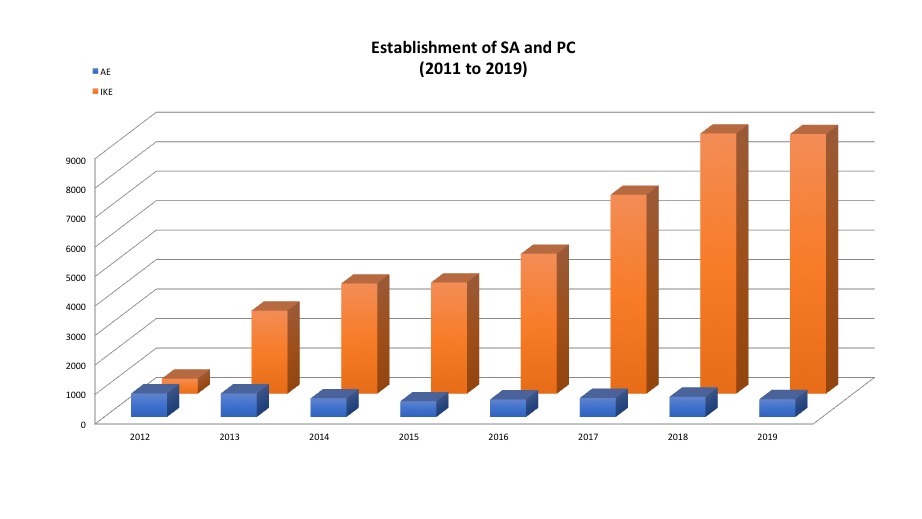
    Despite the fact that SA and Private Company address different audiences, it is interesting to take a look at the Business Registry’s data for the years 2012 (when Private Company was established) until late-October 2019. And to be more precise:

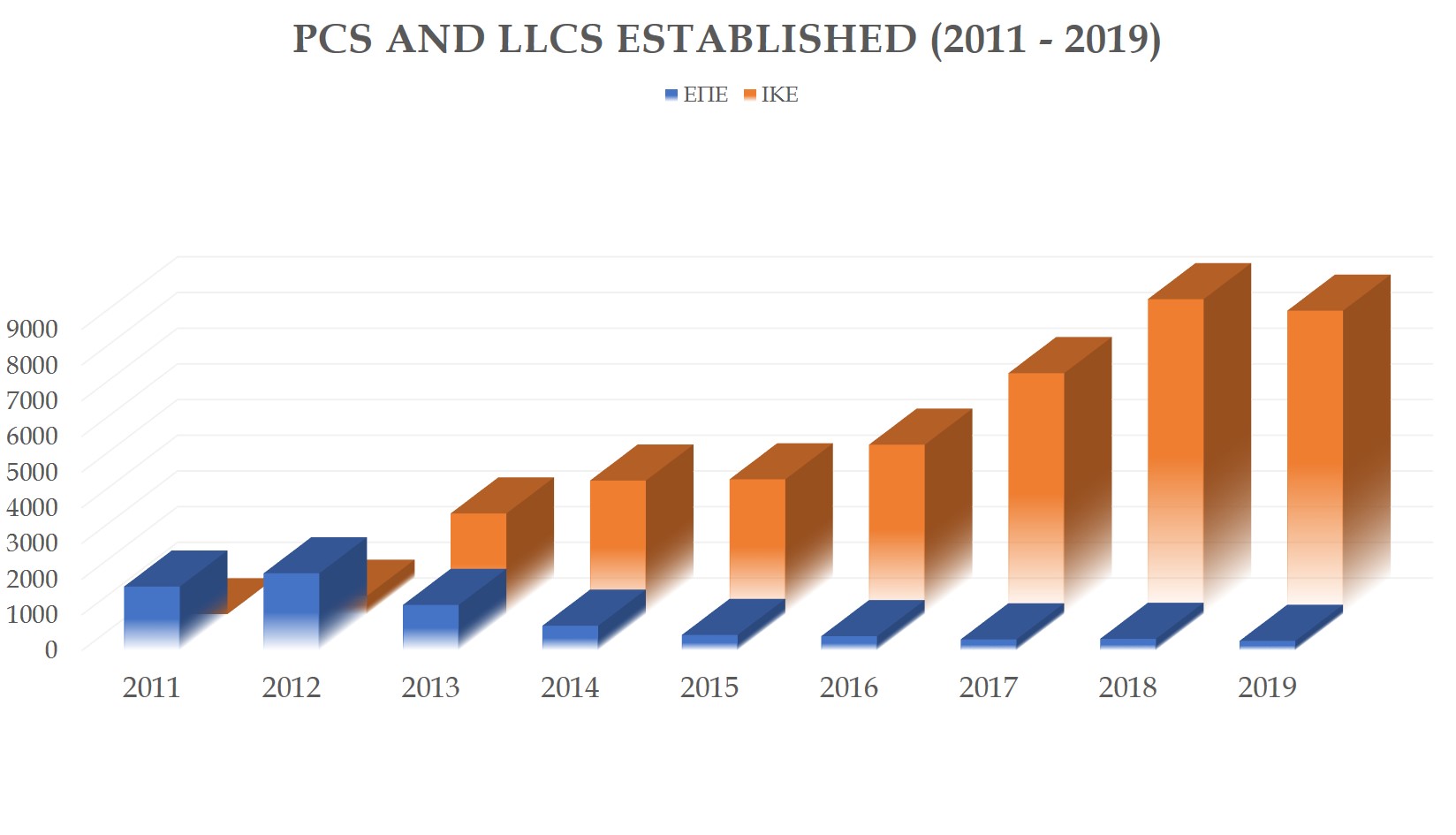
    Business Registry’s statistical data shows that the number of SAs established yearly is kept, notwithstanding some minor fluctuations, rather steady.

    On the contrary, the establishment of Private Company is steadily rising. Its flexibility and the fact that it is cheap and simple are, quite certainly, the reasons why it is preferred over SAs.


    V. In Conclusion

    SA and Private Company never competed against each other.

    Private Company prove to generally be cheaper than SAs. Of course, more flexible as well. And this is why they are generally preferred.

    But their “audience” is different. Bigger schemes, bigger investments and businesses wanting to take advantage of the tools the act on SAs provides, must, no doubt, choose the SA as the most fitting company type.

    The result of the comparison of these two company types, as mentioned above, is overwhelmingly in favor of Société Anonyme.

    And if we were to refer to SA as the “swiss army knife” by Victorinox (as the multitool that it is), we could not but consider Private Companyto be the “pocket knife”.

    Let’s say it is collapsible as well…

    stavros-koumentakis

    Stavros Koumentakis
    Senior Partner

    P.S. A brief version of this article has been published in MAKEDONIA Newspaper (November 10th, 2019).

  • Société Anonyme. The new act on SAs: “headache” or «business opportunity»?

    Société Anonyme. The new act on SAs: “headache” or «business opportunity»?

    New act on SA: a “headache” or a «business opportunity»?)

    Ι. Preamble

    Felix Hoffmann (1868–1946) was a famous German chemist.

    His name went down in history as the creator of, among others, a preparation intended to cope with headaches (the “aspirin”).

    The commercial success of the aspirin was, as we all know, huge. It was destined to be legendary -up to today. (As a result of its success, the aspirin is exhibited in the national Museum of American History of the Smithsonian Institute, in Washington.)

    The fact that the aspirin successfully cures headaches is, to this day, a given. The only headache it cannot cure is that which comes with businesses. And it is a big one…

    The new act on S.A.s has been in force, as it is well known, since 1.1.2019.

    But is it just one more “headache” or a (once in a lifetime) business opportunity?

    An act of a hundred and ninety (190) articles, a sixty-eight (68) page long act (pages in the Government Gazette) could not be analysed in just one article. This is not what we intend to do. But it is quite important to focus on the business aspect of it all. We will attempt to tackle the most important and most common practical issues that arise when dealing with an SA.

    The approach taken in this article will help realize how an act can turn into a business opportunity….

    (or not?)


    ΙΙ. A little backstory

    New act on SA – no. 4548/2018 (which replaced act 2190/1920) is very modern and up-to-date.

    But what was act 2190/1920? The second half of its name confirms that it was passed in 1920.

    Early 20th century, this act was indeed ground-breaking in the field of company law.  But with decades passing after it came into force, amendments were necessary in order for it to remain relevant. Some of them, major. And with the decades passing, the withdrawals, amendments, interventions and additions started piling on. Because going back to the provisions in place and “tweaking” them was not enough, we started adding new ones (e.g. articles 42, 42Α, 42Β, 42C, 42D, 42Ε). Those “adjustments” ended up being so many, that so few elements reminding of the initial act were left. Some provisions seemed to just be “thrown in there”, with no cohesion with the rest of the act. The act ended up being a true patchwork…

    Its replacement was a necessity.

    The hundred-year-old 2190/1920 already gave its place to the “young” 4548/2018. With the latter already in force for ten months now, we are in a place to come to some useful conclusions.


    ΙΙΙ. “Ignorance of the law” and “one size fits all” articles of association

    Since ignorance of the law is not forgiven, no one can claim they are above the law.

    What was happening until 31.12.2018? And what is happening now?

    Businessmen, with only a few exemptions, were completely ignorant when it came to their own company’s articles of association. Unfortunately, so did most of their advisors. Most articles of association were not “made” to serve the specific needs of each businessman. Minor amendments to the (statute) model-texts notaries had once drafted proved(?) enough. And the (new) SA was ready to go!

    But when a problem “knocked” on the SA’s door, the businessman would “knock” on a lawyer’s door. And the latter would turn, for the first time, to the articles of association.

    In most cases, that was TOO LATE…

    That is when the businessman would realize that they should carefully and properly amend their articles of association (and often this realization would come with a painful and unnecessary cost).


    IV. Business view of Societes Anonymes

    We have already seen in the introduction that such a long act (as is act 4548/2018) could not be analyzed (or even presented) in one article. But we sure can attempt to approach the most common and practical aspects of the act, at least from the business point of view. A decalogue would come in handy for businessmen and their advisors.

    Let’s take it one step at a time:


    1. A fast and, foremost, cheap start

    An SA can now be established in minimum time and with an close-to-zero expense.

    Since 2016 (article 9 act 4441/2016) the participation of a notary and a lawyer often proved redundant.

    The SA can now, in some cases, even be established with a private document (article 4 § 2 act 4548/2018). A necessary requirement is to be using the official model articles of association and submit it to the relevant “one stop shop” of the Business Registry. An important prerequisite: to not diverge from the official model. Small (?) detail: the “one stop shops” still only have available models drafted according to the (abolished since 1.1.2019) act 2190/1920…

    In more complex cases (as well as in cases where the founders wish to divert from the provisions of the official model) the SA can only be established with a notarized document. A notarized document is also required when a legal provision specifically calls for it, or if contributions in kind are made to the company, contributions that in order to be transferred a notarized document is required (article 4 §2 act 4548/20190).

    But still in cases where the articles of association can only be valid if they come in a notarized document, there is a way to minimize costs. Choosing small (size-wise) articles of association – by avoiding unnecessary repetitions of the law, is the best practice. The cost (at least of the official copies) will be significantly smaller. And even more so: possible amendments of the law will not create a need to amend the articles of association accordingly.


    1. Attracting and keeping capable executives

    It is extremely important for all businesses to achieve, among others, a triple goal:

    • Attract capable executives,
    • Keep them for a long time,
    • Minimize their cost.

    Businesses and their executives have, in most cases, contradicting interests -and both sides want to mainly serve their own.

    Executives want to receive, in most cases, bigger salaries and other benefits.

    Businesses want to give out lower salaries and minimize other relevant expenses. They also have medium- and long-term targets.

    When the conflict of interests between management and ownership minimizes, at least by a little, everything becomes simpler. But what is the way to do so in an SA?

    New Act on SA – 4548/2018 offers multiple opportunities to SAs, in order for them to successfully tackle the (given) conflict of interests between them and their executives. Some of them are the Stock Options (article 113 act 4548/2018), Bonus Shares (article 114 act 4548/2018) and/or Ordinary Founders’ Shares (article 75 act 4548/2018).

    In cases of Stock Options and Bonus Shares, the executive is offered a chance to become a shareholder (with or without monetary consideration). This new role (that of a shareholder) is offered either at the time the executives are hired or after they have already established a long-term relationship with the SA. This way the interests of the SA and an executive align.

    It is a bit different with Ordinary Founders’ Shares. Those shares are offered, among others, to executives at the time the SA is established.  The owner of an Ordinary Founders’ Share will be hoping for the improvement of the company’s economic outturn. This (improved) economic outturn is what it will bring for them the agreed upon profit. But the shareholders do not carry any risks regarding the shareholding balances: Ordinary Founders’ Shares do not carry rights equal to those typical company shares do (e.g. voting rights or participation in the management). At the same time, the dividend their owners can receive is maximum ¼ of the amount exceeding the minimum distributable dividend. In any case, Ordinary Founders’ Shares do manage to align the interests of executives and the business.


    1. Minimizing company expenses and shareholder disbursements

    Any business’s goal is, among others, the improvement of its cost-benefit ratio. This goal can (also) be achieved by minimizing costs. The shareholders aim to improve the company’s economic result. At the same time, to have to withdraw as less money as possible. The interests of a company and its shareholders are often perfectly aligned, sometimes identical.

    The recent act on Société Anonyme offers tools to achieve the abovementioned goals.

    We have already referred (above under 1) to the deduction of cost at the stage of a company’s establishment. Adopting the formal model articles of association and not involving a notary or a lawyer is a step to that direction. But what happens if a notarized document is required? Short articles of association with no repetitions of the law.

    But how can one minimize expenses when a company operates?

    We have already mentioned the tools the law provides for the minimization of salary expenses (above under 2).

    A relevant tool (for minimizing expenses) is the utilization of technology. The recent act offers significant opportunities for the utilization of technological tools. Opportunities not at all insignificant, that will not only boost effectiveness, but also minimize operating costs.

    And as far as shareholders are concerned, is it possible that they will have to suffer fewer financial burdens and make less withdrawals?

    The partial payment of the SA’s capital (article 21 § 1 act 4548/2018) is the tool to do exactly that. The partial payment of the capital can take place, under certain conditions, not only at the stage of an SA’s establishment, but also in cases of capital increases. By taking advantage of this opportunity, the shareholders can deposit in the company only a fraction of the capital they have taken on to cover. They can postpone the obligation to pay off the rest of it, thus facilitating the management of their finances.


    1. Attracting investment capital

    The expectations businesses once had, that banks would provide financial support, is well in the past.

    Attracting investment capital is now a pressing need.

    The act offers significant options and tools that will accommodate such needs.

    The tools offered are (among others):

    • Warrants (article 56 act 4548/2018), which offer the right to those who hold them to acquire, sometime in the future, shares of the company which issued them, in a pre-determined, low price.
    • Preference Shares (article 38 act 4548/2018) can offer a wide range of privileges. Receiving dividends before ordinary shares, receiving interest and having a priority when it comes to participating in a company’s profits that derive from a specific business activity are only some of them. Preference Shares can either incorporate or not voting rights.
    • Redeemable Shares (article 39 act 4548/2018) offer the right to their owners to request to have them, sometime in the future, bought by the company which issued them, in a beforehand agreed upon price.
    • Bonds (article 59 et seq. act 4548/2018).
    • A combination of the above “tools”.


    1. Drawing liquidity from the Société Anonyme

    Part of the (Greek) reality is the “utilization” of company cash, for covering needs of its shareholders. But a Company’s Cash and the Businessman’s “Pocket” are two different things. A possible blurring of the boundaries between the two will create multiple and extremely severe risks. For the business, as well as for the businessman. This is why “informally” obtaining liquidity from a company should be avoided. There are several tools, though, to help make it “formal”. A necessary prerequisite is the support of the majority of the shareholders and the ability of the company to respond.

    The most common tools are: (a) for the members of the Board to participate in the company’s profits, and (b) the conclusion of contracts between the SA and its major shareholders, BoD members and related parties (even more so since the previous provisions of the act have been abolished).

    As significant (if sometimes not more significant) as the above tools are, among others, the following:

    • The distribution of dividend (final or interim),
    • The Deduction of the Capital (articles 29 et seq. act 4548/2018),
    • The Amortization of Capital (article 32 act 4548/2018),
    • The issuance of Ordinary Founders’ Shares (article 75 act 4548/2018) and
    • The issuance of Extraordinary Founders’ Shares (article 76 act 4548/2018).


    1. Managingsmall shareholders

    New Act on SA – 4548/2018 strengthens, as it seems, the rights of the minority, especially through the right given to them for exceptional auditing.  Nonetheless, the existence and the implementation of the minority’s rights are not always enough to achieve the necessary balance in the relations between the minority and the company. Often, the exit of the minority shareholders from the company is in the best interest of both them and the company.

    The minority shareholders can reach the exit by taking five, among others, ways:

    (a) By the option given, under conditions, to the minority shareholders (holding ≤5% of the share capital) to request before a court:

    (aa) the redemption of their shares by the SA (Act 4548/2019, article 45) and

    (ab) to be bought-out by the majority shareholder (holding ≥ 95% of the share capital) -(Act 4548/2019, article 46)

    (b) By the option given, under conditions, to the majority shareholder (≥95%) to buy-out the minority shareholders (Act 4548/2019, article 47)

    (c) By the increase (ordinary or extraordinary) of the share capital, as well as

    (d) By a (combined) decrease and increase of the capital.


    1. Utilizing technology

    The Act on SAs facilitates, by providing plenty of relevant provisions, the utilization of technology. The use of technology, without it being obligatory, has proven beneficial on many levels. For example, technology can be used in an SA:

    (a) for issuing intangible shares and digitally keeping the Shareholder Book (Act 4548/2019, articles 34, 40 par. 2 & 5),

    (b) for the board of directors to conduct its business and take decisions (Act 4548/2019, articles 90 & 94),

    (c) for shareholders to exercise their rights through emails (Act 4548/2019, articles 122 & 123),

    (d) for General Assembly Meetings and forming of the relevant decisions (remotely and by electronic means – Act 4548/2019, articles 125 to 128, 131,135 and 136),

    (e) for shareholder unions (Act 4548/2019, article 144).


    1. Succession

    The SA is “the ultimate” capital company. In Greece, though, the majority of SAs are family businesses – heavily resembling partnerships, as per the way they are run.

    Almost every family business-SA at some point will have to deal with the issue of succession – the transition to the “next generation”. This issue is often “taboo”.

    Succession issues cannot be solved with “absolute truths”. But they can be solved if they are approached by mature businessmen and proper advisors.

    A great help towards solving succession issues can be drafting “tailor made” articles of association. Those that will:

    (a) Set, in advance, reasonable rules for restricting the free transferability of shares.  Introduce a procedure that can take place through issuing restricted shares (Act 4548/2019, article 43). The restrictions apply on all transfers, including the ones owing to the death of a shareholder.

    (b) Regulate (in the most appropriate way and reasonably) the exercising of the rights of the minority. Also, the rights of minority shareholders concerning auditing.


    1. Protecting the investment

    Attracting investment capital is not enough.

    The shareholders and administrators of an SA have the obligation to protect it.

    As already mentioned, carefully worded, “tailor made”, articles of association will play a significant part. Those articles must carefully set the proper boundaries in the relationships between shareholders, in order to avoid internal disputes.

    The rights of the minority shareholders and how they are exercised must, in this case as well, be carefully defined. Even more so when it comes to the rights of the minority shareholders concerning auditing.

    Another important issue for most SAs is securing the “next day” and the business venture, meaning securing the company’s and the existing shareholders’ interests. A possible transfer, i.e. of company shares to a competitor would, most likely, not be at the interest of the company. A provision for restricted shares appears to be necessary here as well.

    Establishing the reasonable (and probably necessary) restrictions that are the Tag Along Right and the Drag Along Right seems, in most cases, necessary.

    But necessary in all cases are:

    (a) The provisions in the articles of association regarding the protection from possible competitive and unfair actions taken by the BoD members, the executives and the shareholders.

    (b) The careful selection of the SA’s representatives.

    ) The careful definition of boundaries of the responsibilities of each one of its representatives.


    1. Protecting the owners, directors and executives

    The range of the responsibilities of the members of the board of directors is very wide. Civil, criminal, administrative liabilities before the company, before third parties, etc. These liabilities can be put in two large categories:

    (a) The responsibilities of the members of the board of directors, according to the Act on SAs

    (b) The other responsibilities of the members of the board of directors

    The responsibilities of the members of the board of directors cannot be set to zero. But they can be limited. Solutions towards that direction (among others) are:

    (a) The reduction of number of the persons involved (i.e. through the provision of a Single-Membere Administrative Body / Consultant-Manager)

    (b) The Insurance Of The Liability Of The Members Of The BoD And Of The Executives Of The S.A.


    V. The new act on SA as a “headache”

    The new Act on SA is, indeed, one more problem for businesses. And even more so, one more “headache” for businessmen. Businessmen have to (if they haven’t already):

    • Manage the (smaller or bigger) confusion created in their business.
    • Spend money on informing their
    • Spend money (i.e. on new articles of association) in order to align the operation of their company with the requirements of the new Act.
    • Get informed themselves (in general) and make sure that their advisors (legal, financial, tax) are also informed in detail and familiar with every aspect of the new Act.


    VI. The new act as a business opportunity

    On the other hand, the new act on SA is a significant business opportunity. With reference to the (necessary) alignment with its provisions, the businessman has the opportunity to reaproach important data. Among others, to search for the best solutions regarding:

    1. The drastic (and efficient) reduction of cost when attempting new business endeavours,
    2. The attraction and maintenance of capable executives, while simultaneously minimizing the cost of their salaries,
    3. The minimization of operational costs and of the shareholders’ withdrawals,
    4. The (always) wanted and necessary attraction of investment capital,
    5. The (best suited) solutions in obtaining liquidity from one’s business,
    6. The managing of small shareholders, something which, in some cases, proves crucial,
    7. The (multiple) utilization of technology, aiming to the business functioning more efficiently, as well as to saving money.
    8. The tackling of issues relating to succession.
    9. The protection of the business and the investment and, mainly,
    10. The protection of shareholders, BoD members and executives.


    VII. Utilizing the business opportunities

    There is no question that the new act on SA is a significant opportunity. An opportunity which, if approached in the right way, will create multiple business opportunities.

    But how should it be approached?

    It is necessary for the businessman to get informed on all the tools provided by law (it goes without saying, no great detail is needed).

    It is also necessary for them to confirm that their advisors and associates are in a place to support this endeavour. But the most important thing of all:

    It is imperative that they reaproach their SA’s articles of association and have them “tailor made” to their needs. The purpose and end goal should not be to just adjust it to the provisions of the recent act. The purpose should be to utilize the (very significant) opportunities it offers. Few of them mentioned above.


    VIII. In conclusion

    The recent (implemented since 1.1.2019) new act on SA has been the operative event for many headaches. Businessmen, accountants, lawyers, tax consultants, business advisors, we did not avoid them.  (at least not all of us…)

    No aspirin could treat, not even partially, a businessman’s “headaches”. The headaches created by the implementation of a new act included.

    If the “father” of aspirin (Felix Hoffmann) was alive, he would come to the same conclusion.

    With certainty.

    It is well-established that the “business opportunities” this act brought with it are more than significant. And multiple, compared to the “headaches”.

    All that is left is for us to utilize them.

    As soon as possible.

    stavros-koumentakis

    Stavros Koumentakis
    Senior Partner

    P.S. A brief version of this article has been published in MAKEDONIA Newspaper (November 3rd, 2019).

    νέος νόμος για τις ΑΕ απόκομμα

  • Private Company vs Limited Liability Company: Which is the best way to go?

    Private Company vs Limited Liability Company: Which is the best way to go?

    Ι. Preamble

    “Prisoner’s dilemma”: A standard example of a game analysed in game theory, the study of mathematical models of strategic interaction among rational decision-makers. This dilemma, as well as this theory, probably does not regard everyone.

    Other dilemmas seem to be more familiar:

    “Oh but I think I am in trouble, don’t know if I want to choose Kiki or Koko. I do love Kiki but I also like Koko”. Us elders most likely have shared the dilemma of singers Spiros Koronis and Filandros Markou.

    The Private Company (PC) was introduced in the Greek legal system in April 2012, while Société Anonyme and Limited Liability Companies still existed.

    The boundaries between a PC and an SA were (and still are) pretty clear.

    This is not the case with the boundaries between a PC and an Limited Liability Company.

    Or is it?

    And in reality: Which was/is the best choice?

    The (pretty) “new” PC or the “already tested” Limited Liability Company?


    ΙΙ. The legal status of a PC and an Limited Liability Company

    A PC and an Limited Liability Company is somewhere between a public company limited by shares (e.g. an SA) and partnerships (e.g. a General Partnership and Limited Partnership).

    Both PC and Limited Liability Company are considered to be closer to public companies limited by shares. But they still have many similarities with partnerships. Those elements that make them resemble partnerships are either imposed by law or can be introduced with the company’s articles of association.

    What is certain is that those two companies have some distinct differences. A comparative overview will securely lead us to which one of the two is superior.


    ΙΙΙ. Establishment:

    1. Regarding PC

    A PC is established and amended with a private document. The speed and low cost of establishing and amending it is one of the main reasons why it is, at least at a first glance, so appealing.

    But the “private document rule” does have some exceptions.

    A notarized document is mandatory for a PC in some specific cases. In case, for example, that such is required by a specific law or when specific assets are contributed to the company, whose transfer requires a notarized document (e.g. immovable property or rights in rem in immovable property). Additionally, a notarized document can be chosen by the company’s founders or founder (when talking about a single member PC) (article 49 act 4072.2012).

    2. Regarding Limited Liability Company

    Until recently, the establishment and all amendments of a PPC could only take place with a notarized document (article 6§1 act 3190/1955). This rigidness of PPC was, on its own, a good enough reason to avoid this company type.

    Relatively recently (article 2 §2 ν. 4541/2018) par. 1 of article 6, act 3190/1955 was amended. This amendment introduced allowed the establishment of PPC either with a private document or a notarized one.

    A notarized document is required only in specific cases. When, for example, such a document is required by a specific law or when specific assets are contributed to the company, whose transfer requires a notarized document (e.g. immovable property or rights in rem in immovable property). Additionally, a notarized document can be chosen by the company’s founders or founder (when talking about a single member Limited Liability Company).

    A private document (and not a notarized one) is deemed enough when the official model articles of association are adopted. In this case, though, the establishment of the LLC can be realised by any “one stop shop”, as such is appointed by law (act 4441/2016). Meaning: (a) by the Business Registry departments of the Chambers of Commerce, (b) by “one stop shop” notaries, (c) online, in e- “one stop shop” (which, for the time being, only works for PC companies) -and not exclusively before a notary (1 Common Ministerial Decision No 63577/2018).

    What is, though, the main issue? In cases where the official model articles of association must be used, they must be used exactly as they are given, with no alterations. If the official model articles are altered, and the founders choose to establish the company with a private document, this will constitute a ground for the LLC’s invalidity.

    Therefore, in cases where an LLC’s founders want to deviate from the official model articles of association, a notarized document is the only option.  The relevant burden on the founders (timewise and moneywise) can simply not be avoided.

    3. Conclusion

    Based on what we established above, we come to the conclusion that, as far as the establishment of the two companies is concerned, PC is the clear winner. Therefore:

    Private Company-Limited Liability Company: 1-0


    ΙV. Capital:

    1. Regarding PC

    PC’s capital is determined by its partners without limit, it can even be a zero capital. Its partners can partake in the company with capital, non-capital contributions or guarantee duties (article 43 §3 act 4072/2012).

    2. Regarding Limited Liability Company

    LLC’s capital is determined by its partners without a limit (lowest or highest). It is formed either with cash or with contributions in kind (article 4 § 1 act 3190/1955).

    Previous version of the article required a minimum capital deposited in the LLC. It started (:1995) with a requirement of a minimum capital deposited of 200.000 drachmas. Consecutive increases had it reach 18.000€ (:2002). Consecutive decreases followed. Today, the requirement for a minimum capital deposited has been abolished (article 3 § 9 act 4156/2013). But LLC’s capital cannot be zero.

    3. Conclusion

    According to the above, we come to the conclusion that, as far as capital is concerned, at least in a theoretical level PC seems to prevail, since its capital can be zero. On the other hand, an LLC can be established with a capital of 1€. So we should probably call it a tie – no company type prevails, no point is appointed. The score remains:

    Private Company-Limited Liability Company: 1-0


    V. Partner’s contributions:

    1. Regarding PC

    We have already mentioned (above under IV.1) that several kind of capital contributions can be made in a PC. A partner can participate in a PC’s capital by contributing money (:capital contributions). Additionally, they can participate by making non-capital contributions or by having guarantee duties (article 76 § 2 α΄ act 4072/2012). A necessary precondition in order for someone to participate in a PC is to acquire one or more shares (article 75 § 1 α΄ act 4072/2012). Each share represents only one type of contribution (article 76 § 2 b΄ act 4072/2012).

    As a result: it is possible that a PC has received no capital, but only guarantees and non-capital contributions. The latter (guarantees and non-capital contributions despite that the have a value) they can render PC’s capital a zero-capital.

    But which are the non-capital contributions and what are the guarantees?

    The non-capital contributions are those contributions that cannot constitute capital contributions. Such are claims that derive from an undertaking of an obligation to execute works or to provide services. The value of these contributions undertaken when the company is established and/or afterwards, is determined in the company’s articles of association and is freely estimated by the partners (article 78 §§ 1 and 2 act 4072/2012).

    The guarantee duties undertaken by a partner mean that this partner has a guarantee duty for any company debt owed to any lender. The partner’s liability entails covering the company debt (the balance of capital, interest and other charges) up to the amount determined in the company’s articles of association. In this case the partner is liable before the lenders as if they were the principal. The lenders can turn directly against the partner. There is no preliminary procedure. It is also not a requirement for the lenders to first turn against the PC to prove that the company cannot pay them off, before they turn against the partner burdened with a guarantee duty.

    The option given for a non-capital contribution and of a contribution made by undertaking a guarantee duty makes it possible for someone to become a partner in a PC, even if they do cannot or do not want to make a capital contribution.

    The provision allowing for non-capital contributions or contributions made by undertaking guarantee duties makes a PC resemble a partnership. By providing these options, the partners are free to choose if they will be more like a partnership or an SA.

    2. Regarding Limited Liability Company

    There is no provision for non-capital contributions or contributions made by undertaking guarantee duties in an LLC. An LLC’s partners are obligated to contribute money. Alternatively: they can make contributions in kind, but they must be material.

    Even in a case were one of the LLC partners undertakes the obligation to work for the company or undertakes the obligation to pay company debt, they will not be looking at receiving company shares because of those reasons.

    3. Conclusion

    Things are simple. A PC offers the option of making non-capital contributions or contributions by undertaking guarantee duties. LLC does not.

    PC prevails. The score now clearly is:

    Private Company-Limited Liability Company: 2-0


    VI. Decision-making:

    1. Regarding PC

    Each company share carries the right for one vote (article 72 § 2 α΄ act 4072/2012). This means that PC’s partners form their decisions (in an assembly or not -under the provisions of the articles of association and of the law) with the majority of the votes/majority of the shares.

    2. Regarding Limited Liability Company

    LLC is more complex.

    According to article 13 of act 3190/1995: “Unless otherwise provided by law, the decisions are made by the majority of the partners, provided this majority is formed by more than the half of the partners, representing more than half of LLC’s capital”. This means that, in order for a decision to be made in an LLC, two majorities are required: of capital and partners.

    This legal requirement quite often creates significant problems. Even in cases where a partner has more than half (even more than 99%) of the capital, they are not entitled in making decisions. A necessary requirement for the decision to be made is for the partners who could have a minimum participation to agree with the partner holding the majority. In case that the first are outnumbering the majority partner(s), they have the opportunity to even extort, under the threat that they will oppose to a specific proposal. This fact renders LLC dysfunctional. It is quite possible that in some cases it will be impossible to reach a decision, when there are opposing partners who, even though they hold the minority share of the LLC’s capital, still outnumber the majority holder(s).

    3. Conclusion

    It is also clear. PC prevails as far as decision-making is concerned. The score now is:

    Private Company-Limited Liability Company: 3-0


    VΙI. Partner’s social security contributions:

    1. Regarding PC

    One more advantage of PC when compared with LLC is the lower social contributions owed by PC to the National Social Security Entity. The relevant issues are clarified in the National Social Security Entity’s circular no. 21/22.4.2019. Briefly:

    The partners of multi-membered PCs do not have to have a social security. The partners have the option of being insured according the provisions of the Self-Employed Workers’ Insurance (article 116 § 9 b΄, act 4072/12). Only the partner of a single-member PC must be insured accorrding the provisions of the Self-Employed Workers’ Insurance (article 116 § 9 a΄, act 4072/12).

    Nonetheless, PC’s managers must be insured. To be more precise, the following persons must be insured according to the provisions of the Self-Employed Workers’ Insurance (article 116 § 9 a΄, act 4072/12): (a) the partner of the single-member PC who is also its manager, (b) the partner of the multi-member PC who is also its manager, (c) PC’s manager who is not a partner, but has been appointed as the manager by the company’s articles of association or with a decision made by the partners.

    2. Regarding Limited Liability Company

    In contrast with PCs, LLC’s partners must be insured (article 39, act 4387/2016). Respectively, LLC’s partners who are also the company’s managers in exchange for a fee, are obligated to make relevant to their fee social security contributions as per article 38, act 4387/2016. Lastly, LLC’s manager, when they are not also a partner, they do owe social security contributions for the fees they receive, also according to article 38, act 4387/2016.

    3. Conclusion

    The financial burden imposed on LLC partners are clearly more significant than those imposed on PC partners. PC prevails here as well. The score is:

    Private Company-Limited Liability Company: 4-0


    VIΙΙ. Getting back in business

    1. Regarding PC and Limited Liability Company

    Both PC and LLC can be dissolutioned, after, among others, a decision made by the partners, because the company’s duration expired and because of bankruptcy. In both those cases, both company types can get back in business, after a unanimous decision of their partners (article 105 §7, act 4072/2012 and article 50a act 3190/1955). The difference between the two is that a PC can get back in business even after the process of distribution of its assets has started. This cannot happen in LLCs.

    2. Conclusion

    PC prevails here as well.

    The final score is overwhelmingly in favour of PC:

    Private Company-Limited Liability Company: 5-0


    IX. The trust of the market in PCs and Limited Liability Companies

    Since the act on PCs was published (Government Gazette A’ 86/11-04-2012), businessmen, accountants and lawyers showed their complete faith in PCs. (Our Law Firm established the second ever PC in Greece.) Business Registry’s data for the years 2012 (when PC was established) until mid-October 2019 confirm the trust of the parties involved. Overwhelmingly in favour of PCs. And to be more precise:

    X. In conclusion

    PCs and LLCs have been competing each other, since the day PCs were established.

    PCs prove more cost efficient when compare to LLCs. The most important difference between the two, though, is that PCs prove to be more flexible.

    PC’s partners have a lot of room for initiatives, in order to manage important company issues as they think best. The advantages of PCs compared to LLCs are more than clear.

    The trust the market has shown in PCs is also clear. This fact is undoubtedly represented in the data published by the Business Registry -statistical information regarding establishments.

    In this case, when considering choosing between a PC and an LLC, the dilemma at hand is no equivalent to the one presented in the preamble (“…don’t know if I want to choose Kiki or Koko”).

    Not anymore.

    LLCs already seem obsolete.

    stavros-koumentakis

    Stavros Koumentakis
    Senior Partner

    P.S. A brief version of this article has been published in MAKEDONIA Newspaper (October 27th, 2019).

    ΙΚΕ vs ΕΠΕ στην εφημερίδα Μακεδονία

  • The (:ordinary or extraordinary) increase of share capital in Société Anonyme

    The (:ordinary or extraordinary) increase of share capital in Société Anonyme

    Ι. Preamble

    “No Money, no honey” is a widely known expression. It is coming, most likely, from across the Atlantic. A phrase showing the necessary give-and-take in personal relations about to be realized. Or even existing ones. A phrase that shows in a crystal clear – and at the same time cruel- way, the value of money, according to common belief. Those who possess “money”, according to common belief -unfortunately, are the ones who are entitled to “honey”.

    This does not only apply to human relations.

    Those with the financial power in a professional cooperation, business joint venture or corporate relationship have or, eventually, acquire the “upper hand”.

    The Société Anonyme could not be an exception to that rule.


    ΙΙ. The necessary capital for the operation of the Société Anonyme

    A necessary condition for the achievement of a company’s statutory objects, of course the SA included, is the adequacy of its capital. Both at its establishment and, of course, throughout its life.

    In a previous article we looked at the initial Capital of the SA: amount, coverage, payment and certification. We also looked at issues concerning the contributions in kind in the initial capital of the SA. For achieving the corporate goals, the initial capital is, in most cases, not enough. Financial needs always appear in a company. Needs that may last for long, or not.

    The main question is always the same. Share capital increase or external funding? The answers given in each case may and will vary. Depending on the facts, the needs of the company and its shareholders but also their abilities. The criteria may not be strictly financial. The increase of the share capital seems to have, at a first glance, more advantages. We see, though, that lending will often be consciously chosen by financially strong companies and shareholders. As a proof, for example, of the financial health or the good credit rating of the company. Or of the optimal use of its equity.

    If a company chooses to increase its share capital, those who want in will follow. If they have the necessary funds.

    What about the rest?

    They will watch their participation in the total share capital decrease. And in some cases, be reduced to zero. And their participation in the expected economic outturn of the company reduced accordingly.

    ΙΙΙ. The (sufficient?) justification of the share capital increase

    It is not mandatory to justify the share capital increase. It is important, thought, to have a sufficient basis. If not, the Sword of Damocles is hanging above the validity of the relevant decision, due to abuse.

    The cause for the increase cannot be other than the optimal achievement of the corporate goals. In no other case is the decrease (or reduction to zero) of the percentages of the minority shareholders allowed. The minority shareholders have the right to ownership, a right protected under the constitution. According to the European Court, they have: “indirect ownership over the company’s assets”.

    It is possible that the majority shareholder may be aiming to decrease the participation of the minority shareholders in the company. In that case, the minority shareholders are not unprotected. The shareholder affected is given the option to go to court and claim the abusive character of the relevant decision. And, of course, to ask for the protection of their ownership. If the court accepts the relevant arguments, it can rule to cancel the decision for the increase of the share capital.


    IV. The ordinary increase of the SAs share capital

    The decision to increase an SA’s share capital is usually made by the SA’s General Assembly. In this case, there should be an increased attendance quorum and an increase majority. This is called “ordinary increase” of share capital (Act 4548/2018, article 23). The ordinary increase of share capital in the most common one.

    Having an increased attendance quorum means (article 130, par. 3) that the shareholders holding ½ of the share capital or their representatives are present.  If an increased attendance quorum is not achieved, then a second meeting of the General Assembly must be held, which is valid if the shareholders holding the 1/5 of the share capital or their representatives are present (article 130, par. 4).

    Increased majority means that (article 135, par. 2) the shareholders or their representatives who voted for a subject are 2/3 of the total number of votes represented in the General Assembly.

    The articles of association can have provisions requiring higher percentages in order to achieve a quorum (article 130, par. 5) and a majority (article 130, par.3). But it cannot require the presence of every shareholder. Even more so, neither can it require unanimity.


    V. The extraordinary increase of the SAs share capital

    The decision of the General Assembly, made with an increased attendance quorum and majority, is not the only way to increase an SA’s share capital -but this under one condition: a relevant statutory provision must be in place. If that condition is fulfilled, the SA’s share capital can be increased by decision of the General Assembly, with simple (not increased) quorum and majority. It is also possible to increase an SA’s share capital by decision of the board of directors with a majority of 2/3 of its members.

    In cases like these, we are talking about an “extraordinary” increase of the share capital (article 23 Act 4548/2018).

    It must be noted that an extraordinary increase of the share capital can be decided by the board of directors as well as by the General Assembly (article 24, par.5).

    An extraordinary increase of the share capital always constitutes an amendment to the articles of association (contrary to what happened in the past).  Furthermore: the extraordinary increase does not require an administrative approval. And all these, no matter if the decision is made by the General Assembly or by the board of directors (article 24, par. 4).

    There is always the chance that the provision allowing an extraordinary increase will be used in bad faith. In order, for example, to mislead those transacting with the company. To avoid such actions, there it is strictly prohibited to mention to the press, in a commercial or in any document of the company, the amount up to which the competent body can increase the share capital (article 24, par.3).


    VI. The power of the General Assembly to decide an extraordinary increase

    We saw that a necessary requirement for an SA to make an extraordinary increase to its share capital, is the existence of a relevant provision in its statute.

    For the first five years after the establishment of the company, the statute can give to the General Assembly the power to decide an extraordinary share capital increase (article 24, par. 2). This provision may allow the General Assembly to proceed to a share capital increase up to eight times the initial capital. What is noteworthy in this case is that the GA can decide the increase by simple quorum and majority.

    But what is this simple quorum and what this simple majority?

    The simple quorum of the General Assembly (article 130, par.1) requires for the shareholders holding 1/5 of the share capital, or of their representatives to be present. In case the quorum is not attained, a second General Assembly will be validly held, regardless of the number of the shares represented (article 130, par.2).

    As for the simple majority, it is nothing but the votes of at least 50% plus one vote of the votes represented in a General Assembly (article 132 par. 1).


    VIΙ. The power of the board of directors to decide an extraordinary increase

    The board of directors has a power equivalent to that of the General Assembly, as long as there is a relevant provision in the statute, or a relevant authorization is given by the General Assembly. If any of these two requirements is met, an increase of the SA’s share capital up to three times the initial capital can be decided by the BoD. The relevant decision can be made by a minimum majority of two thirds (2/3) of all board members (article 24, par. 1).

    The power for an extraordinary increase cannot be given to the board of directors by the statute indefinitely. It is only given for the first five years -maximum- from the establishment of the company. The share capital can be totally or partially executed by the issuance of new shares (article 24, par.1a).

    Besides the statute, the General Assembly can also give the board of directors the power to decide for an extraordinary increase of the share capital. This power is given by the General Assembly for a period not longer than five years. If given, the share capital can be increased maximum up to three times the initial capital. In this case, the initial share capital is the share capital of the company at the date the relevant power was given to the board of directors (article 24, par. 1b).

    The power of the board of directors can be renewed by the General Assembly. The General Assembly can give the relevant power to the board of directors for five years, maximum. The effect of each renewal can only begin after the end of the previous one (article 24, par.1c).

    The decision for granting or renewing the power to the board of directors to increase the share capital must be published (article 24, par.1c).


    VIII. Extraordinary vs ordinary share capital increase

    We saw (above, under VI), that the General Assembly can decide for an extraordinary increase of the company’s share capital with simple (and not increased) quorum and majority. We also saw (above, under VII) that the board of directors can decide, very quickly, an extraordinary increase with a majority of 2/3 of its members, without having to convene a General Assembly.

    But what do these options mean in practice?

    The General Assembly has the right to increase the company’s share capital up to eight times the initial share capital,

    and do so with reduced percentages. In other words: a shareholder holding, directly or indirectly, ½ of the share capital has the right to decide an increase of the share capital up to 8 times the initial one. And if they have the necessary funds? They additionally have the power to significantly expand their participation in the company and dramatically decrease the participation of the rest of the shareholders.

    Under the requirement of achieving the necessary quorum in the General Assembly (1/2 or 1/5 of the total), a shareholder holding 13.34% of the shares has the right to decide an extraordinary increase up to eight times the initial share capital. In that case, provided they have the necessary funds, a minority shareholder can become the shareholder of a vast majority.

    On the other hand, the implementation of an extraordinary share capital increase by the board of directors might help quickly achieve a certain corporate goal. Since there is no need for conveying a General Assembly, the procedure can be expedited at least by the number of days needed for the convention of the GA -in cases where we are not discussing a Universal General Assembly -which means presence of all the shareholders. Such a quick procedure can be proven valuable when fast response is required -i.e. exploitation of a significant business opportunity.

    Respectively, though, a shareholder who “has” (or can convince or join sides with) 3/5 of the members of the board of directors (regardless the number of their shares), can “force” an extraordinary increase up to three times the initial share capital.  And if, at the same time, they have the necessary funds to cover the increase, but the rest of the shareholders do not, they can at once become a major or a majority shareholder.


    IX. Conclusion

    The regular increase of the SA’s share capital is decided by the General Assembly. It requires an increased attendance quorum and to be voted for by the majority of the shares. Essentially majority of 2/3 of the total number of shares.

    The extraordinary increase must be provided for by a statute.

    When decided by the General Assembly, it requires clearly reduced percentages. Half and, under certain requirements, 13.34% of the share capital could be enough for making such a decision.

    When the extraordinary increase is decided by the board of directors, a vote for the increase by 3/5 of its members suffices.

    Attention though! An extraordinary increase can be a useful tool for fast actions necessary to exploit business opportunities.

    But it can also be a tool for overthrowing shareholding balances.

    Possibly in the interest of the SA.

    But always in the interest (:“honey”) of the powerful (:“money”) shareholders.

    stavros-koumentakis

    Stavros Koumentakis
    Senior Partner

    P.S. A brief version of this article has been published in MAKEDONIA Newspaper (October 20th, 2019).

  • Distributed Ledger Technologies (DLT): businesses and everyday life

    Distributed Ledger Technologies (DLT): businesses and everyday life

    Distributed Ledger Technologies (DLT): businesses and everyday life

    Ι. Preamble

    In a previous article we referred to the 4th Industrial Revolution, the technologies that constitute it, the cosmogonic changes it is bringing. We also mentioned the fact that there is no proper institutional framework in place, as well as the need to introduce one to welcome and utilize those technologies, aiming to the sound development of both businesses and the country.

    Distributed Ledger Technology is uniquely placed among the technologies constituting the 4th Industrial Revolution. The implementations of this technology are countless, “the number of which is immeasurable”, to copy the Old Testament (Psalm 103,25). With that admission in mind, a simple article could of course not sufficiently cover them all, even more so if said article is written by a non-expert.

    It is, though, true that these technologies, their implementations and their benefits, do not only regard the experts.

    They regard all of us.

    None excluded.


    ΙΙ. Distributed Ledger Technology (DLT) and blockchain

    We have already mentioned (in the aforementioned article) that “Distributed Ledger Technology is a database which, instead of being kept in a central location, it is distributed in a network of computers. The users of the computers with access to the network, depending on the licenses they hold, are able to access the information and/or add data. The most common DLT is the blockchain technology. Blockchain is the most common type of Distributed Ledger Technology.” We have also mentioned, regarding blockchain, that “The “chain” is protected in its entirety by complex mathematical algorithms, aiming to ensure the integrity and safety of the data. This chain is a complete recording of all the transactions recorded in the database. The most known application of blockchain is the creation and circulation of cryptocurrencies, as well as the accommodation of transactions entailing cryptocurrencies. Blockchain is said to be bringing changes more significant than those of the creation and broad use of the internet.


    ΙΙΙ. The actions taken by the European Union

    Given the severity and magnitude of the issue, as well as the expansion and utilization of DLT on a global level, EU is taking many actions, especially with regards to blockchain. Unfortunately, though, the technology is “running” too fast. In most cases so fast that most of us are unable to follow it – not even sufficiently.

    A few days ago was the one-year anniversary of the passing of a very interesting text. The European Parliament resolution of 3 October 2018 on distributed ledger technologies and blockchains: building trust with disintermediation (2017/2772(RSP)). This text (hereafter the “Text”) entails several and specific statements. It also offers specific directions to the European Commission for the utilization of DLT applications within the European Union.


    IV. The advantages in using DLT applications

    Using DLT has important advantages. Indicatively:

    (a) DLT and blockchain can prove to be tools that offer to their users the ability to control their own data. To decide which data will be included in the distributed ledger and which will not, who will be able to see them and who will not.

    (b) DLT can minimize transaction costs. Middle men prove to be unnecessary, and so are the fees they charge. The final cost of services and products ends up being lower, benefitting not only the businesses, but the consumers as well.

    (c) DLT, can, through the necessary encryption and control mechanisms, as well as by establishing a relevant electronic model, contribute to the improvement of transactions’ safety and trust.

    (d) DLT promotes the pseudonymization but not the anonymization of its user. (That is the point that kicked off a big discussion regarding the compatibility of DLT and GDPR.)

    (e) DLT can provide a framework of transparency and reduce corruption, detect tax evasion. Also: it can track unlawful payments and appropriate assets, facilitate anti money laundering policies.

    (f) Adopting DLT renders ensuring data integrity and security possible.

    (g) Cyberattacks seem to not have such a big effect on DLT applications, since they have to successfully target an unidentified number of servers, not just one.

    Simultaneously, the dangers of DLT applications, seem, at least for now, insignificant.


    V. Distributed Ledger Technologies (DLT), decentralization and applications

    It is unclear how many applications DLT has. It seems that they won’t be exhausted – at least not in the foreseeable future.

    The ability to create an environment of trust between transacting parties and the lack of need for third parties to mediate a transaction completely reverses today’s transacting reality. This fact can limit (and, eventually, completely eradicate) the “old ways” of conducting business and transactions in general. It can also improve the services offered and achieve a significant, in some cases, deduction of costs -in a broad spectrum of sectors.

    A possible utilization of DLT will have a significant impact on public governance and the role of government institutions. Papers studying possible scenarios of adoption of DLT public networks are expected to come out soon. The European Parliament has directed the European Commission to do so.

    It is a given that the spectrum of possible DLT applications is significantly broad. The economy and, if not all, most of its sectors will most likely be affected.

    Indicatively:

    (a) Energy and environment friendly applications

    Utilizing DLT applications in the energy field can have multiple benefits. It can contribute to the production of “green” energy – even at household level, to energy exchanges and energy donation. It can contribute to a more efficient integration of renewable energy and to its use as an electric vehicle power supply. It can also contribute to the precise tracking of renewable or carbon energy certifications and to the creation of new opportunities in circular economy, by providing motives for recycling.

    (b) Transport

    In transportations, DLT can contribute in the processes of registration and administration of vehicles, verification of driving distances, smart insurance and charging of electric/electronic vehicles, among others.

    (c) Healthcare sector

    In this sector, the utilization of DLT applications is most likely going to be significant. It is possible (and is logically expected) that DLT will promote:

    • The improvement of the efficiency of data in clinical study reports.
    • The digital exchange of data between public and private institutions, with the approval of the interested patients.
    • The improvement of the efficiency of healthcare, thanks to the interoperability of electronic health data.
    • The verification and confirmation of a drug’s identity and the facilitation of medicine distribution.

    It is of extreme importance to stress that DLT technology ensures the privacy of sensitive, health-related personal data and allows data subjects to control, by themselves, their data of that nature. This means that they can choose which health data of theirs will be offered and to whom, and to give their permission for their use by insurance companies and healthcare providers.

    (d) Supply Chains

     DLT can:

    • Contribute to the improvement of supply chains,
    • Facilitate the tracking of the goods and their origin, their ingredients or components,
    • Improve transparency,
    • Offer guarantees for the compliance with sustainability and human rights protocols in a product’s place of origin.

    By utilizing it, the risk of illegal (or unauthorized) interferences of products in the supply chain minimizes. Consumer protection is also ensured, along with healthy entrepreneurship and, of course, government revenue. DLT can be used as an important tool in the hands of custom officials when checking for counterfeits.

    (e) Education

    With reference to specific cases, some of which were presented before the courts, while others were not, cases which have become public during the past year, a big discussion has started. A discussion regarding the ethical and legal contempt and the consequences the one falsely declaring of a degree faces or should face.

    When using DLT, the certification of academic qualifications, higher education degrees and knowledge and skill certification, proves very easy. Specific education and certification organizations have already adopted this technology. By doing so, they ensured a secure connection between a specific degree or knowledge and skill certification with a specific person.

    In this regard, we should be expecting from the European Commission (after the relevant order by the European Parliament) a study on the possibility to create a European network (utilizing DLT) in order to share data and information, aiming to a more efficient recognition of academic degrees. In this same regard, we should be expecting relevant initiatives from the member-states, as well as from the education and certification institutions concerning the qualification degrees they issue.

    If such a system was generally adopted, one could not really be tempted to claim they hold a title that they do not. The result? More transparency and meritocracy, while the relevant authorities and parties involved and will not bother with such cases (cases like the aforementioned).

     (f) Creative industries and copyrights

    Utilizing DLT can securely authenticate and help manage copyrights, related rights and patents. It can facilitate their protection. Identifying ownership and (moral and economic) intellectual property rights could prove to be fairly easy through an open public ledger. And, if that was possible, the need for intermediaries to receive, on behalf of the creators, the relevant payment for their creative content, would eliminate.

     (g) Financial sector

    The international financial sector is probably leading, on a global level, the effort to detect and utilize DLT applications. And this makes sense – DLT is very valuable to this sector. It is very valuable in the field of (innovative) financial intermediation. In the improvement of transparency. In minimizing transaction costs and indirect expenses – and all that thanks to the rationalization it offers and to the better (and safer) data management.

    The subversion of the “ruling” class, resulting from the use of DLT applications on specific procedures, as a means of perusing cost-effectiveness, managing human resources, is already a fact. And let’s not forget cryptocurrencies, probably the most recognized application of DLT. The effects on global economy and the dangers that may be hiding have not yet been estimated.

    The inability of the global financial system to prevent the use of cryptocurrencies does have an interesting result: the (necessary) accepting of their existence and the effort to incorporate them in the European settlement system.


    VI. Smart Contracts

    Technology is the enemy of those who cling (or, futilely, try to cling) to past habits.

    What has history taught us? That technology is the one which will, eventually, win all such battles.

    We, lawyers, are bound to be the first ones to fight smart contracts (those contracts that all one needs to draft, enter and implement them is a few lines of code and an “enter”). It is also a given that smart contracts will win this battle.

    Despite the fact that we still haven’t even familiarized ourselves with this term, the use of smart contracts seems to be inexhaustible. And all that thanks to DLT applications.

    What is the bigger issue, though? The lack of legal certainty.

    Smart contracts are mostly unregulated: as far as the liability of and the risks undertaken by the transacting parties, the applicable law, the competent courts… One thing is certain: smart contracts will gradually prevail over regular ones. And as long as the validity of a digital, cryptographed signature enhances legal certainty, the use of smart contracts will keep getting more “user friendly”, prevailing over regular contracts.

    And even more important: We should take it as a given that technology will start (little by little) to replace us lawyers and remind us that we are not as important as we would like to think.


    VII. Policies for the promotion of DLT technologies in Europe

    The fact that the European Parliament accepts that DLT is unregulated is quite significant. At the same time, the European Parliament has adopted the position that the European Union should not, for now, regulate DLT, but it should try to eliminate all the obstacles in the way of blockchain applications.

    The European Parliament has also accepted that the European Commission should valuate and develop a European legal framework which will resolve possible jurisdiction issues. Such issues would be those that could potentially arise in case of fraud or criminal matters relating to transactions realized in a DLT framework. It has also been proven that the European Commission and the competent national authorities are those that will provide for the prompt emerging of technical expertise and regulatory capacity, which will allow for a fast legislative or regulatory action when deemed necessary.

    DLT can be best applied if certain requirements are met. Additionally, it would have to “go through” certain actions taken by the European Commission and member-states. And not just those.

    The awareness and training of citizens, businesses and public authorities is completely necessary, in order to facilitate the understanding and integration of this technology. The broadening of DLT research is essential as well, and so is the undertaking of the relevant studies, investments on this field, funding research initiatives and development and promotion of strategies for training and retraining on digital skills. These are only some of the actions that are expected to decisively contribute to the active and unrestricted participation of the European community on the necessary shift of perceptions and practices.


    VIII. In conclusion

    Distribution Ledger Technologies (DLT) already have multiple applications (“the number of which is immeasurable”) on many sectors of the economy. We should all take as a given that they will soon cover all its sectors -none excluded. And even more so: our lives and reality.

    The European Union indeed has, according to the European Commission, “an excellent opportunity to become the global leader in the field of DLT and to be a credible actor in shaping its development and market globally”.

    The European Union is expected to undertake initiatives to familiarize, promote awareness and train its citizens on those technologies. For tackling the interstate digital divide.

    That should, respectively, happen in our country as well, as the digital divide between the Greek citizens proves wide. It should quickly close. A shining example for us to follow is that of Estonia.

    The state, businesses and their unions should look for ways to utilize DLT applications, while there is still time. Those of the businesses that will quickly realize the new regime and will utilize the relevant opportunities will have a significant advantage compared to the rest.

    And we, on our part, as active citizens, have a duty to pay a lot of attention to what tomorrow will be our reality.

    To listen!

    To study!

    To collect all relevant information! Not because it will somehow be mandatory to be familiar with such applications and technologies, but because they will, very soon, prove entwined into our own existence and reality.

    Those of us who will chose to turn a blind eye to the “next day” will certainly find ourselves marginalized and isolated.

    The monks of Mount Athos have already, very consciously, made their choice.

    What about the rest of us?

    stavros-koumentakis

    Stavros Koumentakis
    Senior Partner

    P.S. A brief version of this article has been published in MAKEDONIA Newspaper (October 13th, 2019).

  • The protection of commercial secrecy

    The protection of commercial secrecy

    Ι. Preamble

    The majority of businesses, national as well as international, are (some more, some less) depending on the utilization of their commercial secrets, in order to secure their growth. For some businesses, their commercial secrets are crucial (sine qua non element) for their own existence.

    This fact has created, through time, the need for regulations protecting those important commercial sectets. This protection was offered, until recently, mostly through the relevant provisions of act 146/1914. This act mainly provided for penal sanctions in case a commercial secret was infringed.


    ΙΙ. The recent provisions for the protection of commercial secrecy

    The different extends to which commercial secrecy was protected in the EU brought upon the need for the issuance of Direction 2016/943, which called for the harmonization of all its member states’ relative legislation. the Direction was transposed in our country’s legal system with the recent act 4605/2019, which provides civil protection to those whose rights relating to commercial secrecy were violated. This act applies along with the aforementioned act 146/1914.

    For an information to be characterized as a commercial secret, all the following conditions must be met:

    (a) the information must be confidential, meaning that it must not be widely known to persons operating in cycles relevant to this type of information, and it must not be directly accessible by said persons,

    (b) it must have a commercial value, which derives from its confidential nature and

    (c) the person who has legitimately gotten control over the information must have put a considerable effort to protect its confidential nature.


    Indicatively, a piece of information can be confidential if it regards the clients and suppliers of a business, manuals and designs, financial information, know how, market and product research.

    The owner of the commercial secret can be offered temporary judicial protection via a restraining order.

    A restraining order can order:

    • The temporary pause or restriction of use or reveal of the commercial secret,
    • The prohibition of production, offer, placing in the market, use of illegal goods and/or their import, export or storing,
    • The seizing or delivery of goods with indications of illegality.

    (It is especially interesting that the act provides for the deposit of a guarantee from the one requesting the issuance of the restraining order as a mandatory prerequisite for the restraining order to be issued, in order to ensure the coverage of possible damages of the one who appears to be infringing.)

    Measures like the abovementioned can be ordered with the ruling on the principal action. It is noteworthy that the court judging the action can order the payment of a compensation instead of what is asked for in the action. The court is able to do that, after the respondent makes a relevant request, as long as the latter did not know or had no way of knowing that the commercial secret was unlawfully obtained by a third party.

    A compensation can also be ordered by the court if the applicant makes a relevant request, based on the claim that the respondent knew or ought to have known that they are illegally obtaining or using the commercial secret.

    An employee can violate a commercial secret as well. The relevant responsibility will lie with the employer only if the employee acted with no malice.

    In contrast to the right to the protection of one’s commercial secrets, comes the right to the freedom of expression and information, as well as the principal of public interest. The new act is trying to balance out those opposing interests by introducing provisions which mention specific cases where a request for judicial protection should be overruled. Specifically, it is stated that a relevant request is overruled when the the commercial secret was obtained, used or revealed:

    (a) to exercise the right to the freedom of expression and information, which entails respecting the freedom and plurality in the media sector,

    (b) to prove liability or an illegal activity, providing that the respondent acted towards the general public interest,

    (c) from the employees to their representatives, as part of the lawful exercising of said parties’ duties, provided that this reveal was mandatory in order to be able to exercise said duties, and

    (d) for the protection of a lawful right, recognized under EU or national law.

    In all those cases, public interest and the right to the freedom of expression and information are above the right to seek the protection of a commercial secret.


    ΙΙΙ. In conclusion

    It is not uncommon for a business to come across a case where its commercial secrets have been infringed. In this undesirable situation, it is extremely important that the business affected is in a place to easily prove its rights have been violated, since, in such a case, the need for judicial protection is unavoidable. Thus, it is mandatory for all businesses to take the appropriate preventive measures (indicatively: the exact definition of the commercial secrets and of the persons who have access to them, to strengthen their electronical systems, to train its employees). It goes without saying that drafting and having special confidentiality clauses signed, which are linked to specific and severe sanctions is of extreme importance.

    All the above, of course, under the instructions and with the directions of the business’s technical and legal advisors.

    Evdokia Kornilaki
    Senior Associate

    Υ.Γ. A brief version of this article has been published in MAKEDONIA Newspaper (October 6th, 2019).

    η προστασία του εμπορικού απορρήτου από την Ευδοκία Κορνηλάκη

  • The 4th Industrial Revolution: can development be regulated?

    The 4th Industrial Revolution: can development be regulated?

    Ι. Preamble

    The phrase «Graecum est; non legitur» was common in Latin-speaking countries during the Middle Age. It is said that this is where the phrase «That‘s Greek to me» derived from -a phrase first appearing, in this form, in 1599, in “The Tragedy of Julius Caesar” by William Shakespeare.

    The Greek version of the phrase (“this is Chinese”) is very familiar to all Greeks-unfortunately as a philosophy as well: it shows that we are unable to understand anything too complicated, and so it is not even worth trying.

    The term “4th Industrial Revolution” (aka “Industry 4.0” or “I 4.0” or “4IR” or “I.4”) was not that appealing to me.

    Until recently.

    I realized (thankfully, not too late) that this term entails a true cosmogony.evelopments (more or less) familiar, as well as completely unknown. Terms that could make someone quite easily say that “this is Chinese”, stating their indifference, maybe that this all is not worth their time and, simultaneously, quitting. Could this be too risky?


    ΙΙ. The Fourth Industrial Revolution

    The first industrial revolution, which started in the late 18th century in Britain, was identified by the industrial utilization of machines, the power of water and steam. The second, late 19th century, was identified by mass production, assembly lines and utilization of electricity. The third (late 20th century) by the utilization of electronics and information technology.

    What about the fourth, that just started?

    4IR reinforces what came to be called as “smart factory”. Cyber-Physical Systems monitor and supervise physical processes taking place within “smart” factories, create a virtual copy of the natural world and take decentralized decisions. Cyber-Physical Systems communicate and cooperate with humans, as well as (autonomously) with each other in real time. The technology used is constantly improving with the introduction of self-improvement, self-management, self-testing, artificial intelligence and smart employee support.

    Nonetheless, it seems that 4IR’s content is infinite. Its limits have already gone way beyond the limits of factories. Even the smart ones. And, according to Alec Ross («Industries of the future”, 2016): “The coming era of globalization will unleash a wave of technological, economical, andsociological change as consequential as the change that shook my hometown in the 20th century and thechanges brought on by the Internet and digitization as I was leaving college 20 years ago. Try to imagine a breakthrough in sectors of business so different from each other, as are life sciences, finance, war and agriculture, and be sure that someone is already trying to come up with it and make it marketable”. Since then, three years have already passed. Some of these changes are crystal clear. Some others already parts of our daily lives.

    Furthermore: 4IR has already blurred the boundaries between the natural, biological and digital world.


    ΙΙΙ. Technologies constituting 4IR and the (cosmogonic) changes that come from it

    In a brief article like the present one could obviously simply not reference all technologies constituting 4IR, not even mention a sufficient number of them – even more so someone who is not an expert in the field. The same goes for the cosmogonic changes brought on and affecting industrial manufacturing, services (financial or other), the economy, society, human relations -and so many more.

    One could only indicatively make some references, and those being only briefly mentioned in the present – as a foretaste:

    Internet of Things (ΙοΤ): IoT is a network through which “smart” devises or objects communicate (e.g. cars, electronical domestic appliances, watches, clothes) incorporating electronical means, software, sensors and access to a network, allowing them to interconnect and exchange data. The philosophy behind IoT focuses on the interconnection of all electronical appliances via a Local Area Network and/or the World Wide Web. When more objects operate jointly, it is said that they have ambient intelligence. IoT makes it possible for specific “smart” appliances and objects to exchange valuable information for meeting specific needs as best as possible, as well as, under specific circumstances, acquire unitary computing power.

    Robotics: The field of robotics is one implementation of automation. Robotics’ objective is to study, design and realize robots as well as conduct research for their further improvement. A robot, according to a definition given by the Robotic Industries Association (RIA) is “a reprogrammable, multifunctional manipulator designed to move material, parts, tools or specialized devices through variable programmed motions for the performance of a variety of tasks”. Robots are not used today solely for industrial manufacturing, but they have multiple other applications (indicatively: medical and domestic use).

    Virtual Reality (VR): VR is a method used to visualize and process complicated data. VR users can interact with each other using computers, create the illusion they exist in a virtual environment and, worth mentioning, under circumstances have the ability to wander and interact with said environment.

    Augmented Reality: Augmented Reality technology is the one augmenting the natural world with digital elements. It is mostly used in mobile appliances, depicting the natural world while augmenting it with digital elements (texts, sounds, videos). The combination of a camera with an image-indicator or even with a mobile appliance’s GPS system, make possible the projection of additional data of the image or the geographical location respectively, creating an information-wise augmented end result. The data provided can be perceived either from the mobile devises’ screens or via special augmented reality glasses.

    Artificial Intelligence (AI): AI is the field of computer science, which deals with designing smart (intelligent) computing systems, meaning systems that show characteristics of human intelligence and conduct. The classic/symbolic AI is based on understanding mental processes and simulating human intelligence by approaching it with algorithms and systems based on knowledge, building on symbols (e.g. systems of rules). Computational intelligence or connectionist or non-symbolic/subsymbolic is based on imitating the biological function of a human brain, much like the process of species evolution or brain function (e.g. neuronal networks and genetic algorithms).

    Digital transformation: Digital transformation is the incorporation and utilization of digital technology in all the operational aspects of a business, aiming to a rapid enhancement of its performance.

    Distributed Ledger Technology (DLT): DLT is a tool for recording ownership – it could for example show the ownership of money or other assets, like immovable property. A distributed ledger is a database which, instead of being kept in a central location, it is distributed in a network of computers. The users of the computers with access to the network, depending on the licenses they hold, are able to access the information and/or add data. The most common DLT is the blockchain technology.

    Blockchain: Blockchain is the most common type of Distributed Ledger Technology. Its name comes from the fact that transactions are grouped together, in order to form “blocks”, which are connected to each other in chronological order, forming a “chain”. The “chain” is protected in its entirety by complex mathematical algorithms, aiming to ensure the integrity and safety of the data. This chain is a complete recording of all the transactions recorded in the database. The most known application of blockchain is the creation and circulation of cryptocurrencies, as well as the accommodation of transactions entailing cryptocurrencies. Blockchain is said to be bringing changes more significant than those of the creation and broad use of the internet.

    Smart Contract: Smart Contracts are programs (codes) that are automatically activated and executed under specified conditions. The relevant procedure is recorded in a blockchain. This way the data put in a smart contract cannot be changed or disputed. Smart contracts offer safety and minimize costs.

    Platform economy: Trade tends more towards digital business platforms by the day. Platforms are electronical computing systems that can host services which allow the consumers, businessmen, businesses and wider audience to connect, share resources or sell projects.

    Share (or sharing) economy: Utilizing share (or sharing) economy and using the proper technological platform facilitate easy contact and transactions (in exchange for a fee or not) amongst the interested parties (e.g. owner of an apartment which is not being used, a parking spot not needed or an ancient Greek teacher with time to spare and, respectively, of those interested in receiving these services). The results of an economy operating this way is cheaper and more efficient services for those choosing to use them (as those offered by Beat, Uber or Airbnb).

    Digital energy: Approaching energy digitally rapidly changes concepts like saving, consumption, storing and producing electrical energy. This approach is possible with the help of technology, computing, data analysis and digital means. The end consumer is turned from a passive “payer of bills” into a smart receiver of digital services by their energy provider. For example, the consumers in some European countries (UK, the Netherlands, Germany) are able to store in domestic batteries cheap energy from RES or cheap electricity from an electricity network (e.g. with night charges or from cheap zones) and use it during other times of the day to cover possible overcharges of the network, when the market price of KWh gets high or there is high demand from the network.

    Digital health: Digital health is the convergence of digital technologies and health, healthcare, living and society, with the goal to more efficiently offer healthcare and, in the end, more personalized and effective therapy. It entails the use of communications, information and specialized technologies. These technologies entail, among others, software solutions and services, mobile devices and/or remote monitoring sensors.

    Biotechnology: Biotechnology is the sum of technical processes that focus on the best possible utilization and use of the traits of living matter (either that of organisms or their components -e.g. enzymes), aiming to increase the production of products already produced and the creation or production of new ones, with a substantial added value and importance for humanity.

    Neurotechnology: Neurotechnology is the technology which allows us to understand the function of the human brain, consciousness and thought. Neural networks, on the other hand, are the result of the merger of biological intelligence and mechanical intelligence and usually referrs to the connection between the human brain and computers.

    Drones: They are internationally known as UAS (:Unmanned Aircraft System) or UAV (:Unmanned Aircraft Vehicle) or RPAS (Remotely Piloted Aircraft Systems). The Greek Civil Aviation Authority uses the term UAS. UAS are unmanned flying machines. Their size varies, from very small (size of a game drone) to that of a proper airplane. Instead of a pilot, there is a “handler” who either drives it from the ground (remote control) or programs its route before the flight, so it moves automatically, following the flight route already specified (“self-steering” – they are flown by the “electronic orders” program, which is loaded on their memory beforehand and is executed during the flight). Their use is already quite extended: for peaceful purposes or not.

    3D Printing: 3D Printing is a method of making objects by consecutively adding successive layers of a material. 3D Printers are mainly used for manufacturing tangible models and prototypes by designers, engineers and new product development teams. Nonetheless, they are already used for printing parts, spares and bigger constructions by using different materials and different machines and physical properties.


    IV. 4IR and the (necessary) regulations

    With all those (often completely elusive) changes happening all around, one could justifiably wonder: Which legal system, regulatory environment, rules apply when a dispute arises from those new technologies (with only some of them having been mentioned above)? According to which law are the (surely) hundreds of thousands relevant questions arising answered -those questions that could justifiably be asked to a lawyer? And who would be the right lawyer?

    It is more than obvious that the answer to those questions does not exist: when the cognoscenti find it quite difficult to follow the rapid developments of technology (and we, in our ignorance, only occasionally and struggling when trying) no one could ever think of a proper regulatory environment -an applicable law that would holistically address the issue. Simply put: nothing of the sort exists.

    Nonetheless, this does not mean that complete inaction is justified. The changes happening, e.g. in finance, in economy and in our lives from the implementation of blockchain are mind-blowing. Indicatively: cryptocurrency transactions (the most known of which: bitcoin), conversions, either between cryptocurrencies or between cryptocurrencies and currencies more known and accepted, the acceptance of bitcoin (by specific countries) as a means of payment is now a fact. Passing the appropriate regulations for the protection of transactions and the ones transacting is nothing but a deadlock. Some countries have already moved or are moving towards that direction. Let us all watch what is happening internationally and (need be and up to a level) let us copy the innovators.


    V. In conclusion

    The changes that come with the Fourth Industrial Revolution are cosmogonic and do not only regard production and factories -they regard, directly and literally, all our everyday lives.

    If we manage to go past our inability or denial to understand what is happening and we stop giving up by saying “this is Chinese”, we can listen and pay attention to what the experts are saying -as much as each of us can.

    Even more so, what we must do, even ex-post, even if we struggle trying to follow the rapid developments, is to ensure the passing of (nonexistent today) proper regulations: in a national and an international level.

    For the assistance of the healthy development of our country.

    For the protection of the transactions and those conducting them.

    For our, in the end, protection and benefit.

    stavros-koumentakis

    Stavros Koumentakis
    Senior Partner

    P.S. A brief version of this article has been published in MAKEDONIA Newspaper (September 29th, 2019) and in Capital.gr.

  • Electronic payments (and how they are secured)

    Electronic payments (and how they are secured)

    1. Preamble

    “… for law, in its true notion, is not so much the limitation as the direction of a free and intelligent agent to his proper interest… where there is no law, there is no freedom” wrote John Lock in 1690, who was an English philosopher with great influence and a theoretical of the  Social Contract (:Second Treatise of Government, Ch. VI, sec. 57).

    There could, of course, be a big discussion regarding the fulfillment of the purpose (or not) of the law – especially in totalitarian regimes. But sometimes setting rules can prove to be very important for maintaining and extending freedom. In these cases, it is actually, most of the times, widely accepted.

    One of these cases is that of the rules securing transactions and transacting parties as well as maintaining and extending the freedom of both.

    In this context, we need the existence (and application) of relevant rules, although we already have way too many rules as a country.

    The European Union leads the way. The way to the right direction.


    2. The new environment after Directive (ΕU) 2015/2366 (:PSD 2)

    Since 14.9.2019, the Commission Delegated Regulation (EU) 2018/389 of 27 November 2017 is an applicable law. This regulation is supplementing the Directive (EU) 2015/2366 of the European Parliament and of the Council, (also referred to as “Second Directive with regard to regulatory technical standards for strong customer authentication and common and secure open standards of communication”-PSD2). The European Commission very recently published, in a concise manner, the new facts that come from the application of the PSD2 concerning electronic payments in Europe. It should be noted that these new facts and rules are covering electronic payments in total (among others bank transfers, payments with credit or debit cards).

    More Precisely:

    2.1. Regarding the Rights of the Consumers

    Electronic payments taking place throughout the EU and also in Island, Norway and Lichtenstein are becoming cheaper, easier and safer.  It is now as easy and safe to make a payment across those countries, as it would be if the payment was made within the consumer’s country. Additional charges by a merchant when the consumer pays for a product or a service using a card issued in the EU, are no longer tolerated.

    Everyone legally staying in Europe has the right to have a bank account with which they can make electronic payments (“Payment Account”): an account connected to a debit card, covering cash withdrawals, holding of funds, making and receiving payments throughout Europe.

    2.2. Regarding the charges imposed on the consumer

    The Payment Account is provided free of charge or at a reasonable price. Cross-border payments in euro should cost the same as the domestic ones. Cash withdrawals in euro outside of the beneficiary’s ATM network should also cost the same when made in the rest EU member countries as in the country of the beneficiary.

    2.3. Regarding the safety of transactions

    Since 14.9.2019, electronic payments have become more secure, thanks to the strong identification of the users, since a combination of verification levels will be required (i.e. not only a PIN, but also the beneficiary’s fingerprint). The consumer’s liability in case an unauthorized payment is made, is limited to 50€ (i.e. if their credit card has been stolen) – except for cases of gross negligence. The account’s beneficiary is not responsible for any unauthorized payment made after they have informed the card’s issuing bank (i.e. in case of a stolen card) as well as for payments conducted via the internet, if the payment service provider or the bank has not implemented a “strong customer authentication” (below under 4). In cases where the total amount of the bill is not known in advance (i.e. in car rentals or in covering accommodation expenses like staying at a hotel and using the services it provides) the business owner cannot charge at will, but can only charge up to an amount, which amount the card’s owner has approved in advance. In case a business has been authorized for “direct debit” of a bank account (i.e. paying electricity, mobile phone or gas bills), the beneficiary has eight weeks to question the amounts that may have been wrongfully charged. And moreover: this specific amount must be refunded to them in only ten working days.

    2.4. Regarding the (reasonable) charges

    The consumer has the right to know exactly the charges, if any, imposed on their electronic payments. In general, the merchants (either in physical or electronic stores) do not have the right to impose a price greater than the one published (some king of additional charge) when the payment is done by debit or credit card. Only in some cases (i.e. for specific cards) it is possible to have an additional charge, which should not be greater than the amount of the true expense the merchant will have to incur because the specific payment method was chosen.

    2.5. Regarding new technologies

    Thanks to the evolution of technology, it is possible to use new, innovative financial services offered by properly licensed banks and other electronic payment service providers – apart from the beneficiary’s bank. This means, for example that a beneficiary can monitor their financial information and data or make electronic payments without a credit or debit card. But, just like the banks, these new payment service providers must be properly licensed, monitored and, of course, handle the consumers’ data securely. The EU rules ensure that the electronic payments are conducted without problems. If any problem occurs, the consumer’s bank or other payment service provider must reply to the consumer’s complaint within fifteen (15) working days. If the beneficiary is not satisfied with the answer, they can file a complaint with the competent national authority.


    3. Data and the necessity to guarantee electronic transactions

    The competent authorities of the European Union have long now been concerned with the issue of the security of transactions and the protection of the transacting parties. That is why the Commission Delegated Regulation (EU) 2018/389 of 27 November 2017, was issued and, as mentioned above, applies since a few days ago (since 14.9.2019 -article 38 § 2). This regulation was issued, as it was also mentioned above, to supplement the Directive (EU) 2015/2366 of the European Parliament and of the Council, (also referred to as “Second Directive with regard to regulatory technical standards for strong customer authentication and common and secure open standards of communication”-PSD2), about the regulatory technical standards for the strong client identity verification and the common and secure open communication standards.

    Some of the data that were taken into account for the issuing of these legislative texts (Directive and Regulation) are very interesting. Specifically:

    The Directive (EU) 2015/2366 considers as a necessity to have “secure electronic payments” (characterizing them “…crucial in order to support the growth of the Union economy…”), to close regulatory gaps, to provide further legal clarity. The Directive also accepts what goes without saying, which is: “…Safe and secure payment services constitute a vital condition for a well-functioning payment services market. Users of payment services should therefore be adequately protected against such risks. Payment services are essential for the functioning of vital economic and social activities…”.

    Some very interesting assumptions can be found in Regulation (EU) 2018/389, that mention the data, based on which the Regulation introduced the new provisions.

    For example: “Payment services offered electronically should be carried out in a secure manner, adopting technologies able to guarantee the safe authentication of the user and to reduce, to the maximum extent possible, the risk of fraud. The authentication procedure should include, in general, transaction monitoring mechanisms to detect attempts to use  a  payment service  user’s  personalised security credentials that  were  lost,  stolen, or  misappropriated and should also  ensure that  the  payment service  user  is  the  legitimate user  and  therefore  is  giving consent for  the transfer of  funds and  access to  its  account information through a  normal  use  of  the  personalised security credentials. Furthermore, it  is  necessary to specify the requirements of  the strong customer authentication…”.

    As technology progresses, the methods of committing fraud progress with it. That is why the Regulation also accepts that: “As fraud methods are constantly changing, the requirements of strong customer authentication should allow for innovation in  the  technical solutions addressing the  emergence  of  new  threats to  the  security  of  electronic payments. To ensure that the requirements to be laid down are effectively implemented on a continuous basis, it is  also  appropriate  to  require that  the  security  measures for  the  application of  strong customer  authentication…

    And also: “As electronic remote payment transactions are subject to a higher risk of fraud, it is necessary to introduce additional requirements for the strong customer authentication of such transactions, ensuring that the elements dynamically link the transaction to an amount and a payee specified by the payer when initiating the transaction”.

    And finally: “In order to ensure the application of strong customer authentication, it is also necessary to require adequate security features for the elements of strong customer authentication categorised as ‘knowledge’ (something only the user knows), such as length or complexity, for the elements categorised as ‘possession’ (something only the user possesses), such as …something the user is… such as algorithm specifications, biometric sensor and template protection features…


    4. The “strong customer authentication”

    Based on all the above mentioned, it is obvious that the “strong customer authentication” is a very important step towards achieving the security of transactions referenced separately by the Directive and the Regulation mentioned above. This “strong authentication” is not necessary in all instances. In most cases, though, the need for strong authentication of the transacting parties seems to be of the outmost importance, and so is taking proper – increased security measures and having a secure connection for specific transactions with some specific beneficiaries (article 97, Directive (EU) 2015/2366).

    Such cases are, among others, those where payment service providers (i.e. financial institutions, electronic currency institutions, postal check offices, payment institutions etc.): (a) gain access to the customer’s payment account online, (b) conduct the initial payment online, (c) remotely take any action that may involve the risk of committing fraud or other infringement.

    In these specific cases, the payment service providers apply strong customer authentication which includes elements that dynamically and securely connect the transaction with a specific amount and a specific beneficiary.

    In the rare case, though, where these providers overlook their obligation, the responsibility and the relevant liabilities burden them and not the (non-culpable) customers.


    5. In Conclusion

    Payment services, through the ages, have been proven necessary for the operation of vital financial and social activities: nobody can imagine any economy functioning without secure payment services. In the globalized economy of our times, secure electronic payments have been proven of vital importance (“onditio sine qua non”) in order to support the desired (in a national, European or global level) and in some cases absolutely necessary development.

    The “strong customer authentication” is of course aiming to provide security and also facilitate transactions. Of course, to secure and facilitate those transacting as well. The relevant rules, coming from the European Union, fulfill, in this case, John Lock’s requirement, stated in the introduction, about the (desired) objective of the law.

    Development is proven to be closely tied to the security of transactions, among others. And we can’t but benefit from development. All of us.

    So, since 14.9.2019, we are entitled to be a bit happier. And, most importantly, to feel safer.

    stavros-koumentakis

    Stavros Koumentakis
    Senior Partner

    P.S. A brief version of this article has been published in MAKEDONIA Newspaper (September 22nd, 2019).

This site is registered on wpml.org as a development site. Switch to a production site key to remove this banner.