
Blog

  • The Remuneration Policy of the members of the Board of Directors of the SA

    The Remuneration Policy of the members of the Board of Directors of the SA

    The remuneration of the members of the Board of Directors of an SA is a “hot” issue for everyone interested: the company, the shareholders and, of course, the beneficiary. But it also interests third parties: investors and banks. Our national legislator re-approached this issue with the law on SAs (Law 4548/2018). The procedure and conditions for granting remuneration to the members of the Board of Directors on the basis of their organic relationship were covered in our previous article (: Societe Anonyme: Remuneration of the Members of the BoD). At the present article, we will be concerned with the Remuneration Policy. A Mandatory Policy for companies with shares listed on regulated markets (Article 110 §1). A policy welcome, without a doubt, by the rest.

    Remuneration of board members and conflict of interest ˙ the (global) debate

    The remuneration received by the members of the Board of Directors may, under certain conditions, be detrimental to the SA. This is, moreover, a typical case of conflict of interests. It can be proven harmful when, for example, in some cases they are associated with the achievement of high goals (indicatively: the company’s turnover). It is then possible for the members of the Board of Directors to sacrifice the management of the SA by excessive risk-taking, on the altar of achievement of their, short-term, own benefit.

    The recent long-term financial crisis “brought” to our country the global debate over the exorbitant fees of the members of the Board. The basis of the relevant concerns is often the lack of sufficient transparency but also the substantial participation of the shareholders in their approval. Their goal is to defend, ultimately, the corporate interest.

    The achievement of this objective is pursued through the “say on pay” principle (inter: Articles 9a and 9b of Directive 2007/36/EC, as amended by Directive 2017/828/EU). Based on this principle, the remuneration of the members of the Board of Directors should be defined in such a way that the shareholders are able to express an opinion. The tool of its implementation is the Remuneration Policy (as is the Remuneration Report) which have already been transposed into national law.


    Legislative framework

    The national legislator regulated the matters related to the Remuneration Policy (and the Remuneration Report) in the provisions of articles 110-112 of law 4548/2018. In this way, it incorporated into Greek law the provisions of articles 9a and 9b of the aforementioned Directive-as in force.

    With the Remuneration Policy (article 110 and 111 of law 4548/2018), which will concern us in this article, the strategy of the SA regarding the granting of remuneration to the members of the Board of Directors is structured. The SA’s sustainability and long-term interests are also promoted. The content of the Remuneration Report (article 112 of law 4548/2018) regards the remuneration granted to the members of the Board of Directors (or that are still due) for the previous year. It is not permissible, of course, for the paid salaries to deviate from what the Remuneration Policy stipulates.


    Remuneration policy

    The obligation to establish it

    As we “hurried” to note in the introduction, not all SAs are obliged to adopt a Remuneration Policy. This obligation is typically borne only by companies with shares listed on a regulated market. Both for the members of the Board of Directors and for the general manager, if any, and their deputy (article 110 §1). However, with a relevant statutory regulation, it is possible to apply the provisions for the Policy and Remuneration Report in two more cases: (a) to the executives, as they are regulated by the International Accounting Standards (article 24 par. 9) and (b) to unlisted SAs. We aim, in these cases, for greater transparency towards the shareholders. For the benefit, in the end, of SA.

    The obligation to establish a Remuneration Policy covers the remuneration granted to the members of the Board of Directors in their organic capacity and position. It does not cover, in other words, other fees. Such as, for example, those that are due for a special relationship of employment, mandate, independent services or works [int .: Societe Anonyme: Contracts with Members of the BoD for the Provision of (Additional) Services].


    The responsibility of the General Assembly

    Competent body for the approval of the Remuneration Policy is defined by law (article 110 §2) to be the General Assembly. This is a transformation of the principle we have already mentioned: “say on pay” [principle, which, however, already existed in the pre-existing national law (art. 24 par. 2 law 2190/1920)]. The shareholders’ vote is binding. In other words: the SA has no right to deviate from the decision of its shareholders.

    A simple quorum and majority is sufficient for the decision of the General Assembly (for the approval, ie, or not of the Remuneration Policy). In the initial wording of Law 4548/2018, it was provided that in the relevant voting the shareholders who happened to be, themselves, members of the Board of Directors did not have the right to vote. This prohibition is no longer in place (: abolished by law 4587/2018).

    In case of approval of the Remuneration Policy by the General Assembly, its duration extends, at a maximum, to four years from the relevant decision. It will, however, require further submission and approval by the General Assembly, when the conditions under which it was approved change substantially (even within four years) (Article 110 §2).

    When the General Assembly is called upon to approve a new Remuneration Policy after the expiration of the previous one, it is, of course, entitled to reject it. In this case the company is bound by the Policy previously approved. The duration of the latter is extended until the next General Assembly, when a new, revised Remuneration Policy is submitted (article 110 §4).


    The possibility of deviating from the Remuneration Policy

    The obligation to re-submit for approval the Remuneration Policy should be distinguished from the possibility of derogation from it (Article 110 §6). The specific / provided for derogation is, in exceptional circumstances, permissible. As long as three, basic, conditions are met. Specifically:

    (a) There is a relevant provision in the Remuneration Policy of the procedural conditions for the derogation.

    (b) There is a relevant provision in the Remuneration Policy of the items in respect of which the derogation may occur.

    (c) The need for the derogation serves the long-term interests of the company as a whole or ensures its viability.


    The body responsible for submission of the Policy to the General Assembly

    The Board of Directors is the competent body of the company for the submission of the Remuneration Policy to the General Assembly for approval. It is true that the specific competence of the Board of Directors does not explicitly arise from the wording of the law. On the contrary, it is derived, as a collective duty of the members of the Board of Directors, to ensure the preparation and publication, inter alia, of the Remuneration Report (article 96 §2 of law 4548/2018). However, we do not find a corresponding provision for the Remuneration Policy. This, however, does not mean that the members of the Board do not have the obligation to draft the Remuneration Policy and submit it to the General Assembly.

    An different interpretation would not be compatible with the recent law on corporate governance (Law 4706/2020). As we mentioned in a previous article [The (new) law on Corporate Governance (and a comparative overview with the preexisting one)], the relevant law introduces, in addition to the Audit Committee, two additional committees of the Board (Article 10): The Nominations Committee and the Remuneration Committee. The latter is responsible for: “formulating proposals to the Board of Directors regarding the remuneration policy submitted for approval to the General Assembly, in accordance with paragraph 2 of article 110 of law 4548/2018” (: article 11 a’). In addition, it examines the information included in the Remuneration Report, providing an opinion to the Board of Directors (art. 11 par. C).


    The content of the Remuneration Policy

    The provisions of the Remuneration Policy must be recorded in a clear and comprehensible manner. Its (minimum) content is determined, in sufficient detail, in the provision of article 111 §1 law 4548/2018 (which constitutes an exact transposition of the relevant provisions of article 9a of Directive 2007/36/EC).

    The minimum content, for example, should be the way in which this Remuneration Policy contributes to the business strategy, the long-term interests and the viability of the company. In addition, the different components for the granting of fixed and variable remuneration of all kinds as well as the criteria for their granting. The methods used to assess the degree of fulfillment of the specific criteria. The conditions for the postponement of the payment of the variable remuneration and its duration. The duration and content of the employment contracts of the members of the company’s Board of Directors – any existing retirement plans. Any share disposal rights and options. The decision-making process for the approval and determination of the content of the remuneration policy and so on.


    The disclosure formalities

    The central goal of the Remuneration Policy of the members of the Board of Directors is to enhance transparency. The justification is the possibility of constant information of all interested persons (especially shareholders and investors). It is therefore not paradoxical that the Remuneration Policy is made public (articles 110 §5 as well as 12 & 13). At the same time, however, it must remain available on the company’s website for as long as it is valid (art. 110 par. 5).


    The existence and, in particular, the proper implementation of the Remuneration Policy of the members of the Board of Directors, constitutes an important obligation of the companies that have shares listed on a regulated market. This obligation arises from the (recent) law on Société’ Anonymes. However, it also has strong foundations in the (absolutely recent) law on corporate governance.

    The value of the Remuneration Policy lies in the strengthening of corporate governance. And where the latter is strengthened, the companies that invest in it end up benefiting. After all, what investor will not see positively a company that has invested in corporate governance? Which bank will not, at least, increase the creditworthiness of a company with a strong relevant performance? Any relative costs for adopting a Remuneration Policy and complying with its content seem small compared to the reasonably expected benefits.

    Obviously for unlisted companies as well.

    Especially, perhaps, for them.-

     

    Stavros Koumentakis
    Managing Partner


    P.S. A brief version of this article has been published in MAKEDONIA Newspaper (April 4, 2021).


    Disclaimer: the information provided in this article is not (and is not intended to) constitute legal advice. Legal advice can only be offered by a competent attorney and after the latter takes into consideration all the relevant to your case data that you will provide them with. See here for more details.

  • Business: Survival & Development. The (necessary?) turn to the capital markets?

    Business: Survival & Development. The (necessary?) turn to the capital markets?


    Businesses need capital (own or foreign) to survive and grow. In Europe, they turn to the banks, mainly, for their extraction. The European economy therefore is (and does not just look) bank-centered. The Greek market even more so. The comparison with the USA, the United Kingdom and Japan (: countries, that is, with developed capital markets) proves the statement to be true. It is not simply a matter of theoretical findings: the relative magnitudes leave no room for misinterpretation. Should we take it for granted that European companies’ fundraising will start to shift outside the banking system – to the capital markets, for example? And, if so, will this also apply to Greek companies? And if so, when?

    For the advantages (of course conditions and disadvantages) of financing outside the banking system (capital markets and beyond) we will be given the opportunity to deal with in our next article. Respectively with the conditions for increasing the creditworthiness of companies. Let us now try to give an answer to the questions mentioned in the introduction.


    Capital Market: US vs EU

    One indicator that is commonly used to assess the size of a capital market development is that derived from the market capitalization / GDP ratio.

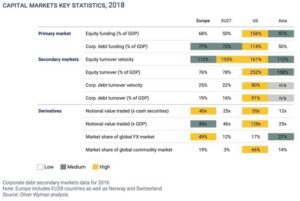
    A relatively recent report by FESE (Federation of European Stocks Exchanges) records an interesting statistic (based on the latest World Bank data published on 31 December 18). Specifically:


    Let us limit ourselves to the Index: Market Capitalization / GDP. We notice that it amounts to:

    At 156% for the US,

    At 50% for the EU27 and

    At 68% for Europe (EU27 + Great Britain + Switzerland + Norway).

    Therefore: for the European Union of 27 the relevant index is limited to 1/3 of that of the USA.

    A very obvious finding follows, that the European capital market lags behind that of the United States.

    There is also, as self-evident, the extremely limited use of European stock exchanges to raise capital by European companies.


    “The Greek economy is primarily bank-centric”

    The Governor of the Bank of Greece, Mr. Stournaras, participated, among others, in an online event of IOBE on 17.12.20 entitled “Financing, private debt and restart of the economy”. His speech, due to his position, was, of course, of particular importance.

    Referring to the Greek economy, Mr. Stournaras said: “The Greek economy is primarily bank-centric. What do I mean by that? Suppose one hundred units of funding are required. And let’s look at America, Europe and Greece. Of the 100 funding units in America, half, about 50%, comes from the capital markets; the other half from banks. In Europe, roughly 75% comes from banks and 25% from the capital markets. In Greece, 95% of the banks and 5% of the capital markets. So Greece is an exceptionally bank-centric country and banks play a very important role in financing and economic development.”

    However: As will be shown later on, the truth is (unfortunately) worse. Corporate finance from the European capital markets holds an even smaller percentage than what our central banker supports. (We can safely assume the same for Greek companies…).

    What if we look for the reason? We must, above all, attribute it to the structure and composition of the European economy. But even more so: in the general culture that prevails in the field of business finance in the old continent.


    The participation of the capital market in the financing of Greek companies

    Unfortunately, there does not seem to be (published-processed) data regarding the financing of Greek companies outside the banking system. But even if we accept as accurate the (rather optimistic) approach of Mr. Stournaras (: 5% share of the capital market as a whole), the conclusions still are absolutely disappointing.

    Listed companies, based on data from the Hellenic Capital Market Commission, are limited to: (a) one hundred and seventy-one (171) for the Main Market and (b) eleven (11) for the Alternative Market.

    Therefore: one hundred and eighty two (182) companies with listed shares in Greece (possibly those that were listed) share the 5% corresponding to the financing from the Greek capital market.

    For the rest (95%) that corresponds to the financing (basically) from the banking system, the 182 mentioned above are competing with the rest of the 821,540 (!) Greek companies. (Their total number is derived from the published data of the European Commission of 2019).


    EU data on SME access to capital markets

    The (dual-secondary) problem of the EU

    The finding of the central banker of our country (: “The Greek economy is primarily bank-centered”) identifies the problem. However, the magnitude of the dependence of the European economy and, consequently, of the Greek economy on the banking system seems more serious and worrying than he points out.

    Our (safe) source, the data and the position of the European Commission, expressed in: “Unleashing the full potential of European SMEs”. From what is mentioned there, it follows that:

    (a) Only 10% (!) of the external financing of European SMEs (ie from third-party sources) comes from the capital markets and

    (b) Only 11% of companies in Europe consider equity as a viable financial option. Most importantly: only 1% have used it.


    EU actions to manage it

    In order for the EU to manage the above (double & extremely serious) problem it decided to create:

    (a) A fund for the listing of SMEs on the stock exchange.

    This private / public fund was established under the InvestEU program. Through this, investments will be channeled to stimulate the financing of companies as well as funds run by women.

    (b) The ESCALAR initiative

    This initiative aims to create a mechanism to increase the size of venture capital and attract more private investment. Its purpose: to support companies with high growth potential.

    The success of both remains to be seen…


    The real (: main) problem of the EU and its management

    The real problem that the EU has to deal with does not seem to (only) be the creation of the conditions for better access of businesses to the capital markets.

    The real (and main) problem of the EU is to limit the further expansion of the financial system in the EU. And the consequent mitigation of the risks linked to this expansion.

    Most importantly: limiting the power of banks and bankers to the detriment of EU political power.

    The above-mentioned EU actions are, in principle, aiming in this direction.


    Do European SMEs have less money available than their US counterparts?

    The Association of Financial Markets in Europe (AFME) in collaboration with the Boston Consulting Group proceeded, together – six years ago (: 2/2015) to publish an interesting report: “Bridging the growth gap Investor views on European and US capital markets and how they drive investment and economic growth”.

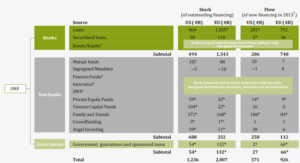
    We read in this report, among other things, that more money is available in European SMEs than in the US. According to the analysis estimates, SMEs (companies with a Turnover of less than € 50 million) in Europe have almost doubled the funding (compared to the US) from banks, non-banks and governments. The data emerge as particularly interesting. Specifically:


    We conclude from the above, indicatively, that in 2013 (taken into account as a reference year), 926 billion Euros of new financing, of all types, were given to European SMEs, compared to 571 billion Euros in the USA. The data, in both areas, exclude financing provided by personal financing (including funds made available to SMEs by their owners through their personal wealth and retained earnings).

    Based on the same analysis above: surveys and interviews show that European SMEs strongly prefer bank lending over personal or alternative sources of financing. This, moreover, is evidenced by the evolved character of the latter (such as venture capital and angel investing-available in smaller SMEs in Europe.

    In 2013, for example, €26 billion was invested by venture capital companies in SMEs in the US – compared to just €5 billion in their European counterparts. During the same period, €20 billion was invested by angel investors in US SMEs – compared to just €6 billion in Europe.

    Therefore: there is no shortage of money flowing into European companies. The problem is that companies are looking to recieve them (primarily) from banks. In this way, however, the banks become “dominant in the game”. Not only does this not solve the existing problems but, on the contrary, it multiplies them.


    Problem…

    It is a common finding that the rapid growth of the (global and European) banking system poses serious risks to the economy. It has already been proven that these risks are not theoretical. Both in the US and in Europe-recently and in the context of the (long-European) financial crisis. National economies have reached the brink of collapse due to the rapid growth and weak foundations of the banking system (see, for example, Cyprus and, secondarily, Greece).

    Also: the attitude of the banking system towards the SMEs in Europe and our country has been diagnosed as a serious problem. And so has it been again, in the context of the ongoing health / financial crisis.


    … vs business opportunity

    Should the specific problems mentioned above maybe push us in thinking “out of the box”? Do they force us to treat (and manage) them as an opportunity? An opportunity for gradual disengagement of the SMEs (but also of the national economy) from the entanglements and risks of the banking system?

    Is it time for SMEs in our country (as well) to turn to financing outside of it (the banking system)?

    To take advantage of the (given-alternative) funding opportunities out there? (Which will always increase ..)

    (And) of the Greek capital market?

    There is no doubt!

    The time has come (as will be shown in an article of ours to follow).


    Stavros Koumentakis
    Managing Partner


    P.S. A brief version of this article has been published in MAKEDONIA Newspaper (March 28, 2021).


    Disclaimer: the information provided in this article is not (and is not intended to) constitute legal advice. Legal advice can only be offered by a competent attorney and after the latter takes into consideration all the relevant to your case data that you will provide them with. See here for more details.
  • Societe Anonyme: Remuneration of the Members of the BoD

    Societe Anonyme: Remuneration of the Members of the BoD

    The Board of Directors of the Société Anonyme acts, in principle, collectively. However, it is possible (: a rule without exceptions) to delegate the powers to bind and represent to a specific member. It is also common for board members to associate with the SA through special relationships. Indicatively, with contracts of employment, works, independent services or mandate. These contracts (also) provide for the fees that the SA (must) pay them for their specific, additional, services. These issues have already occupied us in our previous article [: Contracts of Board Members for the Provision of (Additional) Services]. In this article we will deal with the issues of remuneration of the members of the Board of Directors that the SA (sometimes) pays them in the context of their internal relationship. In the latter case, the legal basis for the payment of remuneration must be sought in the articles of association, in a decision of the General Assembly or in the remuneration policy that may be adopted by the SA (: obligatory if it is listed).


    Establishment of a control mechanism in the remuneration of the members of the Board of Directors

    As already announced by the explanatory memorandum of law 4548/2018, the remuneration regime of the members of the Board of Directors is reformed (with articles 109 et seq.). A specific framework is chosen for the protection of the SA and the minority shareholders. The justifying reason? The risk of impairment of the corporate assets of the SA due to exorbitant fees and other, disproportionate benefits.

    It is noteworthy, however, that the specific provisions (Articles 109 et seq.) “… do not apply in the case of compensations and expenses paid under an approved by law, where required, legal relationship (eg expenses in the context of work or mandate) and / or provided by law (eg CC 723), as after all, it is still valid today, in accordance with the position of the case law”. In other words, what is regulated in independent contracts between the Company and the members of its Board of Directors: (a) is valid independently (we also addressed the specific issues in our aforementioned article) and (b) is not occupied by the regulatory scope of the provisions that we attempt to approach here.

    Therefore, based on the type of remuneration that the members of the Board of Directors may receive in the context of their organic relationship, the terms, the procedure of their granting (but also the relevant restrictions in place) are analyzed as follows:

    Fees and benefits that do not consist of participation in the profits of the year

    Types of fees and other benefits

    The remuneration of salaried consultants consists of a fixed, as a rule, “remuneration”. This, however, is not a rule without exception. The type of pay varies depending on the case. It may take, as an indication, the form of compensation per session or the award of a bonus. Other benefits may include housing, security and / or a car.

    The determination of fees in the articles of association or in the remuneration policy of the company

    Remuneration or other benefits are legally paid to the members of the Board of Directors – provided that there is a relevant provision in the articles of association or in the remuneration policy of the company (article 109 §1 law 4548/18). In more detail:

    (a) Regarding the (possible) provision in the articles of association

    The articles of association may provide for the granting of remuneration to specific (or all) members of the Board. This possibility seems more theoretical as we will rarely and in very special cases encounter it. These are fees, the granting of which concerns (obviously) the future. Retrospective forecasting is excluded. In addition: a mere reference to the articles of association regarding the right to receive remuneration is not enough. The fee must be specified (in the amount and the conditions of its payment) in the articles of association.

    In case it is required to mediate a decision of the General Assembly for its determination, it is considered (and it is) a fee which is granted after the approval of the General Assembly (see below) and not on the basis of the statutory provision.

    We should consider that the regulation of the remuneration determined by the statute also includes the provision for the maximum, the final amount of which is determined by a decision of the General Assembly. However, the same does not apply in those cases where the statute stipulates its minimum amount and it is left to the General Assembly to determine the amount to be finally paid. We must consider, in the latter case, that this is a fee determined by the General Assembly.

    The statutory provision for the payment of remuneration to the members of the Board of Directors may exist in the initial statute of the SA- the one drafted for its establishment. It is, however, possible that the relevant provision will be introduced later – after an amendment, ie, of the statute by a decision of the General Assembly. Unless otherwise provided by the Articles of Association, the relevant decision shall be taken by the usual quorum and majority.

    (b) Remuneration policy

    The determination of fees in the company policy is regulated, specifically, by articles 110-111 of law 4548 / 2018. Remuneration policy arrangements are mandatory for companies with shares listed on a regulated market. Of course, this does not rule out the possibility that other companies will adopt a similar remuneration policy. For these latter companies, the relevant statutory provision is necessary in any case. The further analysis, however, of the remuneration policy will be the subject of a different article of ours.


    The granting of fees after a special decision of the General Assembly

    In the event that there is no provision in the law or the articles of association of the SA (and without prejudice to the provisions of the remuneration policy): “… remuneration or benefit granted to a member of the board of directors… shall be borne by the company only if approved by a special decision of the General Assembly…” (article 109 §1 law 4548/18).

    In contrast to the pre-existing law (article 24 §2 b’ of law 2190/1920), article 109 refers to a decision of the General Assembly and not of an ordinary General Assembly. This does not mean, however, that the relevant responsibility is now assigned to the extraordinary General Assembly. The argument in favor of the exclusive competence of the ordinary General Assembly is not without value.

    The above, approving, decision of the General Assembly should be specific. Therefore, the approval of remuneration or other benefits to the members of the Board of Directors should be an independent item on its agenda. The decision for the approval is taken with the usual quorum and majority. However, it is possible for the articles of association to introduce increased, respectively, percentages. It follows from the wording of the provision that the approval of the General Assembly for the granting of remuneration or other benefits can only concern the previous corporate year. A corresponding approval for future payments cannot take place – but it is possible to pay sums in advance for future fees (as we will see later on).


    Fees from the participation in the profits of the year

    For the granting of remuneration consisting of corporate profits, a prerequisite is the relevant provision in the articles of association of the SA. However, the general, relevant, provision is sufficient. The determination of the amount of these fees may take place following a decision of the General Assembly. The decision shall be taken, as defined in paragraph 2 of Article 109, by a simple quorum. A GA, in this case, is considered the ordinary one.

    The fees in this case are taken from the balance of net profits that may remain after deducting the amounts corresponding to the formation of the regular reserve and the distribution of the minimum dividend (: articles 160 §2 and 161 Law 4548/2018). It is possible, however, in any case, for the articles os association to impose further restrictions.

    The specific fees, therefore, are directly dependent on the existence of profits: It is not possible to approve (and, much more, pay) such fees when there are no profits. This works in favor of the company in two ways: (a) It is not possible for the company to be burdened when it has no profits and (b) It provides (indirect) incentive to the members of the Board of Directors to maximize the profitability of the SA.


    The advance payment of fees

    As already mentioned above, it is possible to pay an advance to members of the Board of Directors: “The General Assembly may allow an advance payment for the period up to the next ordinary General Assembly. The advance payment of the fee is subject to its approval by the next regular General Assembly” (article 109 §4 law 4548/18). The law does not specify the fees that may be paid in advance. However, it is not considered possible to pay a fee in the case of:

    (a) Profit sharing

    It is not considered possible to deposit fees that will eventually consist of a participation in the company’s profits. This is because, at the time of the down payment, it is not possible to make a secure prediction of the existence of net profits; much less to determine the net profits available to board members for remuneration.

    (b) Fees provided by the articles of association

    Advance payment of fees, the granting of which is provided for in the articles of association of the SA, is also not considered possible. The reason is that these fees are paid under the terms, conditions, time and procedure provided therein.


    Judicial review of the amount of fees

    The grid of regulations set by article 109 of law 4548/2018 does not let the decisions concerning the payment of remuneration to the members of the BoD go virtually unchecked even when the set conditions are met. In fact, the relevant choice of the legislator seems reasonable as it is not uncommon for the majority of the shareholders to decide to grant unjustifiably high salaries to members of the Board. Such decisions are usually taken in those cases where the majority of the shareholders (or persons related to them) happen to be members of the Board, without the latter really being entitled to the fees decided to be paid to them.

    In these cases, the right of minority shareholders to oppose to the decision for the payment of remuneration or benefit, of any kind, to a specific member of the Board is recognized. A necessary (formal) condition is that the minority shareholders represent 1/10 of the paid up (according to the most correct point of view) capital of the SA. If the specific formal condition is met, the court may (at the request of shareholders, by those who objected, representing 1/20 of the paid up capital -article 109 §5 law 4548/2018) evaluate, based on the data which will be taken into account, that the remuneration decided to be paid to a member of the Board is excessive and should be reduced.

    The application to the court must be submitted within an exclusive period of two months from the relevant approval of the General Assembly. It is noted, however, that the fees paid to the members of the Board on the basis of a special relationship / contract are outside the framework of this judicial review.


    We should consider it reasonable and, at the same time, imperative to have a clear separation (first of all in our minds) of the qualities of the shareholder, the member of the Board of Directors but also of the employee / provider of services to the SA. In this context, we must accept that the specific persons (must) have a different benefit from their participation in the SA. The shareholder from the dividends due to them; the employee / service provider from the fees provided by the relevant contracts; the member of the Board of Directors from the fees provided (or not) by the statutory regulations and possible decisions of the General Assembly.

    It is true that (especially) in the context of family SAs the aforementioned qualities are “blurred”. It is in these cases that, above all, there should be a separation of the company’s finances from the pocket of the entrepreneur, the establishment of (not mandatory but necessary-essentially) rules of corporate governance.

    In fact, this is not only for the benefit of minority shareholders. It is mainly for the benefit of the company but also of its development.

    Stavros Koumentakis
    Managing Partner


    P.S. A brief version of this article has been published in MAKEDONIA Newspaper (March 21, 2021).


    Disclaimer: the information provided in this article is not (and is not intended to) constitute legal advice. Legal advice can only be offered by a competent attorney and after the latter takes into consideration all the relevant to your case data that you will provide them with. See here for more details.

  • Societe Anonyme: Contracts with Members of the Board for the Provision of (Additional) Services

    Societe Anonyme: Contracts with Members of the Board for the Provision of (Additional) Services

    The Board of Directors of the Société Anonyme is its body, which is responsible for its management and representation. Its existence is provided and its operation is governed by law (basically: articles 77-115 law 4548/18). It acts, in principle, collectively. The principle of collective action, however, is not without its exceptions; it is therefore subject to divergence. The Board of Directors is, by its nature – as already mentioned, an instrument of the SA. Its members, as members of a collective body, are considered to be linked, respectively, with an organic relationship with the SA. The relationship of the Board member with the SA is twofold. It is distinguished (: “theory of separation”) into external-organic and internal-subjective. We will be concerned at this time with the provision of additional services to the SA by the member of the Board of Directors, regardless of their organic position and relationship: on the basis of a “special relationship”. By contracts, indicatively, of employment, works, independent services or mandate.


    The special relationship between board member and SA

    We often find, in practice, that the members of the Board of Directors provide additional services to the SA – especially in the context of the family SA. These are services that go beyond the narrow confines of its administration – as defined by law. They are, in other words, outside the framework of the narrowly defined duties of the members of the Board of Directors (as members, ie, of the specific body of the SA). These services are provided in the context of a “special relationship” (: article 109 par. 3 law 4548/2018). This specific relationship may include, for example, the type of contracts of employment, works, independent services or mandate. In any case, the correct legal characterization of this special relationship is (also) left, as we have already analyzed, to the judgement of the courts.

    With special reference to the specific (“special”) relationship, the legislator explicitly confirms the possibility of concluding such contracts, in order to remove any (possibly existing) relevant doubts. And even more: it demonstrates their difference (of these contracts and relationships) from the relationship that connects the members of the Board of Directors with the company due to their election or appointment. It confirms, in other words, that these are parallel relationships. Also: completely distinct relationships-based on their content.


    The content of the special relationship

    The content of the parallel (and special) contractual relationship that can be concluded by the member of the Board is, as already mentioned, the provision of (any) additional services. Its content is contrasted, in this way, with the content of the organic relationship that connects the SA with the member of its Board of Directors. The (organic) relationship that is determined by the law or the articles of association of the SA.

    The content of the specific, additional, services (and the related special relationship and contract) may be, inter alia, that of the legal, financial or technical consultant. The most common: the provision of services of an executive that usually results from a contract of employment concluded by the member of the Board of Directors with the SA.

    The difficulty of distinguishing the two relationships and qualities (member of the Board of Directors vs employee / provider of services in the SA) depends on their scope and content. This distinction turns out to be easier when the member simply participates in the Board of Directors, without being individually in charge of exercising (organic) power of administration, management and / or representation. On the contrary, when the member of the Board acts as a substitute body, that is, when the powers of the Board have been transferred in whole or in part, the distinction does not seem easy. In fact, in cases where the content of the special legal relationship concerns the management of the company and not just a field of action, the difficulties of discrimination are multiplied.

    The distinction, however, of the individual, aforementioned, relations seems absolutely necessary. This is because the regulations reserved by Law 4548/2018 on the conclusion and operation of the special relationship that connects the SA with the member of its Board of Directors, are different from those that govern their organic position (as a member of the Board).


    The special relationship as a transaction of the SA with a related party

    The members of the Board of Directors are included in those that the law identifies as parties related to the SA (:”parties”). The SA’s transactions with related parties are now regulated in articles 99-101 of law 4548/2018 (as they replaced the well-known article 23a of law 2190/1920). These are transactions with those parties who, due to their position, are likely to influence the content of these transactions based on their own interest. It was therefore deemed necessary to provide a regulatory framework aimed at protecting the SA. The above transactions reasonably include the conclusion of any special relationship (indicatively: employment, works, independent services or mandate contract) of the SA with a member of its Board.


    The conditions for concluding a special contract with related parties

    For the valid conclusion of a contract of the SA with related parties (and in this case, a special employment, works, independent services or mandate contract with members of the Board) the observance of a series of procedural rules and publicity rules is necessary (articles 100 and 101 of Law 4548/2018 ). These rules, in the light of the conclusion of a special contract of a member of the Board of Directors with a non-listed SA, are analyzed below:

    (a) The granting of a license

    In General

    According to paragraph 1 of article 100 of law 4548/2018: “the license to establish a transaction of the company with a related party or to provide collateral and guarantees to third parties in favor of the related party … is provided by a decision of the Board of Directors…”. The license granted is valid for a period of six months.

    The license must be special (article 99 of law 4548/2018). This means that the conclusion of the special contract should be included in the agenda of the meeting of the Board. In addition: its content (especially its financial object and its duration) must be submitted to the decision of the body responsible for granting the license (indicatively: 1990/2018 Court of Appeal of Thessaloniki).

    The Board of Directors is the competent body for issuing the license. In fact, the possibility of further assignment of the specific competence is explicitly excluded (article 100 par. 2 law 4548/2018). This provision of the legislator introduces an innovation in relation to the previous regime, which granted competence to the General Assembly (article 23a of law 2120/1920). In the justifications of the specific choice of the legislator, the fastest and simplest control procedure by the BoD is considered. In addition, the Board, due to its managerial powers, is considered the most appropriate body of the SA to recognize the benefit or not of the conclusion of contracts (as such: the contract of employment, works, independent services or mandate).

    The competence of the General Assembly at the request of shareholders

    In the event that the Board of Directors grants permission for the conclusion of a special relationship between the SA and a member of its BoD, it is obliged to announce its decision to the General Commercial Registry. Within ten (10) days from this announcement, shareholders of the SA representing 1/20 of the capital are entitled to request the convening of a General Assembly, in order for the latter to make a decision on the issue of granting a license. In fact, it is possible to (statutorily) reduce this percentage.

    Any transaction with an affiliated person, for which permission has been granted by the Board of Directors, is considered valid from the beginning, but it is subject to suspensory condition. In other words, either the aforementioned ten-day deadline must pass without any actions taken or the decisive responsibility is assumed by the General Assembly due to a request of 1/20 of the shareholders of the SA. In the latter case, the license for the transaction must ultimately be granted by the General Assembly. This license is not granted if shareholders representing 1/3 of the share capital object (article 100 §5 of law 4548/18-as in force, after modification of the initial wording of the provision, which provided for non-participation of related parties in the formation of a quorum and majority, after our own public intervention).

    The competence of the General Assembly in the absence of a quorum of the General Assembly

    As we have analyzed in our previous articles, the law deprives a member of the Board of Directors of the right to vote on issues in which a conflict of interests arises between them (or the related parties) and the SA. Such a case is the conclusion of a special relationship between the member of the Board of Directors and the SA. Therefore, the other members of the Board of Directors make the necessary relevant decision. However, the exclusion from the voting may concern so many members that the remaining ones do not form a quorum. In this case, the remaining members (regardless of their number) are responsible for convening the General Assembly (to make a decision on granting permission to enter into a special relationship).


    (b) Adherence to the publicity process

    In order to complete the process of granting a license for the conclusion of a special contract of the SA with a member of the Board of Directors, it is required to observe the publicity provided by law. In particular, according to article 101 of law 4548/2018: “The Board of Directors announces the issuance of a license for the preparation of a transaction either by itself or by the General Assembly, as well as the expiration of the deadline of paragraph 3 of Article 100 (ie the above mentioned ten-day deadline) …”. This announcement is submitted to publicity (: posting in the General Commercial Registry) before the completion of the transaction. At the same time, paragraph 2 of the same article sets out the minimum content that the above announcement must have.


    Exceptions to the obligation to issue a license

    The case of current transactions

    The obligation to grant a license is redundant in the event that the transaction (in this case the contract of the SA with the member of its Board of Directors) falls under the current transactions. Current transactions are defined, in article 99 §3 a’ of law 4548/2018, as “… those that are normal in relation to the operations and the object of the business activity of the company, in terms of their type and size and are concluded under market conditions”. In addition, according to the case law formulated under the pre-existing legal regime, a current transaction means “… that which, by its object, falls under the contracts drawn up in the context of the company’s day-to-day operations, ie whose terms are the usual terms of the contracts the company enters into with other traders. ” (1245/2018 Supreme Court).


    The case of the pre-existing contract

    A different case of exclusion from the licensing process is that in which a member of the Board of Directors is associated with the SA with a contract of employment, works, independent services or mandate, concluded before their election (or appointment) (1364/1990 Supreme Court, 21/2019 Single Member Court of First Instance of Volos). An issue, however, arises when the pre-existing contract is amended, after the election / appointment of the member of the Board of Directors (: eg. increase of the agreed fees). Depending on the content of the amended terms of these contracts (of employment, works, independent services or mandate), their prior approval by the competent body may be necessary.


    The remuneration of the members of the BoD on the basis of their special relationship / contract

    The members of the Board of Directors who have concluded an employment, works, independent services or mandate contract with the SA are, reasonably, entitled to receive remuneration – precisely on the basis of that contract. The specific remuneration is granted cumulatively with the (possible) remuneration received by the member of the BoD due to his / her organic position (ie, as a member of the BoD). These are fees which, although coming from the same SA and going to the same person, have different legal treatment. Thus, the fee from the special relationship / contract does not require prior regulation by law or the articles of association. It does not require its approval by the General Assembly (109 §1, Law 4548/2018) – in contrast to the remuneration that may be granted under the organic position. In fact, the law (article 109 §3, law 4548/2018) explicitly excludes the remuneration agreed on the basis of the special contract from the procedure and the conditions for granting remuneration to the members of the Board of directors of article 109 of law 4548/2018.


    Each member of the Board may, therefore, have a second capacity within the SA: the one that connects them with an additional relationship (employment, works, independent services or mandate) with the company. The two properties / legal relations (organic and special) are (and must remain) completely distinct. The first (organic) is governed, exclusively, by the mandatory provisions of the Law of Société Anonymes. On the contrary, the regulatory framework of the second (special) relationship is additionally governed by Civil (or Labor) Law regulations-depending on the contractual type which is chosen each time (mainly on the basis of tax and insurance advantages) and to which, in the end, it falls under.

    However, the separation of the qualities of the shareholder, the member of the Board of Directors and the employee / provider of services in the SA is important for a number of other reasons. Some of them have already occupied us in our articles (including: the need to separate the fees and finances of the entrepreneur / board member from the company’s fund, the use of the facilities provided by the law on SAs in terms of liquidity from businessmen / members of the Board).

    However, the separation of the above-mentioned qualities seems necessary on the basis of alignment with the (not typically necessary for non-listed companies, but substantially absolutely necessary) corporate governance rules.

    Rules necessary for the transition to the new era ˙ to the next day.-

    Stavros Koumentakis
    Managing Partner


    P.S. A brief version of this article has been published in MAKEDONIA Newspaper (March 14, 2021).


    Disclaimer: the information provided in this article is not (and is not intended to) constitute legal advice. Legal advice can only be offered by a competent attorney and after the latter takes into consideration all the relevant to your case data that you will provide them with. See here for more details.

  • The new Law on Insolvency: Insolvency – the last resort?

    The new Law on Insolvency: Insolvency – the last resort?

    This article completes a section aimed at better understanding the new Law on Insolvency. In this context, we started with its basic provisions and innovations, the necessity, the regulatory scope and its importance. We proceeded to analyzing its individual predictions. Our first stop: the early warning. The out-of-court debt settlement mechanism and the consolidation process followed.

    We close, for the time being, with what we logically expect from every bankruptcy law (and which, in the end, is, in this case, only one of its units): bankruptcy (: articles 75 to 211 of law 4738/2020).

    It is obvious that the exhaustive presentation of the one hundred and thirty six (136) articles goes beyond the purposes and limits of the present. We are therefore limited to the most critical: to highlight, that is, the will of the legislator as to the purpose of the bankruptcy and, consequently, the means of achieving it.


    Regarding the purpose and means

    The purpose of bankruptcy is the collective satisfaction of the debtor’s creditors. But by what means is it served?

    Liquidation as a means of collective satisfaction of creditors

    The new Law on Insolvency now highlights liquidation as the only and exclusive possible development of bankruptcy.

    On the contrary, the Bankruptcy Code, after the multi-level amendment it underwent – especially in 2016, it provided for the equivalent alternative possibility of the (bankruptcy) reorganization plan and the satisfaction of the creditors with the maintenance of the business. Creditors could choose one way (liquidation) or the other way (business maintenance). This was, after all, consistent with the choice, inter alia, to “(a) maximize the value of the debtor’s assets, in particular by continuing or reorganizing the business when it is to the benefit of the creditors; b) balance between the liquidation of the insolvency assets and the reorganization of the debtor’s business.”

    The new Law on Insolvency, on the other hand, explicitly and exclusively aims at immediate liquidation, through which the “rapid return of productive means to potentially productive uses” is expected to be achieved. The new Law on Insolvency deprives creditors and debtors of the right to choose to reorganize their business and thus terminate the declared bankruptcy. (As they would try to prevent bankruptcy during the pre-bankruptcy stage of the consolidation and in the context of the known/familiar procedure of “Article 99”).

    The legislator therefore chose not to trust (and further improve) the institution of business reorganization in the event of bankruptcy. It chose, on the contrary, to abolish it. Strong argument pro this decision, we assume, is the small number of reorganization plans that have proven capable of succeeding over time. However, it did not react in the same (drastic) way (and rightly so) to other (to date) low-effectiveness institutions. It sought, for example, to improve (and not abolish) the out-of-court mechanism and thus establish a horizontal Law on Insolvency of automation and of the platform.

    In addition: the legislator did not choose to replace the institution of (insolvency) reorganization with another one. This proves the return to a purely economic reception of the bankruptcy phenomenon, freed from its social and other connotations.

    It is known that the purpose of the law is a traditional tool of interpretation in the hands of its implementer. In this context, it is understood that this shift (: setback) may be of particular value when a case is brought before a judge.


    Liquidation as a means

    Under the new Law on Insolvency, the liquidator (who has the right to be nominated by the creditor) proceeds “without delay” to liquidate the assets of the debtor. As long as they have just completed the inventory (assets).

    After the completion of the inventory(s) of the liabilities (“credit check”), the liquidator distributes the proceeds of the liquidation of the assets to the creditors.

    The “innovation” of the new law lies in the following: the liquidator can proceed quickly to the liquidation of the debtor’s property, while the process of verification of the claims against them has not yet been completed. In fact, at a time when the latter has been significantly simplified by the new law. It is a question of whether it is justified (legally).


    The two types of liquidation

    As we know, either the debtor’s entire assets (or individual operating totals) or their individual assets are subject to liquidation.

    However, the liquidation of all the debtor’s property is subject to strict conditions. It seems, as a result, to end up in the (easier) liquidation of their personal assets as a rule, and under the status of the new law. In more detail:

    The liquidation of all or of part of the insolvency estate

    In order to liquidate all the debtor’s property or its individually the various operating asset units, a relevant application must be submitted or additional intervention must be exercised. The following persons are entitled to submit them: creditor or creditors of the debtor, who represent at least thirty percent (30%) of the total claims against them. It is clarified that the applicants should include secured creditors representing at least twenty percent (20%) of their category. In addition: such a process starts only when the debtor is a business and bankruptcy is significant. The application / request is decided by the relevant court-in this case the Multi-Member Court of First Instance.

    The “innovation” of the new Law on Insolvency therefore lies in the following: under the status of the Bankruptcy Code, the creditors’ assembly had to decide on the sale of the debtor’s business as a whole (or its individual operating units). This decision would then have to be approved by the rapporteur. If no action was brought against it within the prescribed period (or the action brought within the prescribed period was not upheld), then it could be enforced. Today, this process has been abolished.


    The role of the creditors’ assembly

    The creditors’ assembly, however, has the last word: it’s the one to approve (or not) the sale of the debtor’s business as a whole (or its individual operating units). And it has two options:

    First option: to evaluate that the bid submitted in the framework of the necessary public bidding (conducted with the care of the liquidator) is advantageous. In this case, the assembly approves the relevant transaction. This is followed by the conclusion of the relevant transfer agreement.

    Second option: to reject the liquidator’s transaction. Then, unless another decision is made, we are led to the liquidation of the debtor’s assets.


    The integration of the provisions of special management regime

    In the case of the liquidation of the entire property of the debtor or of the individual operating units, the legislator now incorporates the provisions of special management regime (Law 4307/2014), with the necessary adjustments of course, in the spirit of the “holistic” venture that undertakes and subsequent abolition of this specific insolvency procedure.


    The tax incentives

    Also, regarding the very important tax facilities the new law provides that they cover the “liquidation of Chapter A of the Fifth Part of the Second Book”, without distinction whether it concerns exclusively the liquidation of the entire property of the debtor or individually its operational units (Chapter B of the Fifth Part of the Second Book) (as under the status of the Bankruptcy Code) and / or its individual assets (Chapter C of the Fifth Part of the Second Book). We believe that we accurately assume that the legislator’s intentions is to include both types of liquidation.


    The liquidation of individual assets

    In the case of the liquidation of individual assets of the insolvency estate, an (electronic) auction is held instead of the public bidding (now electronic, but without a first bid price).

    However, it is possible that the auction will be fruitless. In this case, the auction is repeated with an (automatically) reduced first offer price. The price is reduced to ¾ of the average value of the estimates of certified appraisers. A derogation is now established from the provisions of the Code of Civil Procedure (to which it otherwise refers) in the sense that there is no longer a court adjudication. In the event of subsequent fruitless auctions, the reduction rests with the rapporteur’s unchallenged decision. If the phenomenon (of the non-appearance of bidders) is repeated again, then there is the possibility of an auction without a first offer price – before the auctioned assets finally end up to the State.


    The “facilitation” of the liquidation process

    The new Law on Insolvency brings three main changes in the level of protection provided in this liquidation process:

    (a) Eliminates the possibility of bringing an action against any levy of execution leading to liquidation; and

    (b) Specifies in a specific way who is entitled to file an objection against the ranking list, instead of the general and abstract provision of the Bankruptcy Code on “legal interest”. This option, however, may lead to a restriction of beneficiaries.

    (c) Shortens the deadline within which objections are made before the bankruptcy court-which rules irrevocably.


    Liquidations of small value

    The scope of application

    The legislator of the new Law on Insolvency has further improved the framework governing small business bankruptcies (: “liquidations of small value”).

    The idea, moreover, for a shorter and simpler process is well known and was particularly elaborated during the 2016 and 2017 amendments.

    It is known that the business burden (which they undertake) and the financial footprint that the “small” businesses have in our country (and not only), seem inversely proportional to their size. It is therefore appropriate to pay special attention to this chapter of the new law.

    The new law significantly expands the scope of the regulatory framework for liquidations of small value, given that small entities now fall under them, as defined in Article 2 of Law 4308/2014. Small entities, according to this provision, are those that do not exceed the limits of at least two of the following three criteria: (a) Total assets: € 4m, (b) Net turnover: € 8m and (c) Average number of employees: 50 people.

    It is easy to see how huge the number of businesses under it is and what impact it has on the economy.


    The “procedures” and the conditions

    In liquidations of small value, the competent bankruptcy court is the District Court, instead of the Multi-Member Court of First Instance, which has jurisdiction over the other liquidations.

    The relevant application is submitted electronically, which is a significant change. It is accepted if no intervention is submitted within thirty (30) days from its publication, ie only with the expiration of the specific time period.

    The (new) presumption of deferral of payment applies in this case, which is determined in 60% of the debtor’s overdue liabilities to the State, Social Security Institutions or credit or financial institutions, instead of the 40% that is for other bankruptcies.


    The liquidation of the debtor’s property

    The liquidation in this case concerns, exclusively, the liquidation of the debtor’s individual assets. Neither the business as a whole nor its individual operating units.

    However, in order to determine whether the debtor’s property is sufficient to cover the costs of the proceedings, the following are taken into account: (a) its elements that are free of any burdens and (b) the debtor’s annual income – their reasonable living expenses taken into account. If these are not enough, then no trustee is appointed either. The rapporteur simply orders the entry of the debtor’s name or company name in the Electronic Solvency Register. In this way, the provided consequences come about.

    The existing (general) regulations are simplified. The liquidator enjoys greater freedom. They retain, in this context, the ability to act without the permission of the rapporteur.


    The time frame of the whole process and its acceleration

    In the event that after the lapse of one year (instead of three – as under the status of the Bankruptcy Code) from the declaration of the simplified procedure the bankruptcy has not been completed, the liquidator is obliged to submit a report to the rapporteur, explaining the reasons for the delay.

    It should be noted here that the corresponding, general regulation stipulates that after 5 years (instead of 15 as under the Bankruptcy Code) from the declaration of bankruptcy, the results of the termination of the bankruptcy occur automatically (and without any other procedure).

    The speed with which the bankruptcy process unfolds is, of course, an important element. Achieving it, however, requires planning at the level of regulations as well as human resources (rational distribution on the basis of needs and training on the subject of all those involved, in the part of their tasks) as well as infrastructure (digital and non-digital). Otherwise, it will be another empty announcement, another deadline that is not met. Or that, alternatively, it will prove ineffective.

    However, the crucial question is whether special provision (incentives) is taken for small businesses in particular, already at the stage of insolvency prevention. The answer, unfortunately, is no. And in this sense the (proclaimed) “holistic” character of the legislation is affected. With it: the economy and the people.

    We must, therefore, consider it necessary (and accept) that small businesses need special support to turn to (and utilize) the necessary, already legislated, tools to prevent their insolvency.

    An equally urgent need is its prompt processing – when, despite all efforts, it occurs.


    Economic over the legal criteria

    The new Law on Insolvency was hastened by the Ministry of Finance, instead of the Ministry of Justice.

    This transfer of powers may mean more than a bureaucratic “portfolio change”. We consider it demonstrates the proposition of the economic criteria being put before the legal ones.

    The rule of law, however, is very important in maintaining a healthy, business-friendly environment: it provides for a rapid, efficient and proper, fair administration of justice.

    It is up to the parties involved to assess whether the legislator is “turning a blind eye” to one side or the other or, alternatively, whether it is rectifying a wrong. Unfortunately: in retrospect.


    The use of the tools provided by the new Law on Insolvency is not the duty of the legislator. The legislator is limited to providing them; it has already done so. Now it’s our (: companies, lawyers, syndicates, justice) move. Therefore, it is up to us (to the extent of the competence and involvement of each one) to make the best possible use of them.

    Only then will bankruptcy prove, as businesses and the national economy need, a “transfer station” in the business process. An important station, however, that will provide the entrepreneur with a new route – possibly to turn or revers their situation.

    The bona fide and honest entrepreneur (but also entrepreneurship in general) is entitled (but also deserves) a, substantial, second chance.

    Only then will the second chance prove to be not a simple declaration of the European Union or the Greek legislator.

    Only then will the second chance prove to be a useful tool for reducing the private debt, recovery and development of our national economy.

    Stavros Koumentakis
    Managing Partner


    P.S. A brief version of this article has been published in MAKEDONIA Newspaper (March 07, 2021).


    Disclaimer: the information provided in this article is not (and is not intended to) constitute legal advice. Legal advice can only be offered by a competent attorney and after the latter takes into consideration all the relevant to your case data that you will provide them with. See here for more details.

  • BoD vs SA: The obligation to omit competition

    BoD vs SA: The obligation to omit competition

    In a previous article we dealt with the provisions of the law regarding the treatment of cases of conflict of interests of the members of the Board of Directors with the SA (BoD Vs SA: The Conflict of Interests Between them). We were concerned, in particular, with the fiduciary duty of the members of the Board of Directors towards the SA. In this context we find the obligation to promote the interests of the company against the own interests (: obligation to act). In this article we will be concerned with another aspect of it (obligation to not act): the obligation to omit making competitive acts.


    Competitive acts

    The conflict of interests of the members of the Board of Directors with that of the SA can also appear in the form of the former conducting competitive acts. In this context, the legislator introduced a specific, relevant, prohibition. This is the obligation to omit competition (article 98 of law 4548/2018). The latter also stems from the fiduciary duty. The case law treats it as the main aspect of this obligation (ind. 797/2010 Supreme Court).


    The legislation

    Article 98§1 of Law 4548/2018 provides: “It is prohibited for the members of the board of directors who participate in any way in the management of the company, as well as for its directors, to act, without the permission of the General Assembly or the relevant provision of the articles of association, for their own account or on behalf of third parties, transactions that fall under the scopes of the company, as well as to participate as partners or as sole shareholders in companies that pursue such objects”.

    This legislation seems perfectly justified. It is enough to consider the scope and type of information available to those who exercise the management of the company. This is completely confidential information that is linked, in the end, to the attempt of the SA to prevail over its competitors.

    But who are the people who have access to the above information?


    Who is affected by the non-compete?

    The non-compete concerns any person who participates in any way in the management of the SA. This means that this person can be in a relationship of a “structural” nature with the legal entity. That is, to be on the board of directors. After their election, for example, as a member. Alternatively: after their direct appointment by a shareholder (based on a relevant statutory regulation) or their temporary appointment (: based on a court decision). The non-compete, however, applies equally – according to the letter of the law – to the directors – that is, the substitute bodies of the Board. In fact, the specific prohibition does not differ in the case of a single-member administrative body. Subject to, of course, the non-coincidence in the same person of the qualities of the director and the sole shareholder (in the case of the single-member SA).

    A debate, however, has started as to whether the ban covers only the executives of the SA or extends to the non-executives as well. In the prevailing (and, we estimate, correct) view, this prohibition applies indiscriminately to both the executives and non-executives of the SA. This is because the law does not differentiate the extent of the latter’s fiduciary duty towards the SA. It is also argued that this prohibition also applies to the liquidators of the SA, to whom the provisions for management are applied (article 167 par. 2 Law 4548/2018).


    Which acts are competitive?

    Article 98 of law 4548/2018 expands the objective scope of the prohibition of competition in relation to the relevant article previously in force (: article 23 of law 2190/1920). However, the prohibition of competition still includes the performance of acts by the liable persons, which are under the company’s statutory objectives. Also, the participation of the liable persons as partners in personal companies that pursue the above objectives. Furthermore, the new provision explicitly prohibits such persons from participating as sole shareholders or as partners in companies pursuing the same objectives as the SA. In this way, the ambiguities regarding the indicative or exclusive enumeration of the previous provision and the inclusion (or not) of other corporate types in the provision of article 23 of law 2190/1920 were addressed.

    At the same time, according to the established position of the jurisprudence “… competitive acts are considered those that are similar to those that fall within the objectives of the company. Thus, the competitive activity includes the direct competition with the establishment of a competitive enterprise, but also the indirect one, with the participation in a competitive enterprise “(797/2010 Supreme Court).

    Corporate objectives mean (: as reasonably expected), those provided by the articles of association. However, the real financial activity of the company proves to be of major importance. This activity includes both the current activities of the SA and the future ones. That is, those that are likely (much more: expected) to be practiced even in a different, related, market.


    The lifting of the ban

    The statutory provision for the lifting of the ban

    The possibility of the articles of association of the company entailing a provision for the lift of the prohibition to act competitively was not expressly provided for in the pre-existing law. It therefore seemed doubtful whether the general lifting of the ban through a provision of the statutes was lawful. That is, whether the granting of a general permit was legal – without it being linked to specific persons and / or acts. The voices of the minority were in favor of this possibility. Opponents, however, held back, expressing well-founded fears of such a possibility. They argued, in particular, that the ex ante general statutory exemption constituted a source of jeopardy of the pursuit of the corporate objectives. Liable persons this way can be in a constant conflict of interests with the SA. A conflict that may pose internal risks to the SA and to its operation for the pursuit of its own interests.

    However, Article 98 §1 of Law 4548/2018 now explicitly provides for the possibility of statutory lifting of the prohibition of competition. The legislator with this provision seems to show confidence in the founders and shareholders of the SA and extends the statutory arrangements that they can make. The legislator accepts (and rightly so) that it is able to understand the disadvantages as well as the risks of such arrangements.

    Statutory provisions of this content may be included in the articles of association from the establishment of the company. However, it is also possible to add them afterwards – after a relevant amendment. This amendment obviously requires a decision of the General Assembly, which is taken by a simple quorum and majority. An exception to this decision may be made by the articles of association. In this case, an requirement for an increased quorum and majority on this issue can be provided for.


    The permission of the General Assembly

    A different way to legitimize the conduct of unauthorized competitive acts is the permission of the General Assembly. Like the act of appointment of the member of the Board of Directors, the said permission of the General Assembly is characterized as an act of an organic nature. Acceptance of this license by the one affected is not required.

    This permission can be solely granted by the General Assembly. It is not transferable. The General Assembly, therefore, as the sole competent body, has the right to decide on this permission by a simple quorum and majority. Including, in fact, the vote of the interested party, if they happen to also be a shareholder. This shareholder is not deprived of the right to vote. The relevant decision of the General Assembly is subject (like any other) to a review for unfairness. In any case: the articles of association can call for percentages higher than the simple quorum and majority.

    The decision of the General Assembly to grant the above permission must, in addition, be explicit and specific. Permission that (can be argued that) is presumed or that is implicitly inferred, is not enough. As regards its content, this permission may include specific acts or be of a general nature. It must specify the duration of exercise of the permitted competitive acts or that the permission is provided for an indefinite period. It may also be granted subject to revocation. The content of this decision is based on the avoidance of risks that may arise. Therefore, the decision of the General Assembly (as a condition for the legal exercise of competitive acts) has an advantage over the corresponding statutory authorization. The latter cannot weigh the specific risks of the case that will arise in each case, given its (necessary) generalization.

    The permission of the General Assembly should be granted before the conduct of the competitive acts. Any ex-post authorization constitutes, in the prevailing view, a waiver of any claims which may arise (Article 98).


    The legal consequences of the relevant infringement

    The legal consequences of any violation of the prohibition of conducting competitive acts are provided in article 98§2 of law 4548/2018. The SA as the beneficiary of the claims is entitled to choose between: (a) compensation, (b) to substitute the debtor in claiming any financial gain and (c) the return or assignment of the claim of the debtor. At the same time, it maintains (based on what is generally provided for) additional claims. Among them: the claim for the cessation and omission in the future of the competitive acts by the liable party, the right of revocation of the liable member of the Board of Directors or the right to terminate the contract of the offender for a great reason – when the liable person is contractually associated with the SA. It is noted that the exercise of prohibited competitive acts, as a conflict of interest between the Board of Directors and the SA may lead to a judicial appointment of an interim administration (69 Civil Code). It may even be required.

    The case of the crime of violation of the fiduciary duty (390 Penal Code) should, in any case, not be excluded.

    In particular (regarding the civil claims of the SA):

    (a) Regarding the claim for compensation

    The basis of the claim for compensation is on the one hand the provision of article 98 §2, on the other hand the provisions for torts. In order for a claim for compensation to be created, a number of conditions must be met. Among them, the legal reason for liability and the other conditions of the law of torts. Specifically: the existence of damages and the causal link between the statutory liability and the damage caused. The company suffers a loss in the cases where due to the competitive behavior of the member of the Board of Directors or Director, it lost a business opportunity which would otherwise be undertaken by it. Or, similarly, in cases where due to the above behavior it had to incur expenses and reduce its assets or increase its liabilities. The person under the non-compete is, of course, liable for the compensation, while the compensation they are required to pay must compensate the actual loss of the SA.

    However, it is important to point out the extent of the (sometimes insurmountable) difficulty we encounter in practice in accurately determining the actual damage suffered by the SA. Also, for the connection of the damage with the prohibited competitive act (: causal link).


    (b) Regarding the right of financial substitution of the SA in the position of the liable party

    As mentioned above, the difficulties of proving the causal link with the amount of damage caused are significant. This problem is tackled, in part, through the exercise of the other rights of the company recognized by article 98 §2. Such a right is the right of substitution. On the basis of this right, the SA is entitled to claim the return of the respective net benefit obtained by the debtor by violating the obligation not to conduct competitive acts. In other words, it is considered that the transactions performed on behalf of the debtor took place on behalf of the company.

    Through the exercise of this right, the SA does not enter into the contractual relations of the debtor with their counterparties and the validity of these contracts is not affected. On the contrary, the debtor is obliged to reimburse all the benefits received after deducting the expenses incurred.


    (c) Regarding the claim of return or assignment of the debtor’s remuneration claim to the SA

    The obligor may, of course, carry out competing transactions not on their own account but on behalf of third parties. In this case, the SA reserves the right to claim either the fee received by the debtor for the mediation or the assignment of the relevant claim from the third party.

    The concept of the fee must be interpreted broadly. Included in this is any property benefit that the debtor derives from their illegal behaviour. The property benefits of the obligor may derive either from a contractual relationship (between them and the third party) or from an organic relationship. In the latter category falls the case of the debtor particilating in the Board of Directors of another company that pursues the same purposes as the adversely affected SA. So, in this case, the debtor must pay in addition to any dividends, fees, etc. received by them as a member of the Board of Directors, any other benefits they obtained (eg the right to free distribution of shares or the right of option to acquire shares-stock options).


    The duration for the obligation to omit competition

    According to the settled position of the case law “… The obligation to omit competition ceases to be valid in any way upon termination of the capacity of consultant, who participates in the management of the SA or as its director…”. However, as it is accepted, it becomes possible to extend the obligation even after the termination of the above status or the departure of the obligor from the company, with an explicit contractual obligation (post-contractual non-compete clause). The latter is in principle valid (797/2010 Supreme Court). The validity of the prohibition clause, however, depends, as the case-law accepts, “… on its validity, its extent, the prohibited professional activity and the compensation to which the company is entitled if the obligor disregards their contractual obligation of non- compete…” (Indicatively 5131/2011 Court of Appeal of Athens, 797/2010 Supreme Court).


    Limitation period

    Finally, Article 98§3 provides for the limitation period of the above claims. The limitation period reserved for these claims is short. It is provided, in particular, that the claims described above expire only one (1) year after their announcement at a meeting of the Board of Directors or their notification to the company. Therefore, the action of the SA to deal with such behaviours and be compensated for the damages suffered must be immediate. In any case, the expiration of these claims occurs five (5) years after the realization of the prohibited act.


    Participation in the Board of Directors of a Societe Anonyme is not without responsibilities. Not without restrictions. One of the most important amongst them: the non-compete obligation.

    A possible breach of the relevant non-compete creates significant (and often unproven) damage to the company. Of course, it also creates an obligation to restore it by the offender. Criminal liability (sometimes serious) should not be ruled out.

    The relevant vigilance during the operation of the company is not enough. The relevant, precise and specific in content, statutory provisions become absolutely necessary.

    More necessary, however, is the absolute compliance of the members of the Board with their relevant obligation.

    The principles of Corporate Governance require it.

    The law sets strict limits and threatened (civil and criminal) sanctions.

    However: the omission of such actions to the detriment of the legal entity should be based on the ethics and conscience of the members of the Board.

    In the absence of these, the members of the Board of Directors cannot have a place in the body.


    Stavros Koumentakis
    Managing Partner


    P.S. A brief version of this article has been published in MAKEDONIA Newspaper (February 28, 2021).


    Disclaimer: the information provided in this article is not (and is not intended to) constitute legal advice. Legal advice can only be offered by a competent attorney and after the latter takes into consideration all the relevant to your case data that you will provide them with. See here for more details.

  • The new Law on Insolvency. The Consolidation Process

    The new Law on Insolvency. The Consolidation Process

    In our previous article, we approached the key sections of the new Law on Insolvency. We examined its basic provisions and innovations, its necessity, its regulatory scope and importance. We proceeded mention its specific provisions. We started with the early warning and proceeded to the out-of-court debt settlement mechanism.

    The pace of the legislator, which we follow in our articles, leads us to the thematic unity of the pre-insolvency process of consolidation (articles 31 to 69 of law 4738/2020).

    We focus on its main predictions, the basic points of which we try to highlight.


    Introductory remarks

    The pre-insolvency settlement process concerns the well-known “procedure of article 99” (Law 3588/2007). The specific procedure had already been fundamentally reformed (with Law 4446/2016 which replaced articles 99 to 106f and repealed articles 106g to 106k of Law 3588/2007).

    The principle of not worsening the position of creditors remains fundamental under the status of the new law (see article 99 par. 2 of law 3588/2007 and article 31 of law 4738/2020).

    The corresponding regulations (of the consolidation process) extend (only) in articles 99 to 106f of law 3588/2007. Under the new regulatory framework, it occupies a number of articles (: articles 31 to 69 of Law 4738/2020).

    The question arises, whether this is a total (and fundamental) change of what was provided for until today.

    The answer, however, is no.

    The critical changes (some of them positive) that have taken place are limited. The legislator chose, in principle, the reformulation of the relevant chapter in many small articles — as opposed to the fewer and longer ones. This is an option that makes the text of the law more comprehensible and easy to use. On this occasion, the legislator proceeded, as the case may be, to additions and rewording.


    Purpose of consolidation

    The purpose of the consolidation process remains the same: the “maintenance, utilization, restructuring and recovery of the company” (see article 99 par. 2 of law 3588/2007 and article 31 of law 4738/2020).


    The only collective, pre-insolvency, process

    Unlike in the past, the consolidation process is now the only collective pre-insolvency process. For three main reasons:

    (a) It concerns all creditors

    Non-institutional creditors are excluded from the out-of-court debt settlement mechanism (see Article 5). The suppliers, for example, of the debtor are excluded. It is therefore neither a collective nor, after all, a strictly equal process: preferential treatment is reserved for financial institutions. Instead, the consolidation process concerns all creditors.

    (b) Inability to submit new applications for submission to a special management regime

    From the entry into force of the new law, the option of submitting new applications for submission to a special management regime based on the provisions of articles 68 to 77 of law 4307/2014 (see article 265 par. 1c), which was a pre-insolvency tool of particular value in recent years ceases to exist. The new law uses only the liquidation provisions of the institution of special management and, exclusively, in the stage of insolvency.

    (c) Abolition of inter-insolvency proceedings

    The new law abolishes the institution of the inter-insolvency settlement process with the submission of a consolidation plan (articles 108 et seq. of Law 3588/2007), which ensured a way out of liquidation in case of insolvency. The new law highlights liquidation as the only means of collective satisfaction in the event of insolvency (see Article 75).

    In the light of the above, the pre-insolvency settlement process is the only alternative to collective satisfaction, which does not simply precede the time of insolvency. It aims to prevent it.


    Field of application

    The new law expands the scope of the institution of consolidation:

    (a) Regarding those subject to it

    It concerns every person who “carries out a business activity” (and not “every natural or legal person with insolvency capacity”, as defined by article 99 par. 1 of law 3588/2007). The persons engaged in business activity may, under the other conditions of article 32 par. 1, request from the competent court the ratification of the co-submitted consolidation agreement (article 34). Let us not forget, after all, that insolvency is now recognized in every natural person. (It should be noted here that the insolvency capacity is now disconnected from the capacity to practice commercial activities (article 76) – in contrast to the regime of law 3588/2007). Moreover, the integrated directive 2019/1023 also refers to entrepreneurs (see article 2 par. 1 par. 9 of the directive).

    (b) Regarding its scope

    Entrepreneurs have the right to resort to the consolidation process. And this even when there is no “present or threatened failure to fulfill their obligations” (as was required by the previous law). The possibility of insolvency suffices, as long as it can be removed by subjecting them to consolidation (see article 32 par. 2).


    Consolidation agreement and the required majority of creditors

    Article 34 is key for the institution of consolidation (see in conjunction with Article 100 of Law 3588/2007). More specifically, Article 34 refers to two possibilities:

    (a) The debtor consents to the consolidation agreement

    In this case, it is necessary for the creditors representing fifty percent (50%) of the preferential claims and fifty percent (50%) of the other claims to agree (§1). Under the regime of Law 3588/2007 the corresponding percentage amounted to sixty percent (60%) of the total receivables, which included forty percent (40%) of any secured or mortgaged receivables (Article 100 par. 1 of Law 3588/2007).

    (b) The debtor does not consent to the consolidation agreement

    Creditors may attempt to ratify a consolidation agreement even if the debtor does not consent. Based on what was in force under the previous law (Law 3588/2007), “forced consolidation” was provided only when the debtor was at the time of concluding the agreement in suspension of payments. The new law provides for three additional new cases (see articles 34, par. 2, b to d). The one we find more “interesting” is the one that the debtor has failed to submit for registration financial statements of at least two (2) consecutive financial years.


    Ratification of the consolidation agreement

    Related to Article 34 is Article 54, which deals with the ratification of the consolidation agreement.

    Article 54 introduces, in the context of the integration of Directive 2019/2013, the ” crossclass cram-down mechanism”, which was not provided for under the corresponding article 106b of Law 3588/2007.

    It is therefore possible that unsecured creditors do not consent. In order to avoid (or work around) any possible negative reactions by them, it is provided [under conditions-alternative to the aforementioned majorities (Article 34 §1: 50% & 50%)], that the ratification of an agreement can approved by creditors representing more than sixty percent (60%) of the total claims against the debtor and more than fifty percent (50%) of the preferential claims.


    Legislative decisions, beyond the transposition of Directive 2019/1023.

    In addition to the necessary improvements and adjustments under Directive 2019/1023, the legislator has made some additional choices. Indicatively, the following:

    The presumption of the consent of the State and the Public Entities

    The consent of the State and public entities in the consolidation process does not always have to be explicit. With article 37 par. 2, a presumption of their consent to a consolidation agreement is introduced (under certain conditions), even if they do not sign it. With this provision the legislator seeks to solve the problem that arose in practice, of the State and public entities consenting in general “almost never” (see explanatory memorandum on Article 124).

    The lack of responsibility of public servants

    Article 38 establishes the exemption of any public servant from any liability, within the meaning of Article 13a of the Penal Code, who signs the consolidation agreement or votes in favor of it, from any criminal, civil or disciplinary liability. An explicit reference is made to the provisions of article 65 §§1 & 2 of law 4472/2017. It is pointed out, however, that with regard to the other participating executives, namely the financial institutions, the respective provisions of par. 3 and 4 of article 65 of law 4472/2017 are abolished (see article 265 par. 2). The last and only protective provision: the provisions on the violation of the fiduciary obligation of article 390 PC (the activation of which presupposes the submission of a complaint).

    The (brief) reasoning of the relevant court decisions

    Article 93 par. 3 of the Constitution requires court decisions to provide specific and detailed reasoning.

    However, Article 56 of the new Law on Insolvency introduces for the first time (not only in the field of consolidation but also in the legal order in general) the provision that the court decision ratifying the consolidation agreement can contain only a brief reasoning with a simple reference to the chapter of the expert report, from which the contribution of each element required for the ratification of the agreement is obtained (provided that no intervention has been exercised against the ratification of the agreement). The difficulty of reconciling this provision with the right of third-party proceedings against the ratifying decision of a person who did not attend the hearing and was not legally summoned is already apparent (see Article 57).


    Out-of-court debt settlement mechanism and consolidation process: Similarities and differences

    Both the out-of-court debt settlement mechanism and the pre-insolvency settlement process are included in the second part of the first book of the new Law on Insolvency, which aims to prevent insolvency. In this sense, it is appropriate to record some prima facie differences between the two institutions.

    The out-of-court debt settlement mechanism is an out-of-court procedure. The pre-insolvency settlement process, on the other hand, is an out-of-court procedure, but requires judicial ratification of the agreement that may be reached (see Articles 33, 54).

    The debtor may be forced to participate in the process of consolidation. On the contrary, the voluntary participation of the latter in the out-of-court mechanism is presupposed as a given (in this case the goal is the general support of the institution by the financial institutions).

    In order for a consolidation process to succeed, among others interim funding is provided (see article 39 par. 1.I) and so are greater margins for the suspension of prosecutions of individuals (see articles 50, 52) etc.


    The pre-existing law and the utilization of its provisions

    The Greek legal order already had a sufficient pre-insolvency framework before Law 4738/2020, especially regarding the process of consolidation, according to the legislator (see explanatory memorandum on article 122, law 4738/2020).

    The legislator of law 4738/2020 therefore correctly used the framework of law 3588/2007, which, after all, had been harmonized (with law 4446/2016) with the then under development new EU framework to a great extent. Also, the legislator correctly incorporated in the Greek legal order the finally crystallized regulations of directive 2019/1023, updating the current regime in the missing part.


    The balancing of opposing interests

    However, the legislator also attempted some changes in relation to the previous provisions. Changes that concern the theory of law ˙ possibly its implementation as well.

    The legislator chooses (and correctly) a flexible scheme in order to prevent insolvency, providing tools to achieve the elimination of any delays (caused eg by shareholders, according to article 35 par. 3 and 101 of law 3588/2007, and also by the State and / or even by the debtor).


    The importance of the institution of consolidation as the only, in essence, tool of collective preventive restructuring is given and accepted by all. It is up to all of us (lawyers of theory and practice, of those who apply the law but also, above all, creditors and debtors – to the extent of each individual’s responsibility), to make the most of this tool – to prevent and deterrent insolvency. Also: the constant effort to utilize and optimize it, e.g. by providing incentives for its use, ensuring guaranteed credible business plans (see Article 43), involvement of continuously trained experts (Articles 65 et seq.) and so on.

    In the event of insufficient utilization of this institution, insolvency will remain the only alternative. Undesirable, of course, for sustainable businesses.

    Let us not forget that every healthy business will sometimes have temporary (more or less significant) financial difficulties. In some cases, those difficulties will have been brought on them by themselves. In some others, the cause of said difficulties will be linked to unexpected phenomena – such as the current health and financial crisis. Providing them with the right tools to overcome them, saving (and why not) multiplying jobs, is, of course, imperative.

    It is a moral and political demand for a socially just development.

    It is, therefore, the duty of all of us.


    Stavros Koumentakis
    Managing Partner


    P.S. A brief version of this article has been published in MAKEDONIA Newspaper (February 21, 2021).


    Disclaimer: the information provided in this article is not (and is not intended to) constitute legal advice. Legal advice can only be offered by a competent attorney and after the latter takes into consideration all the relevant to your case data that you will provide them with. See here for more details.

     

  • Regarding the pandemic, rents, securities and aid…

    Regarding the pandemic, rents, securities and aid…

    The pandemic is well underway. We are preparing (?) for the management of the (unfortunately with certainty expected) “third wave”. Public health is severely affected. Correspondingly, the blow that the national economy (also) suffers (and inevitably the businesses as well) is very heavy. A new package of measures is already a reality. It concerns the rents of the affected businesses, the securities issued by them as well as their support in the form of fixed expenses. Law 4772/2021 (Government Gazette A ’17 / 05.02.2021) is already a fact. It is worth focusing on its relevant provisions.


    A. Section one: Rents

    Question 1: Which businesses are completely exempt from the obligation to pay rent and for which months?

    Businesses (whose operation has been suspended or banned or, at least, affected by the pandemic) are exempted from the obligation to pay their total rent due, for the months of January and February 2021. The specific, affected, businesses are defined by sector and per month by decision of the Minister of Finance (article 26).


    Question 2: What is the tax treatment of the (part or of all) the monthly rent that is not collected?

    When, due to the pandemic, there is either a complete exemption from the payment of rent (see above, for January and February 2021) or a reduced payment of rent (by 40% by law or by at least 30% following a landlord-tenant agreement) the amount of rent that is not collected is not subject to income tax and special solidarity surcharge (Article 27 §1).


    Question 3: Regarding natural persons-landlords, in which cases are their tax liabilities reduced and in which cases does the State undertake to pay a percentage of the rent they did not receive?

    Landlords who, due to the pandemic, receive a reduced rent (by 40% by law or at by at least 30% following a landlord-tenant agreement) are entitled to a 20% discount on the 60% of the rent (up until the rent of 10/2020) before the above reduction, from debts to the tax authority from 31.7.2020 onwards (except those relating to arrangements or facilities for partial payment, debts in favor of a foreign government and recovery of state aid). To the specific natural persons-landlords for November 2020 and onwards, 50% of the rents of these months will be paid by the State, instead of the discount. Especially with regard to the months of January and February 2021, 80% of the rents of these months can be paid by the State, instead of the landlords receiving the discount (article 27 §2a).


    Question 4: Regarding legal entities-landlords, in which cases does the State undertake to pay a percentage of the rent they did not receive?

    To the legal entities-landlords that, due to the pandemic, do not receive rent for the months of January and February 2021, 60% of the rents of these months will be paid by the State (article 27 §2a).


    Question 5: Can the payments of the State to natural and legal persons-landlords that concern percentages of the rents that are not collected due to the pandemic be confiscated?

    The amount paid by the State to landlords relating to a percentage of rents not received by them due to the pandemic, does not fall into any category of income, is not subject to any tax, levy, contribution or other deduction in favor of the State (including solidarity surcharge), is unassignable and inalienable by the State or by third parties, cannot be bound and cannot be set off with certified debts to the State, legal entities under public law, Local Authorities, legal entities of the latter, insurance bunds and credit institutions (Article 27 §2b).


    B. Section two: Securities

    Question 6: Is the deadline for payment of securities suspended? For which businesses? Which securities? For how long? Under what conditions?

    The measure concerns: (a) the affected businesses (which have either suspended their activity or have been severely affected by the pandemic – depending on the NACE Revision 2 classification of their business activity, as determined by decision of the Minister of Finance), which show a reduced turnover during the period October – December 2020 by more than 40% in relation to the turnover of the respective period of the year 2019 and (b) the suspension of deadlines for the expiration, appearance and payment of the securities issued by them (from 25.1.21 to 28.2.21) by 75 days from the date indicated on each security (Article 28 §1a).


    Question 7: What is the procedure to be followed for the suspension of the payment of the securities?

    Anyone who has the right or obligation deriving from the securities mentioned above (Question 6), ie: issuer, recipient or bearer, is entitled to transmit the data of the securities to the banks within six (6) working days from the day following the inclusion of the code of their business activity to the affected businesses or within six (6) working days by a relevant Ministerial Decision, through a special relevant electronic application of the credit institutions of the DIAS payment system (article 28 §1b).


    Question 8: What about the “certified” checks of January 2021? How are they treated?

    The securities that are payable from affected businesses (Question 6), for which it has been confirmed or is to be confirmed that the payment bank is unable to pay them up from 2.1.2020 until the publication of the relevant Ministerial Decision, are not registered in (or if registered are deleted from) economic behavior data files. But only as long as they are repaid within 75 days from their “certification” or expiration. For the claims arising from the specific securities, the issuance of a payment order, as well as the taking of any kind of measures or the levy of execution are suspended for 75 days from their “certification” or expiration (article 28 §2).


    Question 9: Which securities bearers are affected by the extension of payment of VAT?

    The measure concerns: Securities bearers who are not included in industries affected by the pandemic, but the codes of their business activity do not show a significant increase in their trading cycle during the crisis caused by the pandemic.

    Prerequisite: The total value of the securities held by them as bearers, whose repayment is suspended, exceeds 20% of the average monthly turnover of the previous tax year.

    Extension of payment deadlines until 31.5.2021: (a) of the certified debts owed to the Tax Authorities / Audit Centers from VAT declarations, which expired from 1.1.2021-31.1.2021, as well as (b) for payment of VAT which have been certified or will be confirmed, with a submission deadline of 31.1.2021 and 28.2.2021 (Article 28 §3a).


    Question 10: Which securities bearers are concerned with the extension of repayment of their own securities? How long is the extension for?

    The measure concerns: Bearers of securities who are operating in sectors not included in the sectors affected by the pandemic, but do not operate under business codes which show a significant increase in their trading cycle during the crisis caused by the pandemic.

    Prerequisite: The total value of the securities held by them as bearers, whose repayment is suspended, exceeds 50% of the average monthly turnover of the previous tax year.

    Extension of the deadline for the repayment of their own securities: The securities due from the aforementioned security bearers, regarding which the paying bank has certified or will certify an inability to repay from 2.1.2021 to 28.2.21, are not registered in (or if they were registered they are deleted from) economic behavior data files. But only as long as they are repaid within 75 days from their “certification” or expiration (article 28 §3b).


    Question 11: Are the debtor and their bearer entitled to agree on a payment on the date of issue / expiration of a security?

    The right of the debtor to get an extension on the payment of the security does not prevent them from agreeing with the bearer and beneficiary of the security on the repayment on the indicated date of issue / expiration (article 28 §4).


    Question 12: What about the securities repayment deadlines that have already been extended?

    The deadlines for repaying securities have been extended by various laws. The set repayment deadlines of 30.9.20 and 31.10.20 are further extended until 30.4.21. Until the specific date (30.4.21) the issuance of a payment order is suspended, as well as the taking of any kind of measures or levy of execution (article 28 §5).


    Question 13: What about checks that were “certified” or bills of exchange that were not paid from 1.11.20 onwards?

    Securities issued by businesses specified in the Legislative Decree of 22.8.2020 (Article 7 §3), which (securities) have been confirmed or are to be confirmed as default by the paying bank from 1 November 2020 onwards, are not registered in economic behavior data files, if proven to be repaid by 30 April 2021. For receivables arising from the specific securities, the issuance of a payment order, as well as the granting of any kind of measures or any levy of execution are suspended until 30 April 2021 (Article 28 §6).

    The same applies to securities which are under a (legislative) extension of the repayment period until 31.12.20 (pursuant to article 35 of law 4735/20120). This deadline is further extended until 30.4.21 (article 28 §7).


    C. Section three: Business aid in the form of fixed costs

    Question 14: What is it about and who is entitled to business support in the form of fixed costs?

    Businesses affected financially by the appearance and spread of COVID-19 coronavirus may be granted aid in the form of a fixed cost subsidy in support of non-covered fixed costs of businesses. The relevant details will be determined by a Common Ministerial Decision of the Ministers of Finance and Labor & Social Affairs (Article 29).


    Businesses are hit hard – simultaneously with the national economy. Targeted arrangements are made to assist them in managing part of the problems they face. However, their exemption from part of the due rents does not seem enough. Nor the time shift of their obligations to the State or of their obligations arising from securities. Besides, as far as the latter (securities) are concerned, their bearers are looking forward to their repayment in order to deal with their own financial struggles.

    We have all invested a lot in the vaccine to manage (not only) the current financial crisis. At the moment, at least, the relevant “investments” do not seem to be paying off. Other more drastic (and more immediate) measures should therefore be selected and implemented.


    Stavros Koumentakis
    Managing Partner


    P.S. A brief version of this article has been published in MAKEDONIA Newspaper (February 14, 2021).


    Disclaimer: the information provided in this article is not (and is not intended to) constitute legal advice. Legal advice can only be offered by a competent attorney and after the latter takes into consideration all the relevant to your case data that you will provide them with. See here for more details.

  • BoD vs SA: The conflict of interests between them

    BoD vs SA: The conflict of interests between them

    The members of the Board of Directors of an SA are elected to serve and promote its corporate interests. However, it is not necessarily true that their personal interest are not in line with that of the company. Even worse: that they are not in conflict with them. This is when we are talking about a “conflict of interests”. How is it delimited? How can anyone manage it? How is it treated? What are the provisions of the law?


    The economic point of view

    In economics the problem of the principal and the agent (agency problem) is well known. The principal selects the agent in order for the latter to conduct the affairs of the former. The latter (: agent) is responsible for decisions that affect the wealth of the principal. This problem arises when the agent acts on behalf of their client, but acts in a way that does not serve the latter’s interests. According to economists, the main reason for the existence of this problem is the “asymmetry of information”.

    There are two categories of problems owed to asymmetry of information. These are: (a) the problem of moral hazard and (b) the problem of adverse selection. Regarding the latter (: adverse selection), we find it in those cases in which the principal, due to the asymmetry of information, chooses as an agent a person who does not have the ability (or the disposition?) To act in the interests of the principal.

    The conflict of interest between a member of the Board of Directors and the SA is one of the problems of moral hazard. Specifically, the agent has the opportunity to act in the interests of the principal but chooses to act in pursuit of their own, personal, interests.


    The solution to the problem: Corporate Governance and Law of SAs

    The (general) solution to the problem of conflict of interest is twofold. The application of the rules of corporate governance on the one hand and the coexistence with the law of the SA on the other.

    The application of corporate governance rules is proposed. And this, because through the alignment with them, the transparent operation of the members of the Board becomes possible. And so does the controlled structure of mutual interests.

    However, the legislator of the law of SAs also makes more specific regulations concerning the treatment of the problem of the conflict of interests of the members of the Board of Directors with the interests of the company. It is known that each member of the Board of Directors undertakes a fiduciary obligation towards the SA. Its manifestation is the avoidance of conflict of own interests. The legislator has established mechanisms for dealing with such cases of conflict. In order to establish, however, such cases, the corporate and the own interest of the members of the Board of Directors should be conceptually determined.


    The corporate interest

    It obviously does not make sense in the context of this article to start theoretically wandering between the unitary or the pluralistic theory. Let us limit ourselves to what is, according to the author – in simple words, currently applicated: The corporate interest is nothing but the interest of the SA. We can safely identify it with the interest of its shareholders – as a whole.


    The “own interest” of the Board members

    The delimitation of corporate interest seems simple. But what is the “own interest” of the members of the Board? The “own” means the direct and personal (eg financial, moral, etc.) interest of a member, whose satisfaction is in conflict with the satisfaction of the corporate interest.

    However, the own interest of the board member does not necessarily have to be linked to the member themselves – on a personal basis. In other words, the stakeholder may be a third party. But not any third party. They must be a person with whom the board member is connected in some way and can, presumably, influence them. Precisely because of the specific relationship between the member of the Board of Directors and a third party, the benefit of satisfying the interest of the latter can be reaped, in the end, (even indirectly) by the member of the Board of Directors. Therefore, in order for an “alien” interest to be considered as “own” interest of the member of the Board of Directors, the legal relationship that connects them with said third party must be examined.

    The legislator identifies these relationships. It provides, in particular, with cases in which the foreign interest is charged as the own interest of the member of the Board. When, for example, a transaction of the company is imminent with a person of the close family environment of the member of the Board of Directors. Also, with a legal entity controlled by the member of the Board (article 97 §3 in combination with articles 99 §2 law 4548/2018 and 32 law 4308/2015).


    Conflict of interest: the spotting of such cases

    A conflict of interest, therefore, exists in those cases in which the -necessary for the benefit of the SA- independent judgment of the member of the Board is affected (or may be affected) by the involvement of their own interest. These are the cases where the aspirations of the SA do not coincide (on the contrary: they are in conflict) with those of the member of the Board. Therefore, the satisfaction of one of the mutual interests excludes (in whole or in part) the satisfaction of the other interest.

    Such conflicts may have a lasting duration, such as e.g. when the member of the Board of Directors develops an activity competitive to the SA. However, they may also arise momentarily, such as e.g. in cases of the conclusion of a sales contract between the SA and a member of its Board of Directors. However, this conflict must have a certain heft, ie to be “substantial”.

    On the opposite side are the distant conflicts, which we do not need to worry about. This fact is also confirmed by the Explanatory Memorandum of article 97 of law 4548/2019. It states, in particular, that insignificant or distant conflicts of interests do not justify the abstention of a member of the Board of Directors from making a decision on the issue in question (which, as we will see later, is the most drastic way of dealing with cases of conflict of interests).

    Some cases seem more complicated: What happens when, for example, the member of the Board in which the conflict of interest is located is also a (large) shareholder of the company? Let’s not forget that the vast majority (: 80%) of Greek companies are family businesses…


    Conflict of interest: dealing with the cases

    Law 4548/2018 deals with cases of conflict of interest in Article 97. It provides, in particular, three basic rules. Specifically: (a) the priority of the corporate interest, (b) the obligation to disclose the case of conflict of interests of a member of the Board, (c) the prohibition of exercising the voting right of a member of the Board whose own interest conflicts with that of the SA.

    In addition to the provisions of article 97 of law 4548/2018, the legislator also deals with some special cases in articles 99-101 of law 4548/2018. These are the cases concerning the conflict of interests in the cases of the transactions of the members of the Board of Directors with the SA. This issue, as it is big and interesting, will concern us in our next article.

    But let us approach the basic rules of dealing with the conflict of interests:

    (a) The priority of the corporate interest

    As already mentioned, the members of the Board of Directors are in charge, with their election / appointment, with the fiduciary obligation. An obligation that they must always fulfill towards the SA. Its content is the acceptance of the priority of the corporate interest. Therefore, cases of conflict of interest between an SA and a member of its Board of Directors should always be resolved, according to the legislator, based on the principle of the priority of the interest of the SA.

    The legislator, moreover, is absolutely clear: It provides that the members of the Board of Directors (as well as any third party to whom responsibilities have been assigned) must ” … not pursue the own interests that are contrary to the interests of the company” (Article 97 §1 par. a΄ ν. 4548/2018).

    However, the above principle does not prohibit the members of the Board of Directors, in advance and in the abstract, from seeking the satisfaction of their individual interests, which are related to the interests of the SA. On the contrary, it prohibits, in particular, this pursuit from hindering, in whole or in part, the satisfaction of the interests of the SA. Therefore: the member of the Board, clearly has the right to act in their own interest. They are entitled, for example, to negotiate the amount of their salary in those cases in which, in addition to their organic position, they are associated with the company with an employment contract or a contract for the provision of independent services.


    (b) The obligation to disclose the case of conflict of interest

    The legislator has introduced another obligation for the members of the Board, in order to prevent cases of conflict of interest that may arise. This is the obligation of immediate, and sufficient, disclosure to the other members of the Board of the own interests, which are likely to arise in forthcoming transactions of the SA. This corresponding obligation is also borne by every third person to whom responsibilities have been assigned by the Board. This obligation also includes the disclosure of respective interests of any related natural and legal persons (article 97 par. 1 par. b’ of law 4548/2018).

    The information must be addressed to all members of the Board. However, no specific type is required. The person in charge of providing the information can choose to communicate the information orally or in writing. Of course, for reasons of proof, the provision of the information in written is preferable (eg its recording in the minutes of the Board of Directors, if it takes place during its meeting or, even better) before the start of the discussion of the issue in question).

    However, the information must be provided, in any case, in a timely manner. That is, before the situation of conflict of interests occurs. At the same time, as far as its content is concerned, the information must be sufficient; a mere mention of a possible conflict of interest is not enough. The member of the Board of Directors must describe: (a) the transaction of the company, in which the conflict of interests may arise and (b) their own related interests.

    Based on this information, the other members of the Board must be able to come to a substantiated conclusion for the existence of a case of conflict of interest. Also, for the risks that are created for the company.

    In case the obligated member of the Board of Directors omits to provide the required information, questions of liability towards the company are raised. If, of course, the other conditions of the generation of any relevant liability are met.


    (c) The prohibition of voting

    The law provides (article 97 §3 law 4548/2018) the deprivation of the right to vote from the member of the Board, in which the conflict of interests is located. It seems to be the most drastic way to manage such a situation. In this way, the possible lack of objectivity and / or their influence on the other members is addressed.

    It should be noted, of course, that the member of the Board of Directors, in whom the conditions for deprivation of the right to vote are met, is not taken into account neither for the formation of a quorum of the Board of Directors nor for the formation of the majority necessary for a decision.

    It is even argued that it is not enough for the member whose own interests conflict with those of the company to abstain from voting; they must also abstain from the relevant meeting of the Board. Proponents of this view argue that the member with the conflict may have been working to influence the BoD to act in favor of their (the member’s in question) and not the company’s interests. However, an ex ante, indiscriminate ban on their participation cannot be considered, without any doubt, correct. Let us not forget, after all, that you should never convict someone without hearing their point of view. However, it would be safer to judge on a case-by-case basis the question of the participation (or not) of said member of the Board in a relevant meeting.

    The deprivation of the right to vote, however, concerns, as already mentioned, only cases where the conflict of interest is considered significant. The relevant decision rests with the members of the Board. However, a possible incorrect evaluation makes the participation of the interested member of the Board of Directors in the crucial meeting defective. The decision taken at such a meeting does not, however, become illegal (article 102 par. Law 4548/2018). What matters in the end is the importance of the interested member of the Board of Directors for the achievement of the majority, as well as for the (possible) influence they exercised on the other members.

    After the deprivation of the voting right of the member of the Board of Directors in question, the other members make the decision. It is, of course, necessary to meet the conditions for forming a quorum for a decision. If the remaining members of the Board, for whom there is no inability to vote, do not form a quorum, they must convene a General Assembly. The sole purpose of the latter will be to take the specific decision for which issues of conflict of interest are raised.


    Sanctions

    At the civil level, the possible breach of the obligation of the member of the Board of Directors, by avoiding the declaration of conflict of interests, can be the basis for the request for the restoration of the damage that may have been caused to the company. However, the legal consequences that may occur each time depend on the form that the violation will take. Such legal consequences e.g. is the invalidity of the vote of a member of the Board of Directors or, much more, the invalidity of the decision taken by the Board of Directors.

    At the criminal level, however, the case of breach of the fiduciary obligation of the article 390 of the Penal Code may also occur. In this case [“whoever knowingly damages the property of another, whose custody or management (total or partial or only for a certain act) they have under the law or under a legal act, is punished…”]. The sentence will be imprisonment of “at least three (3) months” or, in more serious cases, “imprisonment of up to ten years”.

    In short: Sanctions do not seem, nor are they, to be neglected…


    Joining an SA BoD can often seem like an easy (or plainly for the formalities) affair. Sometimes it can be. Some others, however, it is not. It may even prove to be particularly complicated. The conflict of interest of a board member is in the latter category.

    It is not always easy to manage such issues. How easily can one manage such a situation when the board member (with a conflict) is also a shareholder or, even worse, a major shareholder of the company? When the conflict of interests stems from (known or not) competitive activity of the member of the Board?

    Conflicts of interest take many forms.

    The law (correctly) only in general regulates the issue. The statutory provisions prove to be important. And so do the provisions related to corporate governance rules.

    Each case can only be approached and managed individually.

    Only then will the result be in favor of the company & its shareholders and, why not, the law.-


    Stavros Koumentakis
    Managing Partner


    P.S. A brief version of this article has been published in MAKEDONIA Newspaper (February 7, 2021).


    Disclaimer: the information provided in this article is not (and is not intended to) constitute legal advice. Legal advice can only be offered by a competent attorney and after the latter takes into consideration all the relevant to your case data that you will provide them with. See here for more details.

  • The new Law on Insolvency (: The Out-of-Court Debt Settlement Mechanism)

    The new Law on Insolvency (: The Out-of-Court Debt Settlement Mechanism)

    We have already found in our previous article that the new Law on Insolvency (: Law 4738/20) has as its central goal the management of the significantly high private debt of our country. We have already identified the basic provisions and innovations of the new law. We understood its regulations regarding the insolvency warning and the early warning. Immediately after the insolvency is established, the activation of the Out-of-Court Debt Settlement Mechanism is provided for, under certain conditions.

    Let’s look at the framework of operation and the basic settings that concern it.


    Purpose of the Out-of-Court Mechanism

    The out-of-court mechanism aims to assist the debtor and selected creditors (: Financial Institutions, Public and Social Security Institutions). It provides them (if they choose so) with a functional electronic environment for the formulation of proposals from both sides in order to avoid the risk of insolvency of the debtor (article 5 §1).


    The compulsory nature of the process and the binding nature of its results

    Financial institutions (essentially banks) are not required to submit or accept proposals under this procedure. However, results are produced both for all financial institutions and, under certain conditions, for the State and the Social Security Institutions, provided that the financial institutions representing the majority of claims against the specific debtor accept the application and agree to the formulation of a specific proposal for debt settlement.

    (Article 5 §2)

    Scope

    An application for out-of-court settlement of debts can be submitted, basically, by any natural and legal person with the capacity to declare bankruptcy (Article 7§1).

    There are some exceptions to this rule. The aforementioned natural and legal persons are not entitled (Article 7§2) to submit a relevant application if (among others):

    (a) 90% of all their debts are due to a financial institution or, alternatively, do not exceed € 10,000

    (b) have taken legal action [e.g. have applied (and have not dropped the application) before a Court for ratification of a resolution agreement or for bankruptcy or have been issued relevant court decisions] or

    (c) have been dissolved or liquidated (in the case of legal persons) or have in the meantime have been convicted for specific criminal offenses).


    Application for inclusion in the out-of-court debt settlement

    Initiation of the procedure: of the Debtor or the Creditor (s)?

    The application for out-of-court debt settlement is submitted (article 8§1) by the debtor, electronically, to the Special Secretariat for Private Debt Management through the special Electronic Out-of-Court Debt Settlement Platform (article 29).

    The specific procedure can also be initiated (apart from the debtor) by the State, the Social Security Institutions or the Financial Institutions inviting the debtor to submit the aforementioned application. If the latter does not respond, the procedure is considered terminated (Article 8§2).


    The content of the debt settlement application

    The debtor’s application for the out-of-court debts settlement must include a series of elements. Specifically, among others, it must include: details of their creditors, situation of their assets and any burdens on them. Also, their assets which were transferred during the last five years (Article 9).

    This application must be accompanied by details of the debtor’s relatives (spouse, partners, dependent members) and family income (Article 10§1). In the case of a legal entity – debtor, the following elements are required (among others): financial statements, dividends paid, associated legal persons, fees paid to associated natural persons (Article 10§2).


    The value of the property included in the application

    The value of the real estate included in the application is considered to be that used for the calculation of ENFIA (in relation to the real estate located in Greece-article 11§1) or their commercial value (in relation to the real estate located abroad-article 11§ 2).


    The sharing and cross-referencing of the application details

    Upon submission (or acceptance) of the application by the debtor, permission is granted for the notification to the participating creditors and cross-referencing of the application data and its supporting data. It is important to note that with the submission of the application, the banking and tax secrecy is lifted (article 12§1). The submission of any false information by the debtor interrupts the whole procedure and burdens them with a high default interest rate (Article 12-5).


    The consequences of submitting the application

    It is important to note that the submission of the application for out-of-court debt settlement is not an important reason for the termination of long-term contracts (Article 13§2). However, it suspends the procedure of the Code of Ethics of Banks (article 13§1).


    Suspension of criminal prosecutions and any levy of execution

    It is possible that the out-of-court procedure will not succeed. During the whole process, however (from the submission of the debtor’s application up to its completion – ie the possible acceptance or rejection by the creditors, the notification of their decision not to submit a proposal on their part or the expiration of two months from its submission), any levy of execution is suspended. The continuation of the execution and the criminal prosecution for debts to the State and Social Security Institutions are also suspended (art. 18).


    The restructuring contract

    The (presumed) consent of the State and the Social Security Institutions

    The financial institutions that participate in the process as creditors are entitled (but not obliged) to submit a settlement proposal to the debtor. In case the (possible) proposal of the financial institutions secures: (a) the consent of the debtor, (b) more than 50% of the claims of the financial institutions and (c) the claims of those creditors who have a special privilege (e.g. mortgage note), the relevant contract is concluded between the consenting creditors and the debtor (Article 14-1).

    In case there are debts to the State and / or the Social Security Institutions, the contract can be concluded, but it is subject to their (according to article 21) consent. The consent of the latter is granted after the contract is notified to them (Article 21§2) provided (inter alia-Article 21§2):

    (a) the debtor’s obligations to the State and the Social Security Institutions:

    do not exceed €1.5m

    do not exceed (in value) the sums due to the Financing Institutions.

    (b) the contract meets the requirements of the law (art. 22)

    (c) the content of the restructuring agreement was derived from the tool of the system.

    It should be noted here that, in the latter case (where the content of the restructuring agreement was derived from the computing tool of the system):

    no official shall bear any civil, criminal or disciplinary liability for the signing or acceptance of such agreement

    the signing of the agreement by the State and / or the Social Security Institutions is not required – in fact, their acceptance is presumed with the expiration of fifteen (15) working days from the notification of the proposed agreement to them.

    It should also be noted that there is a case in which the consent of the State is assessed as lawful, even when the content of the restructuring agreement did not arise from the computing tool of the system (or the debt to the State exceeds (in value) the debt to the Financial Institutions. In this case, the consent of the insolvency administrator selected by the Financial Institutions is required, provided that: (a) the position of the State does not worsen (in the event of bankruptcy) and, in addition, (b) the viability of the business or, as the case may be, the solvency of the natural person is ensured (article 21 §3).


    Possibility of mediation

    The debtor is entitled, within ten (10) calendar days from the receipt of the proposal of the Financing Bodies, to submit a request for the submission of the entire dispute to mediation – provided the latter consent.


    Deadline for concluding the restructuring contract. Negotiations

    In the event that it is not possible to reach the conclusion of a restructuring agreement between the majority of the creditors and the debtor within thirty (30) days from the date of submission of the latter’s request for placement of the dispute in mediation, then the whole procedure is considered terminated (art. 15).

    In any case, the conclusion of the restructuring agreement can take place, basically, within two months from the date of submission of the debtor’s application. If the application is rejected by the Financial Institutions or the two-month period expires (without the conclusion of a contract), the whole procedure (through the out-of-court mechanism) is terminated as fruitless (art. 16).

    The whole negotiation process takes place through the Electronic Platform (art. 17).


    Basic restrictions of the contract regarding the State and the Social Security Institutions

    The contract may not provide for more than two hundred and forty (240) monthly installments for the repayment of debts to the State or the Social Security Institutions, a grace period for them or monthly installments of less than fifty (50) euros. Interest and fines are not counted until repayment (and are subject to it). The write-off of these debts presupposes full repayment (Article 21).


    Results of the restructuring contract

    Suspension of any levy of execution and criminal prosecutions

    From the moment the restructuring contract is concluded, the levy of execution against the debtor by Financial Institutions, Public and Social Security Institutions is not allowed. In addition: any levy of execution against the debtor is automatically suspended in order to satisfy a claim regulated by the restructuring agreement for its entire duration – and under the condition of the compliance with the contract (art. 19§1 & 23).

    In the event that, at the time of reaching the restructuring agreement, a levy of execution is pending against the debtor for a claim that has been settled, expedited by Financial Institutions, Public and Social Security Institutions, such is suspended (art. 19§2 & 23).

    Respectively, from the entry into force of the restructuring agreement (and under the condition of its implementation) the criminal prosecution for debts to the State and Social Security Institutions is suspended (article 23).


    Repayment of creditors’ claims. Non-exemption of guarantors & co-debtors

    With the repayment of the installments of the restructuring contract, the debts of each creditor under it are repaid. But guarantors or co-debtors still owe the excess. Possible creditors’ retention of ownership rights are not affected (Article 26).


    Public official’s exemption from liability during the restructuring contract negotiations

    Except in extreme cases (eg bribery) no public official has civil, criminal or disciplinary liability for accepting or recognizing a restructuring agreement or any related action – provided that it has taken place within the law (Article 20) .


    Failure of the restructuring agreement

    In the event of a delay of a total of three installments of the contract or 3% of the total debt, any creditor bound by the contract may terminate it. In this case, their original claim is revived, minus the sums already paid (Article 27).


    Subsidization of installments

    It is possible to subsidize the repayment of part of the loans secured by a debtor’s main residence, for five (5) years from the date of the application for inclusion in the out-of-court mechanism. Basically if: (a) the debtor’s property is mortgaged, (b) said property is used as their main residence, (c) the total of their debts to the State and the Social Security Institutions exceeds € 20.000, (d) the rest of their debt from the loan does not exceed €135.000 or, under certain conditions, €215.000 and (e) there has been a reduction in their family income (Article 28).

    The out-of-court debt settlement mechanism is an important measure to prevent the expansion of private debt. Its provisions are interesting, and so is the logic behind it. However, it focuses on specific categories of creditors: The Financial Institutions, the State and the Social Security Institutions. The fact that it does not extend to all creditors but also the lack of obligation to be subject to its arrangements and facilities can be the elements of its success. However, the correctness of any choices (the legislator’s included) is always evaluated a posteriori.

    The start of the implementation of the new Law on Insolvency was initially determined for 1.1.21. The current conditions of the market not the most appropriate. The stakeholders (Financial Institutions, the State, Insurance Institutions) were not prepared. The (absolutely) necessary for the implementation of the new law fifty three (53) ministerial decisions were impossible to be issue.

    The usual road was taken: The postponement of the start of its implementation.

    Regarding, in particular, the out-of-court debt settlement mechanism, the start of its application was postponed to 1.6.21 (: article 83 of law 4764/20-as well as the provisions for warning debtors of their possible insolvency).

    Hopefully there will be no further postponing.

    The out-of-court mechanism can be an important tool for managing insolvency, tackling private debt, and for the recovering of the economy. Also, for providing the “second chance” that the honourable ones are, after all, entitled to.

    Based on the specific data, while hoping for the success of the specific mechanism and overall project, it is worth wishing for (and supporting) its success.

    However, it is a given that its success is largely left to the banks that will be invited to participate and utilize it.

    Let’s hope that, in practice, they will not “torpedo” it.


    Stavros Koumentakis
    Managing Partner


    P.S. A brief version of this article has been published in MAKEDONIA Newspaper (January 31, 2021).


    Disclaimer: the information provided in this article is not (and is not intended to) constitute legal advice. Legal advice can only be offered by a competent attorney and after the latter takes into consideration all the relevant to your case data that you will provide them with. See here for more details.

This site is registered on wpml.org as a development site. Switch to a production site key to remove this banner.