Author: skoumentakis

  • Wages due? (:The risks of the business)

    Wages due? (:The risks of the business)

    I. Preamble

    The “I am not paying” movement first appeared in 2008. Originally as a refusal to pay tolls. Following: refusal to pay for public transport, property tax and solidarity levy …

    Some claimed to be smarter than the rest of us, refusing to pay what was legally due. While the rest of us kept on paying …

    This Movement blew over when some of those who drove its actions came to power. Even more so: when it turned out that the law applies not only to those who respect it, but to the “smart” ones as well.

    What would the consequences be if a business decided to adopt the “I am not paying” logic with regard to the salaries of its employees? What are the consequences when a company chooses not to pay the salaries owed to one or more of its employees? Or when it truly is unable to pay them?


    II. The employer’s obligations under the employment contract – especially the obligation to pay wages.

    1. When an employer concludes an employment contract with an employee, they (the employer) undertake several obligations. Among them: protecting the life, health and personality of the employee.

    2. One obligation, however, stands out as the principal among the others. That of the payment of the established under the law or, where appropriate, the agreed upon salary (article 648 of the Civil Code). It is the employer’s consideration for the employee’s work.

    The employer’s obligation to pay the salary (whether it is the salary established under the law or the agreed upon salary) is complex. It includes the payment of the basic salary, as well as the payment of other, additional, wage benefits – e.g. of allowances.

    Salaries are not considerations freely agreed-upon. A salary is the means an employee supports their and their family’s livelihood. It is precisely this function that imposes certain thresholds. Those thresholds are set by law or a collective agreement.

    3. Specific legislative provisions aim at protecting wages and ensuring that they are paid. These include those relating to the claim by the employee of their (unpaid) salary – detailed below under III.

    However, the provision of article 48 of Law 4488/2017 added another weapon to the arsenal that the employee has at the expense of their employer. Possibly disproportionately powerful. In particular, the provision of Article 636A has been added to the Code of Civil Procedure. It specifically provides the employee with the option of issuing a payment order for wages due.


    III. The options of the employee in case their salary is not payed

    If the employer fails to pay the salary due, the employee shall be entitled:

    (a) To file a lawsuit. Requested: The wages due and even the relevant interest due, adding up from the date the salaries were due. Also: compensation for any damage suffered by the employee due to non-payment.

    (b) To apply for interim measures. Requested: Provisional award of the salaries demanded (728 Code of Civil Procedure) and / or any other appropriate measures.

    (c) To exercise the right stop providing their work. That is, to stop providing their work until the employer pays them the wages owed. By exercising this right, the employee renders the employer “defaulting” in accepting their work. This means, in practice, that as long as the employee refuses to provide his / her work (in the context of the above right), the employer continues to owe him / her his / her wages. As if the employee was working.

    (d) Apply for a payment order in respect of wages due. This procedure is initiated, as mentioned above (under II.3) under the (new) provision of section 636A of the Code of Civil Procedure.


    IV. Specifically: The issuance of a payment order for wages due to employees

    1. In general

    Of the above (under III) options given to employees, the most problematic and dangerous for the employer is the latter. In particular, the issuance of a payment order against them for wages owed. This is because through this process, the employee enjoys a number of important advantages. These advantages are related to the ease with which a payment order can be issued, as well as to the legal effects it brings. And these specific advantages are, at the same time, significant disadvantages for the employer …

    2. The provision of Article 636A of the Code of Civil Procedure

    According to Paragraph 1 of Article 636A of the Code of Civil Procedure: ‘… an order for payment of a remuneration may be requested, provided that the conclusion of the subordinate employment contract and the amount of the salary are proved by a public or private document or by an interim decision, which has been issued upon acknowledgment or acceptance of the application by the debtor, and if written notice has been served with a bailiff at least fifteen (15) days prior to the filing of the application. The work corresponding to the salary for which the order for payment is requested is presumed to have been provided. ”

    3. The facilitation of the Employee and the problems for the business

    The above (under 2) arrangement is beneficial for the employee and, at the same time, particularly problematic for the business. And this is because:

    (a) The employee (very easily) acquires an enforceable title against the business for their wages due, by having a payment order issued. This takes very little time and comes at a very low cost. At the same time, with this specific order (: payment order), the employee may seek enforcement (e.g. seizure) at the expense of their employer. The fact that an employee can acquire an enforceable title so fast is why the payment order has such a significant advantage compared to a lawsuit for wages due.

    (b) The employee has a lower burden of proof through this procedure. (This fact is also explicitly mentioned in the explanatory memorandum to Law 4488/2017-which introduced the provision of article 636A of the Code of Civil Procedure). The employee is required to prove in writing the conclusion of an employment contract and the amount of their salary. However, according to the explanatory memorandum to Law 4488/2017, the employee may use a wealth of evidence, such as “the printed extract from the employee’s personal account held in a governmental information system, such as the Labor Inspectorate, the Single Social Security Agency, the Independent Public Revenue Office or the offices of the Ministry of Finance, on the basis of information provided by the debtor employer or the public authority itself. ”

    If the employee uses any of these documents, he / she obtains an important (even if it is disputable) presumption. Specifically, that they actually provided the work corresponding to the salaries claimed.

    There is no doubt that in this way the employee’s burden of proof is facilitated in an absolute way. At the expense of the employer.

    (c) The employee shall be empowered to move rapidly and efficiently at the expense of their employer’s property. The employee (making use of the provision of Article 724 of the Code of Civil Procedure), may take advantage of another opportunity offered, one of major importance. They have the right, through the process the payment order, to register a charge or a preventive attachment on their employer’s real estate. Most importantly: they have the right to impose a conservative seizure on any of the employer’s other assets. However, what is most dangerous for the employer is the potential for the conservative seizure of their bank accounts and deposits.

    And all this, without requiring them to, at least, be served with the payment order. Such a “freeze” of the bank accounts of the business can only prove absolutely distressing and dangerous.


    V. The formal requirement of the (earlier) out-of-court declaration of the employee and the vigilance of the employer

    In order for the employee to obtain the payment order for wages due, the employee must notify the employer in writing. In particular, the employee must have served an out-of-court nuisance to his or her employer at least fifteen days prior to the filing of the request for the payment order. This formal requirement serves as a warning to the employer of the imminent issuance of the payment order, which may, within an extremely short time, bring about the extremely adverse consequences discussed above (IV).

    Once such an out-of-court declaration has been served, the employer must act immediately. In particular, the employer must either immediately overcome their inability to pay the wages due or prepare for the intended opposition (and suspension of execution?) against the payment order – and not only that. Their defense will be the proof that the salaries claimed are not due (Article 636A §3 Code of Civil Procedure). But even in this case, the consequences of (possibly) freezing their bank accounts will likely still be there (and still be extremely distressing). Working directly with their legal representative seems necessary …


    VI. In conclusion

    The employer’s potential inability (or refusal – even if it is justified) to pay their employees’ wages triggers indefinitely strong forces. The provision of Article 636A of the Code of Civil Procedure may prove extremely harmful to the employer.

    An employee who is or claims to be owed salaries is entitled to have a payment order issued. Then, without even giving it to their employer, the employee is entitled to make a conservative seizure of their employer’s bank accounts. It essentially blocks its operation completely. Either if the employer actually owes them money or the employee simply claims they owe it. Even if the employee is acting in bad faith.

    The ability of the employee to have a payment order issued is an (extremely dangerous and disproportionately powerful) weapon in their hands.

    The employer must be vigilant. Especially when they receive an out-of-court declaration from their employee for wages due. Even when they aren’t really due.

    Rationales of the “I am not paying” nature, even if “I do not have to pay” can prove to be problematic in this case as well. And dangerous. Even for the operation and the very existence of the employer’s business.

    stavros-koumentakis

    Stavros Koumentakis
    Senior Partner

    P.S. A brief version of this article has been published in MAKEDONIA Newspaper (January 5th, 2020).

    wages due in Makedonia newspaper

  • The Articles of Association of the Société Anonyme…

    The Articles of Association of the Société Anonyme…

    The Articles of Association of the Société Anonyme…(…the scope, the content, the options of the new Act and the compulsory adjustments)


    I. By way of introduction

    The Articles of Association of the Société Anonyme are (known to be) its most important document. The Articles of Association record (and regulate) very important, identifying elements of its existence and operation. The name, the purpose, the duration, the capital, the shares, the company’s bodies, the rights of the shareholders, its financial statements, its dissolution and liquidation etc. are some of them.

    Often, the founders of the Société Anonyme resorted to prefixed by the notaries texts, as it was always the privilege of those who had written them. As a rule, no lawyer expressed any view. Until the non-excellent relations between the shareholders occasionally emerged to the surface.

    In the course of time, however, things began to change: Entrepreneurs were often faced with problems which they found that could have been avoided if they had made provisions in their Articles of Association. Further: Business managers understood, over time, the value of counseling. Thus, more and more people go to their legal advisors to draft (and / or reformate) their company’s Articles of Association.


    II. The scope of the Articles of Association and of the statutory provisions

    Since the fees of notaries depend (among others) on the extent of their contracts, we have been addicted to notarial acts – Articles of Association of Société Anonymes which are (to a large extent) a copy of the relevant law. However, the senior (former) Law 2190/1920 had dozens of interventions in his hundred-year history. What happened every time the law was changed? There was a need for a modification of the Articles of Association (in accordance with the law) and, of course, new fees for the professionals involved. There are, unfortunately, still Articles of Association that have nothing to do with the current institutional framework. Containing completely obsolete provisions.

    One would have expected that this would mean that the Articles of Association would end up being brief. That they would end up containing what was absolutely necessary and, as for the rest, they would refer to the law (there was also a legislative provision in law 2190/1920 which was applicable until 31.12.2018). On the contrary: The Articles of Association are, almost indefinitely, large, even when we proposed (sometimes with pressure) to the founders the short version: That text, which contains only the minimum of what the law requires without copying all of its provisions. The choice of founders was, basically, the full version: A text that copies the law’s regulations and does not “take up” only the essential ones. The causes are varied: Basically, however, the need to refer to the Articles of Association for the issues they were interested in, and not to the law or even to their legal advisor.


    III. The new law (4548/2018) for société anonymes with reference to the Articles of Association: Notarial deed vs private document (agreement).

    The new law on société anonymes is innovating on various issues. One of the most interesting (and business-friendly) options is that a private document, not a notarial act, is sufficient for the establishment of a société anonyme. It is sufficient provided, on the one hand, that there shall not be transferred to it assets any element for the transfer of which a notarial deed is required (e.g. immovable property) and, on the other hand, that standard Articles of Association be adapted. In the latter case, the establishment of the Société Anonymes is completed in a Single Entry Point services. (essentially the General Commercial Registry (GEMI) where its seat is located).


    IV. The essential elements of the Articles of Association

    The provision of art. 5 § 1 L. 4548/2018 provides for the minimum provisions that must be contained into the articles of association of the société anonyme. These must at least include: (a) the name and purpose; (b) the seat; (c) the duration, if not indefinite; (d) the amount and method of payment of the share capital; (e) the type of shares, the number, the nominal value and the issuance; (f) the number of shares in each class, if there are more classes of shares; (g) the conditions and procedure for converting shares to the bearer into registered; (h) the convocation, establishment, operation and responsibilities of the Board of Directors; (i) the convocation, establishment, operation and responsibilities of the General Assemblies; (i) the auditors; (k) shareholder rights; (l) the annual financial statements and the appropriation of profits; (m) the dissolution of the company and the liquidation of its assets; (n) the amount of subscribed capital that is payable at the time of incorporation.

    Nevertheless: The Articles of Association of the company are not required (Article 5 § 1 of Law 4548/2018) to contain even those of the abovementioned provisions which merely repeat the provisions of the law (unless allowed derogations from its content are entered into force).

    Under the above, the Articles of Association of a Société Anonyme could be limited to the following provisions:

    (a) the company name and purpose;

    (b) the seat;

    (c) the amount and the method of payment of the share capital;

    (d) the type of shares, the number, the nominal value and the issuance;

    (e) the number (or minimum-maximum number) of the members of the Board of Directors;

    (f) the amount of the share capital payable at the time of its incorporation.

    In other words: Where the Articles of Association of the Société Anonyme contain the above six (6) provisions they are a complete Statute. But are we (lawyers and businessmen) ready to go through such Articles of Association, even when we are talking about a single-member Société Anonyme(where there are no conflicting interests)?


    V. The options that the new law offers

    The new law provides businesses with a variety of options to regulate critical issues relating to their operation as Société Anonymes.

    It takes advantage of technology as well as modern, international, tools of the law of Société Anonymes.

    Some of them:

    The elements of the company name of Société Anonymes and their duration.

    The way to cover their share capital, contributions in kind, the possibility of partial coverage and payment, the types of its share capital increase.

    The options of reduction and amortization (!) of the share capital.

    The types of titles and their sub-themes and attributes (shares, bonds, warrants, extraordinary and common founders’ shares). In particular: the types of shares [common and preference (with many kinds of utilizable and functional privileges), redeemable, reserved (with also interesting potential commitments – including drag and tag along right), the option right.

    The minority’s right to request the redemption of its shares by the majority and the right of the majority to request the redemption of the minority shares.

    The management of the issues of the acquisition of treasury shares. Issues related to the election, operation, composition of the Board of Directors (or even to the option of having a single Consultant-Manager!). Managing conflicts of interest.

    The management of remuneration-relating issues of the Board of Directors and of the Managing Directors.

    Issues relating to the invitation (even by email!) and convening the General Assembly’s meeting (even remotely!), voting (even by e-mail or postal vote!), taking decisions without a meeting.

    Minority rights and how to manage them.

    The right to audit.

    The shareholders’ associations. The distribution of profits. The minimum dividend. The provisional dividend. The dissolution, liquidation and revival of the company.

    The topics vary. The opportunities are many. The choices may be tedious but, in any case, critical for businesses and entrepreneurs.


    VI. The need of adaptation of the Articles of Association of ALL Sociétés Anonymes

    The provision of art. 183 § 1 L. 4548/2018 can not be challenged: The Articles of Association of the existing sociétés anonymes must be adapted to the provisions of the new law as soon as possible.

    It is clear that detailed information is required from (the proper) legal advisors, jointly assessing the data and the possibilities of the new law and (in particular) adapting to the needs of each business entity and activity.

    Therefore, be alert!

    stavros-koumentakis

    Stavros Koumentakis
    Senior Partner

    Υ.Γ. Part of this article has been published in MAKEDONIA Newspaper (January 6th, 2019)

    articles of association

  • Εmployee resignation

    Εmployee resignation

    Εmployee resignation (How dangerous can it be?)

    I. Preamble

    “I packed it all and left” Kimon (: Orpheus Zachos) said to his brother Philip (George Constantinou) in the famous Greek film of 1967 “Welcoming the Dollar”. Kimon was referring to his resignation, because the manager made the mistake of saying: “Mr. Angelucco, could you please bring me this folder?”.

    Kimon’s resignation was quite complex for his family, but very simple for the employer. Kimon, indeed, left. And the business did nothing. And it had nothing to do.

    But things are not as simple today. The consequences of failing to comply with the procedural requirements in the event of an employee’s resignation are probably unjustifiably detrimental to the business…


    II. The employment contract and its termination

    The employment contract is that which binds the employer to the employee for the provision of the latter’s services to the first.

    There are three ways to terminate an employment contract. Consensually, with the employer terminating it (: dismissal) and with the employee terminating it (: resignation).

    The resignation is effective after the employer or employee terminating makes a statement (expression of will). In case the employee wishes to terminate, such statement can also be implicit. But in case the employer wishes to terminate, their statement must be explicit.

    In a bit more detail, when an employer chooses to dismiss an employee, they are required to carry out a series of (necessary-procedural) actions. Failure to comply with the specific obligations has significant (and damaging) legal consequences.

    But even when the employment contract is terminated by the employee, the employer has to fulfill a series of (formal) requirements. In particular, the employer is obliged to announce the resignation of the employee to OAED through the “ERGANI” platform. The (specific) obligation to notify must be met within four business days after the resignation of the employee (Article 38 of Law 4488/2017). Failure to comply with said obligation can have extremely adverse consequences.


    III. The resignation of the employee and the obligations of the employer

    1. The provisions of the law

    1.1. According to Article 38 § 1 of Law 4488/2017:

    “The employer is obliged to submit, by electronic submission of the relevant forms provided in Ministerial Decision 295/2014 (B 2390) (form E5: Notice of resignation) to the Ministry of Labor, Social Security and Social Solidarity platform “ERGANI”, a notification in any case an employee resigns, of a termination of an employment contract set for an indefinite time or of a termination of a fixed-term employment contract or works contract, no later than four (4) business days after the employee’s resignation, the termination of a contract of indefinite duration or the termination of the fixed-term employment contract or works contract, respectively. ”

    1.2. And, under paragraph 2 of the abovementioned provision:

    “The notification of a resignation must be accompanied either by an electronically scanned form signed by the employer and the employee or by an out-of-court declaration by the employer informing the employee that such voluntary resignation has occurred and that their resignation will be submitted to the “ERGANI” information system. In the latter case, the employer ‘s extrajudicial declaration shall be served to the employee no later than four (4) business days after the voluntary resignation and the announcement shall be made the following business day after the extrajudicial declaration was served. If the employer fails to comply with the obligations relating to the voluntary resignation, including the submission of the accompanying documents, the employment contract shall be deemed to have been irregularly terminated by the employer.

    2. Differences from the previously existing legislative framework

    The provision of article 38 of Law 4488/2017 introduced two important amendments to the provisions of the law so far regarding the obligation of the employer to announce the voluntary resignation of the employee (Article 2 Law 2556/97, Article 65 Law 3996 / 2011). Specifically:

    (a) It shortened the deadline to submit the notification, cutting it into half (from eight days to four days);

    (b) It provided for the compulsory attachment of the electronically scanned form E5 signed by the employee, which was, until then, optional.

    These amendments should not be treated as “just a formality” or as “minor”.


    IV. The obligations of the employer and the consequences of their non (timely) compliance

    1. The obligations of an employer in the event an employee resigns are two (which are basically fulfilled through ERGANI):

    (a) Announcement of the employee’s resignation in just four days

    (b) Submission of the documents required by law

    Possible non-compliance (or non-timely compliance) with the specific obligations of the employer can have extremely negative consequences. The main problem is that such omission serves as a presumption (fortunately refutable) in favor of the employee, that the latter’s voluntary resignation will be considered as an irregular termination of the employment contract by the employer.

    2. It is noteworthy that if four days after the employee’s resignation pass (without the required by law submission to ERGANI having taken place):

    (a) The system does not accept any late electronic submission of resignation – a handwritten submission must be submitter.

    (b) Late submission of a handwritten form E5 by the liable employer shall be deemed to be an irregular termination of the employment contract. This is even when the employee’s signature is on the form (: OAED circular no. 91869 / 21.12.2017).

    3. Any mistake by the employer or failure to act within the four-day period is not to be forgiven! In such a case, the employee has the right to claim that they were fired and did not resign. The law provides them with the relevant presumption and thus greatly facilitates a relevant evidentiary process.

    It is important to note, however, that such a (presumed) dismissal of the employee will be null and void. This is because the formal requirements of its validity have not been met. Moreover, the employer’s claim would be that there is not even a dismissal.


    V. The (possible) exploitation of the employer’s omissions

    In case the employer fails to fulfill their obligations, the employee has three options:

    (a) To accept (explicitly or implicitly) the resignation and the procedure that was followed – whereupon the employment relationship will be terminated.

    (b) To claim a dismissal compensation due to the dismissal having taken place without a notice.

    (c) To sue for claims resulting from the invalid dismissal. That is to say, late salaries but also their re-employment in the job.

    In each of the last two cases, the employer will have the burden of proving that the termination of the employment relationship was due to resignation rather than dismissal. What the employer would be asking for in this case would be to not be obliged to pay compensation or, alternatively, late salaries and to not be obligated to accept the services offered by the employee.


    VI. The problems of the employer

    In some cases, the employer faces particular difficulties when it comes to the timely announcement of an employee’s resignation. Specifically:

    1. The absence of the employee as an implicit termination of the employment contract – the time the relevant extrajudicial declaration by the employer was served

    1.1. When the employee:

    (a) stops coming to work without notice (or without an explicit statement of resignation); or

    (b) refuses to sign their resignation statement on the relevant form;

    The termination of the employment contract on their part is implicit. In this case, the employer faces significant procedural difficulties.

    1.2. According to the relevant legislation (III.1.2. above), the employer is obliged to make an out-of-court statement to their employee regarding their resignation, which has already taken place. But there is an important question to be asked, regarding the employer. Specifically: when exactly could they conclude that the employee implicitly terminated their contract, in order for the employer to make the relevant announcement to “ERGANI”?

    1.3. It should be stressed at this point that the abstention of the employee from their duties may be justified and legal (eg leave, pregnancy, maternity leave, enlistment and sickness – as provided by law). In such cases no one can expressly argue that the employee implicitly terminated the employment contract.

    1.4. But there are also cases of unjustified abstention from work. Cases associated with a refusal to cooperate and make their resignation formal.

    It is important in these cases to assess with sufficient certainty when exactly the employer receives the employee’s implicit declaration of termination. This point will be judged by the specific circumstances of each case. The case law gives one important (and indefinable) direction: good faith. It is therefore a question of interpretation that the employer can hardly manage.

    1.5. The fact that the announcement of the resignation to ERGANI should take place within a specified few days makes it even more difficult for the employer to choose. The law (article 38 of Law 4488/2017) does not help.

    The employer has a number of questions. Indicatively:

    (a) Can the employer (conventionally) agree with an employee that after a specific period of unjustified absence (eg three or five or ten days), it will be considered that the latter has resigned?

    (b) Will this (under a) period of time run parallel to the four working days of the employee’s absence provided by law (Article 38 § 2 of Law 4477/2017) and what are the legal consequences in this case? And, further, when exactly should the employer make their out-of-court statement in order not to be time-barred?

    (c) And if the employer can only act within these four days and make their extrajudicial declaration on the first day of the employee’s arbitrary absence, what would happen?

    It is safer to have the employer’s out – of – court statement served within four days after the employee’ s unjustified absence. However, each case should be evaluated individually, depending on the specific circumstanses.

    2. The (stifling) deadline of one day from the day the employer’s extrajudicial statement was served for posting the notice and the relevant proof that the statement was served to the employee to ERGANI

    This (indeed stifling) deadline is sure to cause serious practical difficulties, especially if the serving takes place far away from the headquarters of the company. And it consequently raises difficult questions for all employers. Indicatively:

    (a) If the declaration is affixed (Article 128 §4 Code of Civil Procedure – when, despite the process of serving may take more than one day, it is falsely considered that is has taken place on the day of the affixing), when should the submission (of the declaration and of the document proving the declaration was served) to ERGANI take place?

    (b) And, much like in the case of the affixing, what date should we consider as the date the declaration was serve to an employee who is of an unknown residence (Article 134 § 1, 135 §1, 136 § 1 Code of Civil Procedure), given the procedural steps mentioned above? And when should the submission of the extrajudicial declaration and proof that the declaration was served be submitted?

    In the first of the above cases, it is more appropriate not to take into account the retroactive effect of the service, but the time taken to complete the relevant procedural steps. The day after their completion, the submission to “ERGANI” should take place. Otherwise, it would always be impossible to meet the deadline (Law 4488/2017, Article 38 § 2, esp. (c) above under III.1.2). In the latter case, however, the solution is provided by Article 136 par. 1 Code of Civil Procedure. According to this article, the submission to “ERGANI” should take place on the next business day following the completion of the publications, in accordance with Article 135 par. 1 of the Code of Civil Procedure, and for the delivery of the extrajudicial declaration within the prescribed four-day deadline, to take into account the initial service to the competent prosecutor.

    And, as if all of these problems were not enough, there is one more to add to the pile of problems a business has to bear:

    Paragraph 5.20 of (the subsequent) Ministerial Decision No. 40331 / D1.13521 / 19.9.2019 (referring, inter alia, to the electronic submission of forms to ERGANI) provides that the deadline for submission of the E5 form is four days after the voluntary resignation. This provision, however, is contrary to Article 38 § 2 Law 4488/2017-above under III.1.2.), which stipulates that when an extrajudicial declaration regarding an employee’s resignation is served, the deadline for notifying ERGANI is five (and not four) days.


    VII. Epilogue

    Employee rights are a given. And must be respected.

    And so is the protection they need to enjoy from the State and business.

    But one question still seems to be important: Does the legislator not have to make good legal (technically speaking) texts?

    And, even more so, when laws prove to be problematic on many levels, isn’t the legislator responsible for their modification?

    The presumption of irregular termination of the employment contract in the event that the employer fails to timely meet their obligations: (a) to have the relevant extrajudicial declaration served to the employee, (b) to submit the relevant document proving the declaration was served to ERGANI and (c) to post the relevant accompanying documents, is unjustifiably tough on the business. And even more so: it also works, unjustifiably, in favor of the employer operating in bad faith.

    And, as if all this was not enough, the recent Ministerial Decision (under V.2 above) was issued, which, illegally, unjustifiably reduced the deadline for submitting to ERGANI the proof of service required by law.

    One thing is certain:

    Growth support cannot go through legislative paths that not only do not solve, but also create problems for businesses, adding to the already existing problems.

    stavros-koumentakis

    Stavros Koumentakis
    Senior Partner

    P.S. A brief version of this article has been published in MAKEDONIA Newspaper (December 29th, 2019).

    οικειοθελής αποχώρηση

  • Accident at work (the, already unlimited, employer liability…)

    Accident at work (the, already unlimited, employer liability…)

    I. Preamble

    Most ancient Greek philosophers were concerned with destiny (and the inability of men to define it). This is why there are so many quotes referencing destiny. The most known of them, “destiny is impossible to escape” («το πεπρωμένον φυγείν αδύνατον») is attributed to Pindar. The relevant Socratic phrase is more or less the same: “no one can avoid destiny” («Την ειμαρμένην ουδ’ αν εκφύγοι»).

    Regardless of one’s position on destiny and fate, the law does not consider destiny at all.

    Even when we talk about accidents. Especially accidents at work.

    And then responsibilities are sought.

    And persons to be held responsible.


    II. Protection of workers

    Protecting the health and physical integrity of workers when they are working must be (and largely is) the responsibility of the State and the legislator. To a significant extent of the business as well. The humanitarian dimension is critical (as well as self-evident). But the financial aspect of accidents at work is also important: accidents at work and occupational diseases come at a cost. And not a negligible one: a cost burdening the victims, businesses, insurance companies, insurance organizations. Of course the community as well.


    III. Accident at work

    1. Legal definitions

    Article 1 of Law 551/1915 provides: “Accidental incident, deriving from a violent event, involving a worker or employee doing one of the works referred to in Article 2, while they are performing or on account of the work, the owner of the business shall provide a compensation to the persons entitled, in accordance with the provisions hereof, in the event that the absence from work caused by the accident is more than four days, except in the case where the worker or employee had intentionally caused the accident.

    Correspondingly, the provision of Article 8 law 1846/1951 (: “IKA (Social Security of employees) Institutional Law”) defines an accident as: “The violent incident or occupational disease occurring at work or because of work”.

    1. Therefore: The concept of an accident at work

    The concept of an accident at work covers any violent event that causes damage to the health of an employee. Requirement: it must have occurred while the employee was performing their job or because of their job. The concept of an accident at work also includes occupational diseases which are (directly or indirectly) related to the work of the victim. More precisely: if it is in a causal (direct or indirect) link with their work. Sometimes case law seems to, unfortunately, end up adopting extreme positions on what constitutes an occupational disease.

    1. Employer liability in the event of an accident at work

    The employer is obliged to compensate the victim (Article 2 of Law 551/1915). This is because (in accordance with Article 662 of the Civil Code): “the employer is responsible for the work and the place it is performed, as well as the residence, facilities and machinery or tools in order to protect the life and health of the employee.”

    Consequently, taking appropriate measures to prevent an accident at work is one of the basic obligations of the employer. It is noteworthy that in the event of an accident at work, the employer is burdened with the strict liability to provide the victims with compensation. In addition: to compensate their relatives (in case of death). It is also noteworthy that the liability of the employer is independent of the fault of the employer or of their agents.

    IKA (today EFKA) contributes (d. 1846/1951) to the compensation of the worker who suffered an accident at work. The employer’s liability for compensation of the employee extends, at least at first, beyond the contribution of EFKA.

    1. The coverage and contribution of EFKA

    When an accident causes the (insured) employee to be unable to work, they are entitled to receive (or, in the event of their death, the persons entitled) the insurance benefits provided by law (Act 1846/1951). Examples: medical care, sickness benefit, disability pension during his or her incapacity. In this case the employer is relieved of their responsibilities (from the Decree of the 24th of July 1920 “on the Codification of the Laws on the Liability of Compensation for Workers or Employees Involved in an Accident at Work”: liability for compensation, hospitalization and funeral). However, the employer (according to law) is not relieved from their duty to pay compensation for moral damage or for the psychological distress of their family (in the event of their death).

    When an employee, insured under EFKA, has an accident, they are entitled to the benefits provided, and the employer is exempted from any liability [under Law 551/1915 or under common law (Article 60 § 3, a). 1846/1951].

    The consequences of an accident at work are particularly (and on many levels) significant. It always activates provisions providing the affected employee with benefits. But it also activates the employer’s and business’s possible administrative, civil and legal responsibilities.

    It is important to note that the deadline for reporting the accident is extremely short (five days). It must be emphasizes, although unnecessarily, that the description of the accident should not be a ‘typical’ procedure. It should always take place with special care.


    IV. The responsibility (and waiver of responsibility) of EFKA

    1. The existing institutional framework

    1.1. The conditions for EFKA to claim from the employer everything it has paid.

    (a) The provision of Article 34 § 2 a. 1846/1951 states:

    «2. If, by judicial decision, it is ascertained that when the accident occurring in the performance or on account of the work is due to the misconduct of the employer or the person added thereto, the employer shall be liable to pay: (a) to IKA, every expense it made, for the benefits it provided due to the accident, (b) to the victim, or, in the event of their death, to the persons referred to in Article 28, the difference between the amount of the compensation due under the Civil Code and the total amount of the compensation benefits granted according to this  law… “.

    (b) Simply put: If a court ruling deems the employer or their agents fraudulent, the employer is obliged to pay to EFKA what the latter (EFKA) has paid to the employee (or, in the event of their death, to their relatives).

    1.2. The (previous) controversies regarding the employer’s misconduct

    The above provision (under 1.1.a) is particularly important. This is because, in the event a court finds a misconduct on the part of the employer, they are the one who bear the sole burden of compensating the employee (or, where appropriate, his or her relatives) in the event of an accident at work. In such a case, EFKA would be completely exempt.

    The payment by the employer of the social security contributions of their employees aims, inter alia, at mitigating their (strict) liability from possible accidents at work. When, however, is it considered that the employer should not be assisted by EFKA?

    It is true that there has been a lot of debate in the legal world about the exact content of (required by law) employer misconduct. Could we assume that an employer intends(!) to have an accident happen to an employee?

    In one hand, the employer’s misconduct (and their full liability) only existed if the misconduct also covers the outcome of an accident at work. That is, in cases where the employer wanted or accepted as probable the harm of the employee.

    According to others, the concept of fraud in the aforementioned provision also refers to the case where the accident at work is causally linked to fraudulent breach by the employer of the laws, decrees and regulations providing for the mandatory measures for the protection of safety and health at work.

    In order to clarify the specific legal considerations, the legislator undertook the authoritative interpretation of this provision. And the result was not in favor of the employer.

    1.3. The (rather unlimited) expansion of employer liability

    (a) Article 212 of Law 4512/2018 provides:

    ‘The true meaning of Article 34 (2) of Law 1846/1951 (A’ 179) is that the employer is obliged to pay the expense provided for under:

    (i) paragraph 2 and the difference between the amount, according to the Civil Code, of the compensation and the insurance benefits provided for in point,

    (ii) of paragraph 2, where, by judicial decision, it is found that the accident, in the performance of, or on the occasion of, the work, is due to the act of the employer or the added person from them, or as a result of the accident itself or in non-compliance with the provisions of laws, decrees or regulations which define the safety and health measures at work, if the accident is causally linked to violations of these provisions.”

    (b) Simply put: It is possible (and of course extremely common) for a court to associate an accident at work with a breach of an obligation to take (mandatory as per the existing institutional framework) measures relating to the health and safety of workers. 

    In this case:

    (i) the employer is considered to have acted fraudulently and

    (ii) the employer is also liable for what EFKA was obliged to pay to the employee who suffered the accident or, in the event of their death, to their relatives.


    V. Regarding the extent of the liability and risks of the business

    The primary responsible for compensating the victim is, at least at first – according to law 1846/1951- both the business and EFKA.

    In the event accidents at work occur, the liability of the employer and the business is already extremely wide (above under III.1.3.a).

    Failure to comply (or failure to least imperfectly comply) with safety standards in an enterprise constitutes the necessary grounds for the full relieving of the EFKA of its obligations to the affected employee. What EFKA paid for it is then sought by the company. The insurance contributions paid by the employer on behalf of the employee do not appear, in this case, to ‘be worth something’ …

    Experience has also shown that it is extremely easy for any accident, in any business, to be attributed (and is easily attributed) to incomplete compliance with safety standards. This fact establishes the employer’s misconduct (!!!). And, as a consequence, the sole responsibility of the employer and the full exemption of EFKA from any liability before the affected employee.


    VI. In conclusion

    It is only natural that the modern legislator does not deal with accidents at work as they were doing so in ancient Greece. Let alone dealing with them by invoking (the inevitable) destiny.

    But the company’s liability regarding accidents at work has already become very broad. Possibly: unjustifiably broad.

    Compliance to safety standards is not sufficient on the part of the business. It is also mandatory to invoke and prove such compliance. A slightly differentiated view of the auditors appointed to the specific accident at work can lead to significant (possibly even disastrous) consequences for the business and the entrepreneur.

    What should be done? It is imperative not only to comply with the safety standards but also to be able to prove (full) compliance.

    Even more:

    Extremely careful management of (in any case, completely undesirable) accidents at work is absolutely crucial. Regardless of whether one believes (or does not believe) in “destiny” and “fate” one thing is certain: The (possibly extremely) adverse consequences of an accident at work can certainly be mitigated.

    The same goes for the consequences affecting the business.

    stavros-koumentakis

    Stavros Koumentakis
    Senior Partner

    P.S. A brief version of this article has been published in MAKEDONIA Newspaper (December 22nd, 2019).

  • Mediation And Litigation

    Mediation And Litigation

    Mediation and Litigation with reference to The Wasps…

    I. Preamble

    The problem of the abusive litigation culture in our country is not recent.

    Aristophanes has already, in 422 BC, presented ” The Wasps” in Lenaea, denouncing and ridiculing the Athenian abusive litigation culture. In this particular comedy of Aristophanes, Bdelycleon struggles to “heal” his father, Philocleon, who is a judge, from his addiction to court trials. There, Aristophanes (through Bdelycleon) refers, inter alia, to the difficulty of curing a disease which is deep-rooted in the state.”

    And, obviously, he was not wrong. The addiction to turning to courts for every little thing is very much like a disease. A disease that has affected most of us. A disease that has driven all of us (and still does).

    It is also well-known that the failure to administer justice is, in any case, a major obstacle to the country’s development.

    The recent law no. 4640/2019 aims to cure some of the problems of the judicial system that derive from the accumulation of cases. It even seeks to create a new culture of dispute resolution through mediation.

    In “The Wasps”, Bdelycleon eventually succeeded in “healing” his father, Philocleon, who was addicted to court trials.

    Will the recent law be able to reduce the consequences of the Greek abusive litigation culture? Perhaps even to reverse the adverse effects of decades-long accumulation of cases on the dusty shelves of the judicial system?


    II. Mediation

    Mediation is an alternative method of out-of-court settlement of private disputes. It is built around the Mediator, who is a person that has no relation at any of the parties involved. The parties, with the assistance of the Mediator, seek to resolve the private dispute between them, avoiding litigation.

    In the context of mediation, the parties negotiate to reach a viable and mutually satisfactory solution to their dispute. If they succeed to do so, they will have avoided the high costs, insecurity, and psychological burden that come with any court dispute. The process of mediation is not (generally) binding. If the parties do not reach an agreement, they are entitled to proceed to the competent court.

    Mediation, as a concept, can only be positive.

    Speeding up the dispute resolution as well as being cost-effective for the parties (compared to a long litigation) are not the only advantages.

    Let us consider, for example, a dispute between two (harmoniously collaborating with each other until recently) businessmen. Choosing mediation can make it possible to rescue professional collaborations and, often, personal relationships (at least in theory). The parties are able to communicate with each other, maintain their dignity and accept a solution they have both agreed on, all of which can contribute to building strong relationships. Even more so: to creating appropriate conditions for future (new) collaborations. On the contrary, after a long, intense, laborious and costly litigation, such a result cannot even theoretically be considered possible.

    All these apply when it comes to relationships between entrepreneurs.

    Mediation can have even more benefits when it is followed in other kinds of disputes – especially family ones. In these particular disputes the restoration of the relations of the parties has a special value.

    Out-of-court settlements of private disputes is therefore an institution that can offer a multitude of advantages. But its application to the Greek reality has proven unsuccessful. And all that despite the (over time) numerous legislative interventions.


    III. A (brief) look at the legislative environment and the issues of unconstitutionality.

    1. As early as 1996, the Greek legislature pursued (by adding Article 214A to the Code of Civil Procedure) the obligation to seek a private settlement of disputes. This provision has been amended several times. A common ground of all its amendments has been the sanction threatened. The inadmissibility of the relevant lawsuit was hanging over the cases when no attempt for settlement was made (in cases where mediation was mandatory by law). The discussion of the lawsuit only proceeded if the minutes of the failed attempt for a compromise was submitted along with the observations to the Court. Alternatively: a statement that could identify the causes of the failure.

    We, the elders, have not served this institution well enough. The minutes of the failed attempt to settle the dispute (or, alternatively, the relevant statement) became yet another document that had to be added to the (generally bulky) case file. A standard process, an additional burden without any meaning and value. The role assigned to it by the legislator remained “on paper”. It was therefore necessary to amend it.

    2. Law 3898/2010 sought a different way of out-of-court settlement. The purpose of the law was to incorporate into Greek law the Directive 2008/52 / EC, known as the “Meditation Directive”.

    This law did not make mediation compulsory. Until very recently (ie the voting of Law 4640/2019), the compromise resolution was completely optional. If the compromise was reached, which was unlikely, the minutes of the compromise would be drafted free of charge.

    3. Law 3898/2010 was repealed eight years later. Law 4512/2018 made it compulsory to subject certain categories of cases to mediation. The sanction, in the event of failure to seek mediation, was the inadmissibility of a hearing before the competent Court for failure to seek mediation.

    The provision rendering mediation mandatory was suspended (after pressure – apparently by us lawyers) for nine months after the law was published.

    4. Nevertheless the decision of the Administrative Plenary of the Supreme Court, No. 34/2018 is noteworthy. The Supreme Court, by a majority (21 against 17 members of the Plenary), considered the compulsory mediation of Law 4512/2018 to be unconstitutional.

    It should be noted here that the right to effective judicial protection is enshrined in a number of important provisions. Indicatively, Article 20 § 1 of the Constitution, Articles 6 and 13 of the European Convention on Human Rights (ECHR) and Article 47 of the Charter of Fundamental Rights (ICC). The Plenary of the Supreme Court therefore considered that the provisions on compulsory mediation affect the core of this right (ie the effective judicial protection).

    5. Despite the rule for unconstitutionality, compulsory mediation was reinstated with the law published a few days ago, namely on November 30, 2019, Law 4640/2019. The new law repeals the previous law, whose provisions were deemed unconstitutional. But the changes it brings are insignificant and clearly of questionable constitutionality. And this is based on what the Administrative Plenary of the Supreme Court has already assessed.


    IV. Law 4640/2019: The (unsuccessful) attempt to deal with the unconstitutionality and the mistakes of the past

    1. The unconstitutionality of a costly compulsory mediation process

    The very recent mediation law does not appear to have surpassed the obstacles where the previous one failed.

    The Administrative Plenary of the Supreme Court held, inter alia, that: (a) the obligation of mediation introduced by Law 4512/2018 is, at a first level, compatible with EU law and (b) as a consequence, it did, however, have significant costs for the parties. It therefore held that as a condition of subsequent recourse to the Court, mediation should be essentially without cost to the parties. Alternatively: the costs incurred by the parties should be minimal.

    This particular rule of the administrative PSC seems to be justified. Expensive compulsory mediation may force the financially weaker indirectly to accept the proposed compromise. This is because, regardless of the (possibly not) agreement on its content, and having exhausted itself at the first stage of mediation, it will not be able to cope with the financial burden of a long legal dispute. In other words, (compulsory) participation in a costly mediation procedure may deprive any of the parties of their constitutionally guaranteed right to appeal to a natural judge.

    2. The obligation to seek mediation

    The mandatory nature of mediation was, however, also chosen by the new Law for specific cases. In this context, Article 6 of the Law provides that the mandatory initial mediation session shall include:

    (a) Family differences. [Exceptionally, mediation is not subject (until 15.1.2020) to family disputes involving divorce, annulment, recognition of the existence or non-existence of marriage, infringement of paternity, maternity etc. (§§1 & 2 of Article 592 CCP)].

    (b) Disputes adjudicated (from 15.3.2020 onwards) in the ordinary course of law and fall under the material jurisdiction of: (i) the Single-Member Court of First Instance if the value of the subject-matter of the case exceeds thirty thousand (30,000) EUR and (ii) the Multimember Court of First Instance in every case.

    (c) Disputes for which a mediation clause provides for a written agreement between the parties.

    3. The Mediator’s remuneration

    The initial first mediation session is not without cost for the parties. The parties are charged with the remuneration of the Mediator, which they (can freely) agree upon (Art. 18 par. 1). In addition, the one who expedites the whole procedure also bears the costs of the mediator’s written notification to the parties in advance (as to the date and venue of the first hearing). These costs are counted in the ordinary judicial costs, if a trial follows (Article 7 (2)).

    4. The remuneration of lawyers

    Each party is liable for the fees of their lawyer at the stage of mediation. This is because the representation by lawyers is mandatory in this case as well. As acknowledged in the above-mentioned (above, paragraph 1) opinion of PSM, advocate support per se is not incompatible with EU law. Even more so since the Mediator is not required to be a lawyer. In this context, the presence of lawyers seems necessary for the parties. However, it sure is an additional expence (and not an insignificant one) the parties have to bear.

    The legislator’s choices regarding the structure of the mediation process obviously does not contradict with the Constitution and EU law.  But it sure seems to directly affect the right of the parties to access the judicial system.

    In the aforementioned (unfortunate) choices, the legislator continues to insist on the new law on mediation: The parties are required to appear together with their lawyer. Consumer and minor disputes are exempted. Parties in such cases have the right to represent themselves (Article 5 § 1). The remuneration of legal representatives at the mandatory initial meeting is freely agreed upon (Article 7 § 5).

    The lowest possible cost of compulsory mediation was reduced compared to that provided by the previous law. It remains, however, significant, especially in the modern Greek reality.

    Consequently, it may, for some parties, be a deterrent to seek protection by turning to an actual judge. As, for example, in the event that a party with limited financial means cannot financially support a subsequent trial. The unintended compromise for them will probably be the only way. On the other hand, it is obvious that the more economically powerful are favored.

    5. Monetary Penalties

    Another calculable cost, which is imposed because of the obligatory nature of the mediation (together with the inadmissibility), are the fines for the party refusing to engage in the whole process. The administrative PSM also took into account the specific costs for its judgment on the unconstitutionality of the provision for compulsory mediation.

    However, the new law also threatens financial penalties, even higher than its predecessors did. The court is entitled (Article 7 § 6) to impose on the party who did not attend the compulsory initial hearing, despite being summoned, a fine between €100 and €500.

    In addition, the party who has not participated in the mediation procedure or failed to pay the amount due to the mediator shall be ordered (Articles 176 et seq. CCP) to pay the full amount paid by the expediting party. This amount is to be regarded as a judicial expense, irrespective of the outcome of the proceedings (Article 18 § 2). That is, a party who acts according to law and is trying to exercise their rights will have to bear an additional cost. This costs will, of course, be reimbursed to them at the end of the trial, a trial which will in the meantime be delayed because of the (mandatory) mediation.

    6. Compulsory written notice of the possibility of resolving the dispute via mediation

    The new law requires lawyers to inform their clients in writing of the possibility of mediation. This information must be given in all cases that may lead the parties before a court. Not only in those for which it is mandatory to seek mediation. The relevant document (entailing that piece of information) must be signed by the party and their attorney. Also, it must be filed with the observations or until the discussion of the lawsuit. Otherwise, the discussion of the application is declared inadmissible (Article 3 § 2).

    It is true that this document brings back old memories (above III.1). The production of the document to certify the attempted settlement of the dispute was also mandatory on the grounds of inadmissibility (Article 214A of the CCP in its pre-existing form). The relevant process was, back then, cost-free. The (previous) legislator abolished the inadmissibility of the lawsuit (as early as 2011) in the event that this document was not produced.

    The new law, however, seems to reinstate past practices. Hopefully, they will not fail once again.


    V. In conclusion

    The goals of Law 4640/2019 are multiple. Among them: to speed up the proceedings and to turn around of abusive litigation culture.

    It is true that it is introducing improvements compared to similar laws of the past. But the successful management of the problems it tries to solve is doubtful -with the most significant example of them being the resolution of (the given) problems of unconstitutionality.

    In addition: It is noteworthy that the law itself (Article 44) has reservations regarding its effectiveness. After March 15, 2022, the Ministry of Justice will evaluate the results of the mediation and mandatory first hearing.

    The strategy followed and choices made by Bdelycleon when trying to deal with his father’s, Philocleon’s, obsession with trials proved to be successful. Philocleon healed for good.

    The Greek legislator’s choices to enforce the mediation process and to alleviate the consequences of the abusive litigation culture have not been, until this day at least, successful.

    We do hope, however, that the legislator’s expectations will be met. The eventual success of Law 4640/2019 (and consequently a reduction of the number of trials) will contribute to the country’s development.

    The supporters of the unconstitutionality of the law have already taken battle positions. The difficulties of implementing the new law are a given. But given are the (already loud) complaints of those affected. Unfortunately, all this does not seem to support the new law’s longevity …

    We shall see…

    stavros-koumentakis

    Stavros Koumentakis
    Senior Partner

    P.S. A brief version of this article has been published in MAKEDONIA Newspaper (December 15th, 2019).

    άρθρο για την διαμεσολάβηση

  • Work stress and the death of an employee

    Work stress and the death of an employee

    Work stress and the death of an employee (An impartial approach of decision no. 1358/2019 of the Athens Single-Member Court of First Instance)

    I. Preamble

    There has been a lot of discussion lately around the decision no. 1358/2019 of the Single-Member Court of First Instance of Athens.

    The case heard? An employee suffered a severe myocardial infarction on his way to work. It was attributed to intense work stress. The business/employer was ordered to pay € 160,000 in damages to the plaintiffs (for mental suffering caused). 80,000 € to the wife of the deceased and the same amount to his son.

    Small(?) Detail: The defendant, the business, was tried in absentia.


    II. Heart attacks as occupational accidents: (known) facts and the “overturn”

    Until now, we knew that a heart attack could (under certain conditions) be subject to the concept of an occupational accident. It is always the court that assesses the fulfillment of the conditions and sovereignly decides on the matter. Depending on the evidence provided.

    We all agree that a death resulting from a heart attack suffered by an employee under normal working conditions is not an accident at work. On the contrary, a heart attack will constitute an accident at work when it is linked to excessive efforts made while trying to perform at work. When, for example, the death was linked to excessive working hours (decision no.1959/2017 of the Single-Member Court of First Instance of Athens). Or, alternatively, to other adverse and debilitating conditions: All that goes without saying …

    The decision no. 1358/2019 of the Single-Member Court of First Instance of Athens came to “rock the boat”, by (excessively) extending the conditions under which a heart attack could fit into the concept of an occupational accident. What it did was characterize as an occupational accident a heart attack (considered to be) caused by an employee’s stress. A heart attack not purely attributed to the working conditions of the employee, but to the broader course of the employer’s business. Maybe the national economy as well…


    III. The facts of the case

    We have already seen that the defendant (employer) company did not participate in the trial. We do not know whether this was due to reasons of financial distress or other. And, of course, it is impossible to (even) assume its position.

    Therefore the Court, given the employer’s default of appearance, accepted the facts presented by the plaintiffs (the deceased’s wife and son) as true.

    The decision accepted the following facts:

    The employer decided in early 2011 (i.e. during the financial crisis) to reorganize their business. The reorganization included the elimination of distribution divisions. Obviously, the employer could not afford to keep on going the same way. Among the divisions being eliminated was the one that the deceased was employed in. However, the employer had not clarified the (new) tasks (if any) of those working in the divisions about to be eliminated. Not even those employees’ future in the business (Couldn’t do so? Didn’t know? Were wishing for the best? Unknown…)

    In February 2011, rumors regarding the aforementioned reorganization of the business started spreading. The deceased (seems that he) had been overwhelmed by the stress regarding the repercussions of the reorganization and the fate of his job. This anxiety (allegedly) turned into unbearable psychological pressure. Indeed, based on what was accepted, the deceased shared his fears about his future with his colleagues and supervisors. He started (according to the decision) to feel dizzy and have back and stomach aches. However, the employer did not provide clarifications (because they had none?) regarding the impact of the reorganization to the supervisors of the diseased. Much less to the latter.

    On 05.05.2011 the unit of the diseased as well as the latter were informed that from 09.05.2011 the new distribution divisions would be taking over. The next morning he left for work. But he returned home. And there he left his last breath. His death was attributed, according to the autopsy, to an “acute myocardial infarction”.


    IV. Subsuming the facts under legal provisions:

    According to the decision: ‘the cause of death … is causally linked to the intense work stress that he experienced because of his insecurity and uncertainty regarding his employment status in view of the impending reorganization of the defendant employer, who on the one hand did not receive appropriate preventive measures and did not a priori provide adequate clarifications to protect the employees from the negative effects the redistribution of the work could have on their mental and physical health, and on the other hand took no measures to eliminate the stress of the abovementioned employee, despite that it was known to his superiors (agents of the employer) that he was experiencing severe job stress due to continued uncertainty regarding his work, which had obviously led him to the brink of collapse. ”

    The Court, in the light of the foregoing, held that the death of the employee concerned, constitutes an accident at work within the meaning of Law 551/1915.


    V. The concrete facts: a brief commentary …

    First

    Summing up:

    (a) A heart attack can, under certain circumstances, constitute an accident at work.

    (b) Among the secondary obligations of the employer is the obligation to provide for the welfare of their employees (which derives, inter alia, from: 662, 288 Civil Code, Law 3850/2010, Directives, Regulations)

    (c) The employer has a legal obligation to protect the occupational safety and health of their employees, by taking appropriate preventive and repression measures.

    Second

    In the above (under 1) context, this particular decision recognizes that the employer had to take appropriate action, since one of its employees (allegedly) developed a problem of work-related stress. Despite that stress is not a disease, the Court holds the position that prolonged exposure to stress can have adverse effects. Reduce, e.g. one’s efficiency at work, but also cause serious problems, such as cardiovascular diseases.

    The decision accepts the responsibility of the company as “it did not take appropriate preventive measures, nor did it provide adequate clarifications in advance to protect employees from the negative effects of the redistribution of the work on their mental and physical health …”. According to the plaintiffs “clarifying his new duties or the future of his employment status would be sufficient to prevent the outcome”.

    The fact that the company did not act in this way constituted (according to the Court) a breach of its obligation to provide for the welfare of its employees.

    Third

    The protection of the health and safety of employees cannot (of course) be an absolute obligation. Obviously, the same goes for the obligation to have regard for the welfare of the employees. The limits are seen in the light of the “maximum sacrifice” each employer can endure.

    Fourth

    The employer in this case proceeded to the restructuring in question in May 2011.

    Let’s go back at that time: Many businesses in our country were struggling to survive. The financial crisis was ongoing. Many failed. Desperate people (businessmen, unemployed, retired) were committing suicide.

    What could that particular business’s financials be back then? Booming?

    And the divisions (which ended up being eliminated)? Lucrative?

    And what did the business do?

    The obvious: it foresaw the need for a reorganization and acted on it, to overcome the financial backlog. The end goal? Survival and safeguarding jobs (as many as possible).

    Of course, it is the employer who carries the business risk, which they cannot pass on to their employees. They therefore bear the responsibility of each of their business decisions, as well as of the restructuring of their business. Meaning that the turnover of a business may be reduced. This does not mean, however, that the employer is justified in taking any measures to save their business, without having any regard for their employees. The law imposes (and rightly so) a series of obligations designed to protect employees.

    Fifth

    But there is a core question. To what extent can an employer’s obligations be extended? All the more so when (we can assume / believe) they derive from vague legal concepts (662 & 288AK etc.) and not, explicitly, from the wording of the law?

    What did the company do in this case? It moved forward with a reorganization (as it should). It did not inform about the forthcoming(?) job cuts. Or did it not (untruthfully) assure the employees that their jobs were secure? Should it?

    Or, alternatively, should it have hired (and paid for) qualified consultants, irrespective of whether its finances were insufficient to pay the redundancy payments due?

    Sixth

    One wonders:

    How can we expect from a company that takes action to withstand the effects of a financial crisis, to communicate with its employee and reassure him of the future of his job!? In this case, the company, along with the reorganization, had not started laying employees off. We can rightly assume that its goal was to avoid layoffs altogether. However, when an entrepreneur is anxious about the existence of their business, they clearly cannot make any guarantees about the future of their employees in the business. All the more so when the future of the business itself is ominous. It is then and there that a possible employee-employer communication about the former’s job will most likely constitute the “coup de grâce” in an overly stressed – as accepted by the court- employee.

    Seventh

    The fact that this particular decision accepted that the employee’s cause of death “is causally linked to the intense work stress that he experienced because of his insecurity and uncertainty regarding his employment status” does not appear to be persuasive in the light of its own assumptions.


    VI. How the business should have acted (according to the court)

    Let’s go back in time: May 2011.

    Let us try, for a moment, to align ourselves with the suggestions of the court ruling.

    I take on the role of the entrepreneur for reasons of convenience. I invite the supervisor and the distribution division staff to a meeting in my office:

    Scenario A:

    “Good morning! Given the financial crisis, I am sadly announcing that I have decided (in order to save the business and most of the jobs) to discontinue distributions in Northern Greece. Those working in this division, that is X, Y and Z, will be fired in ten days from today. Thank you for your services. “

    Scenario B:

    ” Good morning! I hear the same rumors as you do. How, for example, given the financial crisis I am going to discontinue (in order to save the business and most jobs) distributions in Northern Greece. And also how those working in the division, that is X, Y and Z, will soon be fired. It’s all lies-all good! “

    After ten days I am forced (in order to save the business and most jobs) to discontinue distributions in Northern Greece.

    Again, I invite the supervisor and the employees of the distribution division to a meeting in my office and make the following announcement:

    “Good morning! Given the financial crisis, I am sadly announcing that I have decided (in order to save the business and most of the jobs) to discontinue distributions in Northern Greece. Those who work in this division, that is X, o Y and Z, are fired effective immediately. Please go by the accounting department for the procedural issues. Thank you for your services.”

    Following (: same in scenarios A & B) …

    The Supervisor and the distribution division staff look at me frustrated.

    Diagnosis for X: Acute myocardial infarction …

    I wonder: What would the Athens Single-Member Court of First Instance do in any of the aforementioned scenarios?


    VII. The author’s personal views on the matter

    At the same time (: 2011) a friend of mine, a brilliant businessman, shared with me the difficulties he was going through.

    He asked for my opinion on how to manage a crisis in his business. At the time he was employing more than a hundred people.

    His business was impressive and strong, until the crisis started knocking on his door …

    My view (albeit harsh) was absolute: personnel reduction and wage cuts.

    It was very difficult for him.

    My Argument: “If you continue with this payroll cost, the business will be destroyed. One hundred families (not including independent contractors) will be left without the basic income you provide them. Alternatively: You reduce personnel and salaries and seek, conservatively, to overcome the crisis. ”

    My advice seems to have made (at least some) impact on him. Most of the jobs were saved. His business didn’t take long to recover. It has come back stronger: it is again a shining example of Greek entrepreneurship.


    VIII. In conclusion

    A (core) question arises – in the light of this decision:

    With the business being on the brink of catastrophe, what should it do for its employees? Hire specialized (and of course very expensive) psychologists to support them, when: (a) it cannot afford the payroll cost; (b) it cannot pay the forthcoming redundancy payments?

    Or, according to the decision, to ‘clarify the future’ of specific employees? (e.g. “X, Y and Z are fired!” or “X, Y and Z will be fired within ten days!”)

    Decision 1358/2019 of the Athens Single-Member Court of First Instance DOES NOT convince.

    It may even prove to be dangerous.

    Unfortunately.

    But it is instructive for us lawyers: “Let us try to show a (fake) human interest in those hard-pressed employees, so that we have a chance to get away with it …”.

    Is this what we need?

    Pending the review (if any) of the case, let’s hope that no more decisions like this one will be issued …

    stavros-koumentakis

    Stavros Koumentakis
    Senior Partner

    P.S. A brief version of this article has been published in MAKEDONIA Newspaper (December 8th, 2019).

  • Cryptocurrencies, Businesses & Safe Transactions

    Cryptocurrencies, Businesses & Safe Transactions

    I. Preamble

    It is said that the first coins to circulate, in Lydia, Asia Minor, in the early 7th Century B.C., were by an alloy of silver and gold. Before those coins, precious metals were used in trade. And even earlier than that: bartering. Twenty-seven centuries later, currency has a completely different form. And value. And use. And utilization. Almost a decade ago, cryptocurrencies appeared …


    II. Cryptocurrencies

    Bitcoin, Ethereum, Tether, Ripple, Litecoin… And many more!

    Many confuse (or identify) genus with species. Especially cryptocurrencies with Bitcoin. Is there a reason for that?

    David Chaum, an American cryptographer, conceived, in 1983, the idea of cryptocurrencies.

    The year 2008, though, was the turning point.

    In 31.10.2008, a person (self)introduced as Satoshi Nakamoto, published a study titled: “Bitcoin: a Peer to Peer Electronic Cash System”. In their study, they were calling for the creation of the first “Decentralized Digital Currency”. The writer was opposing conventional currencies. They claimed (and not unjustly) that the operation of conventional currencies is based on everyone’s trust in the banks. The writer argued against the banks, pointing out problems deriving from fluctuation and expressing lack of faith in the banking system.

    Even in our recent history, Satoshi Nakamoto was (unfortunately) proven right (Cyprus 2013, Greece 2015). The crisis in trust is what, I presume, aided (and keeps on aiding) the further establishment and development of cryptocurrencies. Especially in those countries with a low quality banking system.

    Bitcoin was/is one of many cryptocurrencies: of those that exist and of those that will be developed.

    But Bitcoin is the one that stands out from the rest. It is the most popular and “successful” one after all; The increase of its price (at least in the past): rapid.


    ΙΙΙ. What exactly are the cryptocurrencies?

    By approaching, in a previous article, blockchain technology from the business point of view, we concluded that cryptocurrencies are: “digital currencies based on an open source software”. We also mentioned that they: “allow for the transfer of value between transacting parties, eliminating the need for the mediation of a central authority (e.g. a Bank or a State). Being digital, those currencies do not take a physical form. All cryptocurrency transactions are confirmed by the users of the decentralized monetary system and are recorded in a blockchain. Cryptocurrencies resist inflation. And, with the technology that currently exists, it is impossible to forge them. The characteristics described render all transactions taking place with cryptocurrencies cheaper, faster and safer compared to transactions that take place using traditional currencies and payment networks.


    IV. Are there opponents to cryptocurrencies?

    Cryptocurrencies have “rocked the boat” of international economy, especially of the financial sector.

    Internationally acclaimed economists (i.e. Allan Greenspan, Paul Krugman, Nouriel Roubini) have turned, with great vigor, against cryptocurrencies. Countries and international organizations have done the same. None of them, though, managed to halt their development, not even by a little bit.

    Why is that? We already mentioned (under II) that there is a crisis in trust…


    V. Accepting them (out of need)

    The changes cryptocurrencies have already started bringing are very important. It is not possible to pretend they don’t exist. Neither to say that they are exclusively tied to criminal organizations. Cryptocurrencies are one of the objects of Fintech (financial services provided exclusively through innovative informatics and communication technologies).

    Most importantly: with countries and international organizations having now accepted the situation and the future, are trying on the one hand to understand cryptocurrencies and on the other to regulate them.


    VI. Are there disadvantages?

    Technological advancements are put into use, in order to maximize the benefits of cryptocurrencies. Furthermore: to broaden the scope of their use, make them easier to handle and safer.

    Of course, they do have disadvantages. But can they be of such an extent that those who trade (with) them are significantly affected?

    Two disadvantages could be identified as the major ones. The first concerns the potential for “transaction volatility” (ind. The famous Mt. Gox case: in 2014 hackers “stole” from Mt. Gox’s stock market, 850,000 Bitcoins). The second is the absence of regulation on cryptocurrency transactions.


    VII. Specifically: the risk of theft  

    According to what is today known, it seems technically impossible to “hack” cryptocurrencies. But what about the “wallets” that contain them?

    Various types of digital wallets (digital / cryptocurrency wallets) are used to store cryptocurrencies. Such are Online Wallets, Desktop Wallets, Smartphone Wallets, Hardware Wallets etc.

    These wallets are just software programs. We can easily match them with (known) bank accounts. This particular storage medium seems to be what is targeted by hackers hoping to steal cryptocurrencies.

    An Online Wallet, for example, although very easy to use and available anytime via the Internet, has a private key. If someone hacks the company that manages the server in which the key is stored, they gain access to that wallet.

    Accordingly, a Desktop Wallet -stored in a user’s computer- is at risk if the computer is “hacked”.

    Protection of Information

    There are also Smartphone Wallets, Hardware Wallets (which seem to be the safest storage method) and Paper Wallets. Each of them is at (potential) risk.

    So it becomes clear that the security of cryptocurrencies depends on the protection of confidential information – such as private keys.

    Various solutions are being developed by specialized companies to protect cryptocurrency holders. One of them is Xapo, which deals with Bitcoins security issues. “If the vulnerability is in hackers being able to access private keys and passwords that allow them to masquerade as the owners of the bitcoins and transfer them away from their rightful owner, then the solution, Xapo reasons, is to make private keys and passwords inaccessible. Xapo has built a network of underground vaults around the world holding confidential information like private keys and cryptographic materials. They are physically stored on servers that have never touched an outside network, including the Internet. The servers are guarded using biometrics and men with guns.” (“The Industries of the Future”, 2016). As Alec Ross observes there, “Some things never change”!


    VIII. The legal nature of cryptocurrencies

    Transactions with cryptocurrencies, despite the risks involved, are a reality. A reality that has made its appearance in the Greek economy as well. More and more businesses (including pharmacies, hairdressers, accounting and law firms, etc.) are being added to those that accept cryptocurrency payments, especially Bitcoin (: a simple online search leads to concrete, impressive, results). Unfortunately, however, the relevant transactions in our country are completely unregulated.

    It is really problematic that the views of (presumably) experts on the legal nature of cryptocurrencies do not coincide. This fact already poses significant problems. One of them relates to the inability to comply with any existing rule of law in order to temporarily, at least, fill the legislative gap.

    It is true, cryptocurrencies are not money – in the strict sense of the term [as, for example, banknotes and coins are]. But the fact is that cryptocurrencies are used as payment instruments. Thus, it seems reasonable to think that they fall into the category of money – in the broad sense (such as other means of payment).

    Law in U.S.

    The case law of the US courts is already moving in this direction. In the case of the Securities and Exchange Commission v. Trendon T. Shavers and Bitcoin Savings and Trust, the Texas District Court dismissed the party’s claims, which held that Bitcoin was not a currency. It considered that money falls under a broad concept (according to Greek terminology) and therefore there is the possibility of extinguishing financial obligations by paying Bitcoins. The same designation was used by a different US court, the District Court in New York (Case of Robert M. Faiella and Charlie Shrem). In contrast, the US Tax Authority (IRS) classifies Bitcoins as assets (circular No. 21 – 2014).

    Law in Europe

    Now looking at Europe, the judgment in Case C – 264/14 (Skatteverket v David Hedqvist) is noteworthy. In this ruling, the Court of Justice of the European Union states that Bitcoin is one of the so-called ‘two-way’ virtual currencies, which users can buy and sell at exchange rates and differ from electronic money (as defined by the 2009 Directive / 110 / EC of the European Parliament and of the Council of 16 September 2009 on the taking up, pursuit and prudential supervision of the business of an electronic money institution). The Court ultimately proposes the concept of service as the most appropriate one. On this basis, any person attempting to trade with Bitcoin is rightly treated – from a tax point of view – as a provider of onerous cause. In addition, with regard to the issue of legal nature, the European Central Bank has relied on the fact that virtual currencies are not widely used in transactions, are not issued by central banks of the States and do not incorporate currency values ​​recognized in accordance with the above as legitimate means of payment by some state entity. It therefore argued that virtual currencies do not fall within the concept of money or currency. Therefore, neither in the broad sense are they money. Instead, they are defined as simple digital representations of value …

    Rules

    It is argued by some that cryptocurrencies are securities and financial instruments. However, this view does not appear to be well founded. Cryptocurrencies cannot be traded in any organized and controlled multilateral trading system. On the contrary, it is commonly accepted that this is a decentralized monetary system, the rules of which are set by its users.

    It is thus incurred from the above that it is absolutely essential to agree on the legal nature of cryptocurrencies. And this is a necessary prerequisite for the (absolutely necessary) regulation to ensure that they are treated as uniformly as possible.


    IX. The need for (uniform) legislation

    Although the developments in the field of cryptocurrencies are rapid, our country is not taking any actions in regulating them. Fortunately, this inaction is not generalized. The State of New York has already, in 2014, initiated a regulation of al cryptocurrencies, filing a bill titled “Regulations of the Superintendent of Financial Services Part 200 VIRTUALCURRENCIES” or “BitLicense”. Canada, Israel, Switzerland, Turkey, the United Kingdom have identified Bitcoin as money (in the broad sense). Cyprus, in the framework of the National Strategy for Decentralized Technologies (Blockchain), provides for regulations, inter alia, on cryptocurrencies. But there it is already possible to pay a lawyer in Bitcoin.

    The need for legislative initiatives in this area (and) by our country is absolutely essential. However, transactions involving the use of cryptocurrencies are mainly cross-border. In this context, perhaps the need for a European or, better, international dialogue on the issue becomes more urgent, so that the individual regulatory frameworks do not decisively diverge from one another.


    X. In conclusion

    “Is there an algorithm for trust? New trading methods make it obligatory to rewrite the contract between company, citizen and state” (:Alec Ross, 2016).

    Cryptocurrencies are a reality.

    Most have accepted that reality. Some are already taking advantage of it. Among them, businesses. (Unknown how, but) In Greece AS WELL.

    Any further delay (legislation-wise) is to the detriment of the national economy.

    And of businesses.

    stavros-koumentakis

    Stavros Koumentakis
    Senior Partner

    P.S. A brief version of this article has been published in MAKEDONIA Newspaper (December 1st, 2019).

  • Smart Contracts and Businesses

    Smart Contracts and Businesses

    I. Preamble

    “Verba volant, scripta manent” (: “spoken words fly away, written words remain”) Romans used to say.  It is similar to a Greek saying, roughly translating: “when there is something in written, no one can dare question it”.  Both phrases obviously refer to the need (our need) for written proof of what is agreed upon.

    This Greek saying depicts the “relationship” between the older among us and written documents entailing what is agreed upon. And, also, the insecurity the absence of written documents brings along.

    Most of us grew up having well engraved in our subconscious the need to “hold” tight a “piece of paper”, usually proof of an agreement, a trait or a title.

    Different times back then.

    Different times indeed! But the “engraving” in our subconscious is, more or less, still somewhere there.

    Today, in the age of technology, tangible documents have started to, gradually, lose their value.


    II. Smart…

    Smart phones, smart house, smart appliances, smart car, smart factory…

    The use of the adjective “smart” is getting wider by the day. We could say that it gives a new meaning to traditional concepts. Especially in the context of the 4th Industrial Revolution and the technological leaps that come with it.

    This is where we also stumble upon “Smart Contracts”. But this is not a new term or concept. The discussion on smart contracts had already begun in the mid 90’s.


    III. A little bit of history

    Nicj Szabo, in his early youth, made some exceptional choices and investments in himself. He chose to study law, informatics and cryptography. This combination is, to this day, remarkably innovative. Even more so for his time. Those specific studies gave him the ability to make a double (but simple in its content) ascertainment: (a) human societies are structured around the use of paper-documents as means of proof of an agreement, an event, a certification, and that (b) it was (technically) possible to  change that, by using computer software -“protocols”, to be more precise.

    Based on those, he highlighted the potential to utilize a wide variety of new protocols.  Their Purpose?

    (a) the digital registration of promises/commitments of both parties – he called this registration “smart contracts”,

    (b) the monitoring of whether the requirements set were met, and

    (c) the automated execution of the obligations the contracting parties undertook (both in case the requirements were met or in case they were not)

    The vending machine is considered to be an ancestor of smart contracts. Their early forms: ATM and POS machines.


    IV. The characteristics and applications of Smart Contracts

    Nick Szabo defined smart contracts as a computer trading protocol (in the form of: “what will happen if…”), which allows for an automated execution of the terms of a contract.

    But the conversation regarding smart contracts spread during the past few years. And this is due to the opportunity which arose, to combine smart contracts and blockchain technology.

    This technology is practically what made smart contracts possible. We already saw that smart contracts are nothing more than a program code. When the conditions that have been agreed upon are met, then smart contracts can self-execute. The clauses and the terms of the contract are registered in the code. The code then verifies whether they were delivered, or it detects any violation that may occur. Finally, it automatically executes what has been agreed upon, taking into consideration whether the agreed upon clauses and terms where delivered. Every movement, every term of the contract that is kept or violated is registered in the blockchain, rendering the data unchangeable and unquestionable.

    Therefore, smart contracts are completely safe. Consequently, more useful.

    This is why their use by businessmen and businesses is widened. And not just by them.


    Smart contracts and blockchain

    While approaching blockchain technology from the business perspective we ascertained that:

    “…Smart contracts can most effectively operate in a blockchain environment. Smart contracts are concluded between two or more parties, but they are not reflected on pieces of paper. They are “written” and “signed” digitally by the contracting parties, in encrypted algorithm software codes.

    They are self-executed contracts and contain terms agreed upon by the contracting parties. It is obvious that businesses can replace most, if not all, contracts (i.e. employment contracts) with a smart contract.

    The usefulness of smart contracts has proven (and will be further proven in the future) to be extremely important in business transactions. For example, businesses that trade with geographically remote buyers and suppliers, are able, by using blockchain technology and the traceability it provides, to certify the origin, integrity and agreed upon quality of their intermediaries or final products. Respectively, they can verify the same characteristics for products they acquire from the global market.

    It is very important to stress that any violation in a smart contract is automatically identified. Such violation cannot be disputed. The consequences of both the execution of the contract (i.e. the payment of its price) and the violation of the obligations deriving from the contract (i.e. no execution of the contract) occur immediately.  These facts lead to the rapid decrease of the cost of transactions, the avoidance of conflicts and of the necessity of extensive involvement by humans. The decrease of the relating costs if self-evident…”

    The benefits from the utilization of smart contracts in business transactions-especially in international ones are, therefore, a fact. Other possible applications are: in transferring movables, real estate, securities and rights. In insurances, healthcare, in patenting and capitalizing copyrights. In creating certificate registries, in energy. Also, in providing guarantees, exchanging and transferring money. The possible applications are literally unlimited…

    We are before an imminent, but real, revolution in transactions and contracts.


    V. Advantages and disadvantages

    Smart contracts offer several of advantages. Due to blockchain’s decentralized structure, there is no need for a mediator. Instead of a mediator, there is digital trust. Every smart contract is executed securely, fast and with transparency. Exactly as agreed. There is no need for the contribution, intervention or mediation of a central authority, bank or lawyers. More precisely: a third party like that has no place. That way, the costs of transactions are significantly reduced.

    However, this new technological opportunity involves some risks.  Some of which are very significant.

    Smart contracts have already been proven inseparably linked to blockchain technology. This means that it is impossible to modify and registered information. This specific trait (as stated above) provides security and trust in the execution of smart contracts. But the same trait, viewed by a different angle, causes significant concerns.

    It possible, for example, one of the contracting parties to change their mind. In case the choice of withdrawing was not provided for when designing the code, withdrawal is not an option. At least at a first glance. The final and unchangeable code, on which a smart contract “runs”, leaves no room for error and does not allow modifications. Something like that would bring into question the above-mentioned advantages.

    It is a fact that there is no legislation on smart contracts. In contract law, there are certain rules that apply. Rules sufficient enough for managing and dealing with problems like the ones already mentioned. Given the lack of legislation on smart contracts, there is no provision for dealing with similar, potential, problems. Smart contracts have an absolute nature, which may possibly (under certain conditions) to be proven problematic.


    VI. Dealing with smart contracts on a legal level

    A smart contract seems to not be recognized as a contract by law. At least not yet. A contract (for us lawyers) is a promise legally executed. It can be written or verbal, explicit or silent, to be, or not, of a specific type (deed). Contracts, according to the predominant opinion, cannot be identified as the automated execution of a code. (It would be possible, of course, to present strong counter-arguments to that position- but let’s leave this discussion to take place on a scientific level).

    But exactly this lack of legislation is what makes the need of finding a way to regulate them imperative. It is a fact that smart contracts are starting to be used, replacing traditional contracts. This makes the legislation securing the rights of the contracting parties absolutely necessary.

    The questions, though, arising is very interesting: Which is the competent authority to adopt the proper legislation? And who will be competent for enforcing its application?

    The applicable law is usually chosen by the national legislative framework within which a contract is developed. Especially when it does not have any cross-border elements. However, blockchain technology favors cross-border contracts and trading. The legislative framework that will possible be created, must take into consideration the rules of private international law. The applicable law will, each time, be chosen based on those rules.

    Another issue that must be regulated, regards the execution of smart contracts. A smart contract, as already mentioned, self-executes. In case the option of withdrawal was not provided for in the first place, withdrawal is impossible. This characteristic does sound quite attractive. On the other hand, it can possibly create serious problems. And this is because there are already provisions in place (i.e. consumer law) that provide for the right of withdrawal.


    VII. The need for a regulatory environmentthe example set by Cyprus

    In this regard, there is a project running for the utilization of Distributed Ledger Technologies (DLT) and especially blockchain. Cyprus has already issued the National Strategy for “Distributed Technologies (Blockchain)”, with the main goal being the creation of the proper environment for businesses, companies, services and investments, in order to welcome the new technologies.

    In Cyprus the relevant legislation is in the works; a legislation that will regulate those technologies. Of course, smart contracts included. They have already accepted that such a legislation must be based on the principal of technological neutrality. The regulation of the proper use of smart contracts is also expected.

    The relevant legislation about to be drafted is expected to acknowledge (and manage) the negative impacts (legal-wise) of, among others, smart contracts in Cypriot law. Among the issues expected to be tackled are the binding nature of smart contracts and its consequences.


    VIII. In conclusion

    Smart contracts are a true revolution in transactions. They offer safety, speed, financial advantages -and many more.

    Given those facts I will not hesitate to assume that smart contracts will gradually substitute conventional contracts. And not only that, but that they will also (sooner or later) completely replace them.

    In the not so far future, the phrase “when there is something in written, no one can dare question it” will no longer apply in contracts…

    Nick Szabo made the right choice to pair up legal, informatics and cryptography studies and he made it at the right time.

    In the following decades, legal studies will no longer suffice for a lawyer. Legal practice, clearly affected by the force of technological advancements, is rapidly changing.

    For the time being: it is necessary to speed up the discussions between the business and the science community concerning the creation of the proper regulatory environment for smart contracts.

    It is not important who will initiate the much-needed dialogue: Chambers of Commerce, Institutions, Universities or the State.

    The only thing certain is that it needs to start.

    Cyprus is already showing us the way.

    stavros-koumentakis

    Stavros Koumentakis
    Senior Partner

    P.S. A brief version of this article has been published in MAKEDONIA Newspaper (November 24th, 2019).

    έξυπνα συμβόλαια smart contracts

  • Blockchain & Businesses

    Blockchain & Businesses

    Ι. Preamble

    In 1956, American President Eisenhauer announced the US satellite program. Dr Richard Woolley, Astronomer Royal, rather hastily publicly characterized the discussions made at the time about space travel as “utter bilge!”. On 4.10.1957, the Soviet Union launched “Sputnik1”.

    Could blockchain be “utter bilge”?


    ΙΙ. 4IR, DLT & Blockchain

    We are at the age of the 4th Industrial Revolution (4IR). As analyzed in a previous article, 4IR emerged as the answer on how to boost production. The main idea behind it was to render factories “smart” and, as a result, more functional and effective. Soon enough, 4IR broke through those limits and started affecting most aspects of our lives.

    4IR has already blurred the boundaries between the natural, biological and digital world.

    We have already talked about the technologies constituting 4IR, among which is the Distributed Ledger Technology/DLT. As far as DLT is concerned, we came to the conclusion that it is “a database which, instead of being kept in a central location, it is distributed in a network of computers. The users of the computers with access to the network, depending on the licenses they hold, are able to access the information and/or add data.”

    We also saw that the most common DLR is the, widely known, blockchain. We understood that this “chain” “is protected in its entirety by complex mathematical algorithms, aiming to ensure the integrity and safety of the data. This chain is a complete recording of all the transactions recorded in the database. The most known application of blockchain is the creation and circulation of cryptocurrencies, as well as the accommodation of transactions entailing cryptocurrencies.” We also understood that blockchain has revolutionized the safety of transactions.

    And all that of course, even if they are hard to understand, seem (and are) extremely interesting. Especially for businesses. As long as the relevant questions are answered.

    Among those:

    What is the value of blockchain for businesses?

    How is blockchain steadily rendering itself necessary and those who ignore it irrelevant?

    Which are the opportunities to utilize it in order to achieve one’s business goals?


    ΙΙΙ. Utilizing blockchain

    Blockchain technology already applies in most sectors, private and public.

    Gradually, more and more businesses and organizations are considering the benefits and possible applications of blockchain in various aspects of their operations. Pilot projects are running. Some, innovators, are enjoying blockchain’s applications and advantages.

    The private sector is, at least for now, at the forefront when it comes to utilizing this technology.

    With banks leading the way (mostly). Internationally.

    Nevertheless, although hesitating at first, now steadily more and more states, public authorities, national and international organizations are coming to terms with the existence of blockchain and are starting to look forward to its benefits. With some of them already enjoying them.


    IV. Blockchain and businesses

    Businesses are set apart by their objects and way of operating. This is why a (possible) application of blockchain would differ, depending on the business applying it. It is a fact that businesses can utilize blockchain on many levels, thus rendering themselves innovators in their respective fields. The main goal always being turning this innovation into business profits. Blockchain can assist in this direction.

    Attaining business profits can be achieved (mainly) in two ways:

    • by incorporating blockchain in everyday operations of the business (in general or in specific aspects of its operations) -essentially by utilizing it as a business advantage.


    (and, as far as those who specialize in this technology are concerned)

    • by incorporating blockchain in the specialized services offered (e.g. offering advisory services to businesses for its utilization as a business advantage or offering tech support for incorporating it, as a tool, for the operation of the business).

    Given the number of possible applications of this technology, it would be impossible to try to mention all of them. We will confine ourselves to only mentioning the most important ones.


    V. Utilizing blockchain in business operations

    Blockchain works as a decentralized ledger. It offers disintermediation, safe and fast transactions. Those advantages have nothing to do with specific fields or objects. All businesses can benefit.

    Blockchain renders mediation and mediators unnecessary.  The relevant expenses are no longer applicable. Blockchain minimizes final costs and bureaucracy. It substantially speeds up the conclusion of transactions.

    Companies are now able to utilize blockchain for recording any data. Especially the data that they consider to add value to their product or service, as well as data verifying that said products or services originated from them. This application is available because any asset (financial, physical or virtual) can be digitalized and depicted in a blockchain ledger.

    In this regard, any business can blindly trust the data stored in a blockchain. Since data can be verified in no time, no one could really successfully claim something untrue in a blockchain world. The authenticity of a product, the country of its origin and the conditions under which it was manufactured could not be disputed in case a blockchain was used for keeping all the relevant information. The consumer, when they are confident about the criteria they used for making their choice, would much rather buy a product from a company with this “seal” than from a company without one.

    The authenticity of a certification of knowledge or of a degree is easily ascertained when the one issuing it has recorded it in a blockchain. This certification (or degree) is more prestigious and has an advantage compared to the ones not stored in a blockchain. In this regard, any employer will have no reason to doubt the authenticity of the titles submitted by a (prospective) employee, when those titles are stored in a blockchain and have a (unique and easily verifiable) “hash value”.


    VI. Cryptocurrencies and businesses

    Cryptocurrencies are digital currencies based on an open source software. The most popular cryptocurrency with the highest circulation is bitcoin.

    Cryptocurrencies allow for the transfer of value between transacting parties, eliminating the need for the mediation of a central authority (e.g. a Bank or a State). Being digital, those currencies do not take a physical form. All cryptocurrency transactions are confirmed by the users of the decentralized monetary system and are recorded in a blockchain. Cryptocurrencies resist inflation. And, with the technology that currently exists, it is impossible to forge them. The characteristics described render all transactions taking place with cryptocurrencies cheaper, faster and safer compared to transactions that take place using traditional currencies and payment networks.

    In general, most of us had a negative reaction when we first heard about the use of cryptocurrencies. The facts that those currencies are not issued by any government authority and they do not correspond to any other asset were enough. Additionally: they cannot be deposited in any bank, which would in turn verify their existence and ownership status. And besides, it was common knowledge that transactions conducted with cryptocurrencies where “shady”: either completely illegal or not so clearly legal.

    Cryptocurrencies are still treated with caution, maybe even fear. Ignorance is what will lead one down that path.

    Nonetheless, it is a fact that businesses can benefit on many levels from the use of cryptocurrencies. Some are already benefitting. In reality, there are many wallets holding a considerable number of cryptocurrencies. The ability of some businesses to transact with the owners of those wallets is already giving the first an advantage compared to their competition.

    The number of businesses accepting cryptocurrencies (mainly bitcoins) in our country is increasing rapidly. What is more interesting is the range of services and products offered. One, for example, could easily receive services offered at vehicle roadworthiness centres, web hosting services or services offered by a lawyer or a dentist and pay for them in cryptocurrencies. It is as easy for someone to buy toner, medical equipment and/or medicine from a drugstore and pay in bitcoin. Also, to pay off tuition fees to the University of Nicosia.

    A simple search at the world wide web gives the full picture.

    Regardless of a business’s day to day operations (sale of products, offer of services, profit-making) cryptocurrencies can be of a significant value when pursuing the corporate goals. Through, for example, a process of raising funds. And that, in some cases, may be more important.

    A business’s need for capital support can arise either at the stage of the establishment of a company or during the time it operates. It is well known that, on a national level, there are several platforms getting perspective investors and interested companies in touch.

    Cryptocurrencies offer companies the ability to raise funds (with incurring close to no expense and really fast) from international investment pools. Using blockchain and cryptocurrencies, crowdfunding no longer needs a third party to mediate investments.

    And even more so: businesses can raise funds that are useful for their operation, via issuing their own digital coins.


    VII. Smart contracts and businesses

    Smart contracts can most effectively operate in a blockchain environment. Smart contracts are concluded between two or more parties, but they are not reflected on pieces of paper. They are “written” and “signed” digitally by the contracting parties, in encrypted algorithm software codes.

    They are self-executed contracts and contain terms agreed upon by the contracting parties. It is obvious that businesses can replace most, if not all, contracts (i.e. employment contracts) with a smart contract.

    The usefulness of smart contracts has proven (and will be further proven in the future) to be extremely important in business transactions. For example, businesses that trade with geographically remote buyers and suppliers, are able, by using blockchain technology and the traceability it provides, to certify the origin, integrity and agreed upon quality of their intermediaries or final products. Respectively, they can verify the same characteristics for products they acquire from the global market.

    It is very important to stress that any violation in a smart contract is automatically identified. Such violation cannot be disputed. The consequences of both the execution of the contract (i.e. the payment of its price) and the violation of the obligations deriving from the contract (i.e. no execution of the contract) occur immediately.  These facts lead to the rapid decrease of the cost of transactions, the avoidance of conflicts and of the necessity of extensive involvement by humans. The decrease of the relating costs if self-evident. Lawyers lose business, which is good for businesses…


    VIII. Blockchain technology as a business activity

    Many people claim that blockchain is a technological revolution more significant than that of the internet. It is a revolutionary technology, which full potential is yet to be discovered. And while its use is steadily, day by day, established, this technology has existed only for a few years. And just like anything new, it has a lot of room for improvement and development. A great number of sectors are suggested as sectors to which this technology could contribute significantly.  Just to name a few of these sectors, blockchain could contribute to the economy, medical care, supply chains, education, creative industries and copyrights, transportation, maritime and energy (areas described in the European Parliament resolution of 3 October 2018 on distributed ledger technologies and blockchains: building trust with disintermediation (2017/2772(RSP)).

    So, it is certain that the businesses that will get involved in utilizing, improving and expanding this technology will be looking towards a more promising future.


    ΙΧ. The example set by Cyprus

    Blockchain technology cannot function on its own. It might cause lawyers to lose part of their business, but other occupational sectors will benefit significantly. Blockchain requires technical infrastructure and skilled personnel.

    Nonetheless, it is very important to understand that it is absolutely necessary for the proper legislative system to be in place and functional. Cyprus is already moving towards that direction.

    The Republic of Cyprus has already announced, in May 2019, the “Distributed Ledger Technologies (Blockchain) – A National Strategy for Cyprus”. Its purpose is the optimal utilization of the potential of Distributed Ledger Technologies, of course Blockchain included. One of the actions taken is the preparation of a legislative framework for new technologies.

    The Republic of Cyprus does not stop at planning the optimal utilization of blockchain in the public sector. It goes one step further by also considering the private sector and businesses. With that in mind, the National Strategy of Cyprus, brings legislative changes in the Companies’ Act, in income tax laws as well as in the Act regarding the prevention of the legalization of income deriving from illegal activities. It focuses on passing legal provisions regarding cryptocurrencies and smart contracts.

    The National Strategy of Cyprus was drafted based on documents already signed by Cyprus. Among them: “The European Blockchain Partnership –EBP”, signed on the 4th of June, 2018. Also, the “Southern Mediterranean Countries Ministerial Declaration on Distributed Ledger Technologies”, signed on the 4th of December, 2018.

    Despite Greece being among the countries that entered the Declaration, it hasn’t yet acted on them, contrary to Cyprus, in order to ease the application of blockchain and utilize it in the best possible way.


    Χ. In conclusion

    Poor Dr. Richard Woolley couldn’t imagine that one year after his infamous blunder regarding space travel (calling it “utter bilge!”-1956), such travels would have become a reality. Respectively, nobody would have possibly imagined (even in the early 1980’s), what a big part of everyday life internet would become.

    No one can mock blockchain today. It is a fact that it constitutes a “revolution” more important than that of the internet.

    The (fast) adaptation of businesses to the new era appears to be necessary. The first to adapt will benefit faster and enjoy more benefits. (The rest?)

    At the same time, the establishment of a regulatory framework regarding blockchain appears necessary. The example of Cyprus is both recent and sufficiently instructive.

    Further delays will only prove harmful.

    On a business and national level.

    stavros-koumentakis

    Stavros Koumentakis
    Senior Partner

    P.S. A brief version of this article has been published in MAKEDONIA Newspaper (November 17th, 2019).

  • SA or Private Company: are they comparable?

    SA or Private Company: are they comparable?

    Ι. Preamble

    The German company Western & Co was the one to undertake, in 1891, the coverage of certain needs of the Swiss army, with a tool that would most likely be used in two ways. The Swiss soldiers would use this tool to disassemble and reassemble their gun (: screwdriver) or open a can to feed themselves (: can opener).

    This (multifunctional) tool was called Model 1890.

    The Swiss Karl Elsener had a company which was manufacturing surgical equipment.

    But because of his national pride, and, probably mainly, because of the business interest he had in this endeavor, he decided to give to the Swiss army more than just Model 1890. To do so, he made additions to the initial version of the tool. He added a corkscrew, a second, smaller blade and a pair of scissors. He established a company which he called Victorinox, using as a logo the Swiss cross in a red shield. This company, famous till this day, specializes -as we all know- in swiss army knives.

    The question is, which of the following would be more useful: a swiss army knife – multi-tool, a cheap knock-off or, just, a collapsible pocketknife?

    And, for our purposes:

    In our effort to compare Private Companies and Societe Anonymes, could we figure out which would be the best company type to go for? And, to take it a step further: which of the two would be the swiss army knife and which the collapsible pocketknife?

    Let’s attempt a brief comparison of the business aspects of the two company types. This way maybe we could give answers to specific questions.


    ΙΙ. The legal status of a Société Anonyme and a Private Company

    Both Private Companies and Societe Anonymes are capital companies (which essentially means that capital is very important in these company types).

    The first (Private Company) sometimes heavily resembles a partnership. The SA, on the other hand, is the clearest example of a capital company.

    Both company types are now well established in the Greek business reality.

    An SA is mostly chosen when the end goal is to create a business with a significant capital base and higher activity.

    The PC was created as a company type–step between an LLC and an SA. But, from the comparison of a PC and an LLCwe have already concluded that the existence of PCs have rendered LLCs irrelevant.

    On the other hand, we have already established that Société Anonyme offers significant business opportunities. We actually draw most of the arguments of the present from our previous article.

    Given all the clear prevalence of the two company types (PC and SA), a comparison of the two would be useful. The main objective would be to figure out which of the two company types is “better”.


    ΙΙΙ. Comparing SAs and LLCs

    It is important to draw (relatively) safe conclusions when it comes to studying the two company types. Analyzing the ten most important aspects of any organized business could be a way to do so. When assessing, from the business point of view, the SA, we pointed the aspects that set the SA apart from the other company types. Let us now assess a comparison of SA and PC.

    1. Establishment

    1.1. Regarding SA

    An SA can now be established in minimum time and with an close-to-zero expense. The articles of association are, of course, necessary.

    Since 2016 (article 9 act 4441/2016) the participation of a notary and a lawyer often proved redundant.

    The recent act adopts a provision previously in force, which, in some cases, allowed for an SA to be established with a private document (article 4 §2 act 4548/2019). A necessary requirement is to be using the official model articles of association and submit it to the relevant “one stop shop” of the Business Registry. An important prerequisite: to not diverge from the official model. Small (?) detail: the “one stop shops” still only have available models drafted according to the (abolished since 1.1.2019) act 2190/1920…

    In more complex cases (as well as in cases where the founders wish to divert from the provisions of the official model) the SA can only be established with a notarized document. A notarized document is also required when a legal provision specifically calls for it, or if contributions in kind are made to the company, contributions that in order to be transferred a notarized document is required (article 4 §2 act 4548/20190).

    But still in cases where the articles of association can only be valid if they come in a notarized document, there is a way to minimize costs. Choosing small (size-wise) articles of association – by avoiding unnecessary repetitions of the law, is the best practice. The cost (at least of the official copies) will be significantly smaller. And even more so: possible amendments of the law will not create a need to amend the articles of association accordingly.

    1.2. Regarding PC

    A PC is established and amended with a private document. The speed and low cost of establishing and amending it is one of the main reasons why it is, at least at a first glance, so appealing.

    But the “private document rule” does have some exceptions.

    A notarized document is mandatory for a PC in some specific cases. In case, for example, that such is required by a specific law or when specific assets are contributed to the company, whose transfer requires a notarized document (e.g. immovable property or rights in rem in immovable property). Additionally, a notarized document can be chosen by the company’s founders or founder (when talking about a single member PC) (article 49 act 4072.2012).

    A PC is established and amended with a private document as well.

    1.3. Conclusion

    Based on the aforementioned, we come to the conclusion that when it comes to the form of the document necessary for the establishment, the flexibility and the expenses relating to the establishment:

    • For the simplest of the cases it seams that no company type deserves a winning point. Both company types can be established with a private document and by adopting the formal articles of association provided.
    • But when considering those more complex cases, we must award the point to PC. Diversions from the formal articles of association provided for PCs can still be in the form of a private document. But when dealing with an SA, the smallest diversions from the formal articles of association and the document must be notarized.

    So: Societe Anonyme – Private Company: 0-1


    2. Attracting and keeping capable executives – minimizing salary expenses

    It is extremely important for all businesses to achieve, among others, a triple goal:

    • Attract capable executives,
    • Keep them for a long time,
    • Minimize their cost.

    When the (given) conflict of interests between management and ownership minimizes, at least by a little, everything becomes simpler. What are the relevant tools offered by an SA and what by a PC?

    2.1. Regarding SA

    The Act on SAs – 4548/2018 offers multiple opportunities to SAs, in order for them to successfully tackle the (given) conflict of interests between them and their executives. Some of them are Stock Options (article 113 act 4548/2018), Bonus Shares (article 114 act 4548/2018) and/or Ordinary Founders’ Shares (article 75 act 4548/2018).

    2.2. Regarding PC

    The provisions of the law are insufficient.

    The attraction of capable executives in a PC and the mitigation of the contradiction of their interest with the interest of the ownership are both covered by only one provision of the relevant act. To be more precise: the opportunity of an executive to become a partner in a PC by making non-capital contributions (meaning contributions that are not made in money or cannot be assessed in money). Such are the demands deriving from the undertaking to conduct works or provide services. Those contributions are made either at the stage of the establishment of the company and/or at a later time. Both the kind of the contributions and their value are determined freely by the partners (article 78 §§ 1 and 2 act 4072/2012).

    In other words: we offer to the executive the opportunity to become a partner of the PC, without them having to contribute capital. Instead of money, they undertake the obligation to simply offer their services.

    The convergence of the interests of the executives and the business is achieved in this particular way, which is provided by law.

    Is it possible for hybrid schemes to be created, schemes relevant to those offered in Société Anonyme (: stock options etc)? The answer is affirmative, but it would never be possible (with them being, by default, hybrids) for those schemes to provide sufficient security. Neither for the business, nor for the employee.

    2.3. Conclusion

    Based on the aforementioned, there is no doubt that the SA clearly prevails in this section. And, because the relevant tools available in an SA are plenty, a three-pointer must be awarded.

    The score now is:

    Societe Anonyme – Private Company: 3-1


    3. Cost savings for the company and the partners/shareholders

    The main goal of businesses and, of course, of partners/shareholders is to seek profit. This goal can be achieved through, among others, cost savings and reduction of expenses. Such are possible by, among others, minimizing salary expenses and utilizing technology. In detail, per company type:

    3.1. Regarding SA

    When an SA is established, it, of course, needs articles of association. The articles of association can be drafted at (almost) no expense, if the formal model articles of association are adopted. Meaning, the company can be established with a private document.

    But still in cases where the articles of association can only be valid if they come in a notarized document, choosing small (size-wise) articles is an effective way to minimize its cost. Such can be achieved by avoiding unnecessary repetitions of the law.

    When the company operates, minimizing expenses can be achieved by utilizing technology. The relevant provisions of the law are multiple and do suffice (below, under 7.1.). Minimizing expenses can also be achieved by utilizing tools for the reduction of salary expenses (above under 2.1.).

    Both when an SA is established and when it operates, its shareholders have options to save money. The partial, only, payment of the share capital (article 21 par. 1 act 4548/2018) is one of the tools available. By taking advantage of this option given, the shareholders must only pay part of the capital they undertake to pay. As for the rest, they undertake the obligation to pay for it sometime in the future.

    3.2. Regarding PC

    When the company is established, as mentioned above (under 1.3.) the cheapest company is PC.

    But when the PC operates, there are close to no tools to minimize salary expenses (above under 2.2.).

    The act on PCs offers enough provisions for the utilization of technology (below under 7). Expenses can be reducedthis way.

    When it comes to depositing the capital owed, there is no provision allowing its partial only payment to the PC. The capital must be deposited in its entirety when the company is established, or its capital is increased (article 77 par. 4 a’ act 4072/2012). However, PCs can have zero capital (article 43 par. 3 a΄ act 4072/2012). Additionally, it can be established only with non-capital contributions (article 78 act 4072/2012) or with contributions in the form of guarantees (article 79 act 4072/2012). In these cases, there is no need for the partners to freeze funds of theirs.

    3.3. Conclusion

    In this section PC seems to slightly prevail over SA when it comes to the stage of establishment. But at the stage of operations, the SA has more and more significant tools available.

    So at the end, SA seems to have a lead on PC. So, with a light heart, we can award the winning point:

    Societe Anonyme – Private Company: 4-1


    4. Attracting investment capital

    The financial crisis that our country has been experiencing for the past years has significantly restricted bank lending. This fact has driven/forced businesses to seek alternatives. Those alternatives are often a necessary prerequisite for their development and, sometimes, survival.

    4.1. Regarding SA

    The act on SAs offers a wide range of tools accommodating the attraction of investment capital.

    The tools offered are (among others):

    (a) Warrants (article 56 act 4548/2018), which offer the right to those who hold them to acquire, sometime in the future, shares of the company which issued them, in a pre-determined, low price.

    (b) Preference Shares (article 38 act 4548/2018), which can offer a wide range of privileges.

    (c) Redeemable Shares (article 39 act 4548/2018) offer the right to their owners to request to have them, sometime in the future, bought by the company which issued them, in a beforehand agreed upon price.

    (d) Bonds (article 59 et seq. act 4548/2018).

    (e) A combination of the above “tools”.

    4.2. Regarding PC

    A PC completely lacks relevant tools to the ones an SA has. It is, of course, possible to design hybrids (relevant to those of SAs), but safeguarding interested investors would not be easy or, to an extent, possible. And with limited guarantees, not many would be interested to invest in a PC.

    4.3. Conclusion

    The predominance of SAs is perfectly clear here as well. Since the tools available in an SA are multiple, a three-pointer must no doubt be awarded.

    The score now:

    Societe Anonyme – Private Company: 7-1


    5. Drawing liquidity from the company

    Most businesses in Greece are family-owned. The shareholders/partners often falsely confuse the company’s accounts with their own “pockets”. The consequences from the unnecessary drawing of liquidity from companies by the businessmen are often severe. This act is an (often felonious) embezzlement and could possibly also have administrative, tax and civil consequences. There are, though, lawful ways for the shareholder/partner to actually draw liquidity from their company without the aforementioned consequences.

    5.1. Regarding SA

    The most common tools are: (a) for the members of the Board to participate in the company’s profits, and (b) the conclusion of contracts between the SA and its major shareholders, BoD members and related parties.

    As significant (if sometimes not more significant) as the above tools are, among others, the following:

    • The distribution of dividend (final or interim),
    • The Deduction of the Capital (articles 29 et seq. act 4548/2018),
    • The Amortization of Capital (article 32 act 4548/2018),
    • The issuance of Ordinary Founders’ Shares (article 75 act 4548/2018) and
    • The issuance of Extraordinary Founders’ Shares (article 76 act 4548/2018).

     5.2. Regarding PC

    The PC does not have such a “toolbox”. The methods for drawing liquidity from a PC are clearly more limited.

    The partners participate in profit correspondingly to the percentage of the company share they hold (article 100 par. 4 act 4072/2012). However, PC partners cannot receive interim payments of the profits that are to be distributed (whereas SA shareholders can).

    Paying a fee to the PC’s manager for the services they offer is allowed, but only if there is a relevant statutory provision or a decision by the partners (article 64 par. 4 act 4072/2012).

    It is also possible to reduce the capital of the PC, as long as capital contributions were made and are still available. The reduction takes place with the cancellation of the shares that correspond to those contributions (article 91 par. 1 act 4072/2012).

    5.3. Conclusion

    The predominance of the SA is impressive. Again, in this case the tools available in an SA are numerous. Three points should be awarded here as well.

    The score now is:

    Societe Anonyme – Private Company: 10-1


    6. “Managing” small shareholders/partners

    The existence of persons holding minority shares is common in businesses. It is fair enough to protect those holding minority shares from possible abuse of the power held by the majority. But it is equally fair to protect the majority from possible extortionate or malevolent behavior of the minority. What are the tools offered by each company type?

    6.1. Regarding SA

    Act 4548/2018 offers a rather wide range of tools in that regard.

    The act strengthens, as it seems, the rights of the minority, especially through the right given to them for exceptional auditing.  Nonetheless, the existence and the implementation of the minority’s rights are not always enough to achieve the necessary balance in the relations between the minority and the company. Often, the exit of the minority shareholders from the company is in the best interest of both them and the company.

    The minority shareholders can reach the exit by taking five, among others, ways:

    (a) By the option given, under conditions, to the minority shareholders (holding ≤5% of the share capital) to request before a court:

    (aa) the redemption of their shares by the SA (Act 4548/2019, article 45) and

    (ab) to be bought-out by the majority shareholder (holding ≥ 95% of the share capital) -(Act 4548/2019, article 46)

    (b) By the option given, under conditions, to the majority shareholder (≥95%) to buy-out the minority shareholders(Act 4548/2019, article 47)

    (c) By the increase (ordinary or extraordinary) of the share capital, as well as

    (d) By a (combined) decrease and increase of the capital.

     6.2. Regarding PC

    The PC does not have such a toolbox.

    It is noteworthy that the acquisition of own shares is strictly prohibited in PCs (article 87 act 4072/2018). Nonetheless. In PCs, just like in SAs, there are provisions for the increase (article 90 act 4072/2012) and decrease (article 91 act 4072/2012) of the capital. The use of these (rather poor) tools offered, could possibly help achieve the intended goals. At least up to a point.

    6.3. Conclusion

    There is no question that the SA prevails by a lot. The tools offered by the SA are multiple.  A three-pointer in favor or the SA is what is appropriate in this case.

    The score now:

    Societe Anonyme – Private Company: 13-1


    7. Utilizing technology

    We are at the heart of an era characterized by fast and rapid technological changes. As a result, technology could not be neglected by the acts regulating the two company types.

    7.1. Regarding SA

    The Act on SAs facilitates, by providing plenty of relevant provisions, the utilization of technology. For example, technology can be used in an SA:

    (a) for issuing intangible shares and digitally keeping the Shareholder Book (Act 4548/2019, articles 34, 40 par. 2 & 5),

    (b) for the board of directors to conduct its business and take decisions (Act 4548/2019, articles 90 & 94),

    (c) for shareholders to exercise their rights through emails (Act 4548/2019, articles 122 & 123),

    (d) for General Assembly Meetings and forming of the relevant decisions (remotely and by electronic means – Act 4548/2019, articles 125 to 128, 131,135 and 136),

    (e) for shareholder unions (Act 4548/2019, article 144).

     7.2. Regarding PC

    In PCs, partners can hold meetings remotely and form decisions using electronic means (articles 125 through 128, 131, 135 and 136 act 4548/2019, 71 και 73 ν. 4072/2012).

    At the same time, PC is obligated to keep a company website, through which certain company information are made public (article 47 par. 2 act 4072/2012).

    7.3. Conclusion

    SA prevails here as well. Its prevalence, although not impressive, is still a fact. The point goes to SA. The score:

    Societe Anonyme – Private Company: 14-1


    8. Succession

    Both SA and PC are, as already mentioned, capital companies.

    PC, by default, resembles a partnership. And, exactly because the business reality in Greece is family-centric, Greek SAs too often have strong family/personal characteristics. It is common knowledge that succession is an issue that concerns all businesses with strong family/personal characteristic. Succession, i.e. the transfer of the business to the next generation, is an issue for which businessmen need to plan ahead. Succession-related issues are successfully tackled if the businessman approaches them with maturity and asks for the contribution of the right advisors. The company’s articles of association will play a definitive role in this regard.

    8.1. Regarding SA

    In SAs, a great help towards solving succession issues can be drafting “tailor made” articles of association. Those that will:

    (a) Set, in advance, reasonable rules for restricting the free transferability of shares.  Introduce a procedure that can take place through issuing restricted shares (Act 4548/2019, article 43). The restrictions apply on all transfers, including the ones owing to the death of a shareholder.

    (b) Regulate (in the most appropriate way and reasonably) the exercising of the rights of the minority. Also, the rights of minority shareholders concerning auditing.

    8.2. Regarding PC

    Similar provisions (to the ones mentioned under 8.1.) are found in the act on PCs as well. Provisions restricting the free transferability of company shares can be included in the latter’s articles of association (article 84 act 4072/2012). The articles of association can forbid or restrict the free (inter vivos) transferability of company shares. It can also provide pre-emption rights to the remaining partners, in case a partner transfers their shares. Additionally, it can provide the company with the right to suggest a specific partner or third party to buy the shares that are to be transferred.

    Similar rights can be provided for the surviving partners and for the company for transfers as a result of death (article 85 act 4072/2012).

    8.3. Conclusion

    In this section the SA does not strikingly prevail over the PC. But since the act regulating the first one is younger, its provisions are more up-to-date. The act on PCs for example does not entail provisions such as the Tag and Drag Along Right. Despite the fact that the SA does not strikingly prevail over PC, it still prevails. The point goes to SA here as well. The score:

    Societe Anonyme – Private Company: 15-1


    9. Protecting the investment

    It is not enough for businesses to be able to attract investment capital. It is necessary that they are able to keep it and protect it as well. An important role in this regard plays a carefully drafted, tailor made, statute. A statute that will be carefully defining the relationships between shareholders/partners, so as to avoid internal disputes.

    9.1. Regarding SA

    The rights of the minority shareholders and how they are exercised must, in this case as well, be carefully defined. Even more so when it comes to the rights of the minority shareholders concerning auditing.

    Another important issue for most SAs is securing the “next day” and the business venture, meaning securing the company’s and the existing shareholders’ interests. A possible transfer, i.e. of company shares to a competitor would, most likely, not be at the interest of the company. A provision for restricted shares appears to be necessary here as well.

    Establishing the reasonable (and probably necessary) restrictions that are the Tag Along Right and the Drag Along Right seems, in most cases, necessary.

    But necessary in all cases are:

    (a) The provisions in the articles of association regarding the protection from possible competitive and unfair actions taken by the BoD members, the executives and the shareholders.

    (b) The careful selection of the SA’s representatives.

    (c) The careful definition of boundaries of the responsibilities of each one of its representatives.

     9.2. Regarding PC

    Everything mentioned (above under 9.1) for SAs apply in PCs as well. Statutory provisions regarding the rights of the minority (the right of auditing included) can be included in a PC’s statute as well. In a PC, though, one cannot provide for Drag and Tag Along Rights. But it is possible to include statutory provisions (as already mentioned above, under 8.2) for restricting the free transferability of the company shares.

    9.3. Conclusion

    In this section we seem to not have a clear winner.

    Let’s leave the score as is.

    Societe Anonyme – Private Company: 15-1


    10. Protecting the natural persons involved:

    The representatives/managers of a business do carry major responsibilities.

    10.1. Regarding SA

    The range of the responsibilities of the members of the board of directors is very wide. Civil, criminal, administrative liabilities before the company, before third parties, etc. These liabilities can be put in two large categories:

    (a) The responsibilities of the members of the board of directors, according to the Act on SAs

    (b) The other responsibilities of the members of the board of directors

    The responsibilities of the members of the board of directors cannot be set to zero. But they can be limited. Solutions towards that direction (among others) are:

    (a) The reduction of number of the persons involved (i.e. through the provision of a Single-Member Administrative Body / Consultant-Manager)

    (b) The Insurance Of The Liability Of The Members Of The BoD And Of The Executives Of The S.A.

     10.2. Regarding PC

    PC’s managers do have responsibilities relevant to those of SA’s representatives (article 67 act 4072/2012). Much like in the case of SA, PC’s managers’ responsibilities are unavoidable. Limiting the number of persons-representatives involved with the PC and insuring them is possible in this case as well.

    10.3. Conclusion

    In this section, analyzing the last of the company aspects we will study in the present article, neither SA or Private Company prevails.

    The final score is overwhelmingly in favor of SA:

    Societe Anonyme – Private Company: 15-1


    IV. Businessmen’s choices

    SA and Private Company serve different purposes and have different advantages. Some aspects of theirs do resemble each other and some others do not.

    Despite the fact that SA and Private Company address different audiences, it is interesting to take a look at the Business Registry’s data for the years 2012 (when Private Company was established) until late-October 2019. And to be more precise:
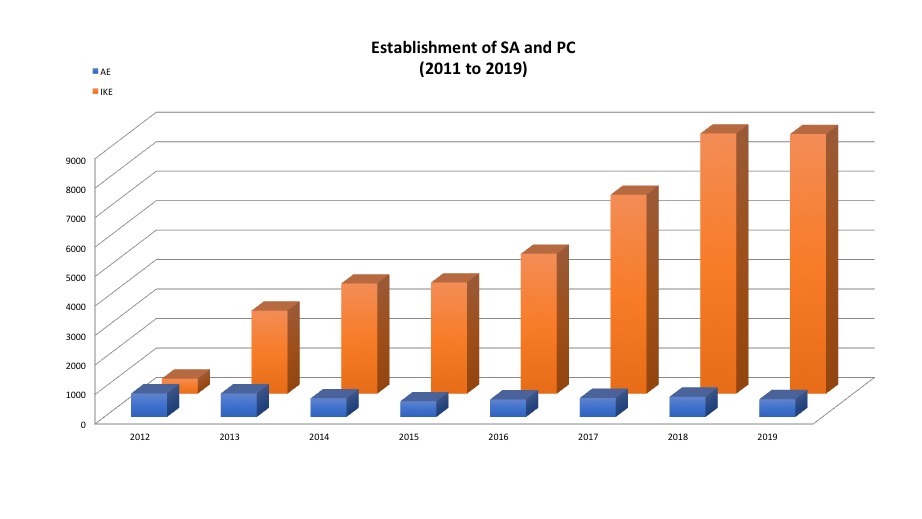
    Business Registry’s statistical data shows that the number of SAs established yearly is kept, notwithstanding some minor fluctuations, rather steady.

    On the contrary, the establishment of Private Company is steadily rising. Its flexibility and the fact that it is cheap and simple are, quite certainly, the reasons why it is preferred over SAs.


    V. In Conclusion

    SA and Private Company never competed against each other.

    Private Company prove to generally be cheaper than SAs. Of course, more flexible as well. And this is why they are generally preferred.

    But their “audience” is different. Bigger schemes, bigger investments and businesses wanting to take advantage of the tools the act on SAs provides, must, no doubt, choose the SA as the most fitting company type.

    The result of the comparison of these two company types, as mentioned above, is overwhelmingly in favor of Société Anonyme.

    And if we were to refer to SA as the “swiss army knife” by Victorinox (as the multitool that it is), we could not but consider Private Companyto be the “pocket knife”.

    Let’s say it is collapsible as well…

    stavros-koumentakis

    Stavros Koumentakis
    Senior Partner

    P.S. A brief version of this article has been published in MAKEDONIA Newspaper (November 10th, 2019).

This site is registered on wpml.org as a development site. Switch to a production site key to remove this banner.