
Author: Petrini Naidou

  • Businesses may continuously operate, but Employees cannot

    Businesses may continuously operate, but Employees cannot

    Businesses may continuously operate, but Employees cannot: The misunderstanding around the institution of industrial enterprises that may continuously operate

    I. Preamble

    Recent public statements by the government regarding the operation of businesses for seven days a week have kicked off a relevant public debate. It seems that on the one side are the defenders of the liberal market, while on the other the defenders of labor rights. The latter are of the opinion that such arrangements violate acquired rights. Although it is an undisputed fact (see the inactivation of Collective Agreements) that labor rights shrank during the decade of the Greek crisis, this institution is not one such example. Its essentially was first introduced with a presidential decree issued during the 1932 Government of Eleftherios Venizelos.

    It is valuable to form an opinion on the subject so that we can clearly understand and distinguish the concept of “work” from the concept of “continuous operation”. Also, to objectively assess the value of this measure for both the employer and the employee, in the present social and economic circumstances.


    II. The legislative provision for the nature of “continuous operation” enterprises

    Article 2 of Presidential Decree 27.6 / 4.7.1932 codifies the provisions regulating working time limits. Employees of industrial and craft undertakings shall not, under this provision, work for more than eight hours per day and forty-eight hours per week. Article 1 §2 of the same regulation states that factories or parts of factories are classify as “continuous operation” if the daily working time of the employees exceeds ten (10) hours.


    III. The rotating employees shift system

    In businesses which are by default continuous operation businesses, the staff works in rotating shifts. This is in order to ensure the continued operation of the business throughout the seven-day or six-day week. The continuous operation of a business requires a differentiated modus operandi and entails changes in the timing and manner of work of the employees of the business. Employees have a say in whether or not they participate in working conditions that suddenly (and beyond the original agreement) go beyond what is common. Specific rules were laid down by law, to limit the unpleasant consequences and burden of this type of work (especially of the work offered at night) on the life of the employees.


    IV. Balancing overtime and the special circumstances.

    1. Average working hours in more weeks

    The eight-hour working hours per day limit, applicable to each employee, may be exceeded as long as the working hours are not more than fifty-six (56) per week. And that is, provided that the average working hours of the weekly working time do not exceed forty (40) hours per week on average, calculated in eight (8) weeks. Subsequently, overtime for employees under this scheme is calculated by offsetting the working hours throughout the eight-week period.

    2. Provision for night employees shift

    In addition, provision should be made, so that employees covering night shifts for one week will cover day shifts the following week.

    3. Provision for weekly holidays

    Finally, it is necessary to ensure: ​​(a) that employees who work on Sundays are required to rest on another day of the week, and (b) that once every three weeks it is mandatory that the employees will have Sunday as a rest day, along with the preceding or following day.


    V. Conditional extension of the regulation to undertakings not considered to be of “continuous operation”

    1. The rotating working groups (shifts)

    According to Article 7 of the Presidential Decree 27.6 / 4.7.1932, when it comes to employees working in shifts, the working hours may be extended to exceed eight hours a day and forty-eight hours per week on average, calculated in three weeks. The weekly average should not exceed 8 hours per day and 48 hours per week.

    2. Continuous operation of the whole business or of parts of it, in businesses not considered to be of “continuous operation” by default

    Pursuant to article 40 of Law 1892/1990, businesses and holdings which are not by their nature continuous, may operate continuously in whole or in part, with a system of alternating working groups. Necessary conditions: (a) the consent of the employee working in shifts and (b) compliance with all the above-mentioned conditions.

    3. The extra employees shift of the weekend

    Undertakings which are not of “continuous operation” by default, may, if necessary, operate as a whole (or in part) continuously over the weekend as well, even if its employees are not consenting to the business operating seven days a week.

    In this case, the employer will be required to employ a new, independent group of employees, which will work two additional days a week. Specifically, the additional staff “weekend team” will work twelve hours each day of the weekend, during a given weekend. The remuneration of this group of staff for these twenty-four hours is equal to the remuneration of employees for a forty hour – five-day week. Of course, the exceptional days for that particular, additional, staff are not counted as such.

    The above is also clarified in Opinion 97/2009 of the State Legal Council, which states that even if there is a Collective Agreement in place that provides for a five-day workday for employees of a particular specialty, it does not contravene the provisions of article 40 of Law 1892 / 11990. This is because a five-day week in no way negates or at least affects the possibility of six-day or even seven-day operation, with the creation of the fourth employees shift.


    VI. In conclusion

    By combining the above provisions, we realize that companies whose character justifies their continued operation or are in need to extend their operations partially or even in whole, can operate with shifts. In particular, subject to the conditions of employment protection provided for by law, companies licensed by the relevant Labor Inspectorate, and with appropriate legal advice to familiarize with the provisions and formulate and apply the right rules, can operate with shifts.

    As a result, it is possible, under legal and legitimate conditions, for a company to “work” twenty-four hours a day and seven days a week with its employees working eight hours a day and five days a week!

    Petrini Naidou
    Senior Associate

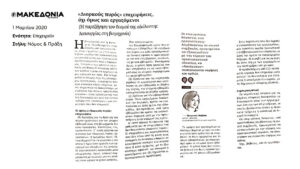
    P.S. A brief version of this article has been published in Greek in MAKEDONIA Newspaper (March 1, 2020).
    βάρδιες-employees-shift


    Disclaimer: the information provided in this article is not (and is not intended to) constitute legal advice. Legal advice can only be offered by a competent attorney and after the latter takes into consideration all the relevant to your case data that you will provide them with. See here for more details.

  • GDPR: The next day: Biometric data and employment

    GDPR: The next day: Biometric data and employment

    The GDPR has been in place since May 25, 2018, and every day we reveal that adjusting to its requirements affects the philosophy and operation of a business. One such issue is the entry – control of employees by taking biometric data (e.g. fingerprints). Why is that so? Because while I can “clock on, on behalf of my colleague” so that my colleague “has a little bit more of morning sleep”, I cannot deceive the smart machine that “reads the fingerprints or the iris”. The GDPR sets strict barriers to such choices.

    Pursuant to Article 9 par.1 of the Regulation, the processing of biometric data is generally forbidden for the purpose of undeniably identifying a person. Such processing is permitted, exceptionally, with the explicit consent of the Subject and in any case in accordance with the consensus guidelines No. 259 / 28.11.2017, adopted by the European Data Protection Board. It is a crystallized position of the Working Party 29 that there can be no question of free consent in the case of a “power imbalance”, as is the case for the employer-employee relationship.

    Already since the application of Law 2472/1997, the Data Protection Authority has issued decisions on the processing of biometric data in the workplace. In these decisions, the position of the Greek Authority is developed that such processing is not necessary to achieve the employees’ time schedule compliance monitoring. As a result, such records constitute an excess, the abusive nature of which is not waived by any employee’s consent.

    The Decision 56/2009 of the DPA in a relevant case, is Indicative of the scope of the exception. According to this decision, the Authority did not find it illegal to use fingerprint recognition equipment because it concerned specific employees who would have special access to a particular site, which could be classified as the highest security due to compliance with “Certification Authority Keys” namely on the basis of the public interest. In fact, this decision deals with the issue in terms of authorization, substance, and legitimacy and not technical, as the specifications had already been met: (a) data encryption, (b) non-maintenance of data, and (c) non-connection to a central system.


    The decision 50/2007 is indicative of DPA’s consistent position

    The Decision 50/2007 for another case is indicative of the Authority’s consistent position. Although the company’s argument was based on the fact that “the system is based on the method of finger’s geometry and the data collected from it are recorded and stored in a file that is encrypted while fingerprints are neither collected nor stored”, the DPA has overtaken the specific arguments and insisted that “the introduction and use of biometric data is a processing of personal data of employees which is not necessary for the purposes of monitoring the entry and/ or exit to premises/buildings and observance of their entering and leaving hours and is therefore illegal”.

    Ultimately, receiving biometric data at a working environment is only possible by way of exception. Balancing the needs of the company and the requirements of the Regulation undoubtedly leads to choices that will also prevent the company from being harmed and employees’ rights not be affected.

    Petrini Naidou
    Senior Associate

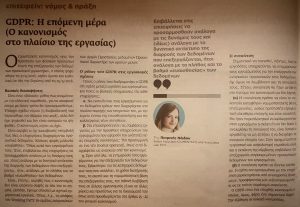
    P.S. A brief version of this article has been published in Greek in MAKEDONIA Newspaper (February 24, 2019).


  • GDPR: The Next Day. The Regulation in the context of employment

    GDPR: The Next Day. The Regulation in the context of employment

    [vc_row][vc_column][vc_column_text] The European Regulation “on the protection of natural persons with regard to the processing of personal data”, adopted on 27 April 2016, is directly and across the board applicable (throughout Europe) since 25.5.2018.


    Basic declarations

    It is a “convenient” myth that we (should) expect for the Greek legislation to decide on how we adapt. There is a draft law (its consultation was completed in March 2018), but it has not yet been adopted nor is necessary to be. The Regulation applies as is.

    It is accurate and not a (malicious) exaggeration that all businesses process personal data. Sometimes even “sensitive”: Like those of their employees. Thus, businesses need to adapt according to their strengths and (in particular) depending on the potential impact of the data leakage they process, that is, depending on the number and degree of “sensitivity” of the data.

    It is also accurate that the Regulation is not entirely clear on all points. However, we have been armed with the relevant interpretative tools. Such as, for example, the views of the Working Party of the 29-member Group of Member States’ Data Protection Authorities.


    The role of GDPR in employment relationships

    What is the role that GDPR plays in the relationship between the Employer and the Employee and which are the main obligations of a business?

    1. To train the Employees on the processing of third-party data it processes in the context of the provision of its services, in the wide sense of awareness and cultivation of new habits.
    2. To re-approach the employment contracts with the addition of the employee’s obligations with regard to the development of a new corporate culture. (Which is) The adaptation of a new modus operandi, as such is required as mandatory by the Regulation.
    3. First of all, to inform employees on the processing of their data. In particular: for the categories of their data to be collected, their retention time, the purpose and the legitimate basis for their processing, their possible transmission to other organizations (or other countries), and above all for their rights as identified in Articles 15 to 22 of the General Regulation.


    The consent

    It is thus very important to be noted that the employers are obligated to inform their employees on the processing of their personal data which are necessary, thus, not to obtain their consent. Such consent would be contrary to the spirit (objective) of the Regulation for the following two reasons:

    (a) Consent must be the “last resort” of a legitimate base for processing as it presupposes true freedom of choice and is revocable. It would be misleading make an employee think that if he/she does not give or withdraw his/her consent, it is possible for the employer not to ask for or delete the necessary personal data of his/hers: In fact, the labor and insurance legislation as well as the performance of the employment contract impose the processing of specific personal data of the employee.

    (b) Consent must be given freely. The relationship between the employee with the business is characterized by a certain imbalance of powers, leading to a “forced” and therefore to an illegal consent.


    GDPR is a cumbersome Regulation which, however, carries a significant gift: Extrusion into a change of mentality.

    Petrini Naidou
    Senior Associate

    P.S. This article has been published in Greek in MAKEDONIA Newspaper (December 23, 2018)

This site is registered on wpml.org as a development site. Switch to a production site key to remove this banner.