Author: Lida Koumentaki

  • Calculating the value of a (minority) shareholding

    Calculating the value of a (minority) shareholding

    1. Preamble

    There is often the need to valuate a company, either as a whole or just a share of it (most likely a percentage of its shares / a specific shareholding). This need for valuation is associated either with a business deal (still at the stage of negotiations) (e.g. a merge or an acquisition) or with a legal dispute.

    The newly introduced law on S.A.s in more than one cases (e.g. articles 30, 45, 166 of Act 4548/2018) calls for a valuation of an S.A. or for a valuation of a specific share of it.

    In previously published articles {Minority Shareholders. Part A: The Claim of redemption of their shares by the S.A.,  Minority Shareholders. Part Β΄: Claim for a buy-out by the Majority Shareholder(s) and Minority Shareholders. Part C: The right of the majority to buy-out the minority} we have examined cases where the courts come in and, with the help of experts, valuate a company and a specific share of it. But what are the methods they follow in order to calculate how much a company is actually worth?

    Are there any laws?

    The answer is no.

    When it comes to public companies (listed either on regulated or unregulated markets), they all have something in common: the price of their shares is undisputable. The value of public companies (at least the value the stock market appoints to them) is easily calculated. “Blocks of shares” can of course reach prices that differ from the stock market value of the shares, but not by much.

    The question is: How are private companies valuated?

    A private company has no objective “market value”. No one can undisputedly assess its shares at any given point. Since such shares are not traded, the market has not been given the chance to show how much a private company is worth for it (the market).

    There are a few valuating methods that are generally (and globally) accepted.

    When it comes to assessing a specific share of a company, one must first valuate the company as a whole, according to specific financial information.


    2. Valuating a company

    According to experts, the most commonly used methods are based on:

    The company’s Balance Sheet (BS)

    Valuating a company according to its BS is, by far, the easiest and shortest way to go, since a BS is nothing but a snapshot of a company, taken the day the Balance Sheet is drawn. On the other hand, as a snapshot, the information a BS entails are static and thus could never represent the true value of a company. Although a BS could not, on its own, reliably evidence a company’s value, it is a good place to start an assessment and build on from that using other financial information.

    Profit and Loss Statement (PNL)

    When valuating a company according to its PNL, the focus is more on the company’s profits, dividend and sales. Such methods, when it comes to private companies, mainly take into consideration the return on capital. That seems to be the (only?) matter that interests an investor. When valuating a company using methods focusing on its PNL, when talking about profits we consider profits after tax.

    Goodwill

    A company’s goodwill is calculated mainly when negotiating a sale of said company. Goodwill is what is left when subtracting the company’s objective value from the sum a seller is willing to pay for it. Goodwill is the sum of a company’s intangible assets, such as its reputation, brand, place in the market, consumer and employee relations etc.

    Cash flow discounting

    This method valuates a company according to its cash flow discounting. The rationale behind it is that such a method will show a potential investor if a company is worth investing in the discounted cash flow finds the present cash value based on an expected cash flow -an x sum today is more valuable than the same x sum collected a year later. To elaborate, if one is holding 1€ today, with an annual interest rate of 5%, this 1€ will be worth 1,05€ in a year. Similarly, if 1€ payment is delayed for a year, today’s 1€ value is 0,95€.


    3. Valuating a company’s shares

    After figuring out how much a company is worth as a whole, its value is divided with the number of shares the company has issued. The result of this division is the value of each of the company’s shares (we have to stress that this is the most simplistic approach, as we, in this article, do not take into consideration the different kinds of shares a company can issue).

    This approach makes a lot of (mathematical) sense. But it makes no economic sense. How can a minority shareholding, for example 2% of the company’s shares, have a value proportional to that of the remaining 98% of the same company?

    When negotiating a sale of a minority shareholding, it is common that a discount is applied [discount from the value the shares come to have after the division: (company value/number of shares) x number of shares sold]. In practice we are shown that the discount applied has almost everything to do with the percentage of the company sold – that is with the powers over the company sold.

    The smaller the shareholding, the less powers come with it.

    Let’s talk with numbers

    The discount that is in practice applied is as follows:

    % of the company sold Discount applied
    < 10% 60% – 75%
    10% – 25% 45% – 55%
    26% – 49% 30% – 40%
    50% 15% – 25%
    >50% 5% – 10%


    A precedent set in the UK (case Lynall, Lynall v IRC (1971) 47 TC 375) is, at this point, worth mentioning, where the court ruled that, when calculating the value of a private company’s shares one has to, no matter the size of the shareholding sold, apply an additional discount of 25% to 50%.

    Nothing is fixed

    In order to apply any discount, all factors relating to the sale have to be taken into consideration. The aforementioned discounts are just a place to (or to not) start negotiations.

    For example, the sale price will be affected not only by the percentage sold, but also by the percentage held by the rest shareholders. There is a big difference, for example, if the shareholding sold is that of 11% when the rest shareholders are holding 5% comparing to when there is one shareholder holding a percentage of 40%. The sale price will also most likely be affected by to the rights following the shares regarding the receiving of dividends, the appointing of BoD members, legal issues regarding the right to vote in GAs, the person buying the shares (for the shareholder already holding 98% over a company, compared to an “outsider”, a 2% shareholding is far more valuable) and so on.

    Anti-embarrassment provision

    When a minority shareholding is sold to existing shareholders, it can be agreed in advance (in a private agreement) that, within a specific time period following the sale, if the buyer of the minority shareholding decides to sell their shares to a new buyer, the initial seller of the minority shareholding will benefit from a (possible) surplus value of the shares they sold in the first place.

    Forced sale

    No discount is applied when there is a case of a forced sale (e.g. a drag along).


    4. In Conclusion

    One has to always align with everything all national or international (e.g. EU Regulations) laws compel. But when it comes to everyday functions of the market, we come to realize that there are some “laws” set by the market itself. Those “laws” set and chosen by the market are often more powerful than the actual legislation that is in place. In any case (and despite all the exceptions), “laws” set by the market are the ones that, in the end, will prevail: the free market (no matter its rivals) will always know what is best, what should be required, how to valuate, to appreciate and, in the end, how to attribute the true value to things.

    Lida Koumentaki
    Junior Associate

    Υ.Γ. The article has been published in MAKEDONIA Newspaper (June 9, 2019).
    value of shareholding

  • Earnouts: Opportunity for Business Agreements or a “stumbling block”?

    Earnouts: Opportunity for Business Agreements or a “stumbling block”?

    [vc_row][vc_column][vc_column_text] To its basic structure, earnouts are agreements concluded between (usually) a seller and a buyer of a company. It is mainly found in M&A agreements or as a tool to promote startup financing.

    When an earnout is agreed on, the buyer agrees to pay, in addition to the cost of acquiring a company itself, a “bonus” – under certain conditions.

    The necessity

    When there are strongly conflicting interests (and usually there are), a deal is almost never easy to be achieved. The seller will always claim that its company is worth more, while the buyer will claim the exact opposite. Of course, no one is able to prove the company’s “actual” value. Earnout comes in to solve this problem.

    Earnouts

    The logic is simple: The sale of a company, if an earnout is included, is agreed at a price closer to what was offered by the buyer. Nonetheless, the seller will not suffer a loss in case the company is actually worth more than what the buyer was initially offering. To achieve that, both the buyer and the seller set specific targets for the company. In case the targets are achieved, the seller will have “proved” that its company is worth more than what it has already received, and therefore will be entitled to receive a beforehand agreed upon bonus.

    This bonus will not necessarily be a specific amount: Its type and method of calculation are left to the discretion of the parties (e.g. it can be agreed that if the sold company has a certain revenue in z years, the seller of the company shall remain its CEO for x years with a salary amounting to y).

    Examples:

    • The seller will receive a percentage (e.g. 2%) of the company’s profits for the next three years.
    • The seller will be the company’s CEO for four years following its buy-out, during which, if certain revenue goals are achieved, the seller will get a bonus for every 10% the company’s revenue has exceeded that of the previous year.

    It truly can be anything. If the seller is confident about the capabilities of its company, it is easy to take the risk that his fee be dependent on his company’s performance.

    This is, of course, a simplified approach.

    Risks and Opportunities

    While earnouts seem to be simple and attractive, they entail many risks. What if, in our first example, the buyer makes sure that the profits of the company for the first few years after the buy-out are hidden, by exaggerating, say, the costs? One solution would be for the seller to remain in the company’s management, as in our second example. Another would be that the earnout will depend on other factors such as, for example, the company’s turnover or it position in the market.

    Earnouts are introduced as an attempt to solve the problem of pre-sale moral hazard. Prior to the sale, the seller will try to inflate the value of the company, while the buyer will try the exact opposite. Earnouts successfully, in my opinion, address this matter. But earnouts themselves will introduce a “new” moral hazard, after the sale of the company. After the sale, the buyer will try to “hide” the factors that will trigger the earnout while the seller will try to highlight them.

    It is obvious that earnouts have to be tailored to any case, in order for all parties involved to be as secured as possible. Nevertheless, with the right planning (when negotiating as well as drafting the agreement), earnouts can solve problems that may otherwise prevent a deal from closing.

    I believe we all agree that the most important job lawyers have is to close the deal their clients want closed, while, of course, protecting them. Earnouts are a good way to save an otherwise “dead” deal: when without an earnout the buyer and the seller do not have the same perspective, earnouts give both parties time to “look through each other’s eyes”. And, ultimately, make profitable business transactions.

    Lida Koumentaki
    Junior Associate

    Υ.Γ. The article has been published in MAKEDONIA Newspaper (December 9, 2018).

  • Blockchain: a revolution in safety

    Blockchain: a revolution in safety

    [vc_row][vc_column][vc_column_text]

    Blockchain is one of the most promising new technologies of the future.

    Blockchain has been around for quite some time now, but the markets only became aware of this technology because of the “bitcoin madness” let’s call it.

    Blockchain is the technology that, until this day, is mostly used to facilitate the creation and movement of cryptocurrency from one individual to another.

    In this article we will approach the matter theoretically and refrain from making references to the actual technical parts. We will try to explain the concept that is blockchain by approaching the subject only from the view of financial transactions.


    Without Blockchain

    In order to make a transaction in an environment other than blockchain you most likely have to go through a third party that both you and your counterparty trust. Don’t think about it from the perspective of technology: black screens and white signs only programmers with black T-shirts can read.

    Let’s say you want to transfer a sum of money; to do so you have to order a third party to make the transfer for you. That third party will most likely be a bank, since till this day in the West very few people can envision a world where not banks but other entities will be holding their money. In Asia, on the other hand, Alipay and WeChat have a huge chunk of the market of money in their role as the third party in most everyday financial transactions.

    In any case, entities (banks or other) that hold money for or receive money from persons are selling the service of transferring money. To be more precise after these entities confirm that the sender of the payment has available funds they identify the receiver of the payment and deposit the money in its account, while withdrawing the same sum from your account. But of course, this service costs. At the same time, depending on the specific banks involved in the process and the countries they reside in, this transfer can take a few days to go through.

    So now we have two problems, both resulting from the involvement of the third party/intermediary: (i) there is a fee owed to that third party and (ii) it takes time for the transfer to actually go through.

    This is where blockchain comes in.


    The innovation of blockchain

    Blockchain resembles a database. Of course that, on its own, is not revolutionary. The innovation is that, while databases have traditionally been centralized, blockchain is decentralized. This means that there has until now always been a need of a “central authority” (a third party, as described above) recording and verifying data transactions happening on those databases. This is not the case with blockchain.

    The need for third parties to intermediate transactions has until now seemed like the only way: parties who wish to transact cannot blindly trust each other. Thus, a need for verification/insurance from a prestigious third party emerged.

    But what if the transaction had no risk at all? What if the verification of data was automatic? What if there was a way to ensure that even if the slightest of the data represented by one of the parties did not check out, the transaction would be automatically blocked and no risk regarding what was communicated would be assumed?

    What blockchain does is exactly that.


    The Mechanics

    As promised, a visualization of blockchain technology:

    (a) Blocks

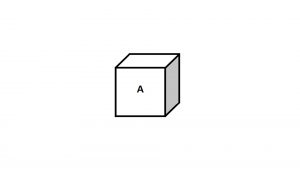
    Each block contains a single piece of information, in the form of a code. That code gives a specific ID to each block. To better understand it, let’s say that code is a letter of the alphabet. In this case, one block would contain the letter A.

     (b) Chain (chainm of transactions)

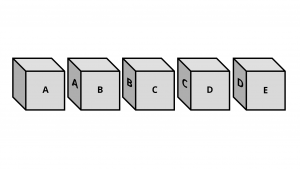
    Blockchain consists of a series of blocks, each one containing a single piece of information on the “inside”, and ID and the “IDs” of the blocks that come before and after them on the sides “touching them”, like so:

    This “function” makes sure that no one can hack the code contained in blocks, because if you hack one block (which would on its own take a ridiculous amount of time), the ID of that block would change (since the IDs of blocks depend on and adjust to the code in the block). So if you hacked Block B, it would no longer be called B. But Block C would still witness that block B should come before it. Now if you hacked block in order for it to witness that not Block B, but the block with the new ID (taken after block B was hacked) was the one that came right before it, then the name of block C would change and so on…

    For a blockchain to function (for a transaction to be valid, as we will see below), the chain has to at any point verify itself.

    One might say that you could try and hack all the blocks in the chain and all the copies of the chain (see below), but, with blockchain technology being as strong as it is today, there is not enough time and computational power in the world to do so.

    (c) Introducing a different way to record transactions.

    Those chains of blocks are much like a ledger in accounting. They record all transactions, all debits and credits. A simplified example would have as follows:

    1. X has 10 (Block A)
    2. Y has 2 (Block B)
    3. X gives 10 to Y (Block C)
    4. X has 0 (Block D)
    5. Y has 12 (Block E)

    A blockchain can simultaneously tell us how much (money) there is and where it is (who has how much). So it truly does not matter what is represented by any party that wishes to transact. We do not have to trust anyone regarding the truthfulness of any representations -not someone we know or don’t, not a third party. We do not even have to trust blockchain. Anything recorded in a blockchain is a fact.

    Any transaction not verified by blockchain is not valid. Anything not validated do not actually happen (technology will not allow an invalid order for a transaction to create and add a new block in the blockchain). Those safeguards result in creating the safest, till this day, environment to transact in.

    In our example, if X tried to give 20 to Y instead of 10 in step one above, blockchain would not allow the transaction to go through, simply because X does not have 20 to give.

    But how can blockchain know? Well … it does not exactly know. But thanks to the principles following, all persons in the network do know and their knowledge alone ensures that the blockchain is valid and protected, through a distributed and decentralized system, which up until this day seems unhackable.


    The principles behind blockchain

    All the essence of blockchain, what renders it the most secure environment to transact in, is its principles:

    (a) Open Ledger Principle

    Everyone in the environment of blockchain, under circumstances, can see all the data (open and public information), but they cannot actually make up the information, because they can only have bits and pieces of it. Thus, everything is public and private at the same time!

    (b) Distributed Ledger Principle

    The open ledger principle on its own would not go far without the distributed ledger principle. The latter ensures that anyone who wishes can hold a copy of the ledger (chain of blocks).

    (c) Shared Ledger Principle

    When you wish to make a transfer through blockchain, you have to make that intention of yours public. The network will immediately see the declaration of your intention. At this point, the transaction is still unvalidated, and thus not yet part of the blockchain – it has not yet created a new entry in the ledger, a new block, so it has not yet taken place. Blocks are created and added to the blockchain only through mining.

    All the above principles can only reassure anyone who chooses to transact using blockchain. Just imagine how much easier it would be to hack a central authority (eg a bank), than the thousands that may have a copy of the ledger (hack all the blocks of the blockchain and all the copies of the blockchain held by all the peers).


    Mining

    Anyone can mine. Miners are persons that choose to hold a copy of the ledger. What they do is compete amongst each other (amongst those who hold a copy of the same chain) in order to be the first to validate a transaction and put it in the ledger (make a new entry – add a new block).

    Mining comes in two steps:

    • Validation: miners essentially check that a transaction is valid according to the data already validated and in blocks.
    • Connecting that new block to the chain: to connect a new block miners have to “find a key” that will mathematically allow them to add that new block. Imagine it like solving an extremely complicated riddle by using computational power.

    The first to validate a transaction and add a block to the blockchain gets a financial reward.


    Application of blockchain

    The very concept behind blockchain technology is unconceivably groundbreaking. Theoretically, if applied, it will eliminate the need for any middle man, including banks, even governments, while simultaneously ensuring that transactions are as secure as can be!

    Many governments have felt uncomfortable with all those changes happening. Some more than others: China has “banned” the trading of bitcoin altogether.

    With bitcoin having almost reached USD 20.000 per bitcoin at its peak, billions of dollars have exchanged hands without anyone having any record of those transactions, without any banks having gotten any fees, without governments having any control over the exchange rates in order to protect their currencies. And all that happened because just one application of blockchain became popular!

    Recently, the World Bank launched a new debt instrument (bond-i) that is blockchain operated. In Cyprus big law firms accept payment in bitcoin, and the relevant laws are in the making.

    Blockchain is not a technology for the dark web, but a technology for all of us. Today.


    To that new reality that blockchain is leading us to we all (and of course businesses and lawyers) have to adapt.

    And soon!

    Lida Koumentaki
    Junior Associate


    P.S. A shorter, Greek version of this article has been published in MAKEDONIA newspaper (November 4, 2018)

This site is registered on wpml.org as a development site. Switch to a production site key to remove this banner.